Showing posts sorted by relevance for query candide. Sort by date Show all posts

Monday, February 4, 2019

Candide

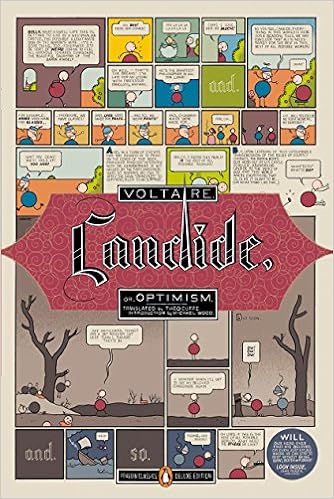
Image result for voltaire candide coverVoltaire's Candide [written in 1759 by French philosopher Voltaire, written during the Age of Enlightenment]  is a terrific work of satire that attacks Leibniz's philosophy of optimism. This is done through the constant refrains of the character Pangloss [Candide's philosophy teacher] saying, "This is the best outcome in the best of all possible worlds." This happens periodically throughout the story. In a way this is a perfect book for me because it reads like a philosophical cartoon strip. Ironically I think I've got a physical copy of Candide with a cartoon strip for a cover, pictured here.

Satire is used to full effect here. Everybody and anyone is fair game for ridicule. The religious establishment especially. Another important feature is that a lot of the events that occur were actually real events. For example, the Lisbon Earthquake was a real event that killed 30,000 people, an event that makes 9/11 look like nothing.

Voltaire ridicules Leibniz's philosophy through the character Pangloss, who's reasoning is silly. For example, the following is ridiculous:

"It is demonstrable that things cannot be otherwise than as they are; for as all things have been created for some end, they must necessarily be created for the best end. Observe, for instance, the nose is formed for spectacles, therefore we wear spectacles."   

Pangloss goes on to defend optimism and reiterate that "its for the best, in all the best of possible worlds." Consider this section where he explains why its good that syphilis exists:

"It was a thing unavoidable, a necessary ingredient in the best of worlds; for if Columbus had not caught in an island in America this disease, which contaminates the source of generation, and frequently impedes propagation itself, and is evidently opposed to the great end of nature, we should have had neither chocolate nor cochineal."

Candide, the main character, goes on to keep believing everything his philosophy teacher Pangloss says until everything goes wrong for him. Eventually he despairs and is ready to give up on everything in life. Thus Voltaire cures him of his optimism. Although its interesting to call out Leibniz I also think a large part of the idea for this work was to contrast irony with comedy, thus we have satire. And this it does very well. You could say that this kind of novel is created for men [and women] of wit to read for fun. And fun it is. 

Voltaire doesn't invent or exaggerate evils of the world. In fact he displays these things as regular real life events. A simple example of satire is when Candide watches as an admiral gets killed for failing to properly engage a French fleet. "The admiral is blindfolded and shot on the deck of his own ship, merely "to encourage the others" (French: pour encourager les autres, a popular quote from Candide). 

Almost of all Candide is a discussion of the various forms of evil. There is one notable exception; when Candide and Cacambo go to El Dorado. This is perhaps the only optimism in the book, where we find a place where everything is perfect. So perfect in fact, that satire doesn't exist here. But because we don't live in such a perfect world as that, satire must and will exist. 

The book is pretty simple plot-wise, a sort of adventure novel. In a way even its plot is a satire of European novels: Candide is of a lower caste than Cunegund, therefore he shan't dare marry her, romance, making fun of the high arts such as music and theater, the mishaps that happen around every corner, etc. These sorts of things are in a lot of archaic novels I've read. The one that comes to mind is The Blazing World by Margaret Cavandash. However, I think Candide is a lot better than that story. But they are very similar plot-wise and written and are archaic. 

All in all this is a fantastic read. I read it in one sitting last night. If you're a man [or woman] of wit, and enjoy philosophy as well as adventure novels this will definitely be on your reading list. Its a classic for a reason after all.

Monday, March 25, 2019

Slaughterhouse-Five


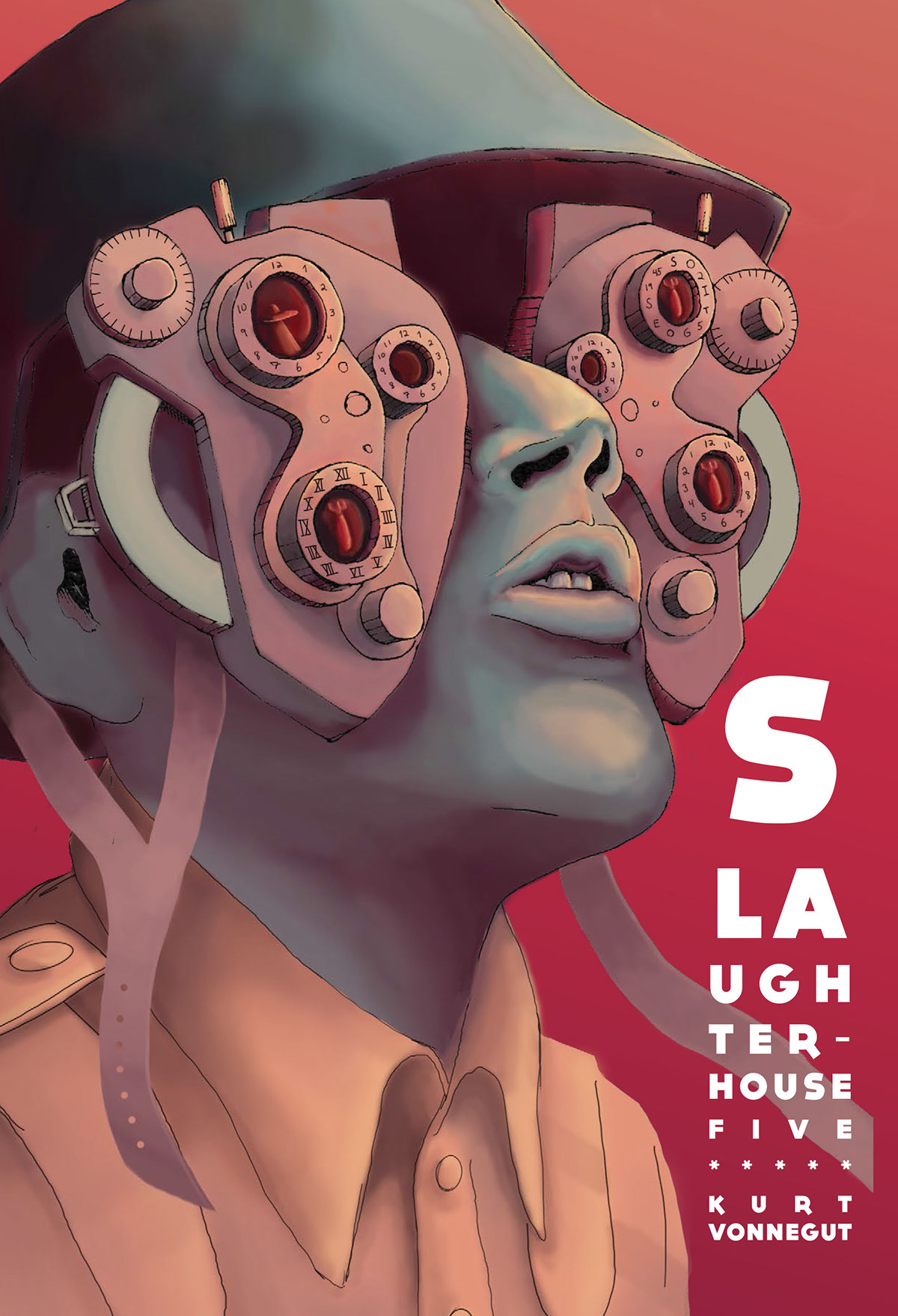
Image result for slaughterhouse-five book cover"All this happened, more or less." [opening line]


Slaughterhouse-Five, or The Children's Crusade: A Duty-Dance with Death (1969) is a science fiction anti-war book about World War 2, written by Kurt Vonnegut. The main character, Billy lives through the Allies' Firebombing of Dresden as a prisoner of war. Vonnegut was actually there in real life, and the book is semi-autobiographical. SH-V is Vonnegut's most influential and popular work, capturing the American zeitgeist in 1969, capturing the spirit of anti-war during Vietnam. Since then its become a classic statement of anti-war, dark humor, science fiction, and satire. 

The book is told in a non-linear way. Flashbacks going backward and forward in time. There's the science fiction element that Billy Dresden experiences. He has been abducted by aliens and now he sees everything in his life through time all at the same time, flashbacks and time travel experiences. On the alien planet, he's in a zoo and forced to mate with a movie star actress. He's 'unstuck in time'. 

Billy was a soldier who refused to fight. A real letdown of an American soldier. He gets captured and is forced to labor at a Dresden slaughterhouse, "Schlachthof-fünf," "slaughterhouse five". Hence the name of the title. The other part of the title's name [The Children's Crusade] comes from a section in the opening of the book about how children are always the ones to fight wars. 

Billy suffers from post-traumatic stress disorder, something not commonly known about back in 1969 but nowadays we are all familiar with because of Iraq and the war in Syria. Billy gets taken under the wing of these aliens, who see in four dimensions, observing all points in the space-time continuum [real science fiction elements, there's also a laser gun]. They adopt a fatalistic worldview. So it goes. That line so it goes is in the book some 106 times. You get used to seeing it. I saw it as dark humor. Your parents died? So it goes. You won a million dollars? So it goes. Nothing happened? So it goes...ad infinitum. 

The style is simplistic. This is probably the easiest book I've read in three months. Its a very enjoyable experience. I finished the book in two days because I couldn't put it down. It was thoroughly entertaining even though the plot isn't linear, its all over the place. 

Coincidentally I'm writing a memoir about myself, growing up in the midwest in the early 2000s with my single parent mother, and I'm writing in a style very similar to this. Although I'm nowhere near as good a writer as Vonnegut. I mean to say that my novella [so far] is kind of non-linear, and the writing style is purposely simplistic. 

It's a very attractive style, it makes you want to read more of the author's work. Another important detail is the fact that the novel reads as part fact [nonfiction] part fiction. Not to mention a lot of dark humor and satire. Initially, when I read the introduction I immediately thought of Voltaire's Candide and Micromegas. However, I find SH-V to be much more emotional than those mostly satirical works from the 1700s, France. Vonnegut manages to combine dark humor, satire, a spirit of the moment [flower power] anti-war message, science fiction, and his own life into a smorgasbord of a novel, and lo and behold, it works somehow.

No doubt there's a lot going on in this novel. In that way, it's not unlike Bruce Sterling's second novel, Artificial Kid, which tries to do everything, but in the end, fails to measure up to its ambition. However, with SH-V we have a work that is highly ambitious and is a winner, not just to me, but to the general reading public today, and from the readers of yesteryear [thank god for online newspaper archives]. This book is considered a classic, deservedly so. 

It's sad, funny, tough, delightful, and it all somehow fits into its own thing, a success. Even if you don't like science fiction I think you as a reader would get a lot out of this book. Its a classic for good reason. 

Recommended if you like classics, science fiction, and war novels.  

Check out my reviews for Voltaire's Candide and Sterling's Artificial Kid.
http://ofigueroamusic.blogspot.com/search?q=candide
http://ofigueroamusic.blogspot.com/search?q=artificial+kid

Friday, January 13, 2023

The Age of Voltaire by Will Durant


The Age of Voltaire is volume 9 of Will Durant's Story of Civilization series. So far I've read four of Will and Ariel Durant's Story of Civilization series of books: The Italian Renaissance, The Life of Greece, The Age of Reason Begins, and now finally I've read The Age of Voltaire

Closing this book, I felt that this was an extensive and comprehensive history of the age right up to and leading into the French Revolution, the Age of Enlightenment in France, roughly 1680s-1780. Voltaire was born in 1694, ensconced in education through the Jesuits. The Jesuits were the main educators in this period and had a lot of influence over schooling of children [boys and girls] and even sometimes in government and various occupations. They were known for being very educated and lenient towards their people, although they themselves were also quite dogmatic about Christianity and its spread throughout other parts of the world like in Latin America and even China. Despite this early great education from the Jesuits, Voltaire grew to increasing dislike the Church as he gained more fame and influence. He spent a lot of time running around to different homes and even the home of Frederick the Great because of his critiques of the church and nobility.  

However, there was a lot more going on in the Church other than Jesuits. There was the growing disputes between church, the peasantry, the aristocrats, the nobles, and the church's feuds with protestants [Jansenists], Catholics, and atheists from the philosophes, the intellectuals [writers, philosophers, scientists, artists, mathematicians, playwrights] like Voltaire, Diderot, Rosseau, Montesquieu, and d'Alembert. These named in particular would have the greatest influence on France and in the world. 

It should be named that being a philosopher in 18th century France isn't the same thing as being a philosopher in the 21st century. These intellectuals delved and wrote in a variety of fields and styles in order to reach their audience in the best ways they could. Voltaire didn't think much of giant books like the Encyclopédie [famous 18th century book from France by the philosophes], rather he thought that small books easily concealed would serve him better. So he ended up writing a lot of small works that contributed to his vast body of works. So Candide ended up becoming his most famous book.

But not every intellectual was an expert in a particular field. Rather a philosophe, was someone who was expected to know a little bit about every subject, even if they themselves weren't a master in each field. In order to write the Encyclopédie, the writers utilized and employed different philosophes for different phrases and words that they didn't feel adequate enough to cover themselves.

What caused the French Revolution? This book doesn't entirely aim to answer this question, rather it focuses more on historical detail. But after reading The Age of Voltaire, you can figure it out.

France was deep in debt from wars and the debt fell upon the peasants more and more, as the nobility became more and more corrupt. Tensions increased between the nobles and the church, and eventually even the Jesuits who had educated all the best minds of the time, were expelled from France. On top of that, the educated people were being more and more exposed to the works of the intellectuals of the time, the philosophes, and now, more than ever, people were more willing to become atheists, little by little, influenced by these great men with big ideas, ideas that changed the world, would eventually lead to the world we live in now. A world of more religious toleration, human rights, democracy, and equality.

Although the Age of Voltaire was published in 1965, it seems to somehow resonate in the scatter-brain afterimages of 21st century 2023. There's something there in this book that has an everlasting effect on the time it is describing, the time it was written in, and the time I live in now as I write this. It seems that now, more than ever, we're living in a world increasingly fraught with the same problems, plus a bunch of new additional ones, that weren't quite resolved from the French Revolution and perhaps never will be solved.

It has occurred to me after reading four volumes of Will Durant's Story of Civilization series, that the problems of any age seem to follow and recur in many others. There's always an endless cycle; renewal, back to the classic ages, onto a newer more advanced, more intellectual more philosophical more scientific less God, then an eventual regression back into a simpler mode of civilization, except we never really find out or perhaps we never can find out, that the civilization itself has already and always collapsed, only to be rebuilt by other people anew.

It is said that on his deathbed, Voltaire, when asked to return to the faith of his fathers and renounce the devil, responded with, “This is no time to be making new enemies.”

Tuesday, November 27, 2018

Holiday riffing and staying motivated

Image result for christmas tf2

Yo, readers and friends! Here I'd like to riff about the holidays, and staying motivated during said holidays. 

Holidays at my job can be pretty stressful. In fact, I was elated to enjoy two days off from work this past Thanksgiving week. Normally I only get one day off a week, and that's cool with me, because more money is the best! That's the right attitude for a young guy, don't lose any of that money, get as much hours of work as you can, work hard, and earn your paycheck, like anybody else at their job. But sometimes its nice to relax. However, you don't want to be too relaxed because things have to be done-guitar playing, writing, reading, and possibly even gaming if I can squeeze it in. 

You have to stay motivated. Stay up as the 'woke' millennial kids say. For me this means getting guitar practice in almost every day (I try to only take one day off a week), posting ads to find jazz musicians to start a trio with (looking for a bassist and a horn to play straight ahead jazz), reading lots of things from novels to news, and writing blog posts like this one. Writing for the blog keeps me motivated. I get to write down all my ideas I've had in my head for a long time and unload all of it in type-press fashion via computer late at night. Its a great form of decompression, relieving stress and giving me new insight on any particular ideas. 

Staying motivated is difficult. Sometimes after a long 1 AM shift I don't feel like reading Don Quixote, Candide, or Aristotle on my Kindle (popular reads for me lately), instead I feel like falling asleep, only to miss out on what would've been great prime time reading time, in complete silence in the middle of the night where nobody will bother me or force me to go back to work (I read on every 30 minute work break to get more reading time in). 

What keeps me motivated? Music mostly. But also novels, great writing, journalism, poetry, classics, science fiction, video games, friendship, and probably last on the list-money. The holidays can be pretty brutal for most workers but I also think it helps put things in perspective. It took 28 years this holiday season before I realized that I don't need to buy luxury items I don't need, and that I should instead save my money, and only worry about getting gifts for others. The new Smash Ultimate game? I'll just play it at my friends' house. Dragon Ball Fighter Z? Been playing it at a friends' house. All those new holiday games? Forget about it. New guitar pedals or new music equipment? I should enjoy the stuff I already have more before I look into that, etc etc. (On second thought I do need a hollow-body jazz guitar)

It was my St. Francis of Assisi moment. At first I said to myself, "I don't need to buy anything for Black Friday or Cyber Monday". Then it turned into I don't need to buy anything for myself for Christmas. And now I've reached that zen state where I realize Christmas gifts for others is the only importance in addition to goodwill to fellow man.

Its a lot to think about but its also good to think about things like this. What motivates you makes you stronger. The moment you lose that motivation, and don't read, don't play guitar, don't write (in my case, yours will be different), then you're losing out on something that makes you happy. Of course there's always exceptions. Nobody wants to get stuck in a rut, reading until 4 or 5 in the morning every night--but its pretty damn fun. 

I've got to keep pushing myself. -Buckethead

Tuesday, February 26, 2019

Artificial Kid

Image result for artificial kid bruce sterling original book cover


Artificial Kid is the second novel by Bruce Sterling. Written in 1980, the book is over the top and satirical, reminding me of the kung foo 80s films. The book's protagonist is a young clone, artificially born at an adult age. He's a big action star. He's a combat artist, where people fight on film, and people pay to watch. One of the Orwellian concepts Sterling uses is the idea of a constant surveillance state. In the world of Artificial Kid everyone films themselves doing everything: eating with friends at dinner, having sex, combat art, the works. All the plutocrats of this society used them constantly. The social structure of the society highly stratified. However, with Kid being a pop star combat artist, owning 4 shares of stock, he was super rich, and famous despite being young. This is something of a cyberpunk novel, as there are some pretty advanced technology.
But then bad things happen to Kid. This guy calls a blood feud on him, wipes Kids' maids mind [akin to murder], and has some goons beat him to a bloody pulp. Barely surviving, Kid and his entourage start living on the run. They find themselves getting blown up on a ship from another enemy sent by Angeluce, who's part of the Cabal, the society that controls the planet.

Moses Moses, Saint Anne-Twiceborn, and Kid end up swimming for hours and hours, only to somehow land upon a flying island. On the island kid miraculously finds his mentor, a scientist. They each take turns telling their personal story, as they might be about to die at any time. They were being hunted by Angeluce, because they knew about Moses Moses, who was out of cryosleep, and was apart of the original government some 300 years ago. Yes, none of this makes sense. 

Although none of the middle and ending sections have too much action, this section where the characters tell their own stories is where Sterling shines at creating a character, even if we have to use a bit of suspension of belief. Saint Anne really comes off as a true loving woman and Kid realizes this. Moses Moses' story about how the world and government of Reverid came to be is fascinating, as it works as exposition for the world. 

The story isn't executed nearly as well as the ideas themselves. Perhaps the outcome of a sophomore slump? I've read a lot of short reviews for Artificial Kid and reviews seem to be mixed. I think the novel is terrific. The plot is all over the place but I think the the characters were well written and the ending is quite nice.

Kid grows up as the story progresses. He starts off as an arrogant, drug addled, violent brute that smashes people with nunchucks, but in the end he turns into a loving guy and reciprocates the love of Saint Anne. Kid and Saint Anne raise Quade, the maid who got mind-wiped, up as a kid. But here we see that Kid gives up the combat artist lifestyle, and ends the novel living in peace with Saint Anne and Quade, on an island, his old mentor's house. Kid goes through an odyssey of his own to find out what the really important things are in life. There's even an alien eating a human head.

There are lots of novels with the theme used here. Candide comes to mind. The satirical aspects are strong here. The characters use 80s arcade slang and made-up slang jargon as well like, "Oh wau, holy death!" stuff like that. The gore described herein is pretty hardcore. At one point Kid kills a man for the first time and he ends up ripping up his skull, with grisly details. There is a science, technology, philosophy, and sociological intensity to the extensive dialogue of the characters and that's where the reader learns more and more, getting caught on turns of plot. I think that this is still a strong book from Sterling, and I've read a few of his books now so I can see where he's made his leaps and changes in writing.  

I do think that the plot could have been written in a more elegant or smooth style. But I think rather than rely on plot Sterling used a lot of dialogue for the reader to learn more about the history and lore of the utopia/dystopia planet, as well as the backgrounds of each of the main characters. It worked, for me. I would even be interested to read this again at some point.  As you can see from my list below of all the other Bruce Sterling books, I've read a lot of Sterling's work. I've even read his first novel Involution Ocean, a science fiction Moby Dick. I would say there's a good evolution from 1980 Artificial Kid Sterling to 1985 Schismatrix Plus Sterling. All great stuff relatively speaking, and definitely worth reading.

On a side note I couldn't find any good reviews for Artificial Kid on a google search. So that's why I decided to write my own. Sterling gets props for imagining a world everybody is constantly being watched by their own cameras. Its like he could see to the age of postmodernism where people enjoy watching Keeping up with the Kardashians and other reality TV popcorn bubblegum. Its an old trope for the state of a brutal regime, but its actually come to pass. Sometimes its good to turn off the cameras.

Check out my other Bruce Sterling novel reviews
https://ofigueroamusic.blogspot.com/2018/12/holy-fire.html
https://ofigueroamusic.blogspot.com/2019/01/zeitgeist.html
https://ofigueroamusic.blogspot.com/2019/01/schismatrix-plus.

https://ofigueroamusic.blogspot.com/2018/11/the-difference-engine.html 

On AI, Existential Threat, and the Collapse

Good evening ladies and gents. Hope you all had a good Sunday. I wanted to write here a bit more about AI, existential threat, and the Colla...