Showing posts with label 1000. Show all posts

Thursday, September 19, 2019

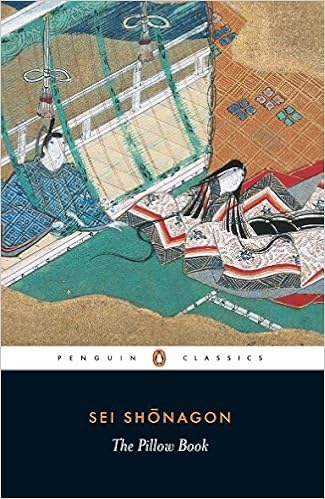
The Pillow Book

Image result for the pillow book mckinney In spring, the dawn — when the slowly paling mountain rim is tinged with red, and wisps of faintly crimson-purple cloud float in the sky.

The Pillow Book is a work of medieval Japanese literature from the Heian period, roughly 800-1200. Written by Sei Shonagon, a woman in the lower level court that served Empress Consort Teishi (定子). This isn't so much of a book per se, and definitely not a novel in the traditional sense, never mind the fact that the idea of a traditional novel didn't exist back then. However, her contemporary was Murasaki Shikibu, author of the famous Tale of Genji, a contemporary, woman serving in the court. Both of these works are studied in Japanese high school to this day. In fact, when Japanese study classical Japanese, it is the Heian period that they go to. 

The book is full of essays, lists, anecdotes, and personal thoughts. When I first started reading it I thought it was all over the place, and it really is. The Pillow Book reads like a conversation from Heian Japan. You get a sense of the character of Sei Shonagon, which is what Meredith McKinney focused on. She wanted to get the voice of the character done in a certain way, that is relatable some thousand years later. Did she get it right? I would say yes. Reading this book is somewhat of personal experience. I found myself smiling at things that were funny and likable, and likewise demurred when Sei said mean girl things. You feel like you are getting to know Sei and how she lives in Heian Japan, ultimately alien, foreign soil for me. Because of that, it is a true work of art, literature. 

In the McKinney translation, Sei comes across as personable but somewhat thorny. Basically, she isn't perfect. There's a mean girls vibe to some of the statements she makes but it doesn't dominate the text. But when you see it you do take notice. Were women really like that back then in Japan? Women are like that today! It's funny in a way how natural Sei comes across in the McKinney translation. Rather than translate the language in a dramatically different way, McKinney decided to change the voice of the character herself in her own inimitable way, that is personable, relatable. It's like listening to a Heian period woman, talks about her life, like a diary but better, much better because she comes across as likable and engaging rather than boring and nonstop. 

My favorite element of the Pillow Book is the anecdotes and stories. Stories of men who are clumsy with poetry, or retreat into hiding if they've walked in a woman's room. What festivals were like as the season changed. What it was like serving an Empress, whom you greatly loved and admired, despite you being of lesser rank, and never having the chance to be like her.  

If I were to compare the Tale of Genji [review here] to the Pillow Book, I would say the Pillow Book is breezy and personable, and that the Tale of Genji is more elusive and poetic. Both great works, vastly different. Sei has a way of explaining her world like a diary, that is in invaluable in respect to Japanese history. In short, its something of a masterpiece. 

"In autumn, the evening — the blazing sun has sunk very close to the mountain rim, and now even the crows, in threes and fours or twos and threes, hurrying to their roost, are a moving sight. Still more enchanting is the sight of a string of wild geese in the distant sky, very tiny. And oh how inexpressible, when the sun has sunk, to hear in the growing darkness the wind, and the song of autumn insects."

Tuesday, September 3, 2019

The Tale of Genji

The Tale of Genji (Penguin Classics) The Tale of Genji is a Japanese masterpiece of literature [considered the first novel] from the Heian period, roughly (794-1185). Written by a woman named Murasaki Shikibu. She was born into a minor branch of the Fujiwara clan. Her father was a governor. Men wrote in Chinese. Women wrote and read in Japanese, which led to female writers of Japanese, highborn women. She started writing this novel, which is over a thousand pages after her husband died. Scholars tend to disagree on the writer. Some say it was the work of many authors, as says Royall Tyler, who's translation [only 300 pages] I read. Others say its solely Muraski's work. The actual story itself has a continuity that suggests there is only one writer, her. 

The original manuscript is gone. This brings up the issue of translation. Heian Japanese is so different from modern Japanese. Translating Heian Japanese into English is a daunting task unto itself. However, a literal translation of Genji is impossible. Not only that but each English translation of Genji is so remarkably different. Consider these renderings of the same sentence by different English translators. 

In Chapter 4, titled “Yugao,” Genji comes across a run-down house, the abode of a young woman he is about to seduce. Waley describes the entrance like this: “There was a wattled fence over which some ivy-like creeper spread its cool green leaves, and among the leaves were white flowers with petals half-unfolded like the lips of people smiling at their own thoughts.” Seidensticker: “A pleasantly green vine was climbing a board wall. The white flowers, he thought, had a rather self-satisfied look about them.” Tyler: “A bright green vine, its white flowers smiling to themselves, was clambering merrily over what looked like a board fence.” Washburn: “A pleasant-looking green vine was creeping luxuriantly up a horizontal trellis, which resembled a board fence. White flowers were blooming on the vine, looking extremely self-satisfied and apparently without a care in the world.” [newyorker] 

Each version is so different, yet say the same thing in their own inimitable way. It's remarkable. The act of translating itself is a science. One could write an entire treatise on the art of translating. It would be worth the read. Genji made me realize how important a good translation of a book is. Before that, I was in the dark about it.

What is The Tale of Genji about? A noble and his concubines. It's about the art of seduction. But even simpler I would say it's about relationships. A man and his relationships with women. In this society, the way to a woman's heart was through poems, delivered by a go-between, who was elegantly dressed, and of appropriate social standing.

Courtly lovers didn't see each other face to face often, certainly not naked. Women of the upper class sat behind screens, and sliding doors. Women were protected by screens even when they spoke with males in their own family. A guy could be driven wild if he saw a woman's sleeve spill out or the sound of silk rustling behind the screen.

But people still got it on. Nobles and their ladies were promiscuous. Affairs with court ladies and ladies in waiting were perks of an aristocrat's life. So was adultery sometimes. Genji, when he's still young, has an affair with his father's [the Emperor] mistress. And both father and son lust after a young girl, that Genji adopted as his daughter. 

The requirement of a gentleman was style. You could be forgiven for seducing a man's wife. But you had to know how to write good poetry, have good handwriting, and wear the right perfume. Despite the influence of Buddhism, Heian society was governed by style rather than virtue. Good looks meant everything, virtue be damned. 

The ideal man wasn't too much different from the ideal woman in Heian society: highly perfumed, smooth-skinned, moon-faced, extravagantly dressed. The decadence of the times led to what Genji called a time “where everything seems to be in a state of decline." A state of decadence.

All of this had a strong sense of hierarchy of course. Also, Heian politics was marriage politics.  

Three important takeaways from reading Tyler's translation of Genji. 

First, this book gave me my first real look at Japanese culture that wasn't from anime or movies. I understand Japanese culture and society a lot better than I did in the past, and am grateful for the experience of reading world literature. It opened up my mind to the literature of other cultures [non-western canon], and that is an amazing gift to oneself, and for anyone who cares to discuss the book with me or listen to me explain it.

Second, the idea of translation. Lost in translation is a big possibility here. But the fact that the first novel can be somewhat preserved and rendered into modern readable English from Heian Japanese is fascinating to me. How do they do it? It's like nuclear physics. The translations in English are all vastly different. The book is 1300 pages, and the version I read and bought is only 300 pages. Obviously, Tyler's version is heavily edited, abridged, and he took out many passages, but I still found the book to be thrilling. 

Third, the sense of style. The elegance of this book is vast. You don't need action and fast-paced fiction writing to create a sense of depth. As a writer, this is very liberating to see, read, and experience. In fact, I had to read this book very slowly because each page is annotated, there's more than one poem on every page, and if you don't read the footnotes at the bottom of the page, you don't quite understand the poems. However, when you realize that the poems aren't literal translations, and don't quite mean much to you, the reader, you realize that you should focus on the story itself, rather than trying to find meanings in the poems. Going through that was a tedious yet rewarding experience. 

I plan on going back through Tyler's version again. Because I was so impressed with it, I bought my own used copy. Definitely worth it. Although the book took me almost a week to read, it was a very fruitful experience. At the very least, now I know where Overwatch's Genji got his inspiration. Of course, the real, yet fictional Genji is so much cooler. 

Wednesday, March 13, 2019

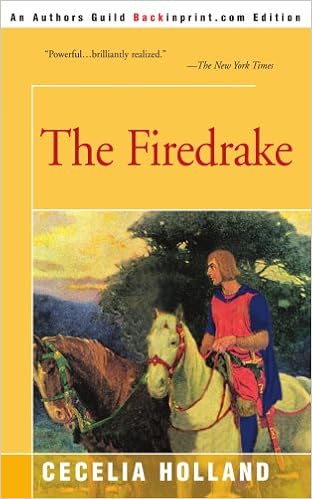
The Firedrake


Image result for the firedrake cecelia hollandThe Firedrake is the debut novel written by historical fiction writer Cecelia Holland, published in 1966, during the height of the flower power movement. I found out about Holland through my stepfather, who recommended that I read her feminist space opera Floating Worlds, which was such an amazing novel that I had to have a copy, nevermind the library's copy. Now its one of my favorite books on my shelf. I plan on going back and rereading it sometime soon. Firedrake is such a rare book because its a debut novel and its from the 60s. There are physical copies going for as much as fifty dollars on Amazon. Talk about expensive. 

Anyways, what made Floating Worlds so great was Holland's style, her voice as a writer. I was extremely happy to see that her writing style was very similar. Short, choppy sentences. You never see the inner mind or psychology of the characters. The story moves by plot and action. Things are always happeneing, even when nothing is happening. The time you spend away from the book leaves you in suspense. This is what makes Holland a great writer. 

Firedrake follows an Irish knight in the year 1006. Named Laeghair, Laeghair from Traelee, Laeghair of the Long Road, he makes his way as a ronin [wanderer] into a commander of William the Conquerer's Army. The novel ends at the Battle of Hastings, where William takes England. Laeghair is very sour, a real asshole. He's a beserker knight that fights like a devil. He kills a guy just because he insulted him in front of the other knights. He's a leader of an army. He buys a woman he sees getting beat up. Hilde bears him a son and two still born children but at the end of the novel he leaves her when she's pregnant yet again, saying, "Leave me alone." He never married her nor did he love her. Yet there were times when he was happy with her. Having that as the ending had me thinking of Laeghaire as a real piece of work. After pillaging a town, he has his way with a woman. She doesn't cry out but its still considered a rape. This guy is bad news. 

What's interesting is William the Conquerer's personality. Is it based on real historical fact? The man seems to be an enigma in the novel. Laeghair pleases William very much, and in fact Laeghair saves William's life at the Battle of Hastings. Not only that, but William finds delight in Laeghair's snotty attitude towards everyone. They would make great friends if one were not subordinate to the other. The historical aspects of this novel were so foreign to me that it was almost like reading a science fiction novel. I couldn't relate to anything here, instead I had to use my imagination and try to imagine a world where people fight with swords, axes, ride horses, drink beer and wine everyday, and women aren't healthy enough to give birth to healthy children, resulting in a lot of still born deaths. 

The physical combat here is brutal. But not gruesome. It reminded me of the Illiad in the way the combat is described. Sort of. But Holland has her own unique way of action as well. Because of her short and choppy style, the action moves along very fast. Like a real fight. It leaves you wanting more and more combat but then the battle is over and something new occurs. 

Lastly, this is a remarkable debut novel. Holland got me into historical fiction from Floating Worlds and now Firedrake. I have in my possession two of her other historical fiction novels, Jerusalem and The Angel and the Sword. I never thought I would be into historical fiction but here I am. I'm reading new genres other than science fiction, classics, and philosophy. Always good to explore new territory. Especially if the writing is so damn good.

Holland wrote this when she was only 22, still studying at college, probably to get her Masters. I don't think she had any grand goals or ideas when she wrote this novel. I don't think the story needed anything grand or idealistic, it works as historical fiction work on its own without any gimmicks. This is a simple, plain novel. No fancy bells or whistles. Just plain old good writing. Highly recommended if you like history, fiction, medevial history in particular.

Check out my review for Ceceila Holland's science fiction epic, Floating Worlds- http://ofigueroamusic.blogspot.com/2019/02/floating-worlds.htm

September Sweater Weather

Good evening ladies and gentlemen, hello world. How are you?  It's good to be writing on a good day off work today on a Saturday. Here, ...