Showing posts with label composer. Show all posts

Saturday, January 4, 2025

Things I learned From Shows in Los Angeles

Letter from the composer: [sends me chords to play on piano]


Me: Thanks, I'll check them out. 


Happy New Year. Kind of bummed out with a work situation at the moment. But the music is keeping me going. The last couple nights I've been going to shows at the bar and figuring out how the sound technician gets all the sounds. I figured it out. 

There are monitors, subwoofers inside the bar on the top of corners on the ceiling. 

The owner only wants the sound tech to only use the brand new [digital equipment]. But he doesn't want to because he likes a more traditional system. 

The owners says the traditional system is too loud. So he can't use it every night. So he's been loading different equipment [a more fancier analog system] all by himself for different nights in a large SUV style van. Not good because the guy is 64 years old. 

The answer to this dilemma is that he must use a smaller sound system for each and every night. But he doesn't want to because he wants to do what he wants, and is reluctant to do anything the owner says because they've been working together for a long time and they have some sort of dispute about it. 

However, the sound technician showed me the older more basic [analog log system that's very small] and I saw that everything that it had was acceptable and could work within the small confines of a small local Encino bar. 

So, you find that the sound systems used to record music are not important at all to the sound of the recording. 

Rather, it is the direction of sound that is placed or pointed at the audience that determines the sound more than anything else. 

In conclusion, theoretically speaking, you could record a classical music album on an iphone 12. 

Keep in mind, this guy used to run sound for Black Flag.


Happy New Year! 

Wednesday, December 2, 2020

Music in the Classic Period

Very clear and concise. The book focuses on Haydn y Mozart. Recommended to all classical music fans, and those interested in the historical aspects of Europe's arts, culture, history, and music in the 18th century.

One of the most important things that I almost overlooked was the cultural differences between the classical styles, most notably opera. Operas were best heard and most liked in Italian, but eventually, the Germans started to form their own operatic styles based on folk music and legends. Mozart tried to write French operas but they just didn't ring as well from the established grand operas in Italian. It appears that Italian was the best language for opera.

Also noteworthy was the fact that many of the composers' notes during this time period for their music were written in Italian. So even if you were an amateur musician playing from scores, you would've known a little Italian to play your parts. 

Lastly, it should also be noted that composers, travelers, and merchants were expected to speak multiple languages like French, Italian, and German, it was the norm for composers like Mozart. 

The development from this 'classic period,' from the baroque to sonata form-rondo, to concertos, to symphonies, to chamber music and string quartets, to opera, to sacred music, and finally into the Romantic era of Beethoven is an amazing development in the history of music, culture, and art. The past has greatly influenced the moderns in terms of classical music and beyond, ad infinitum.

Sunday, March 10, 2019

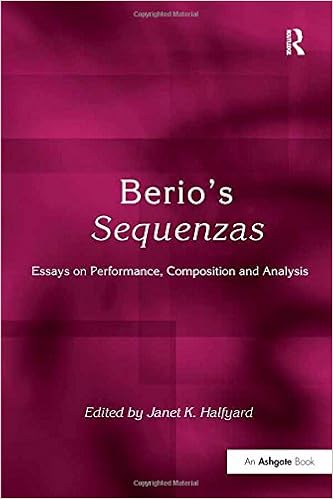
Berio's Sequenzas

Image result for berios sequenzas book janet halfyardBerio's Sequenzas is a music book edited by Janet Halfyard but written by many different musicians. Luciano Berio was an Italian composer from of the modernist school [Cage, Boulez, Stockhausen] and he wrote these pieces titled Sequenza for different instruments. These are a series of works for different instruments that are written for the virtouoso in mind. The book has three parts: 1) Performance Issues, 2) The Compositional Process, and 3) Analytical Approaches. All the parts correspond with each other if you read it that way. 

This sort of book is very important because modernism has in a sense, died and left the building. Replaced by postmodernism, which is nothing in comparison. Now its not unheard of jazz musicians to play rap music for a living. Or for classical musicians' serious 'gigs' to be nothing but pop music gigs. However, back in the 1950s modernism was king. Once you take a look back at the past you realize how important all of this music really was: historically, culturally, musically, and emotionally. 

The section that had the most profound effect on me was the sections regarding Berio's compositional process. "For Berio and the compositional process there was always a question of what does time do?, What is duration and sound? When we experience it, what is the "now" for music." [Amazon review by composer Frank Abbinanti]

There's charts on pitch structure, dynamics, and timbral analysis, as well as performative insights. Written by the musicians who performed the pieces. There's also a lot of information regarding Berio's compositional process as well as his ideas regarding performance aesthetic. All of this had a profound effect on me while reading and upon completion. 

In a way me being a rock and roll jazz guitar player makes me a stranger in a strange land when it comes to this sort of hardcore classical [avant garde, modern] musical analysis. I've been working on Sequenza for Guitar since October but I still have a lot of work before I can actually play the piece in front of anybody. Although I don't think I completely understood everything in the book, I do think I gained a lot of insight regarding music, mainly regarding performance aesthetic, composition, and how to analyze compositions. For that, its a very valuable tool. I think I'll go back to it in due time, and try to see if I can understand parts that I didn't get or misunderstood. 

Listening to all the Sequenzas by themselves is refreshing. Music really was quite something back then. This book is set for retail price of 50 dollars on Amazon. Luckily, my music mentor, and composer Frank Abbinanti gave me a copy back in October. I didn't read it until now. I'm late to the party but I'm glad I finally read it. In some aspects, I can't look at music the same, something has changed. 

And what's changed? Perhaps everything. 

Sunday, July 8, 2018

The Wagner Connection


I've been listening to a lot of classical music. I've found myself listening to more and more classical music after my vacation to Chicago last year, where I saw a quartet (from DePaul University) perform Messiaen's Quartet for the End of Time (check out my review for that performance here). That changed my attitude towards classical music and expanded my musical horizons. Messiaen is much different composer, albeit just as amazing as Richard Wagner. However, it has been Wagner's music that really strikes a chord with me.

Where do I start? I first heard various parts of the Ring Cycle in college, around 2011, however I didn't listen to it seriously until recently. I'm partial to favoring the instrumentals-the Overtures, Preludes, but the actual opera itself is quite a masterpiece. I plan on listening to the entire opera (many hours long) soon when I have enough time away from work, which proves to be extremely difficult this summer. 

Anyways, Wagner's music opened new doors. I've been reading the score for Tristan and Isolde, trying to decipher it, figure out how he gets the Tristan chord sound, how he arranges, how the melodies intertwine with the bass and the melodies. Serious stuff you know. I'll never look at heavy metal the same way again. Wagner's music sounds like heavy metal to me, that's what initially got me interested in college. The music is heavy but there's beauty in the melody, sometimes dark and other times tugging at the heartstrings, not just crushing chords. 

Because Frank Abbinanti, a new music composer that has been mentoring me from Chicago has sent me some pretty difficult scores for me to work on and play, I've been able to read music much better to the point where I can read and understand Wagner's score, albeit in a much less refined way than a classical musician or composer. I think about the chord voicings, how it would sound on guitar, piano, try to imagine the sound in my head as I read the notes. One of my goals is to one day be able to look at a score and know what it sounds like without hearing it on record or playing the notes on an instrument. I may never get there. But its a goal.

Wagner's music has much emotion. I tried to explain Wagner's music to my co-worker when he saw me reading the score on my break. He asked, "What does Wagner's music sound like?" I thought for a long time and explained as best as I could. I said that the music has a heavy feeling to it, like a lot in your head, but melodies that make you see the beauty in that which you didn't know exist. I told him to listen to the Tannhauser Overture and that he would know what I mean. 

I've gone down a very untypical path for a guitarist that first learned to play by playing the Ramones and Black Sabbath. My tastes have evolved eclectically and I'm all the better and smarter for it. My interest in jazz is still strong but now I have the entire classical canon to refer back to, a gift that I didn't know I had access to until recently. 

Most of the music my friends and associates listen to is not classical, nor jazz, or classic rock even. None of the stuff I'm into. Like regular young adults, they listen to whats popular, new, current and "hip", for lack of a better term here I use the word hip rather loosely because for me what's popular will never be hip in my traditional jazz musician's sensibility. I've realized that music for most people is just background noise. Co-workers listen to rap on earbuds while they work. My friend listens to death metal when he's driving fast down the freeway. My other friend listens to indie rock as he drives casually down the boulevard. I've realized that music for me is much greater, and more profound. Music for me is art, nothing to snicker or sneer at, and definitely not background music. In fact, I only listen to music on my computer when I'm sitting down, either reading , or just listening doing nothing else. 

I've found out that to be a musician is a hard life. I can't even get a band of guys together that are willing to meet once every week, let a lone a jazz group. I had a death metal band a while ago but when we didn't make money within three months the singer and bassist called it quits. As Frank Zappa used to say, "Strictly commercial." Most music these days is cheap (hence why the singles thing has become the new medium), just like our culture. We want things fast, hard, and easy. This is what I've come to find out. Life isn't easy, and making money with your art is even harder. 

Even if I never fulfill my childhood dream of becoming a famous hotshot guitar player or make a ton of money playing music I will be happy knowing that the music served it purpose, it opened the path for great artistic achievement and endeavors. And for that I am entirely indebted.

September Sweater Weather

Good evening ladies and gentlemen, hello world. How are you?  It's good to be writing on a good day off work today on a Saturday. Here, ...