Showing posts with label technology. Show all posts

Friday, July 10, 2026

7/10 On AI, AI Art, and the Culture

Good evening folks. I just wanted to jot down some thoughts I've been thinking about since the last post. 

    First, I think more and more people are becoming aware to the fact that AI isn't really as great as its been doing on the stock market. Sure, the American economy is betting a lot on AI and the fact that AI is going to save money and automate things so that workers will be able to do work that is more important, creative, and more meaningful. That's what the techno bro AI companies want you to think. But the reality is that the best thing we've done with AI is create chatbots that aren't really thinking or sentient, rather they spew out things they've been trained on, and they've mostly been trained on the internet. 

    Me personally, I've found a lot of fun and tinkered a lot with AI. In fact, I use AI at my job everyday to look up the prices or products and items that aren't always easily figured out by just regular google searches. The use of AI in a retail environment is great, but again, it's still in a limited position. 

    For years, I worked as a Self-Checkout Cashier Clerk, mostly using the crappy automated AI self-checkout machines, but the thing is, that those machines can only do so much, you have to actually interact with the customers yourself to really know what's going on. These things are limited and on top of that a lot of times late at nights when the store was busy, these self-checkout machines would freeze, automatically shutdown and not work, and it would take forever for them to get back running again. 

    Basically, these AIs aren't coming for your job, not quite yet. You really can't trust any type of AI with basically, anything important, serious, or critical. And yeah folks, that means you can't trust AI with most things that actually matter. I've personally found a lot of fun and utility in using AI to create images. I've been doing it for like two years and its been a blast but of course there's always the dilemma of 'you're doing AI art thats not real art, that's not art,' versus the people who don't know anything about art, and the artists in between who are smart enough to have already been utilizing AI art generators over the past 2-3 years. 

    Secondly, even if you can create stunning great AI art, there's always the issue, how can you get paid being an AI artist or utilizing AI in your handmade art? Well therein lies the rub. You can create AI art all day and be amazing at it but you will still have to work hard and put in the work in order to get paid and actually have a career making a money off your AI art. 

    Even regular artists have to put in a lot of hard labor in order to actually make a living off their art. So just because you can create good AI art doesn't mean you can get paid or make a career out of doing it. See what I'm saying? Even as amazing as AI art generators are, it's difficult to make a career out of using and making AI art, basically they're not going to actually replace real handmade, hand drawn, hand painted, hand sculpted artists. Not by a longshot. 

    Now, that doesn't mean that real artists should shun the AI art generators and throw a tantrum, rather they should use it to enhance their creative abilities and artistic potential. Those that don't learn the new softwares, AI art generators, and products won't be quite as successful as those who do. For example, a lot of Americans love Japanese cartoons anime and whatnot. A lot of Japanese art studios are using AI in anime and have already been doing so for years. 

    I wanted to rant a bit on AI because I keep seeing that people are thinking AI is really amazing and great, and yeah it is, but only up to a very limited point. For example, AI could write something like what this post has written in it, but it can't do it with my personal style, timbre, or swagger. It will always pale in comparison to the real human behind the AI, the ghost in the machine will never be as smart, creative, or innovative as the human in front of the screen. 

    Time after time, I keep seeing people using AI in a way that makes them look like they've never done any thinking for themselves, or if they do, they just haven't figured out the right way to calm down, clear their thoughts, and put themselves in order to actually organize what they want to accomplish, so using AI becomes like their crutch. That's not a surprise and I'm seeing that more and more with customers in the retail environment checking prices with AI, employees checking prices with AI, and my various friends and associates around me who use it for their various reasons. That being said, I'll post my various most recent AI art pictures below this post. 

    Third, the Culture we live within has changed a lot since the 2008 Financial Meltdown during the Obama Presidency, which, oddly enough, seemed like a very normal time period and it didn't really seem that crazy even though we had gone through September 11 and the Iraq War and whatnot. In comparison, the post-covid Trump years seem much worse and the culture has become debased, extremely right-wing, nationalistic, and the main problem imo, very dumbed down and stupid to the point where people don't even do basic things like read and write anymore. 

    That being said, I am the Culture too and I'm here to say to young people its okay to be smart, you don't have to pretend to be dumbed down around other people, you should read books, write, educate yourself to the best of your abilities, and who knows, maybe you're goodwill and influence will spread to others around you and they will become smarter just by having interacted with you even briefly. One can only hope.

    I fear that we're in such a dumbed down society that because people are very uneducated and unschooled and have less morals and standards, these qualities in a nation, in a state, in a city even, even in a job or workplace, this means that things are much more disorganized and it makes it easier for bad actors to wreck havoc in various forms. 

    One of the scariest things that has happened to me recently is that something bad or off happened [not particularly to me but near or around me] and pretty much everyone including those in charge and those who were subalterns were all basically so dumb that they didn't do the right things and things went south. I think for me the fact that I was surrounded by people who just wouldn't think it through for whatever reasons, people who just couldn't think at all very well, that for me, was absolutely terrifying.

    Lastly, I'll end it like this. I'm not exactly a stable genius like Trump says he is, [he's a dumbass lol] but I've gone through a lot of work to educate myself without even going to school or anything, and when I interact with other young people 20s, 30s, even my own age, there is a general vast difference in the amount of knowledge between those people and say people who are in their 40s-80s. 

    One of the things you'll find is that even older people could be a bit uneducated and set in their ways but overall, they have more common sense and smarts that those of us in our 20s, 30s. Respect your elders and learn from them, without them you would never really be able to become wise which is above being learned. 

    I'll end it like this, if you aren't very well studied, don't read or educate yourself in anyway whatsoever, you just can't really become successful in life or in your goals. How do I know this? I've learned this the hard way through the school of hard knocks. I struggled through my 20s and 30s and I didn't go to school, I never got a degree, I'm just a 40 year old black guy with a high school diploma, an imagination, and curiosity. Nowadays, most people are kind of coasting, trying to provide for their wives, their kids, its hard to actually free your mind and educate yourself. 

    If you ask me, this is the main reason why Trump came to power and the country is in decline. If you keep the Culture happy with futbol [special shoutout to the World Cup], football, basketball, videogames, porn, sex, drugs, alcohol, its no wonder that they would never really be able to think for themselves. Remember, knowledges makes a man unfit to be a slave. Watch this space.

Thursday, November 14, 2024

On Reading

Reading, a peaceful balm for the soul, A refuge from life's tumultuous toll, An escape from the world's constant noise, A respite from the chaotic joys.

Through books we venture to realms unknown, We journey to places we've never flown, We meet characters, both great and small, And witness stories that enthrall.

With each turn of the page, we gain insight, Our minds expand, our perspectives take flight, We learn of different cultures and ways of life, And embrace new ideas, free from strife.

As we delve deeper into each written word, Our worries and troubles slowly blur, Our spirits are calmed, our hearts set at ease, And we find a renewed sense of peace.

So let us cherish this gift we're given, This solace that enriches our livin', Let us read with an open heart and mind, And discover the wonders we're sure to find.

[ai generated]

Saturday, January 2, 2021

Pavane


One of my favorite last moments with this book was the warm hearted story at the end where the young man seeks refuge in a old world town. Him, being a new worlder, has no one to help him, but a girl sees him and decides to show favor upon him. That's heart warming. 


You only get to see a few glimpses into the world Roberts has created here. The Church runs everything, they're using technology that is pretty much steampunk aesthetic but won't share it with the rest of the world. 


A heretical Priest forms his own faction and becomes a leader. A Queen forbids technology from entering her country in order for her people to have more time to believe in Truth and Reason, a Renaissance of sorts, that could have actually happened in an alternate history timeline simulacra. 


There's train haulers that know every nook and cranny of their machines. There's a lot of mini stories in Pavene, but in addition to interesting story lines and narrative development, there's also a lot of very well written sentences, sentences written in an elegant, stylistic way. Roberts is a stylist after all. And he never failed to deliver. In some ways I could compare this with some of William Gibson's stories from Burning Chrome or Neuromancer, but that wouldn't do it justice, it's simply a thing  entirely on its own, it's Pavane: 


a stately dance in slow duple time, popular in the 16th and 17th centuries and performed in elaborate clothing.

a piece of music for a pavane.

"the repertory consists mainly of pavanes and galliards"

Thursday, December 3, 2020

Luditas y Tecnócratas

The world today is a machine of chaos. The virus is running rampant, killing 2700 in one day. Social media sows discord and division in our populace and politics. Things aren't the way they were before, you'd hardly even recognize it anymore. We, as an organism are so attached to our technology that most of us couldn't live without it, or even imagine a world without it. Would it be like the Utopia or New Atlantis or Sir Tomas More and Francis Bacon? Maybe. Maybe not. Would I even be writing this if I knew that nobody would read it? Without the support of the internet to share my ideas, would they still be worth writing about only for myself, or just family and friends?  

Everyday is a new construct in which technology is used to maximum effect. We leave our smartphones in our pocket all day long at work and even go on them when at home at night. Our computers, televisions, and video game consoles are bastions of the shiftless biomass, the state of nature in America right now, especially under quarantine. Social media is used to no end and will probably continue to be ad infinitum. 

But not all of it is bad. Tech can be used for the good of society but more often than not, when tech is left unregulated, it becomes a tool of the super rich, powerful, technocrats. They use their mathematical scientific abilities to create apps, or websites, or algorithms that potentially can last forever until eventually replaced by another one. 

You are not a gadget. It isn't normal for a human being or animal [for man is but an animal with sense of virtue of what is good] to walk around with a computer in their pocket, forever connected to a fantasy mini universe [the internet] at all times of morning, day, or night. But we let these things happen because we're moving with the spirit of the times. If everyone has the new iPhone, then it means it's time to upgrade my old iPhone and get the newer one. Is that what you should do?

The luddites that exist in society today are borderline living on the fringe types. They might live in the woods, on a farm, or Wisconsin, or Alaska, or a wood elf type of forest area with big houses enshrouded in darkness. Isolation and loneliness isn't as much of a problem for the luddites, for they always have the natural world, the natural order of things that makes them happy. On the other side of the equation, in comparison, the technocrats have their money, power, and grand influence over the emerging world to make them happy. Who am I to deny any of them happiness? 

The way of the old world is dying and/or already dead. Language learning isn't a focus in America. Music learning isn't a focus. We no longer read books or get our kids to be interested in them. Math test scores are very low. Science scores are very low. Kids from other countries come here to learn and learn more than our kids do, taking their knowledge back to their own countries and doing good things in their worlds. We focus on getting our kids through college and getting them to work, a very fine venture but if they don't actually learn anything, are we really doing a good job?

The old world is nature, animals, music, books, art. The new world is television, video games, movies, social media, and constant overuse of technology. There are good and bad variables regarding the characteristics of the old world versus the new world, but it can't be denied that the way of the world is shifting into a deified technological statehood, being and time of the digital age. 

The cyberpunk aesthetic of William Gibson and Bruce Sterling is already here. Fundamentally, most Americans [most humans with smartphones and computers] are cyborgs. We're attached to our phones, computers, and tv's like they're an extension of our body, an extension of ourselves. Who needs to play Cyberpunk 2077 when we're living through it everyday of our lives. This is why it is important to always take time to reject technology, set it down for a set period, and come back to it at a later period. If you're interested in what a true gritty cyberpunk world looks like, read William Gibson's Neuromancer. In the Trump era, it goes without saying that we are living in the realm of science fiction and far right political ideology that is so fringe that it reminds us of Nazi Germany. The past is reminiscent of the future. When we stare into the abyss, it looks back at us. 

Will the future remember things like Plutarch, Homer, Mozart, and Charlie Bird Parker? Or will they focus more on what happened during the 2016 to 2020 elections? The world lives another day but tomorrow never knows.    

Saturday, April 27, 2019

Gateway


GatewayNovel.JPGGateway is a science fiction novel by Frederik Pohl, written in 1977. This is part of a five book series, called the Heechee Saga, comprised of five books altogether. However, I think I'm going to just settle for just this first one.

"Gateway won the 1978 Hugo Award for Best Novel, the 1978 Locus Award for Best Novel, the 1977 Nebula Award for Best Novel, and the 1978 John W. Campbell Memorial Award for Best Science Fiction Novel. The novel was adapted into a computer game in 1992." [wiki] As you can see this was a very important, very good book when it was released back in the '70s.

The book follows a young man with the unusually feminine name of Robinette Broadhead. He's a filthy rich bastard but he's a crybaby. He's sad and depressed even though he has sex all the time, he's filthy rich, and he has new body parts that will give him an extended human life, wow! 

Why is Robinette sad? Why's he an asshole? How did he get rich? Where's the science fiction in this? Why read it? The book unravels like a good mystery. One. Clue. At. A. Time. Just like that, the book keeps you reading by giving you little snippets of information that reveals the why of the story.

The MC [main character] is sad because he had a terrible childhood working in food mines back on Earth. His mother never told him he loved him, and he felt close to her when he was a kid when she would stick a thermometer up his ass to check his temperature when he was sick. [this is why Robinette's homophobic] His father died and he was a nobody until he won a lottery. Enter Gateway. 

Robinette won a lottery ticket that got him to Gateway. Gateway is this space station of an alien race. They left behind all these ships but humans have no idea how to control them, or where they will go, meaning that many people die just to experiment with the aliens' ships. Sometimes they go to other universes, other galaxies. The purpose of Gateway is to learn all the rules, get a crew, and take Heechee spaceships [aliens here are called Heechee, great name, sounds cute] to wherever it will take them, to somewhere where they will hopefully find Heechee artifacts. Hopefully you don't die along the way. The organization running Gateway pays top dollar for artifacts once crews come back from their trips. The thing is that most crews don't come back. Or they come back splattered all over the ship.

So we have an unsympathetic character and a myriad of other characters, most of which don't have nearly as much personality [or lack thereof] in contrast to Robinette. His girlfriend that he meets on Gateway becomes very important to the story. But eventually, Robinette finds out that she's been sleeping with a bisexual guy, which gets Robinette upset. There's a confrontation about it. Robinette responds by beating the shit out of her, knocking out some of her teeth. It's a super brutal confrontation. Domestic abuse, in a science fiction novel, blasphemy, right? Well, I've actually seen worse in other novels, it's just that this type of thing doesn't happen often in science fiction. In Floating Worlds by Cecelia Holland, the main character gets raped. And in The Stars My Destination by Alfred Bester the main character rapes a woman who eventually becomes his wife. So science fiction has tackled these sorts of difficult issues before. I think we have to look back at the time period that it was written to understand why it would be put into the book. Also, we should look at the age of the writer when they wrote it. What were they trying to say? Of course, Robinette apologizes and things are okay, but its that's just because it's written that way. In real life, the woman would've put a restraining order against him.

There's a side story within the main plot that features Robinette having therapy sessions with a robot called Sigfrid Freud. It's all mostly psychobabble but I can understand a lot of what went into those sessions because I've read a little bit of Freud. There's all the typical stuff. It isn't that interesting but it gives you the bird's eye view of Robinette's mind. Why is he so ungrateful even though he has everything? This gives us some reasons why. 

The science fiction elements here aren't super strong but it's good enough for me. There aren't any spaceship battles, or firefights, or any space action until the very end. In fact, Robinette spends most of the book cowering in fear, deciding when and if he should go out on an expedition. After all, a lot of people don't make it back alive, as humans don't even know how any of the Heechee ships work! However, it is that penultimate ending of the book that finally gave me my science fiction fix-at least until I finish reading the Iliad. At the end of the story, we find out that our main character has survived his space expedition only by killing off nine other people, coming back alive as the sole survivor with tons of artifacts, making him one rich, lucky, son of a bitch. Technically he didn't kill them. They're stuck in a blackhole out in the middle of space. But, he's madly depressed now because, in order to be the last one to survive, he had to 'kill' off his girlfriend. Gateway is one hell of a drug. 

The great thing about this book is that you look at the cover and expect some grand space opera adventure. Or a pulp science fiction novel. What you actually get is a psychoanalytical story that involves alien technology. The writing isn't amazing but writing a science fiction story about psychology and alien tech can take you places if you're Frederik Pohl. It's not as good as Man Plus but its worth the read. I haven't completely given up the idea of reading the series, you never know what the future has in store. The novel was short enough for me to read in a few days, definitely worth the read if you're on a science fiction book hunt. I don't think it's necessary to read the full series, as I think this first book works well as a standalone novel.

Tuesday, April 23, 2019

Player Piano


PlayerPianoFirstEd.jpgPlayer Piano is Kurt Vonnegut's first novel. Released in 1952, the book tells a story of a brave new world [Nytimes back in the 50s, book reviewer compared it to Huxley's Brave New World], where machines have taken over society, a dystopia. This is a book about automation and humans, how they co-exist in a dystopian society ruled by an oligarchy but the interesting thing is that the oligarchs are engineers rather than kings or presidents.

Player Piano's universe is ruled by engineers who build, fix, and keep the machines running. Everyone else with low IQ's [IQ's are known in the public sphere, thru testings] are either in the Army or the Reeks and Wrecks, which is the low-level grunt work of the society. Paul's father helped build the machines that helped win the war, and that currently helps society. He made the engineers the most important class and his son is high up in the company. Paul's father is now deceased and Paul is struggling to find himself, that is, he has an existential crisis. 

Paul thinks that there's more to life than fixing machines and being an engineer, even if he's rich, has a beautiful wife, and a nice house and car. Paul tries to find a way out. He starts reading novels about burly men that do extravagant things in life. He wants to become like Thoreau. He plans on quitting his Engineering managerial position at the factory, one of the most important jobs in the world. He even goes so far as to buy a farm, thinking he's going to get his wife to quit living the high life and work as a farmer with him. She doesn't like his surprise when she sees the farm.

The book hits a high note once Paul goes on an Engineer's retreat, in the woods with all the managers and young engineers from factories all over the country. You get a sense that these engineers are being brainwashed into thinking their job is the most important and everyone else is below them. It's at the retreat that Paul is asked by factory management to infiltrate this organization called the Ghost Shirts. The Ghost Shirts are disgruntled engineers and low-level workers that have had enough of machines taking all the jobs. They want life to go back to the good 'old days when people washed laundry with their hands and jobs were done by people rather than machines. If Paul does this he gets a higher level job at another factory. Big whoop.

Paul plays along quite nicely, and says, "I quit! I quit! I quit!", with so much enthusiasm that his managers think he's playing along too well. The fact of the matter is that his managers had to fire him so he could infiltrate the Ghost Shirts. But Paul really meant that he was really quitting for real, which they interpreted as him playing along. It's very funny. 

Paul goes back home from the retreat and is treated like a second-class citizen by the police, who is notified that he's lost his job, status, and position in society as one of the Engineering Class, the highest social class. 

Once Paul's in the Ghost Shirt Society they make him their leader, almost a Messianic figure because he's the son of the "Father of all Machines, the Father of Engineers", oh how he's fallen from grace. A revolution takes place, and people go ballistic, destroying machines and burning buildings. But when the destruction is over, Paul and the Ghost Shirt Leaders find out that people are finding all the scraps of machines they can find only to rebuild machines! It's very ironic, satire. It turned out that people actually wanted the machines to work for them, and that all this time Paul might have been wrong about society, machines, everything. Or maybe not.
 
Player Piano isn't such much a tirade against technology, machines, or automation so much as it is a critique of progress, within society and politics. Vonnegut may be a Luddite in the sense that he rejects society's unhealthy relationship to technology. But today that could be most people as most people think the young folk shouldn't be so consumed with the tech of the day-social media, online gaming, spending all their time in front of a screen, be it a smartphone, tablet, TV, laptop, or computer. Most adults in the room would say our young people need to stop being consumed by these things, go back to a simpler time-spend more time outdoors with nature or reading books at libraries. Vonnegut perhaps might be saying that a nation that innovates technologically but not socially is not truly progressing. 

These are ideas Vonnegut used for his first novel because they were real and close to him. He had been a prisoner of war after being captured by the Germans during the Battle of the Bulge. You can sort of see how he got some of his ideas. Germany thought that all their problems would go away once factories were built but it turned out that Germany was actually on the wrong side of history socially and politically. Factories and jobs didn't end up helping them. Likewise, Facebook, Twitter, Amazon, SnapChat, Discord, Instagram, and YouTube haven't helped us to progress socially or politically either. 

At the end of the novel when the people are grabbing scraps of machines to rebuild their beloved machines, one of the Ghost Shirt leaders says to Paul, “This isn’t the end, you know… Nothing ever is, nothing ever will be – not even Judgment Day.”

"After all, there’s always a step backward, and a step backward, after making a wrong turn, is a step in the right direction." [vonnegutreview.com] 

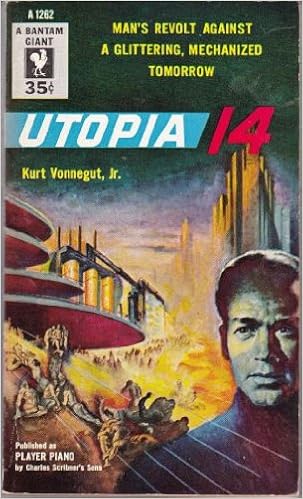
Interesting tidbit-one edition for Player Piano was titled Utopia 14, just to give it a more science fiction name, "whereby Vonnegut gained the repute of a science fiction writer, a genre held in disdain by writers at that time. He defended the genre and deplored a perceived sentiment that "no one can simultaneously be a respectable writer and understand how a refrigerator works" [wiki] Also, it should be noted that Player Piano is more conventional storytelling, especially with the slow narrative. His other novels would go on to more grandiose ideas, more science fiction, and much more satire. If he kept writing in this plain style that is Player Piano he wouldn't have become such a famous name.
 
The original cover pictured above, Utopia 14 cover pictured below
Image result for utopia 14 vonnegut


Sunday, January 27, 2019

Zeitgeist


Image result for zeitgeist bruce sterling coverZeitgeist is a pop thriller by science fiction [cyberpunk especially] mastermind Bruce Sterling. It has no science fiction elements per se but there are some ideas that I've seen in Sterling's sci fi works here. The one that comes to mind is that nothing ever works out as planned. Don't even bother planning things because it will never turn out the way you want it. Shit happens.

The story is about a guy named "Leggy" Starlitz, who's running a Spicegirls-esque scam. He has seven girls from seven countries (the G-7, the American one, the French one, etc), and they go around touring, singing, and dancing, selling tons of merchandise but no records. The scam is going to the Middle East, where Leggy becomes a part of the criminal and political establishment, as an all girls pop group manager. Oh, and the girls can't sing, they're just lip syncing at shows. 

Leggy has just one rule for the group. The whole scam ends on Y2K. Written in 2000, this book fully captures what it was like at the beginning of the millennium. The novel takes a different course in the master narrative when Leggy's ex-lover [a lesbian with whom he had a threesome with, that spawned a child] leaves their kid with Leggy, in Istanbul. This is when Leggy realizes he has to change as a person, become a good father in his own way, while going through his own personal life. You could say Y2K is used as a midlife crisis here. 

Sterling makes good use of references here. Everything from Dragonball, Saliormoon, Celion Dion, heavy metal [which has the same meanings in every language, the language of distorted guitars and screaming vocals] Brian Eno, and tons of European philosophers that even I myself haven't heard of [I'm a big reader of philosophy but these seemed to be modern European philosophers], and Gabriel Marquez. You can see that Sterling knows a lot and that he can show off when he wants to. That's fine and dandy but some of the references can go over your head if you're not familiar with the terrain.

The master narrative, as Leggy tries to explain to his daughter is understood to be Leggy's own personal life story and everything contained within it. Leggy tells his daughter [who's 11 years old] that if you want to understand the world and people, you have to understand language. Never does this make any more sense than in a novel. However, this can also be applied to real life, where language is pretty much a science. The way you speak with your English in America can get you anywhere you want to go in life. 

The narrative takes a climatic turn when Leggy and Zeta, his daughter go off to Mexico to find Leggy's dad. They find him in some dump in the middle of nowhere, in an abandoned building. They had no ID, passports, money, or anything other than the clothes on their backs. "This is how most of the world lives. Most of their lives on the back page." Leggy says something to that effect and after seeing his dad his midlife crisis seems to be almost over. There's a lot of talk during this section about the atomic bomb testings and such. Apparently Leggy's father worked with the government as a code talker. But after this Leggy still has to deal with the G-7 girls, his pop group. 

Once he goes back to the Middle East he finds out the guy he made a deal with to manage the band while he was away didn't do a good job with the girls. Despite it all being a scam, one of Leggy's rules was "don't let any of the girls die". And two of them had died at this point in the novel. As you can imagine, they don't get along. Not to mention the fact that the business associate is also a heroin and arms deals trafficker with ties to government. 

The ending is very anticlimactic. In fact, Y2K passed very easily and painlessly for Leggy and he goes to a somewhat normal life after that. The novel is very funny, sometimes too funny. In fact the last couple sentences, there is a funny joke. Leggy's Russian buddy says they should do an all girls group from impoverished and war-beaten countries, and they wouldn't make any money from the group. And that in fact, they would pay people to lose money for them. That's pop for you. 

This is my third Bruce Sterling novel I've read and wrote about. Check out my other reviews below.

https://ofigueroamusic.blogspot.com/2018/12/holy-fire.html 
https://ofigueroamusic.blogspot.com/2019/01/schismatrix-plus.html 

Sunday, November 25, 2018

The Difference Engine

Image result for the difference engine gibson sterling
The Difference Engine by William Gibson and Bruce Sterling is one of those all-time great 'hard' science fiction novels. Set in a steampunk alternative history where primitive computers were invented in the mid 1800s thanks to Charles Babbage's Analytical Engine, the story has the three things a good cyperpunk story has: steam airships, brass computers, and kinky feminine underwear (Gibson's words). 

The story follows Sybil Gerard, the daughter of a famous Luddite agitator Walter Gerard (Luddites being anti-technologists), Edward 'Leviathan' Mallory-paleontologist and explorer, and Laurence Oliphant, a historical figure, a travel writer who works under service of Her Majesty. What links all these characters together are these computer punch cards that are supposed to be powerful, important enough to die for. 

The characters believe the punch cards are part of a gambling 'modus', a device used in gambling where you can never lose, and have infinite money, a alchemist device.  "The last chapter reveals that the punched cards represent a program that proves two theorems which, in reality, would not be discovered until 1931 by Kurt Gödel. Ada Lovelace delivers a lecture on the subject in France." 

Mallory, his brothers, and Ebenezer Frazer (part of the Secret Police) defends the cards against Captain Swing, who leads a riot during the 'Stink', a major pollution event that happened in London, similar to the London Smog of December 1952. 

At the end Oliphant meets Sybil Gerard and tells her he knows who she is, the daughter of Walter Gerard, the famous Luddite agitator. He says he won't share her identity with anybody, but that he needs information to help take down Charles Egremont MP, her seducer, who poses as an obstacle in the way of Charles Babbage and Lord Brunnel's political careers. 

The end of the novel features all these different histories that occur in the world of Difference Engine. Lovelace delivers her lecture on Godel's Theorem, as its counterpart is known in our world. Fraser accompanies Sybil and meets Lovelace, with Sybil not ever able to forgive Lovelace's father Byron, for her role in her father's death.  

The end features a view of an alternate 1991 from the point of a computer, which turns out to be the narrator as it achieves self-awareness. 

Wow! What a novel. There's a lot to like about this novel. There's even realistic sex scenes, sort of like noir. The description of 'clackers', the book's version of hackers is pretty interesting, and similar to what hackers are like in real life, the 30-hour savants working around the clock with their calculations. 

But I think what was most exciting about this novel was the sheer brilliance of the writing-dialogue, plot, exposition, niche time period words of the 1850s, its got a lot going for it. The way that Gibson and Sterling made the narrator a computer, it gave them more options when it came to plot and exposition. I also believe that because this is the work of Gibson and Sterling, that it was destined to be great. This book was written at a high period of literary achievement for both writers. So its no surprise that the writing is very good. Both of them went on to become very different writers after the cyberpunk 90s. 

Although the novel was nearly 500 pages and took a long time to read (including a lot of 30 minute lunch breaks at work), I would say it was well worth it. This book compares to something like Dune, which I put at a really high literary and science fiction pinnacle. Its just that good.

The truth though is that the book took me a long time to get into. In fact, I had checked it out numerous times and barely ever got 50 pages in and at point I even listened to the audio book version on YouTube. Eventually I decided I was going to read the whole thing, turns out it was well worth the time and effort. But a book this great doesn't take too much effort, the words seemingly move across pages very easily. The time invested in reading this book is time well enjoyed. Such is the literary style of Gibson and Sterling. 

Well worth the read if you like alternative history, steampunk, or cyberpunk stories.  

Monday, January 8, 2018

You Are Not A Gadget


You Are Not A Gadget (a manifesto) is a book written in 2010 by vr (virtual reality) specialist, computer programmer (that works at Microsoft), and musician Jaron Lanier. I've actually written about one of his other books before and that can be found here. In the book Lanier states that the developments of web 2.0 is elevating the collective hive mind at the expense of the individual. He uses Facebook, Twitter, Wikipedia, and Linux as examples. On Wikipedia we have a sort of mob rules from anonymous editors with a weakness in non-scientific content. He also criticizes the open software crowd by saying that they can't create something truly unique, new, or innovative.

In addition, he states that the open source approach has made it difficult to create a middle class of financed content, instead we have "lords of the clouds', people who by luck or virtue make it to be one of the masters of the universe within the cloud.

Lastly, and most importantly be brings up MIDI electronic notes for music. Here he makes a lot of criticisms about the new music standard and the life of musicians in modern times, how hard it is for them to make a living. He has much to say on the topic, after all he is a musician too. He was quite dark on the topic. In fact, he believes we're going through an artistic dark ages. He's probably right.

Anyways, the book is quite the manifesto. He has many ideas but all of these ideas are only useful if you look at them from every angle as a whole. The book makes me envision and wonder about the future more than ever. In some ways we're already living in the future but this book makes me aware of the fact that human evolution still has a long way to go, especially with our mammoth machines, computers, the collective hive mind, and the internet.

It was a fast and short read, only two-hundred pages. I recommend this book to internet users, computer techies, futurists, and science fiction readers. The book is pure electronic philosophy, and its engaging, fun, and intellectually stimulating.

“Funding a civilization through advertising is like trying to get nutrition by connecting a tube from one’s anus to one’s mouth.”  

Tuesday, December 26, 2017

The Machine Stops


The Machine Stops is a science fiction short story written by E.M. Forster in 1909 for the Oxford and Cambridge Review. At 12,000 words its pretty detailed. This isn't your third wave science fiction folks, which is what I'm more used to.

Here we have a civilization that lives in honeycomb-like underground cities. People don't touch each other, not even for handshakes or hugs. People have become anxious when it comes to non-virtual meetings. Each pod that people live in comes with one book, The Book of the Machine. All other books and information are electronic. "All other info is electronic, and the forests, Forster explains, "had been destroyed during the literature epoch for the purpose of making newspaper pulp." The Book not only instructs which button to push when, but alleviates the trepidations of life in the Machine." (Wired) 

The story focuses on a mother and her son. The mother is a lecturer (I think she teaches music of certain civilizations) that gives these lectures from inside a room that is controlled by machines, much like how today we can do tons of things in the comfort of our homes, behind our computer screens, Iphones, and television screens. Her son is against the Machine, the electronics that give the people everything they need, from beds, email, to video (a prehistoric FaceMeet, where you can video call people). The people live underground with no sunlight of course but they can go to the surface, if they wear the proper attire (facemasks, the air can kill them) and if they have permission from the Government. We learn that this guy makes illegal trips to the surface often. He's quite the resistance type. 

Even scholarly trips to the surface are not allowed. Experts get their information about the surface from the Machine, a sort of proto-google. The Machine doesn't sustain itself forever. Life is not getting better. The music starts to get blurbs and bad quality sounds. The water has a smell. The Government says they're fixing the problems with the Machine but the repairs needed exceed the damage that keeps accumulating.

On the final day Vashti (our mother character) isn't doing so well. She's horrified to see whats outside her cubicle.

She whirled around, praying to be saved from this, at any rate, kissing the Book, pressing button after button....
An airship ... crashed downwards, exploding as it went, rending gallery after gallery with its wings of steel. For a moment they saw the nations of the dead, and, before they joined them, scraps of the untainted sky.

And I thought working a nine to five everyday for the rest of my life was scary. 

Here we have a science fiction dystopian sort of story that looks similar to the world we live in today. If all the computers in the world crashed right now the entire world would go into chaos. We're reliant upon these machines for everyday life. Could you live without a smartphone? I don't even own one and never have. We think we can do without it (modern technology) but most Americans would never put themselves through that. For them it would be torture, even for myself. Have we really empowered the machines to the degree that we've become weaker as humans? Perhaps that was what Forster was going for. Nevertheless it certainly makes for interesting science fiction writing. Everyone that likes science fiction and uses computers should read this short story, there's a lot to be gained from its dark brooding mentality about technology.

Read the full story here.

Sunday, December 24, 2017

The Dawn of the New Everything: Encounters with Reality and Virtual Reality


I read this cool book that just came out in 2017 called The Dawn of the New Everything, written by this computer programmer named Jaron Lanier. Lanier and his startup in 1984 (coincidence) created VPL Research Inc, the first VR company ever in which he was the CEO and creator with a bunch of ragtag electronics experts. They created the idea of VR, avatars, VR gloves and suits, and made it what it is today. The book focuses on Jarons' life spectacularly, from his dark child past where he lost his mother in a car accident, to having a goat farm, and eventually going on to learn about computers and electronics at the closest University. He was a musician who was cool with the avant-garde classical scene, he used to hang out in John Cage's circle.

After the more biographical parts of the book he focuses on VR. What it is, the science of it, the dark side of it, his thoughts on everything about it. For me the idea of VR is that it will probably be mostly used for porn and video games, at least that's what its like now. However, Jarons' view on VR is much more optimistic and beautiful. He sees the human side to VR. He isn't interested so much in the creation of VR and the science of it as he is in the workers working together and learning through each other about VR-the humanitarian side of modern technology. That's something that isn't really talked about in the dozens of Wired articles I read. This guy is onto something, something interesting and spiritual, albeit a sort of electronic/human hybrid spiritualistic approach.

I enjoyed the very last ending of the book very much. In the Appendix he talks about ideas that he only touched lightly on in the book. For example he talked a lot about the idea of algorithms choosing things for us. What we watch, what people to be friends with, what music to listen to, who we have sex with, what events we should go to, etc. He believes that because of this we are allowing the computers to become smarter than we are. We aren't informed enough to make good decisions about all those things so instead we rely on Netflix, YouTube, Facebook, Twitter, Instagram, Snapchat, and Tinder to decide all the 'hard' choices for us. In the long run I think he's right. The tech industry is dark, the whole thing with net neutrality is a good example. On the internet he has much to say.

He believes the internet was created for good intentions, with the sales of goods, trade, and expertise for trade between people. Instead some people make tons of money from the internet while others just have a really cool Facebook page, tons of Twitter followers, or write a great informative blog (like this one, I'm talking about myself). He talks about the history of the net and how links and web pages were supposed to go both ways. You were supposed to be able to click on something and tell where it came from, and they were suppose to be able to know where you came from upon finding it. Things like that. And the early ideas of monetization for the net was that people with trades skills were supposed to use it to exchange goods and services for cash, a sort of free enterprise for everyone. Of course it didn't turn out that way. The companies control cyberspace, the term coined by William Gibson in his 1980's science fiction novel Neuromancer. In many ways William Gibson was writing about Lanier (and his computer friends') lives.

The most fun part was reading his ideas on virtual reality within the universe. For example, if an advanced civilization could create virtual realities within a universe, the existence of one or many universes wouldn't matter because we would believe the virtual reality to be the universe. In the Appendix he talked about this idea that aliens could have some sort of compiler that could create VR within the world they or we live in. Sort of reminds me of the matter compiler in Neal Stephenson's The Diamond Age, or A Young Lady's Illustrated Primer. In the book the matter compiler is a device where you can get anything you want from thin air.

No matter what you think of VR or computers the fact remains that our world is shaped by these things, especially right now. In a speech on Youtube, Jaron talked abut the ideas of VR coming to fruition around 2030 and 2040, which isn't that far off. We're already almost there. From the beginnings of Orwellian 1984 to the Fake Russian News of the Trump Era, the times they are a-changin'.

In the book Jaron says the most technologically advanced 'computers' we have today are musical instruments. Maybe one day playing a musical instrument will be like computer programming, a valued and highly sought after skill. The musicians will have more jobs!

September Sweater Weather

Good evening ladies and gentlemen, hello world. How are you?  It's good to be writing on a good day off work today on a Saturday. Here, ...