Showing posts with label horror. Show all posts

Thursday, March 26, 2020

The Plague

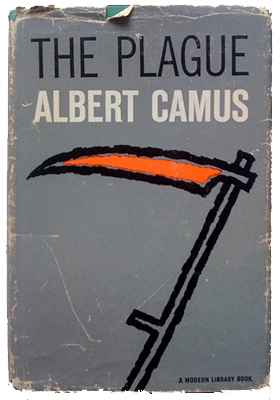
Image result for the plague book covers 1947The Plague (French: La Peste) is a novel by Albert Camus, published in 1947. It's about the plague sweeping the French Algerian city of Oran. It raises questions about destiny and the human condition. Throughout the novel, there are existentialist ideas that reverberate. The novel is said to be based on a cholera epidemic that killed many people in Oran back in 1849 but the novel is set in the 1940s. Likewise, it is based on real plague outbreaks that really happened in Oran back in the 1900s, but these outbreaks were very small compared to the devastation seen in this novel, which is apocalyptic, a word seen in today's NYTimes headline. 

Camus objected to the book being considered an existentialist classic yet it has that sort of tone. It is also seen as an allegorical treatment of the French resistance to Nazi occupation in World War II. Lastly, the novel brings up the philosophical notion of the Absurd, "the conflict between the human tendency to seek inherent meaning and value in life, and the human inability to find any in meaningless, purposeless, or chaotic and irrational universe. 

Let's start at the beginning. This is my first Camus novel although I have heard of The Stranger, which was recommended to me by my father and my friend, a master's degree student from CSUN. The Stranger and The Plague are terrific novels but for entirely different reasons which we won't go into here. I went to the local library book sale initially looking for The Stranger, because I'd seen it multiple times at other book sales, only to find they didn't have it this particular time, but they had The Plague, so that's what institutes my introduction to Camus. 

The story told therein isn't complicated nor long. On the contrary, this is a very simple story, but with deep meanings and notions. There are only a handful of true actions. But again, deep meanings within them.

The story is told from a narrator's point of view. We don't know who the narrator is until the end of the book, where we learn that the narrator is the doctor himself, who had been treating all the victims of the city, possibly exposing himself to the plague, his friends/associates who are workers of the city, helping him in fighting the plague. The fact that the narrator is nameless/faceless until the very end is a great literary device used in some other novels that I've read, especially in science fiction of the 50s and 60s. It's quite an imaginative plot device because the reader is always in a sort of suspense. Who is really telling the story? Well, you don't know until you find out. You don't find out until you keep reading. It's not difficult to guess that it was the doctor but it's rewarding to find out that it's him. Why? Because the doctor has such a personal relationship with the town, the citizens, his friends, the workers, the plague itself. His point of view is important to the telling and conclusion of the story. Even if he isn't the only character that the novel focuses on. Rather, there are a couple of characters in the novel. Although none as important as the doctor because he's the narrator. 

Then, the plague itself. The plague is the worst disease known in the history of mankind. Camus displays fantastic writing ability in the way he describes the symptoms, the victims, the deaths, the burnings, the burials, the quarantined, the panic buying, the lockdown of the city. This is where I get to make a comparison between this novel and what's going on today. 

Today we have the coronavirus having gone viral across the world, and today 13 people died in N.Y.C, but overall something like 1,000 people have died from coronavirus in America. Twenty-six states are on quarantine/lockdowns. Most people are out of jobs or working at home, or they might be like me, they're grocery store workers [essential workers like healthcare workers] on the front lines, battling an invisible enemy, with nothing but gloves and a mask, if they're lucky enough to have PPE [personal protective equipment]. Life today is somewhat like life in Camus' novel. The absurd has already happened: People are panic buying hundreds of rolls of toilet paper and canned goods. Like the novel, people have made a fortune off selling items in a black market sort of fashion, selling toilet paper, hand sanitizer, even foods. Existentialism is more popular amongst my more literary and/or more articulate friends. There's a definite sort of dread, confusion, disorientation, in today's climate. The individual has come apart from the whole, not just objectively, but literally. We literally have been ordered by local, state, and federal governments to practice 'social distancing,' a 2020 buzzword that states we shouldn't gather in groups or get too close to others because we could spread the coronavirus to each other more easily that way. And this is just the beginning! 

So it's easy to see how a novel like The Plague holds such important intrinsic, historical, philosophical, and emotive value because what happened in the novel happens in real life so to speak. This novel is so realistic and spot-on, in some ways it's absolutely terrifying and ultimately unforgettable. A lot of book reviewers like to say this a lot but I mean this; this is one of the greatest novels I've ever read, will read, or will ever want to read again. 

Lastly, this novel portrays everything that a pandemic will and should. The horror, the death, the spreading of the disease, the removal of the bodies, the burning of the bodies [in some cases], the funerals, the lovers being split apart, the non-discrimination of the disease killing everybody including men, women, and children, the human compassion and support especially from doctors, healthcare workers, city officials, police, volunteer workgroups, the love, emotion, isolation, the absurd, the existential angst, it's all there really. What's really comforting to see is that even having gone through the plague this fictional tale has one thing that humanity will always need, crave: hope. For if there is one reason why we should get up out of bed in the morning it's because of hope. That's why this is such an important, great novel.

Tuesday, April 9, 2019

Us


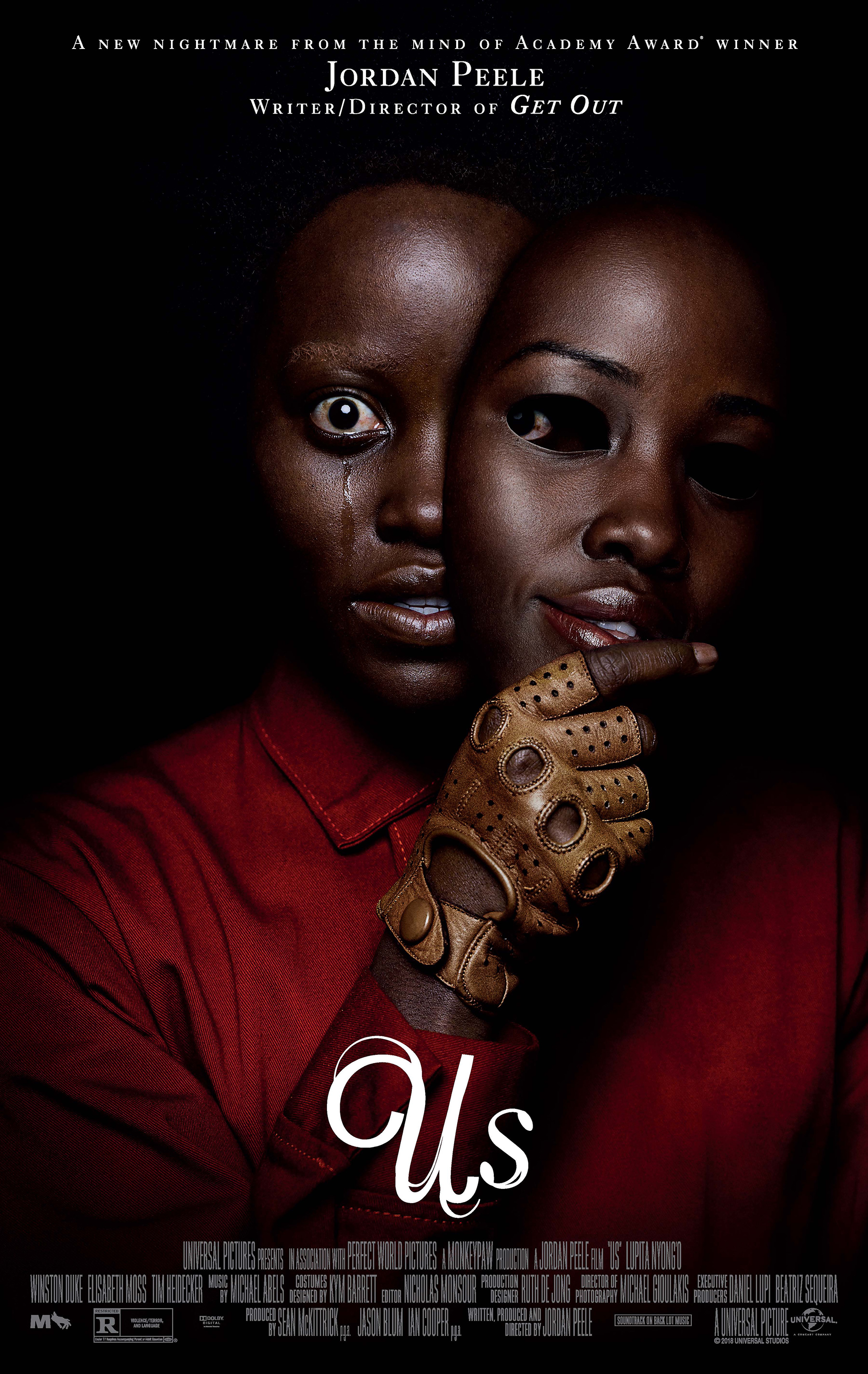
Image result for us movie cast 2019Us is a 2019 science fiction horror film produced and directed by comedian, actor, and writer Jordan Peele. The movie starts with a chilling introduction where we see a young black girl at a pier out with her parents. Her parents don't like each other much, the father is drinking too much, and the mother is telling him no more beer. At some point the girl wanders off on her own, getting lost in a hall of mirrors, some sort of 'ride' at the pier. She was lost for fifteen minutes before her parents found her. When they were reunited, the girl was mute.

The next part of the film starts with a well-to-do black family on vacation at a vacation home. The same girl who got lost at the pier is now an adult, with two children. A boy who is slightly awkward, and a well-adjusted girl. Her husband is a jokey fatherly type with glasses. Things take a turn for the worst when a family wearing red jumpsuits appear on their lawn. They don't say anything. The father goes out to scare them off with a baseball bat but it doesn't work. It turns out that the family is actually them-doppelgangers. This is where the horror element comes from. 

It turned out that the family on the lawn were actually doppelgangers, an apparition or double of a living person. This is where the science fiction element comes in. Later in the film, after some exposition, we find out that there are doppelgangers of Americans living underground, the disenfranchised, the dispossessed. Meanwhile, the privileged, well-to-do people that have it easy in life are living above ground, getting their vitamin D from sunlight and livin' easy.

Not only that but the film makes a reference to the 1980's Reagan era with this event that actually happened, called Hands Across America. These doppelgangers have come up from underground to exact revenge across their doubles, holding hands across vast areas of land in America, after killing people. Does that make sense?  Does it have to?

We see underground that the doppelgangers live with these white rabbits in the corridors. That was an interesting visual. The idea that there are underground places across America reminded me of Colson Whitehead's The Underground Railroad, where slaves find their way to freedom using these underground passages. The movie is somewhat similar and referential a lot of other horror movies, such as A Nightmare on Elmstreet, The Shining [b/c of the white family's twins], and even has some similar aspects to Get Out, Peele's first film.

The movie is filled with too many references, metaphors, and so much symbolism that its all to much to write about here. The main takeaway I got from Us is the idea of the have nots coming to take their revenge on the bourgeois. This goes back to Marx and Hegel's philosophy about the rise of the proletariat, meanwhile, the bourgeois does everything in their power to keep the working class in the gutter. This is what the Communist Manifesto is all about. It's a very overt philosophical overtone. 

Many writers online have been speculating about what this film means. I'm not sure that it particularly means anything, other than that it is a damn good black horror movie. It's great to look at visually too. The fact that the main actors are black people is a plus [and a negative, see below] because its 'the first black horror movie', other than Get Out,  however, that movie works better than Us in the sense that Get Out is simpler in form and not overstocked with 'too much syndrome'. In short, it's less messy, thus works better as a movie that can be enjoyed as well as reviewed. 

I didn't come to the conclusion that Us was too cluttered until I read reviews. After viewing the movie with my friend, we got sidetracked by the clutter: symbolism, metaphors, references, and subtext. But now that I've seen what good movie reviewers think I've come to realize that the movie was still great, although probably not as great as I first thought. This isn't going to be Jordan Peele's best film but it will definitely be one of his most referenced and most talked about, probably for years to come. 

Lastly, I want to mention another thing that is personal to me regarding the movie. I don't think Jordan Peele did black people a favor making a movie like this. Yes, its a black horror movie but in a metaphorical way, I think it works as entertainment for white people to enjoy watching black people get scared, complete with vaudeville big eyes, tears falling down their faces and animalistic noises instead of speech from the doppelgangers. I don't think this is a movie my mother would like or any older, serious, black person. In short, its a young black persons thing, if they're into it at all. Older black folk would scoff at the way black people are portrayed in this movie. This is a personal criticism yet I think it is crucial to the film as a whole culturally. Of course, you could speculate until you turn black and blue and say, "Yeah, Peele is trying to say something important regarding class and race in America." And I would respond with, "Yes, we understand that. But at what cost?"

Despite that I still enjoyed the movie. You can see the ending coming a mile away yet it is still satisfying. Jordan Peele is a young film director and he was trying to do too much, not unlike a great author's sophomore slump. Yet somehow the movie still works, although probably not as effectively as Peele intended. Still, this was probably the best movie I've seen in 2019. You should definitely see this movie.

Wednesday, March 6, 2019

E.T.A. Hoffmann Automata

Automata is an early proto-science fiction short story written by E.T.A. [Ernst Theodor Amadeus Hoffmann] Hoffmann in 1814. The story involves discussions and retellings of several distinct stories, during the evening amongst several men. The narrator walks into the gathering and notices all the guys are staring at this golden ring swinging in the ceiling. His friend says the ring moves according to the will of the men present. Then, another guy begins to tell his tale to prove the existence of the supernatural. 

Then, he tells a story about a young girl who every night at nine o'clock, sees this White Maiden. However, only she can see it. And her family soon believes that she's crazy. However, one night she sees the maiden and proves to her family that it is real. The girl throws a plate in the air to the White Lady [phantom] and the plate floats in the air, stunning everybody. Shocked, the mother dies, and the Colonel father dies in battle, leaving the girl a shell of her former self. 

Then, another guy recalls a story about a musician who was haunted by something playing on his piano at night, with virtuosic skill. Another guy is asked to speak so they can drop these occult stories but he brings up this manuscript titled Automata. Before starting he says something about how all of this is connected.

This story begins with an automaton called the Talking Turk [a reference to unbeatable chess playing Turk], which has such a lifelike human appearance, and people have a hard time figuring out its control mechanism, as well as how it answers questions accurately in many languages and attitudes. Its a bloody AI story, written in 1814. Or something like that. 

Lewis and Ferdinand end up visiting the Talking Turk and they see that the answers he's giving to the audience aren't to their satisfaction. Ferdinand goes to speak with the automaton and comes back to Lewis. He tells Lewis that there must be a spirit controlling the automaton because he asked him questions he had never told anybody else about. 

From here we learn that Ferdinand had a dream in an inn where a beautiful woman was singing to him, perhaps a childhood friend who he was destined to be with. Upon waking up, Ferdinand realized that the woman he saw from his window wasn't the woman from his dream. Although he locks eyes with the woman, she quickly takes off in a carriage. When he now asked the Turk if he would see the woman, the Turk says, "Next time you see her, she will be lost to you forever." 

Ferdinand is upset by his answer and won't give up. So Ferdinand and Lewis decide to learn more about the automaton and its maker, the old man Professor X. They meet the Professor and he puts on a musical performance for them, complete with performing automatons. Afterward, there is a discussion on the nature of music. On the sounds of nature and instruments.

Several months later Ferdinand leaves on business and sends a letter to Lewis, saying he's seen this long-sought-after singer. Upon recognizing Ferdinand she faints in the hands of Professor X. Ferdinand wonders if the Turk's prophecy has been fulfilled by psychic bonds making their way into everyday life. 

The story ends with Ferdinand being fine, they had even recently read one of his dialogues on opera. The group is tired of the automaton story, and ask to be done with it. It is said that the Talking Turk is merely a fragment, and the conversation moves away from the subject. 

This is a pretty great early sci-fi story from a German writer, artist, composer, jurist, and music critic. Hoffmann was an author of fantasy and Gothic horror, as this story seems to suggest. Hoffmann was also one of the major authors of the Romantic moment. One of the things that this short story does very well is involve music in the story. There are lots of musical terms, phrasing, sounds, as well the music performance of the automatons itself. I attempted to do something similar in my robot short story [which you can read here]. However, Hoffmann does it so much better. The way music is described by Lewis in the story is quite moving, he describes the way the sound of the stars might sound, and how he is appalled by the automatons performance. He believes that electronics and automatons cannot make moving music, because it is the human touch and emotion which moves us in music. It's quite a scarring rebuke in the postmodernist musical world, where EDM and house music can sound like a washing machine gyrating on and on. 

The literary style here is baroque. Hoffmann was a man of much learning. The way he writes isn't simple and some words I even had to look up online to understand the story. However, it isn't overly complex and his meanings do get across quite easily. The writing style isn't smooth, but it's not wooden either. It works. 

The musical aspects of this story moved me. The automatons themselves were interesting even though they weren't described too much or with much detail. Were they made of wood, plastic, or metal? How did they operate? Gears? Not sure but one thing for sure they could do many things. Another thing that this story makes me think about is the rise of AI, whether they are in the form of robots or just simply as everyday computers. This story definitely brings that all to mind. Although I can't say this is pure science fiction, there are definitely sci-fi elements here. This is a great read, recommended to anyone who likes literature of antiquity and proto-science fiction. 

I learned about this short story from Wikipedia's Timeline of science fiction. I found it under 1814, right before Mary Shelly's Frankenstein, a personal favorite. This story has aged gracefully and I believe it still has relevance in 2019, some 100 years later.

Read Automata here--http://users.clas.ufl.edu/burt/touchyfeelingsmaliciousobjects/Hoffmannautomata.pdf

Sunday, January 21, 2018

Frankenstein, or The Modern Prometheus


Hello everybody! Here I'd like to discuss Mary Shelly's Frankenstein, which I literally just finished reading just now. The book was inspired by Mary Shelly and her friends friends who used to tell each other ghost stories around the campfire, they all decided they should all write their own ghost story and whoever wrote the best one, that one would get published. This is the only one that got done and published folks. Its quite good and inspired movie(s), cartoons, video games, and much more. The first unedited version was written and published in 1819, making this the oldest science fiction I've ever read, wow!

This book can be a little difficult to get into at first. Everybody knows the story of Frankenstein and the book only differs from the movie in some slight ways. For example, the monster here is eloquent and quite poetic, however, that is just the writing, times, and style of the book. The writing is quite formal, which is expected of the time in which it was written. For instead of thinking of the monster as eloquent, its more evident that the monster is a product of the times (1819) and that he is still quite evil despite his mastery of persuasion and making the reader feel sympathy for the state of this pathetic wretch.

The main difference from the book and the 1930s movie we've all seen is that Victor Frankenstein (the creator, mad scientist) gets a full biography and history where we learn near the end that the woman he is to marry is a childhood friend that his family took in, almost like a sister, which to me was a little incestuous but otherwise not that different from the movie. In addition, his monster torments and kills members of his family in the book, whereas in the movie the monster accidentally kills a villager's daughter. Also, the ending of the book is quite different from the movie, but I do like that after all is said and done our monster runs away like a thief into the night. It was quite a fitting ending for what could be construed as science fiction horror.

Today we look at this kind of thing and call it horror but back at its inception this type of writing would be considered science fiction. Mary Shelly's writing here is quite stylized; formal, educated, high art of a certain style. Its definitely a product of its time and I could see some people having trouble getting used to the literary style. I've found that I really enjoy these old types of science fiction writings, especially by women, they have a certain voice that men don't have. I suspect I'll learn more about this as I read more and more science fiction by female authors. I just ordered Ursula K. Le Guin's The Left Hand of Darkness, which is a sort of feminist cyberpunk sort of thing. I'm looking forward to reading that next.

However, Frankenstein is a hellova novel. I liked it so much that I'll probably want to read it again in the future, probably some months or years down the line. There's a sensation of eerie evil doings alongside justice in this book and it seems to do it in a literary personable voice rather than just being sinister just because. It's great, and if you like the movie then you should definitely check out the book.

"Cursed, cursed creator! Why did I live? Why, in that instant, did I not extinguish the spark of existence which you had so wantonly bestowed? I know not; despair had not yet taken possession of me; my feelings were those of rage and revenge. I could with pleasure have destroyed the cottage and its inhabitants and have glutted myself with their shrieks and misery."

Tuesday, January 16, 2018

The Shape of Water


The Shape of Water is a fantasy (and somewhat science fiction) drama film directed by Guillermo del Toro and written by del Toro and Vanessa Taylor (of tv and movie fame, she wrote for seasons 2 and 3 of Game of Thrones). The film follows a mute custodian woman working in a security government facility, where she befriends and falls in love with an amphibian creature. Think creature from the black lagoon except this creature is way too cute and human-like. 

Anyways, the plot is simple enough. The woman frees our amphibian dude from the lab where she falls in love with him, and they even have sex! She has a great ass by the way and the film has a bit of sexual sensuousness. There's a couple scenes where we see her masturbating, always in the tub full of water. But I digress. 

It must be said with utmost authority that actress Sally Hawkins (who plays Elisa the lead female role) makes this movie, the monster doesn't add much. Her acting is so lovely, so pure, and in the scene where she was singing I got caught up in her poetic elegance. Back to the story. 

So she frees him (the monster) and the bad guys from the facility eventually find out she has him. The bad guy shoots our amphibian and our girl, and they both die. However, the amphibian heals himself, surprise! He has a healing factor! What is this Logan? After he heals his bullet wound in a second he slashes our bad guy across the face, killing him instantly. If he was this god-like and powerful why was he chained up and beaten so easily earlier in the film? After that he takes Elisa (our girl) and jumps into the river (they were at a harbor where he was to be transported elsewhere but plans got sent to hell), where a sort of magikal realism occurs.

At this point we can choose to believe that a) Elisa gets killed and that the monster turns her scars into gills, thus turning her into a sort of reverse mermaid or b) the monster grabs Elisa and jumps into the river, and what we see is an illusion scene of love, fantasy, and romance, showing that Elisa's love for the monster has transcended human nature, that she has become like him, thus the gills. Either way its quite an interpretative ending, albeit a lazy one. 

Another complaint is that the monster was too damn cute and puppy-like. A true monster by definition has to be ugly, perhaps even disturbed in some ways, think Mary Shelley's Frankenstein. This monster was not a 'true' monster, in fact, other than him eating the head off a cat and killing the bad guy, he was hardly monster-like. Instead, del Toro relies on a cutesy Disney sort of love affair, effective enough for Best Director and Best Score at the 75th Golden Globes but it doesn't satisfy me in any realistic way. The film tries to allow Elisa to transcend human nature with this love story but it doesn't get the nitty gritty down right. The devil's always in the details. 

However, I can see why this movie is such a success. I can see why women and girls especially like it a lot, it is very much a romantic type of thing. This is the kind of movie you would bring a date to, or your girl friend, perhaps even your wife if she's open to different kinds of movies. Its quite good and I enjoyed it very much but the monster isn't really a true monster, he's a sort of cute puppy dog, which I can see why the girls would like the film and the creature. 

Giles: [interpreting Elisa] When he looks at me, the way he looks at me... He does not know, what I lack... Or - how - I am incomplete. He sees me, for what I - am, as I am. He's happy - to see me. Every time. Every day. Now, I can either save him... or let him die.

Monday, October 31, 2016

Happy Halloween


Halloween is here! This is probably the first time I've ever taken Halloween seriously as a holiday or ever really celebrated. Probably because I've been partying with my friends like its the second coming of high school. It's been a blast.

As a kid my mom didn't really allow us to celebrate Halloween. Being a strict Catholic and a bit of an overprotective moma bear she's against most things associated with horror and dark vibes. I'm not necessarily the opposite but Halloween is cool.

The thing that I like the most about Halloween isn't the partying or the candy. It's that evil vibe that really seems to go with it. There's something dark about Halloween that only lasts during this late autumnal period. To go further with this idea it could possibly be related to the change in the weather (winter is coming) but its not just that. It's also the way people think and interact with each other. Halloween ain't so big a holiday that people act totally different but people do seem to be more joyful. That's a great thing. 

I've been celebrating by listening to the band Ghost a lot. I wrote about them in a post that you can check out here. I literally just got into them this week and they're like the perfect Halloween band. They're dark gothic costumes certainly fit Halloween perfectly. I might delve more into more authentic black metal because of Ghost.

But yeah the whole festivities of Halloween have had me not playing games so much. Lately, I've been listening to music (Ghost mostly) and hanging out with friends. I've been working on getting my friends better on guitar and bass for our band that we're starting. So far we have the beginning of a simple song and we're playing the Adventure Time theme song together. The song started off as just a bass line I wrote for my friend to practice and its developed into something more. Not bad but we have so far to go.

I feel like I'm a great teacher but I can only provide so much training with them. They have to go the extra mile and become a better musician on their own. Hell, even though I've had like three great teachers none of them really taught me how to play with original style or creativity. I did that myself over time.

I have many ideas for the band. I kinda wanted a simple rock group with a strong punk, black metal, and pop vibe. By pop I mean have catchy metal riffs and lyrics, not like Taylor Swift or anything. I want our songs to have tasty arrangements that require musical prowess and skill but in the beginning I want things to be more simpler until the guys can learn to hang at my level.

That could be a while. In the meantime I'm still looking around for people to jam with and I'm still working on jazz standards. I'm also in the process of saving up for a cheap drum machine so when we start recording we'll use that because we don't have a drummer as of yet. We're gonna need drums at some point and I also want to get a keyboards player.

I gotta say that I love it when we all play with guitars and bass together. They're a couple of noobs now but they just might be good musicians given the right musical training and if they practice harder.


We're not even sure what the band will be called but knowing my friends it will probably be something that suggests a metalcore sound. They're really into the more modern metalcore bands whereas I'm more old school, more into the 60s and 80s sound of rock and roll.

We'll have to see what happens. Hopefully I can emerge out of this with a gigging band and get somewhere. Let's see what winter brings us. 

Who's that guitar playin' sonuva bitch, a question commonly asked, on his head a bucket of chicken bones, on his face a plastic mask. He was born in a cage, raised on a coop, children fear him, critics rage, he's half alive, he's half dead, folks just call him Buckethead.

On AI, Existential Threat, and the Collapse

Good evening ladies and gents. Hope you all had a good Sunday. I wanted to write here a bit more about AI, existential threat, and the Colla...