Showing posts with label story. Show all posts

Tuesday, November 25, 2025

November Thoughts

Good day early morning readers. 

Here I'd like to jot down some ideas that I've been thinking about lately or within the last time of writing. First, is it just me or has American society become and/or has always been like a pay-to-play subscription? Hear me out. You have to pay for rent to live in a place if you don't own it, you have to pay for food, you have to pay to go to work if you drive there in your car or even take the bus, you have to pay to go out to bars/clubs if you want easy cheap entertainment, and if you're a homebody you will most likely spend money on streaming services, movies, and/or video game computers and/or systems. So where exactly is America, home of the Brave, right now?

I would say not in good place. Think about everyone you have ever interacted with on a personal level, how are they really doing? Would they be mad to hear that you're doing better than them? In this sort of climate, it's hard to even define what a better life would even be. For me a better life would be playing music in bars, making money off it, and not working a day job. Or perhaps becoming a day writer and somehow writing novels that somehow sell millions of copies. Or even running a small record shop in China or Japan, being the only black guy in a small area. Or, this would ironically be the easiest one, to marry a wealthy girl and still pursue all these other things with her. 

But it seems most people I know or have interacted with on a personal basis are not doing good. Neither am I really. I'm living but I'm not thriving. At this middle age of life, I should be doing a lot more and thriving. Oftentimes, we know what we should be doing but we keep getting distracted in life by various things, people, work, family, and friends that we forget the reasons why we are living and what we should be doing and we're not pursuing our true goals. It's like going to a job, it's good because it provides you money in order to pay rent and buy food but overall, a job isn't going to make you reach your goals faster, in fact, its going to be a hindrance to it. For me, working jobs has slowed down my growth and lowered my ability to be creative and think outside the box. Working, ironically, has become a hindrance to me.

It seems the more people you know now and the more people you knew in the past, the more you know about people, their lives, and their goals, and how and if they go about achieving it. Some people inspire you and you can grow with their help, but only for a little while. Other people are sinking more and more into the abyss, even girls you really like. It's hard to figure out where you stand and everyday is a struggle in order to figure out who you truly are. 

It's hard to figure out if anyone is even real or authentic anymore these days, online especially, but even people you know personally and see day to day, a lot of them are living a lie. I've had a few strange off occurrences that make me truly believe than even some of the people around you who you think are really good people are actually working towards and/or trying to hurt you, defame you, or ruin you behind your back. This is kind of dark but last year I was laid off from my job and when I called the work union about it I told them my situation and they told me that so-and-so, a female manager I worked for six years before this incident, had called them and said something to them about my case, even though she wasn't there, and there's no telling what she might have said, it could've been really negative, thus encouraging them to get rid of me. I only say that because when I asked what she said about me, they said some negative things about it. 

There's a darkside to the soft underbelly of Los Angeles. Like sometimes, people from your past, like past jobs or old friends and acquaintances will want to keep tabs on you but not for good reason. They'll ask you questions about what you're doing, what job you're doing now, and that you should be doing this and that instead, and this and that. And you're just wondering, why does this person want to know all this stuff about me? And it makes you wonder who they're reporting the information to. There's this funny black youtuber I've watched and as he says, "We are trying living in the worst times of history, people showing their horns, its like you're truly alone."

I've seen the darkside of the Los Angeles valley over my entire tenure out here, although technically I'm just visiting from the Midwest. I will probably leave when the time is right. But back to the darkside. I was a part of a small friends group where the leader of the pack, my friend, was sort of going off the rails. He lost his girlfriend, was about to lose his apartment, and pack everything up to leave to go live in a different city, kind of far away. He was doing coke and lsd and weed/beer and just in general very scatterbrained, paranoid, and crazy. I mentioned this to other friends of the group and they told him and he instantly came at me hard and said we can't be friends anymore. This is a guy I was friends with for like ten years. All the guys in the group were friends for at least ten years and when he broke the friendship with me, he must've told them to stop talking to me too, because after that none of them ever responded to my messages and calls, except for one guy in the group. Looking back on it, I think I did a good job warning the other guys that he was on a crazy binge and that they should be weary. If I was a spiritual person, I would say that he was a sort of demon, or possessed. Ironically, I was sort of glad to be rid of him, because being around someone like that isn't fun because they're always only seeing the negativity of life and making you see through their demon-infused lenses. 

I'll leave you with another weary tale. I was at work at this clothing shop gig and this guy called out to me in the storeroom that somebody had taken down the clothes off a manakin [it might've been him]. The guy manakin has like a little junk pouch, so I had to put some pants on it to cover it up. The guy took a picture of the naked manakin and he said, "I'm going to send this to corporate." I said, "Okay," calling his bluff. Then I took some pants and put it on the manakin and he took another picture of me doing that and said "look at this picture, I'll use it to blackmail you," I called his bluff again and just said, "Okay," nonchalantly. Then he proceeded to tell me about how he wanted an item off a manakin and an employee told them they couldn't have it until the manager takes it down at the end of the month. And how he had to go through hoops and make a lot of phone calls to get the clothing off the manakin. Okay, so you get where I'm going with this story. This is a possibly psychotic individual, maybe he's even under the influence of drugs and/or alcohol, because usually people don't get to this level of pettiness without being altered by substances. 

Why am I writing about all this? It's mostly a cautionary tale. Not everything is a coincidence. And believe it or not, there are people who are out to get you. I'm not afraid to leave my stoop or anything but I do realize that most of the people in my inner circle that I was actively engaging with and talking to, hanging out with, and meeting with at bars/clubs were in fact bad actors. They might not have been straight up demons [demons are mostly people who don't know you personally] but they had bad intentions, and being around them so often dimmed my light. Not that I'm a saint either, but generally I have a much better more positive attitude than everybody I've ever met. It's nothing special, it's innate. 

Lastly, I guess I write this to say, yeah, we're in dark times. Remain in light. 

Thursday, September 24, 2020

Birthday Op-Ed

Breonna Taylor's Case and Death: What We Know - The New York Times

So my birthday is tomorrow. I'm pretty excited to enjoy the next three days off work, relaxing with family and friends. I wanted to jot down some thoughts about today, this year, this birthday, and what it means for me, and consequently for all.

Today a cop was ONLY charged for misfire shots, NOT for the death of Breonna Taylor. Although the family has been paid off some $12 million, the fact that the cop or cops in question weren't charged for manslaughter is an unforced error. Consequently, the streets of Kentucky are running hot, because as the hardcore BLM people say, "No Justice, No Peace." It's a dishonor to her memory. She was a front line health worker. The law in Kentucky has been written in a way that does not help black people, and it could be argued that it is written in a way to hurt them, as what happened in this situation. The disregard of black life animates much of life in America these days.

This goes into the question; what kind of country do we want to be? For the police and county and Kentucky not to have charged at least one cop for the death of Taylor is an unforced error. They couldn't at least have charged one cop for manslaughter? That's ridiculous. Instead they charged one cop for misfiring. That's just stupid. They might as well have not charged any cops with anything, that's what that charge was good for.

Now, I'm not a conspiratorial man. I leave that to the Socialist Leftists and the Far Right Trump Supporters. BUT...I also believe that this plays right into the hands of Mitch McConnell and Donald Trump. Bare with me. Kentucky is Mitch's state and if protests break into violence and deaths then this is the perfect scenario for McConnell and Trump to say, "Look! All these blacks are acting out.  They're dangerous. They're going to come to your cities and burn everything to the ground. Keep Mitch in power, he will protect you in Kentucky. Keep me as President, I will quell the chaos." That's pretty much exactly how I see the scenario playing out. Consequently, Trump's numbers will go up and he could even be reelected.

Now we get to the crux of the matter, the Tolstoyian question; who are we? What kind of country have we become, and what kind of country will we choose to be? I believe this is the most important year in my life, given everything that's happened [dismantling of American democracy, COVID, stagnant wages, unemployment, 200,000 American deaths, and this is just the beginning], and with that being said, this is the most important election of my lifetime thus far, probably the most important election of this country [ever]. 

Because you see that whatever direction we go in this election year will determine the fate of America. If we choose Trump then we will have chosen evil. We will go down the continued path of dismantling American democracy and fanning the flames of racism, bigotry, and hatred for anybody who isn't white. If we choose Biden/Harris then we will have seen the ultimate errors of our ways and try to find a way to go back to the way things were before [which will take years because Trump has already done so much damage]; human decency and respect for your fellow man [and woman]. 

There's no easy way to say this but I'm afraid that America will choose the wrong path, the Trumpian way, and delve deep into a ever evolving fascist system. More Americans will die, probably much faster because Trump will continue to botch COVID if reelected. More black Americans will be shot by policemen, provoking the black community to protest [and maybe some will riot], enabling Trump to fan the flames of racism, and allow him to say, "I will keep your cities safe from them." Unemployment will continue to be at its high peaks and the only jobs available will be low end minimum wage. College degrees will hardly be worth the tuition because families will not only not be able to afford it but they won't want to send their kids to school during COVID. 

Imagine if I were 20 instead of 31. This all would not only be very overwhelming to me, it would penetrate the fiber of my being. However, because I'm already an adult, and have lived a fairly privileged life, I feel the weight of this moment more powerfully than ever. I know that nothing is more important than the history that is happening now. I quit playing video games and find the internet to be not very worthy of my time. I live my life to the fullest everyday and love all the people in my life. This younger generation is going to have a much harder time than I did. College won't save them from COVID and Donald Trump. Let's pray the voters make the right choice. 

Biden/Harris 2020 

Thursday, May 30, 2019

The Epic of Gilgamesh

The epic of Gilgamesh is a trip. Dating back to Mesopotamia around 2112 BC, it's one of the oldest works of writing in human history. Older than anything I've ever read. Of course, the original story was written on clay tablets in Akkadian, but today we have these English translations that may or may not be a direct translation. This makes for interesting reading for the modern reader like myself. 

The story is about a ruthless king named Gilgamesh. This guy is such an asshole that he rapes any woman he wants, and even rapes a woman on her wedding day. Gilgamesh is on the war path, treating his subjects like crap. The old Babylonian gods are mad at Gilgamesh, who happens to be 2/3's god but still a mere mortal. So they decide to create an equal to go up against him and show him whats up. Nobody is equal to Gilgamesh in strength or wit until the gods create Enkidu from clay. Enkidu is first a wild man, living with the animals in nature. Eventually, a hunter finds him and takes him to the city, where he joins civilization. After he realizes that the animals don't like him anymore he sees that he has become apart of mankind. 

Enkidu hears about the bad stuff Gilgamesh does so he challenges him to a fight. They wrestle for a long time until Gilgamesh gets the upper hand and defeats him. After that, they see each other as equals and become fast friends. Sounds like the fight I had between my first bully in middle school.

Later, they decide to take up the mantle of heroes. The two embark on a voyage to this forest that is forbidden to mortals. They just want some trees and show off that they are heroes for going where mortals aren't allowed. They go there and find the guardian of the forest, a monster that guides the forest for the gods. They kill the monster, take some trees, and build a boat out of it and go back home to Uruk as heroes.

Later, the goddess Ishtar attempts to seduce Gilgamesh but he's not interested. She gets mad and has her father, Anu, the god of the sky, creates a monster called the Bull of Heaven to fight Gilgamesh but together, Gilgamesh and Enkidu slay the beast. However, as punishment for killing the Bull of Heaven the gods decide that one of our two heroes must die. Enkidu draws the shortest straw. Enkidu gets sick and tells Gilgamesh of visions of the afterlife before he croaks.

Enkidu's death causes Gilgamesh grief, something he had never experienced before, experiencing the death of a loved one. This causes Gilgamesh to seek out a way to cheat death and live forever. Gilgamesh goes through many trials on his own but finds his way to  Utnapishtim. Utnapishtim is the first Noah as in Noah's ark. The gods created a flood that destroyed all of mankind but Utnapishtim ended up creating an ark that housed two [male/female] of every animal, to save life after the Deluge. After the gods saw that he did this and ended up living after the flood they granted him eternal life. Utnapishtim offers to give Gilgamesh the gift of eternal life but he has to do one thing first: He has to stay awake [without sleeping] for an entire week. Gilgamesh foolishly attempts to do it only to fail spectacularly. He prepares to go home in shame and sorrow. But then Utnapishtim's wife feels sorry for Gilgamesh and has Utnapishtim tell Gilgamesh where he can find this plant that will restore life back to its vibrant youth [pretty much eternal life sort of]. Gilgamesh finds the plant easily, but when he's sleeping a snake comes and steals it [echoes of Satan of the Bible], sheds its skin, and regains its youth, leaving Gilgamesh defeated. 

The story ends with Gilgamesh going back to Uruk and coming to terms with his mortality. He realizes that the city he has will be his everlasting legacy. He realizes that although he and the city may be forgotten the human race will live forever [sort of].  

Well, where do we start? In terms of themes, there's a lot going on here. There's love, friendship, and loss once Gilgamesh becomes best friends with Enkidu, and then Enkidu ends up dying. This is a theme that continues throughout literature even today. When Enkidu becomes a best friend Gilgamesh changes, starts to feel compassion for others. In fact, he had changed so much that when he got the plant that restores youth, he was planning on giving it to the elders of Uruk. I did not see that coming.

Another major theme is the inevitability of death. This is a theme that continues throughout literature today as well. Here we have a guy who tries to overcome death but inevitably realizes that he's a mere mortal like all of us. He comes to grips with reality and sees that the life he has is the only life he will ever have so he should make the most of it and live a fulfilling life. Although Gilgamesh is part god he's still mortal too after all. 

It should also be noted that there are parallels here between Gilgamesh and the Bible. The flood story [called the Deluge here] is completely identical to the story of Noah's ark in the Bible exempting the fact that God didn't make Noah immortal for doing that in the Bible. Also, the poem makes a serpent the thief of eternal life [the youth-restoring plant]. This is identical to when Satan takes the form of a snake and persuades Eve to eat the apple from the forbidden area of the Garden of Eden. It's remarkable that Gilgamesh and the Bible are so similar especially because they were separated by so much time. This shows the legacy of literature. Once something is written down it may last forever [or 4000 years in this case]. And that really shows how important the epic of Gilgamesh is.

Closing thoughts 

This is a fast read but an interesting adventure. It's a classic because it's one of the oldest surviving works of fiction and its themes are still being rehashed today. The gods of these ancient times are still talked about today [usually in conspiracies] and they resonant with the Greek/Roman/Norse gods as well. You see a pattern here with the way the gods behave here as well as in the Iliad, Odyssey, and Aeneid. You see a pattern with the savage violence of monsters here as you do in say, Beowulf. However, I'm just comparing these things to each other because I read them all in one fell swoop. They are all very different of course. I think I would understand Gilgamesh better if I knew more about those ancient times but for now, the long introduction of the translation I had [Penguin Classics] will have to suffice. This is a grand tale worth your attention and time. If you like epics, poetry, fiction, and classics then this will definitely take up space on your bookshelf. You don't forget a tale like this easily because it's just that damn good. 

Monday, March 18, 2019

The War of the Worlds [novel]


Image result for the war of the worlds book coverThe War of the Worlds is a novel written in 1898 by H.G. Wells. The novel has been overshadowed by movies, a record album, and a broadcast in 1938 by Orson Welles, which made people angry because it was never said that the broadcast story was fictional, leaving some people to probably believe that it was true. Or maybe they just didn't like to hear it. The novel was originally written in serial format Pearson's Magazine in the UK and by Cosmopolitan magazine in the US. 

The story is told in the first person. Its told from the narrator's point of view and then tells his brother's account of the invasion. Nothing is known about the characters personally. In fact, here is a novel where hardly anything is known about the characters other than that he's a philosophical writer and married. The aliens land in London and all hell breaks loose, literally. The Martians have a Heat-Ray gun that they use to burn down everything in sight. Not only that, but they have a black poisonous cloud that kills humans too.

The Martians are described first as not having chins. They have small bodies, round heads. They have these tripod mechanical vehicles they use to lay waste to London. They eat kill humans and inject their blood, sort of like zombies.  The narrator spends a lot of time not unlike the nuclear video game Fallout, hiding out in houses, searching for food, and avoiding contact with the Martians with fear for his life, believing his wife to be dead.

The writing style here is formal. Old school. In fact, I could see high schoolers reading this novel back in the 50s or 60s, but today's millennials would not like this in the least bit. They would find the prose wooden. In fact, if I wasn't such a fan of classical books, having gone as far back as Voltaire's Micromegas, Sir Tomas More's Utopia, Cavendish's Blazing World, Francis Bacon's New Atlantis, Jules Verne's From the Earth to the Moon, and Shelly's Frankenstein, I might find this prose to be a bit wooden. 

However, it is precisely because I am familiar with these works of antiquity that I can see how great Well's prose really is. I must admit that some of the words, phrases, and sentences were lost in translation to me. But that only happened a few times, and if I couldn't interpret what Wells was saying, I could always look up the old school phrases online. That's how I got through all those old classical works. Wells knows how to describe things, with a lot of detail. There's tons of exposition, dialogue between characters, but only just bits and pieces of action here and there. In a way he makes you work for all the alien destruction, with tons of exposition. But in the end, you realize that it's worth it. It's a good read. A fun read. 

The War of the Worlds is only science fiction in retrospect. Because science fiction has had such an immense influence on pop culture this book will never be forgotten. Although like I said, the prose doesn't age well. Kids today would not enjoy this novel. Again, this is just my thinking but from what I know about high schoolers today, they would hate this novel. Much in the same way that they would hate Frankenstein. Too many classical words and phrases, that would bewilder them and leave them disliking the book. 

The book touches on a couple of themes that have become commonplace. Invasion, space travel, total war, weapons, natural selection, human evolution, colonialism and imperialism, social Darwinism, and religion and science. Did you get all that? All that basically just means that although this is a thin book with only 194 pages, it is quite a heavy book thematically. 

Lastly, the influence upon other books, movies, TV shows, and music are immense. Edgar Rice Burroughs wrote A Princess of Mars in 1912, not too long after Wells wrote this. It is because of this book that we use the term 'martian' to describe something unknown or otherworldly. This is a great 'scientific romance' [a term used for science fiction back in Wells' and Jules Verne's' day] novel that will continue to influence. As a science fiction reader, I'm obligated to read it. It was an enjoyable experience.

Recommended if you enjoy classical literature and science fiction.

Sunday, March 17, 2019

Spring 2019 Goals

Hello ladies and gents. Here I'd like to go on a short motivational speel about goals. Personal mostly but this can apply to anyone relatively speaking. Spring 2019 is here. Life is moving by quickly. Have you been working on all your New Years resolutions? Are you getting everything you want to be done? 

First, my biggest New Years Resolution [only one really] was to work out more. In the beginning of the year I was working out super hard. In fact, during the first week I ran 2 miles everyday for five days. That was way too extreme. Hurt my legs. But I felt great in my mind. I had a strong mental mindset about the whole thing. Then, the California winter was super harsh, so I didn't run because of the rain and cold. Now, spring is here so I have no excuse. I'm not going to go hardcore. In fact, I'll probably run one day, then rest the next. End up running 3 days, resting for 4 days. My weight is still the same, which is not good, as I'm above 200 pounds. I have a lot more work to do. 

Second, I need to learn how to eat less. Contrary to what Americans believe, it isn't the fact that I don't exercise much that I'm overweight. Its the fact that every day I'm eating too much, overfeeding my body, too many calories. If I can learn to eat less [and drink less soda, drink more water], I can lose weight the natural way, by just allowing the weight to fly off, by letting my body be hungry more. This is more difficult than working out for me because my friends all love to eat out all the time and they sure as hell don't eat healthily. In fact, they're all getting overweight too. I was doing this for a while and I managed to lose twenty pounds. Unfortunately, I went back to bad eating habits and gained the weight back. This is the most difficult task for me. My number one goal.

Third, finish my novella and show it around to some publishers. I've been working on a novella [long short story] and my goal once I've finished it is to show it around to some publishers and try to get it published. If I can't get it published its no big deal. In fact, I think just learning how to write better in the process is worth it just by itself. My goal is 100 pages. I currently have 28 pages. So I've got a lot more writing and editing to do before I even really discuss it with anyone.

Fourth, release an album for sale on Bandcamp. I've been working with an alto saxophonist named Jason Thomas. He says he can get us free studio time. Our end goal is to record at the studio and release the best tracks as an album on Bandcamp, a music website people use to sell their tunes. I also want to perform live with him more whether it just be open mics or real gigs. Hopefully real gigs. I also want to find a bass player so we can have a legit jazz trio. The guitar, alto saxophone duo is cool but we really need that bass for the low end, as well as having the complete complementary instrumentation. 

Fifth, read more books. Reading is my spirit animal at this point. Most of all my blog posts are about novels. I love reading with a  passion. Maybe even as much as music. Or more? Not sure. I want to finish reading The Illiad, read the Aeneid,  the Odysee, finish the Divine Comedy by Dante Alighieri, more Hemingway novels, more philosophy, in particular, finish reading Heidegger's Time and Being. Hopefully, I get to all those. Its a lot but I've got the discipline and reading habit to actually do it. I'm a reading machine.

Sixth, think about finding another job if my family doesn't end up moving. The family plan is to move to Chicago but I'm not sure when if ever that is going to happen. I love California and I'd love to stay here but its too expensive to live here on my own. If we end up staying in California say, another year, then my plan will be to find another job. Retail can only take you so far in life. They're not giving me that many hours anymore. Sometimes its good to know when to pull the plug. 

Life is full of distractions. In a way its good that my friends are busy working most of the time. I've found that seeing my friends only once or twice a week is a lot better for our friendship. Time makes the heart fonder, as they say. Not only that, but I enjoy more free time by myself, where I'm able to work on all my goals. A lot of my friends have moved away and others have drifted apart. Sometimes you have to realize that some people will only be in your life for a short while. Such is life. In the meantime, I'm going to keep pushing myself, and fight the good fight, so to speak. 

Sunday, January 27, 2019

Zeitgeist


Image result for zeitgeist bruce sterling coverZeitgeist is a pop thriller by science fiction [cyberpunk especially] mastermind Bruce Sterling. It has no science fiction elements per se but there are some ideas that I've seen in Sterling's sci fi works here. The one that comes to mind is that nothing ever works out as planned. Don't even bother planning things because it will never turn out the way you want it. Shit happens.

The story is about a guy named "Leggy" Starlitz, who's running a Spicegirls-esque scam. He has seven girls from seven countries (the G-7, the American one, the French one, etc), and they go around touring, singing, and dancing, selling tons of merchandise but no records. The scam is going to the Middle East, where Leggy becomes a part of the criminal and political establishment, as an all girls pop group manager. Oh, and the girls can't sing, they're just lip syncing at shows. 

Leggy has just one rule for the group. The whole scam ends on Y2K. Written in 2000, this book fully captures what it was like at the beginning of the millennium. The novel takes a different course in the master narrative when Leggy's ex-lover [a lesbian with whom he had a threesome with, that spawned a child] leaves their kid with Leggy, in Istanbul. This is when Leggy realizes he has to change as a person, become a good father in his own way, while going through his own personal life. You could say Y2K is used as a midlife crisis here. 

Sterling makes good use of references here. Everything from Dragonball, Saliormoon, Celion Dion, heavy metal [which has the same meanings in every language, the language of distorted guitars and screaming vocals] Brian Eno, and tons of European philosophers that even I myself haven't heard of [I'm a big reader of philosophy but these seemed to be modern European philosophers], and Gabriel Marquez. You can see that Sterling knows a lot and that he can show off when he wants to. That's fine and dandy but some of the references can go over your head if you're not familiar with the terrain.

The master narrative, as Leggy tries to explain to his daughter is understood to be Leggy's own personal life story and everything contained within it. Leggy tells his daughter [who's 11 years old] that if you want to understand the world and people, you have to understand language. Never does this make any more sense than in a novel. However, this can also be applied to real life, where language is pretty much a science. The way you speak with your English in America can get you anywhere you want to go in life. 

The narrative takes a climatic turn when Leggy and Zeta, his daughter go off to Mexico to find Leggy's dad. They find him in some dump in the middle of nowhere, in an abandoned building. They had no ID, passports, money, or anything other than the clothes on their backs. "This is how most of the world lives. Most of their lives on the back page." Leggy says something to that effect and after seeing his dad his midlife crisis seems to be almost over. There's a lot of talk during this section about the atomic bomb testings and such. Apparently Leggy's father worked with the government as a code talker. But after this Leggy still has to deal with the G-7 girls, his pop group. 

Once he goes back to the Middle East he finds out the guy he made a deal with to manage the band while he was away didn't do a good job with the girls. Despite it all being a scam, one of Leggy's rules was "don't let any of the girls die". And two of them had died at this point in the novel. As you can imagine, they don't get along. Not to mention the fact that the business associate is also a heroin and arms deals trafficker with ties to government. 

The ending is very anticlimactic. In fact, Y2K passed very easily and painlessly for Leggy and he goes to a somewhat normal life after that. The novel is very funny, sometimes too funny. In fact the last couple sentences, there is a funny joke. Leggy's Russian buddy says they should do an all girls group from impoverished and war-beaten countries, and they wouldn't make any money from the group. And that in fact, they would pay people to lose money for them. That's pop for you. 

This is my third Bruce Sterling novel I've read and wrote about. Check out my other reviews below.

https://ofigueroamusic.blogspot.com/2018/12/holy-fire.html 
https://ofigueroamusic.blogspot.com/2019/01/schismatrix-plus.html 

Monday, January 21, 2019

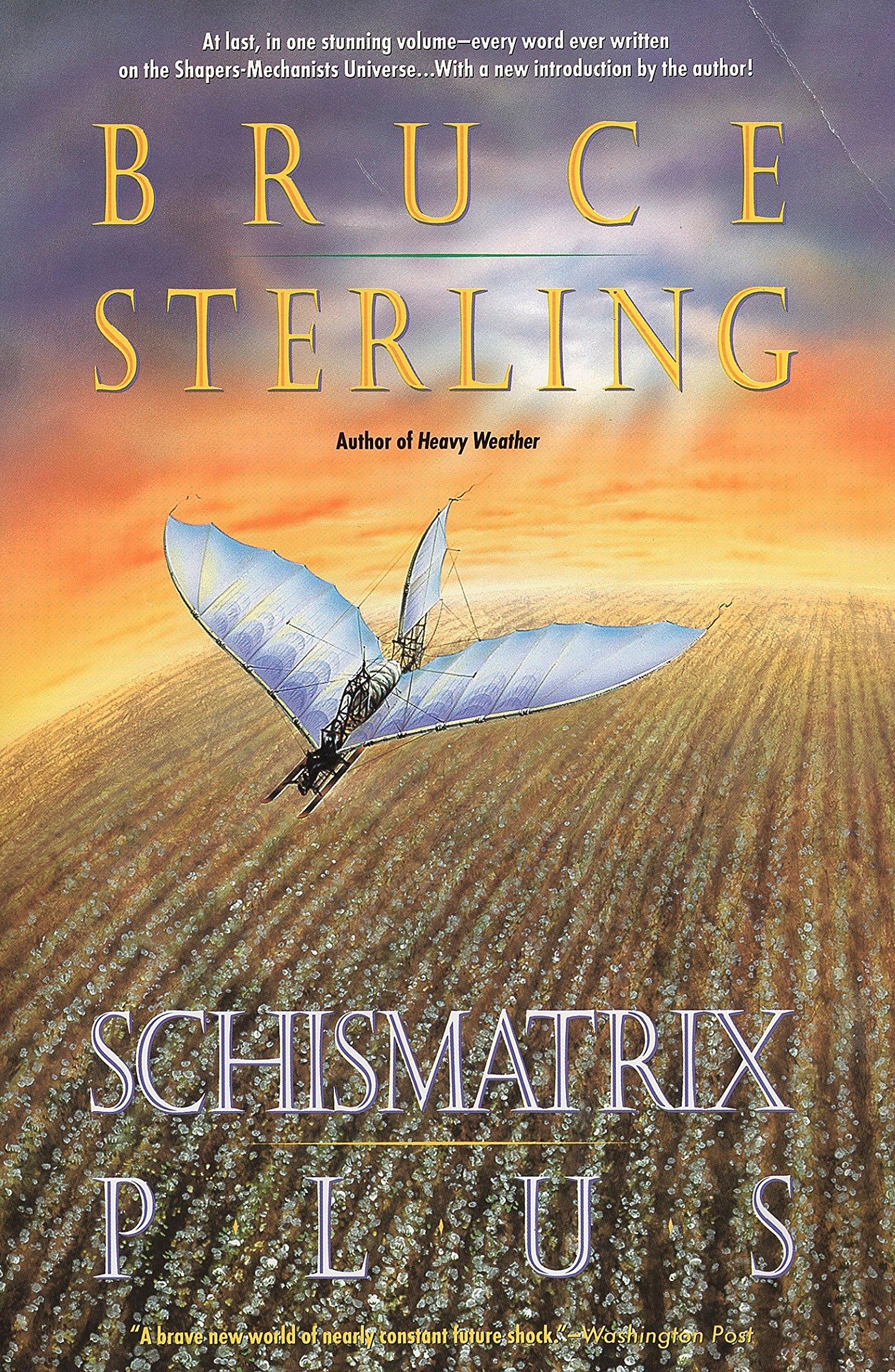
Schismatrix Plus

Image result for schismatrix book cover originalSchismatrix Plus is a science fiction novel by Bruce Sterling, written in 1985. Schismatrix was nominated for the Nebula Award for Best Novel in 1985, and the British Science Fiction Award in 1986. This story is set in Bruce Sterling's fictional Mechanist/Shaper universe. Five short stories that preceded the novel are apart of the Schismatrix Plus edition. The novel by itself without the short stories is simply titled Schismatrix. 

What can I say about this novel? It is simply fantastic and got me more interested in the cyberpunk genre. Sometimes you read a book and something hits you in the head. Bang! This is one of those books. This is an important book. Even a week after finishing the novel I still think about it, the themes and concepts, and especially the ending. 

There's a universe of potential, Lindsay, think of that. No rules, no limits.  

The world of Schismatrix is transhuman. There are Shapers, who use biotechnology and psychology to enhance human potential and then there are Mechanists, who apply AI, and mechanical parts to enhance themselves and become more than human. The Shapers/Mechanists are colonizing the solar system, divided in their two distinct philosophies. 

The book follows the life of a sundog [wanderer, ronin] named Ableard Lindsay, a Shaper with diplomatic training and a brilliant liar, which he uses to great effect. "Before the end of the novel his careers have included being a revolutionary, a theatre producer, a space pirate, a xenodiplomat, a scholar and a prophet." [https://www.aleph.se/Trans/Cultural/Art/schismatrix.html] 

"Politics pulls us together, technology pulls us apart".

Throughout the book changes in technology, habitat, economics, and politics change the dynamics of the entire narrative and discourse. There's a similarity here to the Cold War. This was written in 1985 after all, in a different era from mine [2019]. This similarity is shown when the Shapers/Mechanists have problems when they start colonizing neutral zones. 

The changes force people to adapt, their life styles as well as their philosophies. Some people turn to Zen Serotonin, something of a religion where people get high off neurochemical implants. Others are Cataclysts, who think radical change is a good way to open ones' eyes, whether you want it or not. 

The one theme that repeats throughout the novel is that nothing goes as planned. A plan might work out for a little while, but you have to always be prepared to move on, do something else, just in case. 

He mourned mankind, and the blindness of men, who thought that the Kosmos had rules and limits that would shelter them from their own freedom. There were no shelters. There were no final purposes. Futility, and freedom, were Absolute. [From the short story Ten Evocations]


Futility is freedom could be seen as the overarching mood of Schismatrix. Its impossible to plan for the future because the everything's always changing. But the chaos is also affected by our actions. 

In the short story Swarm, we find have a group of symbiotic non-sentient species living in a hive society. Through this story we find out that intelligence isn't needed for long-term survival, and sometimes it might not even be desirable.  

Sterling makes me think a lot about what transhumans would really be like. Transhumanism is one thing but when its mixed with politics, ideology, and power it becomes something else. Its not a cheerful thing. The flaws in ideology is the price paid for continued evolution. 

One thing I'd like to say that this book made me feel like a kid again. The Investors [tall, big, reptilian-like aliens, who are more interested in business than anything else] were really cool and I could see aliens really looking and acting like them. The ending where Lindsey becomes one with the Presence was pretty great too. Although the actual writing in the novel is a bit dense the mind-set of the novel is tough-minded, and never lets you down. 

The ideas here are thought provoking and would do well to be explored further by Sterling himself [not gonna happen] or others with similar ideas for the science fiction canon. Sterling seems to suggest that there wont be one posthumanity, but many and tremendously diverse posthumanities. Our greatest enemy might be our inability to handle infinite possibilities. [https://www.aleph.se/Trans/Cultural/Art/schismatrix.html]

Wednesday, January 2, 2019

China Mountain Zhang


ChinaMountainZhang.jpgChina Mountain Zhang is the debut science fiction novel by Maureen McHugh. The novel was nominated for the Hugo Award for Best Novel and Nebula Award for Best Novel and won a Lambda Literary Award, the Locus Award for Best First Novel, and the James Tiptree, Jr. Award. 

The book features several stories from a small group of characters, some ABC (American Born Chinese) and others Americans. The story focuses on the story of a gay Chinese and Puerto Rican man named Rafael Zhang in his non-Chinese context, and when with Chinese people he goes by "Zhongshan, which is written with the characters with primary meanings "center" and "mountain"; the Mandarin name for China also begins with the character meaning "center" or "middle". Thus, "China Mountain" is an alternate reading of his Chinese given name. (Zhongshan is also one of the given names used by Chinese revolutionary leader Sun Yat-sen.)" (wiki)  

The story is about how Zhang and how these other characters he meets along his path live in a near distant future, where socialism has completely replaced capitalism, in the Cleansing Winds Campaign, going from arrogant outsiders to finding their place in society. A maturation, a coming of age for all involved.


Zhang is almost thirty and he's just got a two year degree as a construction tech in New York. His Chinese boss wants him to marry his daughter, and he would support him so he could go to school in China and get a good job. In this future, China has the best jobs and the richest people. Zhang meets the Foreman's daughter, only to find out that she's very ugly and needs surgery on her face, some kind of bone problem. 

Zhang goes out with the Foreman's daughter but he doesn't get romantically involved, after all he's gay. Shenanigans ensue with the daughter, the Foreman thinks he's been sleeping with her at his place, after she was missing for days after an argument with her parents. 

Some time passes. Zhang decides he's going to study systems engineering in China so he can get a good job and go somewhere in life. He ends up doing a work program in the polar region, where he almost loses his mind among scientists there to study marine biology. The trade off is that if he works there for a couple years, the government will send him to China where he can get a systems engineer degree, and from there either stay in China and work at a big company, or go back to New York, where he could live with friends and family around. 

On another side story we have a sport called kite racing, where humans have been enhanced and ride these body kites, in races. The racers are legends and the spectators watch them race through the skies on a live video feed, which they can 'jack' into. 

This sub-story involves a kite racing woman who is sort of involved with another racer, who's older brother was a racing legend, who died recently. Although most of this section is sort of filler, and ultimately non sequential to Zhang's main plot, there is an amazing description of the kite racing that had me sitting at the edge of my seat. The way the fliers runs through the air with their bodies, with the impending doom of possible death is quite exhilarating. This was the action section. 

On a third side story we have the Foreman's daughter. She just got face surgery and now she's very pretty. She still works at the same company job, and one night a handsome guy talks to her at some bar. He eventually calls her at work and asks her out. He proceeds to take her to the bar, to a party, then swimming. Then he asks her to his place, at first she wants to go home but the guy makes a stink about how much he spent on her and that all he wants is for her to have a cup of coffee. In the end the Foreman's daughter ends up getting raped. This part of the novel was dark, but it could happen to any woman. She ends up not telling anybody about it, and that's that. She never sees the guy again. It puts a very realistic spin on rape, because it sounds like such a real and believable story. Scary.

At the end of the novel we find Zhang has his degree from studying in China, and is teaching systems engineering at a city college in Brooklyn. However, in China Zhang had a boyfriend named Haitao (being gay can get you killed in this future), who ends up killing himself after a late night party goes awry. Another thing to note is that while studying in China, Zhang tutors a student who's living on Mars, and Alexi, the student, challenges Zhang to think about systems in a completely different way, increasing his skills for his work.

Zhang goes to China to check on a possible job but in the end he gets down on China, even though at the beginning of the novel its his dream to be a big shot in China, making the big bucks. In the end he realized that he liked teaching in New York, that he liked being around all his friends and neighbors, and that he's going to stay put. 

Zhang meets the Foreman's daughter at the end of the novel and they have an awkward interaction. When the Foreman's daughter is about to drive off on the train, Zhang says in her ear that it wasn't her, implying that he didn't want to have sex with her because she was ugly, rather that its because he's gay. We don't get to see a reaction from the Foreman's daughter, as the train door closes and rushes away. 

The novel is quite damn good, very good for a debut novel. The writing brings to mind Samuel Delaney, who can write science fiction but is very literary about it. Also, although this novel is considered science fiction, it doesn't use any typical science fiction tropes, nor does any of the characters impact the world around them in a profound way. In a sense, this is a near distant future about people being people. What makes the book so great is that its all very ordinary, the world and the characters. It also must be noted that McHugh wrote this after living in China for a while, and the novels makes use of tons of Chinese words and culture. Some of the cultural stuff I recognized from things my step-father has told me about China.

This was a great Christmas gift from my dad. The book came out in 1992 and it holds up well to this day. Not all first novels are as good as this one for a writer. Good read even if you aren't into science fiction. First book of the new year already finished. Woo! 

Wednesday, December 5, 2018

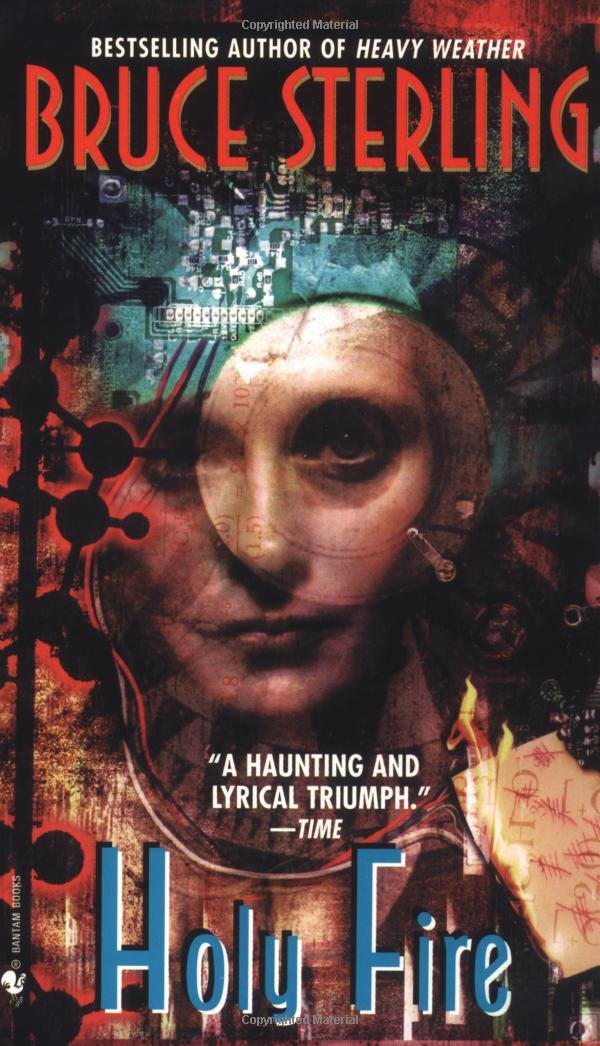
Holy Fire

Image result for bruce sterling holy fire book coverHoly Fire is a great science fiction novel written by Bruce Sterling. It came out in 1996. It was nominated for the British Science Fiction Award in 1996 and the Hugo and Locus awards in 1997. High praise for great art. 

The story follows a medical economist named Mia Ziemann, a ninety-year old woman who transforms into a twenty-year old girl through intrusive technological means. Now (post-op) and borderline psychotic she goes by the name Maya as a young lady, traveling across Europe with nothing but a bag and the clothes on her back. She makes friends with all kinds of artists, bohemians, hackers, and fashion gerontocrats. The story is about life, death, the human condition, art, fashion, a very poetic sort of philosophy and ontology. 

The world of Gilead is somewhere in the year 2100. Gerontocrats control mostly everything and young people are like the scraps on their shoes, living on the margins. However, most things are free, including free health care and food, provided you don't harm your body or anyone else. Its a near future but its not a totally implausible one.

Once transformed, Maya gets caught up with thieves and drifters, eventually making her way into the fashion/modeling industry because of her sexy look. From there she makes friends in high places, mostly programmer types that help her with her palace, a digital life-space given to her by her now dead husband, complete with ruins and stuff. This is a cyberpunk story and the technology here is out of this world. Even with Sterling's esoteric explanations, the tech can get lost in between the dialogue, which is what helps make the novel move along nicely. 

Sterling gets very in depth with the virtuality within the story. His scientific explanation for Ziemann's transformation was quite complex. It was like reading Greek for me. However, it was mostly just advanced biology terms. The tech stuff here reminded me of William Gibson. Although I think Gibson does it better because he's able to make more out of the tech with his literary technique. 

Anyways, Ziemann gets caught up with a bunch of rich, radical anarchists and they plan on 'living forever' and taking control of the system, and this and that...But it turns out in the end that Ziemann gets caught up with the police, who were tracking her down because she skipped out on paying back her medical bills for the youth procedure. And not only that, but her dead husbands' talking dog Plato was always in the virtual palace, he'd been looking for her too. 

Ziemann goes through an ontological transformation. She realizes that she doesn't want to go back to being a gerontocrat, and that she wants to be a young photographer, even if she's really bad at it. It takes becoming a full blown criminal, a celebrity (at the end), a widow, and a Frankenstein-esque monster to realize what she wanted in life. 

The novel contains many debates between these young bohemian types over the immorality of immortality as well as the aesthetics of fashion. The underclass here are also talked about frequently, the class of people who can't become 'post-human', those are the real disenfranchised of the story. 

The writing of this story is free flowing with great metaphysical ideas. This is mostly done through dialogue and small events that happen over many pages-fifty pages here, another fifty pages there, etc. Although there are heavy cyberpunk elements here the ideas presented command more authority than mere tech. This isn't an easy novel to understand but its easy to read because the dialogue is interesting and the characters have artistic and idealistic charm.

If you want a different sort of cyberpunk novel this is for you. If you want a different sort of science fiction novel, this is it. They don't make science fiction like this anymore these days. And this was only from 1996! 

I'm currently waiting for my order of Bruce Sterling's Schismatrix. I heard from my father that's his most important novel. After reading his amazing collaboration novel with William Gibson, The Difference Engine, this was a great follow-up. On his own Sterling has grandiose philosophical ideas to go along with his cyberpunk technology. It has legs. 

Sunday, February 4, 2018

Bird the Saxophone Playing Robot

Hello, what's up everybody? This is a new idea I'm trying out, instead of writing so much about certain subject matters I'm going to start writing short stories and eventually write an entire novel if I can get something interesting enough to keep writing for long periods of time (lol). Anyways, this is the first short story and its called Bird the Saxophone Playing Robot. Its a light-hearted yet serious story about a robot who gets backlash by humans because people can only see robots as creatures of labor, much to the robot's chagrin. I'm going to work on it in installments. Thank you. 

Bird was at the end of a set at the Jazz Estate, a top notch jazz club in New York. His 1960's Selmer saxophone glistening in the shadows of the dim performance hall. His solo was quite something. Sheets of sound, as they called Coltrane's sound in the early 60's, but with melodic, fast, and improvisational lines more akin to Charlie Bird Parker. This was Bird, a robot designed by US Robotics Corporation in the year 2077. Bird was of course named after Charlie Parker, however no matter how hard Bird swings, he can't get any slack. He ended his solo, played the head to All The Things You Are and ended the tune over a major sixth chord. 

He walked to the backstage room and sat down, thinking about the music, how certain parts sounded great, others were just okay, and other similar thoughts. He heard someone tapping at the door and speaking to get his attention. 

"Hey, whats up Bird! May I come in?" 
"Come on in. I'm just chilling", Birdbot's voice a low melodic whisper. 
They talked about the performance. Bird's friend was a human named Varian who was a close and longtime friend, music collaborator, and quasi promoter and manager. He was a young white man, with long brown hair, and he often wore sunglasses even indoors at night. They talked more about the music. 

"Really cool set out there man", Varian said, his voice a Californian tenor. 
"Thanks dude, yeah I was really trying to channel my inner self, my soul. I'm getting ready to record an album of all original compositions, I wanted you to go over my arrangements and see if anything needed changes." 
"Sure, I can do that. Would you like me to play (piano, Varian is a pianist) piano on the album?" 
"That sounds great!", Bird's voice as gay as an actual songbird. 

They laughed and were as happy as ever. Bird was a young robot, just freshly built off the assembly line some five years ago. Varian was in his late twenties, and although his best friend was a robot, he made a living out of playing jazz, arranging, and composing. He helped Bird find gigs, and oftentimes they would play together in the same bill, either in the same band, or in different groups. They were quite simpatico you would say. With his help, Bird would release his own album as a leader and composer, and he would help arrange and even perform on it. Times were good. However there was one issue to contend with. 

Humans couldn't stand Bird's playing. Although this was the world of tomorrow, people weren't used to the idea of robots as artists, especially talented robots that had genius attached to their positronic circuits. I'm speaking metaphorically of course. Humans still only saw robots as vehicles of labor, not of art or performance. Such was the fate of our virtuoso saxophone playing robot, nicknamed Bird because he loves Charlie Parker but whose actual name was Sigma IV, a robot originally designed as a family robot. Eventually, Sigma IV got tired of the family robot gig and found out that he wanted to be an artist. 

He had been listening to Charlie Parker for a long time. His first family had tons of jazz records and they would play them often. He learned to love the sound of the saxophone and the bebop era in general. He also loved free jazz era Coltrane, Ornette Coleman, Eric Dolphy, Monk, Dizzy, Bird (his favorite), Miles, all the cats. Eventually he figured out that he had to be a jazz musician, it became his goal. He bought a sax and started practicing all the time. Eventually, he became really good, and he pulled a LeRoi Jones and changed his name to Bird. 

Nobody had ever heard of a robot playing jazz before, so Bird was in for some major backlash. He was the first of what would become a societal norm. But that's far down the line from when this story takes place...

Tuesday, December 26, 2017

The Machine Stops


The Machine Stops is a science fiction short story written by E.M. Forster in 1909 for the Oxford and Cambridge Review. At 12,000 words its pretty detailed. This isn't your third wave science fiction folks, which is what I'm more used to.

Here we have a civilization that lives in honeycomb-like underground cities. People don't touch each other, not even for handshakes or hugs. People have become anxious when it comes to non-virtual meetings. Each pod that people live in comes with one book, The Book of the Machine. All other books and information are electronic. "All other info is electronic, and the forests, Forster explains, "had been destroyed during the literature epoch for the purpose of making newspaper pulp." The Book not only instructs which button to push when, but alleviates the trepidations of life in the Machine." (Wired) 

The story focuses on a mother and her son. The mother is a lecturer (I think she teaches music of certain civilizations) that gives these lectures from inside a room that is controlled by machines, much like how today we can do tons of things in the comfort of our homes, behind our computer screens, Iphones, and television screens. Her son is against the Machine, the electronics that give the people everything they need, from beds, email, to video (a prehistoric FaceMeet, where you can video call people). The people live underground with no sunlight of course but they can go to the surface, if they wear the proper attire (facemasks, the air can kill them) and if they have permission from the Government. We learn that this guy makes illegal trips to the surface often. He's quite the resistance type. 

Even scholarly trips to the surface are not allowed. Experts get their information about the surface from the Machine, a sort of proto-google. The Machine doesn't sustain itself forever. Life is not getting better. The music starts to get blurbs and bad quality sounds. The water has a smell. The Government says they're fixing the problems with the Machine but the repairs needed exceed the damage that keeps accumulating.

On the final day Vashti (our mother character) isn't doing so well. She's horrified to see whats outside her cubicle.

She whirled around, praying to be saved from this, at any rate, kissing the Book, pressing button after button....
An airship ... crashed downwards, exploding as it went, rending gallery after gallery with its wings of steel. For a moment they saw the nations of the dead, and, before they joined them, scraps of the untainted sky.

And I thought working a nine to five everyday for the rest of my life was scary. 

Here we have a science fiction dystopian sort of story that looks similar to the world we live in today. If all the computers in the world crashed right now the entire world would go into chaos. We're reliant upon these machines for everyday life. Could you live without a smartphone? I don't even own one and never have. We think we can do without it (modern technology) but most Americans would never put themselves through that. For them it would be torture, even for myself. Have we really empowered the machines to the degree that we've become weaker as humans? Perhaps that was what Forster was going for. Nevertheless it certainly makes for interesting science fiction writing. Everyone that likes science fiction and uses computers should read this short story, there's a lot to be gained from its dark brooding mentality about technology.

Read the full story here.

On AI, Existential Threat, and the Collapse

Good evening ladies and gents. Hope you all had a good Sunday. I wanted to write here a bit more about AI, existential threat, and the Colla...