Showing posts with label revolution. Show all posts

Friday, January 13, 2023

The Age of Voltaire by Will Durant


The Age of Voltaire is volume 9 of Will Durant's Story of Civilization series. So far I've read four of Will and Ariel Durant's Story of Civilization series of books: The Italian Renaissance, The Life of Greece, The Age of Reason Begins, and now finally I've read The Age of Voltaire. 

Closing this book, I felt that this was an extensive and comprehensive history of the age right up to and leading into the French Revolution, the Age of Enlightenment in France, roughly 1680s-1780. Voltaire was born in 1694, ensconced in education through the Jesuits. The Jesuits were the main educators in this period and had a lot of influence over schooling of children [boys and girls] and even sometimes in government and various occupations. They were known for being very educated and lenient towards their people, although they themselves were also quite dogmatic about Christianity and its spread throughout other parts of the world like in Latin America and even China. Despite this early great education from the Jesuits, Voltaire grew to increasing dislike the Church as he gained more fame and influence. He spent a lot of time running around to different homes and even the home of Frederick the Great because of his critiques of the church and nobility.  

However, there was a lot more going on in the Church other than Jesuits. There was the growing disputes between church, the peasantry, the aristocrats, the nobles, and the church's feuds with protestants [Jansenists], Catholics, and atheists from the philosophes, the intellectuals [writers, philosophers, scientists, artists, mathematicians, playwrights] like Voltaire, Diderot, Rosseau, Montesquieu, and d'Alembert. These named in particular would have the greatest influence on France and in the world. 

It should be named that being a philosopher in 18th century France isn't the same thing as being a philosopher in the 21st century. These intellectuals delved and wrote in a variety of fields and styles in order to reach their audience in the best ways they could. Voltaire didn't think much of giant books like the Encyclopédie [famous 18th century book from France by the philosophes], rather he thought that small books easily concealed would serve him better. So he ended up writing a lot of small works that contributed to his vast body of works. So Candide ended up becoming his most famous book.

But not every intellectual was an expert in a particular field. Rather a philosophe, was someone who was expected to know a little bit about every subject, even if they themselves weren't a master in each field. In order to write the Encyclopédie, the writers utilized and employed different philosophes for different phrases and words that they didn't feel adequate enough to cover themselves.

What caused the French Revolution? This book doesn't entirely aim to answer this question, rather it focuses more on historical detail. But after reading The Age of Voltaire, you can figure it out.

France was deep in debt from wars and the debt fell upon the peasants more and more, as the nobility became more and more corrupt. Tensions increased between the nobles and the church, and eventually even the Jesuits who had educated all the best minds of the time, were expelled from France. On top of that, the educated people were being more and more exposed to the works of the intellectuals of the time, the philosophes, and now, more than ever, people were more willing to become atheists, little by little, influenced by these great men with big ideas, ideas that changed the world, would eventually lead to the world we live in now. A world of more religious toleration, human rights, democracy, and equality.

Although the Age of Voltaire was published in 1965, it seems to somehow resonate in the scatter-brain afterimages of 21st century 2023. There's something there in this book that has an everlasting effect on the time it is describing, the time it was written in, and the time I live in now as I write this. It seems that now, more than ever, we're living in a world increasingly fraught with the same problems, plus a bunch of new additional ones, that weren't quite resolved from the French Revolution and perhaps never will be solved.

It has occurred to me after reading four volumes of Will Durant's Story of Civilization series, that the problems of any age seem to follow and recur in many others. There's always an endless cycle; renewal, back to the classic ages, onto a newer more advanced, more intellectual more philosophical more scientific less God, then an eventual regression back into a simpler mode of civilization, except we never really find out or perhaps we never can find out, that the civilization itself has already and always collapsed, only to be rebuilt by other people anew.

It is said that on his deathbed, Voltaire, when asked to return to the faith of his fathers and renounce the devil, responded with, “This is no time to be making new enemies.”

Tuesday, April 21, 2020

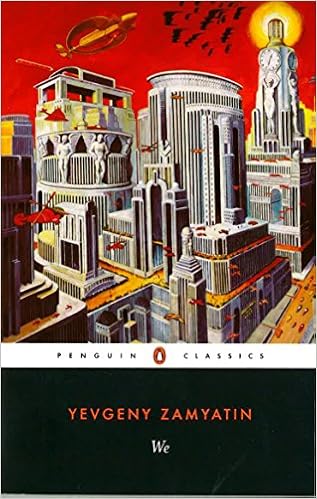
We

We: Yevgeny Zamyatin, Clarence Brown, Clarence Brown ...
We is a classic dystopian science fiction novel by Yevgeny Zamyatin, written in 1920-1921, published in 1924, via English translation in New York. Yevgeny was part of Russian proletariat writing groups and eventually requested to leave Russia as many writers were being persecuted, thus resulting in the death of their writing careers. In fact, when Zamyatin died, there was no mention of him in Russian papers. Most proletariat Russian writers made livings elsewhere like in Paris, England, and the United States. 

The novel depicts a world of harmony within a totalitarian system. There is freedom but only ruled by the Benefactor and activities are ordered along to the 'Table,' a system that controls every hour of everyone's day. In some respects, there wouldn't be a Brave New World by Huxley if it weren't for We. No 1984 by Orwell. No Handmaid's Tale. There wouldn't be all those tons of young adult dystopian novels either. We did it first. 

I will focus on the plot first because it's pertinent to the ideas therein. 

We is set in the future. Probably far future because they have space ships. It's said that there was a great war over something, which is only alluded to in the novel. A resource perhaps. It resulted in the use of weapons of mass destruction, leaving the world outside One State a post-apocalyptic landscape. 


The main character is D-503, a space engineer. People have no names, rather they are identified by number. It takes place in an urban society constructed of glass, which helps for mass surveillance. The people march in step with one another and wear uniforms.  Life is managed scientifically; everybody eats at the same time, works the same time, has recreation hours at the same time, and they even have scheduled times to have sex with partners they can sign up for, rather than of their own choosing. People think with science, logic, and reason above all. The formulas people use are ones devised by the One State, their form of government, lead by the Great Benefactor, their supreme leader.

One State has conquered the whole world. They're now building a spaceship in order to invade and conquer other planets, thus bringing One State across the universe, helping their cause, and increasing their numbers. The ship's project engineer D-503 writes a journal that is meant to be brought along the spaceship when they go to another planet.  

D-503 lives in a glass building like all the others. His partner, O-90 is deemed too short to bear children and is upset by this. His best friend is R-13, a guy who reads his poetry verses at public executions. On an assigned walk, D-503 meets I-330, who flirts with him without being properly assigned. I-330 is a careless free spirit; she drinks alcohol, smokes cigarettes, has casual [not assigned] sex. Every guy has met a girl like I-330, that footloose, and fancy-free girl. In short, she's doing everything that you're not supposed to do in One State. D-503 is appalled but intrigued at the same time. He continues to see her. 

D-503 starts to have a lot of freedom through I-330 and starts to have dreams, which the One State describes as mental illness. "What's wrong with me doc?" "You've found out that you have a soul, for which there is no cure." That's my favorite line in the book because it has that edge of snarky satire as well as philosophical ramifications that goes back to the Greeks. It works well. 

Slowly, I-330 reveals that she's part of an organization called Mephi, which plans to bring down One State. O-90 wants D-503 to illegally impregnate her but in order for her to stay with the baby, she has to leave One State and go beyond the wall, where primitive humans live, complete with coats of fur. 

The last journal entry details the 'Great Operation,' a brain surgery of sorts, that targets the brain with x-rays, so they can function as 'tractors in human form.' It basically makes you more of a vegetable. Removes imagination. Once D-503 gets the operation he runs to the Benefactor to tell him about the Mephi operation. I-330 and her associates are sentenced to death under the Benefactor's machine, which literally melts the human body. A  death ray.

But the novel ends on somewhat of a good note. The Mephi operation is doing well, birds are repopulating the city, and people start acting out against the regime. One State's survival is left in doubt. The book ends with a strong manifesto; just as there is no highest number, there can be no final revolution. 

 Now we get some ideas. 

First, the writing style can, at certain times, be quite a satire. There's one scene early in the book where a woman is playing the piano and people are watching and listening to her play. At one point during the impromptu performance, which is already rare in this society, D-503 starts laughing uncontrollably because music is such an unstructured improvised form that most of the citizens just aren't used to. 

The scene with the doctor is my favorite in the book. "You have a soul. There is no cure." That's a great satirical moment, a great laugh. Of course, it was true, D-503 had indeed, somehow developed a soul through his new girlfriend, I-330. 

The idea of having sex only with assigned partners and only at certain days and times is also a laugh. Did they also forbid masturbation?

There are philosophical ideas at work here too. In fact, the doctor scene isn't just a satire, there's a religious tone to it as well. The idea of the soul separate from the body and mind goes back to Plato and Aristotle. This is used in fiction to good effect. The fact that D-503 developed a soul rather than being born with one is another note on satire. 

The idea of a conformist culture where everybody is happy [for the most part One State is happy] should be considered utopian, right? Well, the thing that makes One State a dystopian novel rather than a utopian one is the fact that One State not only wants to take away freedoms [which is fine because most of the people are cool with that], but One State also wants to get rid of imagination. In We, imagination is the mind-killer rather. If the citizens of One State were allowed to imagine this would be an entirely different novel. 

Lastly, this is one of the important and critical works in science fiction, particularly in the dystopian canon. I initially read this on the recommendation of a Russian friend of mine. I'm glad I read it because it's truly a great story and it stays with you. This isn't something you read and forget about a few months later. It's that important of a book. Considering the way governments are run today you will find that Yevgeny Zamyatin's ideas still ring true to this day. For just as there is no highest number, there can be no final revolution.

Saturday, April 4, 2020

The Moon is a Harsh Mistress

The Moon Is a Harsh MistressThe Moon is a Harsh Mistress, the novel by the classic and famous Robert Heinlein is one of those classic science fiction novels, from the golden age of science fiction, the 50s-60s. TMIAHM was initially released through magazine installments, later as a full novel. The novel won the Hugo Award for best science fiction novel in 1967, during the height of the flower power hippie movement.

Which was great timing for Heinlein to write this book. For you see, this book is a good story, but it is also an exercise in literary politics and/or political economy, particularly libertarianism. So it makes sense that Heinlein would publish and write books with this flavor of politics during the 1960s when many young people would be exposed to these, then new ideas for them.

Let's start with the story. This is a story about revolution. A lunar colony on the moon is taking control over the colony, giving it to the people [in this case, our narrators/main characters], and saying, "screw you," to Earth, and all the Earth countries that won't recognize this new regime. 

The new regime comes to be through a particularly striking main character; a sentient supercomputer who befriends the narrator and his two friends. The supercomputer, named Mike, is so lifelike, but the fact that he wants to help humans stage a revolution and succeeds in helping them do so, makes him a lot like a computer Pinocchio. What does he get out of it? Friendship really is all. It's worth it.

The narrator, the main character as well, is a guy named Manuel, who's first language seems to be Russian, so he speaks in a sort of broken English not unlike what you would see in Slavic languages. Sort of like the slang in A Clockwork Orange. The first couple of pages reading it is sort of strange, but then you get a feel for it, and just go with it. After all, you can't expect everybody you talk to, to speak in perfect English, better get used to it. Mannie is Mike's technician, and he isn't a much of a political guy, but he gets roped into this. 

By a woman of course. Wyoming Knott-Davis. She's a beautiful blonde. For a while, she uses advanced technological makeup to make her look African while she's in hiding, complete with an afro. But she's blonde most of the time. She gets Mannie involved with politics, after Mannie saves her from a blood bath, as you see a political secret meeting against the Warden took place, and it was raided by Dragoon Troops, the Warden's hired goons. The action scene that took place in that instant was classic military science fiction, complete with laser guns, blood, and gore. I liked the scene a lot and expected more of this. Ironically, there isn't much actual fighting and action, at least not till the very end. But our three characters needed one more person to help them realize their mission. 

Enter Professor Bernado de la Paz. He's an old teacher who's taught nearly half of Luna. He describes himself as a Rationalist Anarchist, which basically means that the government has no existence but for the acts of responsible individuals, "tries to live perfectly in an imperfect world." He's the true radical of the group but realizes that the need for the government does indeed exist and achieves it.

Some info on the world-building here. Luna is seen as a sort of Old West, and the revolution is reminiscent of the Bolshevik October Revolution as opposed to the American Revolution. People are sent to Luna either to escape bad fate, live a new life, or they're prisoners. Luna is short on women so women are heads of families and families are composed of 'line marriages,' giant families that pool all their resources together. Once when Mannie is in North America he gets arrested for polygamy, as he has multiple wives. Women are so scarce on Luna that they never get hurt, or even raped. They're safer there than on Earth surprisingly, even among criminals.

So we have these characters achieve a revolution. Now what? They do their best to form a government, get the rest of the world to recognize their new independent status. Failing that, they 'throw rocks,' at the Earth, hitting most of the countries with heavy bombs, carefully shot from Luna with the help of Mike, a ballistics expert, who even gets his own human persona, which he creates using images on a screen. What a computer! Probably the best-written computer character I've seen in science fiction. 

After the Earthlings get mad at Loonies [yes that's what they're called] for bombing them, they retaliate by indoctrinating some prisoners and drugging them, telling them that unless they kill as many Loonies as possible, they won't get their freedom back. This results in an epic bloodbath on Luna. More Loonies die in the firefight that ensues, but they kill all the Earthling intruders and come together more than ever. In a blaze of glory!  

Realizing that they failed, the Earthlings concede Luna's independent status and the mission is complete. It's a great read in terms of story, plot, characters, politics, and philosophy, but the thing that can't be overlooked is that this is just a damn good story. Definitely read this is you're a science fiction avid reader. Don't get me wrong, this is not a masterpiece, but it's important enough that it's a must-read science fiction novel, in my humble opinion. 

On a side note, reading this during the pandemic has me thinking a lot about politics. Could it be that the politics that emerge out of this historic pandemic would shift to a more libertarian sort of state? Something to think about.

"There Ain't No Such Thing As A Free Lunch!", (a common expression on Luna that states one of the main ideas of the book's political system.)

Friday, December 27, 2019

The Proletariat Christmas

The last two weeks have been pretty rough at the retail gig. The holidays have come and gone, save for New Year's Eve and New Year's Day. It's been rough. That's a phrase I've been saying a lot at work. I'm just a little stressed. That's another likely quote. How do you fight back against this stress, this holiday frenzy, eating away at the core of modern American society? 

Well, the thing is, you just have to rise above like the Black Flag song. Inevitably every little thing in our lives affects us at least somewhat on somewhat of a scale. One of the best pieces of advice my manager at work gave to me was, "no matter what happens, just go with it." At first, this sounded to me like a plea of defeat. But then you put it to practice and see how useful it really is. 

There are two kinds of customers in retail work: assholes and friendly people. There is no in-between. You might think you're a tough guy and that nothing anybody says to you can ever affect you but in reality, every interaction we have affects us in some way, however small, or large.   

Think of all the people you've met in retail work [if you work in retail] that you've ever had contact with.  Most of it is overwhelmingly positive, at least for me. I'm pretty much something of a celebrity at my job, just for the sheer fact that I'm a unique personality [I talk a lot to people about books, music, guitar] that people never forget me and want to talk to me more the next time they come in. I think that it just shocks people that I'm a big black dude that shreds the guitar like Hendrix and reads Heidegger. They will never meet a black man quite like myself ever in their entire lives. In that sense, I'm something of a novelty. The other side of it is the depressive, melancholy that comes with the retail experience. 

A large chunk of that melancholia would be bad interactions with customers. Customers who are overwhelmingly rude, customers who want to take advantage [return things with no receipt, demand cheaper prices, yell if it doesn't go their way, etc], upper management that tries to tell you how to do your job even though you've been working there longer than them, and the rest is just low-level grunt work that gets old fast.

There's also a sort of late-night depressive side of retail. When you work 430pm-1am 5 days a week for seven years straight you start to find that you're thinking more about the darker side of life at the later hours of the shift. Ironically it's at these hours that I feel the most awake, the most alive, in a sense. When I come to realizations. 

But wait. Here's the good news. This is happening to other people too. Not just you. The modern American workers need to rise up in solidarity. The middle-class, upper-middle-class, and rich people with their nice cars, their mocha frappuccinos, their office jobs, and their gym memberships know nothing of the true struggle of the proletariat.  If it were up to them they would stay rich and you would stay poor, indefinitely. And if you don't recognize this truth, then you aren't one of us. 

This is why it is so important to have a worker's movement in America. The modern American worker is losing so much right now. The rich are so happy with their fancy video games, their pornography, binge-watching their favorite Netflix TV shows. They know nothing about what it's like to be a true proletariat. 

The next worker's revolution is coming sometime. There will be no video games, pornography, or Netflix in it. 

The revolution will not be televised. Say goodbye to the bio-mass. 

September Sweater Weather

Good evening ladies and gentlemen, hello world. How are you?  It's good to be writing on a good day off work today on a Saturday. Here, ...