Showing posts with label classics. Show all posts

Sunday, August 3, 2025

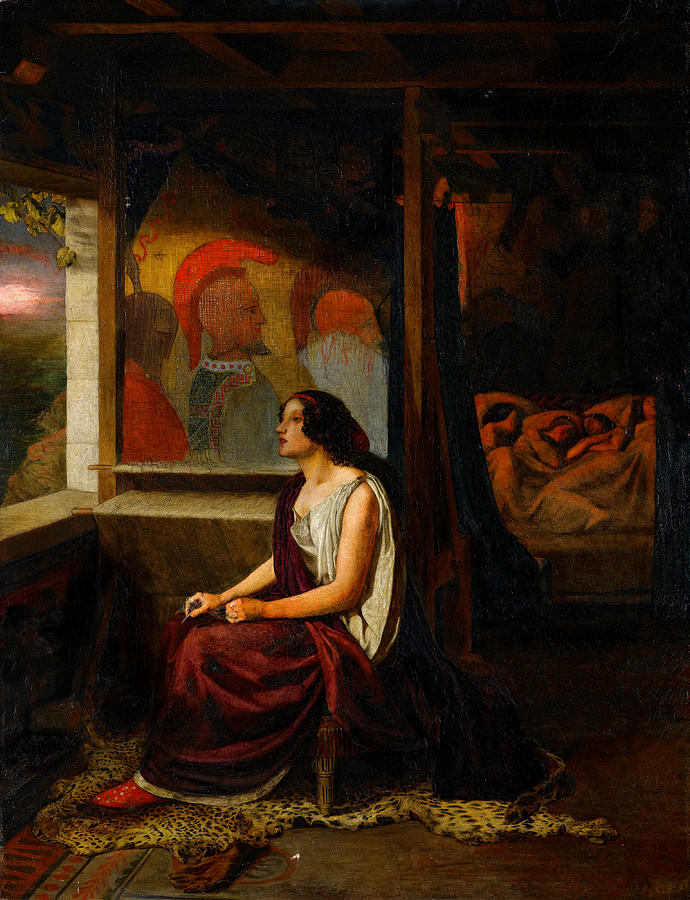
Eliot's Renaissance Tempest: Romola's Moral Crucible


First, it may be surprising that, George Eliot, famous writer of 19th century English novels wrote one novel about the Renaissance period. Romola is George Eliot's fourth novel, a significant departure from all her other novels. Romola is set in Florence in the 15th century of Niccolo Machiavelli, [he's a minor character in the book], during Christian religious leader Savonarola's rise. 

George Eliot took meticulous notes on the Renaissance period for this novel and dives in deep to explore the themes of humanism and psychological human struggles. This is most likely Eliot's most intellectual novel, whereas her more popular books like Middlemarch and Mill On the Floss focus more on the intimate social realism of rural England in the 19th century, the core of all her writing and style. However, for the curious western canon reader, this book is not only important, but is a must read.

Second, Eliot uses the world of 15th century Renaissance Italy as more than a backdrop, it is a protagonist, the city itself comes alive almost like a character. This is one of Eliot's strongest stylistic writing skills. The political machinations of the city have it come alive like a person. The Medici's versus republicans, artististic ferment, impassioned religious leaders [Savonarola], and the passion of learning, ambition, and decline. The setting is important for the characters because it helps to explore the themes of humanism, faith, individualism, and communal duty. 

Third, Romola's journey from naive helper-scholar to her blind father to adept Holy Madonna is not only inspiring, it is downright transformative. Romola is one of Eliot's most well thought out characters, like Tito, her husband. Her duties were initially to help her blind-scholar father, her god-father, and her husband Tito, who she marries, but along the way she finds herself in struggle and contradiction. As every powerful character in Eliot's novels, she has to make tough decisions in order to find meaning in her life. She might be the most powerful and transformative character in Eliot's writings. 

Fourth, Tito Melema. Tito is a remarkable villain and, one of the best villains in Eliot's work. He's good looking, tall, dark, personable, intellectual, ambitious, but he's also backstabbing [marrying a peasant girl behind Romola's back and having two kids with her], he's so ambitious to the point of getting too involved in the internal politics of Italy [thus garnering him enemies], he backstabs his father who adopted him as a child, and because of that, his father ends up getting his revenge. Tito's Father's revenge is ultimately satisfying although not quite as action packed as one would think it would be. Most writers will never be able to write a better villain. If Romola represents Life and Holy Goodness, then Tito is Death and Intellect

Moving on, Savonarola plays a big role in the stage because of his strong religious fervor and influence. He's reacting against corruption of politics and the church, offering a powerful vision of moral renewal in Florence, Italy. You could say that because of Eliot's ideas on religion, she always has strong ideas of religious characters, ideas, and influence. You can say that she never has anything bad to say about religion. The role on religion on Romola is immense, to the point where in the end she finds a village suffering from the plague, and she ends up helping and saving a lot of them, thus becoming a Holy Madonna

Finally, putting it all together. Eliot's dense, allusive, descriptive, intellectual writing style in a psychologically penetrating prose style is what makes this book an amazing read. She's able to successfully and accurately use historical notes and detail without losing the narrative flow or psychological state of the characters. Her characteristic philosophical concerns are explored through this unique renaissance prism. The novel is considered Eliot's least popular novel and it was received with mixed reviews, but reading it in 2025 feels as fresh as a daisy, and I believe its a must read for the western canon list

In conclusion, like many historical novels of the western canon, this novel has epic scope. When the fires of belief and lightning of new ideas clash across Renaissance Florence, testing one woman's soul as kingdoms fall and fanatics rise, George Eliot's Romola forges a story so powerful it echoes through centuries, standing forever as a towering testament to how we hold onto what's true when the whole world shakes. The novel begs to ask the question, "How do we find meaning in our lives?" You could say that is what every George Eliot novel is really about.

Wednesday, February 24, 2021

Dubliners

Dubliners by James Joyce is one of the best collections of short stories. Maybe the best ever of all time. Yes, it's that good. 

This is a collection of short stories based on people, their lives, relationships, and the history of their times in which they're living in, Victorian era. It's based in Dublin, Ireland, which is full of alcoholics, Catholics, Protestants, Priests, school children, working people, and rich people of the Victorian style era in which this is written. 

What makes James Joyce's stories here so great and so effective is that he writes a simple style that is easy to read and understand. Not only that, but his stories go somewhere emotionally, something that is very much lacking in modern entertainment like video games, television, and movies where things simply just happen in a linear escapade. 

One of the stories that hit me hard was the one where two friends are talking. One is a bigshot that made it in Europe, traveled everywhere, has a great career, wife, and kid. The other didn't make anything of himself and never left their hometown. We get the idea that the other didn't appreciate his friend because he declined his friends' offer to see his wife and kid, thinking that his friend thinks he's better than him because he's so successful in life. But at the end of the story we find that the successful one with the wife and kid is actually miserable and doesn't like his life. Things like that are impressive in writing, that sort of contrast.  

There's a meta magical realism in James Joyce's writing that is unmatched even by other writers of the same period like say for example, Jane Austen. It's realism but there's always a little something extra, a twist here and there that makes the short stories pop and shine with luster unmatched by other writers of his time period, of even the entire western canon. I haven't completely tapped into and understood this writing style completely, but I will understand more when I read more of his works, the next one being Portrait of an Artist as a Young Man. 

Lastly, a review can't be written without mentioning The Dead, the story at the end. Here we have a party where a wife and husband attend. The husband is ready to have sex with the wife in their hotel room, but he sees she's crying about something so it doesn't happen. It turned out that she was thinking about a boy she loved when she was younger, who was a great singer. Music is very important in Joyce's world. In Ireland. In Europe in general during this period. The husband realizes that his relationship with his wife is actually nothing in comparison with the boy who died loving her. The snow falls outside the window. It doesn't really get more meta than that. 

James Joyce is one of the greatest writers of the western canon. I plan on reading much more of his works: Portrait of an Artist as a Young Man, Ulysses, and Finnegan's Wake. 

Tuesday, September 22, 2020

Thoughts on Tolstoy's War and Peace, Parts V-X

Tolstoy - War and Peace - first edition, 1869.jpg
 

Okay, so if you have made it this far on my series on War and Peace, thanks for reading. Make sure you check out the last post here. So if you saw that post you noticed that although the book has many characters in it, I focused mostly on Pierre and Prince Andrey. 

Pierre goes on a hunt for spiritual enlightenment by joining the Freemasons. Andrey recovers from a near fatal wound from an army battle, only to come home and have his wife die from childbirth, the child Nikolai survives but Andrey feels bad that he didn't treat his wife better. 

Pierre's wife, who Pierre had a falling out with because he believed she was cheating on him, begs Pierre to take her back, and Pierre, urged by the Freemasons' laws of forgiveness, decides to take her back. 

Natasha, the Countess of the Rostov family, is engaged with Prince Andrey. However, she meets a new man, named Anatole who seamlessly gets her to fall in love with him, and him with her. Faced with new feelings of loving a different man other than Prince Andrey, she inevitably breaks off the marriage with Andrey, which was scheduled to go on. This entire section devoted to Natasha, her falling in, and consequently out of love is such a heartbreaking part of this book. Because when you see that she could have been happy if not for wanting more, wanting what she couldn't have, you see how capricious love really can be sometimes. What is also interesting is that Pierre realizes he's in love with Natasha. And Prince Andrey coldly accepts Natasha's break off of the engagement, but he doesn't wish to ever see her again. 

Meanwhile, the whole of Russia is fighting Napoleon's army. Napoleon is characterized by Tolstoy as a charismatic man, even a good man, although he has his moments of arrogance. At times he sounds like a guy who loves the sound of his own voice. But at other times, he's sympathetic, caring, charismatic, powerful, well spoken, the very best of the best qualities that leaders and generals all share. Napoleon is a man who has many virtues according to this description in the book. 

Alright, so all these things are happening right after the next. But it is also at the end of this section [or near it at least], where the rest of War and Peace becomes a reading difficulty, the strain on you from reading the book becomes much more intensified, there's a degree of heaviness that bears upon the soul. Because of that this is probably one of the most difficult, most intense books I have ever read, maybe will ever read, who knows. 

Because you see that Tolstoy puts every emotion: joy, surprise, fear, disgust, anger, contempt, and sadness, and all the variations on and between them. This is what is meant by the fact that the second part of War and Peace [this part and onward to the end] becomes less a literary novel and more a grand philosophical design. "Tolstoy wrote in a letter to Afanasy Fet that what he has written in War and Peace is also said by Schopenhauer in The World as Will and Representation. However, Tolstoy approaches it from the other side." [wiki]

"Tolstoy said War and Peace is "not a novel, even less is it a poem, and still less a historical chronicle." Large sections, especially the later chapters, are philosophical discussions rather than narrative. Tolstoy also said that the best Russian literature does not conform to standards and hence hesitated to call War and Peace a novel. Instead, he regarded Anna Karenina as his first true novel." [wiki]

So when Tolstoy puts these aristocrat characters in these very personal, intense situations, and then he goes into every detail of their lives in a grand philosophical way, you get to experience philosophy in a much more literal literary form. It's been simplified of course so that we can experience it more from our hearts rather than just from our heads. This is important to note because I think this is what is meant by the fact that Tolstoy says the same thing as Schopenhauer in his The World as Will and Representation, but "from the other side," the other side could perhaps be the heart rather than the head [or brain]. I've also seen this particular comparison in Fritz Lang's Metropolis [the mediator between, the heart and the brain]. 

The book has become immensely more difficult but I plan to be done with the novel perhaps by early next week, perhaps earlier. At this point its not about how long it takes to read 1200 pages, rather it is about all the thinking that takes place when one reads something like this. You'll be thinking a lot. Nonstop, in fact, it seems. 

Tuesday, September 15, 2020

Thoughts on Tolstoy's War and Peace, Parts I-V

 
Tolstoy - War and Peace - first edition, 1869.jpgSo I'm reading War and Peace by Tolstoy for the first time. I figured I would do a writing exercise where I lay out my thoughts on what I've read so far and use it as further analysis for when I finish the book and inevitably write more about it. Because the book is some 1200 pages, I thought breaking it down into parts might be easier to read and understand, mostly for myself, but also for the readers. So without further adieu, here are my thoughts on War Peace Parts I-V, approximately from page 1 to 400, about 1/3 of the book. This will read like a reaction review.

For starters, this book is amazing. The beginning is quite complicated because Tolstoy introduces many characters at once, everybody is chatty, and many characters are introduced right after the other. What you get is that there are about 3 or 4 major characters, and everyone else are minor characters that might get more screen time later on, presumably. 

Pierre appears to be the "main", main character, a bastard son who's committed some crimes in the past, like the hilarious crime where he tied a police officer to a bear. He inherits a large some of money from the Count, his father, and is troubled by what he must do with it, as well as what he should do with his life in general. He thinks his wife is having an affair with a family friend, a gentlemen he's helped greatly in life. Pierre challenges him to a duel, and the poor man doesn't even fire at Pierre because of everything Pierre's done for him, but Pierre shoots him, satisfying his ego but destroying his soul in the process. Later, Pierre tries to pick the pieces and come to grace, by becoming a Freemason and changing his life forever, trying to become a better man; a better man to his peasants, his family, and his friends. Tolstoy goes into great detail, displaying Pierre's initiation into Freemasonry, and its quite what you would expect.

Prince Andrey seems to be another important, "main", character. He joins the army and fights against the French, fighting against Napoleon. He goes to war to prove himself and become a hero, he wants to be loved by men who will never know his name, but instead all he finds is death and suffering. He wants Pierre to apologize to his wife about the duel and the affair, for which Pierre had no evidence, but Pierre wants nothing to do with his wife and says he's done with it forever. 

Pierre and Andrey seem to me to be the two most important characters in the novel thus far. There are many other characters; children of the aristocrats [they're all rich people here except for the maids and peasants, who sometimes take on important roles], princesses, counts, generals, soldiers, the list goes on and on, but for me, I tend to focus on Pierre and Andrey because Tolstoy writes them [as well as the minor characters, fantastically] with such detailed precision, its like an x-ray onto the character. Tolstoy goes into the general character, their thoughts, their moods, their language and dialogue, but he also goes into the soul of the character; mind, body, and spirit, which brings me to my next point. 

At this point in the book one begins to realize that this is not just a book, not just a story. Sure, there are innovative plot points and the narrative flows better than most fiction today [the development of good story and narration is something I learned a lot about from Don Quixote, but Tolstoy is such a master of this art, that it leaves one awestruck], but what I'm getting at is that this book isn't just a story, or about characters, or about war and peace, rather it could perhaps be a grand philosophical opus. Tolstoy himself said that War and Peace was his take on German philosopher Arthur Schopenhauer's ideas, particularly his masterpiece, The World as Will and Representation. 

Here is where the reader must know Kant, and must know that Schopenhauer's ideas take off from Kant's metaphysical system of transcendental idealism. 

Schopenhauer saw the human will as our one window to the reality behind the world as representation, i.e. the external world as we experience it through our mental faculties. According to Schopenhauer, the will is the 'inner essence' of the entire world, i.e. the Kantian thing-in-itself (Ding an sich), and exists independently of the forms of the principle of sufficient reason that govern the world as representation. Schopenhauer believed that while we may be precluded from direct knowledge of the Kantian noumenon, we may gain knowledge about it to a certain extent (unlike Kant, for whom the noumenon was completely unknowable). This is because, according to Schopenhauer, the relationship between the world as representation and the world as it is 'in itself' can be understood by investigating the relationship between our bodies (material objects, i.e. representations, existing in space and time) and our will. [wiki] 

That's very intense German metaphysics for the laymen, but the ideas represented do fit like a missing puzzle piece to this great novel. Why do you think this novel is so great? Of course Tolstoy read Schopenhauer and took some ideas of it for War and Peace.

More on this subject when I reach the halfway point. Watch this space.   

Wednesday, September 9, 2020

The Ingenious Gentleman Don Quixote of La Mancha


"The Ingenious Gentleman Don Quixote of La Mancha (Modern Spanish: El ingenioso hidalgo (in Part 2, caballero) Don Quijote de la Mancha, is a Spanish novel by Miguel de Cervantes. It was published in two parts, in 1605 and 1615. A founding work of Western literature, it is often labeled "the first modern novel" and many authors consider it to be the best literary work ever written." [wiki]

 The book is about an old noble named Alonso Quixano, who reads so many books of knighthood and chivalry that he goes mad out of his mind, decides he's a knight, and goes out on adventures; helping fair maidens, righting wrongs, dreaming the impossible dream. Once he reinvents himself as Don Quixote de la Mancha, he recruits a simple farmer named Sancho Panza as his squire. Although Sancho is a simple farmer, he speaks eloquently at times throughout the novel, and he's a master of endless proverbs, much to Quixote's chagrin. 

To put it simply, Don Quixote doesn't want to or simply doesn't understand or take the world for what it is [1600s Spain] and instead decides to live in a fantasy where he's a knight. The book takes place in the 1600s, in Spain, so at that point the people of his world think he's a lunatic, for knighthood and chivalry were seen as things of the past, medieval. People had already moved past that at this point, in the novel, and in the real time period in which Cervantes wrote the book. 

"The book was a bestseller and had a strong impact on the literary community, influencing works like Alexandre Dumas' The Three Musketeers (1844) and Mark Twain's Adventures of Huckleberry Finn (1884). The 19th-century German philosopher Arthur Schopenhauer cited Don Quixote as one of the four greatest novels ever written." [wiki]

I consider Don Quixote as the all time best example of the first modern novel. It bridges the gap between medieval classical literature and modern literature. Why is this the case? Well, for starters, the old medieval literature that comes before this period puts God above all else. As above, so below. The ancient literature might not be about the Christian God, rather it revolves around other deities, like the Greek or Roman gods, or others. Literature back then was meant solely for the glorification of God or gods, sometimes employing heroes to carry out their bidding.

Here comes Don Quixote in 1605. Although it isn't the "first" example of what I would consider modern literature, it's surely the best and does it the best. This differs from ancient and medieval literature because its one of the first and best examples of the transition from ancient/medieval literature to modern literature. Why? Because you can clearly see that the transition from glorification to God goes to being about the individual, becoming less religious, but still examining central themes that every novel has; looking at virtue, the mind, the body, and the soul. Just as important is the fact that this is the first example in literature where we have a linear story-line, stellar story telling, narrative development, and a beginning, middle, and end. Mostly all other works of fiction prior wasn't like this although you can find little snippets and elements throughout various time periods and other countries' works of fiction. For these reasons, Don Quixote is in my opinion, one of the best books of all time, maybe the best novel ever written. 

Don Quixote is considered both a comedy and a tragedy. For its time it was considered comic. You can say its central idea is that individual can be right while society is wrong. It was considered social commentary, satire, if you will. 

What does it mean? This is a hard question to tackle, because the work is open to many different interpretations. For myself, I saw the work like a comedy or satire movie. I watched a man bewitched with his silly knight-errantry. I laughed throughout most of his silly adventures but there was always certain moments when I would stop laughing and think this is quite sad, this gentlemen being so far out of wack that he doesn't even know when he's being taken advantage of. The beauty of the work is that even if you find it tragic, or even if you find it too funny, you're never laughing or crying too long, because Cervantes throws so much at you; more plot development, more characters, more actions, more dialogue, more of everything, more is more. Because of this you don't [or at least I didn't] get bogged down by my emotions. 

The one truly emotional part, for me at least, was at the halfway mark through the book, where Don Quixote gets into too much trouble, gets really hurt, almost dies, and goes back to his house to get rest and heal from his wounds. This is where he might denounce knighthood and end it all forever, and just relax at home. When he gets home, his niece and his maid are worried sick for him, and are so afraid he might die from his wounds, that they are tearing their hair out and cursing knighthood and chivalry. That was when I realized how powerful this book truly is and was.

What the book means to me is quite simple. Even if you are mad, your reality is only substantiated by society so much. In a way, you are your reality. I think, therefore I am. Don Quixote thinks he's a knight-errant, so he is a knight-errant. It's very simple but very deep in a philosophical way and individualistic way. 

Lastly, it must be mentioned that this novel made me see the development and history of the novel in good form. The progression of beginning, middle, and end, development of story, narration, dialogue, action, plot, climax, are all great elements within the novel. Although I was aware of all of these important literary devices, it was only while reading Don Quixote that I came to understand, see, and analyze these devices in other works of literature, news articles, and even in spoken dialogue between friends and family. There's a form and there's substance, you can see it when it's there, and you can see it when it's missing. This was such a big revelation to me as a reader and a people's person, who gets so much out of spoken dialogue with friends, family, acquaintances, and customers. 

There's a way to tell a story and Cervantes was a master of doing so. I'll definitely check it out again at some point and take a look at some other translations. I switched between reading the late 1800s Ormsby translation and the modern Edith Grossman translation. I like the older translation better for a more literal older style and I liked Edith Grossman's translation for its simplicity. This is one of the best novels, you must read this if you like books, especially classics of the western canon. Even if you can't read all 800 pages, just being familiar with the work will make an impression upon you.  

"Bewitched with his silly knight-errantry."

Wednesday, August 26, 2020

An Odyssey: A Father, a Son, and an Epic


The Patience of Penelope, Pre-Raphaelite Muse | 19th Century ...An Odyssey: A Father, a Son, and an Epic is a terrific book written by classics scholar, philologist, and professor David Mendelsohn. Written in 2017, the novel is part memoir, part scholarly insight into the Odyssey, and has its share of philosophy as well. I would compare this sort of writing to Zen and the Art of Motorcycle Maintenance, except this is much more scholarly and that is much more hippie. However, the classic idea of a novel being a memoir, the idea of how you can travel without really going anywhere by going in circles, and the bonds made in the process is what makes them similar. As the Dead would sing, "What a long strange trip it's been."

Mendelsohn compares the Odyssey to his relationship with his father. And it works. His father is a mathematician who regrets that he never got his Ph.D. or ever read Ovid in Latin like he wanted to. David, the son, and writer is a gay man who always wanted to be close to his father but his father is the typical grumpy dad type that doesn't like to be touched even by the wife sometimes. He's the conventional stiff math guy. Mendelsohn goes into great detail what type of man his father was but its a sore oversight that he doesn't say much about any of his mentors in life or his relationship to a female partner whom he has kids with. Yes, you heard that right, a gay man who has a female partner so he can have kids. Until I read this book I didn't even know that was a thing that gay people did, but apparently, it's not out of the ordinary. So yes, although it is great that Mendelsohn can describe his father, mother, and uncle with great detail and we get a sense of who they were, he doesn't really describe himself or any of his mentors much. Which makes the book lesser.

However, despite that, what makes this book truly remarkable is the scholarly aspects and the form, the way it is written; before, after, and future can happen all at once like in the Odyssey. It goes without saying that if you read this book you will know more about the Odyssey, the Iliad, and the Aeneid than everyone you come across. Heck, Mendelsohn even goes into the elements of the Greek language, which is downright informative and good to know even if I could never use or apply it.

Mendelsohn teaches a university course to freshman about the Odyssey, and his father ends up taking the course. Using the class, his father, and his students as a way to explain the many ways you can, should, and should not interpret the Odyssey, Mendelsohn does a fantastic job not only of describing the experience in his book but making it fun, digestible, and easy to understand. The scholarly elements of this book are like gold, the insight I got from Mendelsohn's explanations on every part of the Odyssey not only strengthens my love for classics and the Western Canon, but also makes me smarter, so that when I reread the Iliad, Odyssey, and Aeneid, I will read them with a much more sophisticated outlook, one that takes into account how to interpret its many lines, chapters, and books. One of the things Mendelsohn stresses to his students is that you can't just make up interpretations, rather, he has been taught how to look at the Greek classics in a specific way, the way his teachers taught him. In a way, this is limiting to the students, meaning they have to listen and accept everything he says, but on the other hand, I can see things through the more traditional route as well. His father is always there in class to stand up to him and disagree at times.

For an example of some scholarly things I learned, one of them is the idea of the proem, or the beginning of the epic poem. This establishes the entire epic poem in the first couple lines and is so important to the interpretation that you can't understand it without understanding and analyzing the proem first. The last lines are equally important to the interpretation as well. Then there's the famous Homeric Question: Was he a real person? Most scholars believe that there might have been a real Homer but that if he did exist, he did not know how to read or write, thus the idea of traveling poets and bards comes up. Poets and bards who memorize some 15k lines of epic poetry and know it so well that they can improvise new lines and variations upon it while telling the same story. It's history.

Lastly, one of the best elements of the book is that it's an odyssey itself. By talking about and interpreting the odyssey, Mendelsohn takes us on one. And like the Odyssey, the end has to do with a strong bond between father and son. Mendelsohn relates how at the end of the Odyssey, it is the reveal from Odysseus to his father that he's still alive and well, that is truly heartwarming and brings about the final end, the slaughter of Penelope's suitors, who have tried to force Penelope to marry them, taken over the palace, seduced the maids, and eaten all the food.

This is one hellova book. I recommend it to anyone who's read the Iliad, the Odyssey, and the Aeneid. It will give you more than enough new information to last a lifetime. Not only is it valuable for its scholarly and philosophical insight, but its also a decent memoir, and shows that you can write a book that has many styles in one; memoir, scholarly insight, and philosophy, using time in any which way you choose. Recommended to anyone who likes memoirs, the classics, or wants to learn more about the classics. 

The painting above is called The Patience of Penelope, who waited 20 years for Odysseus to come home.

Monday, August 24, 2020

Politics, Retail, An Odyssey


Penelope - The Odyssey Painting by Thomas SeddonHello everybody. Trying to get back into the groove of continuously writing even without a proper subject. It's a bit like Seinfeld. It's a show about nothing. Of course, I like to think what I say here is very important in terms of letting the public know what life is like working retail during COVID, as well as providing interesting, informative, and entertaining posts about well, just about anything ranging from books, movies, music, shows, to actual real life.

The summer heat has been a true heat death of the universe. The kind of heat that burns away a planet in a 1960s science fiction novel. Yeah, it's that bad! But Fall is upon us, and my birthday will come up at the end of September, my favorite month. Mostly because its nice and cool in California during that time. 

I had an awkward Lyft ride to work today. This tall blonde white guy, who was the driver, went on and on about how the coronavirus is all a scam, and that the Democrats are using it to control the masses, while they try to turn the country into a socialist state. Of course, I've heard all this drivel before and have to say that most Republicans who believe this type of conspiracies are amongst the most stupid people I've ever encountered, even stupider than peasants who don't know English. At least peasants have enough honor and smarts to know that's not what's happening. 

So what's his problem? He's white, so he's privileged. The fact that he's driving Lyft means he didn't get to where he wanted to in life, so he takes it out on other people, in this case, Democrats, and you betcha, anybody who's brown. Mindless stupidity. It could be mind-boggling, but it's best to call a pig a pig, an idiot an idiot. Of course, I didn't tell him off, there was hardly any time to discuss politics but the fact that he spewed all that so quickly shows how loyal he is to Trump, the Trump Swamp Republican Party [that sorely needs to be drained], and the fuck you, I got mine mentality of older white Republican men. It truly was a spectacle. Which leads me to say that I'm really tired of the Republican rhetoric being spewed by the masses right now. At best its a joke, albeit not a funny one. At worst, it's the destruction of American democracy, integrity, and human decency. I'm not even a real Democrat but I know right from wrong. So yeah, that was a fucked way to start my workday. 

Work has been stressful. Despite the raging pandemic, my store will be going back to normal hours starting tomorrow; 5am to 1am, every day except for certain holidays. The employees are all exhausted. The customers have become much more irate and have forgotten how to treat retail workers with respect. At the beginning of COVID retail workers were like gods, like nurses, the essential workers. At this current juncture, it seems most of the customers don't give a shit about the fact that retail workers are possibly exposing their bodies to COVID every single day. There's no real good way to deal with it; you go in, do your work, and go home. At some point, you realize that the people are what they are; essentially gray blobs but there's always a few good ones. About 90% of the customers that come in treat you like human garbage. And then there's about 10% that treat you really great. It's a low bar over there. At some point, you have to learn to let go of all of your emotions and "not give a shit," because otherwise, the overwhelming amount of disrespect will most certainly cramp your style. The 'lose your emotion,' route is where most of my coworkers go. I can't say I blame them. Like the customers, none of us employees are perfect, but of course, some are better than others, have better personalities, and have better talents for working with people and whatnot. At the end of the day, a job is a job and if we didn't do it somebody else would.

Lastly, in more enlightening news, I took a break from Don Quixote and started reading An Odyssey. It's part memoir, part scholarly classics and philosophy. This classics professor named David Mendelsohn wrote the book. He goes into great detail explaining the Iliad, the Odyssey, and the Aeneid but focuses primarily on the Odyssey throughout. He relates the journey in the story to his own life, particularly his relationship with his father. Here's the thing though; he is a gay man who has a female partner that he had kids with, and his father is a grumpy sort of fellow, a stiff mathematician that never showed his family much affection except for certain key moments in their lives. I'm in the middle of the book now and plan to finish it soon. 

One of the big points of the book is that if you're going in circles all the time you will always be traveling but never get to your destination. That's what life is like right now under quarantine. It's neverending. Infinite. Kind of like how the first half of the Odyssey feels a lot longer than the second half.  

The fact that Mendelsohn chooses to focus on his conventional father and his relationship to him rather than his own relationship to his own children, or even to other male friends, or even female friends like his partner is a sore oversight on the writer. However, his insight into the classics is downright remarkable, and if you read this book, you will have a better understanding of the classics, and be able to appreciate them more in a scholarly and emotive way. It's downright terrific. Not only that, but the writing style is personable. It's a lot like Zen and the Art of Motorcycle Maintenance, a flowing easy to read style that establishes a strong father-son relationship but requires the reader to think thoroughly about what is being read. Insight and enlightenment ensue. I definitely recommend this book to anyone who's into the classics or wants to get into the classics. If you ever read the Iliad, the Odyssey, and the Aeneid, reading this will make you appreciate those books a lot more. And then you'll go back and reread them with a lot more wisdom and insight.    

Keep on keepin' on, as they say. As the Dead sing, "What a long, strange trip it's been."

Tuesday, April 21, 2020

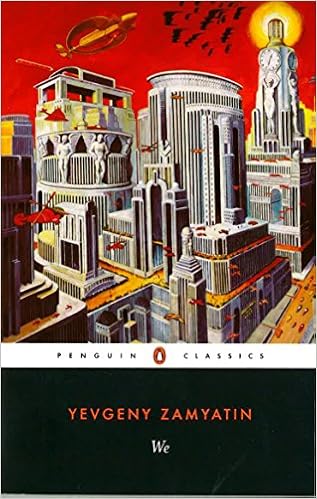
We

We: Yevgeny Zamyatin, Clarence Brown, Clarence Brown ...
We is a classic dystopian science fiction novel by Yevgeny Zamyatin, written in 1920-1921, published in 1924, via English translation in New York. Yevgeny was part of Russian proletariat writing groups and eventually requested to leave Russia as many writers were being persecuted, thus resulting in the death of their writing careers. In fact, when Zamyatin died, there was no mention of him in Russian papers. Most proletariat Russian writers made livings elsewhere like in Paris, England, and the United States. 

The novel depicts a world of harmony within a totalitarian system. There is freedom but only ruled by the Benefactor and activities are ordered along to the 'Table,' a system that controls every hour of everyone's day. In some respects, there wouldn't be a Brave New World by Huxley if it weren't for We. No 1984 by Orwell. No Handmaid's Tale. There wouldn't be all those tons of young adult dystopian novels either. We did it first. 

I will focus on the plot first because it's pertinent to the ideas therein. 

We is set in the future. Probably far future because they have space ships. It's said that there was a great war over something, which is only alluded to in the novel. A resource perhaps. It resulted in the use of weapons of mass destruction, leaving the world outside One State a post-apocalyptic landscape. 


The main character is D-503, a space engineer. People have no names, rather they are identified by number. It takes place in an urban society constructed of glass, which helps for mass surveillance. The people march in step with one another and wear uniforms.  Life is managed scientifically; everybody eats at the same time, works the same time, has recreation hours at the same time, and they even have scheduled times to have sex with partners they can sign up for, rather than of their own choosing. People think with science, logic, and reason above all. The formulas people use are ones devised by the One State, their form of government, lead by the Great Benefactor, their supreme leader.

One State has conquered the whole world. They're now building a spaceship in order to invade and conquer other planets, thus bringing One State across the universe, helping their cause, and increasing their numbers. The ship's project engineer D-503 writes a journal that is meant to be brought along the spaceship when they go to another planet.  

D-503 lives in a glass building like all the others. His partner, O-90 is deemed too short to bear children and is upset by this. His best friend is R-13, a guy who reads his poetry verses at public executions. On an assigned walk, D-503 meets I-330, who flirts with him without being properly assigned. I-330 is a careless free spirit; she drinks alcohol, smokes cigarettes, has casual [not assigned] sex. Every guy has met a girl like I-330, that footloose, and fancy-free girl. In short, she's doing everything that you're not supposed to do in One State. D-503 is appalled but intrigued at the same time. He continues to see her. 

D-503 starts to have a lot of freedom through I-330 and starts to have dreams, which the One State describes as mental illness. "What's wrong with me doc?" "You've found out that you have a soul, for which there is no cure." That's my favorite line in the book because it has that edge of snarky satire as well as philosophical ramifications that goes back to the Greeks. It works well. 

Slowly, I-330 reveals that she's part of an organization called Mephi, which plans to bring down One State. O-90 wants D-503 to illegally impregnate her but in order for her to stay with the baby, she has to leave One State and go beyond the wall, where primitive humans live, complete with coats of fur. 

The last journal entry details the 'Great Operation,' a brain surgery of sorts, that targets the brain with x-rays, so they can function as 'tractors in human form.' It basically makes you more of a vegetable. Removes imagination. Once D-503 gets the operation he runs to the Benefactor to tell him about the Mephi operation. I-330 and her associates are sentenced to death under the Benefactor's machine, which literally melts the human body. A  death ray.

But the novel ends on somewhat of a good note. The Mephi operation is doing well, birds are repopulating the city, and people start acting out against the regime. One State's survival is left in doubt. The book ends with a strong manifesto; just as there is no highest number, there can be no final revolution. 

 Now we get some ideas. 

First, the writing style can, at certain times, be quite a satire. There's one scene early in the book where a woman is playing the piano and people are watching and listening to her play. At one point during the impromptu performance, which is already rare in this society, D-503 starts laughing uncontrollably because music is such an unstructured improvised form that most of the citizens just aren't used to. 

The scene with the doctor is my favorite in the book. "You have a soul. There is no cure." That's a great satirical moment, a great laugh. Of course, it was true, D-503 had indeed, somehow developed a soul through his new girlfriend, I-330. 

The idea of having sex only with assigned partners and only at certain days and times is also a laugh. Did they also forbid masturbation?

There are philosophical ideas at work here too. In fact, the doctor scene isn't just a satire, there's a religious tone to it as well. The idea of the soul separate from the body and mind goes back to Plato and Aristotle. This is used in fiction to good effect. The fact that D-503 developed a soul rather than being born with one is another note on satire. 

The idea of a conformist culture where everybody is happy [for the most part One State is happy] should be considered utopian, right? Well, the thing that makes One State a dystopian novel rather than a utopian one is the fact that One State not only wants to take away freedoms [which is fine because most of the people are cool with that], but One State also wants to get rid of imagination. In We, imagination is the mind-killer rather. If the citizens of One State were allowed to imagine this would be an entirely different novel. 

Lastly, this is one of the important and critical works in science fiction, particularly in the dystopian canon. I initially read this on the recommendation of a Russian friend of mine. I'm glad I read it because it's truly a great story and it stays with you. This isn't something you read and forget about a few months later. It's that important of a book. Considering the way governments are run today you will find that Yevgeny Zamyatin's ideas still ring true to this day. For just as there is no highest number, there can be no final revolution.

Sunday, December 15, 2019

It's the holiday season

Howdy, yall? Thought I'd write a short post late tonight. I haven't been writing much. Not because there's nothing to write about. I've been sick this whole week straight. I'm actually still sick but am in recovery mode from a serious cold. It started as faint flu-like symptoms earlier in the week and lasted the entire week until today...Sunday. 

Sunday Funday, as they say. I'm going in for a late 1am shift again. But this time I won't be sick. So I'll be more up to it. Have a better attitude and all that jazz. Although I haven't been writing as often I've been busier than ever. 

I've been playing a lot of guitar for one thing. Practicing Sequenza by Luciano Berio as well as my improvising skills. I took a break from the jazz duo jam session this week because I was sick but we will resume this upcoming week. 

For another thing, I finished a book in a single day today on my day off from work. I finished reading Ursula K. LeGuin's second novel, Planet in Exile, the second book in her Hainish trilogy cycle. Her first three novels. I'll probably write a post about all three books when I'm finished. Also, I recently finished reading Susan Sontag's second collection of essays entitled Styles of Radical Will. What a transformative informative read that was. 

I haven't even started on any holiday shopping but I'll get it done on my days off later this week. It's truly the holiday season. This time of year always reminds me of Paul McCartney doing that Christmas song, "Simply having, a wonderful Christmas time." Great tune, Paul. 

The job has been really tough this week with the flu/cold. I really wanted to call out four times in a row but sometimes you gotta tough it out and go with the flow. Especially when you need that holiday pay for Christmas gifts.  

I've been listening to a lot of straight-ahead jazz. That's been my spirit music for the longest now. I've given the 60s rock and roll a break. Too much Mothers of Invention and The Beatles. There's only so much Sgt. Pepper, Freak Out, Revolver, and We're Only In It For The Money I can take.

I've ordered a bunch of great books that I plan on reading soon. The list includes Sontag Under the Sign of Saturn, Dante Divine Comedy, Kant Critique of Pure Reason, Kushner Telex from Cuba, Goethe Faust, and more. I want to read more science fiction as well. Perhaps more LeGuin, say, The Dispossessed, or the Lathe of Heaven, heck, why not both? 

As a result of all this reading, my computer time has dwindled down to maybe an hour a day or just not at all. I don't even really play computer games anymore. There's just not enough time in the day if I want to read, play guitar, and go to work. 

That's the end of this one. Happy holidays!

Sunday, May 5, 2019

The Iliad


Image result for the iliad book coverThe Iliad is one of those majesterial works. It's an all-time classic Western masterpiece, maybe THE classic Western work of fiction. I read Robert Fagles' translation, released in 1996. It's one of the best books of 1996. Fagles brings the archaic ancient fiction story into the modern age with his translation. Sure, it isn't 100% what it is in Greek BUT it stays faithful to it AND reads like beautiful epic poetry. Rather than write my typical book review blog post, I'm going to explain the story itself just a bit and then point out things about it.

I'm familiar with epic poetry. I've read John Milton's Paradise Lost, Dante's Inferno, and the King James Bible. However, Homer's meter and verse are much different, of an older time period, a dramatic, emotive, precursor to all that Renaissance stuff in Europe after the Dark Ages. Homer portrays the Trojan War in a brutalist manner, complete with brains and entrails flying over the battlefield. One thing that Homer makes clear is that once a man is dead, he is dead. Nothing becomes of him. Later in the European Rennaissance, orators, writers, and poets would use Christianity as justification for salvation or damnation after death. Interesting little tidbit.

There's this big Homer debate. Was he blind? Could he write? Was he illiterate? The Iliad is some 2,700 years old and there's evidence that supports that the story was altered, changed over hundreds of years. Homer was the Shakespeare of his time. It doesn't really matter if he was a blind oral poet or one of the very early Europeans who could write on stones or papyrus. In his day you didn't write unless you were of the upper class. Most people were illiterate. So it goes. 

The story itself is about Helen of Troy. The Trojans are safeguarding her in Troy. Meanwhile, the Acheans are coming to kill them, take back Helen, and the city. The fighting description and imagery are so raw, visceral that I joked with my friends that the violence in the Iliad makes me want to throw up. Some of it is pretty gut-wrenching. At times it can be a bit much. But fictional death can't be all that bad, right? Well...

At some point, Patroclus, Achilles' friend [and people have also said that Patroclus was Achilles' lover] gets killed by Hector, son of Priam, king of Troy. Achilles responds by going to war. Thus the Iliad is about the Rage of Achilles. Rage is definitely what it was. He goes on a massive murder spree, even chasing Trojans into the river and killing them there. The gods get involved in all the fighting. This war takes place over multiple years by the way, so this really is epic in proportion, even more, epic than Avengers End Game [review here].  

This is a battlefield where men give speeches, telling their life story and taunting to their enemies before they duke it out in a blaze of glory and honor. A lot of times both sides are fighting harder and harder every time an enemy gets a leader or champion's corpse and tries to defile it, stabbing at it, mashing it up, etc. This leads to both armies gaining fighting strength in order to preserve said dead allies' body so that it can be brought to their family for a proper burial. Not to mention Poseidon's war cry, making troops gain sudden strength and will. 

The gods intervene a lot. They seem to have a big stake in this. Achilles is destined to die if he fights in the Trojan War-a prophecy from his goddess mother Thetis. Hera and Artemis work to undermine the Trojans. Poseidon fights on the actual battlefield for a large portion of the story. Gods shield certain champions from certain death. Zeus makes sure Hector's body gets back to Priam, back to Troy, because Hector was a much-loved champion who always praised Zeus and sacrificed the right amount of goats and pigs in Zeus' honor. This shows that the gods will always be involved in mortal human life. They all have their reasons. But maybe they just don't have anything better to do? 

Achilles kills Hector and defiles his corpse by dragging it around the battlefield, three times around Patroclus' grave. Now satisfied, Achilles holds the greatest games, the last chapter entitled Funeral Games For Patroclus [perhaps a precursor to the Olympic Games]. There are all kinds of contests in honor of Patroclus, fighting to the death even. And there's a huge bbq party, and Priam, Hector's father comes. 

When Priam comes to get Hector's body for Achilles, Achilles goes from rampaging god-like creature to a mere mortal when he realizes that Priam's love for Hector reminds him of his father. You could say that at that moment he is humanized, no longer the raging invincible monster, angry because Agamemnon, lord of men stole his girl. His rage is hard to justify.  Because he didn't fight until the end of the war he caused a lot of death amongst his comrades. 

So what is the Iliad about? Generally speaking its about a city about to get sacked. But in between, we have the making of the origin story of tragedy. The Iliad is usually described as the Rage of Achilles but it can also be thought of as the Tragedy of Hector. Although Achilles was a master warrior and a much better fighter than Hector, Hector, in fact, was much more loved, more loving, and a better man to his family and comrades. No wonder Zeus brought his body back to his family. The caveat is that Priam [Hector's father] had to get the body personally from Achilles, who might have killed him if not for the threat of Zeus looming overhead. Very dangerous move for the King to go out and meet with the enemies, especially right before your city is about to get sacked. 

This story has everything: love, war, death, honor, love, sex, gods, mortals. Robert Fagles' translation is easy to understand. The lines all flow in a cohesive way. You have to read a good translation for the Iliad or any work of ancient fiction. A crappy translation will completely ruin the experience. I enjoyed the Iliad so much that now I'm reading the Odyssey, also the Robert Fagles translation. I've caught the ancient fiction bug all of a sudden. I have plans to read the Aeneid and Beowulf after.

You pick up this book and you realize its a 617-page behemoth. I was deep into it, reading it on and off for a while. I started on page 240 on Monday and by Wednesday I had finished the book on page 617. I managed to read 400 pages in three days in a wild burst of long and super enjoyable reading sessions. The language is simply beautiful. I can't explain the mechanics of the poetry at work here, the line, meter, verse and all that but there's overarching linearity to the prose here. It's like the entire work itself connected in such a way that it was all one long sentence. Like it was an oratory experience. This is one of those books I will definitely come back to. I would love to read other translations. 

How could you rate this book? It's a masterpiece, a complete 5 out of 5 stars. Anyone who disagrees either doesn't like epic poetry or just doesn't get it. That's fair too, to not get it. After all Greek mythology isn't for everybody. But I sincerely believe that this ancient fiction is so magnificent that most people would enjoy it. Especially Robert Fagles' version. Do check out this book, it's one of the best books ever.

Tuesday, April 16, 2019

The Sirens of Titan


sirens-of-titan
“I was a victim of a series of accidents, as are we all.”

The Sirens of Titan by Kurt Vonnegut is a satire science fiction novel from '59. The story is about a guy named Malachi Constant, who is told by a man-playing-God figure stuck in space via something called 'chrono-synclastic infundibulum', that he's going to marry his wife Beatrice, have a kid with her, and end up living [and dying] on Titan, one of Saturn's moons. Malachi, the richest man on Earth does everything in his power to make sure none of that happens. He responds by throwing the best damn party ever and loses all his money.

The first Vonnegut book I read was Slaughterhouse-Five, check out my review for that book here.  I liked The Sirens of Titan much more than Slaughterhouse-Five. And that's because Sirens is much more of a science fiction novel, with grandiose ideas about life, sprinkled with tons of satire, with what I call dark humor or black comedy. Siren's has a very breezy, easy reading style just like Slaughterhouse. The ideas are many but are rooted more in science fiction here than in Slaughter-house, which is why I liked it much better. After all, I'm a science fiction guy. 

There are two obvious themes of the novel. Free will is one of them. Vonnegut suggests that we are victims of a series of accidents, as its quoted from the story. Malachi Constant, Unk, Beatrice, Chrono, the Tralfamore robot [the reason why all this is happening is so the robot can get a part to go home], and Winston Niles Rumford don't have free will. Random events put them in the positions they were in and there's nothing they could say or do that could influence the unpredictable. 

The other theme is the philosophical one. The meaning of life. Vonnegut suggests that everyone knows how to find the meaning of life by themselves. Although there's no free will we can find meaning and purpose in life. And the purpose of life, no matter who's controlling it, is to love whoever is around to be loved. If I wasn't single this would be more meaningful. :D

Life is meaningless but we should be happy. No matter what happens we have the option to make life meaningful. That's what makes us different from the music organisms on Titan, what makes us human.  

Going forward, this isn't your typical 50's pulp science fiction novel, although technically it is a 'pulp 50's science fiction novel'. What I mean is that if you're into Heinlein, Asimov, and Alfred Bester, you'll notice that this is an entirely different animal. Although there are spaceships, a war between Martians and Earth, and Universal Will To Become [metaphysics perhaps] to power spaceships, Vonnegut is using science fiction to tell an allegorical story about life. With ideas and philosophy that is anti-war, anti-religion, and anti-Bio-Mass [anti-society]. 

The science fiction element stems from the character Winston Niles Rumfoord, who, with his dog Kazak, accidentally becomes “chrono-synclastic infundibulated” during a space voyage. They're spread through space and time, appearing on planets sometimes. Vonnegut explains the phenomenon in his own inimitable way. Being spread through space and time allows Rumfoord to know everything that is past, present, and future. This allows Rumfoord to play God with the human race, with emphasis on Malachi Constant, and Rumfoord's wife, Beatrice. Rumfoord stages a war between the Martians [there's Martians living on Mars in this story too] and Earth just to make a point, to teach mankind a lesson. 

There are enough great ideas in this novel to be two or three novels. The characters are unpredictable, the humor is dark at times, and satirical, and philosophical themes make this a terrific science fiction treatise. 

To conclude, you don't have to look into grandiose ideas for what this story is really about. As a matter of fact its very simple. Vonnegut's satire ends with this conceit: All of mankind's purpose, past, present, and future is for this alien robot [the Tralfmadorian] to find this one little metal part [the size of a can opening lid], that will take him home.

I'm already reading more Vonnegut. I'm currently reading his first published novel Player Piano, which is much different from this style and voice-wise. Stay tuned to the page, as I will write my Player Piano review sometime soon.   

[original book cover art by Richard Power pictured above] 

Thursday, April 4, 2019

Purple Haze [Live]

Here's a live rendition of Purple Haze, played and sung by yours truly. With the Petie's Place open mic house band. Petie's Place is a bar in Tarzana, CA that hosts open mic sessions every Wednesday night. This is the first time I've ever done Purple Haze live. Enjoy!

https://soundcloud.com/user-294063763/purple-haze

Orlando Figueroa-guitar, vocals
Art-bass
Jim X-drums 
?-keyboard

Sunday, March 17, 2019

Spring 2019 Goals

Hello ladies and gents. Here I'd like to go on a short motivational speel about goals. Personal mostly but this can apply to anyone relatively speaking. Spring 2019 is here. Life is moving by quickly. Have you been working on all your New Years resolutions? Are you getting everything you want to be done? 

First, my biggest New Years Resolution [only one really] was to work out more. In the beginning of the year I was working out super hard. In fact, during the first week I ran 2 miles everyday for five days. That was way too extreme. Hurt my legs. But I felt great in my mind. I had a strong mental mindset about the whole thing. Then, the California winter was super harsh, so I didn't run because of the rain and cold. Now, spring is here so I have no excuse. I'm not going to go hardcore. In fact, I'll probably run one day, then rest the next. End up running 3 days, resting for 4 days. My weight is still the same, which is not good, as I'm above 200 pounds. I have a lot more work to do. 

Second, I need to learn how to eat less. Contrary to what Americans believe, it isn't the fact that I don't exercise much that I'm overweight. Its the fact that every day I'm eating too much, overfeeding my body, too many calories. If I can learn to eat less [and drink less soda, drink more water], I can lose weight the natural way, by just allowing the weight to fly off, by letting my body be hungry more. This is more difficult than working out for me because my friends all love to eat out all the time and they sure as hell don't eat healthily. In fact, they're all getting overweight too. I was doing this for a while and I managed to lose twenty pounds. Unfortunately, I went back to bad eating habits and gained the weight back. This is the most difficult task for me. My number one goal.

Third, finish my novella and show it around to some publishers. I've been working on a novella [long short story] and my goal once I've finished it is to show it around to some publishers and try to get it published. If I can't get it published its no big deal. In fact, I think just learning how to write better in the process is worth it just by itself. My goal is 100 pages. I currently have 28 pages. So I've got a lot more writing and editing to do before I even really discuss it with anyone.

Fourth, release an album for sale on Bandcamp. I've been working with an alto saxophonist named Jason Thomas. He says he can get us free studio time. Our end goal is to record at the studio and release the best tracks as an album on Bandcamp, a music website people use to sell their tunes. I also want to perform live with him more whether it just be open mics or real gigs. Hopefully real gigs. I also want to find a bass player so we can have a legit jazz trio. The guitar, alto saxophone duo is cool but we really need that bass for the low end, as well as having the complete complementary instrumentation. 

Fifth, read more books. Reading is my spirit animal at this point. Most of all my blog posts are about novels. I love reading with a  passion. Maybe even as much as music. Or more? Not sure. I want to finish reading The Illiad, read the Aeneid,  the Odysee, finish the Divine Comedy by Dante Alighieri, more Hemingway novels, more philosophy, in particular, finish reading Heidegger's Time and Being. Hopefully, I get to all those. Its a lot but I've got the discipline and reading habit to actually do it. I'm a reading machine.

Sixth, think about finding another job if my family doesn't end up moving. The family plan is to move to Chicago but I'm not sure when if ever that is going to happen. I love California and I'd love to stay here but its too expensive to live here on my own. If we end up staying in California say, another year, then my plan will be to find another job. Retail can only take you so far in life. They're not giving me that many hours anymore. Sometimes its good to know when to pull the plug. 

Life is full of distractions. In a way its good that my friends are busy working most of the time. I've found that seeing my friends only once or twice a week is a lot better for our friendship. Time makes the heart fonder, as they say. Not only that, but I enjoy more free time by myself, where I'm able to work on all my goals. A lot of my friends have moved away and others have drifted apart. Sometimes you have to realize that some people will only be in your life for a short while. Such is life. In the meantime, I'm going to keep pushing myself, and fight the good fight, so to speak. 

Wednesday, March 6, 2019

For Whom the Bell Tolls

ErnestHemmingway ForWhomTheBellTolls.jpg

For Whom the Bell Tolls is a novel that came out in 1940, written by Ernest Hemingway. The story is about a young American named Robert Jordan, who works as a dynamiter on his sabbatical away from college [where he works as a Spanish professor], in a Republican guerilla unit in the Spanish Civil War. His mission is to blow up a bridge. The novel is regarded as one of Hemingway's best works, along with The Sun Also Rises, A Farewell to Arms, and The Old Man and the Sea. [Wiki]

However, the cast of characters that are suppose to be helping Robert Jordan with blowing up the bridge are untrained, unschooled rebels, with their own plans on whats to happen. It takes all of Jordan's skills to get them all to work together. He meets young Maria, who after three days and three nights becomes the love of his life. Pilar is an older woman who mocks Jordan, but ultimately ends up letting Maria end up loving him. Pablo is rebel with bad intentions but in the end pulls through for the team. Anselmo is the star of the novel other than Jordan. Anselmo is this older man who dies blowing up the bridge. 

The literary style here is highly stylized. This is one of the best novels I've ever read. The prose can be very simple. Sentences start off extremely short and simplistic. Later on, as the novel develops, the style gets more complex. Especially with the dialogue of the characters. At some point Hemingway ditches exposition for complete dialogue between the characters. What the characters say is quite simple but how they say it is where things get interesting. The characters speak Spanish and have a very formal and noble way of speaking [they say thou, thee, and thy when speaking]. That is until they start cursing. However, Hemingway never uses a single curse word throughout the novel. Rather, he has the characters saying things like, "I obscenity in the milk of thy mothers". Rather than say fuck, at one point at the end we have these endless sentences where the word muck is used over and over. Also at the end, there are endless sentences that describe the inner mind of Robert Jordan, knowing that he is probably going to die and that the three days and three nights he spent on the mountains with rebels were the best days of his life. This style has been endlessly copied because its so great. 

The novel touches on a couple themes. Death for one thing.  Camaraderie and sacrifice in the face of death is another. Suicide always looms in the backyard as a way out if they get trapped. There's also exploration of political ideology and the nature of bigotry. Divination appears as an alternative in perception. Pilar [Pablo's woman] is a reader of hands and more. She claims to know things that are superstitious. 

The imagery is powerful. The automatic weapon is a strong visual element. Hemingway uses the fear of modern weaponry to destroy the romantic notions of war. Likewise, the fascist planes bombing on the characters is a sign that all is lost. There's also the soil and the earth. Jordan and Maria have sex in a meadow and then afterwards he asks María, "Did thee feel the earth move?", to which she responds affirmatively. Variants of this phrase have become a cultural cliché, often used humorously. [Wiki]

Hemingway has become a symbol of macho male charisma in the literary world. He influenced generations of American writers. He helped create the great American voice in novels. In this novel it shows. The hardness of war is so strong here that I would argue that this novel is very tough-minded, not for the thin-skinned. This is a manly novel. Even the aspect of love is manly, for Jordan knows that his love was just a three day affair. The fact that he knows he is going to die is existential and philosophical. This book is heavy. 

At nearly 500 pages this book is long. However, the prose flows effortlessly because of well written prose and challenging characters. You'll find that the book reads itself in a way.

The book is named after a poem by metaphysical poet John Donne- Meditation XVII. Hemingway quotes a section of the poem at the end of the novel. Here it is below.

No man is an Island, intire of it selfe; every man is a peece of the Continent, a part of the maine; if a Clod bee washed away by the Sea, Europe is the lesse, as well as if a Promontorie were, as well as if a Mannor of thy friends or of thine owne were; any mans death diminishes me, because I am involved in Mankinde; And therefore never send to know for whom the bell tolls; It tolls for thee

Thursday, June 21, 2018

Summer Reading


I've been reading a lot lately. This entire month has been full of chapter and verse. Honestly I've just been trying to read as much as I can from a wide variety of subjects from science fiction, fantasy, the news, political science, philosophy, and classics. Here's some of the books I've been checking out. 

Thomas Hobbes Leviathan 
This book was recommended to me by Dad. It was written in the late 1600s so the prose is quite different from what I'm used to. Its political science philosophy sort of stuff. I've already finished the first book (its made of several books put together) and I have to say that Hobbes had some interesting ideas about well, everything. 

Marx and Engels the Communist Manifesto
This book opened my eyes to what the modern day Proletariat is all about. I have to go back and read certain sections, it was that good. 

Frank Herbert Dune
I saw the movie first before I finished the book (I'm almost done with it) but the book is quite a stunning science fiction epic. 

Ursuala K Leguin Tales from Earthsea
This was my first fantasy novel I've read since middle school with The Lord of the Rings and Harry Potter. This is way better than Harry Potter of course! 

William Gibson Burning Chrome
I'm almost done with Gibson's short story collection. I've learned a lot about science fiction short story writing from his great cyberpunk stories. 

Washingtonpost, NyTimes, The Guardian, BBC World News, Newyorker
Politics has become a big thing for me as of late. When I was ignorant I used to laugh at everything Trump did, and think that it didn't matter. When I realized I was wrong and stupid I changed my ways.  

Wired
I read a lot about Silicon Valley and the tech industry. Part of my interest for this came from pc gaming. From there I read Jaron Lanier's two books and didn't look back. 

W.E.B. Du Bois The Souls of Black Folk
I'm really into archaic prose and this is no exception. Not only is it exciting to read a black scholar's work from the late 1800's, I can relate to some of this stuff as a modern day black man. As my brother Robert said when I told him I bought the book for 50 cents,"I thought you weren't into that black stuff." 

I'm reading so much now that its hard to keep track of it all and I have to constantly manage my subscriptions from the library. I'm learning a lot and having fun doing it. 

"I find your lack of obsession with books disturbing."

On AI, Existential Threat, and the Collapse

Good evening ladies and gents. Hope you all had a good Sunday. I wanted to write here a bit more about AI, existential threat, and the Colla...