Showing posts with label 1700s. Show all posts

Wednesday, December 2, 2020

Music in the Classic Period

Very clear and concise. The book focuses on Haydn y Mozart. Recommended to all classical music fans, and those interested in the historical aspects of Europe's arts, culture, history, and music in the 18th century.

One of the most important things that I almost overlooked was the cultural differences between the classical styles, most notably opera. Operas were best heard and most liked in Italian, but eventually, the Germans started to form their own operatic styles based on folk music and legends. Mozart tried to write French operas but they just didn't ring as well from the established grand operas in Italian. It appears that Italian was the best language for opera.

Also noteworthy was the fact that many of the composers' notes during this time period for their music were written in Italian. So even if you were an amateur musician playing from scores, you would've known a little Italian to play your parts. 

Lastly, it should also be noted that composers, travelers, and merchants were expected to speak multiple languages like French, Italian, and German, it was the norm for composers like Mozart. 

The development from this 'classic period,' from the baroque to sonata form-rondo, to concertos, to symphonies, to chamber music and string quartets, to opera, to sacred music, and finally into the Romantic era of Beethoven is an amazing development in the history of music, culture, and art. The past has greatly influenced the moderns in terms of classical music and beyond, ad infinitum.

Sunday, March 31, 2019

How are you doing?

Time for a vlog style blog post, spring 2019 style. I like to write these every now and then, talk about real life, as opposed to sharing memes, tweets, and Facebook posts via social media. That stuff is so blah.

First off, I quit soda and energy drinks cold turkey. I've noticed a big difference in my stamina and stress levels. In addition, I'm starting to lose weight again, albeit very slowly, about a pound or two a day. At this rate, I'll lose twenty pounds in twenty days. This might be the way I lose weight and keep it off forever, in shallah. [as the Muslims say] 

I really needed to do something drastic because I don't want to get diabetes. I was drinking soda and energy drinks every day at work. I'm glad I'm not buying and drinking that crap anymore. 

My body is detoxing. My stress levels are down and my stamina is up. I still get tired after one am shifts at the job, however, without the sugar chemicals messing with my system, I don't get as tired as I used to. It's quite a change. 

Speaking of changes, I've been taking things slower with my reading. I'm spending more time reading the news during the day before work and reading physical books at night before bed. I'm letting all the readings ruminate more. Rather than say, reading a book in three days and then starting another one on the same day. I'm guilty of that. 

I'm also guilty of being completely obsessed with classical music. I've always liked it but now its pretty much my favorite thing to listen to. Saying since most modern straight-ahead jazz is pretty clean cut, not many interesting things going on, I mostly listen to classical music, usually while reading. 

My favorites lately have been baroque composers within the last couple months-Bach in particular right now. Coincidentally it was his birthday the other day. I'm getting into piano prodigy Glen Gould's Bach interpretations. I've also been listening to Handel, Telemann, Vivaldi, Mozart, Chopin, Corelli, Marcello, there are tons of composers from 1600-1700s that display beautiful music, composed of functional harmony. I've become a huge fan of harpsichord and clavichord. So much to the point that I'm planning on playing keyboard more seriously and possibly having my dad put together our harpsichord one day [yes I have a harpsichord]. I have the time, I just need to put in the effort. "Or so it goes."

Work is work and I'm glad to get the hours. My jazz trio is coming along nicely, although I need a bass player asap to complete the sound I want, a chamber jazz sort of sound, with bass playing the role of percussion. The plan is still to record at a studio [and release an album on bandcamp], and apparently, the saxophonist can get us free recording time at the studio because he's done session work for the studio, ie they owe him. I'm still working on my memoir, and I've got thirty-four pages to work with so far. I'm at a crossroads with the text at this point, but I'm getting ideas on how to make it flow more thematically now that I've covered all the facts, exposition and lots of dialogue between characters. Lastly, I've been doing well making new friends, of the female variety. As that Ramones song goes, "I don't wanna be a pinhead no more, I just met a nurse that I can go for." 

April will bring hot temperatures and soon summer will be among us Californians. Bring on the one-hundred-degree heat. I love it when its over one-hundred degrees in the Valley.

Not! 

April Fools     :D 

Monday, February 4, 2019

Candide

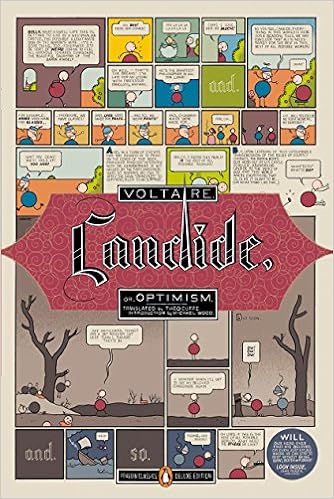
Image result for voltaire candide coverVoltaire's Candide [written in 1759 by French philosopher Voltaire, written during the Age of Enlightenment]  is a terrific work of satire that attacks Leibniz's philosophy of optimism. This is done through the constant refrains of the character Pangloss [Candide's philosophy teacher] saying, "This is the best outcome in the best of all possible worlds." This happens periodically throughout the story. In a way this is a perfect book for me because it reads like a philosophical cartoon strip. Ironically I think I've got a physical copy of Candide with a cartoon strip for a cover, pictured here.

Satire is used to full effect here. Everybody and anyone is fair game for ridicule. The religious establishment especially. Another important feature is that a lot of the events that occur were actually real events. For example, the Lisbon Earthquake was a real event that killed 30,000 people, an event that makes 9/11 look like nothing.

Voltaire ridicules Leibniz's philosophy through the character Pangloss, who's reasoning is silly. For example, the following is ridiculous:

"It is demonstrable that things cannot be otherwise than as they are; for as all things have been created for some end, they must necessarily be created for the best end. Observe, for instance, the nose is formed for spectacles, therefore we wear spectacles."   

Pangloss goes on to defend optimism and reiterate that "its for the best, in all the best of possible worlds." Consider this section where he explains why its good that syphilis exists:

"It was a thing unavoidable, a necessary ingredient in the best of worlds; for if Columbus had not caught in an island in America this disease, which contaminates the source of generation, and frequently impedes propagation itself, and is evidently opposed to the great end of nature, we should have had neither chocolate nor cochineal."

Candide, the main character, goes on to keep believing everything his philosophy teacher Pangloss says until everything goes wrong for him. Eventually he despairs and is ready to give up on everything in life. Thus Voltaire cures him of his optimism. Although its interesting to call out Leibniz I also think a large part of the idea for this work was to contrast irony with comedy, thus we have satire. And this it does very well. You could say that this kind of novel is created for men [and women] of wit to read for fun. And fun it is. 

Voltaire doesn't invent or exaggerate evils of the world. In fact he displays these things as regular real life events. A simple example of satire is when Candide watches as an admiral gets killed for failing to properly engage a French fleet. "The admiral is blindfolded and shot on the deck of his own ship, merely "to encourage the others" (French: pour encourager les autres, a popular quote from Candide). 

Almost of all Candide is a discussion of the various forms of evil. There is one notable exception; when Candide and Cacambo go to El Dorado. This is perhaps the only optimism in the book, where we find a place where everything is perfect. So perfect in fact, that satire doesn't exist here. But because we don't live in such a perfect world as that, satire must and will exist. 

The book is pretty simple plot-wise, a sort of adventure novel. In a way even its plot is a satire of European novels: Candide is of a lower caste than Cunegund, therefore he shan't dare marry her, romance, making fun of the high arts such as music and theater, the mishaps that happen around every corner, etc. These sorts of things are in a lot of archaic novels I've read. The one that comes to mind is The Blazing World by Margaret Cavandash. However, I think Candide is a lot better than that story. But they are very similar plot-wise and written and are archaic. 

All in all this is a fantastic read. I read it in one sitting last night. If you're a man [or woman] of wit, and enjoy philosophy as well as adventure novels this will definitely be on your reading list. Its a classic for a reason after all.

On AI, Existential Threat, and the Collapse

Good evening ladies and gents. Hope you all had a good Sunday. I wanted to write here a bit more about AI, existential threat, and the Colla...