Showing posts with label french. Show all posts

Wednesday, December 2, 2020

Thoughts on Language Learning

-These are my thoughts on language learning after learning Spanish for three weeks, he estado aprendiendo español por solo tres semanas pero planeo aprender de por vida.

-You're brain is actually learning something so new, so different, that it's teaching you to think differently, think differently in another language.

-It's like that science fiction movie from 2016, starring Amy Adams, Arrival, in which she learns how to communicate with aliens. 

-Her brain gets rewired, she learns to think so differently, that she learns to think like the aliens and communicate with them.

-The revolutionary philosopher Wittgenstein says, "life is language games," well the more different words in different language that you know, the more you see that this is the case.

-Sometimes when sleeping and upon wakeup, you're thinking about all the new words, phrases, and accents that you've learned. At first this freaked me out because I wasn't used to a cacophony of words of different languages in my head, however, you soon realize that you'll become used to it, and that you've begun to learn to think in those other words/languages.

-It's a fun activity for me, I learn on the google translate app or google translate on my computer, sometimes I learn for 5 minutes a day, sometimes for over an hour, and sometimes 20-30 minutes. Because I'm not being forced to learn against my will, my mind is open and I've even begun to become something of a miniature polyglot. 

-The vast wealth of beauty that exists in language appear to me in the form of Spanish, Italian, and French. However, I do find a different kind of beauty in the languages from the Far East like Chinese and Japanese.

-Upon reaching my fourth week of Spanish language studies, and learning bits and pieces from other languages, you soon realize that all of the information will be forgotten unless the material is consistently repeated and reworked over and spoken aloud with others, speaking the words aloud is the most consistent way to reinforce your memory. 

-Once you learn more words in other languages, the sound of the languages, the sound of the culture becomes a part of you, thus you are able to articulate and understand English much better as a result.  

-Spanish is the best language for me because it is the first language I wanted to learn, then next in line is Italian because it sounds muy bonita, then French because its very useful and also sounds great.

-There is somewhat of a correlation between the thick European languages like German, Russian, Swedish, and say Chinese [Mandarin, Cantonese] and Japanese, although it is very small.

-The root of all my language learning, as what Wittgenstein would call language games is all based on Latin, the godfather of Romance Languages; Learn Latin, and I can finally read Ovid's Metamorphosis in its original format, a true worthy goal of artistic expression and understanding. [Very difficult and would take years]

-The case is that once you start learning you can't stop otherwise your vocabulary of phrases, words, grammar, visual memory of the words, and accents will slowly fade away, so don't give up. 

-An end goal would be to travel across the world and speak whatever languages I need with ease. 

-A much more difficult goal could be to learn Spanish, Italian, and French, and become a translator and do that as a career.

-An easier goal, move to another country that speaks Spanish, Italian, or French [or even China to speak Mandarin], and get a job teaching English, and learning their language from the locals. 

-You're brain is rewired and overloaded with so much new information every time you learn, you must remember to always get plenty of rest. Day naps and night naps are both needed!

-Sometimes upon wakeup you'll think thoughts in Spanish as you get out of bed, at first it's a bit scary and unusual, but you soon get used to it, and recognize the fact that you're thinking in another language but that you're fundamentally the same animal. 

-Miguel de Cervantes Saavedra's Don Quixote is one of my primary inspirations for my Spanish learning, as Cervantes' has been called the godfather of the Spanish language, for good reason, his Spanish language style is unmatched. 

-After quarantine is over, I want to visit Mexico, and have a blast with Spanish.

-What better way to spend your time in quarantine than learning other languages and appreciating other cultures? The world doesn't revolve around just America or just English. In the brand new emerging world, the times they are changing. 

Thursday, March 26, 2020

The Plague

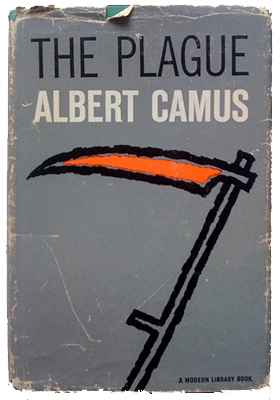
Image result for the plague book covers 1947The Plague (French: La Peste) is a novel by Albert Camus, published in 1947. It's about the plague sweeping the French Algerian city of Oran. It raises questions about destiny and the human condition. Throughout the novel, there are existentialist ideas that reverberate. The novel is said to be based on a cholera epidemic that killed many people in Oran back in 1849 but the novel is set in the 1940s. Likewise, it is based on real plague outbreaks that really happened in Oran back in the 1900s, but these outbreaks were very small compared to the devastation seen in this novel, which is apocalyptic, a word seen in today's NYTimes headline. 

Camus objected to the book being considered an existentialist classic yet it has that sort of tone. It is also seen as an allegorical treatment of the French resistance to Nazi occupation in World War II. Lastly, the novel brings up the philosophical notion of the Absurd, "the conflict between the human tendency to seek inherent meaning and value in life, and the human inability to find any in meaningless, purposeless, or chaotic and irrational universe. 

Let's start at the beginning. This is my first Camus novel although I have heard of The Stranger, which was recommended to me by my father and my friend, a master's degree student from CSUN. The Stranger and The Plague are terrific novels but for entirely different reasons which we won't go into here. I went to the local library book sale initially looking for The Stranger, because I'd seen it multiple times at other book sales, only to find they didn't have it this particular time, but they had The Plague, so that's what institutes my introduction to Camus. 

The story told therein isn't complicated nor long. On the contrary, this is a very simple story, but with deep meanings and notions. There are only a handful of true actions. But again, deep meanings within them.

The story is told from a narrator's point of view. We don't know who the narrator is until the end of the book, where we learn that the narrator is the doctor himself, who had been treating all the victims of the city, possibly exposing himself to the plague, his friends/associates who are workers of the city, helping him in fighting the plague. The fact that the narrator is nameless/faceless until the very end is a great literary device used in some other novels that I've read, especially in science fiction of the 50s and 60s. It's quite an imaginative plot device because the reader is always in a sort of suspense. Who is really telling the story? Well, you don't know until you find out. You don't find out until you keep reading. It's not difficult to guess that it was the doctor but it's rewarding to find out that it's him. Why? Because the doctor has such a personal relationship with the town, the citizens, his friends, the workers, the plague itself. His point of view is important to the telling and conclusion of the story. Even if he isn't the only character that the novel focuses on. Rather, there are a couple of characters in the novel. Although none as important as the doctor because he's the narrator. 

Then, the plague itself. The plague is the worst disease known in the history of mankind. Camus displays fantastic writing ability in the way he describes the symptoms, the victims, the deaths, the burnings, the burials, the quarantined, the panic buying, the lockdown of the city. This is where I get to make a comparison between this novel and what's going on today. 

Today we have the coronavirus having gone viral across the world, and today 13 people died in N.Y.C, but overall something like 1,000 people have died from coronavirus in America. Twenty-six states are on quarantine/lockdowns. Most people are out of jobs or working at home, or they might be like me, they're grocery store workers [essential workers like healthcare workers] on the front lines, battling an invisible enemy, with nothing but gloves and a mask, if they're lucky enough to have PPE [personal protective equipment]. Life today is somewhat like life in Camus' novel. The absurd has already happened: People are panic buying hundreds of rolls of toilet paper and canned goods. Like the novel, people have made a fortune off selling items in a black market sort of fashion, selling toilet paper, hand sanitizer, even foods. Existentialism is more popular amongst my more literary and/or more articulate friends. There's a definite sort of dread, confusion, disorientation, in today's climate. The individual has come apart from the whole, not just objectively, but literally. We literally have been ordered by local, state, and federal governments to practice 'social distancing,' a 2020 buzzword that states we shouldn't gather in groups or get too close to others because we could spread the coronavirus to each other more easily that way. And this is just the beginning! 

So it's easy to see how a novel like The Plague holds such important intrinsic, historical, philosophical, and emotive value because what happened in the novel happens in real life so to speak. This novel is so realistic and spot-on, in some ways it's absolutely terrifying and ultimately unforgettable. A lot of book reviewers like to say this a lot but I mean this; this is one of the greatest novels I've ever read, will read, or will ever want to read again. 

Lastly, this novel portrays everything that a pandemic will and should. The horror, the death, the spreading of the disease, the removal of the bodies, the burning of the bodies [in some cases], the funerals, the lovers being split apart, the non-discrimination of the disease killing everybody including men, women, and children, the human compassion and support especially from doctors, healthcare workers, city officials, police, volunteer workgroups, the love, emotion, isolation, the absurd, the existential angst, it's all there really. What's really comforting to see is that even having gone through the plague this fictional tale has one thing that humanity will always need, crave: hope. For if there is one reason why we should get up out of bed in the morning it's because of hope. That's why this is such an important, great novel.

Monday, February 4, 2019

Candide

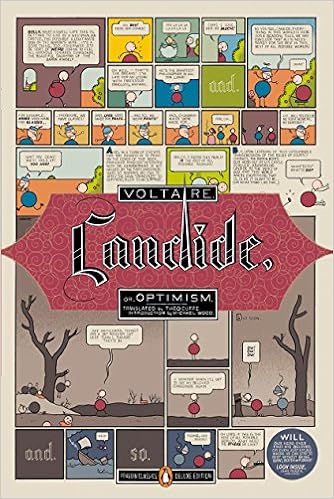
Image result for voltaire candide coverVoltaire's Candide [written in 1759 by French philosopher Voltaire, written during the Age of Enlightenment]  is a terrific work of satire that attacks Leibniz's philosophy of optimism. This is done through the constant refrains of the character Pangloss [Candide's philosophy teacher] saying, "This is the best outcome in the best of all possible worlds." This happens periodically throughout the story. In a way this is a perfect book for me because it reads like a philosophical cartoon strip. Ironically I think I've got a physical copy of Candide with a cartoon strip for a cover, pictured here.

Satire is used to full effect here. Everybody and anyone is fair game for ridicule. The religious establishment especially. Another important feature is that a lot of the events that occur were actually real events. For example, the Lisbon Earthquake was a real event that killed 30,000 people, an event that makes 9/11 look like nothing.

Voltaire ridicules Leibniz's philosophy through the character Pangloss, who's reasoning is silly. For example, the following is ridiculous:

"It is demonstrable that things cannot be otherwise than as they are; for as all things have been created for some end, they must necessarily be created for the best end. Observe, for instance, the nose is formed for spectacles, therefore we wear spectacles."   

Pangloss goes on to defend optimism and reiterate that "its for the best, in all the best of possible worlds." Consider this section where he explains why its good that syphilis exists:

"It was a thing unavoidable, a necessary ingredient in the best of worlds; for if Columbus had not caught in an island in America this disease, which contaminates the source of generation, and frequently impedes propagation itself, and is evidently opposed to the great end of nature, we should have had neither chocolate nor cochineal."

Candide, the main character, goes on to keep believing everything his philosophy teacher Pangloss says until everything goes wrong for him. Eventually he despairs and is ready to give up on everything in life. Thus Voltaire cures him of his optimism. Although its interesting to call out Leibniz I also think a large part of the idea for this work was to contrast irony with comedy, thus we have satire. And this it does very well. You could say that this kind of novel is created for men [and women] of wit to read for fun. And fun it is. 

Voltaire doesn't invent or exaggerate evils of the world. In fact he displays these things as regular real life events. A simple example of satire is when Candide watches as an admiral gets killed for failing to properly engage a French fleet. "The admiral is blindfolded and shot on the deck of his own ship, merely "to encourage the others" (French: pour encourager les autres, a popular quote from Candide). 

Almost of all Candide is a discussion of the various forms of evil. There is one notable exception; when Candide and Cacambo go to El Dorado. This is perhaps the only optimism in the book, where we find a place where everything is perfect. So perfect in fact, that satire doesn't exist here. But because we don't live in such a perfect world as that, satire must and will exist. 

The book is pretty simple plot-wise, a sort of adventure novel. In a way even its plot is a satire of European novels: Candide is of a lower caste than Cunegund, therefore he shan't dare marry her, romance, making fun of the high arts such as music and theater, the mishaps that happen around every corner, etc. These sorts of things are in a lot of archaic novels I've read. The one that comes to mind is The Blazing World by Margaret Cavandash. However, I think Candide is a lot better than that story. But they are very similar plot-wise and written and are archaic. 

All in all this is a fantastic read. I read it in one sitting last night. If you're a man [or woman] of wit, and enjoy philosophy as well as adventure novels this will definitely be on your reading list. Its a classic for a reason after all.

Friday, January 5, 2018

Liliom


Liliom is an expressionist fantasy French film directed by Fritz Lang in 1934. Its based off a Hungarian play by Ferenc Molnár, which is where the movie's name comes from. The film stars Charles Boyer as Liliom, a carousal worker who gets fired from his job after defending a woman named Julie (Madeleine Ozeray), all because his boss was jealous of her and the attention he was giving her.

Julies becomes smitten with Liliom and they begin living together. The problem is that Julie works and takes care of Liliom but he doesn't work, he just takes and is a lazy bastard. Eventually Liliom learns he's about to become a father. So he takes part in a robbery, but it turns out the rich man they tried to rob had a gun! Rather than let himself be arrested he ends up stabbing himself, and his soul is transported to heaven. He sees all these babies with angel wings, and angels playing harps and stuff, space itself (fantasy elements). A heavenly commissioner tells him he's stuck in purgatory unless he goes back to Earth to do one good deed. That's the basic synopsis for the film.

"Liliom was one of the two first French productions by producer Erich Pommer for Fox-Europa and director Fritz Lang's only French film. On the film's release it was protested by the French Catholic clergy and was generally not well received by French film critics or playwright Ferenc Molnár. Despite the reception, the 1934 Liliom was one of Lang's favorites out of all his films." (wiki) 

I can see why the film was berated by French Catholic clergy for sure. The depiction of heaven is quite silly and laughable, however it is a product of its time and quite expressionistic, thus a bit unrealistic. More on the plot.

Once Liliom is in purgatory the commissioner asks him why he beat Julie (he was a woman beater folks), Liliom says he doesn't know. Then the commissioner plays a video of him talking to and then slapping Julie. Then he plays the same video, this time showcasing Liliom's thoughts out loud. He realizes he hit Julie a lot because he hated himself for his cruelty and selfishness (he finished the coffee in that video and didn't offer any to Julie until it was all gone, then proceeded to yell at her).

Sixteen years pass in purgatory and Liliom goes down to Earth to meet his daughter. He catches up with her and tells her that he knew her father, and that he was a violent brute. He had a gift for her too, a star that he stole on the way down to Earth from the heavens. His daughter Louise gets upset and throws the star in the gutter. The scale of good and evil gets tipped more towards the evil. This scale has the pyramid and all-seeing eye at the top of it, and the devil begins to inscribe Liliom's name on his tablet. Liliom slaps his daughter's hand out of frustration before he gets lifted back to the heavens.

Lousie goes to her mother and tells her Liliom's slap felt like a kiss. She then asks her if its possible to be beaten but for it not to hurt at all. Her mother says yes and and the two of them embrace with tears in their eyes. The scales of justice then tips towards the heavenly side and Liliom's name is slowly removed from the devil's tablet. Ending screen, FIN.

The film mostly got negative reception. But that didn't stop Fritz Lang from loving the movie. "Despite the film's reception, Liliom was one of Lang's favourite directorial efforts. In 1974, Lang stated that "Liliom, I always liked very much... Today, I almost like Liliom best of all". 

I actually liked the movie. It's the second Fritz Lang movie I've seen and I think he did a job directing it. I would say most of all I like the acting style in the movie the most. It had a sincere quality, the qualities of the characters seemed so believable and realistic, these characters could be people in real life with real life problems and lack of solutions.

The fantasy element of it was fun. In this film we find that for people who don't necessarily belong in heaven, there's justice waiting for them, and that's what we find in this film. I liked the special effect of the star that he tried to give to his daughter. And then there was the entire heavenly images and the scale with the devil, which was his friend that wanted to rob this rich man, except that he was in black face, or just covered in black paint wearing no shirt and shrubbery as his pantaloons. Kind of makes you wonder if they were trying to portray the evil side as African, which may or may not be the case.

All that being said, I don't think this is a necessary film to watch or know about, after all, its quite esoteric and expressionistic with its ideas. But I do think that its a good movie and quite an entertaining two hours of cinema. I would recommend this film to film students, directors, and film connoisseurs who haven't seen much of Fritz Lang's work. I highly recommend you see Metropolis from 1924 if you haven't seen it.

Liliom Zadowski: Even in Heaven, there's only justice - nothing but justice!

Thursday, January 4, 2018

From the Earth to the Moon


From the Earth to the Moon (French: De la terre à la lune) is a science fiction novel written by French writer Jules Verne in 1865, the oldest science fiction I've ever had the pleasure of reading. Its quite archaic with its primitive (but at the time quite spot on) scientific facts about ballistics, science, and astronomy. 

The book tells the story of a Gun Club creating a spaceship (the Colombiad Space gun) that blasts off to the moon at the end. The Gun Club's President, his armor making rival, and French poet are the ones who get launched out in the nether of space. Everything in between is mostly scientific facts and happenings going on the United States and around the world based off the Gun Club's actions.  

Although one could say that all the hard 'facts' or science in this book is pretty unrealistic and probably goes off to the realm of surrealism it must also be noted that it is quite close to reality given the science of the day (1865). To my understanding of science and physics I look at the facts of this book and see it for its imaginative creativity, and I also see it for its literal realism, for the facts are quite close to reality according to online sources. I'd like to call it a sort of magickal realism if you will. From there you can go into the idea of metaphysics but the book is perhaps too science driven to go to that extreme. However, you can't talk about man leaving his place of origin and exploring other planets without entering into that realm.

"The story is also notable in that Verne attempted to do some rough calculations as to the requirements for the cannon and, considering the comparative lack of any data on the subject at the time, some of his figures are surprisingly close to reality. However, his scenario turned out to be impractical for safe manned space travel since a much longer muzzle would have been required to reach escape velocity while limiting acceleration to survivable limits for the passengers." (wiki)

Another thing to note is that the story takes place some time after the Civil War, and the Gun Club is based in Baltimore, lead by Union scientists, who were formerly soldiers. Some even had their limbs blown off in battle. There's descriptions of men in the club with hooks and such. 

This book is a part of a series and its sequel is called Around the Moon, which describes everything once they actually land on the moon. This first book is the preparations and the launching-FIRE! So I have my work cut out for me, I still have another novel to read. Thankfully, this book was only one hundred and fifty-three pages so its quite a short read. 

One more thing to note is that this book had quite an influence on popular culture-cinema and literature. This book inspired the movie A Trip to the Moon, the first science fiction film ever (which is how I learned about this) and H.G. Wells made a reference to it in his 1901 novel The First Men in the Moon. 


Its quite a fast and enjoyable read. I thought that I would find the archaic writing and old school science facts to be boring, quite dull, but instead I found it to be imaginative and exciting. After reading Alfred Bester's The Stars My Destination this was a good follow-up, ancient science fiction from the aftermath of the civil war, the beginning of the Industrial Revolution. I'm looking forward to reading the sequel, Around the Moon, which I will promptly order from my local library at some point in the near future.  

If you like old school text and science fiction this will be something you will want to check out.
  
“How many things have been denied one day, only to become realities the next!” 

Sunday, December 31, 2017

A Trip to the Moon


A Trip to the Moon (French: Le Voyage dans la Lune) is a 1902 French space exploration surrealist silent film directed by George Melies. The film is inspired by a variety of sources, notably Jules Verne's novels From the Earth to the Moon and Around the Moon. I've already checked out these novels in pdf form through Google and I gotta say that it is quite impressive science fiction writing for the time, 1865 and 1870. Fitting for the time of the Industrial Revolution.

The film follows astronomers who decide to build a rocket and get launched into space to reach the moon via a cannon. They explore the moon's surface and find Selenites, (lunar inhabitants) these sort of insect creatures that explode when they get hit by the astronomers. They end up capturing a Selenite and bring it back to Earth. The film features a bunch of French theatrical performers, "led by Méliès himself in the main role of Professor Barbenfouillis, and is filmed in the overtly theatrical style for which Méliès became famous." (Wiki)

The film was very successful and ended up getting pirated a lot in the United States. This movie ended up having a profound influence in cinema because of its use of narrative, through this more movies ended up developing stories more effectively. Although the movie became out of place when Melies went into retirement, later in 1930 the film resurfaced when film devotees noted its importance on the history of cinema.

"A Trip to the Moon was named one of the 100 greatest films of the 20th century by The Village Voice, ranked 84th. The film remains the best-known of the hundreds of films made by Méliès, and the moment in which the capsule lands in the Moon's eye remains one of the most iconic and frequently referenced images in the history of cinema. It is widely regarded as the earliest example of the science fiction film genre and, more generally, as one of the most influential films in cinema history." (Wiki) Now for more on the movie.

The film starts with a meeting of the Astronomic Club, where the leader Professor Barbenfouillis proposes a mission to the moon. After a bit of dissent five other brave astronomers; Nostradamus, Alcofrisbas, Omega, Micromegas, and Parafaragaramus—agree to the plan. They build a rocket in the shape of a bullet and get shot into space via a cannon. They get a little help with the rocket from the 'marines', women dressed in sailor's outfits. As they fly off to the moon the Man in the Moon watches the spaceship, and it hits him in the eye.

One they get on the surface of the moon the astronomers walk around (without the need of a spacesuit) and after a while they get tired and sleep. As they sleep a comet passes, and the Big Dipper appears with human faces in each star, "old Saturn leans out of a window in his ringed planet, and Phoebe, goddess of the Moon, appears seated in a crescent-moon swing. Phoebe causes a snowfall that awakens the astronomers, and they seek shelter in a cavern where they discover giant mushrooms. One astronomer opens his umbrella; it promptly takes root and turns into a giant mushroom itself."

Then, a Selenite (an insectoid alien inhabitant of the Moon, named after one of the Greek moon goddesses, Selene) appears but is easily killed by an astronomer, as the Selenites explode after being hit by blunt force. More Selenites appear and the astronomers get zerg rushed (reference to Blizzard pc game starcraft, insect-like aliens that come to kill you in great numbers), captured, and brought to the Selenite king. An astronomer hits the king on the head and the king explodes. The astronomers get chased as they run back to their spaceship.

As they approach the ship Barbenfouillis himself tips the spaceship off the moon and into space, while a Selenite is attached to it. The ship, astronomers, and Selenite end up in the ocean on Earth. At the ending scene we see a celebratory parade for the astronomers, the captured Selenite in a cage, and a statue bearing the motto "labor omnia vincit" (work conquers all).

The movie is quite thrilling, fun, adventurous, surreal, and perhaps even psychedelic. Running at only thirteen minutes its a great film to show to a film class, friends, and science fiction aficionados. Its the history of cinema at work. And although it isn't quite developed you could say that its still quite good for its time, 1902. This is the oldest movie I've ever seen and its great. I highly recommend watching it. If anything you should watch it so you can see where cinema and science fiction cinema comes from. Education for sure.

You can watch the film here.

Friday, December 29, 2017

La Jetee


La Jetee is a French short science fiction film made in 1962. It runs at about twenty-eight minutes. The movie was a big influence on William Gibson, one of my favorite science fiction writers. The story focuses on a man as a child and adult who is watching planes take off at an airport. He sees a woman there. The last thing he remembers is seeing the woman and in that moment he knew that he saw a man die, but this is all he can discover from this. Eventually the world becomes engulfed in darkness, a sort of nuclear apocalypse perhaps? In the end we learn that what he saw was actually his own death.

Later he wakes up as an adult in this underground city, called galleries in the film. There's these scientists that are doing experiments on people so that they can go to the future to find a technology that can restore the world of the past. They decide to use this man because the strain of going to the future is hard on the mind. They think that because this guy is so attached to this idea of his youth, that moment described above, that his chances for doing it will be greater. So they put some stuff over his eyes and conduct experiments on him. In these experiments he meets (in a sort of other world) the woman he saw at the airport as a child and he comes to have a romantic relationship with her complete with jokes, conversations, and numerous hangouts every time he goes through the experiments.

Eventually during one of these experiments our protagonist finds himself in the world of the future, where the people have this black dot stuff (not all of them were dots, some were other shapes) on their foreheads. The future civilization people give him a technology that can restore the past and prevent impending doom. So he goes back to the dystopian present where his mission is completed, thus saving humanity.

Upon his arrival our main character figures out that these scientists are going to kill him. The aliens of the future ask him if he wants to leave that time permanently and go with them but the man instead asks to go back to the past so he can meet the woman. They agree to do this.

So he goes back to the past at the airport. He knows he is there as a kid. He sees the woman and just before he gets to her he dies, killed by a government agent that works for the scientists. What a movie!

The movie brings to mind a bunch ideas. Time is inescapable. Try as we might we are all subservient to time, we bend to its will in a way. We think we understand the past but we don't totally get it. Instead, we find ourselves in the hear and now, an important concept in Zen Buddhism, which I've read a little about. 

It also brings to mind the idea of dystopian modernism. If the Earth got flattened by nuclear war we would probably build cities underground, a popular idea in many science fiction movies. The surface would be contaminated by nuclear waste and we wouldn't be able to live in such nice places anymore. As the movie said we would become lords of rats.

There's ideas of utopia thrown in there as well, The scientists in the present think that the world in which they live is so horrible that they have to keep conducting experiments that probably harm peoples' minds because they want to regain what they had lost, their precious happy-go-lucky past where parents take their children to see airplanes take off at the airport. What a precious and happy thought.

Lastly, the film brings up romance. Ultimately our main character becomes attracted to the woman and keeps wanting to see her. When he finds out he's going to be killed, instead of going with the future citizens he asks them to send him back to the past so he can find the woman. When he does this it shows that he loves the woman, perhaps may want to spend the rest of his life with her. He could have gone to the future and lived the life of a revolutionary but instead he chooses love.

There you have it. A short science fiction film that displays tons of great ideas and all with still photos! I can see how and why something like this would influence William Gibson. These ideas are still portrayed in movies and talked about to this very day. You could even say that some of the virtual reality things I've been blogging about and reading are sort of related to this-science, dystopia, utopia, love, futurism, and the modern dark ages.

You can watch the film here.

Nothing distinguishes memories from ordinary moments. Only later do they become memorable by the scars they leave.

On AI, Existential Threat, and the Collapse

Good evening ladies and gents. Hope you all had a good Sunday. I wanted to write here a bit more about AI, existential threat, and the Colla...