Showing posts with label science fiction. Show all posts

Monday, July 13, 2026

On AI, Existential Threat, and the Collapse

Good evening ladies and gents. Hope you all had a good Sunday. I wanted to write here a bit more about AI, existential threat, and the Collapse. 

    First, AI is the latest buzzword of the last couple years and it's really taken the world by storm. I've used a ton of AI art generators to generate art mostly for fun but also here for the blog so its got some pictures to go along with these giant blocks of text. A lot of media and news sources want to keep constantly making the claim that AI is here to take your jobs, that we're training AIs to replace us, that using AI for art isn't real art, that the best thing for humanity is to just not even use AI for anything at all and sort of boycott it by just not using it at all ever.

    But I don't think not using AI is going to do anything whatsoever. In fact, if you're not using AI to augment your skills, abilities, or even for personal fun, research, and learning, then, my God, you are going to become behind in life and your other associates around you are going to surpass you in the occupational, intellectual, and the Culture itself. What I mean to say is that if you are boycotting AI, not using it and haven't used it yet, or just think its the worst thing in the world, you are going to be behind in the future economy and Culture. Think of it like a person who doesn't use a smartphone, they're definitely at a disadvantage, or someone who doesn't use the Internet, well, that person is like a fossil at this point. 

    Moving on, I don't think AI is going to replace us and I'm not sure if I believe that its really such a shocking blackbox that news and media outlets keep saying that it is. I think it is imperative for news and media outlets and people around you to say that AI is bad and you should never use it and that its going to replace you, and I think the reason why is that because if they can get you to be stuck up on AI, get you scared, get you excited, all of it generates more media and attention, which is then used to pump up AI and get more revenue and sales from AI, especially because now all the biggest stocks are all tech/AI companies, actually mostly AI, all the big money is all on AI now, trillions. 

    So keep in mind, if you think AI is bad and stupid and shouldn't be used for the sake of humanity, that's probably what they want you to think, especially because even bad news is sensational for these AI companies, and not only that, but sometimes you can see it as good news for people who love bad news, as this also generates media, attention, and revenue. 

    Second, the existential threat of AI. Is AI an existential threat to the United States, China, Europe, and the globe? I'm not a genius but I would say no, not at this moment in time. I think the global threat of extreme heat, fires/earthquakes/storms, fascism, obesity, cancer, dementia, nuclear disaster, war, contagious diseases, and drone warfare are much more of a existential threat to this world than anything AI could inflict upon us, at least that is how I feel on the subject, at least at this current juncture, but that could change if suddenly AI becomes some sort of electronic God and takes over every city and town in America, but now we have entered the realm of science fiction? Who here has read Alfred Bester? Or, if you're even older, who here has read The Machine Stops? 

    Third, we are now in the age of the Collapse here in America. You don't have to think and wait for the Collapse, it's already here folks. You aren't going to wake up one morning and all the news media outlets are going to tell you straight out, 'this is it, this is the Collapse,' rather, America has declined more and more after only very small intervals of time. Now, it's gotten to the point where America has fallen so fast that as a normal human being, you just don't have enough time, energy, cash, attention, or resources to even to keep up with the fact that everyday America is declining faster and faster. 

    Lastly, if I was a boomer I would say that throughout my life the decline of America was slow and took place over successive stages. However, I'm a 40 year old guy and I found out for myself that the decline of America happened very fast, its almost as if it happened in the blink of an eye. 

    It's like the Romans when they had their decline. The Romans were so busy living luxurious lives, having orgies, and watching the fighters get eaten by lions at the coliseum, they were so busy doing that, that they didn't have time to realize that their entire civilization had fallen. 

    Which brings me to America. America is sort of like a baby Rome, short of the years required to truly be a longstanding civilization, but has had the military strength to subdue all her foes and take over through the sword of imperialism. Not bad for only 250 years, eh? 

    In conclusion, and I'll end it like this. I think most Americans just don't have the wherewithal to do anything to stop this and some of them might not even care and yet even some more know this and are using it to their advantage to scheme, loot, rob, disenfranchise, and take over things to keep control and turn things to their advantage at other peoples' detriment [Trump in a nutshell]. 

    There will always be bad actors but given these terrible circumstances of a failed state, a failed government, the cataclysmic collapse of the American Empire, that not only will there winners and losers but there will be more criminals and bad actors of any and all sorts, infinite in their form. 

    I'll end it like this, I might be the only person you read who's my age who will tell you this like this, other people won't be able to articulate it in quite the same way, and they don't have the free time to really talk about it, write about it, or articulate it. Leisure is the hobby of the intellectual class. 

Wednesday, August 6, 2025

Liu Cixin's Three Body-Problem


The Three-Body Problem took the western science fiction world by storm when it was translated from Chinese into English in 2014. Liu Cixin not only wrote an amazing science fiction [and he's the most critically acclaimed Chinese science fiction writer] novel but the novel is also the first eastern novel to earn the prized historic Hugo Award [the best award for science fiction novels], thus becoming a bridge between western and eastern science fiction. 

The Three-Body Problem challenges the western conceptions of science fiction, thus introducing us to different ways of seeing science fiction writing, and showing us how very different the idea of Chinese science fiction can be. Science fiction from different cultures are all very different. British science fiction, French, Polish, German, Russian, and American science fiction are all different, well, Chinese science fiction might even surprise us even more than all of those, simply because we, as westerners have never read any Chinese science fiction. 

Keep in mind that I'm an avid science fiction reader, having read all the golden age science fiction short stories [starting with the 1950s stuff], and all the important sf writers of the 60s, 70s, and 80s. And The Three Body Problem is much different from all of that. This book is great because it is different, it introduces us to a new cultural genre. The Three-Body Problem is just the first part of Cixin's series, there are two other books in this series after, The Dark Forest, and Death's End. 

The story begins with the Chinese Cultural Revolution and follows with protagonist Wang Miao's investigation in a list of suicides. There's this mysterious video game where you have to wear a haptic suit and its virtual reality. The game is connected to an alien civilization facing extinction. The story takes place throughout different points in space and time that keeps the readers engaged to the end. The characters in the game have to dehydrate their bodies in order to survive these great periods of draught and darkness, a unique feature of the game. 

There are a lot of hard science elements. Liu Cixin is an engineer, uses complex astrophysics in an accessible way for the modern average reader, in order to dive deep into the philosophical nature of man's place in the universe. The novel explores how first contact with aliens would go, alongside the ethical dilemmas if Earth was destroyed by the aliens or other humans. 

The story opens with the turbulent violent era of the Chinese Cultural Revolution, which is much different from the western American Cultural Revolution of the 1960s. However, because of the history of America's Revolution in the 1960s, we can see/compare/contrast that with the Chinese Cultural Revolution and learn something from it. There's a deep Chinese cultural connection to this novel that transcends most Americanisms in American science fiction. Liu Cixin loves China, and its easy to see that even from the first page's violence of the Chinese Cultural Revolution, which, by the way, gets you hooked right in from the get-go. We can learn from the way Cixin uses the Chinese Revolution as a way to explore deeper elements of science fiction in an emotional way. 

The book is very strong from the get-go. It keeps your curiosity high and the element of the virtual reality video game is sort of like an anime, another eastern import. The only weakness I can see here is that the English translation may or may not be as strong as how the book really is in Chinese. A lot of people have critiqued the translation and said that it feels wooden, but I think this is how Cixin actually writes and sounds. He wouldn't have wanted a wooden translation put out into the west, and The Three-Body Problem would not have earned a Hugo Award if the translation was off. 

However, I do think that because some of the elements of science fiction aren't your traditional hard American/western science fiction elements, I do think some people will simply not like it. But it's their loss, as the book shows you how different and how great Chinese science fiction can be. While Western science fiction often frames humanity as exceptional and destined for the stars, The Three Body Problem humbles us with cosmic indifference, suggesting we may be merely insignificant players in a universe governed by forces beyond our comprehension or control.

Wednesday, January 11, 2023

111 Day 2023, Happy New Year!

Good evening ladies and gentlemen, 

Happy new year! Today is 111 day, it's January 11th, the first month of the year, on the 11th day, 111 day. What a nice number. I hope you have been well. Have you? Is everything alright?

Things are spectacular right now. I'm on day 3 of my vacation week. This is a quiet vacation. I'm not going to travel anywhere or do anything too fancy. I just wanted time off from my busy retail gig. The store has been busy since the pandemic began in 2020. I requested this week long vacation every month since September 2022 and have been denied every month. That is, until now. 

The vacation has been fruitful and relaxing. I have been reading a lot, practicing drums everyday, creating a lot of AI art, and eating out at my favorite restaurants. But contrary to most vacationers I haven't been overeating, rather I feel like I've been eating less, which has been better for the body. Refreshing and rejuvenating.  

First, I spent the first two days reading The Age of Voltaire by the historian Will Durant. It's an analysis of England and France before and around the time of the French revolution. Amazing historical detail. And I've learned a lot more about Voltaire, who although was trained by the Jesuits, was a sore wound in the side of Christianity and he was often persecuted for his views against the Church and the nobles as well as other intellectuals. 

I nearly finished the book but decided to take a break because my dad recommended this new space opera that came out back in 2019. It's called A Memory Called Empire by Arkady Martine. It's a homage to early Ursula K Leguin but it has a vibe very similar to Cecelia Holland's Floating Worlds, a 1970s space opera. It has all those space opera bells and whistles but it's also got a cultural and linguistics thing going for it as well. Some of the naming systems are middle eastern and the cultures within the book are Japanese and Chinese. It's quite good and I'd recommend it to any science fiction fans or anyone who's interested in reading a good space opera, a brand new one rather than the old classics. 

Second, I've also been practicing drums with my new hi-hat cymbal. Tomorrow I've got a jam session with my friend who plays a Selmer alto saxophone. So tomorrow I'll use my makeshift 4-piece drum set, which includes a kibaga practice snare pad, a pearl limited edition snare, a meinL cymbal, and a ziljin hi-hat. I would have a bass drum and a tom, but space is limited here at the moment so I have to play with what I have.

Third, I've been creating a lot of ai art. You can view my work here https://www.instagram.com/jazzerrocker779/. I've created a lot of my AI generated art using www.mage.space, a wonderful tool that recently came out with a payment model because so many people were using it and enjoying it. I've found that with AI I've been able to find out that I have an eye for art, the eye of an artist. 

Furthermore, I had no idea that I had an eye for art until I was recommended to read Vasari's Lives, The Illustrated Lives of the Italian Painters of the Renaissance, I was recommended the book by my friend's wife, Elizabeth. From there I looked at and studied all the Italian Renaissance art I could and then after that my dad saw that I seemed interested in art, so he recommended that I start using mage.space to create AI art. From two older people with more knowledge I was able to find these things out and the rest is history. Now I do AI art often and I have over 5,000 images [gasp!]. 

Lastly, what does life feel like now, and furthermore, going forward? Even though there are cyclones over Los Angeles and 90% of the state is in fear of flooding I feel great. I'm happy now because I'm on vacation and doing all the things I love with unlimited free time but in four days I'm back at work and it will be tough. How does one stay happy? 

"There is no definitive answer to what makes humans happy, as it can vary greatly from person to person. However, some things that are commonly associated with happiness include having strong and supportive relationships, feeling fulfilled by one's work or hobbies, having financial security, having good physical and mental health, and feeling a sense of purpose or meaning in one's life. Additionally, people can also experience pleasure and enjoyment through different types of activities, such as exercising, traveling, or listening to music.

It's important to note that there are also other factors that play into happiness, such as genetics, which can account for up to 50% of the variance in happiness levels among people, and daily activities and practices can also have a positive impact.

Therapy and meditation, positive thinking, and gratitude are also known to be beneficial for one's well-being and may help some people increase their happiness levels." [openchatGPT]

"Beneath cherry blossoms pink and white, I find happiness in simple sights. A gentle breeze, a babbling stream, The rustling leaves, a peaceful gleam.

With every step upon the path, I feel my spirit start to lift. And though the road may have its twists, I know that joy and peace exist.

As petals fall and dance around, I'm filled with beauty that astounds. And in the sunshine and the rain, I find my heart is free again.

So let us all take life in stride, And let our hearts be open wide. For in the end, it's not the end, But the simple joys that make us blend.

With the world and all its wonder, Happiness will always be under our feet, a constant companion, guiding us to a brighter horizon." [openchatGPT]

image ai generated

Friday, January 7, 2022

Aristoi

Wow, what a terrific space opera god adventure story!

The way I described this book to people was this: this is a space opera about gods that become humanized. I mentioned Homer and his humanizing of his Olympians. So there's a long cherished tradition here going back throughout time, the western canon, of pathos, from Plato. What does it mean to be human? A god? What is good and evil? Who gets to justify right and wrong? These are some of the existential philosophical questions this book brings to mind in a general sense, disguised in the form of a 90s space opera. 

In addition to that, the momentum of the book never really stops, not even at the very bitter end. The story itself isn't remarkable, its rather predictable, and we've seen this same science fiction space opera tropes used time and time again within the golden age of science fiction and even the cyberpunk and new wave, it's rather space opera cliché. 

However, it is the way he tells the story that is truly a thrill. The style is simple but downright effective. It was never dull and every moment is a good one. I'm somewhat of a science fiction connoisseur but I missed this one all these years and I know I've missed much more. I would even say it's a required science fiction reading in the genre of space opera. It would be extremely difficult for a new science fiction writer in 2021 to write a space opera this good. It might even be downright impossible unless it was coming from overseas [not the US], maybe China.

Wednesday, February 17, 2021

This Immortal

This Immortal
, serialized as ...And Call me Conrad, is a novel by Roger Zelazny released in 1965. 

"It was abridged by the editor and published in two parts in The Magazine of Fantasy and Science Fiction in October and November 1965. It tied with Frank Herbert's Dune for the 1966 Hugo Award for Best Novel."

It's a short fantastic tale set in a post-apocalyptic world full of mutants and aliens.

In the beginning our protagonist Conrad, who either is or isn't Pan, [a Greek god], takes an alien visitor to a Haitian vodou ceremony. The idea of overmen, or gods, is very important here. The Haitians at the ceremony tell Conrad that his friend is possessed by a devil god named Angelsou. Well, to be fair he was a hired killer. The Haitian vodou section was a good experience reading in science fiction because Haiti isn't mentioned much in science fiction. As a Haitian-American, I find rather that most of the time Haiti is mentioned in popular works, it's always the negative zombies in the fields motif. Here, it was nice to see more of a cultural connection through religion. This shows Zelazny's interests in other cultures and makes his work more interesting other than big dumb objects in the sky of the science fiction pulp fanfare. The notion of tourism comes to mind especially while the characters are traveling in Greece, Rome, and Egypt. 

The story here is nothing special. Other people want our protagonist Conrad to kill someone going on his tour. Conrad doesn't want to do it unless they have a good reason for him to. They don't. So the whole point of the book is for Conrad to figure out why they want to kill him and how he's going to protect this guy from getting killed. It's very simple but the suspense is built up throughout the entire short novel. It's quite the usual linear novel that builds to a climax. 

Again, like in other Zelazny novels, it's not the story that is all that great or important, rather it is the writing style. Zelazny writes a fast, expressive exposition and dialogue that keeps you on the edge of your seat. There's a lot of fast action scenes in this novel. One of my favorite parts was when they attacked and captured by cannibals. And then some anthropologist who became leader of the cannibals pitted their vampire-god against Conrad, but it ends up being Husan, an Arab who ends up doing the fighting. 

Zelazny really got me when I found out they had to fight a vampire. But it turned out that the cannibals keep this guy locked up in a cage and only let him out to eat humans and drink their blood. So he's of course being taken advantage of even though his people see him as a god. Not only that but he's also a fat slab of 350 pounds that can barely move. However, what gives him his godlike physical abilities is not only his drinking of blood, which is the reason why he's called a vampire, because he drinks the blood, but also the cannibals give him drugs that numb any pain that may be inflicted upon him. He's basically a fat beefcake that feels no pain when fighting. But the fight was lackluster. It turned out that Husan had poison on his finger tips and although he got his ass kicked, the poison at some point finally kicked in and our vampire god dies in one instant. Anticlimactic to say the least but it does move the story along quickly. Simply put, it was written that way. 

At the end we still don't know what Conrad is. What we do know is that he is or isn't Pan. Also the novel begins and ends in the same way. Conrad and his girlfriend are just hanging out. Which is a good place to begin AND end a story. 

Saturday, February 13, 2021

Lord of Light

Lord of Light is a terrific science fiction novel written by Roger Zelazny. It was awarded the 1968 Hugo Award for Best Novel. It is was easy to see why this novel won the Nebula Award in 1968. Why? 

Because shock and awe. 

What can I say? This is one of the best science fiction novels I've read in a while [over 6 months], and if you take a look at my reading list [look here] you can tell that I've read a lot of really great science fiction. Although I've read a lot of the science fiction golden age canon, I must add that there's still a lot of great science fiction writers I haven't read. 

Moving on, the idea of gods, Buddhism, Hinduism, was known to me through hippy rock and roll and the flower power generation, even Frank Zappa says in a song, "a book of Indian lore." Keep in mind that I've also read the Bhagavad Gita and a primer on Buddhism entitled What the Buddha Taught, written by a Buddhist monk. But you don't have to know any of that to actually appreciate this book and that's the brilliance of it. However, I will say that known those two other books helps give me somewhat more of an understanding regarding these religious doctrines. Knowing about actual Buddhist parables gave me a much greater appreciation for this book. Having read the Bhagavad Gita, you can clearly see that the Hindu gods and their actions aren't entirely based on imagination. 

I fancy myself as some sort of zen master type. I tap into it quite often as a way to help me get through my day. Seeing our main character, Sam, as a Buddha but without having him actually proclaiming to be a Buddha, or even a god, or even a lesser god, although we still aren't sure what he is, that is something exactly like a real Buddha would do! It's brilliant. Why? Because its simple, it works, and it stays true to how we perceive gods and or prophet-god. The idea of Sam taking over all the godly order, there's a Luciferian catch to it, but the way the book is written, he's nothing like the Bible's Lucifer, nor even Milton's Lucifer, who is a lot more endearing in a sense than the Biblical version. Although the story is all over the place and the fight scenes are mostly just cinematic metaphors with thunder and lightning, the story makes sense until almost the complete end around the 230 page mark, where things go all over the place. But that's okay. I'll forgive Zelazny because it's fun. 

Zelazny is a stylist. Here the book turns out amazing not because the idea is great, unique, or original, rather it is because it is written in Zelazny's true voice, or original style as I will call it here, and because the writing is simply put, shock and awe. The idea of a science fiction novel in 1968 that's inspired by Hindu and Buddhist ideas from the East was probably a novel idea at the time, but it isn't so original these days. If this book was written in the modern era it would have a completely different effect on the audience, the reader. Because ideas were still new back then, and because it is precisely because its original that it doesn't matter if a lot of it doesn't make sense. Why? Because the way its written, the style, it just works.

A lot of the fight scenes between the gods make no sense. But it doesn't have to. Such is the nature of the gods. Long live the Lord of Light. 

Wednesday, January 27, 2021

Tower of Glass


Tower of Glass, a terrific Robert Silverberg 1970 novel that includes android sex, their relationships with humans, equality for all androids, interstellar space travel, and more.

Terrific early new wave science fiction writing. Watchman and Lilith are androids written to be, and are, real human beings. A lot happens and there's a grand crescendo, ironically, the Godhead that screws everything gets what he wants, a true Voltaire, a true cosmic joke in the universe.

Saturday, January 2, 2021

Pavane


One of my favorite last moments with this book was the warm hearted story at the end where the young man seeks refuge in a old world town. Him, being a new worlder, has no one to help him, but a girl sees him and decides to show favor upon him. That's heart warming. 


You only get to see a few glimpses into the world Roberts has created here. The Church runs everything, they're using technology that is pretty much steampunk aesthetic but won't share it with the rest of the world. 


A heretical Priest forms his own faction and becomes a leader. A Queen forbids technology from entering her country in order for her people to have more time to believe in Truth and Reason, a Renaissance of sorts, that could have actually happened in an alternate history timeline simulacra. 


There's train haulers that know every nook and cranny of their machines. There's a lot of mini stories in Pavene, but in addition to interesting story lines and narrative development, there's also a lot of very well written sentences, sentences written in an elegant, stylistic way. Roberts is a stylist after all. And he never failed to deliver. In some ways I could compare this with some of William Gibson's stories from Burning Chrome or Neuromancer, but that wouldn't do it justice, it's simply a thing  entirely on its own, it's Pavane: 


a stately dance in slow duple time, popular in the 16th and 17th centuries and performed in elaborate clothing.

a piece of music for a pavane.

"the repertory consists mainly of pavanes and galliards"

Thursday, December 3, 2020

Luditas y Tecnócratas

The world today is a machine of chaos. The virus is running rampant, killing 2700 in one day. Social media sows discord and division in our populace and politics. Things aren't the way they were before, you'd hardly even recognize it anymore. We, as an organism are so attached to our technology that most of us couldn't live without it, or even imagine a world without it. Would it be like the Utopia or New Atlantis or Sir Tomas More and Francis Bacon? Maybe. Maybe not. Would I even be writing this if I knew that nobody would read it? Without the support of the internet to share my ideas, would they still be worth writing about only for myself, or just family and friends?  

Everyday is a new construct in which technology is used to maximum effect. We leave our smartphones in our pocket all day long at work and even go on them when at home at night. Our computers, televisions, and video game consoles are bastions of the shiftless biomass, the state of nature in America right now, especially under quarantine. Social media is used to no end and will probably continue to be ad infinitum. 

But not all of it is bad. Tech can be used for the good of society but more often than not, when tech is left unregulated, it becomes a tool of the super rich, powerful, technocrats. They use their mathematical scientific abilities to create apps, or websites, or algorithms that potentially can last forever until eventually replaced by another one. 

You are not a gadget. It isn't normal for a human being or animal [for man is but an animal with sense of virtue of what is good] to walk around with a computer in their pocket, forever connected to a fantasy mini universe [the internet] at all times of morning, day, or night. But we let these things happen because we're moving with the spirit of the times. If everyone has the new iPhone, then it means it's time to upgrade my old iPhone and get the newer one. Is that what you should do?

The luddites that exist in society today are borderline living on the fringe types. They might live in the woods, on a farm, or Wisconsin, or Alaska, or a wood elf type of forest area with big houses enshrouded in darkness. Isolation and loneliness isn't as much of a problem for the luddites, for they always have the natural world, the natural order of things that makes them happy. On the other side of the equation, in comparison, the technocrats have their money, power, and grand influence over the emerging world to make them happy. Who am I to deny any of them happiness? 

The way of the old world is dying and/or already dead. Language learning isn't a focus in America. Music learning isn't a focus. We no longer read books or get our kids to be interested in them. Math test scores are very low. Science scores are very low. Kids from other countries come here to learn and learn more than our kids do, taking their knowledge back to their own countries and doing good things in their worlds. We focus on getting our kids through college and getting them to work, a very fine venture but if they don't actually learn anything, are we really doing a good job?

The old world is nature, animals, music, books, art. The new world is television, video games, movies, social media, and constant overuse of technology. There are good and bad variables regarding the characteristics of the old world versus the new world, but it can't be denied that the way of the world is shifting into a deified technological statehood, being and time of the digital age. 

The cyberpunk aesthetic of William Gibson and Bruce Sterling is already here. Fundamentally, most Americans [most humans with smartphones and computers] are cyborgs. We're attached to our phones, computers, and tv's like they're an extension of our body, an extension of ourselves. Who needs to play Cyberpunk 2077 when we're living through it everyday of our lives. This is why it is important to always take time to reject technology, set it down for a set period, and come back to it at a later period. If you're interested in what a true gritty cyberpunk world looks like, read William Gibson's Neuromancer. In the Trump era, it goes without saying that we are living in the realm of science fiction and far right political ideology that is so fringe that it reminds us of Nazi Germany. The past is reminiscent of the future. When we stare into the abyss, it looks back at us. 

Will the future remember things like Plutarch, Homer, Mozart, and Charlie Bird Parker? Or will they focus more on what happened during the 2016 to 2020 elections? The world lives another day but tomorrow never knows.    

Wednesday, July 1, 2020

Reading List & Thoughts

Hello, everybody! 


I took a couple days in between posts but now I'm back. Life is good despite the fact that what we're all going through regarding COVID-19 is undeniably terrible and bleak. I figured I'd take some time to write about some of the books I've been reading. 

I just finished Plutarch's Lives a few days ago. Undeniably, one of the greatest works of literature of the Western canon. One of the greatest literary works I've ever read, without a doubt. Most literary and scholarly types would know Plutarch's Lives, but for those that don't know, Plutarch was an ancient Greek that wrote biographies, histories, of famous Greeks, then compared them to famous Romans, then showed how they were similar and how they were different. It was so good that it eventually became a part of the Western canon.  For nearly 2,000 years the book was widely read. Still, to this day.

Plutarch starts the 1400 page mammoth of historical biographies with Pericles [Greek] and Romulus [Roman], thus by starting with the founders of each nation, giving them a grand introduction, as they appear rather as myths or folklore, or gods rather than men. Giving them a grand legendary story, maybe not sticking to the facts, he gives us a great introduction to the series.  This introduction is perfect as it sets a foundation myth story that is foundational to any culture.

Although a lot of the book is military conquest facts and historical details, events, and dates, what actually makes Plutarch's work more interesting than mere historical biography is the fact that he's interested more so in the personality and virtues of the characters as opposed to the other stuff. Meaning, that, however, some of his historical details, events, and dates are actually wrong, sometimes going on some random tangent, stories that might portray the character in a certain light or different angle. 

Here are some takeaways from completing the work:

1) Everybody should know at least a little bit about Greek and Roman history.
2) Military history is an important element and should be looked at closely.
3) The virtues of world leaders should be taken into consideration when they're elected into office.
4) In order to be an effective leader, one needs to have lots of free time; thus, when he spends his leisure time, he should spend the time reading works of the western canon, and studying philosophy, thus so when he interacts with people in society, he has a kind and gentle nature. 
5) If you read and finished this book, congrats, as its a heavy book, full of the dry, difficult, Victorian-era one-page sentences [by way of the Dryden translation, which has been revised by Arthur Hugh Clough in the 19th century]. Yeah, there are many one page sentences in the Dryden translation I read, and yes, it was all very hard to keep track of, and yes I did have to reread lines, and yes it was painstakingly time-consuming, but in the end, it was worth it, because I enjoyed what I was reading, what I was learning, and although the process was a chore, in the end, it was worth it because I was passionate about Greek and Roman history, history in general, and adding another great Western canon book to my list of reads. 
6) Read this book! Even if you only read Pericles and Romulus, it would give you such a great introduction to the history of the Western world. It appears to be the case, that at least in terms of written history we can recall from, the Western world starts with the Greeks and Romans. Very important. Foundational.

For a while, I was reading Don Quixote too. I love the idea of a satire about chivalry and knights-errant. What is also interesting is that although most of the stories seem to be jokes, some of them appear to be quite serious and realistic, almost as if they actually happened. Some of it is so realistic that it almost had to have happened to actual people. Some of the events might have been real, others satirized, and what have you. I've been reading a 2013 translation by Edith Grossman, the only woman to ever translate it, and she wrote it in a modern way, giving it more appeal than its usual 1800s translations, which have in my opinion, more of the language of their time. With the Grossman translation, it appears that Don Quixote has been modernized in the best way possible. I plan on eventually finishing it sometime in the near future. Another classic on my list. 

Lastly, I have a book I just started reading tonight, a fantasy novel. It's called The Last Ringbearer by a Russian writer named by Krill Yeskov. I heard about this book through friends on Facebook. They were talking about Tolkien and someone mentioned that someone wrote a book from where Tolkien left off and put things more in the orc's perspective. I asked them what the book was called. I started reading it. While the idea seems like a fanfiction sort of thing, Yeskov is a serious guy, a paleontologist of all things, and if you want a good reason for why he wrote a sequel to the Lord of the Rings, look no further than here, https://www.salon.com/test2/2011/02/23/last_ringbearer_explanation/and although I can't say the guy is a great writer or a literary writer, his style fits the bill decently, and it's a quite a fun read, especially considering that Tolkien never really cared much for his orcs, and here, Yeskov gives them a lot of depth and personality. I've been meaning to read more fantasy, this will work.

Reading has been my one solace during the pandemic. I hope all of you have been reading good books or at the very least recent news articles. It's hard to find time in the day to read but if you make time, the reading will be well worth your time and effort. 

Stay safe.

Friday, June 19, 2020

2100

ArtStation - Freelance Work V2, Josan Gonzalez (con imágenes ... Hello, how's it going? I was thinking about the current state of affairs in the world and started thinking about what planet Earth would look and be like in say, 2050, 2100. I'd like to jot down some ideas on that subject. 

1) Will we take to the Stars?

Well, technically speaking, we have already gone far in space via machinery. But to see the human race fly to the stars and live there, that would be a true scientific revolution, the likes of which haven't been seen for a long time.

2) What would a banana republic like the United States look like in say, 2100, over the current debacle going on since 2016?

Government has shown to be effective and useful when used by the right hands, working with the heads and hearts of the people. But there are always going to be bad actors in any sort of governing, thus, as bad as Trump is, is there any more worse it can get?

3) How would we react to an overheated Earth, with lots of pollution? Natural disasters that get worse and worse every year. It's already happened in the California and Australian fires recently, but the key to effective climate control is your government officials, signing laws that lessen the impact of pollution, using clean, renewable energy and resources and cracking down on companies that violate those protocols. 

4) What if there's life out there?

The potentiality of others, alien life, is always there. Perhaps not in our solar system but in another one like it, or different to it. Possibly travel there via wormholes. Wormhole technology. I surely jest with science fiction but if there's water on other planets perhaps there's a slight chance that sentient life lived there at some point in the billions of millennia.  

5) Will education fail our young?

Education is a powerful thing, especially when imposed upon the young. What we teach our youth, or even younger friends even, is what we know based on education and experience. Learning through various methods will help you get through in life, bearing a modest sentimental education. You don't have to go to college, you don't even have to have finished high school, the more you educate yourself through various activity like reading, writing, and public speaking, the better your chances. Sounding less street can get you places. 

6) Will there be hover cars? 

Of course! But probably meant for the pure novelty at first until they figure out how all the techno-gadgetry works.  

7) What will people eat?

Obviously, the world's supply of chicken, beef, and pork will run out. With a growing population, planet Earth is eventually going to run out of food. Will this inevitably bring about an apocalyptic vision that was early COVID where all retailers rationed chicken, beef, and pork to only two packages? Perhaps we will need a lot more farmers in the world and America can become like the Old West. Oh, where the buffalos roam. 

8) Will we run out of air? 

What if the oxygen on Earth runs out and we all have to fly to colonies on Mars? Or perhaps to some neighboring star?

9) Will there be laser-guns or portal-guns? 

There are some great laser-gun fights in Heinlein's The Moon is a Harsh Mistress. It gave the novel a lot of pure action. Would laser-gun tech come about easily? Likewise, it would be cool to have a real, live, portal-gun, and be able to go places through your portals. Much like the critically acclaimed Steam game, Portal.  

10) Where does humanity go from here?

Well, you ask that question to everyone and they'd all tell you something different. Some would say we need to take to the stars and colonize them. Others would say stay home and read your Bible. Yet more would say we need to improve science and technology, because, as they say, things like artificial intelligence, machine learning, and cognitive learning are where it's at. We live in a postmodern philosophical world if one could even call it that. There's no telling where we as a people, as a tribe, as dna, will go. 

Excelsior! 

Wednesday, June 10, 2020

Goodreads

In the last two months, I spent a lot of time reading. Here's a list of the things I read and what I plan on reading in the near future. 

The Plague by Albert Camus
Love in the Time of Cholera by Gabriel Marquez
Slan by A.E. Van Vogt 
The Day They H Bombed Los Angeles by Robert Moore Williams
The Science Fiction Hall of Fame collection 
Bring the Jubilee by Ward More
The Groundwork for the Metaphysics of Morals by Kant
Currently on page 800 out of 1400 pages in Plutarch's Lives
A little bit of Don Quixote 
The Tao Te Ching
Parts of Zhuangzi
The Art of War by Sun Tzu
Parts of a 90s cyberpunk novel called Vurt

Plan on reading/finishing:

Plutarch's Lives
Don Quixote 
War and Peace by Tolstoy
The Bamboo Cutter 
Tunnel in the Sky by Robert Heinlein
Being and Nothingness by John Paul Sarte 

It's a list of merit methinks. I've made a decent dent into my own personal library collection. I hope to complete the collection sometime in the near future. Reading has been the one thing that has helped me the most during this pandemic, lockdown, and quarantine. Let's hear it for the great interior life activity of reading! 

Monday, June 8, 2020

Back To Reality

Hello, world. I've been on a leave of absence from work since April. Tomorrow I get back to my retail gig at the market. I thought I'd jot down some thoughts on the time I spent away from work. 

I've been in my own quarantine without having caught the virus since April. I didn't see or talk to people in person other than people at the grocery store and my family. I really started to miss those everyday actions and interactions with people. I went out on a lot of long walks on most days. Even tonight I went for a long walk. 

The time I spent away for two months was great. Time spent enjoying an interior life. This pandemic calls for the individual to have an interior life. If you don't have an interior life this pandemic is going to be very rough for you.

I caught up on a lot of reading. I read The Plague by Albert Camus, We the Russian dystopian novel, Slan the first mutant novel sort of like X-Men, The Day They H Bombed Los Angeles the first zombie novel from the 1960s, an entire Science Fiction Hall of Fame collection of short stories from the 1930s-1960s, Love in the Time of Cholera by Gabriel Marquez, The Satyricon by Petronius Nero's style expert, The Art of War, the Tao Te Ching, parts of Don Quixote, 75% of Plutarch's Lives, and parts of Zhuangzi. All of these things have merit and were well spent reading time. I was particularly impressed by Love in the Time of Cholera. How it goes to such excruciating and yet humorous details about the tribulations of undying love. 

Reading was probably the one thing that I couldn't do without during this time. I learned a lot reading Plutarch's Lives about famous men of antiquity [my favorites are Pompey, Crassus, Ceasar, Pericles, Romulus, and Nero], their virtues or lack thereof, military conquest, and the culture, history, and philosophy of ancient Greece and Rome. I plan on finishing Plutarch's Lives within the next week or so. I got into reading Plutarch because my brother turned me onto a podcast about the History of Rome, Mike Duncan's History of Rome [downloaded over 100 million times] so I supplemented that with Plutarch. The book was given to me by a customer at my work. She thought I would like it because I've told her that I've read certain things in history and philosophy.

I also spent a lot of time gaming. I played a lot of Heroes of the Storm, Overwatch, and Team Fortress 2. My go-to games for the last six years. I started playing ranked Heroes of the Storm a lot more and that's been a good experience. I took a break from competitive Overwatch but still plan on playing it in the future. Likewise, I've been on a break from Team Fortress 2. So it's mostly been Heroes of the Storm ranked mode. Playing online games competitively teaches you how to be a team player and a leader. To improve and rank up in games takes determination, will, skill, and sheer luck. Although I probably played way too much I would say it was a good experience. Therapeutic even.

I also spent a lot of time reading the news, watching the news, and discussing politics with friends on social media. If you aren't following up on the news you should wise up and start paying attention. There's so much happening in a single 24-hour news cycle nowadays that not reading the news for one day will put you far behind on the issues. I read the news every night before bed and sometimes also in the morning when I wake up. It's a routine.

With the pandemic still ravaging the human population in America and the unending systemic oppression of black and brown people by police still haunting us every day, keeping up with the news will make you a smarter, more informed individual. You don't want to be an everyday low information person. Those people sound dumb when they speak before others and they speak the loudest as well. Do you want to be like them? If not, then keep up on the news. You don't have to be a news junkie but a few articles every day goes a long way.  I recommend Rachel Maddow [for a general but important view] on msnbc for TV and the Nytimes [for a national view] website for text-based news.

Lastly, I want to say that I did a lot of thinking and soul searching, without even going anywhere, doing anything in particular, or leaving my house. This is the time for us to do that; during a pandemic that's put millions of Americans out of work, during a period of civil unrest where police brutality and racism is running rampant. I thought a lot about what I want out of life. Goals, dreams, actions, near, far-term, the future, and all the metaphysical feelings associated with it. The time off really chilled me out. I see now more than ever that the world exists based on your reaction to it, as well as others'. You can only control yourself, your own actions, and your own thoughts. If you can bring people into your life and make them meaningful to it in some way then perhaps that's what we are all here for. "Love is life's sovereign goal." If more people saw life in that way, the world would be a much better place.

Saturday, May 9, 2020

Surviving the Zombie Apocalype Virus pt. 7

Salutations, good people of the internet, and of the ofigueroamusicblog. I haven't written in a long time, and for starters, let me say, that it's good to be back writing blogs again. For those of you that were wondering where or what I have been doing, feel free to check out my plague journal, located here.

Moving on, to the current events. Covid-19 has ravaged the lands. America is described as a failed state by other nations that feel pity for us and periodicals in op-eds state the same. Today, 2,000 people died from the virus in the US.

I'm still on hiatus from work, on a leave of absence. This has been ongoing since April but I think when my time is up in June, I will go back to work, and just pray to God that I don't get COVID. I need the money and the stimulus isn't enough. I wear gloves and a mask as a safety precaution. I think everybody should wear gloves and a mask if they go to the grocery store.

I've been bunkering in my room. I've been playing a lot of video games and reading a lot. Right now I'm focused on finishing Plutarch's Lives, a history/biographies book by an ancient Greek named Plutarch, and the book focuses on the lives, achievements, and virtues of famous Greeks and Romans. It's a heavy-duty book, consisting of 1200 pages, right now I'm almost to page 400! I find that reading ancient history really puts me in a different universe, one where I don't have to worry about the woes of the present predicament. It's a sense of freedom, that's what I enjoy about reading the book in particular.

Before that, I finished a science fiction short story hall of fame collection. That one was very impressive and I learned a lot about the science fiction genre from it. It focused on stories from the 1940s to the 1960s, aka the golden age of science fiction. I can see where a lot of sf ideas came from and noted that none of the new sf movies/shows/short stories/novels are original. "It's all been done before." 

I also read two great science fiction pulp novels from the 1940s and 1960s. The first one was The Day They H Bombed Los Angeles, a wonderful zombie apocalypse wasteland story, probably the first of its kind. The writing was only okay but it was a fun read. Want to know how a zombie apocalypse wasteland is created? An H Bomb. There's a twist. These zombies become sentient, enough to the point where they can shoot guns and call others for help in firefights.

In addition, I read Slan, a novel from 1940, the first mutant novel. It's very pulpy writing, meaning its not very literary at all, however, there's a great twist for an ending that is very endearing. It turns out that the woman the main character, a young mutant man loves, she's also a mutant, her father is the villain of the novel. But that's not all. The villain was known for being a bad guy that hates mutants, and not a mutant, completely human. Well, it turns out that he's the father of the woman our hero loves, AND a mutant, AND our hero doesn't have to kill him because he's allowed him into his shadow government organization where mutants have infiltrated human society. How nice. 

Aside from books, I did start writing a beginning for a zombie apocalypse virus novel but haven't made much progress. It has the same name as my zombie virus short story, entitled Human, Ghoul, Zombie, which you can read here.

Lastly, I've been playing a lot of guitar. I play acoustic guitar on my balcony most afternoons or evenings. As a result, I've become a much better guitar player. Acoustic forces you to work on your chords and timing, leaving the fancy solos in the dust. My jazz improvisation is at its best its ever been and I'm still doing my jazz duo with my friend Jason, who plays the alto saxophone. In my plague journal, you can hear some of our recordings. Check out our latest free form improvisational track The All Wizard.

Tonight I jammed outside on the balcony and my neighbor across the way came out with his acoustic and we did a short jam session. It was a lot of fun. He played chords and I played lead over it. We had one really good number but the rest wasn't so hot. Still, I give Chris props for coming out and bringing out his guitar, him knowing that I practice guitar outside almost every day and have a lot more chops. There was a sensational moment as a result of this; both his family and my neighbor's family next door came out, and we all talked for a bit. The power of music really brings us together!

I plan on going back to work in June. But in the meantime, I'm reading Plutarch and taking the news day by day. If you read the news nowadays or watch the news on TV, it's very scary, and it's very real. Welcome to our nightmare. 

But don't fret. The best thing we can do is keep calm and stay undeterred from our goals, our plans, our lives, our families, our jobs, our hobbies, our fortunes and virtues, or lack thereof. The strongest skill of this time period isn't wealth or even happiness, perhaps not even health, rather it is the ability to stay focused on the things at hand, that truly matter. 

Don't let up.

Tuesday, April 21, 2020

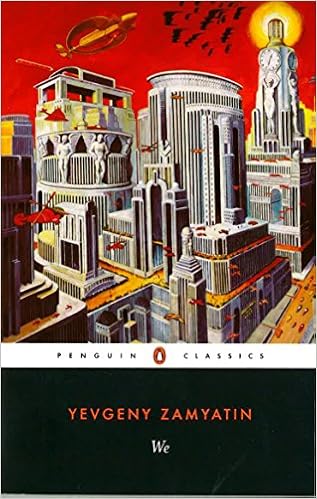
We

We: Yevgeny Zamyatin, Clarence Brown, Clarence Brown ...
We is a classic dystopian science fiction novel by Yevgeny Zamyatin, written in 1920-1921, published in 1924, via English translation in New York. Yevgeny was part of Russian proletariat writing groups and eventually requested to leave Russia as many writers were being persecuted, thus resulting in the death of their writing careers. In fact, when Zamyatin died, there was no mention of him in Russian papers. Most proletariat Russian writers made livings elsewhere like in Paris, England, and the United States. 

The novel depicts a world of harmony within a totalitarian system. There is freedom but only ruled by the Benefactor and activities are ordered along to the 'Table,' a system that controls every hour of everyone's day. In some respects, there wouldn't be a Brave New World by Huxley if it weren't for We. No 1984 by Orwell. No Handmaid's Tale. There wouldn't be all those tons of young adult dystopian novels either. We did it first. 

I will focus on the plot first because it's pertinent to the ideas therein. 

We is set in the future. Probably far future because they have space ships. It's said that there was a great war over something, which is only alluded to in the novel. A resource perhaps. It resulted in the use of weapons of mass destruction, leaving the world outside One State a post-apocalyptic landscape. 


The main character is D-503, a space engineer. People have no names, rather they are identified by number. It takes place in an urban society constructed of glass, which helps for mass surveillance. The people march in step with one another and wear uniforms.  Life is managed scientifically; everybody eats at the same time, works the same time, has recreation hours at the same time, and they even have scheduled times to have sex with partners they can sign up for, rather than of their own choosing. People think with science, logic, and reason above all. The formulas people use are ones devised by the One State, their form of government, lead by the Great Benefactor, their supreme leader.

One State has conquered the whole world. They're now building a spaceship in order to invade and conquer other planets, thus bringing One State across the universe, helping their cause, and increasing their numbers. The ship's project engineer D-503 writes a journal that is meant to be brought along the spaceship when they go to another planet.  

D-503 lives in a glass building like all the others. His partner, O-90 is deemed too short to bear children and is upset by this. His best friend is R-13, a guy who reads his poetry verses at public executions. On an assigned walk, D-503 meets I-330, who flirts with him without being properly assigned. I-330 is a careless free spirit; she drinks alcohol, smokes cigarettes, has casual [not assigned] sex. Every guy has met a girl like I-330, that footloose, and fancy-free girl. In short, she's doing everything that you're not supposed to do in One State. D-503 is appalled but intrigued at the same time. He continues to see her. 

D-503 starts to have a lot of freedom through I-330 and starts to have dreams, which the One State describes as mental illness. "What's wrong with me doc?" "You've found out that you have a soul, for which there is no cure." That's my favorite line in the book because it has that edge of snarky satire as well as philosophical ramifications that goes back to the Greeks. It works well. 

Slowly, I-330 reveals that she's part of an organization called Mephi, which plans to bring down One State. O-90 wants D-503 to illegally impregnate her but in order for her to stay with the baby, she has to leave One State and go beyond the wall, where primitive humans live, complete with coats of fur. 

The last journal entry details the 'Great Operation,' a brain surgery of sorts, that targets the brain with x-rays, so they can function as 'tractors in human form.' It basically makes you more of a vegetable. Removes imagination. Once D-503 gets the operation he runs to the Benefactor to tell him about the Mephi operation. I-330 and her associates are sentenced to death under the Benefactor's machine, which literally melts the human body. A  death ray.

But the novel ends on somewhat of a good note. The Mephi operation is doing well, birds are repopulating the city, and people start acting out against the regime. One State's survival is left in doubt. The book ends with a strong manifesto; just as there is no highest number, there can be no final revolution. 

 Now we get some ideas. 

First, the writing style can, at certain times, be quite a satire. There's one scene early in the book where a woman is playing the piano and people are watching and listening to her play. At one point during the impromptu performance, which is already rare in this society, D-503 starts laughing uncontrollably because music is such an unstructured improvised form that most of the citizens just aren't used to. 

The scene with the doctor is my favorite in the book. "You have a soul. There is no cure." That's a great satirical moment, a great laugh. Of course, it was true, D-503 had indeed, somehow developed a soul through his new girlfriend, I-330. 

The idea of having sex only with assigned partners and only at certain days and times is also a laugh. Did they also forbid masturbation?

There are philosophical ideas at work here too. In fact, the doctor scene isn't just a satire, there's a religious tone to it as well. The idea of the soul separate from the body and mind goes back to Plato and Aristotle. This is used in fiction to good effect. The fact that D-503 developed a soul rather than being born with one is another note on satire. 

The idea of a conformist culture where everybody is happy [for the most part One State is happy] should be considered utopian, right? Well, the thing that makes One State a dystopian novel rather than a utopian one is the fact that One State not only wants to take away freedoms [which is fine because most of the people are cool with that], but One State also wants to get rid of imagination. In We, imagination is the mind-killer rather. If the citizens of One State were allowed to imagine this would be an entirely different novel. 

Lastly, this is one of the important and critical works in science fiction, particularly in the dystopian canon. I initially read this on the recommendation of a Russian friend of mine. I'm glad I read it because it's truly a great story and it stays with you. This isn't something you read and forget about a few months later. It's that important of a book. Considering the way governments are run today you will find that Yevgeny Zamyatin's ideas still ring true to this day. For just as there is no highest number, there can be no final revolution.

Tuesday, April 14, 2020

Surviving the Zombie Apocalypse Virus pt. 6

Greetings noble readers of my blog. How's the quarantine life treating you all? I figured I would continue my series about life during the coronavirus. If you haven't seen any of the previous posts about this up to this point, I recommend you click on the 'plague journal' at the top of my blog page and review some of the earlier posts. Or you can find it here. I explain the working conditions at my job and stuff, it's quite an overview. 

Anyways, we're somewhere in the middle of this virus. Not contained by any means but it has not taken over California like it did in New York, Italy, China, or Spain. 23,000 people have died in the US. But that's considered low numbers. For the time being. But it's still a crippling reminder that this virus has ravaged our country. It's very sad. 

We're all very lucky to have good leadership in California under Gavin Newsom and under the Los Angeles mayor Garcetti. They called for stay at home orders long before other states followed suit. Smart guys who listen to their advisers. 

I didn't catch the virus from work but the threat of continuing to work in the front end at a grocery store greatly expanded my chance of catching the virus, exponentially. Naturally, I took a leave of absence from my job, as other coworkers did as well. The number one reason was fear that I could catch the virus, bring it home, and give it to my elderly father, whom I love very much. The other being unsafe working conditions.

Now I'm on somewhat of a respite. The threat of the virus is still there if I go out in public like another grocery store but as long as I stay in lockdown I am now much safer. Thankfully! Eventually, I'll have to return to work but hopefully, by then the stay at home order will be lifted and perhaps businesses will open up again. I doubt it but anything's possible, right?

What is life like now? Well, it's calm. I have a regular routine per usual. 

I started running in the mornings to try to lose weight. Been working on zen breathing and the art of running. I do afternoon jazz guitar concert sets on my balcony for all the passersby walking down my busy street. I love to play solo guitar jazz standards. I stream video games on twitch, which you can find here. I read a lot, mostly science fiction at the moment. I've also got a new Kant book to read as well; Moral on Metaphysics, my cup of tea. I plan on writing a zombie virus series which you can find the beginning of here. 

I have no social life because some of my friends have existing conditions and some of their parents are against us meeting up during this time of crisis. A fair assessment of the situation I would say. As a result, we've banded together online, text chat on phone, direct messaging on Facebook, voice coms on Discord, hanging out in each other's twitch streams, gaming together online, and such. In such dire straights, you would think the infrastructure of the internet would collapse, lol. But it's fun to talk to and chill with my friends online. I miss them very much and perhaps that's the greatest loss during this pandemic. The fact that we can't gather round in person, chill together, find solace in human solidarity together. 

If there's one thing I'll remember with all this shit going on [a popular California way of talking about the virus], other than 'social distancing,' it's the fact that "we're all in this together."

Thursday, April 9, 2020

Human, Ghoul, Zombie

Hey everybody, how's the quarantine life going? Here, I'd like to share with you a fictional short story I wrote that was inspired by the virus. It's called Human, Ghoul, Zombie. It's going to be a series, maybe eventually the theme would be written into a novel. You can read it here; Human, Ghoul, Zombie

Thanks for reading. Keep social distancing and stay healthy! We will get through this together.  

Saturday, April 4, 2020

The Moon is a Harsh Mistress

The Moon Is a Harsh MistressThe Moon is a Harsh Mistress, the novel by the classic and famous Robert Heinlein is one of those classic science fiction novels, from the golden age of science fiction, the 50s-60s. TMIAHM was initially released through magazine installments, later as a full novel. The novel won the Hugo Award for best science fiction novel in 1967, during the height of the flower power hippie movement.

Which was great timing for Heinlein to write this book. For you see, this book is a good story, but it is also an exercise in literary politics and/or political economy, particularly libertarianism. So it makes sense that Heinlein would publish and write books with this flavor of politics during the 1960s when many young people would be exposed to these, then new ideas for them.

Let's start with the story. This is a story about revolution. A lunar colony on the moon is taking control over the colony, giving it to the people [in this case, our narrators/main characters], and saying, "screw you," to Earth, and all the Earth countries that won't recognize this new regime. 

The new regime comes to be through a particularly striking main character; a sentient supercomputer who befriends the narrator and his two friends. The supercomputer, named Mike, is so lifelike, but the fact that he wants to help humans stage a revolution and succeeds in helping them do so, makes him a lot like a computer Pinocchio. What does he get out of it? Friendship really is all. It's worth it.

The narrator, the main character as well, is a guy named Manuel, who's first language seems to be Russian, so he speaks in a sort of broken English not unlike what you would see in Slavic languages. Sort of like the slang in A Clockwork Orange. The first couple of pages reading it is sort of strange, but then you get a feel for it, and just go with it. After all, you can't expect everybody you talk to, to speak in perfect English, better get used to it. Mannie is Mike's technician, and he isn't a much of a political guy, but he gets roped into this. 

By a woman of course. Wyoming Knott-Davis. She's a beautiful blonde. For a while, she uses advanced technological makeup to make her look African while she's in hiding, complete with an afro. But she's blonde most of the time. She gets Mannie involved with politics, after Mannie saves her from a blood bath, as you see a political secret meeting against the Warden took place, and it was raided by Dragoon Troops, the Warden's hired goons. The action scene that took place in that instant was classic military science fiction, complete with laser guns, blood, and gore. I liked the scene a lot and expected more of this. Ironically, there isn't much actual fighting and action, at least not till the very end. But our three characters needed one more person to help them realize their mission. 

Enter Professor Bernado de la Paz. He's an old teacher who's taught nearly half of Luna. He describes himself as a Rationalist Anarchist, which basically means that the government has no existence but for the acts of responsible individuals, "tries to live perfectly in an imperfect world." He's the true radical of the group but realizes that the need for the government does indeed exist and achieves it.

Some info on the world-building here. Luna is seen as a sort of Old West, and the revolution is reminiscent of the Bolshevik October Revolution as opposed to the American Revolution. People are sent to Luna either to escape bad fate, live a new life, or they're prisoners. Luna is short on women so women are heads of families and families are composed of 'line marriages,' giant families that pool all their resources together. Once when Mannie is in North America he gets arrested for polygamy, as he has multiple wives. Women are so scarce on Luna that they never get hurt, or even raped. They're safer there than on Earth surprisingly, even among criminals.

So we have these characters achieve a revolution. Now what? They do their best to form a government, get the rest of the world to recognize their new independent status. Failing that, they 'throw rocks,' at the Earth, hitting most of the countries with heavy bombs, carefully shot from Luna with the help of Mike, a ballistics expert, who even gets his own human persona, which he creates using images on a screen. What a computer! Probably the best-written computer character I've seen in science fiction. 

After the Earthlings get mad at Loonies [yes that's what they're called] for bombing them, they retaliate by indoctrinating some prisoners and drugging them, telling them that unless they kill as many Loonies as possible, they won't get their freedom back. This results in an epic bloodbath on Luna. More Loonies die in the firefight that ensues, but they kill all the Earthling intruders and come together more than ever. In a blaze of glory!  

Realizing that they failed, the Earthlings concede Luna's independent status and the mission is complete. It's a great read in terms of story, plot, characters, politics, and philosophy, but the thing that can't be overlooked is that this is just a damn good story. Definitely read this is you're a science fiction avid reader. Don't get me wrong, this is not a masterpiece, but it's important enough that it's a must-read science fiction novel, in my humble opinion. 

On a side note, reading this during the pandemic has me thinking a lot about politics. Could it be that the politics that emerge out of this historic pandemic would shift to a more libertarian sort of state? Something to think about.

"There Ain't No Such Thing As A Free Lunch!", (a common expression on Luna that states one of the main ideas of the book's political system.)

September Sweater Weather

Good evening ladies and gentlemen, hello world. How are you?  It's good to be writing on a good day off work today on a Saturday. Here, ...