Showing posts with label sci fi. Show all posts

Thursday, February 28, 2019

Alita Battle Angel


Alita Battle Angel (2019 poster).pngAlita Battle Angel is the latest anime inspired flick to hit the big screen. Its an adaptation of the 1990s manga Gunnm, also known as Battle Angel Alita. Directed by Robert Rodriquez, written by James Cameron and Laeta Kalogridis, and produced by Cameron and Jon Landau. As you can see this is a multi-million dollar movie with James Cameron [of Avatar fame] involved. 

Alita Battle Angel reminds you of a lot of things. Avatar because Alita is acted out using a sensor capture suit, with big wide-eyed anime eyes, complete with a cyborg body, which is totally Ghost in the Shell. The actual city that the movie takes place in, Iron City is complete with neon signs, multilingual people, and different races. Very reminiscent of Blade Runner. Those are great things to be reminded of. 

Alita is found in the scrapyard by a paternal scientist named Ido, who gives her a cybernetic body that he was planning on using for his daughter [not weird at all!]. Alita is mostly cyborg but she has a human brain intact, giving her emotions. Hence, she's a lot like a teenage girl at first and gets a teenage boyfriend, who turns out to be a bad guy. Turns out this guy is apart of a youth gang that hijacks cyborgs and steals their parts, while they're still alive. Then his gang sells the parts to Vector [a guy who gets his fashion sense from the Matrix], in what they believe is the only chance to get to the utopian city Zolumn in the sky above Iron City. Sound convoluted yet? It is.

However, it is not the razor-blade addled cyborg fights or the intense violence of Motorball [basically death race, a futuristic sport where you throw a ball and try to kill your opponents, while racing on motorized roller blades]. Nor is it the fact that Alita learns that she was an ancient weapon used some 300 years ago in some battle, possibly fighting to destroy Zolumn [again convoluted]. 

The thing that makes this movie good, maybe even memorable for a few months [for me at least] is the sheer emotional appeal of this cyborg girl. Some people would find the emotional scenes in this movie to be corny. I did not. I was moved when Alita was trying to justify herself to her boyfriend, only for him to respond, "You're the most human person I've ever met." Their love was real in that scene. That shows that even a cyborg girl is capable of loving, and of being loved back. Very powerful indeed. 

Another characteristic moment was when she was talking to the boyfriend about going to Zolumn. She says, "I'll do anything to get you to Zolumn. I'll give you my heart. It's so powerful it can power the city for a whole year!" Then the boyfriend responds, saying "I can't do that to you. You can't just give people things. You can't be so naive." And the reality is that Alita is quite naive, she's basically like a teenage girl. 

The climax of the movie is when the love interest dies, killed by an unknown villain in Zolumn, [who like a characteristic anime character wears some cyberpunk googles that look really cool]. At some point Alita finds her 300 year old Erhm bodysuit and she discovers that she's a Battle Angel, an ancient weapon, which is the reason why she was able to beat the crap out of Hunter Warriors, cyborgs who do the policing in Iron City. The new suit has bigger breasts and a small waist. There's something of a feminist affect in Alita Battle Angel but for whom, and why? I can't really say. Some scenes have feminist overtones. Like when Alita beats up everyone in the Hunter Warrior bar and when her boyfriend says not to challenge them she says, "I'm gonna need you to step back." As if men should sometimes take a step back from women, that kind of thing. But the fact that her body suit is sexy and sleek, with the 'ideal' feminine traits, I think that is something purely for the male fanboy audience. Of which I am apart of [lol]. The one thing that I liked regarding Alita's physical appearance was her big anime eyes that never seemed to close, and that seemed to change during emotional scenes. I think they did a great job with those eyes. You can see Alita's soul through her eyes. However, I can also see the eyes in a negative sexual sense. Someone might say she looks like a sex doll. Or something.

Alita becomes a Hunter Warrior and a pro Motorball player in her attempt to get to Zolumn, to discover more about the world, and herself, I presume. The movie ends much better than it starts, on a cliffhanger. Rodriquez and Cameron believed that the world would catch Alita fever. While I don't see that being the case [most of my friends haven't seen it], I do think they had something here with this movie. It may not even be as good as Ghost in the Shell [it lacks the maturity that Ghost in the Shell had] but I think that the little bit of pathos utilized here was good enough for me. However, I'm a fanboy that has watched years and years of anime, so I'm a bit biased. 

I'll definitely watch the anime version sometime soon. 

Sunday, February 24, 2019

Floating Worlds

Image result for floating worlds cecelia hollandFloating Worlds is a terrific science fiction novel from 1975. Written by historical fiction writer Cecilia Holland, this is her first and only science fiction novel. The book is about a biracial woman named Paula Mendoza, who at the beginning of the book gets tired of her lame boyfriend, dumps him, and gets a job working for The Committee, a group of Anarchists who help manage Earth's government. This all happens thousands of years into the future by the way, where pollution has decimated the Earth, resulting in humans living protected in domes. 

Enter Styths. Paula's job is to get the Styths to agree to a treaty, which lasts ten years. The Styths are descendants of the first humans on Uranus, except they've changed, they're mutated. They're eight feet tall mutated humans [aliens], that speak a different language, live in a patriarchal society, are disgustingly racist [use the n-word all the time], and are complete savages who raid Mars and enslave thousands of people. They are described as black skinned mutants with long mustaches. Paula's means of getting the Styths to sign the treaty is a bit scandalous. She seduces their leader, Saba, and has a Styth baby by him, goes to live with him on his home planet, and engages in the politics from there.

Saba is a brutal alien. He beats Paula and at one point even rapes her. However, Paula comes back to him in order to do what she wants, which is whatever she wants, whenever she wants it. She's the idea of the female man, she's the perfect anarchist because although she's working for the Committee, she's also working for herself, and for the Styths, all at the same and sometimes different points in the novel. In a sense, we never get to know whats going on in Paula's head, but we can infer from the prose.

Floating worlds has two very important quirks. First, the prose is very short and simple sentences. Second, Holland never explains anything. There's no legendary or epic grand science fiction exposition here. This isn't Man Plus, with its eloquent and long exposition, a book I read recently. She doesn't explain how any of the technology works, the world of the space opera itself, the psychological state and/or feelings of the characters. Instead, we get a point of view of the character told from these short simple sentences that explain whats going on, and the dialogue between the different characters. It's a unique way to write, a very inspiring one as well when you realize that sometimes all you need is to be simple and straight to the point. In a way, this book taught me a new way to approach writing. I realized that technically, I don't have know the scientific facts that exist in the world of science fiction. You could just have incredible technology and just have it work, that's what Holland does here. None of the tech is explained, the characters just use these advanced computers and they work fine without any fine details.

There's space combat, tribal duels to claim the Styth throne, romance, lesbian sex, lots of sex in general, seduction, betrayal, politics regarding gender, race, and class, war, a fallout Earth that feels like the 1970s, contemporary. The ending itself is almost the same as the ending for Schismatrix, which came out ten years later, which is the main character walking away from the entire space opera in a state of experienced zen-bliss? Perhaps something like describes it.

There are many reasons why this novel is important. The biggest reason is that this is a science fiction novel with a powerful female protagonist. Another important female protagonist I can think of is Lady Jessica, of the Bene Gesserit Order, from Dune. Also, this is a space opera on a grand scale that takes place over twenty years. You're going to be going through long reading sessions to finish this novel [465 pages]. However, you get in a rhythm, pacing if you will, when you learn to enjoy the simpleness of the sentences, and the uniqueness of the prose. I can see how the 80's of writers like Bruce Sterling may have been influenced by this. If not influenced then at least definitely aware. Schismatrix Plus comes to mind especially. Lastly, because of the writing style and lack of psychological detail and exposition, this is a very unique science fiction novel, which makes it worth reading, dusting off the 1970's dust and brought into the light of 2019.

I liked this book so much that I ended up buying a used copy from a third party on Amazon for eight bucks. This is going to be one of my prized SF novels on my book shelf. It's so good that I'm planning on reading Holland's historical fiction at some point in the future too. This is a work of great lost art from the '70s, it deserves to be on anyone's book shelf. 

[my copy has this book cover, the original book cover, pictured top]

Sunday, January 27, 2019

Man Plus


Image result for man plus frederik pohl cover
Man Plus is a science fiction novel written by Frederik Pohl in 1976. Pohl is one of those rare great writers who was not only a great writer but also a great editor. I heard from my dad that he didn't start out as a great writer either. In fact, it took him a while and eventually he just got good.  [much like how gamers get good after playing for years and years, practicing rigorously]

Man Plus is a the modern world at that time, in the 70s. Communism has taken hold in every part of the world except North America. They mention the evil Chinese and this and that but no word on Africa at all. Anyways, the world is in a Cold War state and the only thing that will save humanity from Armageddon is colonizing Mars and eventually settling a colony. The Americans come up with the Man Plus program to achieve this.

Interestingly enough, when I compare the politics and President here to the current Trump administration and the rise of Communism across the globe, I see an eerie similarity. Basically President Deshantine in Man Plus is very much like Trump. Full of shit with bad politics. 

Roger Torraway was third in line to be the Man Plus. However, the first guy has a complication and dies. The second guy has a broken leg. Roger is up. The thing is that the scientists needed to create a being who can stand on the surface of Mars without a space suit, something totally implausible in any scenario. But Pohl makes it almost make sense. And he plays it off very well. In order to get this to work the scientists rip apart Roger's body and rebuild him with mechanical parts and a computer, saving only what makes him human, his brain. He becomes a human-machine hybrid, a cyborg. 

The cyborg seems like one of those old pulp science fiction tropes. Or Doctor Who if you're familiar with that show. Its a popular idea for a good reason. Because its interesting. Its captivating and all that jazz. We as the audience want to see into the inner soul of the cyborg, can they have that?

While Roger's failing to control his new mechanical body he's also failing to deal with his own personal relationship; mainly the fact that his wife has been cheating on him with his best friend! [which reminds me of The Room, a parody movie

Roger doesn't fully come into his own until he actually walks the surface of Mars. Once there he realizes he can't control the machine within him, and at the end we learn that the machines built within him as well as the machines of the Earth might've influenced him and humanity in order to get to Mars and establish a colony, a sort of AI-human hybrid influenced fate. Perhaps Pohl is saying that the machine will become sentient and we'll be the machines? Role-reversals? I think of things like this when I see how smartphones have taken over the consumer to the point where consumers are using their phones for everything instead of just to make calls. [E.M Forster's The Machine Stops comes to mind]

The ending is very interesting and I'm still not sure what to make of it. Satire maybe? You could say the whole novel is satire. I only know that I think its fantastic. It left me in a state where after I read it at a lunch break at work, finished it, clocked back into work, and thought "I just finished reading a masterpiece". Realistically and thinking back on it a day later, its just a great work of style. 

Pohl is a stylist here. This is New Wave science fiction with a high literary style and voice. This is beyond the 50s and 60s pulp science fiction. More technical, more scientific but in the end its all great made up fiction, which is really the only thing that matters in the end. Never mind all the biological and technological jargon regarding the machinery and the climate/habitat of Mars. Forget how the frog's eyes work. All that is just extra for great writing and great ideas. 

Another important factor is the psychology of the characters involved. This novel is intellectual in a psychological way. None of them are say villains but they ain't saints, especially Roger's best friend, who ends up going to space with him. [you can guess what happens on Mars when that happens

This book was so captivating that I could hardly put it down. I finished all 180 pages in two days and was thoroughly satisfied upon completion. Great classic science fiction read, recommended to anyone who loves space, adventure, as well as an intellectually stimulating narrative.

Monday, January 21, 2019

Schismatrix Plus

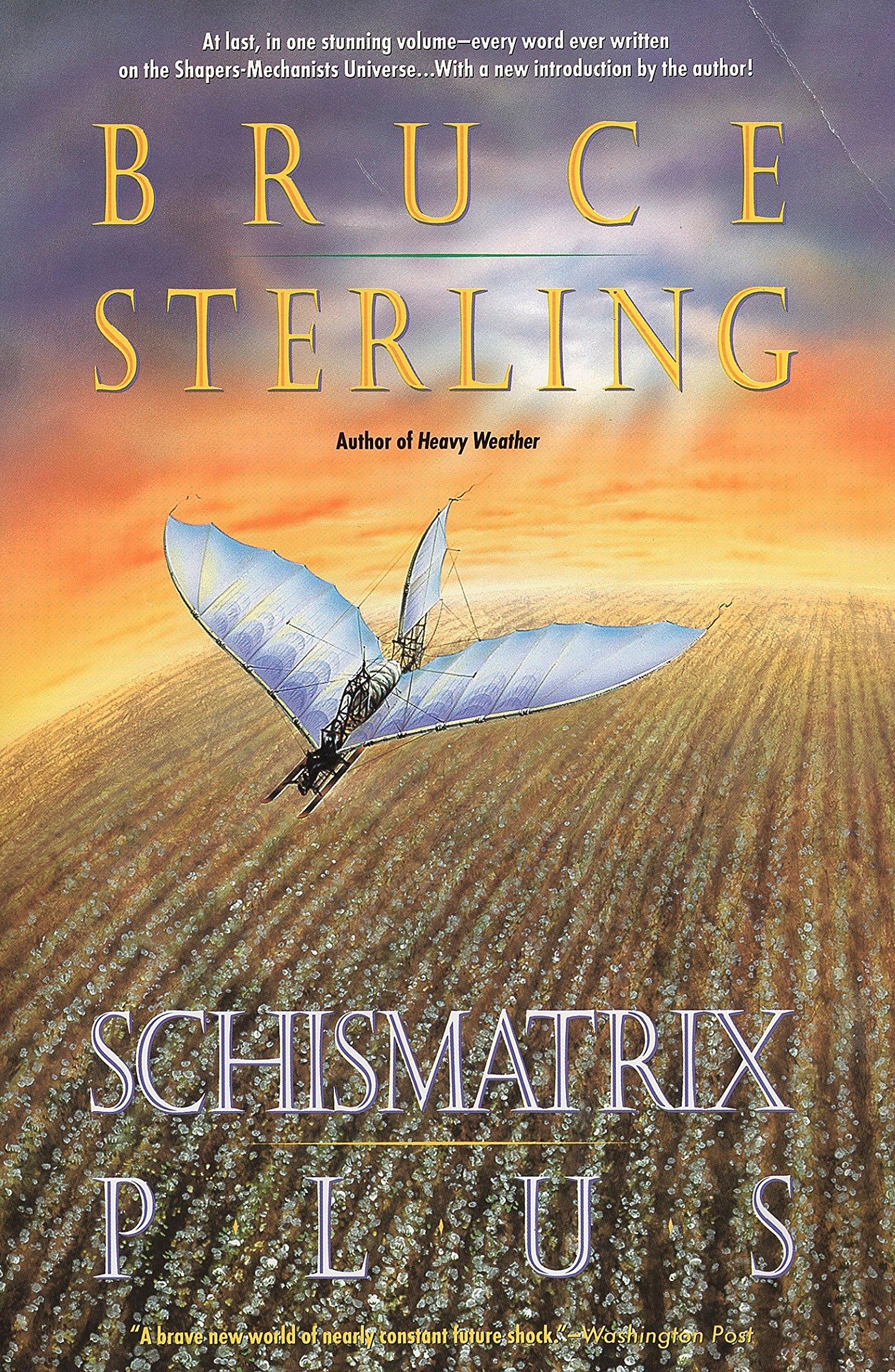
Image result for schismatrix book cover originalSchismatrix Plus is a science fiction novel by Bruce Sterling, written in 1985. Schismatrix was nominated for the Nebula Award for Best Novel in 1985, and the British Science Fiction Award in 1986. This story is set in Bruce Sterling's fictional Mechanist/Shaper universe. Five short stories that preceded the novel are apart of the Schismatrix Plus edition. The novel by itself without the short stories is simply titled Schismatrix. 

What can I say about this novel? It is simply fantastic and got me more interested in the cyberpunk genre. Sometimes you read a book and something hits you in the head. Bang! This is one of those books. This is an important book. Even a week after finishing the novel I still think about it, the themes and concepts, and especially the ending. 

There's a universe of potential, Lindsay, think of that. No rules, no limits.  

The world of Schismatrix is transhuman. There are Shapers, who use biotechnology and psychology to enhance human potential and then there are Mechanists, who apply AI, and mechanical parts to enhance themselves and become more than human. The Shapers/Mechanists are colonizing the solar system, divided in their two distinct philosophies. 

The book follows the life of a sundog [wanderer, ronin] named Ableard Lindsay, a Shaper with diplomatic training and a brilliant liar, which he uses to great effect. "Before the end of the novel his careers have included being a revolutionary, a theatre producer, a space pirate, a xenodiplomat, a scholar and a prophet." [https://www.aleph.se/Trans/Cultural/Art/schismatrix.html] 

"Politics pulls us together, technology pulls us apart".

Throughout the book changes in technology, habitat, economics, and politics change the dynamics of the entire narrative and discourse. There's a similarity here to the Cold War. This was written in 1985 after all, in a different era from mine [2019]. This similarity is shown when the Shapers/Mechanists have problems when they start colonizing neutral zones. 

The changes force people to adapt, their life styles as well as their philosophies. Some people turn to Zen Serotonin, something of a religion where people get high off neurochemical implants. Others are Cataclysts, who think radical change is a good way to open ones' eyes, whether you want it or not. 

The one theme that repeats throughout the novel is that nothing goes as planned. A plan might work out for a little while, but you have to always be prepared to move on, do something else, just in case. 

He mourned mankind, and the blindness of men, who thought that the Kosmos had rules and limits that would shelter them from their own freedom. There were no shelters. There were no final purposes. Futility, and freedom, were Absolute. [From the short story Ten Evocations]


Futility is freedom could be seen as the overarching mood of Schismatrix. Its impossible to plan for the future because the everything's always changing. But the chaos is also affected by our actions. 

In the short story Swarm, we find have a group of symbiotic non-sentient species living in a hive society. Through this story we find out that intelligence isn't needed for long-term survival, and sometimes it might not even be desirable.  

Sterling makes me think a lot about what transhumans would really be like. Transhumanism is one thing but when its mixed with politics, ideology, and power it becomes something else. Its not a cheerful thing. The flaws in ideology is the price paid for continued evolution. 

One thing I'd like to say that this book made me feel like a kid again. The Investors [tall, big, reptilian-like aliens, who are more interested in business than anything else] were really cool and I could see aliens really looking and acting like them. The ending where Lindsey becomes one with the Presence was pretty great too. Although the actual writing in the novel is a bit dense the mind-set of the novel is tough-minded, and never lets you down. 

The ideas here are thought provoking and would do well to be explored further by Sterling himself [not gonna happen] or others with similar ideas for the science fiction canon. Sterling seems to suggest that there wont be one posthumanity, but many and tremendously diverse posthumanities. Our greatest enemy might be our inability to handle infinite possibilities. [https://www.aleph.se/Trans/Cultural/Art/schismatrix.html]

Wednesday, January 2, 2019

China Mountain Zhang


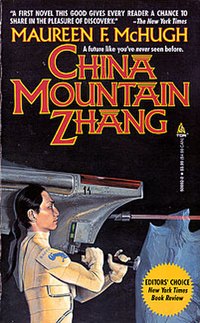
ChinaMountainZhang.jpgChina Mountain Zhang is the debut science fiction novel by Maureen McHugh. The novel was nominated for the Hugo Award for Best Novel and Nebula Award for Best Novel and won a Lambda Literary Award, the Locus Award for Best First Novel, and the James Tiptree, Jr. Award. 

The book features several stories from a small group of characters, some ABC (American Born Chinese) and others Americans. The story focuses on the story of a gay Chinese and Puerto Rican man named Rafael Zhang in his non-Chinese context, and when with Chinese people he goes by "Zhongshan, which is written with the characters with primary meanings "center" and "mountain"; the Mandarin name for China also begins with the character meaning "center" or "middle". Thus, "China Mountain" is an alternate reading of his Chinese given name. (Zhongshan is also one of the given names used by Chinese revolutionary leader Sun Yat-sen.)" (wiki)  

The story is about how Zhang and how these other characters he meets along his path live in a near distant future, where socialism has completely replaced capitalism, in the Cleansing Winds Campaign, going from arrogant outsiders to finding their place in society. A maturation, a coming of age for all involved.


Zhang is almost thirty and he's just got a two year degree as a construction tech in New York. His Chinese boss wants him to marry his daughter, and he would support him so he could go to school in China and get a good job. In this future, China has the best jobs and the richest people. Zhang meets the Foreman's daughter, only to find out that she's very ugly and needs surgery on her face, some kind of bone problem. 

Zhang goes out with the Foreman's daughter but he doesn't get romantically involved, after all he's gay. Shenanigans ensue with the daughter, the Foreman thinks he's been sleeping with her at his place, after she was missing for days after an argument with her parents. 

Some time passes. Zhang decides he's going to study systems engineering in China so he can get a good job and go somewhere in life. He ends up doing a work program in the polar region, where he almost loses his mind among scientists there to study marine biology. The trade off is that if he works there for a couple years, the government will send him to China where he can get a systems engineer degree, and from there either stay in China and work at a big company, or go back to New York, where he could live with friends and family around. 

On another side story we have a sport called kite racing, where humans have been enhanced and ride these body kites, in races. The racers are legends and the spectators watch them race through the skies on a live video feed, which they can 'jack' into. 

This sub-story involves a kite racing woman who is sort of involved with another racer, who's older brother was a racing legend, who died recently. Although most of this section is sort of filler, and ultimately non sequential to Zhang's main plot, there is an amazing description of the kite racing that had me sitting at the edge of my seat. The way the fliers runs through the air with their bodies, with the impending doom of possible death is quite exhilarating. This was the action section. 

On a third side story we have the Foreman's daughter. She just got face surgery and now she's very pretty. She still works at the same company job, and one night a handsome guy talks to her at some bar. He eventually calls her at work and asks her out. He proceeds to take her to the bar, to a party, then swimming. Then he asks her to his place, at first she wants to go home but the guy makes a stink about how much he spent on her and that all he wants is for her to have a cup of coffee. In the end the Foreman's daughter ends up getting raped. This part of the novel was dark, but it could happen to any woman. She ends up not telling anybody about it, and that's that. She never sees the guy again. It puts a very realistic spin on rape, because it sounds like such a real and believable story. Scary.

At the end of the novel we find Zhang has his degree from studying in China, and is teaching systems engineering at a city college in Brooklyn. However, in China Zhang had a boyfriend named Haitao (being gay can get you killed in this future), who ends up killing himself after a late night party goes awry. Another thing to note is that while studying in China, Zhang tutors a student who's living on Mars, and Alexi, the student, challenges Zhang to think about systems in a completely different way, increasing his skills for his work.

Zhang goes to China to check on a possible job but in the end he gets down on China, even though at the beginning of the novel its his dream to be a big shot in China, making the big bucks. In the end he realized that he liked teaching in New York, that he liked being around all his friends and neighbors, and that he's going to stay put. 

Zhang meets the Foreman's daughter at the end of the novel and they have an awkward interaction. When the Foreman's daughter is about to drive off on the train, Zhang says in her ear that it wasn't her, implying that he didn't want to have sex with her because she was ugly, rather that its because he's gay. We don't get to see a reaction from the Foreman's daughter, as the train door closes and rushes away. 

The novel is quite damn good, very good for a debut novel. The writing brings to mind Samuel Delaney, who can write science fiction but is very literary about it. Also, although this novel is considered science fiction, it doesn't use any typical science fiction tropes, nor does any of the characters impact the world around them in a profound way. In a sense, this is a near distant future about people being people. What makes the book so great is that its all very ordinary, the world and the characters. It also must be noted that McHugh wrote this after living in China for a while, and the novels makes use of tons of Chinese words and culture. Some of the cultural stuff I recognized from things my step-father has told me about China.

This was a great Christmas gift from my dad. The book came out in 1992 and it holds up well to this day. Not all first novels are as good as this one for a writer. Good read even if you aren't into science fiction. First book of the new year already finished. Woo! 

Sunday, November 25, 2018

The Difference Engine

Image result for the difference engine gibson sterling
The Difference Engine by William Gibson and Bruce Sterling is one of those all-time great 'hard' science fiction novels. Set in a steampunk alternative history where primitive computers were invented in the mid 1800s thanks to Charles Babbage's Analytical Engine, the story has the three things a good cyperpunk story has: steam airships, brass computers, and kinky feminine underwear (Gibson's words). 

The story follows Sybil Gerard, the daughter of a famous Luddite agitator Walter Gerard (Luddites being anti-technologists), Edward 'Leviathan' Mallory-paleontologist and explorer, and Laurence Oliphant, a historical figure, a travel writer who works under service of Her Majesty. What links all these characters together are these computer punch cards that are supposed to be powerful, important enough to die for. 

The characters believe the punch cards are part of a gambling 'modus', a device used in gambling where you can never lose, and have infinite money, a alchemist device.  "The last chapter reveals that the punched cards represent a program that proves two theorems which, in reality, would not be discovered until 1931 by Kurt Gödel. Ada Lovelace delivers a lecture on the subject in France." 

Mallory, his brothers, and Ebenezer Frazer (part of the Secret Police) defends the cards against Captain Swing, who leads a riot during the 'Stink', a major pollution event that happened in London, similar to the London Smog of December 1952. 

At the end Oliphant meets Sybil Gerard and tells her he knows who she is, the daughter of Walter Gerard, the famous Luddite agitator. He says he won't share her identity with anybody, but that he needs information to help take down Charles Egremont MP, her seducer, who poses as an obstacle in the way of Charles Babbage and Lord Brunnel's political careers. 

The end of the novel features all these different histories that occur in the world of Difference Engine. Lovelace delivers her lecture on Godel's Theorem, as its counterpart is known in our world. Fraser accompanies Sybil and meets Lovelace, with Sybil not ever able to forgive Lovelace's father Byron, for her role in her father's death.  

The end features a view of an alternate 1991 from the point of a computer, which turns out to be the narrator as it achieves self-awareness. 

Wow! What a novel. There's a lot to like about this novel. There's even realistic sex scenes, sort of like noir. The description of 'clackers', the book's version of hackers is pretty interesting, and similar to what hackers are like in real life, the 30-hour savants working around the clock with their calculations. 

But I think what was most exciting about this novel was the sheer brilliance of the writing-dialogue, plot, exposition, niche time period words of the 1850s, its got a lot going for it. The way that Gibson and Sterling made the narrator a computer, it gave them more options when it came to plot and exposition. I also believe that because this is the work of Gibson and Sterling, that it was destined to be great. This book was written at a high period of literary achievement for both writers. So its no surprise that the writing is very good. Both of them went on to become very different writers after the cyberpunk 90s. 

Although the novel was nearly 500 pages and took a long time to read (including a lot of 30 minute lunch breaks at work), I would say it was well worth it. This book compares to something like Dune, which I put at a really high literary and science fiction pinnacle. Its just that good.

The truth though is that the book took me a long time to get into. In fact, I had checked it out numerous times and barely ever got 50 pages in and at point I even listened to the audio book version on YouTube. Eventually I decided I was going to read the whole thing, turns out it was well worth the time and effort. But a book this great doesn't take too much effort, the words seemingly move across pages very easily. The time invested in reading this book is time well enjoyed. Such is the literary style of Gibson and Sterling. 

Well worth the read if you like alternative history, steampunk, or cyberpunk stories.  

Sunday, January 21, 2018

Frankenstein, or The Modern Prometheus


Hello everybody! Here I'd like to discuss Mary Shelly's Frankenstein, which I literally just finished reading just now. The book was inspired by Mary Shelly and her friends friends who used to tell each other ghost stories around the campfire, they all decided they should all write their own ghost story and whoever wrote the best one, that one would get published. This is the only one that got done and published folks. Its quite good and inspired movie(s), cartoons, video games, and much more. The first unedited version was written and published in 1819, making this the oldest science fiction I've ever read, wow!

This book can be a little difficult to get into at first. Everybody knows the story of Frankenstein and the book only differs from the movie in some slight ways. For example, the monster here is eloquent and quite poetic, however, that is just the writing, times, and style of the book. The writing is quite formal, which is expected of the time in which it was written. For instead of thinking of the monster as eloquent, its more evident that the monster is a product of the times (1819) and that he is still quite evil despite his mastery of persuasion and making the reader feel sympathy for the state of this pathetic wretch.

The main difference from the book and the 1930s movie we've all seen is that Victor Frankenstein (the creator, mad scientist) gets a full biography and history where we learn near the end that the woman he is to marry is a childhood friend that his family took in, almost like a sister, which to me was a little incestuous but otherwise not that different from the movie. In addition, his monster torments and kills members of his family in the book, whereas in the movie the monster accidentally kills a villager's daughter. Also, the ending of the book is quite different from the movie, but I do like that after all is said and done our monster runs away like a thief into the night. It was quite a fitting ending for what could be construed as science fiction horror.

Today we look at this kind of thing and call it horror but back at its inception this type of writing would be considered science fiction. Mary Shelly's writing here is quite stylized; formal, educated, high art of a certain style. Its definitely a product of its time and I could see some people having trouble getting used to the literary style. I've found that I really enjoy these old types of science fiction writings, especially by women, they have a certain voice that men don't have. I suspect I'll learn more about this as I read more and more science fiction by female authors. I just ordered Ursula K. Le Guin's The Left Hand of Darkness, which is a sort of feminist cyberpunk sort of thing. I'm looking forward to reading that next.

However, Frankenstein is a hellova novel. I liked it so much that I'll probably want to read it again in the future, probably some months or years down the line. There's a sensation of eerie evil doings alongside justice in this book and it seems to do it in a literary personable voice rather than just being sinister just because. It's great, and if you like the movie then you should definitely check out the book.

"Cursed, cursed creator! Why did I live? Why, in that instant, did I not extinguish the spark of existence which you had so wantonly bestowed? I know not; despair had not yet taken possession of me; my feelings were those of rage and revenge. I could with pleasure have destroyed the cottage and its inhabitants and have glutted myself with their shrieks and misery."

Friday, January 12, 2018

The Hitchhiker's Guide to the Galaxy


The Hitchhiker's Guide to the Galaxy is a science fiction novel written by Douglas Adams in 1979. You can see the book influenced science fiction in a popular cultural aspect, just take a look at Dr. Who and this book is that. The idea of the actual book in the novel, entitled The Hitchhiker's Guide to the Galaxy, a book with so much information compiled into it that it could be city, this idea is in a book I'm currently reading, Neal Stephenson's The Diamond Age Or A Young Lady's Illustrated Primer. In this book an electronic book is given to a girl of a lower social class, a book compiled by men in government. That idea is much more serious than this book however. But Hitchhiker's is good fun. 

The plot follows a cast of characters (one human with a bunch of aliens) following the destruction of the planet Earth. This alien who was living on Earth for fifteen years and got stranded and this human are the only Earthlings that lived through it and now they've gone out into the Galaxy as sort of space dandy ronin, thus hilarity and shenanigans ensue.

It must be mentioned that Douglas Adams also wrote for Monty Python and it is evident here. There's lots of off the wall wacky descriptions of things (often with made up words), hilarious comedy dialogue, all the while being descriptive in a quasi literary way. 

I thought the ending was kind of funny. So basically because the Earth man had been on the Earth right before it was destroyed, somehow he knew the meaning to life (or something like that), and these mice (who were the secret overlords of the Earth, although they allowed themselves to be tested on by humans) needed his brain to access it and give this Universal Truth to the entire Universe, which needed to be said by this millions of years old Computer. They needed to remove his brain. Got that?

Its just funny that ultimately they found themselves in a sort of popular science fiction cyberpunk moment, which was a change of pace from the rest of the book, which is mostly descriptions of things and evolution of plot. There's a part where our gang of misfits meet two liberal cops who say they're just regular guys, liberals who embrace their girl friends in the fact that they feel bad when they shoot or kill people, and that they like to write poetry but haven't had anything published. It was an over the top moment like most of this book, but this part in particular had a Zen feeling, we can humanize our enemies, even within the contexts of this fun space adventure. That's probably the best thing I can say about it. Its not quite like the science fiction I mostly read, which is all serious works about class and society but it was a fun alternative for something to read in between my usual readings. Right now I'm reading through Octavia Butler's Kindred and I gotta say it is phenomenal, I'll be writing about that novel next. 

"In the beginning the Universe was created. This has made a lot of people very angry and been widely regarded as a bad move."

On AI, Existential Threat, and the Collapse

Good evening ladies and gents. Hope you all had a good Sunday. I wanted to write here a bit more about AI, existential threat, and the Colla...