Here we are. We've arrived at part five of our series. Here I'd like to jot down some general notes and ideas on the current state of affairs during this historic moment. Mostly of a personal nature. I've saved part 4 for detailing the historical aspects and news headlines. Reading through those headlines in part 4 really gives you the wider picture beyond me and my now solitary life.
First, my life has fundamentally changed. Maybe not forever but for the indefinite future. No more guitar and singing at open mics. No more hangouts with friends. Now I live the humble life of a guitar playing, writing, gaming, grocery store worker. It ain't much, but it's a living. But at what cost?
Some of my relationships have been put on hold. Others have gone south in some aspects. A friend of mine wants to hang out but he's got a weak immune system so I dare not hang out with him, lest I unknowingly spread the virus to him, and kill him. Another friend of mine got into it with me over comments on social media, saying that I was being delusional. I'm not going to be seeing any friends anytime soon. That much has sunk in. I've started a new life, not without them, but away from them, temporarily. 'Social distancing!' Once this thing blows over, I believe my friendships will be stronger than ever. But in the meantime, the distance has brought a rift between us. I feel sad about it, but alas, this is the fate of all.
Well, that's grim. But remember this is only temporary. But until then it is indefinite. These are the facts, the new reality, the brave new world. Let's see how brave we really are. I'm going to keep practicing social distancing and avoid going out of the house except for work. I can't risk spreading the virus to my family, friends, or even coworkers really. Which brings me to my next point.
Although my personal friendships are going through some rough patches I have to admit that my relationships at work with customers and coworkers have improved a hundredfold. The staff, employees, and management have really come together, showing me that even if my own friendships are put on hold, at least I have my coworkers to depend on. We've really come together at that little store. There have been so many changes, so many alternating managers and employees, that we have no other choice but to come together. Showing the power of human solidarity, our workplace is a great example for others, a beacon of hope. We will get through this and prevail.
Lastly, I can't say that personal life has improved. It's become more solitary. More hermit-like. I really only talk to or hang out with family and coworkers. I do talk a lot to friends online on social media but social media isn't like real life. You can fake being happy or sad on social media or texts. It's artificial.
I've spent a lot of time in isolation writing nonstop. I'm going through a creative spike. I've also been playing a lot of guitar. Listening to a ton of new music via YouTube, especially classic jazz albums from the 50s and 60s that I've missed over the years. I've been reading a lot and posting my book reviews on Goodreads. Currently, I'm ranked as a #12 Reviewer in the US, ranked #19 in the world. Not too shabby for a guy who loves to read and write. You can view my ranking here. Keep in mind you have to have an account to see view it. I've also been gaming a lot to relieve the pandemic stress. I believe that nowadays more than ever we should have a good amount of time just for dumb fun. Now more than ever.
Until the next post in this series. Keep the faith.
Showing posts with label absurd. Show all posts
Showing posts with label absurd. Show all posts
Friday, March 27, 2020

Thursday, March 26, 2020
The Plague
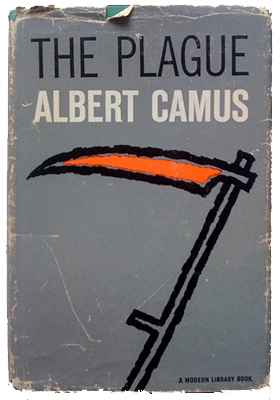 The Plague (French: La Peste) is a novel by Albert Camus, published in 1947. It's about the plague sweeping the French Algerian city of Oran. It raises questions about destiny and the human condition. Throughout the novel, there are existentialist ideas that reverberate. The novel is said to be based on a cholera epidemic that killed many people in Oran back in 1849 but the novel is set in the 1940s. Likewise, it is based on real plague outbreaks that really happened in Oran back in the 1900s, but these outbreaks were very small compared to the devastation seen in this novel, which is apocalyptic, a word seen in today's NYTimes headline.
 Camus objected to the book being considered an existentialist classic yet it has that sort of tone. It is also seen as an allegorical treatment of the French resistance to Nazi occupation in World War II. Lastly, the novel brings up the philosophical notion of the Absurd, "the conflict between the human tendency to seek inherent meaning and value in life, and the human inability to find any in meaningless, purposeless, or chaotic and irrational universe.
Let's start at the beginning. This is my first Camus novel although I have heard of The Stranger, which was recommended to me by my father and my friend, a master's degree student from CSUN. The Stranger and The Plague are terrific novels but for entirely different reasons which we won't go into here. I went to the local library book sale initially looking for The Stranger, because I'd seen it multiple times at other book sales, only to find they didn't have it this particular time, but they had The Plague, so that's what institutes my introduction to Camus.
The story told therein isn't complicated nor long. On the contrary, this is a very simple story, but with deep meanings and notions. There are only a handful of true actions. But again, deep meanings within them.
The story is told from a narrator's point of view. We don't know who the narrator is until the end of the book, where we learn that the narrator is the doctor himself, who had been treating all the victims of the city, possibly exposing himself to the plague, his friends/associates who are workers of the city, helping him in fighting the plague. The fact that the narrator is nameless/faceless until the very end is a great literary device used in some other novels that I've read, especially in science fiction of the 50s and 60s. It's quite an imaginative plot device because the reader is always in a sort of suspense. Who is really telling the story? Well, you don't know until you find out. You don't find out until you keep reading. It's not difficult to guess that it was the doctor but it's rewarding to find out that it's him. Why? Because the doctor has such a personal relationship with the town, the citizens, his friends, the workers, the plague itself. His point of view is important to the telling and conclusion of the story. Even if he isn't the only character that the novel focuses on. Rather, there are a couple of characters in the novel. Although none as important as the doctor because he's the narrator.
Then, the plague itself. The plague is the worst disease known in the history of mankind. Camus displays fantastic writing ability in the way he describes the symptoms, the victims, the deaths, the burnings, the burials, the quarantined, the panic buying, the lockdown of the city. This is where I get to make a comparison between this novel and what's going on today.
Today we have the coronavirus having gone viral across the world, and today 13 people died in N.Y.C, but overall something like 1,000 people have died from coronavirus in America. Twenty-six states are on quarantine/lockdowns. Most people are out of jobs or working at home, or they might be like me, they're grocery store workers [essential workers like healthcare workers] on the front lines, battling an invisible enemy, with nothing but gloves and a mask, if they're lucky enough to have PPE [personal protective equipment]. Life today is somewhat like life in Camus' novel. The absurd has already happened: People are panic buying hundreds of rolls of toilet paper and canned goods. Like the novel, people have made a fortune off selling items in a black market sort of fashion, selling toilet paper, hand sanitizer, even foods. Existentialism is more popular amongst my more literary and/or more articulate friends. There's a definite sort of dread, confusion, disorientation, in today's climate. The individual has come apart from the whole, not just objectively, but literally. We literally have been ordered by local, state, and federal governments to practice 'social distancing,' a 2020 buzzword that states we shouldn't gather in groups or get too close to others because we could spread the coronavirus to each other more easily that way. And this is just the beginning!
So it's easy to see how a novel like The Plague holds such important intrinsic, historical, philosophical, and emotive value because what happened in the novel happens in real life so to speak. This novel is so realistic and spot-on, in some ways it's absolutely terrifying and ultimately unforgettable. A lot of book reviewers like to say this a lot but I mean this; this is one of the greatest novels I've ever read, will read, or will ever want to read again.
Lastly, this novel portrays everything that a pandemic will and should. The horror, the death, the spreading of the disease, the removal of the bodies, the burning of the bodies [in some cases], the funerals, the lovers being split apart, the non-discrimination of the disease killing everybody including men, women, and children, the human compassion and support especially from doctors, healthcare workers, city officials, police, volunteer workgroups, the love, emotion, isolation, the absurd, the existential angst, it's all there really. What's really comforting to see is that even having gone through the plague this fictional tale has one thing that humanity will always need, crave: hope. For if there is one reason why we should get up out of bed in the morning it's because of hope. That's why this is such an important, great novel.
Subscribe to:
Posts (Atom)
September Sweater Weather
Good evening ladies and gentlemen, hello world. How are you? It's good to be writing on a good day off work today on a Saturday. Here, ...

-
The Difference Engine by William Gibson and Bruce Sterling is one of those all-time great 'hard' science fiction novels. Set in a ...
-
Man Plus is a science fiction novel written by Frederik Pohl in 1976. Pohl is one of those rare great writers who was not only a great wr...
-
Holy Fire is a great science fiction novel written by Bruce Sterling . It came out in 1996. It was nominated for the British Science Fi...

