Showing posts with label goodreads. Show all posts

Wednesday, July 16, 2025

Adam Bede, by George Eliot


He's in love with her, she's in love with him, he's mad at him for being in love with her, and she doesn't realize he loves her. Set in rural England in 1799, the hardworking well-respected carpenter Adam Bede falls in love with the dairymaid Hetty Sorrel, as the upper-class Arthur Donnithorne also falls in love with Hetty, and pursues a relationship with her in a classic tragedy of seduction and betrayal that ends with a happy ending for some but not for all.

First, this novel focuses on psychological realism. Eliot's free writing style allows us to inhabit each and every character, from Dinah, the preacher, to Hetty the dairymaid, to the old folks, the Church goers, the upper-class Donnithorne, to Seth, Adam's brother, and their parents. You get to live within the world of these rural English people. They may not be rich or have much, but they have values like church going, family, eating good home-cooked meals with the family, and hardwork. The other side of this realism is the inner mind of Hetty later with this novel, when she is charged with the crime of letting her baby die and eventually ends up being hanged.

Second, this novel has moral complexity. Hetty isn't exactly a crazed lunatic killer when she lets her baby die of exposure in the woods. She's a tragic character that didn't know where to turn. Arthur isn't exactly innocent when he finds out Hetty is pregnant and he ends the relationship and goes abroad to Ireland, only to come back to find that Hetty let the baby die after she ran away from marriage with Adam. Dinah the preacher seems to be the only true god-blessed person in the book, as she's a preacher and ends up marrying Adam at the very end. So there is some happiness.

Third, this novel has a lot of pastoral imagery of a rural England of old. From Adam working at his carpentry workshop business and working a farm, to Hetty doing chores around the house, to the Church dinner celebrating Adam Bede's success, even the scenery and backgrounds where the characters live in and interact in, is almost like additional characters in and of themselves. 

In addition, this novel includes a lot of Church and Methodist preaching, a lot of it by a character named Dinah. There are many preaching chapters in the novel. Oftentimes, this can slow down the narrative of the novel and prolong the novel. You'll find that Dinah's preaching often overrides the novel itself. This display of religious preaching fervor takes over much of the novel. However, this could be because that's the world in which these characters inhabit, and because that was the world of England in 1799, ultimately making the novel much stronger in its realism.

Ultimately, though, we find that in the end this is a very rewarding experience. We find that Adam's love interest in Hetty was genuine, but that doesn't mean that other men couldn't have been interested in her and courted her. Arthur's remorse after the death of the baby and Hetty's death is lifelong, and Hetty's tragedy is a reminder to society that poor women have no safety net; if they do something wrong and have no money or help like to say, raise a baby, they might have no choice but to give the baby up or worse, a sad reminder that poor women are often the most neglected members of society within any time period throughout history. 

Lastly, although written in 1859, Adam Bede reads like a modern literary novel, albeit even with all the Methodist preaching. I would also recommend reading Eliot's The Mill On The Floss, for a more biographical take also in a rural England setting. And of course, you should've already read Middlemarch, if you've read any of George Eliot's works. 

Friday, January 13, 2023

The Age of Voltaire by Will Durant


The Age of Voltaire is volume 9 of Will Durant's Story of Civilization series. So far I've read four of Will and Ariel Durant's Story of Civilization series of books: The Italian Renaissance, The Life of Greece, The Age of Reason Begins, and now finally I've read The Age of Voltaire. 

Closing this book, I felt that this was an extensive and comprehensive history of the age right up to and leading into the French Revolution, the Age of Enlightenment in France, roughly 1680s-1780. Voltaire was born in 1694, ensconced in education through the Jesuits. The Jesuits were the main educators in this period and had a lot of influence over schooling of children [boys and girls] and even sometimes in government and various occupations. They were known for being very educated and lenient towards their people, although they themselves were also quite dogmatic about Christianity and its spread throughout other parts of the world like in Latin America and even China. Despite this early great education from the Jesuits, Voltaire grew to increasing dislike the Church as he gained more fame and influence. He spent a lot of time running around to different homes and even the home of Frederick the Great because of his critiques of the church and nobility.  

However, there was a lot more going on in the Church other than Jesuits. There was the growing disputes between church, the peasantry, the aristocrats, the nobles, and the church's feuds with protestants [Jansenists], Catholics, and atheists from the philosophes, the intellectuals [writers, philosophers, scientists, artists, mathematicians, playwrights] like Voltaire, Diderot, Rosseau, Montesquieu, and d'Alembert. These named in particular would have the greatest influence on France and in the world. 

It should be named that being a philosopher in 18th century France isn't the same thing as being a philosopher in the 21st century. These intellectuals delved and wrote in a variety of fields and styles in order to reach their audience in the best ways they could. Voltaire didn't think much of giant books like the Encyclopédie [famous 18th century book from France by the philosophes], rather he thought that small books easily concealed would serve him better. So he ended up writing a lot of small works that contributed to his vast body of works. So Candide ended up becoming his most famous book.

But not every intellectual was an expert in a particular field. Rather a philosophe, was someone who was expected to know a little bit about every subject, even if they themselves weren't a master in each field. In order to write the Encyclopédie, the writers utilized and employed different philosophes for different phrases and words that they didn't feel adequate enough to cover themselves.

What caused the French Revolution? This book doesn't entirely aim to answer this question, rather it focuses more on historical detail. But after reading The Age of Voltaire, you can figure it out.

France was deep in debt from wars and the debt fell upon the peasants more and more, as the nobility became more and more corrupt. Tensions increased between the nobles and the church, and eventually even the Jesuits who had educated all the best minds of the time, were expelled from France. On top of that, the educated people were being more and more exposed to the works of the intellectuals of the time, the philosophes, and now, more than ever, people were more willing to become atheists, little by little, influenced by these great men with big ideas, ideas that changed the world, would eventually lead to the world we live in now. A world of more religious toleration, human rights, democracy, and equality.

Although the Age of Voltaire was published in 1965, it seems to somehow resonate in the scatter-brain afterimages of 21st century 2023. There's something there in this book that has an everlasting effect on the time it is describing, the time it was written in, and the time I live in now as I write this. It seems that now, more than ever, we're living in a world increasingly fraught with the same problems, plus a bunch of new additional ones, that weren't quite resolved from the French Revolution and perhaps never will be solved.

It has occurred to me after reading four volumes of Will Durant's Story of Civilization series, that the problems of any age seem to follow and recur in many others. There's always an endless cycle; renewal, back to the classic ages, onto a newer more advanced, more intellectual more philosophical more scientific less God, then an eventual regression back into a simpler mode of civilization, except we never really find out or perhaps we never can find out, that the civilization itself has already and always collapsed, only to be rebuilt by other people anew.

It is said that on his deathbed, Voltaire, when asked to return to the faith of his fathers and renounce the devil, responded with, “This is no time to be making new enemies.”

Friday, January 7, 2022

Aristoi

Wow, what a terrific space opera god adventure story!

The way I described this book to people was this: this is a space opera about gods that become humanized. I mentioned Homer and his humanizing of his Olympians. So there's a long cherished tradition here going back throughout time, the western canon, of pathos, from Plato. What does it mean to be human? A god? What is good and evil? Who gets to justify right and wrong? These are some of the existential philosophical questions this book brings to mind in a general sense, disguised in the form of a 90s space opera. 

In addition to that, the momentum of the book never really stops, not even at the very bitter end. The story itself isn't remarkable, its rather predictable, and we've seen this same science fiction space opera tropes used time and time again within the golden age of science fiction and even the cyberpunk and new wave, it's rather space opera cliché. 

However, it is the way he tells the story that is truly a thrill. The style is simple but downright effective. It was never dull and every moment is a good one. I'm somewhat of a science fiction connoisseur but I missed this one all these years and I know I've missed much more. I would even say it's a required science fiction reading in the genre of space opera. It would be extremely difficult for a new science fiction writer in 2021 to write a space opera this good. It might even be downright impossible unless it was coming from overseas [not the US], maybe China.

Thursday, September 16, 2021

Autumn Leaves [in the key of A major]


So this is what you call sushi?

Autumn is upon us! This is one of my favorite times of years because it represents the changing of the seasons, the Four Seasons, like the famous Vivaldi piece. This is a good time of year. It always reminds me of childhood and growing up in the Midwest. Memorial Day and this tie dye shirt I always wore. It represents to me schooling, learning, coldness, newer and more crisp air around me. It's also my birthday at the end of the month. 

At this point in the pandemic if you haven't become used to quarantine and haven't found a new way to live within this new paradigm, then you're very far behind. It's a time of healing, renewal, learning, growth, spiritually, mentally, physically, all of it, it's kind of a big deal! Get with the program if you haven't heard that the bird is the word.  

I've become entranced in my own activity. Although I have friends and hang out with them, it is really only within myself that I feel the Muse at its strongest and best. The muse is simply what keeps you going in your life. What do you really enjoy? Do that thing a lot. And find other things like it. And so on until you find what you find fulfilling in life. It could take 10,000 hours, it could take forever, or it might never happen if you don't search for your own meaning. 

I've been playing a lot of jazz guitar and have found some improvement in the jazz playing genre. A steep learning curve was simply just playing different chord voicings over the same chords as substitutions. Nothing fancy but it keeps the beat going and sounds super straight ahead. In a guitar/saxophone only duo it works really well and keeps us grounded within the saxophone solos. 

I've been reading a lot as well. My goal for this year on Goodreads [https://www.goodreads.com/user/show/56122996-og-space] was to read 50 books, but a las, it's getting nearer and nearer the end of the year and right now I'm only at 34 books. We'll see what happens. I recently finished reading Ulysses by James Joyce and right now I'm reading Plato Dialogues selections, an old copy from an old man, a customer I met at work. He gave me his copy of this Plato book [as well as my copy of Ulysses, which I specifically asked him for], it's from 1927, the Modern Student's Library, Philosophy Series. I've been getting a lot out of the book and I've been spending time ruminating on the various ideas within the dialogues. Sitting beneath the warmth of the fire.  

I've also been eating very well but also making sure to eat and live in a healthy way. Food has been one of the best things in the world to me [lol] and I've been very lucky to live in California where the cuisine is literally everything and anything I want, reasonably within affordable price ranges. 

Another great place for food was Chicago, I used to love Chicago hot dogs, polish sausages, hot Italian beef sandwiches, and pizza Chicago style with real bulk sausage instead of diced sausage. It makes a big difference folks. 

Last night I had a superb meal at our favorite Korean restaurant, I had the ginseng chicken in hot broth. You add salt to the broth for flavor or you can eat it as is, which is pretty bland, but very delicious. Not only that but a customer gave me a Persian dish the other day at work and I ate it for my lunch. It was small pastries with meat inside them, they reminded me of pate, which my great Aunt used to make when I was a youngster. The stories within food is incredible and it'll keep you inspired till the end of time. 

Keep hitting those high notes! 

Tuesday, March 16, 2021

Bertrand Russell The Problems of Philosophy


Great introduction to philosophy. It's not really the problems of philosophy that are important, rather the ideas where they come from, the terms, the definitions, the meanings, the different ways to explain, refute, and rationalization, in short, how to think about well, anything, and everything. 

If you've read a lot of philosophy, chances are you will know everything in this book, or at least be familiar with the ideas and concepts presented, but it's a good fresh reminder and Bertrand's final chapters here are especially refreshing for a retail philosopher in aisle 9 like myself. 

One of my favorite parts of the book was the chapter where Russell explains Hegelian dialectic in 15 pages. It's poignant, and the fact that I'm familiar with Hegel firsthand, I found Russell's interpretation quite appreciated and inciteful. 

Remember that his friend, Ludwig Wittgenstein said there are no problems with philosophy, only a problem with language. One is standing with the pillars of western philosophy and the other is smashing it to pieces in a way.

Saturday, February 13, 2021

Lord of Light

Lord of Light is a terrific science fiction novel written by Roger Zelazny. It was awarded the 1968 Hugo Award for Best Novel. It is was easy to see why this novel won the Nebula Award in 1968. Why? 

Because shock and awe. 

What can I say? This is one of the best science fiction novels I've read in a while [over 6 months], and if you take a look at my reading list [look here] you can tell that I've read a lot of really great science fiction. Although I've read a lot of the science fiction golden age canon, I must add that there's still a lot of great science fiction writers I haven't read. 

Moving on, the idea of gods, Buddhism, Hinduism, was known to me through hippy rock and roll and the flower power generation, even Frank Zappa says in a song, "a book of Indian lore." Keep in mind that I've also read the Bhagavad Gita and a primer on Buddhism entitled What the Buddha Taught, written by a Buddhist monk. But you don't have to know any of that to actually appreciate this book and that's the brilliance of it. However, I will say that known those two other books helps give me somewhat more of an understanding regarding these religious doctrines. Knowing about actual Buddhist parables gave me a much greater appreciation for this book. Having read the Bhagavad Gita, you can clearly see that the Hindu gods and their actions aren't entirely based on imagination. 

I fancy myself as some sort of zen master type. I tap into it quite often as a way to help me get through my day. Seeing our main character, Sam, as a Buddha but without having him actually proclaiming to be a Buddha, or even a god, or even a lesser god, although we still aren't sure what he is, that is something exactly like a real Buddha would do! It's brilliant. Why? Because its simple, it works, and it stays true to how we perceive gods and or prophet-god. The idea of Sam taking over all the godly order, there's a Luciferian catch to it, but the way the book is written, he's nothing like the Bible's Lucifer, nor even Milton's Lucifer, who is a lot more endearing in a sense than the Biblical version. Although the story is all over the place and the fight scenes are mostly just cinematic metaphors with thunder and lightning, the story makes sense until almost the complete end around the 230 page mark, where things go all over the place. But that's okay. I'll forgive Zelazny because it's fun. 

Zelazny is a stylist. Here the book turns out amazing not because the idea is great, unique, or original, rather it is because it is written in Zelazny's true voice, or original style as I will call it here, and because the writing is simply put, shock and awe. The idea of a science fiction novel in 1968 that's inspired by Hindu and Buddhist ideas from the East was probably a novel idea at the time, but it isn't so original these days. If this book was written in the modern era it would have a completely different effect on the audience, the reader. Because ideas were still new back then, and because it is precisely because its original that it doesn't matter if a lot of it doesn't make sense. Why? Because the way its written, the style, it just works.

A lot of the fight scenes between the gods make no sense. But it doesn't have to. Such is the nature of the gods. Long live the Lord of Light. 

Tuesday, February 2, 2021

Hegel: Outlines of the Philosophy of Right


I read this book directly after reading The Phenomenology of Spirit. It was a great, smooth transition. Also keep in my mind that because I've read Kant, Wittgenstein, and Heidegger, and a little Fichte, this makes a lot more sense that if I had gone in not knowing much about German philosophy, particularly the style known as German Idealism. Hegel is dense reading but his ideas are truly thought provoking and exciting for those who are curious. This is truly fascinating reading during the coronavirus pandemic of January 2021. What a great way to spend quarantine. 


Anyways, Hegel would say I have a good life because I have a job under a corporation, that is under a government, that is under a nation, we as a people all are one people together, and as individuals we mere atoms, nothing. However, there is a clear and important discussion about we the people, and how important the universal will is, how important it is to see the good, and make the world a better place. But remember that is only the universal will, and that the state must act in whatever ways it may, such as by fighting wars or making peace in the world, increased taxes, and such.

Tuesday, January 5, 2021

Pride and Prejudice

Wow, just wow. From the very first couple sentences I was captivated by this book. The way the men are characterized, the way the girls are portrayed emotionally, the weariness of the mother to marry off her poor three daughters. The father who has to deal with them. You begin to see that this isn't a novel, it is rather much very like real life. If you're single, then you know that your mother is wondering if you have a girlfriend when she calls.


That's where Jane Austen captivates me. This work of fiction is rather like real life. The way the characters say things but they really mean the exact opposite of what they say, that is what happens in real life too! This was one of my favorite aspects of the book.

What do girls want? To be loved and married and all that good stuff, to marry a man of good looks, status and prestige, of wealth and land ownership, of upright jovian bearing, who will treat them right and love them, that's what Jane Austen says.

But how to they achieve that, being but a girl of low social status, no money, and possibly not even the best looker? Well, that's where things get complicated, and the devil is in the details. It turns out, that sometimes, even if a man and woman like each other, they might love each other too, but only if they can truly find each other, I know that sounds corny but it's what happens in this book. How does a couple find each other? Turns out just by talking to each other. Sometimes it turns out that they loved each other upon first meeting but sometimes it doesn't click instantly, and their love only intensifies from there. You had me from the very beginning, you really got me.

Girls just want to get married and then have fun.

Thursday, March 26, 2020

The Plague

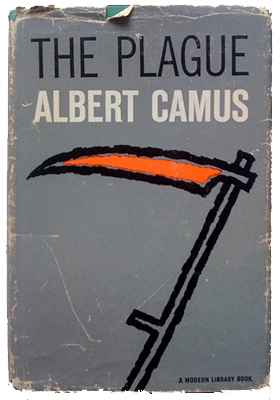
Image result for the plague book covers 1947The Plague (French: La Peste) is a novel by Albert Camus, published in 1947. It's about the plague sweeping the French Algerian city of Oran. It raises questions about destiny and the human condition. Throughout the novel, there are existentialist ideas that reverberate. The novel is said to be based on a cholera epidemic that killed many people in Oran back in 1849 but the novel is set in the 1940s. Likewise, it is based on real plague outbreaks that really happened in Oran back in the 1900s, but these outbreaks were very small compared to the devastation seen in this novel, which is apocalyptic, a word seen in today's NYTimes headline. 

Camus objected to the book being considered an existentialist classic yet it has that sort of tone. It is also seen as an allegorical treatment of the French resistance to Nazi occupation in World War II. Lastly, the novel brings up the philosophical notion of the Absurd, "the conflict between the human tendency to seek inherent meaning and value in life, and the human inability to find any in meaningless, purposeless, or chaotic and irrational universe. 

Let's start at the beginning. This is my first Camus novel although I have heard of The Stranger, which was recommended to me by my father and my friend, a master's degree student from CSUN. The Stranger and The Plague are terrific novels but for entirely different reasons which we won't go into here. I went to the local library book sale initially looking for The Stranger, because I'd seen it multiple times at other book sales, only to find they didn't have it this particular time, but they had The Plague, so that's what institutes my introduction to Camus. 

The story told therein isn't complicated nor long. On the contrary, this is a very simple story, but with deep meanings and notions. There are only a handful of true actions. But again, deep meanings within them.

The story is told from a narrator's point of view. We don't know who the narrator is until the end of the book, where we learn that the narrator is the doctor himself, who had been treating all the victims of the city, possibly exposing himself to the plague, his friends/associates who are workers of the city, helping him in fighting the plague. The fact that the narrator is nameless/faceless until the very end is a great literary device used in some other novels that I've read, especially in science fiction of the 50s and 60s. It's quite an imaginative plot device because the reader is always in a sort of suspense. Who is really telling the story? Well, you don't know until you find out. You don't find out until you keep reading. It's not difficult to guess that it was the doctor but it's rewarding to find out that it's him. Why? Because the doctor has such a personal relationship with the town, the citizens, his friends, the workers, the plague itself. His point of view is important to the telling and conclusion of the story. Even if he isn't the only character that the novel focuses on. Rather, there are a couple of characters in the novel. Although none as important as the doctor because he's the narrator. 

Then, the plague itself. The plague is the worst disease known in the history of mankind. Camus displays fantastic writing ability in the way he describes the symptoms, the victims, the deaths, the burnings, the burials, the quarantined, the panic buying, the lockdown of the city. This is where I get to make a comparison between this novel and what's going on today. 

Today we have the coronavirus having gone viral across the world, and today 13 people died in N.Y.C, but overall something like 1,000 people have died from coronavirus in America. Twenty-six states are on quarantine/lockdowns. Most people are out of jobs or working at home, or they might be like me, they're grocery store workers [essential workers like healthcare workers] on the front lines, battling an invisible enemy, with nothing but gloves and a mask, if they're lucky enough to have PPE [personal protective equipment]. Life today is somewhat like life in Camus' novel. The absurd has already happened: People are panic buying hundreds of rolls of toilet paper and canned goods. Like the novel, people have made a fortune off selling items in a black market sort of fashion, selling toilet paper, hand sanitizer, even foods. Existentialism is more popular amongst my more literary and/or more articulate friends. There's a definite sort of dread, confusion, disorientation, in today's climate. The individual has come apart from the whole, not just objectively, but literally. We literally have been ordered by local, state, and federal governments to practice 'social distancing,' a 2020 buzzword that states we shouldn't gather in groups or get too close to others because we could spread the coronavirus to each other more easily that way. And this is just the beginning! 

So it's easy to see how a novel like The Plague holds such important intrinsic, historical, philosophical, and emotive value because what happened in the novel happens in real life so to speak. This novel is so realistic and spot-on, in some ways it's absolutely terrifying and ultimately unforgettable. A lot of book reviewers like to say this a lot but I mean this; this is one of the greatest novels I've ever read, will read, or will ever want to read again. 

Lastly, this novel portrays everything that a pandemic will and should. The horror, the death, the spreading of the disease, the removal of the bodies, the burning of the bodies [in some cases], the funerals, the lovers being split apart, the non-discrimination of the disease killing everybody including men, women, and children, the human compassion and support especially from doctors, healthcare workers, city officials, police, volunteer workgroups, the love, emotion, isolation, the absurd, the existential angst, it's all there really. What's really comforting to see is that even having gone through the plague this fictional tale has one thing that humanity will always need, crave: hope. For if there is one reason why we should get up out of bed in the morning it's because of hope. That's why this is such an important, great novel.

Tuesday, December 17, 2019

Hainish Cycle [Trilogy]

RocannonsWorld.jpg
PlanetofExile.jpg


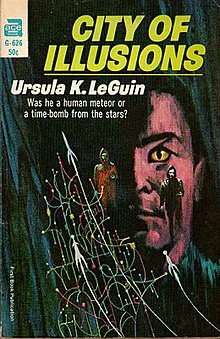
CityofIllusions.JPG


Finally getting back to more book blogs. I just finished reading the third book in Ursula K LeGuin's Hainish Cycle, or trilogy in this case. Her other novels in the Hainish universe are much different from these, her first three novels. I'll describe each novel's plot and simply tell you my thoughts on the works in and of themselves, and then what I think of them as a whole. 

Rocannon's World

Rocannon's World is Ursula K LeGuin's literary debut. It's a science fiction space opera with heroic fantasy elements. Other alien races are similar to fairies and gnomes, who wield swords and axes. The word "ansible" for a faster-than-light communicator, was coined in the novel. The term has since been widely used in science fiction. 

The story begins with a prologue titled Semley's Necklace, which is about a woman who travels to a primitive planet to recover a family heirloom. However, her husband and daughter aged so much while she was on the trip, that when she got back they were dead. It combines Rip Van Winkle fairy tale [a person goes off with dwarves for a short bit, only to find that generations have gone by] with modern [the 1960s] science fiction elements.   

Rocannon is an ethnologist space operator turned warrior turned mystic god. The story has fantasy elements, especially the dialogue of the alien races being similar to the dialogues of fairies and elves in fantasy novels. Also, the idea of the impermasuit, a suit that makes the wearer invulnerable as long as he's wearing it. This seems like a now-classic fantasy trope. The characters ride on flying winged beasts. Rocannon learns how to Mindspeak [Le Guin's idea of telepathy in the Hainish universe], calls his human allies from the League of All Worlds to help him destroy the enemies' base, but because he's telepathic he feels the death of hundreds of his enemies, making him sorry and traumatized.

The first Le Guin novel is stunning. It's short, simple, straight to the point. The writing is simple but not too simple. It's still got the deep meaning behind the text. In this case, we're talking about Le Guin's primary ideas coming out for the first time in novel form. The idea of anthropology for one thing. One great civilization from outer space comes to some other faraway planet, only to find primitive aliens living in the Bronze Age. The idea of the cargo cult. Some evildoers are enemies of the League and then there are good guys like Rocannon, and then there are all the gray areas that would naturally appear. Considering this came out in 1966, I would say its an important book to read in the science fiction canon. Must read science fiction actually. 

Planet in Exile 

Planet in Exile also came out in 1966. The story is set one Werel, the third planet of the Gamma Draconis system. The planet is about to through its long winter. The planet has an orbital period of 60 Earth years. Wold, a chieftain and his daughter Rolery are humanlike aliens indigenous to the planet. Jakob Agat is a young man from a dwindling human colony. Although both races have human genes, the differences between them are enough to prevent interbreeding. The main point A to be B here is that the two races have to come together despite a dispute between Rolery getting involved with Agat, which is forbidden to Wold and his people in their culture. There are invading alien creatures, the Gaal, that aren't hilfs [LeGuin term meaning high intelligence life forms] that take them to war. 

Planet in exile plays back on the action that is at the forefront of Rocanon's world. In fact, the siege part where they're defending their city from the invaders doesn't focus entirely on the action and fighting. There are a few gory moments and descriptions but it's downplayed heavily considering they were at war. 

What Planet of Exile does bring more to the picture is the extension of the LeGuin aesthetic; anthropology, space opera, and believe it or not in 1966, feminist overtones. This novel focuses more on the ecology of the planet itself [something science fiction fans got for the first time from Frank Herbert in Dune]. There is a lot of exposition about the native animals, plants, and races here. 

Also, this is the first time that Le Guin writes a powerful sympathetic female character. Rolery isn't as powerful or as important as Agat, rather it's something of a Pocchahantas story. However, it was a push in the direction she would inevitably take. To write feminist science fiction space operas like The Left Hand of Darkness where she goes more into female identity, gender, sex, and equality. Sure, Planet of Exile is sort of conventional in terms of female characters, but it's also so early in the science fiction canon that it can't go unmentioned how important Le Guin's female characters were even as early as her second novel. 

City of Illusions

City of Illusions came out in 1967 and lays the foundation for the Hainish universe, where most of Le Guin's novels take place. 

The story takes place 1200 years after the Shing has broken the power of the League of All Worlds and occupied Earth. Humans are alive, living as nomads and in small tribes. The Shing suppresses human civilization with Mindspeak, telepathy, and the ability to mind-lie. A descendant from the characters from Planet in Exile is involved in a spaceship crash. The Shing mindwipe him, leaving his mind a blank slate, tabula rasa. They throw him in the forest left to die as practically an infant. He develops a new identity and tries to find out who or what he is. 

I finished this novel today and find it to be the weakest of the three in terms of plot but the strongest in terms of character identity. Falk is a powerful sympathetic character. This novel is primarily about the inner psychology of the main character. Not unlike Frederic Pohl's masterpiece, Man Plus. It's not about action, it's about the soul. That's what matters here. 

The weakest part of this novel for me was the Shing themselves. They were supposed to be a race of Hitlers but they were portrayed as practically harmless. It was laughable in certain aspects considering that all the humans on Earth live in fear of them and animals have learned to talk because of them. The problem was that they were not convincingly evil. For one thing, they do not kill and have an oath about it. A group of 'bad guys' who don't come off as really all that bad is the death of a novel. Keep in mind that it's very hard to write a group of bad guys in novel form. Most of the time there are one or two bad guys in a novel, but a whole race? That's pushing it. This is why the idea of the literary Satan is usually left for poetry and drama.

LeGuin makes use of her own Tao Ching here. She creates a book for the humans that is basically their bible. It's important and was before and now a staple science fiction trope. I also liked how the humans on Earth 1200 years into the future were all nomads, barbarians, savages, yet there were still some peaceful ones living across the apocalyptic wasteland. It reminded me of Fallout 4. Of course, only in retrospect could someone [a video gamer] say that.  

In short, these three novels got me back into my science fiction readings. Le Guin strikes deep with her science fiction. As a whole, the work comes across as a vast cultural societal experience. Le Guin's work makes me think more about the bigger picture. Who really are the good guys in the world? Who are the bad guys? Who are we? What am I? I've already ordered Le Guin's The Lathe of Heaven and The Dispossessed [also in the Hainish cycle]. For now, I'm reading a modern 2013 new verse translation of Dante's Divine Comedy. Watch this space.

Tuesday, December 3, 2019

The Canterbury Tales


2696The Canterbury Tales is a collection of 24 stories running over 17,000 lines written in Middle English by Geoffrey Chaucer between 1387 and 1400. Chaucer was appointed Controller of Customs and Justice of Peace, and in 1389, Clerk of the King's work. It was during this time that Chaucer wrote the Canterbury Tales. He was a court poet that wrote for nobility.

Although Chaucer wrote other works it is Canterbury Tales that is considered his magnum opus. He uses the stories within stories to satirize, and paint a critical and ironical picture of English society of the times. The fact that all the characters in the story are all from a cornucopia of social classes was something fairly new to English literature. Even poorer, more lowly classes could still call out a more noble, character, like a knight, and stop them mid-story, to criticize and tell their own story instead. Because of all the characters here are on a pilgrimage, they are all concerned with everything spiritual. The work itself is considered incomplete especially considering that all the characters didn't get to tell their stories. The work is generally opened to a lot of different interpretations. 

Canterbury Tales is a sort of stories within stories. We have some 30 pilgrims at a tavern. They are all on pilgrimage to St. Thomas Beckett's Shrine. We have our host proclaiming, "Tell your best stories. The one who tells the best story shall have a feast here when we get back and I shall pay for it." Needless to say, everybody from the knight to the parson tells a story. Some are short, some long, some serious, some jokey, some holy, some about love, some about chivalry, some epic like the knight's tale. What's interesting is that other characters interrupt and/or stop some stories by calling them out and criticizing them [regardless of social class or wealth], sometimes thereby starting their own tale.   

I enjoyed the knight's tale the most. It opens the book and gets the reader acquainted with the style of the book. Two cousins, Palamon and Arcite, both knights are in prison and they chance upon a beautiful woman, Emily from their cell windows. They both claim her but they both can't have her. They end up having this epic duel with 100 warriors on both sides. Palamon is wounded by a chance sword thrust from one of Arcite's men, leaving Arcite the victor, but then Arcite is mortally wounded by his horse throwing him off and falling on him, leaving Palamon to marry Emily. The story is epic and intended to be. The next story is an antithesis to this knight's tale of courtly love and chivalry. In the next story, the miller's story, it is about regular people in love and is more lowbrow.

As stories go, none of them are especially terrific or satisfying in my opinion. In fact, I didn't start to thoroughly enjoy the book until at least 150/484 pages. Why? Because I was expecting the stories to be more thrilling. What I found out was that as I read farther on, the stories didn't become particularly more interesting, rather, my thoughts on them changed. I began to find seemingly unimportant yet realistic stories for the medieval time, to be fun. How, why? I'm not even quite sure. Like I said I didn't get into the book until nearly 150 pages in. In fact, I found the constant rhyming going on nonstop to be quite jarring to get used to, especially considering the format is poetic but of an especially non-epic quality. Homer is forgiven for constant rhyme but I wasn't so sure about Chaucer. Consider the fact that most of these archaic works of literature that I've read have been epic, think Aeneid, Odysee, Iliad, Beowulf, Gilgamesh, Divine Comedy, so when you come to Canterbury Tales from all that you just say to yourself, "where's the action?" That was what made Canterbury Tales so hard to get into for me. Eventually, the text speaks for itself and you see how great and important it really is. For me, it took a while to sink in.

It is believed Chaucer got a good deal of his ideas from other literary works. But no other works of literature featured pilgrims telling tales together. In that sense, he's a true visionary. Harold Bloom says the text is mostly original but the idea of the host, a "master of ceremonies" was derived from Dante and Virgil in the Divine Comedy. The Decameron by Giovanni Boccaccio is most similar to the Canterbury Tales than any other work. It features a cast of characters telling stories as they flee from the Black Death. It is believed that Chaucer might have known him.

The tales themselves usually center around a single theme, mostly religious. However, the themes here aren't necessarily all religious or set. They're dependent upon the characters themselves and they don't speak in any sort of hierarchy. The passage of the time, or any traveling what so ever, or even locations along the way, is never mentioned. Rather the stories themselves are all that is spoken of. 

The version I read was a modern English translation, translated by Nevill Coghill. His translation is very smooth, breezy even in the most difficult of circumstances. Considering this is almost a 500-page book, the modern translation reads almost like modern-day. Of course, it really doesn't. What I mean is that it's very smooth as opposed to old medieval English. The words used sometimes can still be complicated and I did still have to look words up online at times. Another thing that must be said about Canterbury Tales is that a lot of the lines rhyme and they are definitely in poetic verse. Sometimes the rhyming gets overwhelming. That's typical for a lot of the 14th-century prose. But overall, for my first Canterbury Tales experience, the Penguin Classics modern translation was very good. I'll try reading it again in the future, but a different translation. I would recommend this book to anyone: students, writers, readers who like the western canon especially. A "do not miss" book.

Thursday, September 19, 2019

The Pillow Book

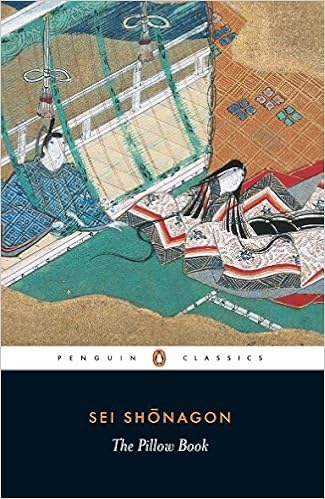
Image result for the pillow book mckinney In spring, the dawn — when the slowly paling mountain rim is tinged with red, and wisps of faintly crimson-purple cloud float in the sky.

The Pillow Book is a work of medieval Japanese literature from the Heian period, roughly 800-1200. Written by Sei Shonagon, a woman in the lower level court that served Empress Consort Teishi (定子). This isn't so much of a book per se, and definitely not a novel in the traditional sense, never mind the fact that the idea of a traditional novel didn't exist back then. However, her contemporary was Murasaki Shikibu, author of the famous Tale of Genji, a contemporary, woman serving in the court. Both of these works are studied in Japanese high school to this day. In fact, when Japanese study classical Japanese, it is the Heian period that they go to. 

The book is full of essays, lists, anecdotes, and personal thoughts. When I first started reading it I thought it was all over the place, and it really is. The Pillow Book reads like a conversation from Heian Japan. You get a sense of the character of Sei Shonagon, which is what Meredith McKinney focused on. She wanted to get the voice of the character done in a certain way, that is relatable some thousand years later. Did she get it right? I would say yes. Reading this book is somewhat of personal experience. I found myself smiling at things that were funny and likable, and likewise demurred when Sei said mean girl things. You feel like you are getting to know Sei and how she lives in Heian Japan, ultimately alien, foreign soil for me. Because of that, it is a true work of art, literature. 

In the McKinney translation, Sei comes across as personable but somewhat thorny. Basically, she isn't perfect. There's a mean girls vibe to some of the statements she makes but it doesn't dominate the text. But when you see it you do take notice. Were women really like that back then in Japan? Women are like that today! It's funny in a way how natural Sei comes across in the McKinney translation. Rather than translate the language in a dramatically different way, McKinney decided to change the voice of the character herself in her own inimitable way, that is personable, relatable. It's like listening to a Heian period woman, talks about her life, like a diary but better, much better because she comes across as likable and engaging rather than boring and nonstop. 

My favorite element of the Pillow Book is the anecdotes and stories. Stories of men who are clumsy with poetry, or retreat into hiding if they've walked in a woman's room. What festivals were like as the season changed. What it was like serving an Empress, whom you greatly loved and admired, despite you being of lesser rank, and never having the chance to be like her.  

If I were to compare the Tale of Genji [review here] to the Pillow Book, I would say the Pillow Book is breezy and personable, and that the Tale of Genji is more elusive and poetic. Both great works, vastly different. Sei has a way of explaining her world like a diary, that is in invaluable in respect to Japanese history. In short, its something of a masterpiece. 

"In autumn, the evening — the blazing sun has sunk very close to the mountain rim, and now even the crows, in threes and fours or twos and threes, hurrying to their roost, are a moving sight. Still more enchanting is the sight of a string of wild geese in the distant sky, very tiny. And oh how inexpressible, when the sun has sunk, to hear in the growing darkness the wind, and the song of autumn insects."

September Sweater Weather

Good evening ladies and gentlemen, hello world. How are you?  It's good to be writing on a good day off work today on a Saturday. Here, ...