Showing posts with label england. Show all posts

Wednesday, July 16, 2025

Adam Bede, by George Eliot


He's in love with her, she's in love with him, he's mad at him for being in love with her, and she doesn't realize he loves her. Set in rural England in 1799, the hardworking well-respected carpenter Adam Bede falls in love with the dairymaid Hetty Sorrel, as the upper-class Arthur Donnithorne also falls in love with Hetty, and pursues a relationship with her in a classic tragedy of seduction and betrayal that ends with a happy ending for some but not for all.

First, this novel focuses on psychological realism. Eliot's free writing style allows us to inhabit each and every character, from Dinah, the preacher, to Hetty the dairymaid, to the old folks, the Church goers, the upper-class Donnithorne, to Seth, Adam's brother, and their parents. You get to live within the world of these rural English people. They may not be rich or have much, but they have values like church going, family, eating good home-cooked meals with the family, and hardwork. The other side of this realism is the inner mind of Hetty later with this novel, when she is charged with the crime of letting her baby die and eventually ends up being hanged.

Second, this novel has moral complexity. Hetty isn't exactly a crazed lunatic killer when she lets her baby die of exposure in the woods. She's a tragic character that didn't know where to turn. Arthur isn't exactly innocent when he finds out Hetty is pregnant and he ends the relationship and goes abroad to Ireland, only to come back to find that Hetty let the baby die after she ran away from marriage with Adam. Dinah the preacher seems to be the only true god-blessed person in the book, as she's a preacher and ends up marrying Adam at the very end. So there is some happiness.

Third, this novel has a lot of pastoral imagery of a rural England of old. From Adam working at his carpentry workshop business and working a farm, to Hetty doing chores around the house, to the Church dinner celebrating Adam Bede's success, even the scenery and backgrounds where the characters live in and interact in, is almost like additional characters in and of themselves. 

In addition, this novel includes a lot of Church and Methodist preaching, a lot of it by a character named Dinah. There are many preaching chapters in the novel. Oftentimes, this can slow down the narrative of the novel and prolong the novel. You'll find that Dinah's preaching often overrides the novel itself. This display of religious preaching fervor takes over much of the novel. However, this could be because that's the world in which these characters inhabit, and because that was the world of England in 1799, ultimately making the novel much stronger in its realism.

Ultimately, though, we find that in the end this is a very rewarding experience. We find that Adam's love interest in Hetty was genuine, but that doesn't mean that other men couldn't have been interested in her and courted her. Arthur's remorse after the death of the baby and Hetty's death is lifelong, and Hetty's tragedy is a reminder to society that poor women have no safety net; if they do something wrong and have no money or help like to say, raise a baby, they might have no choice but to give the baby up or worse, a sad reminder that poor women are often the most neglected members of society within any time period throughout history. 

Lastly, although written in 1859, Adam Bede reads like a modern literary novel, albeit even with all the Methodist preaching. I would also recommend reading Eliot's The Mill On The Floss, for a more biographical take also in a rural England setting. And of course, you should've already read Middlemarch, if you've read any of George Eliot's works. 

Tuesday, January 5, 2021

Pride and Prejudice

Wow, just wow. From the very first couple sentences I was captivated by this book. The way the men are characterized, the way the girls are portrayed emotionally, the weariness of the mother to marry off her poor three daughters. The father who has to deal with them. You begin to see that this isn't a novel, it is rather much very like real life. If you're single, then you know that your mother is wondering if you have a girlfriend when she calls.


That's where Jane Austen captivates me. This work of fiction is rather like real life. The way the characters say things but they really mean the exact opposite of what they say, that is what happens in real life too! This was one of my favorite aspects of the book.

What do girls want? To be loved and married and all that good stuff, to marry a man of good looks, status and prestige, of wealth and land ownership, of upright jovian bearing, who will treat them right and love them, that's what Jane Austen says.

But how to they achieve that, being but a girl of low social status, no money, and possibly not even the best looker? Well, that's where things get complicated, and the devil is in the details. It turns out, that sometimes, even if a man and woman like each other, they might love each other too, but only if they can truly find each other, I know that sounds corny but it's what happens in this book. How does a couple find each other? Turns out just by talking to each other. Sometimes it turns out that they loved each other upon first meeting but sometimes it doesn't click instantly, and their love only intensifies from there. You had me from the very beginning, you really got me.

Girls just want to get married and then have fun.

Saturday, November 21, 2020

How Progressive Rock Saved Me During Coronavirus

Buenos dias, 

I've recently started listening to a ton of progressive rock. It's saved me during this quarantine. If you haven't already read my post about how the Beatles saved me during quarantine, check it out here.

For those of you who don't know, progressive rock was a more technical, magical, and showy form of rock and roll that appeared after the Beatles, after Cream, after the Hendrix, arguably the three most important rock bands in my eyes. It reached its zenith in the middle or end of the 70s, and was most popular and more well done in England in the richer country areas. So these guys came from wealth unlike those four raggedy Andy dolls from Liverpool. They had college degrees, education, any perhaps money.

Now that you know the background of progressive rock let's talk about the actual style. The style is well, kind of all over the place. Every progressive band sounds different. The biggest prog bands were King Crimson, Yes, Genesis, and Emerson, Lake, and Palmer, and Pink Floyd [they had their prog moments like the Meddle album and Atom Heart Mother, even the first album]. They all sound totally different and you could never confuse them. 

The style incorporates changing time signatures. The time signature is the beat or rhythm of the music. Most basic blues and rock is in 4/4 time, meaning you count each beat: 1, 2, 3, 4, however, in progressive rock the time signature could change to literally anything: something simple would be a changing time signature of 3/4 to 2/4, meaning you would count the beat like 1, 2, 3-1, 2, and so on. 

The music that goes over these widely varied beats is loud guitars, keyboards, synthesizers like the Mellotron, drums, bass, vocals, and sometimes even a saxophone in King Crimson's case. Sometimes the guitar parts are super soft, other times they're like deafening death metal before death metal even existed. King Crimson goes super hard with their drumming and guitar playing. Yes goes super soft with their beautiful singing. Emerson, Lake, and Palmer makes the keyboard as heavy as a guitar. Genesis is like the perfect arranger's band where the band plays their parts and are well rehearsed. Some bands are like a jazz band and they don't even have to speak to each other about what they did in the band. Others are more tight like an orchestra.

Progressive rock died at the end of the 70s when the youth in England got fed up with pompous grandiose rock stars. So they created their own genre based on three chords and angst. It became punk rock. The most famous band from England being the Sex Pistols with their one and only album, Never Mind The Bullocks, Here's The Sex Pistols. 

Progressive rock has saved me during coronavirus. I've been so bored. Going through all these old bands has recharged my spirit. I go through lots of phases in music. I've been in nearly every music phase since 7th grade, that's how I know so much about music. Almost everything I know from music I learned from YouTube. It's all free! 

There's just something so exciting about revisiting all these bands. It really puts things in perspective. I've heard all these songs ten years ago and ten years after all the music, all of it, sounds so much more refreshing, exciting, and invigorating. I can see why all these bands pushed me so hard to practice guitar as a kid. 

I've had really good memories of listening to progressive music. Some of my prog CD's got damaged because they've had so much greenery spread over them in my youth. If you want to smoke out to some exciting music, this is the style for you. 

I don't think any of the musicians in the genre realized how powerful they were as musicians and just how influential they would be on the world of music. And to think none of this would have even been a twinkle in the eye if it weren't for the Beatles. The Beatles were progressive because they did things like a concept album like Sergeant Pepper. Every progressive guitarist I like: Steve Howe, Robert Fripp, Steven Hackett, Michael Rutherford, Chris Squire, Roger Waters, and David Gilmour all brought something different to the table and inspire me to this day to rock out hard. 

I'll leave you with some lyrics from my favorite Yes song at the moment. The song is called Seen All Good People. 

Take a straight and stronger course
To the corner of your life
Make the white queen run so fast
She hasn't got time to make you a wife
 
Don't surround yourself with yourself
Move on back two squares
Send an instant karma to me
Initial it with loving care (Don't surround yourself with yourself)

Sunday, October 18, 2020

King Crimson

Today was an interesting morning. As soon as I woke up I kept thinking about a certain King Crimson song. The song was Lament from their album Starless and Bible Black. It's a terrific record, as most of their early records and late records are. What makes that song in particular so interesting that I was reciting them in my head upon wake up?

Well, the song is, well, a lament of sorts. The song features some interesting lines. Here are some:

I guess I tried to show you how
I'd take the crowd with my guitar
And business men would clap their hands
And clip another fat cigar
 
But now it seems the bubble's burst
Although you know there was a time
When love songs gathered in my head
With poetry in every line
 
I like the way you look at me
You're laughing too down there inside
I took my chance and you took yours
You crewed my ship, we missed the tide
 
And strong men strove to hold the doors
While with my friends I passed the age
When people stomped on dirty floors
Before I trod the rock'n'roll stage
 
Those are all pretty damn good lines for vocals. Even in the 70s. And the music was topnotch art-rock with heavy feedback guitar and mellotron [a synth].  


So yeah those lines in particular really stood out to me. I guess what I'm trying to say is that I can't escape the influence of King Crimson on my life. When I was 19 years old I would sit in the freezing basement in Wisconsin. I would invite my friend David over and we would smoke a lot of weed and blast progressive rock. But it was always King Crimson that was our favorite progressive band from England. 
 
There's something about King Crimson that makes them stand out apart from the other English art-rock bands from the 1970s. Robert Fripp's guitar playing and lead role in forming and keeping the band going through many permutations made them a much better band than say, ELP, Genesis, and even Yes. Fripp was a art-rock guitar god. He knew how to play any chord for any feeling. He was like a jazz guitarist in a rock band. He knew many great 'noise chords,' as I would call it, but he could always mellow out and play something that a nice jazz guitarist could play. I credit him for this day for helping me develop my guitar sound. 


What's also interesting is the fact that when my friend and I were listening to King Crimson stoned all those years ago is that we are both black kids. I know this might be kind of arrogant to think, [but I definitely believe this is true] but I actually believe that David and I were probably the only black kids [or at least part of a very select few] in America in the mid 2000s that listened to and loved King Crimson. That's actually truly remarkable. 
 
King Crimson is one of my favorite bands. I listened to them more than any other band from England, including those four lads from Liverpool [who they were inspired by of course]. Their legacy lives on. Fripp was and still is a monster and I credit him [and countless others] for inspiring me to make noise on the guitar. The art-rock thing died but its influence will live forever through indie rock and its noise variants.
 
As Pete Townsend [the guitarist from The Who] said about the first album, the critically acclaimed In the Court of the Crimson King, "an uncanny masterpiece."

Tuesday, December 3, 2019

The Canterbury Tales


2696The Canterbury Tales is a collection of 24 stories running over 17,000 lines written in Middle English by Geoffrey Chaucer between 1387 and 1400. Chaucer was appointed Controller of Customs and Justice of Peace, and in 1389, Clerk of the King's work. It was during this time that Chaucer wrote the Canterbury Tales. He was a court poet that wrote for nobility.

Although Chaucer wrote other works it is Canterbury Tales that is considered his magnum opus. He uses the stories within stories to satirize, and paint a critical and ironical picture of English society of the times. The fact that all the characters in the story are all from a cornucopia of social classes was something fairly new to English literature. Even poorer, more lowly classes could still call out a more noble, character, like a knight, and stop them mid-story, to criticize and tell their own story instead. Because of all the characters here are on a pilgrimage, they are all concerned with everything spiritual. The work itself is considered incomplete especially considering that all the characters didn't get to tell their stories. The work is generally opened to a lot of different interpretations. 

Canterbury Tales is a sort of stories within stories. We have some 30 pilgrims at a tavern. They are all on pilgrimage to St. Thomas Beckett's Shrine. We have our host proclaiming, "Tell your best stories. The one who tells the best story shall have a feast here when we get back and I shall pay for it." Needless to say, everybody from the knight to the parson tells a story. Some are short, some long, some serious, some jokey, some holy, some about love, some about chivalry, some epic like the knight's tale. What's interesting is that other characters interrupt and/or stop some stories by calling them out and criticizing them [regardless of social class or wealth], sometimes thereby starting their own tale.   

I enjoyed the knight's tale the most. It opens the book and gets the reader acquainted with the style of the book. Two cousins, Palamon and Arcite, both knights are in prison and they chance upon a beautiful woman, Emily from their cell windows. They both claim her but they both can't have her. They end up having this epic duel with 100 warriors on both sides. Palamon is wounded by a chance sword thrust from one of Arcite's men, leaving Arcite the victor, but then Arcite is mortally wounded by his horse throwing him off and falling on him, leaving Palamon to marry Emily. The story is epic and intended to be. The next story is an antithesis to this knight's tale of courtly love and chivalry. In the next story, the miller's story, it is about regular people in love and is more lowbrow.

As stories go, none of them are especially terrific or satisfying in my opinion. In fact, I didn't start to thoroughly enjoy the book until at least 150/484 pages. Why? Because I was expecting the stories to be more thrilling. What I found out was that as I read farther on, the stories didn't become particularly more interesting, rather, my thoughts on them changed. I began to find seemingly unimportant yet realistic stories for the medieval time, to be fun. How, why? I'm not even quite sure. Like I said I didn't get into the book until nearly 150 pages in. In fact, I found the constant rhyming going on nonstop to be quite jarring to get used to, especially considering the format is poetic but of an especially non-epic quality. Homer is forgiven for constant rhyme but I wasn't so sure about Chaucer. Consider the fact that most of these archaic works of literature that I've read have been epic, think Aeneid, Odysee, Iliad, Beowulf, Gilgamesh, Divine Comedy, so when you come to Canterbury Tales from all that you just say to yourself, "where's the action?" That was what made Canterbury Tales so hard to get into for me. Eventually, the text speaks for itself and you see how great and important it really is. For me, it took a while to sink in.

It is believed Chaucer got a good deal of his ideas from other literary works. But no other works of literature featured pilgrims telling tales together. In that sense, he's a true visionary. Harold Bloom says the text is mostly original but the idea of the host, a "master of ceremonies" was derived from Dante and Virgil in the Divine Comedy. The Decameron by Giovanni Boccaccio is most similar to the Canterbury Tales than any other work. It features a cast of characters telling stories as they flee from the Black Death. It is believed that Chaucer might have known him.

The tales themselves usually center around a single theme, mostly religious. However, the themes here aren't necessarily all religious or set. They're dependent upon the characters themselves and they don't speak in any sort of hierarchy. The passage of the time, or any traveling what so ever, or even locations along the way, is never mentioned. Rather the stories themselves are all that is spoken of. 

The version I read was a modern English translation, translated by Nevill Coghill. His translation is very smooth, breezy even in the most difficult of circumstances. Considering this is almost a 500-page book, the modern translation reads almost like modern-day. Of course, it really doesn't. What I mean is that it's very smooth as opposed to old medieval English. The words used sometimes can still be complicated and I did still have to look words up online at times. Another thing that must be said about Canterbury Tales is that a lot of the lines rhyme and they are definitely in poetic verse. Sometimes the rhyming gets overwhelming. That's typical for a lot of the 14th-century prose. But overall, for my first Canterbury Tales experience, the Penguin Classics modern translation was very good. I'll try reading it again in the future, but a different translation. I would recommend this book to anyone: students, writers, readers who like the western canon especially. A "do not miss" book.

Wednesday, August 28, 2019

A Distant Mirror


Image result for a distant mirror book cover A Distant Mirror by historian Barbara W. Tuchman is one of the most captivating books I've ever read. The work encapsulates the history of the 14th century Europe in thrilling six-hundred pages. Have you ever wondered what life was like in the middle ages? This book is the perfect resource for that. This is the best nonfiction book I've ever read. It does have story elements within, however, they are rather limited. 

The book is loosely based around one man's life. Enguerrand De Coucy. He was a French noble that had a double allegiance, to England and his native France. He was the shining example of nobility, chivalry, and grace. He led war campaigns against England and led knights into battle in crusades as well. He helped unite England and France at key moments in the war. In the end, he got captured on a crusade and the Moslems imprisoned him. He died.

What was more fascinating than the life, goals, and happenings of Engerrand was the sheer alienness of this world, this so-called medieval Europe. What inspired me to read this book was the recommendation from my father. He said, "saying since you love science fiction so much, you should read this book. This world described therein is so foreign to you, that it will be like reading science fiction." He couldn't be any more correct. 

It's hard to believe that the middle ages even happened in some respects. Of course, it did, because we have literature, art, music [sheet music], and architecture to prove it. However, what I mean is that the world was so different back then, that it's hard to reconcile this universe in a modern perspective, which is what Tuchman does here. Spectacularly.  

The book covers the black plague [pestilence carried by rats, dung, and uncleanliness], the consanguinity of the papal order, the papal schism [which brought the Protestant Reformation some 100 years later-but it started here], knighthood, chivalry, philosophy of the time as well as art, literature, food, debauchery, flagellants, sexual deviancy, anti-semitism, as well as the gory bloody details that existed in the age; what life was like for the king, the noble, the knight, the squire, the peasant, the laborer, the noblewoman, the peasant woman, the priest, the pope, the aristocrat, the merchant, the sailor, the writer, the poet, the artiste, the architect. A Distant Mirror pretty much covers everything you would ever want to know about the middle ages. 

Some fun facts. The first sheet music was published in 1473. Contrary to popular belief the black plague did not only affect Europe, thus killing off 1/3 of the population. I learned from this book that the black plague affected India, Africa, and China. It was actually all over the world, not just in Europe. Chivalry was idealized in immortal knighthood but was hardly if ever utilized in practice. People lived long lives [living into their 70s sometimes], however, because of the brutal nature of the times [war, famine, pestilence], they often died at a younger age. People became senile faster too. Thus girls were married off at younger ages and bore children earlier, sometimes resulting in their deaths due to the nature of childbirth and the primitive methods of doing so. Kings and nobles were in a constant state of war, even with French on French assassinations, and likewise English on English murder. Kings and nobles kept power within families, making alliances with other countries by marrying off their daughters to royalty. 

The details of the war are remarkable. "To be a knight was to be a terrible worm in an iron cocoon." That's one of my favorite lines in the book. I had such a different view on knights in my mind. But the truth of the matter was that their iron armor was often so heavy that they could hardly move or attack very fast in it. They had to supported by archers wearing little armor for mobility and peasant foot soldier militia to win battles. They certainly couldn't swim in water if they had to. Terrible worm in an iron cocoon indeed. 

Overall, this is a remarkable work of history. In fact, I was so impressed with this book that I bought my own copy used from Amazon. Lucky for me, this book is very old so it was pretty cheap. In time I will look back to it. I read and finished the book in three weeks but during those three weeks, I didn't play any video games or waste my time in frivolous activity. Rather I went to the library and Starbucks and savored each and every word. This book is a masterpiece. You should definitely check it out. Reading the entire thing is a daunting task but once you finish you see the beauty in history. Bring on the Japanese feudal war era next.

Monday, March 18, 2019

The War of the Worlds [novel]


Image result for the war of the worlds book coverThe War of the Worlds is a novel written in 1898 by H.G. Wells. The novel has been overshadowed by movies, a record album, and a broadcast in 1938 by Orson Welles, which made people angry because it was never said that the broadcast story was fictional, leaving some people to probably believe that it was true. Or maybe they just didn't like to hear it. The novel was originally written in serial format Pearson's Magazine in the UK and by Cosmopolitan magazine in the US. 

The story is told in the first person. Its told from the narrator's point of view and then tells his brother's account of the invasion. Nothing is known about the characters personally. In fact, here is a novel where hardly anything is known about the characters other than that he's a philosophical writer and married. The aliens land in London and all hell breaks loose, literally. The Martians have a Heat-Ray gun that they use to burn down everything in sight. Not only that, but they have a black poisonous cloud that kills humans too.

The Martians are described first as not having chins. They have small bodies, round heads. They have these tripod mechanical vehicles they use to lay waste to London. They eat kill humans and inject their blood, sort of like zombies.  The narrator spends a lot of time not unlike the nuclear video game Fallout, hiding out in houses, searching for food, and avoiding contact with the Martians with fear for his life, believing his wife to be dead.

The writing style here is formal. Old school. In fact, I could see high schoolers reading this novel back in the 50s or 60s, but today's millennials would not like this in the least bit. They would find the prose wooden. In fact, if I wasn't such a fan of classical books, having gone as far back as Voltaire's Micromegas, Sir Tomas More's Utopia, Cavendish's Blazing World, Francis Bacon's New Atlantis, Jules Verne's From the Earth to the Moon, and Shelly's Frankenstein, I might find this prose to be a bit wooden. 

However, it is precisely because I am familiar with these works of antiquity that I can see how great Well's prose really is. I must admit that some of the words, phrases, and sentences were lost in translation to me. But that only happened a few times, and if I couldn't interpret what Wells was saying, I could always look up the old school phrases online. That's how I got through all those old classical works. Wells knows how to describe things, with a lot of detail. There's tons of exposition, dialogue between characters, but only just bits and pieces of action here and there. In a way he makes you work for all the alien destruction, with tons of exposition. But in the end, you realize that it's worth it. It's a good read. A fun read. 

The War of the Worlds is only science fiction in retrospect. Because science fiction has had such an immense influence on pop culture this book will never be forgotten. Although like I said, the prose doesn't age well. Kids today would not enjoy this novel. Again, this is just my thinking but from what I know about high schoolers today, they would hate this novel. Much in the same way that they would hate Frankenstein. Too many classical words and phrases, that would bewilder them and leave them disliking the book. 

The book touches on a couple of themes that have become commonplace. Invasion, space travel, total war, weapons, natural selection, human evolution, colonialism and imperialism, social Darwinism, and religion and science. Did you get all that? All that basically just means that although this is a thin book with only 194 pages, it is quite a heavy book thematically. 

Lastly, the influence upon other books, movies, TV shows, and music are immense. Edgar Rice Burroughs wrote A Princess of Mars in 1912, not too long after Wells wrote this. It is because of this book that we use the term 'martian' to describe something unknown or otherworldly. This is a great 'scientific romance' [a term used for science fiction back in Wells' and Jules Verne's' day] novel that will continue to influence. As a science fiction reader, I'm obligated to read it. It was an enjoyable experience.

Recommended if you enjoy classical literature and science fiction.

Wednesday, March 13, 2019

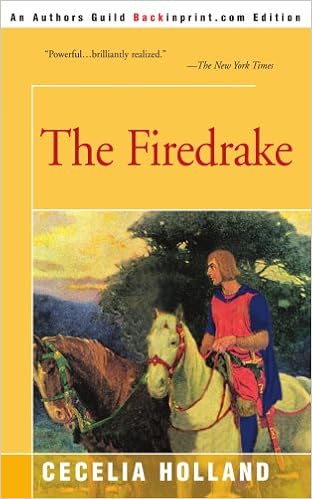
The Firedrake


Image result for the firedrake cecelia hollandThe Firedrake is the debut novel written by historical fiction writer Cecelia Holland, published in 1966, during the height of the flower power movement. I found out about Holland through my stepfather, who recommended that I read her feminist space opera Floating Worlds, which was such an amazing novel that I had to have a copy, nevermind the library's copy. Now its one of my favorite books on my shelf. I plan on going back and rereading it sometime soon. Firedrake is such a rare book because its a debut novel and its from the 60s. There are physical copies going for as much as fifty dollars on Amazon. Talk about expensive. 

Anyways, what made Floating Worlds so great was Holland's style, her voice as a writer. I was extremely happy to see that her writing style was very similar. Short, choppy sentences. You never see the inner mind or psychology of the characters. The story moves by plot and action. Things are always happeneing, even when nothing is happening. The time you spend away from the book leaves you in suspense. This is what makes Holland a great writer. 

Firedrake follows an Irish knight in the year 1006. Named Laeghair, Laeghair from Traelee, Laeghair of the Long Road, he makes his way as a ronin [wanderer] into a commander of William the Conquerer's Army. The novel ends at the Battle of Hastings, where William takes England. Laeghair is very sour, a real asshole. He's a beserker knight that fights like a devil. He kills a guy just because he insulted him in front of the other knights. He's a leader of an army. He buys a woman he sees getting beat up. Hilde bears him a son and two still born children but at the end of the novel he leaves her when she's pregnant yet again, saying, "Leave me alone." He never married her nor did he love her. Yet there were times when he was happy with her. Having that as the ending had me thinking of Laeghaire as a real piece of work. After pillaging a town, he has his way with a woman. She doesn't cry out but its still considered a rape. This guy is bad news. 

What's interesting is William the Conquerer's personality. Is it based on real historical fact? The man seems to be an enigma in the novel. Laeghair pleases William very much, and in fact Laeghair saves William's life at the Battle of Hastings. Not only that, but William finds delight in Laeghair's snotty attitude towards everyone. They would make great friends if one were not subordinate to the other. The historical aspects of this novel were so foreign to me that it was almost like reading a science fiction novel. I couldn't relate to anything here, instead I had to use my imagination and try to imagine a world where people fight with swords, axes, ride horses, drink beer and wine everyday, and women aren't healthy enough to give birth to healthy children, resulting in a lot of still born deaths. 

The physical combat here is brutal. But not gruesome. It reminded me of the Illiad in the way the combat is described. Sort of. But Holland has her own unique way of action as well. Because of her short and choppy style, the action moves along very fast. Like a real fight. It leaves you wanting more and more combat but then the battle is over and something new occurs. 

Lastly, this is a remarkable debut novel. Holland got me into historical fiction from Floating Worlds and now Firedrake. I have in my possession two of her other historical fiction novels, Jerusalem and The Angel and the Sword. I never thought I would be into historical fiction but here I am. I'm reading new genres other than science fiction, classics, and philosophy. Always good to explore new territory. Especially if the writing is so damn good.

Holland wrote this when she was only 22, still studying at college, probably to get her Masters. I don't think she had any grand goals or ideas when she wrote this novel. I don't think the story needed anything grand or idealistic, it works as historical fiction work on its own without any gimmicks. This is a simple, plain novel. No fancy bells or whistles. Just plain old good writing. Highly recommended if you like history, fiction, medevial history in particular.

Check out my review for Ceceila Holland's science fiction epic, Floating Worlds- http://ofigueroamusic.blogspot.com/2019/02/floating-worlds.htm

Tuesday, October 23, 2018

John Milton's Paradise Lost


Image result for paradise lost john milton book coverParadise Lost is a biblical epic poem by John Milton, written in 1668, the most well known epic poem in English. It has about 10,000 lines of verse. Milton was a highly religious man, a Protestant until late in life, who became apart of the new government in England, after they chopped off King Henry's head. He worked in government in between writing; poems and discourses on things like divorce and monarchy, he argued that the Divine Right of Kings was wrong, even idolatrous. Paradise Lost tells the story of the fall of man, when Satan tempts Eve to eat from the Tree of Knowledge, and ultimately lose Eternity with God in the Garden in Eden.

The story has everything; love, war, peace, evil, politics, science fiction style peaks into the future, marriage talk, sex talk, metaphysics, and philosophy. There are a lot of themes that this book touches on. I'd like to go over a few that I found interesting.

Milton shows us that his God in Paradise Lost is an artistic god, omnific, knowing all, creating all, everything. God is professorial here, the ultimate Monarch. In the passages where we see how God created the Earth, we see the true artist in his godly abilities. Milton's God is also shown as the ultimate sovereign, who sends his Warrior Son Chieftain to single-handedly destroy Satan and his evil angel allies, sending them to Hell. This is unusual because Milton doesn't believe in the Divine Right of Kings, but despite this he chooses to write a biblical epic about the most divine right of thee King. Milton strives to show us "the ways of God to men". Here we must take note and separate Milton's work in Parliament from his work as a poet. The artist's pen differs greatly from the political essays. 

Another theme is the justification of Satan being a sympathetic character. Here, Satan is portrayed as a bad guy, yes, but there's strong argumentation for Satan being a more understandable character than Milton's God, empathy. Sure, Satan is evil, and wants to overthrow God with a third of the angels, but in seeing this we see that, yes he is proud, but we can also see his "radicalism and fraudulence, freedom and its counterfeit fused in a single personality not easily pigeonholed." (hudsonreview) Milton doesn't see Satan as a hero, because Milton understands whats its like to go against an absolute soverign and lose. We can sympathize with Satan's determination, never to yield, perhaps because its inherently human, which we see when Eve eats from the Forbidden fruit. 

Another strong theme is the relationship between Adam and Eve. There's a hierarchical aspect to their relationship because when Raphael comes to warn them of an approaching enemy in the future, Raphael mostly talks with Adam. They talk about marriage, the enemy, even sex. When Satan enters their lives, things change forever. It seems to me that the way Raphael warns Adam and speaks mostly to him, it was like an early temptation for Eve to rebel. 

Once we see Satan travel through the Earth's globe, and take the form of the serpent, we know its all over for the human race. However, what comes off as a surprise is the psychological justification for Eve choosing to rebel from God, and eat from the Tree of Knowledge, and that justification creates greater empathy for Eve than it did for Satan. Its interesting, what a way to write. Of course, Adam choose to Fall with Eve because he "loves his wife too much." He can't stand the thought of being away from her, and the thought of losing another rib doesn't sound too good.

The book is quite astonishing. There's a great scene where after the Fall, Adam talks with the archangel Michael and is shown the future of the human race. This part had a strong emotional effect on me, in some aspects I could see how that future represents the world of today in a way, I almost can't explain it in words, the sheer emotional intelligence brings to mind Wagner's music (my signature daily favorite is Tannhauser), or the sounds of the archaic delta bluesmen, with their yells, shouts, blue notes expressing emotion and pain. This section had a science fiction vibe to it, because they were looking at the heavens at this portal, and seeing everything that would happen on Earth. It was beautiful. 

Another highlight was the description of the civil war between God's angels, Satan, and his army of evil angels. Again, I really like the archangel Michael's stature, because he's the ultimate angel-warrior, with a flaming sword, second only to the Son of God Himself. We get this description of the most epic civil war in the universe. Ultimately though it is Christ Himself, The Son of God, who comes out and single-handedly defeats Satan and his army, sending them to Hell. 

Yet another interesting section was a talk between Satan and his evil angels in Hell. Here we get a real glimpse of the ultimate evil-doers in their lair. This section gave me a strong Dante's Inferno vibe, reminiscent because I just finished reading that a few weeks back. 

Paradise Lost is one of the all time great writings. Its something I plan on going back to and rereading, and I think the poetic beauty in every line will be just as exciting the next time I read it. In today's world, Milton is still relevant. These ideas haven't died as technology has taken over, rather these ideas are forever, and shouldn't be overlooked in the modern age of literature. This isn't just for Lit grad students, its for everyone. 

Wednesday, September 26, 2018

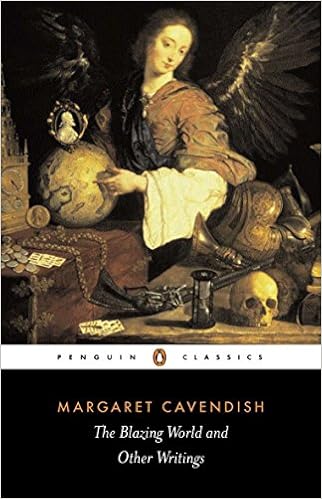
The Blazing World

The Description of a New World, Called the Blazing-World, otherwise known as The Blazing World is a 1666 work of prose fiction written by Margaret Cavendash, Duchess of Newcastle. Its considered a proto-science fiction novel, with utopian themes and political ideas that resonant with Thomas Hobbes, whom Cavendash would have read, and for the most part agrees with. This is the only utopian fiction novel written by a woman from the 17th century, making it a rare event and a feminist work, she's one of the first feminist writers in a sense. The book was published as a companion piece to her scientific work, Observations Upon Experimental Philosophy, which I ordered a while back from the library.
 

The Blazing World is a fanciful, romantical, satirical, utopian vision where a young woman enters another world via the North Pole, where she becomes an Empress of a world with talking creatures, complete with fish-men, bear-men, mer-men, and the like. She even converses with spirits, and the real life Duchess herself, that is, the author becomes a character in the story itself.

What really got me into this novel, reading it for hours every day other than the fact that its considered ancient science fiction, was the fact that the writing is different, it has a voice. Cavendash creates a poetic space with her imaginative creative style. Its one of the first ever feminist takes on utopian fiction. Its feminist in the sense that its about a woman who takes over control of a whole world in a utopian society, a kind of feminist ideological. But it doesn't end there. This is a work of many genres, be them poetry, utopia, proto-science fiction, romance, epic, morality, kabbala, philosophy, its a hybridization, which makes it even more highly unusual.
 

In the book, the Empress creates a monarchy government. Cavendash argues that monarchy is the best form of government because it eliminates separations of powers. She writes, "it was natural for one body to have one head, so it was also natural for a politic body to have but one governor … besides, said they, a monarchy is a divine form of government, and agrees most with our religion.
 

Cavendash gets her philosophy from Thomas Hobbes, who says in his work Leviathan (which I'm almost done reading) that monarchy is the best form of rule, and without it men would be at each others throats by the sword, and lastly, that life is nasty, brutish, and short. We see Hobbes echoed through The Blazing World, and its not surprisingly to me given that they're both from civil war era England and Cavendash was even familiar with the smartest men of the day. She even dined with Descartes.

But how does the book read, and is it good? The book reads kind of slow. It was some three-hundred pages but sometimes a whole day of reading (which is only like three hours for me) felt like it didn't get me very far. Its so overly detailed and all over the place that sometimes its hard to keep track of whats going on. Arguably you could say that Cavendash's refusal to write in a simplistic 'feminine' way is her being a rebel, a true feminist doing whatever she wants, saying whatever she wants, and writing whatever she wants in her own self-published books, just because she can.
 

I also think the writing is very good. The book lives up or down depending on your outlook, although it doesn't exactly keep you on the edge of your seat. I have the advantage of reading this book four-hundred years later and not only enjoying it, but interpreting it in my own way. The book gets tedious, it meanders through many, many pages, and it seemingly becomes more and more fantastical and philosophical, its exciting through and through and I would probably read it again given some time. The story is a little bonkers but if you keep going with it you can find its riches.
 

Read this if you're into creative writing, feminist writing, or archaic science fiction of the utopian variety. Also recommended: Sir Tomas More Utopia and Francis Bacon New Atlantis.

Sunday, January 21, 2018

Frankenstein, or The Modern Prometheus


Hello everybody! Here I'd like to discuss Mary Shelly's Frankenstein, which I literally just finished reading just now. The book was inspired by Mary Shelly and her friends friends who used to tell each other ghost stories around the campfire, they all decided they should all write their own ghost story and whoever wrote the best one, that one would get published. This is the only one that got done and published folks. Its quite good and inspired movie(s), cartoons, video games, and much more. The first unedited version was written and published in 1819, making this the oldest science fiction I've ever read, wow!

This book can be a little difficult to get into at first. Everybody knows the story of Frankenstein and the book only differs from the movie in some slight ways. For example, the monster here is eloquent and quite poetic, however, that is just the writing, times, and style of the book. The writing is quite formal, which is expected of the time in which it was written. For instead of thinking of the monster as eloquent, its more evident that the monster is a product of the times (1819) and that he is still quite evil despite his mastery of persuasion and making the reader feel sympathy for the state of this pathetic wretch.

The main difference from the book and the 1930s movie we've all seen is that Victor Frankenstein (the creator, mad scientist) gets a full biography and history where we learn near the end that the woman he is to marry is a childhood friend that his family took in, almost like a sister, which to me was a little incestuous but otherwise not that different from the movie. In addition, his monster torments and kills members of his family in the book, whereas in the movie the monster accidentally kills a villager's daughter. Also, the ending of the book is quite different from the movie, but I do like that after all is said and done our monster runs away like a thief into the night. It was quite a fitting ending for what could be construed as science fiction horror.

Today we look at this kind of thing and call it horror but back at its inception this type of writing would be considered science fiction. Mary Shelly's writing here is quite stylized; formal, educated, high art of a certain style. Its definitely a product of its time and I could see some people having trouble getting used to the literary style. I've found that I really enjoy these old types of science fiction writings, especially by women, they have a certain voice that men don't have. I suspect I'll learn more about this as I read more and more science fiction by female authors. I just ordered Ursula K. Le Guin's The Left Hand of Darkness, which is a sort of feminist cyberpunk sort of thing. I'm looking forward to reading that next.

However, Frankenstein is a hellova novel. I liked it so much that I'll probably want to read it again in the future, probably some months or years down the line. There's a sensation of eerie evil doings alongside justice in this book and it seems to do it in a literary personable voice rather than just being sinister just because. It's great, and if you like the movie then you should definitely check out the book.

"Cursed, cursed creator! Why did I live? Why, in that instant, did I not extinguish the spark of existence which you had so wantonly bestowed? I know not; despair had not yet taken possession of me; my feelings were those of rage and revenge. I could with pleasure have destroyed the cottage and its inhabitants and have glutted myself with their shrieks and misery."

September Sweater Weather

Good evening ladies and gentlemen, hello world. How are you?  It's good to be writing on a good day off work today on a Saturday. Here, ...