Showing posts with label ancient fiction. Show all posts

Thursday, May 30, 2019

The Epic of Gilgamesh

The epic of Gilgamesh is a trip. Dating back to Mesopotamia around 2112 BC, it's one of the oldest works of writing in human history. Older than anything I've ever read. Of course, the original story was written on clay tablets in Akkadian, but today we have these English translations that may or may not be a direct translation. This makes for interesting reading for the modern reader like myself. 

The story is about a ruthless king named Gilgamesh. This guy is such an asshole that he rapes any woman he wants, and even rapes a woman on her wedding day. Gilgamesh is on the war path, treating his subjects like crap. The old Babylonian gods are mad at Gilgamesh, who happens to be 2/3's god but still a mere mortal. So they decide to create an equal to go up against him and show him whats up. Nobody is equal to Gilgamesh in strength or wit until the gods create Enkidu from clay. Enkidu is first a wild man, living with the animals in nature. Eventually, a hunter finds him and takes him to the city, where he joins civilization. After he realizes that the animals don't like him anymore he sees that he has become apart of mankind. 

Enkidu hears about the bad stuff Gilgamesh does so he challenges him to a fight. They wrestle for a long time until Gilgamesh gets the upper hand and defeats him. After that, they see each other as equals and become fast friends. Sounds like the fight I had between my first bully in middle school.

Later, they decide to take up the mantle of heroes. The two embark on a voyage to this forest that is forbidden to mortals. They just want some trees and show off that they are heroes for going where mortals aren't allowed. They go there and find the guardian of the forest, a monster that guides the forest for the gods. They kill the monster, take some trees, and build a boat out of it and go back home to Uruk as heroes.

Later, the goddess Ishtar attempts to seduce Gilgamesh but he's not interested. She gets mad and has her father, Anu, the god of the sky, creates a monster called the Bull of Heaven to fight Gilgamesh but together, Gilgamesh and Enkidu slay the beast. However, as punishment for killing the Bull of Heaven the gods decide that one of our two heroes must die. Enkidu draws the shortest straw. Enkidu gets sick and tells Gilgamesh of visions of the afterlife before he croaks.

Enkidu's death causes Gilgamesh grief, something he had never experienced before, experiencing the death of a loved one. This causes Gilgamesh to seek out a way to cheat death and live forever. Gilgamesh goes through many trials on his own but finds his way to  Utnapishtim. Utnapishtim is the first Noah as in Noah's ark. The gods created a flood that destroyed all of mankind but Utnapishtim ended up creating an ark that housed two [male/female] of every animal, to save life after the Deluge. After the gods saw that he did this and ended up living after the flood they granted him eternal life. Utnapishtim offers to give Gilgamesh the gift of eternal life but he has to do one thing first: He has to stay awake [without sleeping] for an entire week. Gilgamesh foolishly attempts to do it only to fail spectacularly. He prepares to go home in shame and sorrow. But then Utnapishtim's wife feels sorry for Gilgamesh and has Utnapishtim tell Gilgamesh where he can find this plant that will restore life back to its vibrant youth [pretty much eternal life sort of]. Gilgamesh finds the plant easily, but when he's sleeping a snake comes and steals it [echoes of Satan of the Bible], sheds its skin, and regains its youth, leaving Gilgamesh defeated. 

The story ends with Gilgamesh going back to Uruk and coming to terms with his mortality. He realizes that the city he has will be his everlasting legacy. He realizes that although he and the city may be forgotten the human race will live forever [sort of].  

Well, where do we start? In terms of themes, there's a lot going on here. There's love, friendship, and loss once Gilgamesh becomes best friends with Enkidu, and then Enkidu ends up dying. This is a theme that continues throughout literature even today. When Enkidu becomes a best friend Gilgamesh changes, starts to feel compassion for others. In fact, he had changed so much that when he got the plant that restores youth, he was planning on giving it to the elders of Uruk. I did not see that coming.

Another major theme is the inevitability of death. This is a theme that continues throughout literature today as well. Here we have a guy who tries to overcome death but inevitably realizes that he's a mere mortal like all of us. He comes to grips with reality and sees that the life he has is the only life he will ever have so he should make the most of it and live a fulfilling life. Although Gilgamesh is part god he's still mortal too after all. 

It should also be noted that there are parallels here between Gilgamesh and the Bible. The flood story [called the Deluge here] is completely identical to the story of Noah's ark in the Bible exempting the fact that God didn't make Noah immortal for doing that in the Bible. Also, the poem makes a serpent the thief of eternal life [the youth-restoring plant]. This is identical to when Satan takes the form of a snake and persuades Eve to eat the apple from the forbidden area of the Garden of Eden. It's remarkable that Gilgamesh and the Bible are so similar especially because they were separated by so much time. This shows the legacy of literature. Once something is written down it may last forever [or 4000 years in this case]. And that really shows how important the epic of Gilgamesh is.

Closing thoughts 

This is a fast read but an interesting adventure. It's a classic because it's one of the oldest surviving works of fiction and its themes are still being rehashed today. The gods of these ancient times are still talked about today [usually in conspiracies] and they resonant with the Greek/Roman/Norse gods as well. You see a pattern here with the way the gods behave here as well as in the Iliad, Odyssey, and Aeneid. You see a pattern with the savage violence of monsters here as you do in say, Beowulf. However, I'm just comparing these things to each other because I read them all in one fell swoop. They are all very different of course. I think I would understand Gilgamesh better if I knew more about those ancient times but for now, the long introduction of the translation I had [Penguin Classics] will have to suffice. This is a grand tale worth your attention and time. If you like epics, poetry, fiction, and classics then this will definitely take up space on your bookshelf. You don't forget a tale like this easily because it's just that damn good. 

Thursday, May 16, 2019

Beowulf


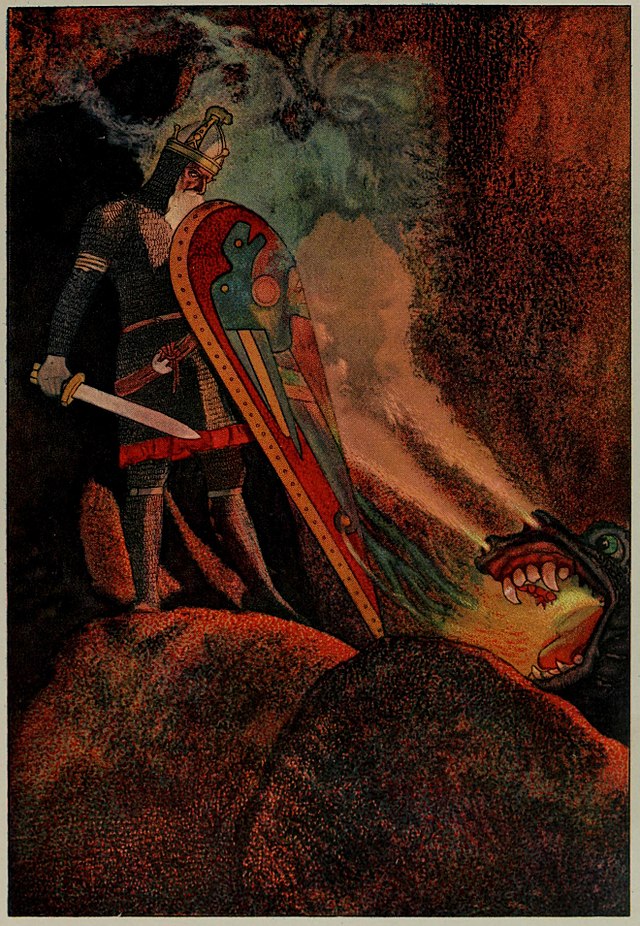
Image result for beowulf classical artBeowulf is a classic of western literature. Dating back to 975-1000 AD, it was written by an anonymous writer. The translation I read had the Old English on the left pages and a modern English translation on the right side of the pages. The work is some 3,000 lines of verse. 

Beowulf is also a Scandinavian epic about a great warrior, who stands up to save people from this monster, Grendel. Grendel rips apart humans and eats them raw and bloody. Beowulf, the brave hero, takes him down, then kills his mother, Grendel's mother seeking revenge. In old age, Beowulf is a King. But a dragon has attacked, so he goes to arms. He kills the dragon with his most trusted soldier but likewise the dragon lands a killing blow on him. The tale ends with Beowulf's grand funeral, cremated with hero's rites. 

The action flows along with the poetic style. When Grendel attacks it's menacing. When Grendel's mother vows revenge, things get psychological. When Beowulf fights the dragon it's the first time he's ever scared. 

The narrative tropes appear in other literature throughout time. The translation is a little bare at times, but there are also lots of archaic sayings at work. Meaning you might have to look up certain words or just read slowly for better comprehension. You have to read this one slow in order to fully understand. Thankfully Beowulf is pretty short. I was able to finish reading it in two sessions. 

I was holding off on reading Beowulf for a long time because I wasn't sure if I would truly be into epics, poetry, mythology. But it turns out that I'm really into it. So far I've read Paradise Lost, Dante's Inferno, the Odyssey, the Iliad, Beowulf, and now I'm currently reading Virgil's Aeneid. This is a big departure from my usual science fiction reading sprees. At first, it took a while to get into all these epics. You get a taste then you're hooked. 

Skyrim anyone? 

Wednesday, May 15, 2019

The Odyssey


The Odyssey is one of the best books ever. Written some 2,700 years ago by Homer, the story contains everything you'd want in a good story. In fact, it's hard for writers or story tellers in any medium not to be influenced by this monumental masterpiece. How does one go about and review the best book, one of the most original books, the most copied book? Rather than answer that I think I'll improvise and see what I can make of it. Make a go of it shall we? 

First of all, a lot happens in the Odyssey. Fundamentally this is ancient fiction, epic poetry about a guy struggling to get home. That's all it's about. But along the way, all these things happen. Where shall we start? There's a cyclops who eats Odysseus' crew-members alive. Circe, the goddess witch turns his crew into pigs, making them forget about going home. There's the sea monster Scylla, lying in wait in the wayward seas. The only way past Scylla is to just sail on past her, there was no chance of killing it. There are sirens that sing a beautiful tune, making the men go to them, and forget about going home. Zeus himself strikes a thunder bolt that hits Odysseus' ship, sending him lost at sea, alone, and helpless. 

The big question for the reader is why is all this happening to Odysseus? Well, for one thing, Poseidon is trying to stop him from getting home because Odysseus took out his cyclops sons' eye, stabbing it out with a sharp stick. Zeus himself intervenes sometimes against Odysseus but it isn't clear why. Odysseus never thought himself greater than the gods, quite the contrary. The only good thing Odysseus has going for himself is that he is Athena's champion. Pallas Athena, daughter of Zeus, loves Odysseus and does everything in his power to see that he gets home. She intervenes throughout the story, helping immensely. 

I read the Robert Fagles modern style translation from 1996. It reads like butter, meaning that it flows effortlessly. Everything makes sense. I was never confused or puzzled by anything. This is one of the better translations you can find out there. Better in the sense that its a modern take on the classic. There's no classical English phrasing or the archaic language of antiquity. Rather, this is an inspired translation based on the original Greek text. Meaning this is an authentic rendition but it's been updated to fit the modern reader's taste. All in all, this means that this is a great version of the Odyssey for your first read through of the epic. It's so inspiring that I'm already planning on buying other translations so I can compare and contrast them with this. Robert Fagles is a true master of bringing works of antiquity to the modern era. What a guy. 

On a side note if you want to read the Odyssey you should read the Iliad first. It just makes more sense to do that because the events in the Iliad happen before the Odyssey. Also, it will help prepare you for Greek mythology in a nutshell. All the basics are there in the Iliad and appear again or in different shades in the Odyssey.

Back to our plot synopsis. So the Odyssey is a man going through many trials. He even goes down to the House of the Dead on some errand, one of my favorite parts. But the most difficult trial is still at hand after that. Odysseus goes back home only to find that his palace has been overtaken by many suitors, who have been wooing his wife, trying to win her hand in marriage, never knowing if the king of Ithaca will ever return, the champion from the Trojan War This part is interesting. 

All those events that everybody knows about happen in the first half of the book. The entire second half is dedicated solely to Odysseus getting his revenge against the suitors in Ithica. Athena turns him into an old man, begging for scraps at the palace. Eventually, old man Odysseus and his son Telemachus, and two farmhands take up arms and kill all the suitors, a real blood bath. To be quite frank, it ends like how you expect it to end. With him getting him but barely making it, and taking his revenge against these suitors. He also kills the maids who were whores and slept with the suitors. The guy has no mercy. He even cuts off the ears and nose of a guy, tears off his genitals, and feeds it to the dogs! My name is reek anyone? After going through the intense violence that is the Iliad, going through this was a walk in the park. Intense violence isn't really my thing but the Iliad is a much more fucked up and violent story, showcasing the complexities of war in the most aggressive way possible. 

Lastly, what you can come to expect is that you'll see and rehear these tales rehashed over and over again. In other books like fantasy novels in particular, in video games [like Warcraft], in movies, TV shows, and even in music [Symphony X, Odyssey]. What I've learned through my fascination with epic poetry, ancient fiction is that everything you'd ever want in a story is already written. It's all either in the Bible or Greek mythology. Everything is variations of those themes. It's the job of the writer to make these variations better and more interesting. This is one of those books you must read. Even if you don't like ancient fiction literature there's something for everybody here. The fact that its a straight narrative of one man makes it a simpler story to tell than the Iliad. A lot of writers have been copying the tales here in endless variations. Of course, in the end, nothing is better than the original source.

Check out my review for the Iliad https://ofigueroamusic.blogspot.com/2019/05/the-iliad.html 

Sunday, May 5, 2019

The Iliad


Image result for the iliad book coverThe Iliad is one of those majesterial works. It's an all-time classic Western masterpiece, maybe THE classic Western work of fiction. I read Robert Fagles' translation, released in 1996. It's one of the best books of 1996. Fagles brings the archaic ancient fiction story into the modern age with his translation. Sure, it isn't 100% what it is in Greek BUT it stays faithful to it AND reads like beautiful epic poetry. Rather than write my typical book review blog post, I'm going to explain the story itself just a bit and then point out things about it.

I'm familiar with epic poetry. I've read John Milton's Paradise Lost, Dante's Inferno, and the King James Bible. However, Homer's meter and verse are much different, of an older time period, a dramatic, emotive, precursor to all that Renaissance stuff in Europe after the Dark Ages. Homer portrays the Trojan War in a brutalist manner, complete with brains and entrails flying over the battlefield. One thing that Homer makes clear is that once a man is dead, he is dead. Nothing becomes of him. Later in the European Rennaissance, orators, writers, and poets would use Christianity as justification for salvation or damnation after death. Interesting little tidbit.

There's this big Homer debate. Was he blind? Could he write? Was he illiterate? The Iliad is some 2,700 years old and there's evidence that supports that the story was altered, changed over hundreds of years. Homer was the Shakespeare of his time. It doesn't really matter if he was a blind oral poet or one of the very early Europeans who could write on stones or papyrus. In his day you didn't write unless you were of the upper class. Most people were illiterate. So it goes. 

The story itself is about Helen of Troy. The Trojans are safeguarding her in Troy. Meanwhile, the Acheans are coming to kill them, take back Helen, and the city. The fighting description and imagery are so raw, visceral that I joked with my friends that the violence in the Iliad makes me want to throw up. Some of it is pretty gut-wrenching. At times it can be a bit much. But fictional death can't be all that bad, right? Well...

At some point, Patroclus, Achilles' friend [and people have also said that Patroclus was Achilles' lover] gets killed by Hector, son of Priam, king of Troy. Achilles responds by going to war. Thus the Iliad is about the Rage of Achilles. Rage is definitely what it was. He goes on a massive murder spree, even chasing Trojans into the river and killing them there. The gods get involved in all the fighting. This war takes place over multiple years by the way, so this really is epic in proportion, even more, epic than Avengers End Game [review here].  

This is a battlefield where men give speeches, telling their life story and taunting to their enemies before they duke it out in a blaze of glory and honor. A lot of times both sides are fighting harder and harder every time an enemy gets a leader or champion's corpse and tries to defile it, stabbing at it, mashing it up, etc. This leads to both armies gaining fighting strength in order to preserve said dead allies' body so that it can be brought to their family for a proper burial. Not to mention Poseidon's war cry, making troops gain sudden strength and will. 

The gods intervene a lot. They seem to have a big stake in this. Achilles is destined to die if he fights in the Trojan War-a prophecy from his goddess mother Thetis. Hera and Artemis work to undermine the Trojans. Poseidon fights on the actual battlefield for a large portion of the story. Gods shield certain champions from certain death. Zeus makes sure Hector's body gets back to Priam, back to Troy, because Hector was a much-loved champion who always praised Zeus and sacrificed the right amount of goats and pigs in Zeus' honor. This shows that the gods will always be involved in mortal human life. They all have their reasons. But maybe they just don't have anything better to do? 

Achilles kills Hector and defiles his corpse by dragging it around the battlefield, three times around Patroclus' grave. Now satisfied, Achilles holds the greatest games, the last chapter entitled Funeral Games For Patroclus [perhaps a precursor to the Olympic Games]. There are all kinds of contests in honor of Patroclus, fighting to the death even. And there's a huge bbq party, and Priam, Hector's father comes. 

When Priam comes to get Hector's body for Achilles, Achilles goes from rampaging god-like creature to a mere mortal when he realizes that Priam's love for Hector reminds him of his father. You could say that at that moment he is humanized, no longer the raging invincible monster, angry because Agamemnon, lord of men stole his girl. His rage is hard to justify.  Because he didn't fight until the end of the war he caused a lot of death amongst his comrades. 

So what is the Iliad about? Generally speaking its about a city about to get sacked. But in between, we have the making of the origin story of tragedy. The Iliad is usually described as the Rage of Achilles but it can also be thought of as the Tragedy of Hector. Although Achilles was a master warrior and a much better fighter than Hector, Hector, in fact, was much more loved, more loving, and a better man to his family and comrades. No wonder Zeus brought his body back to his family. The caveat is that Priam [Hector's father] had to get the body personally from Achilles, who might have killed him if not for the threat of Zeus looming overhead. Very dangerous move for the King to go out and meet with the enemies, especially right before your city is about to get sacked. 

This story has everything: love, war, death, honor, love, sex, gods, mortals. Robert Fagles' translation is easy to understand. The lines all flow in a cohesive way. You have to read a good translation for the Iliad or any work of ancient fiction. A crappy translation will completely ruin the experience. I enjoyed the Iliad so much that now I'm reading the Odyssey, also the Robert Fagles translation. I've caught the ancient fiction bug all of a sudden. I have plans to read the Aeneid and Beowulf after.

You pick up this book and you realize its a 617-page behemoth. I was deep into it, reading it on and off for a while. I started on page 240 on Monday and by Wednesday I had finished the book on page 617. I managed to read 400 pages in three days in a wild burst of long and super enjoyable reading sessions. The language is simply beautiful. I can't explain the mechanics of the poetry at work here, the line, meter, verse and all that but there's overarching linearity to the prose here. It's like the entire work itself connected in such a way that it was all one long sentence. Like it was an oratory experience. This is one of those books I will definitely come back to. I would love to read other translations. 

How could you rate this book? It's a masterpiece, a complete 5 out of 5 stars. Anyone who disagrees either doesn't like epic poetry or just doesn't get it. That's fair too, to not get it. After all Greek mythology isn't for everybody. But I sincerely believe that this ancient fiction is so magnificent that most people would enjoy it. Especially Robert Fagles' version. Do check out this book, it's one of the best books ever.

September Sweater Weather

Good evening ladies and gentlemen, hello world. How are you?  It's good to be writing on a good day off work today on a Saturday. Here, ...