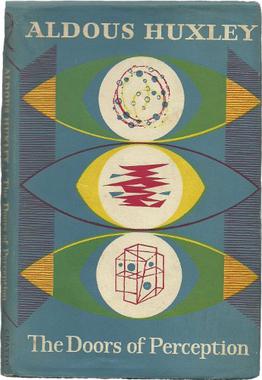
I've picked up a lot of books over multiple library book sales. These are first-come, first-serve sales of mostly paperback but sometimes you can find handsome editions of hardcover novels. I picked up The Doors of Perception because I'm been inspired by the counterculture hippie movement since high school. The Doors was one of my favorite rock bands as a kid.
That's my paradigm. I'm mostly inspired through rock and roll rather than experimentation of drugs. But even as a youngster I was familiar with the Merry Pranksters, Timothy Leary, LSD, Sgt. Pepper, and "turn on, tune in, drop out." And of course, all my favorite American hippie rock bands supported all that stuff. The Doors named themselves after Huxley's Doors of Perception. This edition comes with a separate book entitled Heaven and Hell. Both of these short books explores the mind's remote frontiers and the unmapped areas of human consciousness.
For starters, one of the main problems with these books is that its no longer apart of the zeitgeist or discourse. The idea of taking psychedelics in order to gain some insight into the spiritual self is no longer apart of the current paradigm. Native Americans were known to use peyote/mescaline for spiritual purposes. But do even they still do that today?
The young people I know who have experimented with heavy drugs like LSD, mushrooms, cocaine, and heroine are using it in order to escape from their reality. Much like the quote above. They use drugs as a backlash against the real world because they feel they are suffering. Any release into paradise will suffice. Even if it only for but a moment. Drugs and alcohol relieve them from their suffering. Albeit only for a short while until they come down from the high. Knowing that, it's very difficult for millennials to truly understand anything that Huxley is talking about here. But I like a challenge.
This isn't really a book. Rather its a dialogue of Huxley containing his trip on mescaline. Ironically the trip takes place in the world's largest pharmacy during the early stages of the trip. A bit of comedy for his mescaline trip. What happens to someone under the influence of mescaline?
a) Ability to think straight is little if at all reduced. You don't become stupid.
b) Visual impressions are greatly intensified and the eye recovers some of the perceptual innocence of childhood when the sensum was not immediately and automatically subordinated to the concept. Interest in space is diminished and interest in time falls almost to zero.
c) Though the intellect remains unimpaired and though perception is enormously improved, the will suffers a profound change for the worse. The mescaline taker sees no reason for doing anything in particular and finds most of the causes for which, at ordinary times, he was prepared to act and suffer, profoundly uninteresting. He can't be bothered with them, for the good reason that he has better things to think about.
d) These better things may be experienced (as I experienced them) "out there," or "in here," or in both worlds, the inner and the outer, simultaneously or successively. That they are better seems to be self-evident to all mescaline takers who come to the drug with a sound liver and an untroubled mind. [Doors of Perception]
Time meant nothing. Huxley mentions there was plenty of time. Not a concern. He also wasn't concerned by spatial forms. This could mean the distance between me to my computer screen as well as the matter of me writing this review and then finishing it. Neither mattered anymore.
What really is important to him is experiencing and observing. Looking around the room takes on a new perception and/or concepts of the things we see. Mescaline strips down concepts but allows you to see them for the first time, the beauty of it.
Man-made art had little effect on him. He was humored by the fact that humans tried too hard to symbolize things. "How dare they?" "The audacity?" This goes alongside paintings as well as classical music composers. He was more mesmerized by nature than by human-made things.
Heaven and Hell go into religious aspects. Huxley notes that in the middle ages Christians would beat themselves until wounds would fester [flagellants] and starve themselves until they literally saw visions. They would literally see the devil. The festering wounds would cause hallucinations. How about that?
My favorite concept that Huxley mentions in heaven and hell is a simple one. If you are a mystic/artist, you must learn from the scholar. If you are a scholar you must learn from the mystic/artist. It makes perfect sense. Why isn't the world like that? Why aren't more people across different discipline working together and learning from each other? It makes me wonder what could have been.
The truth is that I would never do any hallucinatory drugs and this book doesn't make a convincing argument for me to find a dude off the street and buy some mescaline off him. Rather, I'm impressed with Huxley's experience. I'll take his word for it and agree that the experience changed him for the better. Even if it only changed him for that day I can see from his writing that it had a profound spiritual effect on him. None of these drugs should be used for recreational purposes. Hell, at this point I don't even believe marijuana should be used recreationally. Maybe I'm getting too old. Maybe I'm a square. Maybe drugs are good for people sometimes.
In the end, we are all riders on the storm.


