The last two weeks have been pretty rough at the retail gig. The holidays have come and gone, save for New Year's Eve and New Year's Day. It's been rough. That's a phrase I've been saying a lot at work. I'm just a little stressed. That's another likely quote. How do you fight back against this stress, this holiday frenzy, eating away at the core of modern American society?
Well, the thing is, you just have to rise above like the Black Flag song. Inevitably every little thing in our lives affects us at least somewhat on somewhat of a scale. One of the best pieces of advice my manager at work gave to me was, "no matter what happens, just go with it." At first, this sounded to me like a plea of defeat. But then you put it to practice and see how useful it really is.
There are two kinds of customers in retail work: assholes and friendly people. There is no in-between. You might think you're a tough guy and that nothing anybody says to you can ever affect you but in reality, every interaction we have affects us in some way, however small, or large.
Think of all the people you've met in retail work [if you work in retail] that you've ever had contact with. Most of it is overwhelmingly positive, at least for me. I'm pretty much something of a celebrity at my job, just for the sheer fact that I'm a unique personality [I talk a lot to people about books, music, guitar] that people never forget me and want to talk to me more the next time they come in. I think that it just shocks people that I'm a big black dude that shreds the guitar like Hendrix and reads Heidegger. They will never meet a black man quite like myself ever in their entire lives. In that sense, I'm something of a novelty. The other side of it is the depressive, melancholy that comes with the retail experience.
A large chunk of that melancholia would be bad interactions with customers. Customers who are overwhelmingly rude, customers who want to take advantage [return things with no receipt, demand cheaper prices, yell if it doesn't go their way, etc], upper management that tries to tell you how to do your job even though you've been working there longer than them, and the rest is just low-level grunt work that gets old fast.
There's also a sort of late-night depressive side of retail. When you work 430pm-1am 5 days a week for seven years straight you start to find that you're thinking more about the darker side of life at the later hours of the shift. Ironically it's at these hours that I feel the most awake, the most alive, in a sense. When I come to realizations.
But wait. Here's the good news. This is happening to other people too. Not just you. The modern American workers need to rise up in solidarity. The middle-class, upper-middle-class, and rich people with their nice cars, their mocha frappuccinos, their office jobs, and their gym memberships know nothing of the true struggle of the proletariat. If it were up to them they would stay rich and you would stay poor, indefinitely. And if you don't recognize this truth, then you aren't one of us.
This is why it is so important to have a worker's movement in America. The modern American worker is losing so much right now. The rich are so happy with their fancy video games, their pornography, binge-watching their favorite Netflix TV shows. They know nothing about what it's like to be a true proletariat.
The next worker's revolution is coming sometime. There will be no video games, pornography, or Netflix in it.
The revolution will not be televised. Say goodbye to the bio-mass.
Showing posts with label rich. Show all posts
Showing posts with label rich. Show all posts
Friday, December 27, 2019

Wednesday, December 5, 2018
Holy Fire
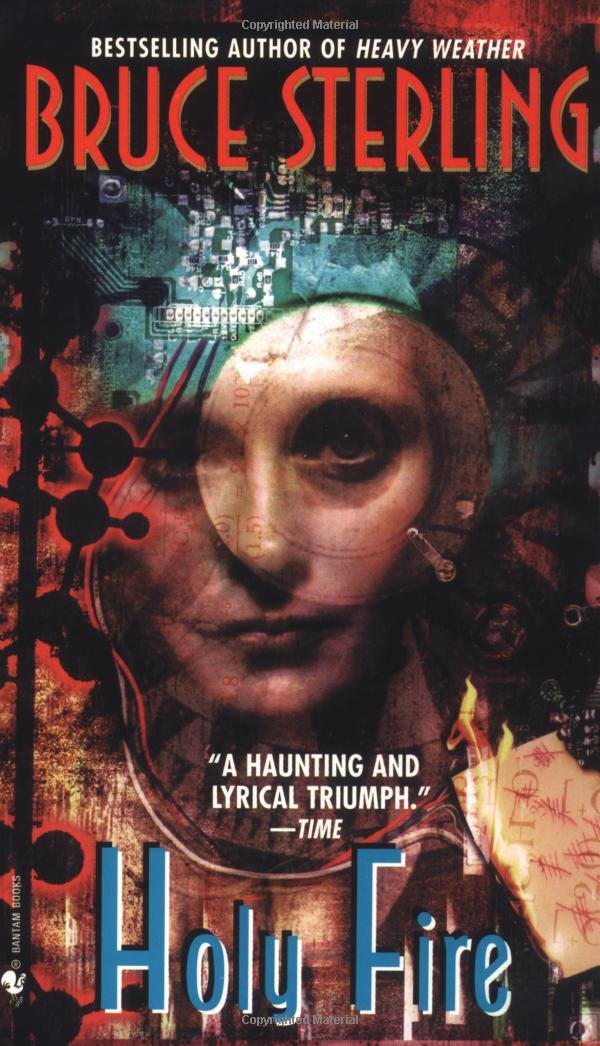 Holy Fire is a great science fiction novel written by Bruce Sterling. It came out in 1996. It was nominated for the British Science Fiction Award in 1996 and the Hugo and Locus awards in 1997. High praise for great art.
The story follows a medical economist named Mia Ziemann, a ninety-year old woman who transforms into a twenty-year old girl through intrusive technological means. Now (post-op) and borderline psychotic she goes by the name Maya as a young lady, traveling across Europe with nothing but a bag and the clothes on her back. She makes friends with all kinds of artists, bohemians, hackers, and fashion gerontocrats. The story is about life, death, the human condition, art, fashion, a very poetic sort of philosophy and ontology.
The world of Gilead is somewhere in the year 2100. Gerontocrats control mostly everything and young people are like the scraps on their shoes, living on the margins. However, most things are free, including free health care and food, provided you don't harm your body or anyone else. Its a near future but its not a totally implausible one.
Once transformed, Maya gets caught up with thieves and drifters, eventually making her way into the fashion/modeling industry because of her sexy look. From there she makes friends in high places, mostly programmer types that help her with her palace, a digital life-space given to her by her now dead husband, complete with ruins and stuff. This is a cyberpunk story and the technology here is out of this world. Even with Sterling's esoteric explanations, the tech can get lost in between the dialogue, which is what helps make the novel move along nicely.
Sterling gets very in depth with the virtuality within the story. His scientific explanation for Ziemann's transformation was quite complex. It was like reading Greek for me. However, it was mostly just advanced biology terms. The tech stuff here reminded me of William Gibson. Although I think Gibson does it better because he's able to make more out of the tech with his literary technique.
Anyways, Ziemann gets caught up with a bunch of rich, radical anarchists and they plan on 'living forever' and taking control of the system, and this and that...But it turns out in the end that Ziemann gets caught up with the police, who were tracking her down because she skipped out on paying back her medical bills for the youth procedure. And not only that, but her dead husbands' talking dog Plato was always in the virtual palace, he'd been looking for her too.
Ziemann goes through an ontological transformation. She realizes that she doesn't want to go back to being a gerontocrat, and that she wants to be a young photographer, even if she's really bad at it. It takes becoming a full blown criminal, a celebrity (at the end), a widow, and a Frankenstein-esque monster to realize what she wanted in life.
The novel contains many debates between these young bohemian types over the immorality of immortality as well as the aesthetics of fashion. The underclass here are also talked about frequently, the class of people who can't become 'post-human', those are the real disenfranchised of the story.
The writing of this story is free flowing with great metaphysical ideas. This is mostly done through dialogue and small events that happen over many pages-fifty pages here, another fifty pages there, etc. Although there are heavy cyberpunk elements here the ideas presented command more authority than mere tech. This isn't an easy novel to understand but its easy to read because the dialogue is interesting and the characters have artistic and idealistic charm.
If you want a different sort of cyberpunk novel this is for you. If you want a different sort of science fiction novel, this is it. They don't make science fiction like this anymore these days. And this was only from 1996!
I'm currently waiting for my order of Bruce Sterling's Schismatrix. I heard from my father that's his most important novel. After reading his amazing collaboration novel with William Gibson, The Difference Engine, this was a great follow-up. On his own Sterling has grandiose philosophical ideas to go along with his cyberpunk technology. It has legs.
Subscribe to:
Posts (Atom)
September Sweater Weather
Good evening ladies and gentlemen, hello world. How are you? It's good to be writing on a good day off work today on a Saturday. Here, ...

-
The Difference Engine by William Gibson and Bruce Sterling is one of those all-time great 'hard' science fiction novels. Set in a ...
-
Man Plus is a science fiction novel written by Frederik Pohl in 1976. Pohl is one of those rare great writers who was not only a great wr...
-
Holy Fire is a great science fiction novel written by Bruce Sterling . It came out in 1996. It was nominated for the British Science Fi...

