Showing posts with label literature. Show all posts

Thursday, November 14, 2024

On Reading

Reading, a peaceful balm for the soul, A refuge from life's tumultuous toll, An escape from the world's constant noise, A respite from the chaotic joys.

Through books we venture to realms unknown, We journey to places we've never flown, We meet characters, both great and small, And witness stories that enthrall.

With each turn of the page, we gain insight, Our minds expand, our perspectives take flight, We learn of different cultures and ways of life, And embrace new ideas, free from strife.

As we delve deeper into each written word, Our worries and troubles slowly blur, Our spirits are calmed, our hearts set at ease, And we find a renewed sense of peace.

So let us cherish this gift we're given, This solace that enriches our livin', Let us read with an open heart and mind, And discover the wonders we're sure to find.

[ai generated]

Saturday, August 7, 2021

Summer's Almost Gone [Quarantine 2021]

Hello world, 

It's been a bit of a hiatus but now I'm back and hopefully will resume my regular scheduled programming, aka the blog and keeping up to date with things via blogging. First off, I'll describe the scene in regards to covid and work. 

Things have been going pretty well at the store although things could be better of course. My one complaint is that we lost the $5 increased pay and now I feel ever so sad that my paycheck isn't what it used to be. Yes, we deserve that $20 per hour and I hope we get it back considering that we're still in the midst of the pandemic. 

In terms of covid and everything there's been no new cases at the store. However, in terms of social distancing in the lines there's none of that. In addition, there's hardly any cleaning of any kind except for when customers ask us to clean the register belts when they look dirty. However, most customers are wearing masks so at least there's that. But there isn't much social distancing of any sort. 

I've just been coping with the sustained quarantines. I've been reading a lot per usual, chilling with friends, and enjoying life in general while social distancing. 

Right now I'm reading Ulysses by James Joyce. This is an amazing work of literature. It reads like an off the cuff stream of consciousness. Like a jazz song. I can't go into all the details here but it's something of a monumental work in the western canon. It reminds me of Coltrane sometimes, that sheets of sound mentality in the words and phrasing. 

The direction of the company at work has become a more severe one, in which the workers get exploited just a little bit more. I believe its because of the pandemic that this has happened. The fact that we only got the hazard pay for three months is a shame, we should be getting that pay during this entire period of the pandemic, considering we are frontline workers, around hundreds of people each day, putting our lives on the line to make groceries sales, beholden to the company to give us hours and paychecks.

The name of the game for me since covid has been finding a new way to live and I believe I've succeeded in that. I have friends, family, my job, my reading, my games, my guitar playing, everything seems to be falling into place despite the pandemic. I'm the kind of person who never gets bored so I've found this entire quarantine experience to be highly enjoyable and I've been able to spend time doing a lot of different and new things. 

For example, I started working on a lot of language learning, particularly Spanish, but I've also been learning French, German, and bits of other languages. I'm not saying I can become a polyglot but it is quite fun, entertaining, and something different to do rather than my usual. 

I've also still been jamming once a week with my saxophone player friend Jason Thomas. It's been going quite well and I've learned a lot about comping [accompaniment on guitar, rhythm] through our duo jam sessions. My sense of guitar chords has become vastly more interesting. 

Lastly, I've been reading a lot. My goal for this year is to read 50 books and I've already read 32. Check out my goodreads account https://www.goodreads.com/user/show/56122996-og-space to see all the great works of literature that I've been reading and/or have read. In a world of chaos, reading is the one solace I that puts my mind at ease. 

Want to read more about what it's been like working grocery retail during the pandemic? Check out my plague journal, where I've documented my version of events starting from the day before the pandemic was announced, check it out https://ofigueroamusic.blogspot.com/p/blog-page.html.

Gracias por leer 

Bonne Nuit

Saturday, May 1, 2021

A Farewell to Arms

A Farewell to Arms is a terrific and thought provoking novel written by Ernest Hemingway. It tells the somewhat story of love, death, and war that is based on Hemingway's actual war experience in the first world war. The book was published in 1929 but not in published in Italy until 1948 because the way Hemingway depicted the Italian battles were seen as anti-militaristic by the Italian government and could have been detrimental to the war effort. Hemingway wrote no less than some thirty nine different endings to the novel until he picked the one he ended up with. What makes this book great, terrific, and probably his best novel, and best known work?

Well, the book describes three different things superbly. Love, war, and death. These themes permeate the literature of the western canon and Hemingway's depiction of the first world war is probably one of the best descriptions of war in the western canon. Especially modern warfare. Remember, when this came out in 1929 there was no realistic depiction of modern warfare in fiction. You end up really living the life of this soldier, how he gets wounded, how he falls in love, how he talks to and works with his officers. You get the feeling that this was really how it was on the battlefield. A lot of the off duty time of the officers was spent on drinking, drinking, and drinking. Alcohol appears in endless scene after scene and it permeates throughout Hemingway's life, continuously leading to his suffering. 

Another important theme was love. We get the feeling at first that our young Frederic Henry is wounded and just wants a girl to pass the time until his recovery. What instead happens is that he falls in love with her, but is it really love? The circumstances of war were excruciatingly difficult especially with his war wound [a shell hit him in the leg], not to mention his surgery to his knee. So what we have is a wounded soldier and a lonely nurse. It's a match made in heaven. 

Lastly, it must be mentioned the theme of death. Death appears many times. A fellow friend and officer gets shot down out of nowhere for no reason, but when Frederic and another officer go out into the open, nobody shoots them, and they walk past both German and Italian soldiers unmolested. 

Now, the most striking part of this book for me was the ending. The nurse is pregnant and gives birth but nearly dies. Frederic hates the baby and states within himself, "I care nothing of fatherhood of it, it nearly killed its mother," which goes back to the Greeks, the idea of the father hating the son because he could take his place in the patriarch of the family. However, in this case I prefer to see it as Hemingway's allegory for war, meaning that war is a ghastly nihilism, no good will ever come of it, it brings only evil and destruction and misery. To add insult to injury, the baby ends up dying and our young father is relieved. 

That ending knocked my socks off because although it seems simple I found it to be philosophical, a display of existentialism in fiction format. It's an ending I will never forget. Something sort of like what Tolstoy did with War and Peace, it was a fictional novel but parts of it translated into philosophy, at least in my viewing. Obviously you can make the case that Hemingway's take on war is that it is terrible and must be eradicated at all costs. Although the first 140 pages focus on the romance, the rest of the novel is thrilling, moving, and mindful. A must read for the western canon, a must read Hemingway, a must read war novel, and a must read novel for all. 

Want more Hemingway? Check out my blog post about Hemingway's Spanish American war novel For Whom The Bell Tolls https://ofigueroamusic.blogspot.com/2019/03/for-whom-bell-tolls.html.

Sunday, April 4, 2021

The Decameron

What can I say about Boccaccio's Decameron? Well, for starters, its the best dirtiest book in the western canon. A group of noble young women and three men decide to travel and tell tales for ten nights, amongst the ten of them, telling ten tales, thus equaling 100 tales. There's some significance to the number ten as relating to the Greeks, which is where the Decameron name comes from.  It provides a document of life at the time. Written in the vernacular of the Florentine language, it is considered a masterpiece of classical early Italian prose.


Not every story here is a ten out of ten. In fact, every night perhaps three out of the ten tales that they tell aren't that great. But those other seven in fact have everything you would want in a story, book, or novel; adventure, picaresque, nobles, kings, queens, lords, peasants, farmers, thieves, murderers, a threesome even.

There's sex, lots and lots of sex. But the sex isn't described in a saucy or offensive way, rather it's more interesting albeit still provocative such as "the resurrection of the flesh," "they made the nightingale sing many times," phrases such as that. 

One of my favorite stories was the one where a young girl goes through a series of unfortunate events and finds herself getting fucked by nine different men over a short period of time. At the end of her misery she marries a King, who believes she is a virgin, and she fakes how good the sex is making it seem as if she really is a virgin. It was comical yet still realistic, showcasing something within the human condition. 

What is so fascinating about this book is that the stories are mostly about everyday people; nobles, lords, and peasants, there are lots of common ordinary peasants in the Decameron, and it seems that Bocaccio has a lot to say about them, the way the live, their wants and desires, which always somehow come back to lots and lots of sex. 

Most of the stories have an ABCD format. Something begins, then three things happen, and then the story is over. Some of the stories are only a page or two long, others are more complex. Although the stories are pretty simple, there's always something unexpected here and there to bring the stories to a climax. Usually in the form of actions and/or dialogue. 

Women take on a very important role here although they end up being the butt of a lot of the jokes. However, there are many stories where the wife commits adultery, right under the husband's nose and gets away with it, the wife being the better for it in the end even in terms of the morality of some of these stories. Consequently, you could see why in terms of morality, this book was condemned by the church and religious peoples. 

Boccaccio uses actions and dialogue to move the stories along. One of the finer details to note is that the language the people use is the common tongue and language of the people of the times, making the Decameron something noteworthy as a historical literary work in addition to being the best dirtiest book in the western canon. 

Again, some of the stories don't really go anywhere or are just for giggles, and that's okay. This book is a must read for readers of the western canon, medieval literature, and Italian literature. I was so inspired by Italy with Boccaccio that I've started reading Purgatorio of Dante's Divine Comedy. Before now, I've only read the Inferno. 

A must read for the western canon crowd or those interested in historical literature from the 13th century. 

Tuesday, September 22, 2020

Thoughts on Tolstoy's War and Peace, Parts V-X

Tolstoy - War and Peace - first edition, 1869.jpg
 

Okay, so if you have made it this far on my series on War and Peace, thanks for reading. Make sure you check out the last post here. So if you saw that post you noticed that although the book has many characters in it, I focused mostly on Pierre and Prince Andrey. 

Pierre goes on a hunt for spiritual enlightenment by joining the Freemasons. Andrey recovers from a near fatal wound from an army battle, only to come home and have his wife die from childbirth, the child Nikolai survives but Andrey feels bad that he didn't treat his wife better. 

Pierre's wife, who Pierre had a falling out with because he believed she was cheating on him, begs Pierre to take her back, and Pierre, urged by the Freemasons' laws of forgiveness, decides to take her back. 

Natasha, the Countess of the Rostov family, is engaged with Prince Andrey. However, she meets a new man, named Anatole who seamlessly gets her to fall in love with him, and him with her. Faced with new feelings of loving a different man other than Prince Andrey, she inevitably breaks off the marriage with Andrey, which was scheduled to go on. This entire section devoted to Natasha, her falling in, and consequently out of love is such a heartbreaking part of this book. Because when you see that she could have been happy if not for wanting more, wanting what she couldn't have, you see how capricious love really can be sometimes. What is also interesting is that Pierre realizes he's in love with Natasha. And Prince Andrey coldly accepts Natasha's break off of the engagement, but he doesn't wish to ever see her again. 

Meanwhile, the whole of Russia is fighting Napoleon's army. Napoleon is characterized by Tolstoy as a charismatic man, even a good man, although he has his moments of arrogance. At times he sounds like a guy who loves the sound of his own voice. But at other times, he's sympathetic, caring, charismatic, powerful, well spoken, the very best of the best qualities that leaders and generals all share. Napoleon is a man who has many virtues according to this description in the book. 

Alright, so all these things are happening right after the next. But it is also at the end of this section [or near it at least], where the rest of War and Peace becomes a reading difficulty, the strain on you from reading the book becomes much more intensified, there's a degree of heaviness that bears upon the soul. Because of that this is probably one of the most difficult, most intense books I have ever read, maybe will ever read, who knows. 

Because you see that Tolstoy puts every emotion: joy, surprise, fear, disgust, anger, contempt, and sadness, and all the variations on and between them. This is what is meant by the fact that the second part of War and Peace [this part and onward to the end] becomes less a literary novel and more a grand philosophical design. "Tolstoy wrote in a letter to Afanasy Fet that what he has written in War and Peace is also said by Schopenhauer in The World as Will and Representation. However, Tolstoy approaches it from the other side." [wiki]

"Tolstoy said War and Peace is "not a novel, even less is it a poem, and still less a historical chronicle." Large sections, especially the later chapters, are philosophical discussions rather than narrative. Tolstoy also said that the best Russian literature does not conform to standards and hence hesitated to call War and Peace a novel. Instead, he regarded Anna Karenina as his first true novel." [wiki]

So when Tolstoy puts these aristocrat characters in these very personal, intense situations, and then he goes into every detail of their lives in a grand philosophical way, you get to experience philosophy in a much more literal literary form. It's been simplified of course so that we can experience it more from our hearts rather than just from our heads. This is important to note because I think this is what is meant by the fact that Tolstoy says the same thing as Schopenhauer in his The World as Will and Representation, but "from the other side," the other side could perhaps be the heart rather than the head [or brain]. I've also seen this particular comparison in Fritz Lang's Metropolis [the mediator between, the heart and the brain]. 

The book has become immensely more difficult but I plan to be done with the novel perhaps by early next week, perhaps earlier. At this point its not about how long it takes to read 1200 pages, rather it is about all the thinking that takes place when one reads something like this. You'll be thinking a lot. Nonstop, in fact, it seems. 

Wednesday, September 9, 2020

The Ingenious Gentleman Don Quixote of La Mancha


"The Ingenious Gentleman Don Quixote of La Mancha (Modern Spanish: El ingenioso hidalgo (in Part 2, caballero) Don Quijote de la Mancha, is a Spanish novel by Miguel de Cervantes. It was published in two parts, in 1605 and 1615. A founding work of Western literature, it is often labeled "the first modern novel" and many authors consider it to be the best literary work ever written." [wiki]

 The book is about an old noble named Alonso Quixano, who reads so many books of knighthood and chivalry that he goes mad out of his mind, decides he's a knight, and goes out on adventures; helping fair maidens, righting wrongs, dreaming the impossible dream. Once he reinvents himself as Don Quixote de la Mancha, he recruits a simple farmer named Sancho Panza as his squire. Although Sancho is a simple farmer, he speaks eloquently at times throughout the novel, and he's a master of endless proverbs, much to Quixote's chagrin. 

To put it simply, Don Quixote doesn't want to or simply doesn't understand or take the world for what it is [1600s Spain] and instead decides to live in a fantasy where he's a knight. The book takes place in the 1600s, in Spain, so at that point the people of his world think he's a lunatic, for knighthood and chivalry were seen as things of the past, medieval. People had already moved past that at this point, in the novel, and in the real time period in which Cervantes wrote the book. 

"The book was a bestseller and had a strong impact on the literary community, influencing works like Alexandre Dumas' The Three Musketeers (1844) and Mark Twain's Adventures of Huckleberry Finn (1884). The 19th-century German philosopher Arthur Schopenhauer cited Don Quixote as one of the four greatest novels ever written." [wiki]

I consider Don Quixote as the all time best example of the first modern novel. It bridges the gap between medieval classical literature and modern literature. Why is this the case? Well, for starters, the old medieval literature that comes before this period puts God above all else. As above, so below. The ancient literature might not be about the Christian God, rather it revolves around other deities, like the Greek or Roman gods, or others. Literature back then was meant solely for the glorification of God or gods, sometimes employing heroes to carry out their bidding.

Here comes Don Quixote in 1605. Although it isn't the "first" example of what I would consider modern literature, it's surely the best and does it the best. This differs from ancient and medieval literature because its one of the first and best examples of the transition from ancient/medieval literature to modern literature. Why? Because you can clearly see that the transition from glorification to God goes to being about the individual, becoming less religious, but still examining central themes that every novel has; looking at virtue, the mind, the body, and the soul. Just as important is the fact that this is the first example in literature where we have a linear story-line, stellar story telling, narrative development, and a beginning, middle, and end. Mostly all other works of fiction prior wasn't like this although you can find little snippets and elements throughout various time periods and other countries' works of fiction. For these reasons, Don Quixote is in my opinion, one of the best books of all time, maybe the best novel ever written. 

Don Quixote is considered both a comedy and a tragedy. For its time it was considered comic. You can say its central idea is that individual can be right while society is wrong. It was considered social commentary, satire, if you will. 

What does it mean? This is a hard question to tackle, because the work is open to many different interpretations. For myself, I saw the work like a comedy or satire movie. I watched a man bewitched with his silly knight-errantry. I laughed throughout most of his silly adventures but there was always certain moments when I would stop laughing and think this is quite sad, this gentlemen being so far out of wack that he doesn't even know when he's being taken advantage of. The beauty of the work is that even if you find it tragic, or even if you find it too funny, you're never laughing or crying too long, because Cervantes throws so much at you; more plot development, more characters, more actions, more dialogue, more of everything, more is more. Because of this you don't [or at least I didn't] get bogged down by my emotions. 

The one truly emotional part, for me at least, was at the halfway mark through the book, where Don Quixote gets into too much trouble, gets really hurt, almost dies, and goes back to his house to get rest and heal from his wounds. This is where he might denounce knighthood and end it all forever, and just relax at home. When he gets home, his niece and his maid are worried sick for him, and are so afraid he might die from his wounds, that they are tearing their hair out and cursing knighthood and chivalry. That was when I realized how powerful this book truly is and was.

What the book means to me is quite simple. Even if you are mad, your reality is only substantiated by society so much. In a way, you are your reality. I think, therefore I am. Don Quixote thinks he's a knight-errant, so he is a knight-errant. It's very simple but very deep in a philosophical way and individualistic way. 

Lastly, it must be mentioned that this novel made me see the development and history of the novel in good form. The progression of beginning, middle, and end, development of story, narration, dialogue, action, plot, climax, are all great elements within the novel. Although I was aware of all of these important literary devices, it was only while reading Don Quixote that I came to understand, see, and analyze these devices in other works of literature, news articles, and even in spoken dialogue between friends and family. There's a form and there's substance, you can see it when it's there, and you can see it when it's missing. This was such a big revelation to me as a reader and a people's person, who gets so much out of spoken dialogue with friends, family, acquaintances, and customers. 

There's a way to tell a story and Cervantes was a master of doing so. I'll definitely check it out again at some point and take a look at some other translations. I switched between reading the late 1800s Ormsby translation and the modern Edith Grossman translation. I like the older translation better for a more literal older style and I liked Edith Grossman's translation for its simplicity. This is one of the best novels, you must read this if you like books, especially classics of the western canon. Even if you can't read all 800 pages, just being familiar with the work will make an impression upon you.  

"Bewitched with his silly knight-errantry."

Tuesday, April 21, 2020

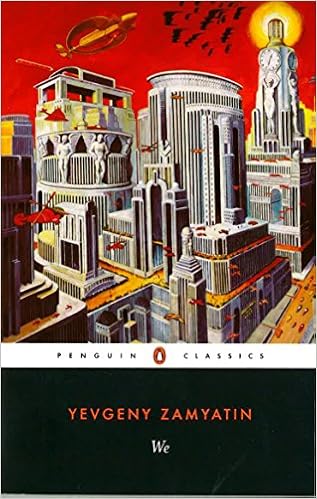
We

We: Yevgeny Zamyatin, Clarence Brown, Clarence Brown ...
We is a classic dystopian science fiction novel by Yevgeny Zamyatin, written in 1920-1921, published in 1924, via English translation in New York. Yevgeny was part of Russian proletariat writing groups and eventually requested to leave Russia as many writers were being persecuted, thus resulting in the death of their writing careers. In fact, when Zamyatin died, there was no mention of him in Russian papers. Most proletariat Russian writers made livings elsewhere like in Paris, England, and the United States. 

The novel depicts a world of harmony within a totalitarian system. There is freedom but only ruled by the Benefactor and activities are ordered along to the 'Table,' a system that controls every hour of everyone's day. In some respects, there wouldn't be a Brave New World by Huxley if it weren't for We. No 1984 by Orwell. No Handmaid's Tale. There wouldn't be all those tons of young adult dystopian novels either. We did it first. 

I will focus on the plot first because it's pertinent to the ideas therein. 

We is set in the future. Probably far future because they have space ships. It's said that there was a great war over something, which is only alluded to in the novel. A resource perhaps. It resulted in the use of weapons of mass destruction, leaving the world outside One State a post-apocalyptic landscape. 


The main character is D-503, a space engineer. People have no names, rather they are identified by number. It takes place in an urban society constructed of glass, which helps for mass surveillance. The people march in step with one another and wear uniforms.  Life is managed scientifically; everybody eats at the same time, works the same time, has recreation hours at the same time, and they even have scheduled times to have sex with partners they can sign up for, rather than of their own choosing. People think with science, logic, and reason above all. The formulas people use are ones devised by the One State, their form of government, lead by the Great Benefactor, their supreme leader.

One State has conquered the whole world. They're now building a spaceship in order to invade and conquer other planets, thus bringing One State across the universe, helping their cause, and increasing their numbers. The ship's project engineer D-503 writes a journal that is meant to be brought along the spaceship when they go to another planet.  

D-503 lives in a glass building like all the others. His partner, O-90 is deemed too short to bear children and is upset by this. His best friend is R-13, a guy who reads his poetry verses at public executions. On an assigned walk, D-503 meets I-330, who flirts with him without being properly assigned. I-330 is a careless free spirit; she drinks alcohol, smokes cigarettes, has casual [not assigned] sex. Every guy has met a girl like I-330, that footloose, and fancy-free girl. In short, she's doing everything that you're not supposed to do in One State. D-503 is appalled but intrigued at the same time. He continues to see her. 

D-503 starts to have a lot of freedom through I-330 and starts to have dreams, which the One State describes as mental illness. "What's wrong with me doc?" "You've found out that you have a soul, for which there is no cure." That's my favorite line in the book because it has that edge of snarky satire as well as philosophical ramifications that goes back to the Greeks. It works well. 

Slowly, I-330 reveals that she's part of an organization called Mephi, which plans to bring down One State. O-90 wants D-503 to illegally impregnate her but in order for her to stay with the baby, she has to leave One State and go beyond the wall, where primitive humans live, complete with coats of fur. 

The last journal entry details the 'Great Operation,' a brain surgery of sorts, that targets the brain with x-rays, so they can function as 'tractors in human form.' It basically makes you more of a vegetable. Removes imagination. Once D-503 gets the operation he runs to the Benefactor to tell him about the Mephi operation. I-330 and her associates are sentenced to death under the Benefactor's machine, which literally melts the human body. A  death ray.

But the novel ends on somewhat of a good note. The Mephi operation is doing well, birds are repopulating the city, and people start acting out against the regime. One State's survival is left in doubt. The book ends with a strong manifesto; just as there is no highest number, there can be no final revolution. 

 Now we get some ideas. 

First, the writing style can, at certain times, be quite a satire. There's one scene early in the book where a woman is playing the piano and people are watching and listening to her play. At one point during the impromptu performance, which is already rare in this society, D-503 starts laughing uncontrollably because music is such an unstructured improvised form that most of the citizens just aren't used to. 

The scene with the doctor is my favorite in the book. "You have a soul. There is no cure." That's a great satirical moment, a great laugh. Of course, it was true, D-503 had indeed, somehow developed a soul through his new girlfriend, I-330. 

The idea of having sex only with assigned partners and only at certain days and times is also a laugh. Did they also forbid masturbation?

There are philosophical ideas at work here too. In fact, the doctor scene isn't just a satire, there's a religious tone to it as well. The idea of the soul separate from the body and mind goes back to Plato and Aristotle. This is used in fiction to good effect. The fact that D-503 developed a soul rather than being born with one is another note on satire. 

The idea of a conformist culture where everybody is happy [for the most part One State is happy] should be considered utopian, right? Well, the thing that makes One State a dystopian novel rather than a utopian one is the fact that One State not only wants to take away freedoms [which is fine because most of the people are cool with that], but One State also wants to get rid of imagination. In We, imagination is the mind-killer rather. If the citizens of One State were allowed to imagine this would be an entirely different novel. 

Lastly, this is one of the important and critical works in science fiction, particularly in the dystopian canon. I initially read this on the recommendation of a Russian friend of mine. I'm glad I read it because it's truly a great story and it stays with you. This isn't something you read and forget about a few months later. It's that important of a book. Considering the way governments are run today you will find that Yevgeny Zamyatin's ideas still ring true to this day. For just as there is no highest number, there can be no final revolution.

Tuesday, December 3, 2019

The Canterbury Tales


2696The Canterbury Tales is a collection of 24 stories running over 17,000 lines written in Middle English by Geoffrey Chaucer between 1387 and 1400. Chaucer was appointed Controller of Customs and Justice of Peace, and in 1389, Clerk of the King's work. It was during this time that Chaucer wrote the Canterbury Tales. He was a court poet that wrote for nobility.

Although Chaucer wrote other works it is Canterbury Tales that is considered his magnum opus. He uses the stories within stories to satirize, and paint a critical and ironical picture of English society of the times. The fact that all the characters in the story are all from a cornucopia of social classes was something fairly new to English literature. Even poorer, more lowly classes could still call out a more noble, character, like a knight, and stop them mid-story, to criticize and tell their own story instead. Because of all the characters here are on a pilgrimage, they are all concerned with everything spiritual. The work itself is considered incomplete especially considering that all the characters didn't get to tell their stories. The work is generally opened to a lot of different interpretations. 

Canterbury Tales is a sort of stories within stories. We have some 30 pilgrims at a tavern. They are all on pilgrimage to St. Thomas Beckett's Shrine. We have our host proclaiming, "Tell your best stories. The one who tells the best story shall have a feast here when we get back and I shall pay for it." Needless to say, everybody from the knight to the parson tells a story. Some are short, some long, some serious, some jokey, some holy, some about love, some about chivalry, some epic like the knight's tale. What's interesting is that other characters interrupt and/or stop some stories by calling them out and criticizing them [regardless of social class or wealth], sometimes thereby starting their own tale.   

I enjoyed the knight's tale the most. It opens the book and gets the reader acquainted with the style of the book. Two cousins, Palamon and Arcite, both knights are in prison and they chance upon a beautiful woman, Emily from their cell windows. They both claim her but they both can't have her. They end up having this epic duel with 100 warriors on both sides. Palamon is wounded by a chance sword thrust from one of Arcite's men, leaving Arcite the victor, but then Arcite is mortally wounded by his horse throwing him off and falling on him, leaving Palamon to marry Emily. The story is epic and intended to be. The next story is an antithesis to this knight's tale of courtly love and chivalry. In the next story, the miller's story, it is about regular people in love and is more lowbrow.

As stories go, none of them are especially terrific or satisfying in my opinion. In fact, I didn't start to thoroughly enjoy the book until at least 150/484 pages. Why? Because I was expecting the stories to be more thrilling. What I found out was that as I read farther on, the stories didn't become particularly more interesting, rather, my thoughts on them changed. I began to find seemingly unimportant yet realistic stories for the medieval time, to be fun. How, why? I'm not even quite sure. Like I said I didn't get into the book until nearly 150 pages in. In fact, I found the constant rhyming going on nonstop to be quite jarring to get used to, especially considering the format is poetic but of an especially non-epic quality. Homer is forgiven for constant rhyme but I wasn't so sure about Chaucer. Consider the fact that most of these archaic works of literature that I've read have been epic, think Aeneid, Odysee, Iliad, Beowulf, Gilgamesh, Divine Comedy, so when you come to Canterbury Tales from all that you just say to yourself, "where's the action?" That was what made Canterbury Tales so hard to get into for me. Eventually, the text speaks for itself and you see how great and important it really is. For me, it took a while to sink in.

It is believed Chaucer got a good deal of his ideas from other literary works. But no other works of literature featured pilgrims telling tales together. In that sense, he's a true visionary. Harold Bloom says the text is mostly original but the idea of the host, a "master of ceremonies" was derived from Dante and Virgil in the Divine Comedy. The Decameron by Giovanni Boccaccio is most similar to the Canterbury Tales than any other work. It features a cast of characters telling stories as they flee from the Black Death. It is believed that Chaucer might have known him.

The tales themselves usually center around a single theme, mostly religious. However, the themes here aren't necessarily all religious or set. They're dependent upon the characters themselves and they don't speak in any sort of hierarchy. The passage of the time, or any traveling what so ever, or even locations along the way, is never mentioned. Rather the stories themselves are all that is spoken of. 

The version I read was a modern English translation, translated by Nevill Coghill. His translation is very smooth, breezy even in the most difficult of circumstances. Considering this is almost a 500-page book, the modern translation reads almost like modern-day. Of course, it really doesn't. What I mean is that it's very smooth as opposed to old medieval English. The words used sometimes can still be complicated and I did still have to look words up online at times. Another thing that must be said about Canterbury Tales is that a lot of the lines rhyme and they are definitely in poetic verse. Sometimes the rhyming gets overwhelming. That's typical for a lot of the 14th-century prose. But overall, for my first Canterbury Tales experience, the Penguin Classics modern translation was very good. I'll try reading it again in the future, but a different translation. I would recommend this book to anyone: students, writers, readers who like the western canon especially. A "do not miss" book.

Friday, October 18, 2019

Black Metal October

I figured I'd write a what's up, vlog-style post, considering I haven't written anything lately. 

The Holidays are here, and as a result, I've been working a lot at the retail gig. I'm doing a lot more daytime shifts, which are pretty tiring. However, a job's a job and everybody has to play his part, as they say. The hard-working proletariat never dies. But sometimes he gets stomped on. But that's subject for another discourse: The Dialectics of the Modern Proletariat, to be continued...

I've been reading nonstop, pretty hardcore actually. I read Colin Greenland's science fiction space opera Take Back Plenty, and then, on the recommendation from a friend I read Robert M. Pirsig's Zen and the Art of Motorcycle Maintenance. In between I read Wittgenstein's The Preliminary for the Philosophical Investigations, which includes his Brown and Blue books, notebooks for his friends and students in philosophy. Quite a stellar reading list if I may say so myself. I haven't written about any of these because in a way I'm still gathering my thoughts on them and in addition, I'm continuing to read so much more every day that it's hard to keep up, to put my thoughts on previous readings on paper, or in this case computer writing format. Now I'm reading Susan Sontag's Against Interpretation and Other Essays. After that, I plan on reading The Outsiders by Colin Wilson. Wow. "Gotta get down to it." 

I've also been chilling with my friends a lot too. We play a lot of Smash Ultimate. I don't really do any solo computer gaming anymore at this point. I've sort of given up on it because I don't get the same level of joy, excitement, or motivation to improve at video games anymore. The thrill is gone. Video games are important only in a superficial instant gratification sense, once you get past that, you realize that there's so much more Quality, gravitas, emotional content in music and literature. I could actually predict a time when video games become uninteresting and kids actually begin to lose interest, and start playing instruments and reading books. A utopian pipedream.

I'm also working more seriously on losing weight. My plan is to eat less. So far its been working. The great thing is that I'm a lot more alert and on the ball when I'm not overfed. It will probably take at least three months to see real results but already I know that I'm a lot quicker to the draw, especially at work. Who knows, maybe I can go from fat Buddha to skinny Buddha in this fashion? To sit under the Bodhi tree and only eating what is required and nothing more.

I haven't been playing as much guitar but I will probably play a bit tonight. I haven't played the keyboard in a while either but again, I'll play a bit tonight. The hardest thing about music is keeping up the practice. There's so many other goals and pursuits, its easy to put it off one day, then two, then three, etc. For me I notice that if I'm not constitently listening to music all the time then I won't practice guitar or keyboard either. Reading in silence becomes my music, and it is not a bad music either! 

I'm going to end with a nod to Halloween. Back in 2017 I wrote a black metal song entitled Spirits of the Dead, with my then current band. Check out the song on YouTube here. Yes, that is me on guitar and vocals LOL. Oh, to be a young metalhead. Also, its notable that I wrote the song on a gloomy rainy morning in Octobert 2017. I played the song at least ten times at open mics with Martin Arevalo, on drums. One time we got a very good lead guitarist to play lead for the song while I did rythmn and vocals, it's a killer recording.

Spirits of the dead!

Tuesday, September 3, 2019

The Tale of Genji

The Tale of Genji (Penguin Classics) The Tale of Genji is a Japanese masterpiece of literature [considered the first novel] from the Heian period, roughly (794-1185). Written by a woman named Murasaki Shikibu. She was born into a minor branch of the Fujiwara clan. Her father was a governor. Men wrote in Chinese. Women wrote and read in Japanese, which led to female writers of Japanese, highborn women. She started writing this novel, which is over a thousand pages after her husband died. Scholars tend to disagree on the writer. Some say it was the work of many authors, as says Royall Tyler, who's translation [only 300 pages] I read. Others say its solely Muraski's work. The actual story itself has a continuity that suggests there is only one writer, her. 

The original manuscript is gone. This brings up the issue of translation. Heian Japanese is so different from modern Japanese. Translating Heian Japanese into English is a daunting task unto itself. However, a literal translation of Genji is impossible. Not only that but each English translation of Genji is so remarkably different. Consider these renderings of the same sentence by different English translators. 

In Chapter 4, titled “Yugao,” Genji comes across a run-down house, the abode of a young woman he is about to seduce. Waley describes the entrance like this: “There was a wattled fence over which some ivy-like creeper spread its cool green leaves, and among the leaves were white flowers with petals half-unfolded like the lips of people smiling at their own thoughts.” Seidensticker: “A pleasantly green vine was climbing a board wall. The white flowers, he thought, had a rather self-satisfied look about them.” Tyler: “A bright green vine, its white flowers smiling to themselves, was clambering merrily over what looked like a board fence.” Washburn: “A pleasant-looking green vine was creeping luxuriantly up a horizontal trellis, which resembled a board fence. White flowers were blooming on the vine, looking extremely self-satisfied and apparently without a care in the world.” [newyorker] 

Each version is so different, yet say the same thing in their own inimitable way. It's remarkable. The act of translating itself is a science. One could write an entire treatise on the art of translating. It would be worth the read. Genji made me realize how important a good translation of a book is. Before that, I was in the dark about it.

What is The Tale of Genji about? A noble and his concubines. It's about the art of seduction. But even simpler I would say it's about relationships. A man and his relationships with women. In this society, the way to a woman's heart was through poems, delivered by a go-between, who was elegantly dressed, and of appropriate social standing.

Courtly lovers didn't see each other face to face often, certainly not naked. Women of the upper class sat behind screens, and sliding doors. Women were protected by screens even when they spoke with males in their own family. A guy could be driven wild if he saw a woman's sleeve spill out or the sound of silk rustling behind the screen.

But people still got it on. Nobles and their ladies were promiscuous. Affairs with court ladies and ladies in waiting were perks of an aristocrat's life. So was adultery sometimes. Genji, when he's still young, has an affair with his father's [the Emperor] mistress. And both father and son lust after a young girl, that Genji adopted as his daughter. 

The requirement of a gentleman was style. You could be forgiven for seducing a man's wife. But you had to know how to write good poetry, have good handwriting, and wear the right perfume. Despite the influence of Buddhism, Heian society was governed by style rather than virtue. Good looks meant everything, virtue be damned. 

The ideal man wasn't too much different from the ideal woman in Heian society: highly perfumed, smooth-skinned, moon-faced, extravagantly dressed. The decadence of the times led to what Genji called a time “where everything seems to be in a state of decline." A state of decadence.

All of this had a strong sense of hierarchy of course. Also, Heian politics was marriage politics.  

Three important takeaways from reading Tyler's translation of Genji. 

First, this book gave me my first real look at Japanese culture that wasn't from anime or movies. I understand Japanese culture and society a lot better than I did in the past, and am grateful for the experience of reading world literature. It opened up my mind to the literature of other cultures [non-western canon], and that is an amazing gift to oneself, and for anyone who cares to discuss the book with me or listen to me explain it.

Second, the idea of translation. Lost in translation is a big possibility here. But the fact that the first novel can be somewhat preserved and rendered into modern readable English from Heian Japanese is fascinating to me. How do they do it? It's like nuclear physics. The translations in English are all vastly different. The book is 1300 pages, and the version I read and bought is only 300 pages. Obviously, Tyler's version is heavily edited, abridged, and he took out many passages, but I still found the book to be thrilling. 

Third, the sense of style. The elegance of this book is vast. You don't need action and fast-paced fiction writing to create a sense of depth. As a writer, this is very liberating to see, read, and experience. In fact, I had to read this book very slowly because each page is annotated, there's more than one poem on every page, and if you don't read the footnotes at the bottom of the page, you don't quite understand the poems. However, when you realize that the poems aren't literal translations, and don't quite mean much to you, the reader, you realize that you should focus on the story itself, rather than trying to find meanings in the poems. Going through that was a tedious yet rewarding experience. 

I plan on going back through Tyler's version again. Because I was so impressed with it, I bought my own used copy. Definitely worth it. Although the book took me almost a week to read, it was a very fruitful experience. At the very least, now I know where Overwatch's Genji got his inspiration. Of course, the real, yet fictional Genji is so much cooler. 

Thursday, May 23, 2019

The Aeneid


The Aeneid is a Latin epic poem written by the Roman poet Virgil between 29 and 19 BC. It tells the story of Aeneas, a Trojan who traveled to Italy and became the ancestor of the Romans. It comprises nearly 10,000 lines dactylic hexameter. The first half of the book tells of the travels he and his fellow Trojans go through. The other half deals with battling the Latins and defeating them.

Aeneas was already known in Greco-Roman legend as he was a character in the Iliad. Virgil took the character and created a compelling national epic that tied Rome to the legends of Troy, explained the Punic Wars, glorified Roman values, and legitimized the Julio-Claudian dynasty as descendants of the founders, heroes, and gods of Rome and Troy.

Virgil begins his poem with a statement of his theme (Arma virumque cano ..., "Of arms and the man I sing ...") and an invocation to the Muse, falling some seven lines after the poem's inception (Musa, mihi causas memora ..., "O Muse, recount to me the causes ..."). He then explains the reason for the principal conflict in the story: the resentment held by the goddess Juno against the Trojan people. This is consistent with her role throughout the Homeric epics. [wiki]

Now onto my actual ideas on this great work of Western literature. For starters, Virgil grew up in a small town and was taken in by the wealthy to study in the great cities of his day. He's regarded as one of Rome's greatest poets, even being popular in the middle ages, where Dante Alighieri uses Virgil the poet/writer as one of the main characters for his Divine Comedy, another great classic of Western literature. He is described as a tall man, very learned but he spoke like a commoner of his day.

I read the Robert Fagles translation from 2006. It's got a strong modernist sensibility without being too easy to read or understand. I also read Fagles' modern translation of the Iliad and the Odyssey and it should be noted that there is a continuity of style and particular words in usage throughout all three works. I recommend this version for a first read. I'm also interested in reading a more literal and/or different translations, as well as these are the kind of books that I'd like to reread in order to understand more about it and enjoy again.

The beginning of the Aeneid is very slow. In that sense its a lot different from the Odyssey, which is fast-paced. There's the sacking of Troy, the Trojan horse, lots of wandering and sailing, Queen Dido, Sicily, Underworld, and lastly, war. However, the events that happen in the Aeneid are so similar to the Odyssey and the Iliad that you could say that the Aeneid is Virgil's take, putting both the Iliad and the Odyssey together in his own story. After all, he used Homer's works as the template for his creativity here.

One of the most compelling moments is when Aeneas falls in love with Queen Dido but ends up leaving her in order to fulfill his destiny, as prophesized by the gods. It's presumed after they get lost together during a hunting expedition that they have sex, which Dido takes as an indication of marriage between them. However, Jupiter sends Mercury [these gods have different names but are roughly equivalent to the Greek gods] to send Aeneas out to sail, to focus on his task. Her heart crushed and thrown in the garbage, Dido commits suicide, stabbing herself upon a pyre with Aeneas' sword. How tragic.

The fighting in this book is intense, full of heroes fighting valiantly. It's not quite as powerful psychologically as the Iliad but that's my take. The speeches taunting the other champions are aplenty but I found it a little flat compared to the epic chest-beating in the Iliad. The actual fighting was more interesting to me especially the female warrior Camilla, a warrior virgin. It's interesting because I've been reading these epics like Beowulf and Homer and none of them have any female warriors in particular. That really stood out to me. Early feminist overtones? It was sad to see her die to treachery.

Also, it should be noted that during the time of this writing Rome was going through a lot of changes with the Fall of the Republic and the Final War of the Roman Republic having torn through society and many people began to think twice about the "Greatness of Rome". But then the new Emperor Augustus Ceaser brought on an era of prosperity and peace through the reintroduction of traditional Roman values, which Virgil highlights with the utmost detail in the Aeneid. The abrupt ending suggests that Virgil died without finishing the work.

This is one of those all time great books that should be a must-read for anyone interested in great literature. The story itself is grand, eloquent, and contains very expressive and beautiful lines and themes. Although the original text was written in Latin, it comes across very well in English to my young modern mind. Sometimes these epics from the early ages come across sort of flat. Not so here in Fagles' translation, where although it isn't a literal translation, he has taken care to update the writing without losing its edge, its expressive quality. This is why I enjoyed reading it [and Fagle's other translations] so much. Yes, its a very long work and lots of lines and words with little spacing, but it's just so good that reading it is a breeze, a pleasure, stimulating intellectually and aesthetically. Take as long as you need because although its a slow-burn, its fantastic.

Check out my Fagle's translation reviews for the Iliad and the Odyssey below
http://ofigueroamusic.blogspot.com/2019/05/the-iliad.html
https://ofigueroamusic.blogspot.com/2019/05/the-odysee.html

Thursday, May 16, 2019

Beowulf


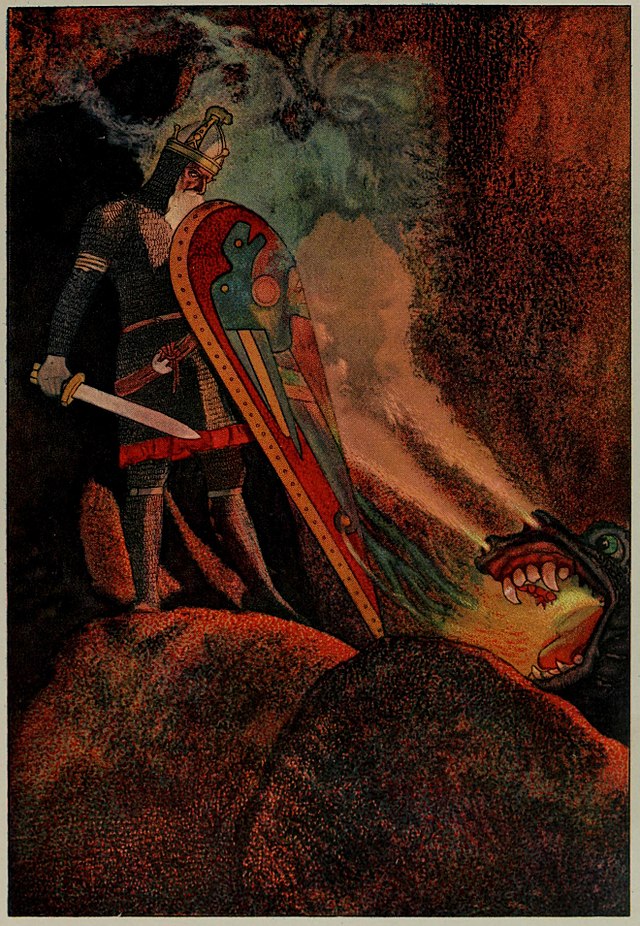
Image result for beowulf classical artBeowulf is a classic of western literature. Dating back to 975-1000 AD, it was written by an anonymous writer. The translation I read had the Old English on the left pages and a modern English translation on the right side of the pages. The work is some 3,000 lines of verse. 

Beowulf is also a Scandinavian epic about a great warrior, who stands up to save people from this monster, Grendel. Grendel rips apart humans and eats them raw and bloody. Beowulf, the brave hero, takes him down, then kills his mother, Grendel's mother seeking revenge. In old age, Beowulf is a King. But a dragon has attacked, so he goes to arms. He kills the dragon with his most trusted soldier but likewise the dragon lands a killing blow on him. The tale ends with Beowulf's grand funeral, cremated with hero's rites. 

The action flows along with the poetic style. When Grendel attacks it's menacing. When Grendel's mother vows revenge, things get psychological. When Beowulf fights the dragon it's the first time he's ever scared. 

The narrative tropes appear in other literature throughout time. The translation is a little bare at times, but there are also lots of archaic sayings at work. Meaning you might have to look up certain words or just read slowly for better comprehension. You have to read this one slow in order to fully understand. Thankfully Beowulf is pretty short. I was able to finish reading it in two sessions. 

I was holding off on reading Beowulf for a long time because I wasn't sure if I would truly be into epics, poetry, mythology. But it turns out that I'm really into it. So far I've read Paradise Lost, Dante's Inferno, the Odyssey, the Iliad, Beowulf, and now I'm currently reading Virgil's Aeneid. This is a big departure from my usual science fiction reading sprees. At first, it took a while to get into all these epics. You get a taste then you're hooked. 

Skyrim anyone? 

Wednesday, March 6, 2019

For Whom the Bell Tolls

ErnestHemmingway ForWhomTheBellTolls.jpg

For Whom the Bell Tolls is a novel that came out in 1940, written by Ernest Hemingway. The story is about a young American named Robert Jordan, who works as a dynamiter on his sabbatical away from college [where he works as a Spanish professor], in a Republican guerilla unit in the Spanish Civil War. His mission is to blow up a bridge. The novel is regarded as one of Hemingway's best works, along with The Sun Also Rises, A Farewell to Arms, and The Old Man and the Sea. [Wiki]

However, the cast of characters that are suppose to be helping Robert Jordan with blowing up the bridge are untrained, unschooled rebels, with their own plans on whats to happen. It takes all of Jordan's skills to get them all to work together. He meets young Maria, who after three days and three nights becomes the love of his life. Pilar is an older woman who mocks Jordan, but ultimately ends up letting Maria end up loving him. Pablo is rebel with bad intentions but in the end pulls through for the team. Anselmo is the star of the novel other than Jordan. Anselmo is this older man who dies blowing up the bridge. 

The literary style here is highly stylized. This is one of the best novels I've ever read. The prose can be very simple. Sentences start off extremely short and simplistic. Later on, as the novel develops, the style gets more complex. Especially with the dialogue of the characters. At some point Hemingway ditches exposition for complete dialogue between the characters. What the characters say is quite simple but how they say it is where things get interesting. The characters speak Spanish and have a very formal and noble way of speaking [they say thou, thee, and thy when speaking]. That is until they start cursing. However, Hemingway never uses a single curse word throughout the novel. Rather, he has the characters saying things like, "I obscenity in the milk of thy mothers". Rather than say fuck, at one point at the end we have these endless sentences where the word muck is used over and over. Also at the end, there are endless sentences that describe the inner mind of Robert Jordan, knowing that he is probably going to die and that the three days and three nights he spent on the mountains with rebels were the best days of his life. This style has been endlessly copied because its so great. 

The novel touches on a couple themes. Death for one thing.  Camaraderie and sacrifice in the face of death is another. Suicide always looms in the backyard as a way out if they get trapped. There's also exploration of political ideology and the nature of bigotry. Divination appears as an alternative in perception. Pilar [Pablo's woman] is a reader of hands and more. She claims to know things that are superstitious. 

The imagery is powerful. The automatic weapon is a strong visual element. Hemingway uses the fear of modern weaponry to destroy the romantic notions of war. Likewise, the fascist planes bombing on the characters is a sign that all is lost. There's also the soil and the earth. Jordan and Maria have sex in a meadow and then afterwards he asks María, "Did thee feel the earth move?", to which she responds affirmatively. Variants of this phrase have become a cultural cliché, often used humorously. [Wiki]

Hemingway has become a symbol of macho male charisma in the literary world. He influenced generations of American writers. He helped create the great American voice in novels. In this novel it shows. The hardness of war is so strong here that I would argue that this novel is very tough-minded, not for the thin-skinned. This is a manly novel. Even the aspect of love is manly, for Jordan knows that his love was just a three day affair. The fact that he knows he is going to die is existential and philosophical. This book is heavy. 

At nearly 500 pages this book is long. However, the prose flows effortlessly because of well written prose and challenging characters. You'll find that the book reads itself in a way.

The book is named after a poem by metaphysical poet John Donne- Meditation XVII. Hemingway quotes a section of the poem at the end of the novel. Here it is below.

No man is an Island, intire of it selfe; every man is a peece of the Continent, a part of the maine; if a Clod bee washed away by the Sea, Europe is the lesse, as well as if a Promontorie were, as well as if a Mannor of thy friends or of thine owne were; any mans death diminishes me, because I am involved in Mankinde; And therefore never send to know for whom the bell tolls; It tolls for thee. 

Thursday, August 30, 2018

Thoughts on Literature

Image result for reading video game character

Hello, what's up? I've been reading a lot lately and finished quite a few as well. Here I'd like to jot down some thoughts, impressions of the readings.


Bertrand Russell A History of Western Philosophy
This is an excellent primer and I recommend it to well, anybody interested in philosophy really. Russell starts with the early civilization, pagans, Plato, Socrates, Aristotle, thru the Christian period, to Renaissance, and 1600s through late 1800s.

What makes this book so great is in fact learning about the great ideas as they've developed through the ages, but its also Russell's writing style. His voice isn't your typical textbook philosophy book. He seems to speak to the reader in a much more personal way, making the 840 page book a lot smoother than it otherwise could've been.


I was interested in reading this because I read Sir Toms More's Utopia and Francis Bacon's New Atlantis. These books came up when I typed in "oldest science fiction novel" on google. From there I read Descartes' Objections and Replies, and I'm reading through Thomas Hobbes' Leviathan as well. Not light reading, but at the same time I read it because I find it fun and interesting.


This book helped put a context for a lot of the things I read. I can understand where the writers are coming from what I learned here. Its a great beginning to philosophy. Of course I still have a lot to learn, and in fact I would like to never stop learning, for it is a fun as well as enlightening endeavor.


The Iliad

I just started reading this epic beginning story of Western Literature. I'm in Book 2 in the translation I'm reading. I find the lines to be quite beautiful, describing every detail in excruciating detail. One of the things I love about the Iliad is that there are some lines that end with exclamation points. With these you always get a sense for the voice of the story, of the characters, plot, and subplot. Madeline Miller's two novel prepared me for these epic poetic legends. I plan on finishing it soon.

Black Music by Amiri Baraka

This book is a collection of essays by Amiri Baraka (Formerly Leroy Jones), a black poet, musician, and writer from beat era. I know a guy that said he used to hang out Baraka when he came to LA. The book is quite fascinating, we see a jazz critical perspective from a black artist himself. What I find great is that Baraka seems to understand the so called new thing, or free jazz when it first appeared. He spoke highly of Ornette Coleman, Cecil Taylor, Eric Dolphy, late period Coltrane, and Don Cherry. He knows whats up musically, artistically. Baraka's writing style is interesting, descriptive, and sometimes captivating when you realize he knows what he's talking about. Worth a read if you love jazz.

Also on my reading list is Dune, Tales From Earthsea, Seduction and Betrayal, Paradise Lost, and Dante's Inferno. A wide range of stuff, some fun, light, serious, classical, and captivating.


As I think back about all the great stuff I've read since spring to pre-fall, all the things I've learned, about words, reading, and writing,  I feel a great sense of wonderment. Reading has really enriched my life, and time seems to be very pleasant when I spend it in this manner. Finding the time to read is difficult for most people, that's why I'm grateful that I can even do all this, lol. Its a good obsession. 

Monday, August 27, 2018

The Song of Achilles


Image result for the song of achilles miller
The Song of Achilles is Madeline Miller's debut novel, released in 2011. It took her ten years to write. The novel is a modern retelling of the Iliad that focuses on Achilles' friendship with his friend Patroclus. Miller was inspired by Homer's story from the Iliad. She wanted to explore who Patroclus was to Achilles, and in this case Patroclus is Achilles' best friend and lover. This idea is quite old as Miller says she stole the idea from Plato. The actual Iliad doesn't explicitly say they are lovers, but its sort of implied. The book won the 17th annual Orange Prize for Fiction. Homer would be proud of  her! 

Before I go in depth here I want to say that this is an amazing novel. After finishing the novel I was riding a high for nearly two days straight. Its only 360 pages but it feels like it was a 1,000 pages, 1,000 grand pages of beautiful prose. It was like falling in love in a way, like how I am with music. I was so into it that I finished it in nearly 4 days, forget the two week library rental. That being said, lets talk about what makes this book great. 

The prose. The fact that Miller worked on the novel for five years, but completely scrapped everything because the narrator's voice wasn't developed well enough shows you the depth of her writing powers. The writing style here is very much a la Homer, like the Iliad. Its a modernized version so its all complete sentences and full thoughts, a little less poetic because of these fully thought out sentences, but it still has a poetic beauty, albeit a modernized one. Like her second novel Circe, The Song of Achilles has a young adult novel feel to it, in the sense that the story is about two boys who grow up together and fall in love. Miller really knows how to describe young people in love, I learned this from Circe as well as this book. If there's one thing I learned from Miller its that one can never underestimate young love, its one of the greatest and most powerful things in the universe. 

The story is told from the first person point of view, from Patroclus' point of view, Achilles' lover and best friend. Patroclus is somewhat of a loser, he was exiled from his Princely happenstance after he killed a boy by accident. He becomes a somebody when Achilles wants him to be forever by his side. In addition, Patroclus becomes a hero in the Trojan War when he kills Serpedon, a son of Zeus, a god. This makes Patroclus a hero in the Trojan War. 

Next, lets talk about the story. So the story is sort of slow until the end, then it builds to a climax and ends on a high note, its fantastic. It begins with Achilles and Patroclus meeting in their youth, they begin a friendship, and then eventually a romantic, sexual relationship. The boys meet each other as young as 10 or 12. They get trained in the art of war as well as other things men should learn by a centaur, that Achilles' mother, a goddess named Thetis, is an associate of. 

From there Achilles gets asked to fight in the Trojan War, to save Helen, the most beautiful woman in the world, "the face that launched a thousand ships." This is where the novel really takes off as something else, not just a loving relationship. Its interesting to note that the war parts of the novel are very graphic and gory. However, the sex scenes here are all polka dots and moonbeams, like softcore porn. Miller is willing to describe men's guts hanging out of their stomachs but won't go near the physicality of gay sex, interesting choice, can't say I blame her. But we as an audience know better than that. 

Inspiration. This book is inspiring to read. There's something about it that sticks with you for a long time. Its only been two days since I finished reading it and not only do I have a great sense of accomplishment from reading it but I also realize that this is something I will remember for a long time because a) its terrific writing b) its a great story and c) its inspirational. 

By inspirational I mean that the novel got me reading the actual Iliad, of which I have two different translations. This book prepared me for the epic poetry of the Iliad, which was indispensable. I have read epic poetry before. I've read the Bible in its entirely about ten years ago. I've read Shakespeare. Now I'm finding myself reading more of that kind of material. The interesting thing to note is that I bought two different copies of the Iliad, a hardcover and a paperback, but I never read any of them until now. Now is the time. This is what I call a great inspiration. 

If a writer can get you to go back and read what is arguably the beginning of Western Literature you know that's a great writer. This is a novel fit for young adults, adults, anyone curious and sophisticated enough to appreciate fine literature.

September Sweater Weather

Good evening ladies and gentlemen, hello world. How are you?  It's good to be writing on a good day off work today on a Saturday. Here, ...