Showing posts with label the aeneid. Show all posts

Wednesday, August 26, 2020

An Odyssey: A Father, a Son, and an Epic


The Patience of Penelope, Pre-Raphaelite Muse | 19th Century ...An Odyssey: A Father, a Son, and an Epic is a terrific book written by classics scholar, philologist, and professor David Mendelsohn. Written in 2017, the novel is part memoir, part scholarly insight into the Odyssey, and has its share of philosophy as well. I would compare this sort of writing to Zen and the Art of Motorcycle Maintenance, except this is much more scholarly and that is much more hippie. However, the classic idea of a novel being a memoir, the idea of how you can travel without really going anywhere by going in circles, and the bonds made in the process is what makes them similar. As the Dead would sing, "What a long strange trip it's been."

Mendelsohn compares the Odyssey to his relationship with his father. And it works. His father is a mathematician who regrets that he never got his Ph.D. or ever read Ovid in Latin like he wanted to. David, the son, and writer is a gay man who always wanted to be close to his father but his father is the typical grumpy dad type that doesn't like to be touched even by the wife sometimes. He's the conventional stiff math guy. Mendelsohn goes into great detail what type of man his father was but its a sore oversight that he doesn't say much about any of his mentors in life or his relationship to a female partner whom he has kids with. Yes, you heard that right, a gay man who has a female partner so he can have kids. Until I read this book I didn't even know that was a thing that gay people did, but apparently, it's not out of the ordinary. So yes, although it is great that Mendelsohn can describe his father, mother, and uncle with great detail and we get a sense of who they were, he doesn't really describe himself or any of his mentors much. Which makes the book lesser.

However, despite that, what makes this book truly remarkable is the scholarly aspects and the form, the way it is written; before, after, and future can happen all at once like in the Odyssey. It goes without saying that if you read this book you will know more about the Odyssey, the Iliad, and the Aeneid than everyone you come across. Heck, Mendelsohn even goes into the elements of the Greek language, which is downright informative and good to know even if I could never use or apply it.

Mendelsohn teaches a university course to freshman about the Odyssey, and his father ends up taking the course. Using the class, his father, and his students as a way to explain the many ways you can, should, and should not interpret the Odyssey, Mendelsohn does a fantastic job not only of describing the experience in his book but making it fun, digestible, and easy to understand. The scholarly elements of this book are like gold, the insight I got from Mendelsohn's explanations on every part of the Odyssey not only strengthens my love for classics and the Western Canon, but also makes me smarter, so that when I reread the Iliad, Odyssey, and Aeneid, I will read them with a much more sophisticated outlook, one that takes into account how to interpret its many lines, chapters, and books. One of the things Mendelsohn stresses to his students is that you can't just make up interpretations, rather, he has been taught how to look at the Greek classics in a specific way, the way his teachers taught him. In a way, this is limiting to the students, meaning they have to listen and accept everything he says, but on the other hand, I can see things through the more traditional route as well. His father is always there in class to stand up to him and disagree at times.

For an example of some scholarly things I learned, one of them is the idea of the proem, or the beginning of the epic poem. This establishes the entire epic poem in the first couple lines and is so important to the interpretation that you can't understand it without understanding and analyzing the proem first. The last lines are equally important to the interpretation as well. Then there's the famous Homeric Question: Was he a real person? Most scholars believe that there might have been a real Homer but that if he did exist, he did not know how to read or write, thus the idea of traveling poets and bards comes up. Poets and bards who memorize some 15k lines of epic poetry and know it so well that they can improvise new lines and variations upon it while telling the same story. It's history.

Lastly, one of the best elements of the book is that it's an odyssey itself. By talking about and interpreting the odyssey, Mendelsohn takes us on one. And like the Odyssey, the end has to do with a strong bond between father and son. Mendelsohn relates how at the end of the Odyssey, it is the reveal from Odysseus to his father that he's still alive and well, that is truly heartwarming and brings about the final end, the slaughter of Penelope's suitors, who have tried to force Penelope to marry them, taken over the palace, seduced the maids, and eaten all the food.

This is one hellova book. I recommend it to anyone who's read the Iliad, the Odyssey, and the Aeneid. It will give you more than enough new information to last a lifetime. Not only is it valuable for its scholarly and philosophical insight, but its also a decent memoir, and shows that you can write a book that has many styles in one; memoir, scholarly insight, and philosophy, using time in any which way you choose. Recommended to anyone who likes memoirs, the classics, or wants to learn more about the classics. 

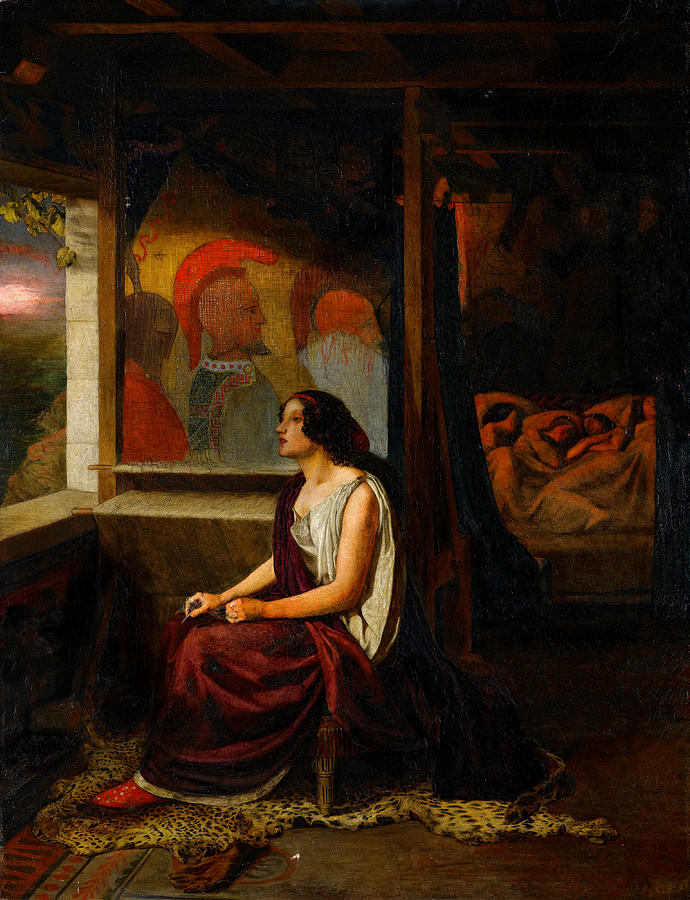
The painting above is called The Patience of Penelope, who waited 20 years for Odysseus to come home.

Monday, August 24, 2020

Politics, Retail, An Odyssey


Penelope - The Odyssey Painting by Thomas SeddonHello everybody. Trying to get back into the groove of continuously writing even without a proper subject. It's a bit like Seinfeld. It's a show about nothing. Of course, I like to think what I say here is very important in terms of letting the public know what life is like working retail during COVID, as well as providing interesting, informative, and entertaining posts about well, just about anything ranging from books, movies, music, shows, to actual real life.

The summer heat has been a true heat death of the universe. The kind of heat that burns away a planet in a 1960s science fiction novel. Yeah, it's that bad! But Fall is upon us, and my birthday will come up at the end of September, my favorite month. Mostly because its nice and cool in California during that time. 

I had an awkward Lyft ride to work today. This tall blonde white guy, who was the driver, went on and on about how the coronavirus is all a scam, and that the Democrats are using it to control the masses, while they try to turn the country into a socialist state. Of course, I've heard all this drivel before and have to say that most Republicans who believe this type of conspiracies are amongst the most stupid people I've ever encountered, even stupider than peasants who don't know English. At least peasants have enough honor and smarts to know that's not what's happening. 

So what's his problem? He's white, so he's privileged. The fact that he's driving Lyft means he didn't get to where he wanted to in life, so he takes it out on other people, in this case, Democrats, and you betcha, anybody who's brown. Mindless stupidity. It could be mind-boggling, but it's best to call a pig a pig, an idiot an idiot. Of course, I didn't tell him off, there was hardly any time to discuss politics but the fact that he spewed all that so quickly shows how loyal he is to Trump, the Trump Swamp Republican Party [that sorely needs to be drained], and the fuck you, I got mine mentality of older white Republican men. It truly was a spectacle. Which leads me to say that I'm really tired of the Republican rhetoric being spewed by the masses right now. At best its a joke, albeit not a funny one. At worst, it's the destruction of American democracy, integrity, and human decency. I'm not even a real Democrat but I know right from wrong. So yeah, that was a fucked way to start my workday. 

Work has been stressful. Despite the raging pandemic, my store will be going back to normal hours starting tomorrow; 5am to 1am, every day except for certain holidays. The employees are all exhausted. The customers have become much more irate and have forgotten how to treat retail workers with respect. At the beginning of COVID retail workers were like gods, like nurses, the essential workers. At this current juncture, it seems most of the customers don't give a shit about the fact that retail workers are possibly exposing their bodies to COVID every single day. There's no real good way to deal with it; you go in, do your work, and go home. At some point, you realize that the people are what they are; essentially gray blobs but there's always a few good ones. About 90% of the customers that come in treat you like human garbage. And then there's about 10% that treat you really great. It's a low bar over there. At some point, you have to learn to let go of all of your emotions and "not give a shit," because otherwise, the overwhelming amount of disrespect will most certainly cramp your style. The 'lose your emotion,' route is where most of my coworkers go. I can't say I blame them. Like the customers, none of us employees are perfect, but of course, some are better than others, have better personalities, and have better talents for working with people and whatnot. At the end of the day, a job is a job and if we didn't do it somebody else would.

Lastly, in more enlightening news, I took a break from Don Quixote and started reading An Odyssey. It's part memoir, part scholarly classics and philosophy. This classics professor named David Mendelsohn wrote the book. He goes into great detail explaining the Iliad, the Odyssey, and the Aeneid but focuses primarily on the Odyssey throughout. He relates the journey in the story to his own life, particularly his relationship with his father. Here's the thing though; he is a gay man who has a female partner that he had kids with, and his father is a grumpy sort of fellow, a stiff mathematician that never showed his family much affection except for certain key moments in their lives. I'm in the middle of the book now and plan to finish it soon. 

One of the big points of the book is that if you're going in circles all the time you will always be traveling but never get to your destination. That's what life is like right now under quarantine. It's neverending. Infinite. Kind of like how the first half of the Odyssey feels a lot longer than the second half.  

The fact that Mendelsohn chooses to focus on his conventional father and his relationship to him rather than his own relationship to his own children, or even to other male friends, or even female friends like his partner is a sore oversight on the writer. However, his insight into the classics is downright remarkable, and if you read this book, you will have a better understanding of the classics, and be able to appreciate them more in a scholarly and emotive way. It's downright terrific. Not only that, but the writing style is personable. It's a lot like Zen and the Art of Motorcycle Maintenance, a flowing easy to read style that establishes a strong father-son relationship but requires the reader to think thoroughly about what is being read. Insight and enlightenment ensue. I definitely recommend this book to anyone who's into the classics or wants to get into the classics. If you ever read the Iliad, the Odyssey, and the Aeneid, reading this will make you appreciate those books a lot more. And then you'll go back and reread them with a lot more wisdom and insight.    

Keep on keepin' on, as they say. As the Dead sing, "What a long, strange trip it's been."

Thursday, May 23, 2019

The Aeneid


The Aeneid is a Latin epic poem written by the Roman poet Virgil between 29 and 19 BC. It tells the story of Aeneas, a Trojan who traveled to Italy and became the ancestor of the Romans. It comprises nearly 10,000 lines dactylic hexameter. The first half of the book tells of the travels he and his fellow Trojans go through. The other half deals with battling the Latins and defeating them.

Aeneas was already known in Greco-Roman legend as he was a character in the Iliad. Virgil took the character and created a compelling national epic that tied Rome to the legends of Troy, explained the Punic Wars, glorified Roman values, and legitimized the Julio-Claudian dynasty as descendants of the founders, heroes, and gods of Rome and Troy.

Virgil begins his poem with a statement of his theme (Arma virumque cano ..., "Of arms and the man I sing ...") and an invocation to the Muse, falling some seven lines after the poem's inception (Musa, mihi causas memora ..., "O Muse, recount to me the causes ..."). He then explains the reason for the principal conflict in the story: the resentment held by the goddess Juno against the Trojan people. This is consistent with her role throughout the Homeric epics. [wiki]

Now onto my actual ideas on this great work of Western literature. For starters, Virgil grew up in a small town and was taken in by the wealthy to study in the great cities of his day. He's regarded as one of Rome's greatest poets, even being popular in the middle ages, where Dante Alighieri uses Virgil the poet/writer as one of the main characters for his Divine Comedy, another great classic of Western literature. He is described as a tall man, very learned but he spoke like a commoner of his day.

I read the Robert Fagles translation from 2006. It's got a strong modernist sensibility without being too easy to read or understand. I also read Fagles' modern translation of the Iliad and the Odyssey and it should be noted that there is a continuity of style and particular words in usage throughout all three works. I recommend this version for a first read. I'm also interested in reading a more literal and/or different translations, as well as these are the kind of books that I'd like to reread in order to understand more about it and enjoy again.

The beginning of the Aeneid is very slow. In that sense its a lot different from the Odyssey, which is fast-paced. There's the sacking of Troy, the Trojan horse, lots of wandering and sailing, Queen Dido, Sicily, Underworld, and lastly, war. However, the events that happen in the Aeneid are so similar to the Odyssey and the Iliad that you could say that the Aeneid is Virgil's take, putting both the Iliad and the Odyssey together in his own story. After all, he used Homer's works as the template for his creativity here.

One of the most compelling moments is when Aeneas falls in love with Queen Dido but ends up leaving her in order to fulfill his destiny, as prophesized by the gods. It's presumed after they get lost together during a hunting expedition that they have sex, which Dido takes as an indication of marriage between them. However, Jupiter sends Mercury [these gods have different names but are roughly equivalent to the Greek gods] to send Aeneas out to sail, to focus on his task. Her heart crushed and thrown in the garbage, Dido commits suicide, stabbing herself upon a pyre with Aeneas' sword. How tragic.

The fighting in this book is intense, full of heroes fighting valiantly. It's not quite as powerful psychologically as the Iliad but that's my take. The speeches taunting the other champions are aplenty but I found it a little flat compared to the epic chest-beating in the Iliad. The actual fighting was more interesting to me especially the female warrior Camilla, a warrior virgin. It's interesting because I've been reading these epics like Beowulf and Homer and none of them have any female warriors in particular. That really stood out to me. Early feminist overtones? It was sad to see her die to treachery.

Also, it should be noted that during the time of this writing Rome was going through a lot of changes with the Fall of the Republic and the Final War of the Roman Republic having torn through society and many people began to think twice about the "Greatness of Rome". But then the new Emperor Augustus Ceaser brought on an era of prosperity and peace through the reintroduction of traditional Roman values, which Virgil highlights with the utmost detail in the Aeneid. The abrupt ending suggests that Virgil died without finishing the work.

This is one of those all time great books that should be a must-read for anyone interested in great literature. The story itself is grand, eloquent, and contains very expressive and beautiful lines and themes. Although the original text was written in Latin, it comes across very well in English to my young modern mind. Sometimes these epics from the early ages come across sort of flat. Not so here in Fagles' translation, where although it isn't a literal translation, he has taken care to update the writing without losing its edge, its expressive quality. This is why I enjoyed reading it [and Fagle's other translations] so much. Yes, its a very long work and lots of lines and words with little spacing, but it's just so good that reading it is a breeze, a pleasure, stimulating intellectually and aesthetically. Take as long as you need because although its a slow-burn, its fantastic.

Check out my Fagle's translation reviews for the Iliad and the Odyssey below
http://ofigueroamusic.blogspot.com/2019/05/the-iliad.html
https://ofigueroamusic.blogspot.com/2019/05/the-odysee.html

September Sweater Weather

Good evening ladies and gentlemen, hello world. How are you?  It's good to be writing on a good day off work today on a Saturday. Here, ...