Showing posts with label medieval. Show all posts

Sunday, April 4, 2021

The Decameron

What can I say about Boccaccio's Decameron? Well, for starters, its the best dirtiest book in the western canon. A group of noble young women and three men decide to travel and tell tales for ten nights, amongst the ten of them, telling ten tales, thus equaling 100 tales. There's some significance to the number ten as relating to the Greeks, which is where the Decameron name comes from.  It provides a document of life at the time. Written in the vernacular of the Florentine language, it is considered a masterpiece of classical early Italian prose.


Not every story here is a ten out of ten. In fact, every night perhaps three out of the ten tales that they tell aren't that great. But those other seven in fact have everything you would want in a story, book, or novel; adventure, picaresque, nobles, kings, queens, lords, peasants, farmers, thieves, murderers, a threesome even.

There's sex, lots and lots of sex. But the sex isn't described in a saucy or offensive way, rather it's more interesting albeit still provocative such as "the resurrection of the flesh," "they made the nightingale sing many times," phrases such as that. 

One of my favorite stories was the one where a young girl goes through a series of unfortunate events and finds herself getting fucked by nine different men over a short period of time. At the end of her misery she marries a King, who believes she is a virgin, and she fakes how good the sex is making it seem as if she really is a virgin. It was comical yet still realistic, showcasing something within the human condition. 

What is so fascinating about this book is that the stories are mostly about everyday people; nobles, lords, and peasants, there are lots of common ordinary peasants in the Decameron, and it seems that Bocaccio has a lot to say about them, the way the live, their wants and desires, which always somehow come back to lots and lots of sex. 

Most of the stories have an ABCD format. Something begins, then three things happen, and then the story is over. Some of the stories are only a page or two long, others are more complex. Although the stories are pretty simple, there's always something unexpected here and there to bring the stories to a climax. Usually in the form of actions and/or dialogue. 

Women take on a very important role here although they end up being the butt of a lot of the jokes. However, there are many stories where the wife commits adultery, right under the husband's nose and gets away with it, the wife being the better for it in the end even in terms of the morality of some of these stories. Consequently, you could see why in terms of morality, this book was condemned by the church and religious peoples. 

Boccaccio uses actions and dialogue to move the stories along. One of the finer details to note is that the language the people use is the common tongue and language of the people of the times, making the Decameron something noteworthy as a historical literary work in addition to being the best dirtiest book in the western canon. 

Again, some of the stories don't really go anywhere or are just for giggles, and that's okay. This book is a must read for readers of the western canon, medieval literature, and Italian literature. I was so inspired by Italy with Boccaccio that I've started reading Purgatorio of Dante's Divine Comedy. Before now, I've only read the Inferno. 

A must read for the western canon crowd or those interested in historical literature from the 13th century. 

Tuesday, December 3, 2019

The Canterbury Tales


2696The Canterbury Tales is a collection of 24 stories running over 17,000 lines written in Middle English by Geoffrey Chaucer between 1387 and 1400. Chaucer was appointed Controller of Customs and Justice of Peace, and in 1389, Clerk of the King's work. It was during this time that Chaucer wrote the Canterbury Tales. He was a court poet that wrote for nobility.

Although Chaucer wrote other works it is Canterbury Tales that is considered his magnum opus. He uses the stories within stories to satirize, and paint a critical and ironical picture of English society of the times. The fact that all the characters in the story are all from a cornucopia of social classes was something fairly new to English literature. Even poorer, more lowly classes could still call out a more noble, character, like a knight, and stop them mid-story, to criticize and tell their own story instead. Because of all the characters here are on a pilgrimage, they are all concerned with everything spiritual. The work itself is considered incomplete especially considering that all the characters didn't get to tell their stories. The work is generally opened to a lot of different interpretations. 

Canterbury Tales is a sort of stories within stories. We have some 30 pilgrims at a tavern. They are all on pilgrimage to St. Thomas Beckett's Shrine. We have our host proclaiming, "Tell your best stories. The one who tells the best story shall have a feast here when we get back and I shall pay for it." Needless to say, everybody from the knight to the parson tells a story. Some are short, some long, some serious, some jokey, some holy, some about love, some about chivalry, some epic like the knight's tale. What's interesting is that other characters interrupt and/or stop some stories by calling them out and criticizing them [regardless of social class or wealth], sometimes thereby starting their own tale.   

I enjoyed the knight's tale the most. It opens the book and gets the reader acquainted with the style of the book. Two cousins, Palamon and Arcite, both knights are in prison and they chance upon a beautiful woman, Emily from their cell windows. They both claim her but they both can't have her. They end up having this epic duel with 100 warriors on both sides. Palamon is wounded by a chance sword thrust from one of Arcite's men, leaving Arcite the victor, but then Arcite is mortally wounded by his horse throwing him off and falling on him, leaving Palamon to marry Emily. The story is epic and intended to be. The next story is an antithesis to this knight's tale of courtly love and chivalry. In the next story, the miller's story, it is about regular people in love and is more lowbrow.

As stories go, none of them are especially terrific or satisfying in my opinion. In fact, I didn't start to thoroughly enjoy the book until at least 150/484 pages. Why? Because I was expecting the stories to be more thrilling. What I found out was that as I read farther on, the stories didn't become particularly more interesting, rather, my thoughts on them changed. I began to find seemingly unimportant yet realistic stories for the medieval time, to be fun. How, why? I'm not even quite sure. Like I said I didn't get into the book until nearly 150 pages in. In fact, I found the constant rhyming going on nonstop to be quite jarring to get used to, especially considering the format is poetic but of an especially non-epic quality. Homer is forgiven for constant rhyme but I wasn't so sure about Chaucer. Consider the fact that most of these archaic works of literature that I've read have been epic, think Aeneid, Odysee, Iliad, Beowulf, Gilgamesh, Divine Comedy, so when you come to Canterbury Tales from all that you just say to yourself, "where's the action?" That was what made Canterbury Tales so hard to get into for me. Eventually, the text speaks for itself and you see how great and important it really is. For me, it took a while to sink in.

It is believed Chaucer got a good deal of his ideas from other literary works. But no other works of literature featured pilgrims telling tales together. In that sense, he's a true visionary. Harold Bloom says the text is mostly original but the idea of the host, a "master of ceremonies" was derived from Dante and Virgil in the Divine Comedy. The Decameron by Giovanni Boccaccio is most similar to the Canterbury Tales than any other work. It features a cast of characters telling stories as they flee from the Black Death. It is believed that Chaucer might have known him.

The tales themselves usually center around a single theme, mostly religious. However, the themes here aren't necessarily all religious or set. They're dependent upon the characters themselves and they don't speak in any sort of hierarchy. The passage of the time, or any traveling what so ever, or even locations along the way, is never mentioned. Rather the stories themselves are all that is spoken of. 

The version I read was a modern English translation, translated by Nevill Coghill. His translation is very smooth, breezy even in the most difficult of circumstances. Considering this is almost a 500-page book, the modern translation reads almost like modern-day. Of course, it really doesn't. What I mean is that it's very smooth as opposed to old medieval English. The words used sometimes can still be complicated and I did still have to look words up online at times. Another thing that must be said about Canterbury Tales is that a lot of the lines rhyme and they are definitely in poetic verse. Sometimes the rhyming gets overwhelming. That's typical for a lot of the 14th-century prose. But overall, for my first Canterbury Tales experience, the Penguin Classics modern translation was very good. I'll try reading it again in the future, but a different translation. I would recommend this book to anyone: students, writers, readers who like the western canon especially. A "do not miss" book.

Thursday, September 19, 2019

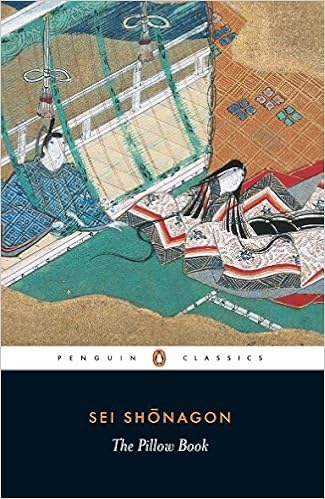
The Pillow Book

Image result for the pillow book mckinney In spring, the dawn — when the slowly paling mountain rim is tinged with red, and wisps of faintly crimson-purple cloud float in the sky.

The Pillow Book is a work of medieval Japanese literature from the Heian period, roughly 800-1200. Written by Sei Shonagon, a woman in the lower level court that served Empress Consort Teishi (定子). This isn't so much of a book per se, and definitely not a novel in the traditional sense, never mind the fact that the idea of a traditional novel didn't exist back then. However, her contemporary was Murasaki Shikibu, author of the famous Tale of Genji, a contemporary, woman serving in the court. Both of these works are studied in Japanese high school to this day. In fact, when Japanese study classical Japanese, it is the Heian period that they go to. 

The book is full of essays, lists, anecdotes, and personal thoughts. When I first started reading it I thought it was all over the place, and it really is. The Pillow Book reads like a conversation from Heian Japan. You get a sense of the character of Sei Shonagon, which is what Meredith McKinney focused on. She wanted to get the voice of the character done in a certain way, that is relatable some thousand years later. Did she get it right? I would say yes. Reading this book is somewhat of personal experience. I found myself smiling at things that were funny and likable, and likewise demurred when Sei said mean girl things. You feel like you are getting to know Sei and how she lives in Heian Japan, ultimately alien, foreign soil for me. Because of that, it is a true work of art, literature. 

In the McKinney translation, Sei comes across as personable but somewhat thorny. Basically, she isn't perfect. There's a mean girls vibe to some of the statements she makes but it doesn't dominate the text. But when you see it you do take notice. Were women really like that back then in Japan? Women are like that today! It's funny in a way how natural Sei comes across in the McKinney translation. Rather than translate the language in a dramatically different way, McKinney decided to change the voice of the character herself in her own inimitable way, that is personable, relatable. It's like listening to a Heian period woman, talks about her life, like a diary but better, much better because she comes across as likable and engaging rather than boring and nonstop. 

My favorite element of the Pillow Book is the anecdotes and stories. Stories of men who are clumsy with poetry, or retreat into hiding if they've walked in a woman's room. What festivals were like as the season changed. What it was like serving an Empress, whom you greatly loved and admired, despite you being of lesser rank, and never having the chance to be like her.  

If I were to compare the Tale of Genji [review here] to the Pillow Book, I would say the Pillow Book is breezy and personable, and that the Tale of Genji is more elusive and poetic. Both great works, vastly different. Sei has a way of explaining her world like a diary, that is in invaluable in respect to Japanese history. In short, its something of a masterpiece. 

"In autumn, the evening — the blazing sun has sunk very close to the mountain rim, and now even the crows, in threes and fours or twos and threes, hurrying to their roost, are a moving sight. Still more enchanting is the sight of a string of wild geese in the distant sky, very tiny. And oh how inexpressible, when the sun has sunk, to hear in the growing darkness the wind, and the song of autumn insects."

Wednesday, August 28, 2019

A Distant Mirror


Image result for a distant mirror book cover A Distant Mirror by historian Barbara W. Tuchman is one of the most captivating books I've ever read. The work encapsulates the history of the 14th century Europe in thrilling six-hundred pages. Have you ever wondered what life was like in the middle ages? This book is the perfect resource for that. This is the best nonfiction book I've ever read. It does have story elements within, however, they are rather limited. 

The book is loosely based around one man's life. Enguerrand De Coucy. He was a French noble that had a double allegiance, to England and his native France. He was the shining example of nobility, chivalry, and grace. He led war campaigns against England and led knights into battle in crusades as well. He helped unite England and France at key moments in the war. In the end, he got captured on a crusade and the Moslems imprisoned him. He died.

What was more fascinating than the life, goals, and happenings of Engerrand was the sheer alienness of this world, this so-called medieval Europe. What inspired me to read this book was the recommendation from my father. He said, "saying since you love science fiction so much, you should read this book. This world described therein is so foreign to you, that it will be like reading science fiction." He couldn't be any more correct. 

It's hard to believe that the middle ages even happened in some respects. Of course, it did, because we have literature, art, music [sheet music], and architecture to prove it. However, what I mean is that the world was so different back then, that it's hard to reconcile this universe in a modern perspective, which is what Tuchman does here. Spectacularly.  

The book covers the black plague [pestilence carried by rats, dung, and uncleanliness], the consanguinity of the papal order, the papal schism [which brought the Protestant Reformation some 100 years later-but it started here], knighthood, chivalry, philosophy of the time as well as art, literature, food, debauchery, flagellants, sexual deviancy, anti-semitism, as well as the gory bloody details that existed in the age; what life was like for the king, the noble, the knight, the squire, the peasant, the laborer, the noblewoman, the peasant woman, the priest, the pope, the aristocrat, the merchant, the sailor, the writer, the poet, the artiste, the architect. A Distant Mirror pretty much covers everything you would ever want to know about the middle ages. 

Some fun facts. The first sheet music was published in 1473. Contrary to popular belief the black plague did not only affect Europe, thus killing off 1/3 of the population. I learned from this book that the black plague affected India, Africa, and China. It was actually all over the world, not just in Europe. Chivalry was idealized in immortal knighthood but was hardly if ever utilized in practice. People lived long lives [living into their 70s sometimes], however, because of the brutal nature of the times [war, famine, pestilence], they often died at a younger age. People became senile faster too. Thus girls were married off at younger ages and bore children earlier, sometimes resulting in their deaths due to the nature of childbirth and the primitive methods of doing so. Kings and nobles were in a constant state of war, even with French on French assassinations, and likewise English on English murder. Kings and nobles kept power within families, making alliances with other countries by marrying off their daughters to royalty. 

The details of the war are remarkable. "To be a knight was to be a terrible worm in an iron cocoon." That's one of my favorite lines in the book. I had such a different view on knights in my mind. But the truth of the matter was that their iron armor was often so heavy that they could hardly move or attack very fast in it. They had to supported by archers wearing little armor for mobility and peasant foot soldier militia to win battles. They certainly couldn't swim in water if they had to. Terrible worm in an iron cocoon indeed. 

Overall, this is a remarkable work of history. In fact, I was so impressed with this book that I bought my own copy used from Amazon. Lucky for me, this book is very old so it was pretty cheap. In time I will look back to it. I read and finished the book in three weeks but during those three weeks, I didn't play any video games or waste my time in frivolous activity. Rather I went to the library and Starbucks and savored each and every word. This book is a masterpiece. You should definitely check it out. Reading the entire thing is a daunting task but once you finish you see the beauty in history. Bring on the Japanese feudal war era next.

Wednesday, March 13, 2019

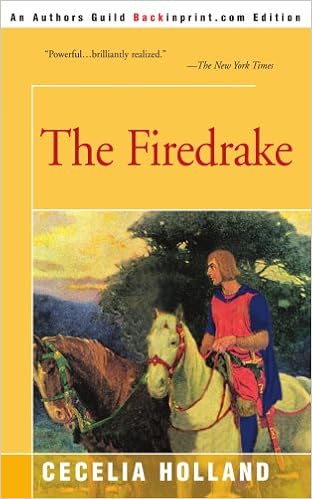
The Firedrake


Image result for the firedrake cecelia hollandThe Firedrake is the debut novel written by historical fiction writer Cecelia Holland, published in 1966, during the height of the flower power movement. I found out about Holland through my stepfather, who recommended that I read her feminist space opera Floating Worlds, which was such an amazing novel that I had to have a copy, nevermind the library's copy. Now its one of my favorite books on my shelf. I plan on going back and rereading it sometime soon. Firedrake is such a rare book because its a debut novel and its from the 60s. There are physical copies going for as much as fifty dollars on Amazon. Talk about expensive. 

Anyways, what made Floating Worlds so great was Holland's style, her voice as a writer. I was extremely happy to see that her writing style was very similar. Short, choppy sentences. You never see the inner mind or psychology of the characters. The story moves by plot and action. Things are always happeneing, even when nothing is happening. The time you spend away from the book leaves you in suspense. This is what makes Holland a great writer. 

Firedrake follows an Irish knight in the year 1006. Named Laeghair, Laeghair from Traelee, Laeghair of the Long Road, he makes his way as a ronin [wanderer] into a commander of William the Conquerer's Army. The novel ends at the Battle of Hastings, where William takes England. Laeghair is very sour, a real asshole. He's a beserker knight that fights like a devil. He kills a guy just because he insulted him in front of the other knights. He's a leader of an army. He buys a woman he sees getting beat up. Hilde bears him a son and two still born children but at the end of the novel he leaves her when she's pregnant yet again, saying, "Leave me alone." He never married her nor did he love her. Yet there were times when he was happy with her. Having that as the ending had me thinking of Laeghaire as a real piece of work. After pillaging a town, he has his way with a woman. She doesn't cry out but its still considered a rape. This guy is bad news. 

What's interesting is William the Conquerer's personality. Is it based on real historical fact? The man seems to be an enigma in the novel. Laeghair pleases William very much, and in fact Laeghair saves William's life at the Battle of Hastings. Not only that, but William finds delight in Laeghair's snotty attitude towards everyone. They would make great friends if one were not subordinate to the other. The historical aspects of this novel were so foreign to me that it was almost like reading a science fiction novel. I couldn't relate to anything here, instead I had to use my imagination and try to imagine a world where people fight with swords, axes, ride horses, drink beer and wine everyday, and women aren't healthy enough to give birth to healthy children, resulting in a lot of still born deaths. 

The physical combat here is brutal. But not gruesome. It reminded me of the Illiad in the way the combat is described. Sort of. But Holland has her own unique way of action as well. Because of her short and choppy style, the action moves along very fast. Like a real fight. It leaves you wanting more and more combat but then the battle is over and something new occurs. 

Lastly, this is a remarkable debut novel. Holland got me into historical fiction from Floating Worlds and now Firedrake. I have in my possession two of her other historical fiction novels, Jerusalem and The Angel and the Sword. I never thought I would be into historical fiction but here I am. I'm reading new genres other than science fiction, classics, and philosophy. Always good to explore new territory. Especially if the writing is so damn good.

Holland wrote this when she was only 22, still studying at college, probably to get her Masters. I don't think she had any grand goals or ideas when she wrote this novel. I don't think the story needed anything grand or idealistic, it works as historical fiction work on its own without any gimmicks. This is a simple, plain novel. No fancy bells or whistles. Just plain old good writing. Highly recommended if you like history, fiction, medevial history in particular.

Check out my review for Ceceila Holland's science fiction epic, Floating Worlds- http://ofigueroamusic.blogspot.com/2019/02/floating-worlds.htm

Sunday, December 24, 2017

Christmas in the Modern Dark Ages


Its two hours from Christmas. I got off work at nine. It was a bit of a downer at work but otherwise another successful (and unfulfilling day). Another day at the office. Sitting down and thinking about Christmas, many thoughts go through my mind. This is a Christmas unlike any other. A medieval Christmas, a Christmas ripe for the modern dark ages. Let me explain.

Sure, life is okay and the economy isn't in a complete recession. You might even have a great job, security, a home, friends, family, and food. But sitting down this year during the holidays I can't help but feel a sort of modern holiday dystopian feeling. Its a gut feeling, brooding within the mind. Donald Trump is President and things haven't improved although many Republicans will tell you the economy is great and that unemployment is down. Even if that was true they haven't made my life better. What has Trump done for me? Nothing great.

Part of this feeling comes from the loss of my step-mother, who loved Christmas and always went all out for gifts. Then there's the age difference. I'm now twenty-eight years old and Christmas just doesn't do it for me anymore. The gifts are still significant, they show that people care for me. However, my circumstance of being 'po' (as black people say) has made me much more disillusioned. In fact, I wasn't able to get everything I wanted for my friends and loved ones this year because I didn't have enough money. And I didn't have enough money because they didn't want to give me more hours at the office. Tough break. Better luck next year kid.

The government, your jobs, big pharma, and businesses want us to spend a lot of money this year but how can one find happiness in buying gifts for others when the state of the country (city, state, continent, world, universe) is in such disarray? You could say, "Look man, you need to lighten up. Its just a holiday." But the thing is that this 'holiday' has a bleak future, that is if we are to keep promoting gifts instead of investing in better lives for the people.

As I sit back and wait for Christmas I think about all the people who have nothing, the have nots, the Untouchables, the Undesirables, the sick, the disabled, the poor, the homeless, the mentally ill, and I say to myself, "What does this holiday mean for them?"

The best gift for me this Christmas would be a resignation from Donald Trump. Or people 'smartening' up and running for government themselves. That's the only way to fix this political malfeasance. I'm hopeful in the next generation of politicians, priests, CEO's, writers, poets, musicians, computer programmers, and business owners.

After all, if there's one gift I'm giving to myself this Christmas, its hope. 

Monday, December 18, 2017

Eifelheim


Eifelheim is a book written by Michael Flynn that came out back in 2006. Flynn is a notable third wave science fiction writer that's won some prestigious awards. This book is ancient by today's memelord society (because it came out in 2006). Its a science fiction novel about aliens that visit human civilization in medieval Germany (1340s AD). Meanwhile, in the future these physicists are trying to decipher what happened to the town because it seemed the town of Eifelheim just disappeared right off the map. Its an interesting idea and noteworthy because of how prolix the writing is.

The writing in this book is hard to get around. Difficult. Unrewarding throughout the entire book until the very end. However, that doesn't mean its a terrible novel. Rather, you get to notice how much work went into this projeckt. This isn't just a book. Its about a historical narrative, science and physics, metaphysics, and spiritual searching and reformation. All great ideas rolled into one book. Something like Star Wars could never compete with something like this. Although the book is 'difficult' (for lack of a better term) you get a sense that you are learning about something, all the things I just mentioned.

The book starts with the aliens crash landing in medieval town Eifelheim and this priest named Dietrich is the first human to meet with them. He eventually comes to befriend these demons from the sky and he realizes that they aren't so bad. They crashed and their ship was wrecked. Now they were stuck and had nowhere to go. They needed to get supplies to fix the ship and fly back to their home planet. Simple enough.

Dietrich learns to converse with these grasshopper-like creatures and he comes to the conclusion that these creatures must be saved in the name of Christ. So he tells them about Jesus and converts them. Can humans convert aliens? Michael Flynn says yes you can. Why not, right? Its a novel idea and something I've never seen before in science fiction. That alone constitutes reading the book. If anything its a great idea. Of course it makes you wonder if that's really possible why is it that sometimes we can't even convert ourselves? But I digress.

The aliens steal some steel wire somewhere and Dietrich gets upset. But in the end the aliens fix their ship and fly home. However, some aliens stayed in Eifelheim. The Black Plague was purging the entire region and it had reached Eifelheim. Those remaining aliens that stayed helped to take care of the sick, as they were immune to the disease. What a wonderful part of the story. You help me and I help you, what a great intergalactic Utopian moment for the book.

At one point Dietrich is accused of being a heretic for converting demons but he gets out of it through politics and knowing the right people, mostly knights in the army. The book ends with Dietrich fleeing the Black Plague-infested Eifelheim. Meanwhile in the future the physicists had worked out the idea of how the aliens used time and space travel to get there and leave. The idea that aliens had been there was ruled out until the very end of their findings. There was talk (earlier in the book) that these demons might have even been Chinese.

They decide to go to Eifelheim and look for themselves. They dig up the town's graveyard and find skeletons of the grasshopper aliens and even their German names written down on plaques. Knowing that they discovered something of lasting importance to the human race and civilization they revel in their discovery, and that ends the book.

Pretty great idea ain't it? I think so. I haven't read science fiction like this before and I'm not sure there's really any other books out there that are like this one. It got me interested in the Dark Ages and I've even got Barbara Tuchman's A Distant Mirror checked out. History can be science fiction too. Its so foreign to me that it might as well be from another planet.

Long live the Devil home!

September Sweater Weather

Good evening ladies and gentlemen, hello world. How are you?  It's good to be writing on a good day off work today on a Saturday. Here, ...