Showing posts with label classical. Show all posts

Sunday, December 28, 2025

Holidays, End of 2025

Good evening, ladies and gents. I haven't written in a long time so I decided to take some time tonight to jot down some of my thoughts, ideas, activities on everything up to this moment in time-let's say the Holidays and the End of 2025. 

First, I'm glad 2025 is coming to a close. It's been rough for me, and more importantly, for America, and the world, as President Trump is pretty much taking an axe to The Constitution, the Government, and Our Way of Life [in terms of affordability and health insurance/jobs]. I had a bad year, came out of a twelve-year job unemployed for some months, and luckily I was able to land something in the same year because for a while I wasn't sure where I was going to get a job, cash, or even a good hot meal that wasn't ramen with hot dogs. 

And here's the thing, there are many more Americans that were dealt much worse than what I went through. Yeah, I lost my job and had no income for a while, but there are others with families who lost their homes, their jobs, their cars, had to live in shelters or their cars [or warehouses], and are still unable to get into a job. Also, consider the number of people who lost their homes in the Palisades Fire [here in CA]. So yeah, it hasn't been a cakewalk for pretty much every American citizen this year. I know for me personally, this has been the hardest year of my existence out here in California. 

I know for myself personally, I've had to go into hibernation mode and not really go out to too many places or spend too much cash. I only really go to restaurants when I'm spending cash. I haven't been out to the bar or a concert for a year straight. It's a bit like covid 2.0. My new job is okay but they only have limited hours but the volume of work is vast and unwieldy for anyone working there. The work itself isn't hard but the volume is difficult to deal with. This job has drastically changed from the summer up to now, vast changes that have made the work much harder, but I've been hammering through with it, because I know that there aren't really too many other jobs available at this time, and maybe not for months, if not years, especially with this current Administration.

As a result, going into 2026, it doesn't exactly feel great, for me personally, and for all of us Americans. I spent the entire year trying to catch up in terms of my finances and now I'm just barely catching up. And like I said, I think its worse for other Americans with more assets who have families, cars, houses, rent, upkeep, etc. The holidays didn't feel festive this year. My family didn't do gifts at all this year but that's not why it wasn't festive. It wasn't festive because everything has become  much more difficult and we notice it much more often nowadays, everything is out of control in terms of affordability, and things like health insurance might be impossible to get without getting it at a good company job. Like I said, its good to say goodbye to 2025, it was a bad year for our country, for us as Americans, and the word affordability is not a hoax. 

Second, I've been trying to wholly inrich my personal life with lots of literature because otherwise, what's a boy to do? I've been reading a lot and listening to a lot of music-mostly jazz livestreams from a nyc jazz club and a bit of classical like Mozart arias and Bach. I tend to think that without the reading and music my life wouldn't be quite so fun and engrossing. I read 49 books this year, the last book being Charles Dickens, a title called Hard Times, about people living in a lumber mill town. It's dark and gritty but doesn't quite have the strong influential characteristic Dickens voice of say A Tale of Two Cities or David Copperfield, yet it was great. This is an important part. Even when I was at my darkest points this year with little cash, I was still reading, still listening to music, still practicing music, still going to the library. I think that's what kept me resilient, even after going through one of the harder darker chapters of my life out here in California. At one point when it seemed like I wasn't going to find work, I thought about leaving California and moving back to the Midwest, where I'm originally from. But theoretically, it would be difficult to find a job there too, as its a much smaller pool with a lot less resources. You can't really win in terms of the job market right now. And what's crazy is that lots of people I know personally are struggling with work-getting fired, getting laid off, not able to get unemployment, struggling to find another job, forced to work a job that they're overqualified for just to pay rent, etc. The struggle is real right now folks. 

Third, here's a Christmas Eve story for you. I was working my new thrift shop job on Christmas Eve and there was this homeless lady yelling in the front patio area to the side of the front door of our place. A guy was riding his bike past her and she ran and threw him off the bike. He may or may not have been hurt, I didn't really see the full impact of the fall from the cashier stand. 

But he jumped on the homeless women, and beat the crap out of her with his fists pretty hard. He got in maybe 6-7 hard swings on her face, even pushing her down on top of a car while swinging at her. A man from inside my work ran outside and got between them to break up the brawl. The homeless lady sort of came to her senses after that. But Jesus Almighty, what possessed her to tackle a man off his bike? 

I don't condone the man's behavior but you have to admit, if some random lady threw you off your bike, and you were injured, you would probably want to take a few punches to her face, like he did. It was a pretty crazy incident. My co-worker called the cops but they didn't show up. The lady chilled outside for a long time and came inside the store, and just looked around for a bit, bought some clothing, and left. 

I tell this story online as a warning to people who work in stores and retail. At my place I was the only one there after a bit so there's not much I could do. Sometimes when you're dealing with these types of issues you don't want to get involved, especially if you're alone, but sometimes you're going to have to develop psychological tactics in order to deal with this sort of stuff. So when the lady came in I acknowledged her and made her feel welcome but also made her aware that I was there kind of watching. So yeah, that was my Christmas Eve...lol. 

Lastly, I think more and more, I'm beginning to realize that most of the content online in terms of social media, news media, even information from real friends on social media and irl, most information from people you know from your past, now, online, or irl [in real life], I'm beginning to notice that a lot of it is negative based doomer-maxxing sort of content/information. For example, yesterday, I was at the library reading the news and after maybe an hour of reading it, I just felt sick to my stomach, like it was just such awful information to absorb and take in, albeit it may have been important information like about how we were going to rain this week and stuff, although that was one of the less disturbing news even though it sometimes brings mudslides and floods. 

For example, just think about the people you know, knew, work with now/past, family, friends, co-workers, management, a lot of them are telling you some really bad stuff. For example, this might not be the best example, but I remember there were a few girls I was sort of infatuated with even though they didn't really have such nice or great personalities, but I just liked them, and I noticed in a lot of long conversations irl or online, they would often say some messed up stuff to me about myself, my personality, or how I'm too-this or too-that or that's why people don't like me, some kind of messed up doomer-maxxing type stuff. 

This was like a few girls I was in talking stages with. And then I thought maybe I'm the problem? Until I realized that wasn't actually the case, that in actuality everyone's different, and everyone's capable of being an asshole, even when you think they're a pretty girl and should have a nice perky personality. It took me a bit to really understand that. Even girls can be assholes too. I usually prefer to talk to girls and women. Hard lesson on that one, lol. 

Another example of this kind of bad stuff you hear from others is from your management at work. Hardly ever does the Manager or Boss tell you you're doing good, keep it up, and keep bringing the A-Game. Instead, you hear them nagging you, saying you're not doing this, you're not doing that, etc. They're telling you to do it their way and they're changing it all the time and then they're getting mad that you're not getting it, even though they keep changing everything. Another example is family. Family will always be there to tell you you aren't doing enough, you're not good enough, you should do this or you should do that, and then when you try something new they'll tell you, 'you can't be that.' 

In conclusion, I guess the reasons why I'm going into this sort doomer-maxxing type stuff topic is because I notice that this current paradigm of human history is mostly just that. As we go into 2026, you'll begin to realize that genuine people who are good, happy, and have the capacity for happiness have become fewer and fewer in number and you don't really see them in the big crowds or the club or the bar anymore. Maybe you'll only see them online in a post here and there. 

I feel like something has changed. And maybe its not, maybe its not even them, but perhaps just our society as a whole has sort of gone down the drain? You don't wanna go around blaming people even if they are unhappy saps or a-holes or lack a good personality, but after a certain while, if you're one of the good ones, then you're going to have to realize that you and them won't be compatible for long. 

This is a hard lesson for the die-hard good people out there, you know if you know. That girl you liked that called you out numerous times, yeah she's a rotten apple lol. That co-worker that you get along with but who complains to you 24/7, yeah you probably aren't good with that person in the long run. That management that ratted you out and got you fired, yeah there's a special place in hell for that guy. LOL, you get the picture. In a Matrix where everyone is doomer-maaxing/scrolling and complaining about every element of their life, be the child who has his own. 

If you don't hear back from me soon, happy new year! 

Sunday, January 12, 2025

Scalloped Neck Guitars: What Is It?

What is a scalloped neck guitar? 

Tonight at the bar I had the privilege of running into a guy who bought a Malmsteen scalloped neck guitar from a pawnshop. I asked to play it and I played it while he was on break from his performance, so I soundchecked it for him. And then later in his gig I asked for one song with the singer, who was also playing acoustic guitar. I played "Now I wanna be your Dog," with him on vocals and acoustic guitar and me on electric guitar. I took two long neoclassical/hendrixy blues solos [one in the middle of the song, and one at the end of the song] on this immaculate conception of an electric guitar. 

A scalloped neck guitar is a guitar where the neck has been 'scalloped,' meaning the wood under the frets has been shaved off and deeply cut, more like an acoustic violin, than an electric guitar. The most popular guitar player that uses, and has popularized scalloped neck guitars, is Yngwie Malmsteen, mostly known for his work in the 1980s with a short lived LA metal band called Steeler. 

Steeler was popular because of Malmsteen's fast fiery technical guitar work, using a scalloped neckboard. The guitar I played tonight at the bar, ironically, through a guy who bought it at a pawn shop for $800, was Malmsteen's guitar, probably one of his older models that was still in good condition. Enough to get him a decent amount of cash at a pawn shop. The guy might be going through some hard times or maybe he just needed some quick cash. But I digress, the guy is a living legend on the guitar. 

Moving on, so now you know what a scalloped neck guitar is. Think of it like a violin but as an electric guitar. That's it. 

Next, so if my electric guitar has a wooden fretboard like a violin, how do I play it, how does that change the sound? 

Well, for one thing, it makes the sound better in a more classical way, like a violin. 

Also, when you play chords, its way easier because the scalloped neck makes holding many notes easier, like a violin. 

However, when you play single notes, it makes playing solos harder, again because its more like a violin. 

Lastly, when you're playing it live onstage with another guitarist [on acoustic/and/or singing] the guitar is harder to hear when the sound is contrasted with other sounds [it sounds more acoustic even though its electric still] to play so you have to control the volume of the guitar more with either the volume control button knob or either by using your right hand more or less [palm muting/lighter touches and/or harder touches.

Wednesday, December 2, 2020

Music in the Classic Period

Very clear and concise. The book focuses on Haydn y Mozart. Recommended to all classical music fans, and those interested in the historical aspects of Europe's arts, culture, history, and music in the 18th century.

One of the most important things that I almost overlooked was the cultural differences between the classical styles, most notably opera. Operas were best heard and most liked in Italian, but eventually, the Germans started to form their own operatic styles based on folk music and legends. Mozart tried to write French operas but they just didn't ring as well from the established grand operas in Italian. It appears that Italian was the best language for opera.

Also noteworthy was the fact that many of the composers' notes during this time period for their music were written in Italian. So even if you were an amateur musician playing from scores, you would've known a little Italian to play your parts. 

Lastly, it should also be noted that composers, travelers, and merchants were expected to speak multiple languages like French, Italian, and German, it was the norm for composers like Mozart. 

The development from this 'classic period,' from the baroque to sonata form-rondo, to concertos, to symphonies, to chamber music and string quartets, to opera, to sacred music, and finally into the Romantic era of Beethoven is an amazing development in the history of music, culture, and art. The past has greatly influenced the moderns in terms of classical music and beyond, ad infinitum.

Thursday, September 19, 2019

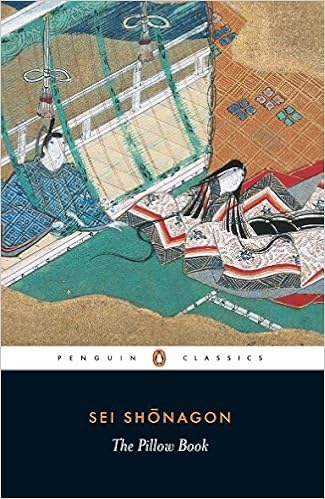
The Pillow Book

Image result for the pillow book mckinney In spring, the dawn — when the slowly paling mountain rim is tinged with red, and wisps of faintly crimson-purple cloud float in the sky.

The Pillow Book is a work of medieval Japanese literature from the Heian period, roughly 800-1200. Written by Sei Shonagon, a woman in the lower level court that served Empress Consort Teishi (定子). This isn't so much of a book per se, and definitely not a novel in the traditional sense, never mind the fact that the idea of a traditional novel didn't exist back then. However, her contemporary was Murasaki Shikibu, author of the famous Tale of Genji, a contemporary, woman serving in the court. Both of these works are studied in Japanese high school to this day. In fact, when Japanese study classical Japanese, it is the Heian period that they go to. 

The book is full of essays, lists, anecdotes, and personal thoughts. When I first started reading it I thought it was all over the place, and it really is. The Pillow Book reads like a conversation from Heian Japan. You get a sense of the character of Sei Shonagon, which is what Meredith McKinney focused on. She wanted to get the voice of the character done in a certain way, that is relatable some thousand years later. Did she get it right? I would say yes. Reading this book is somewhat of personal experience. I found myself smiling at things that were funny and likable, and likewise demurred when Sei said mean girl things. You feel like you are getting to know Sei and how she lives in Heian Japan, ultimately alien, foreign soil for me. Because of that, it is a true work of art, literature. 

In the McKinney translation, Sei comes across as personable but somewhat thorny. Basically, she isn't perfect. There's a mean girls vibe to some of the statements she makes but it doesn't dominate the text. But when you see it you do take notice. Were women really like that back then in Japan? Women are like that today! It's funny in a way how natural Sei comes across in the McKinney translation. Rather than translate the language in a dramatically different way, McKinney decided to change the voice of the character herself in her own inimitable way, that is personable, relatable. It's like listening to a Heian period woman, talks about her life, like a diary but better, much better because she comes across as likable and engaging rather than boring and nonstop. 

My favorite element of the Pillow Book is the anecdotes and stories. Stories of men who are clumsy with poetry, or retreat into hiding if they've walked in a woman's room. What festivals were like as the season changed. What it was like serving an Empress, whom you greatly loved and admired, despite you being of lesser rank, and never having the chance to be like her.  

If I were to compare the Tale of Genji [review here] to the Pillow Book, I would say the Pillow Book is breezy and personable, and that the Tale of Genji is more elusive and poetic. Both great works, vastly different. Sei has a way of explaining her world like a diary, that is in invaluable in respect to Japanese history. In short, its something of a masterpiece. 

"In autumn, the evening — the blazing sun has sunk very close to the mountain rim, and now even the crows, in threes and fours or twos and threes, hurrying to their roost, are a moving sight. Still more enchanting is the sight of a string of wild geese in the distant sky, very tiny. And oh how inexpressible, when the sun has sunk, to hear in the growing darkness the wind, and the song of autumn insects."

Sunday, March 10, 2019

Berio's Sequenzas

Image result for berios sequenzas book janet halfyardBerio's Sequenzas is a music book edited by Janet Halfyard but written by many different musicians. Luciano Berio was an Italian composer from of the modernist school [Cage, Boulez, Stockhausen] and he wrote these pieces titled Sequenza for different instruments. These are a series of works for different instruments that are written for the virtouoso in mind. The book has three parts: 1) Performance Issues, 2) The Compositional Process, and 3) Analytical Approaches. All the parts correspond with each other if you read it that way. 

This sort of book is very important because modernism has in a sense, died and left the building. Replaced by postmodernism, which is nothing in comparison. Now its not unheard of jazz musicians to play rap music for a living. Or for classical musicians' serious 'gigs' to be nothing but pop music gigs. However, back in the 1950s modernism was king. Once you take a look back at the past you realize how important all of this music really was: historically, culturally, musically, and emotionally. 

The section that had the most profound effect on me was the sections regarding Berio's compositional process. "For Berio and the compositional process there was always a question of what does time do?, What is duration and sound? When we experience it, what is the "now" for music." [Amazon review by composer Frank Abbinanti]

There's charts on pitch structure, dynamics, and timbral analysis, as well as performative insights. Written by the musicians who performed the pieces. There's also a lot of information regarding Berio's compositional process as well as his ideas regarding performance aesthetic. All of this had a profound effect on me while reading and upon completion. 

In a way me being a rock and roll jazz guitar player makes me a stranger in a strange land when it comes to this sort of hardcore classical [avant garde, modern] musical analysis. I've been working on Sequenza for Guitar since October but I still have a lot of work before I can actually play the piece in front of anybody. Although I don't think I completely understood everything in the book, I do think I gained a lot of insight regarding music, mainly regarding performance aesthetic, composition, and how to analyze compositions. For that, its a very valuable tool. I think I'll go back to it in due time, and try to see if I can understand parts that I didn't get or misunderstood. 

Listening to all the Sequenzas by themselves is refreshing. Music really was quite something back then. This book is set for retail price of 50 dollars on Amazon. Luckily, my music mentor, and composer Frank Abbinanti gave me a copy back in October. I didn't read it until now. I'm late to the party but I'm glad I finally read it. In some aspects, I can't look at music the same, something has changed. 

And what's changed? Perhaps everything. 

Tuesday, February 19, 2019

Jazz Duo

This is a track from my jazz duo project, for lack of a name yet I'll just call it the Figueroa/Thomas Duo.

Guitar, Orlando Figueroa
Alto Saxophone, Jason Thomas

https://soundcloud.com/user-294063763/jazz-duo

Thursday, November 15, 2018

Focus Pocus Part II: A Philosophical view

Howdy yall, what's up? I thought I'd write a bit more about what I discussed in the previous post, which can be viewed here. I explained how I was in a funk after vacation and how I couldn't get anything done, mainly my reading and guitar playing, in a lull. 

Well its been almost a month since I've been back, things have been going good for me. Work has been pretty insane, retail, over 40 hours a week. I'm working from today (Thursday) until next week (Friday) with no days off in between. The crazy thing is that although the thought of that is a little depressing, I'm actually getting a lot done in the sense that I've divided up all my time for rest and only the essentials. What's that pray-tell? 

The essentials for me is reading, writing, and music. Once I realized that I have no time to play video games probably ever! it was a pretty hard thing to observe, and then to get over. I used to love video games but now there's simply no time for it if I'm going to become a better writer, keep reading great science fiction (The Difference Engine) and philosophy (Adam Smith), and learn more classical and jazz guitar pieces (so much practice). Its a full time job all on its own, forget about the retail job, this is my job! 

There's a philosophy to this. Breaking everything down in your life to just the bare essentials. What do you want to accomplish in one day? What do you want to accomplish in a lifetime? Practice it one day at a time until you achieve complete and total mastery. 

My job gets in the way but if I take away the video gaming and stop spending so much time procrastinating on Facebook or playing video games, I can actually get a lot done in a day. Because I stay up very late (sometimes till 4 or 5, reading on my Kindle, which I got from a co-worker for free, retail is great sometimes) I can get a lot of reading done late at night after my late night shift. Everything's turning up Millhouse.

Happiness is a very tangible thing. Happiness is practicing guitar every day, reading, and writing. Find your passion and stick to it. Work is a necessary by-product of monetary situation, but it doesn't dictate who I am or who I will be. The future is ours to decide! 

Friday, October 26, 2018

Classical Music at DePaul

Image result for depaul university music buildingI've been in Chicago the last couple days and I've been checking out as much music as I can. Last night on the 25th I attended a free classical music concert at DePaul University, a Catholic institution in Lincoln Park. Amazingly it was free and all I had to do was rsvp online and pick up my "ticket" at their box office. Not bad! 

The actual performance was quite elegant. Here's the setlist:

Mozart 
String Quartet No. 19 in C Major, K. 465 (1785) 

Beethoven 
Piano Trio in C Minor, Op. 1, No. 3 (1795)
Piano Trio in D Major, Op. 70, No. 1 "Ghost" (1809)
String Quartet in C Minor, Op. 18, No. 4 (1801)

Debussy 
String Quartet in G Minor, Op. 10 (1893)

Jean Cras (1879-1932)
Trio for Violin, Viola, and Cello (1926)

Schubert 
String Quintet in C Major, Op. 163, D. 956 (1828) 

As you can see it was quite a standard string quartet 'showcase I' as they called it on their program. The Mozart piece opened things up nicely with that characteristic 'classical' sound. The Beethoven pieces were the main showpieces. The Debussy piece was unusual, mainly because I think its the only string quartet piece that he wrote. 

I've never heard of Jean Cras, and when I asked my music mentor, a new music composer named Frank Abbinanti (find his work on YouTube), he said he had never heard of the guy either. However, his composition was quite good. There was definitely a middle eastern sound here. It was refreshing because it was the only modern piece, written in 1926. 

The Beethoven piano pieces were grand. The most virtuosity and musicianship was displayed when the pianists got onstage and woo'd the crowd with their dazzling gymnastic pyrotechnics. I tend to think that most pianists are virtuosos, due to the fact that its a solo instrument. Most guitarists aren't virutosos because its mostly an instrument of accompaniment. Anyways, these piano trio tunes were the real highlight for me. 

The other high light for me was watching the cellists bow and play emotive low notes. Cello is quite an expressive instrument and I've been interested in playing it, but I've been unable to because the instrument is too damn expensive. Maybe one day when I get a better job. Cello would be a great instrument for me to get into, and become a new music musician, one of my goals as a musician; to move from rock and jazz into the new music, modern music scene. 

Lastly, they ended the program with Schubert, classic quartet stuff. I've actually heard a lot of Franz Schubert's quartet music, thanks to YouTube, my main source for music of all kinds. It was a good note to end it on. 

Chicago is known as a blues town but I spent my first night here going to a classical concert. Its good to know that Universities put on free shows for the public, not just for those affiliated with Uni. In the words of Ice Cube, "Yeah today was a good day." 

Saturday, August 4, 2018

Circe, the good witch

 Image result for circe novel

Circe is a new novel from April 2018 written by Madeline Miller, a classicist and teacher who won the Orange Prize For Fiction, for her first novel The Song of Achilles. I think so highly of Circe that I already went ahead and ordered The Song of Achilles from the library server.
 
Circe is a a great modern take on mythology. We've all read mythology as kids. Probably when teachers forced it upon us in grade school or middle school, maybe even high school. Circe is the daughter of Helios (sun god and Titan) and an unimportant naiad named Perse. The story is told from Circe's point of view, the first person. Its quite a stunning tale.
 
The novel starts with Circe as a young naiad, living in the halls of the gods. The beginning has a young mind framework, you get the sense that yes Circe is a god but she also started off not unlike humans, young, immature, and afraid of the world. The first couple chapters makes Circe look like a teenage girl. At first I was thinking, am I reading some sort of classical mythological young adult novel?  
 
The book kicks off plot-wise once Circe notices that Promethus (a Titan, a god) has been punished hardcore. He was caught helping humans, teaching them the art of fire and culture. His punishment was being chained outside and having his liver pecked at by birds for eternity. Once his liver regenerated, the birds would come back the next day and do it all over again. Talk about harsh.
 
Circe goes out and helps Prometheus but once Zeus finds out she's helped him Circe gets cast out from the halls of the gods, her punishment being imprisonment on her own island, which is where the common tales of Circe stem from.

Most people know Circe as a witch who lives on an island and pretends to help lost sailors on their wayward travels. Then she turns them into pigs using magic, otherwise known in the gaming world as casting polymorph, pretty neat trick. But Circe is shown in this novel as not just being an evil witch.
 
She started turning men into pigs because she was sexually assaulted by the first men who came to her island, which brings to mind the issue of rape in modern society. There's a feminist tone to Circe's actions once she interacts with the mortal world, man in particular.
 
Another strong feminist tone in the novel is when Circe becomes a mother to a mortal son. She exclaims that she will do anything for her son, including claw her eyes out. She lives for her son and loves her more than anything. In motherhood we cannot see Circe as just a witch who plagues men. She is a loving character, much like mortal mothers are their kids.
 
Circe's love for her son is symbolic for the maternal love of mothers. It made me think about my relationship to my mother, weather good or bad ultimately a mother does whatever they can for you because they love you. Even their mistakes and bad actions are acts of love. Of course making Circe a loving mother humanizes her and turns her into a good witch, which isn't the usual myth tale.  
 
And then of course there's plenty of other interesting stuff that happens. Circe turns a mortal into a god using magic, but once the man, Glaucos decides to marry another unimportant naiad instead of her, despite the fact that they were lovers when he was mortal, Circe gets made and uses magic to turn Scylla, the unimportant naiad into a multi-headed monster, who goes on to plague man in the seas for generations. Typical bickering, even among gods.
 
A cool part that I enjoyed in particular was when Circe swam to the bottom of the ocean and met with an ancient sea god. They come to an agreement of some sort where Circe got to keep his tail, which was a weapon of poison, of godly destruction. Circe later uses this weapon to fight against Scylla. The weapon turns Scylla to stone.
 
What makes Circe such a great novel is that the prose is elegant and sharp. There's classical meaning to terms and phrases. There's modern every day exclamations. The story itself feels like an eternity, the life of Circe, a goddess. You get the sense that this is what a god's life could really be, thousands of years old and still feuding with your relatives over petty things.
 
The first person view for the narrative plays a key role in this book's success. Because everything is told by Circe in the first person you get to understand all the different nuances of the character in question. We begin to understand Circe's thoughts and actions, and vice versa. In this point of view we can relate more to Circe, turning her into a good witch despite turning men to pigs with spells.
 
The novel reads incredibly easy. Not that its kiddie stuff or young adult by any means. More that the writing isn't complicated or busy, just technical enough to be of mythological historical importance. But not overbearing with the technicalities of it, and even offering new slants and points of views within the story.
 
It was a great read, I recommend it to anyone who wants to read something different and very good.

September Sweater Weather

Good evening ladies and gentlemen, hello world. How are you?  It's good to be writing on a good day off work today on a Saturday. Here, ...