Showing posts with label writers. Show all posts

Monday, July 6, 2026

RE: Post July 4th


Good evening, denizens of the internet. It's been a long time since I've written any blogs, and it's good to be online tonight at 2 in the morning, jotting down thoughts and ideas. 

    First, post July 4th, I can't help to have the blues. Yes, life is good, as long as you don't weaken, but looking at everything in terms of our government, our environmental challenges with global warming, job security, and even just basic life's necessities like rent, food, and gas, its like Americans have really been pushed to the farthest limits. The War with Iran seems to be winding down and there's security and so called peace talks but nobody really knows what's going on for sure with this current second Trump administration. Trump has become the ultimate right-winger's dictator. 

    Everyday, there's some new scandal involving Trump, what he's doing, this and that, and almost every other day you see it on the news TV or even news online headline readings, and you just know that any one single incident of these are grounds for removal of the Presidency, termination of the Presidency from him, and impeachment. The fact that nothing happens and he walks away unscathed is a stain upon the US Constitution, which is not being upheld by this current administration. 

    But the main problem I have with Trump is that he's become a fascist demagogue controlling a vast amount of the US population through Fox News, social media, cable news media, and a vast array of extreme right wing MAGA republicans, who seem to not only be extreme right wingers that want a fascist dictator strongman, but who may unknowingly and begrudgingly be doing harm to the US constitution, government, and even ethics itself. 

    Think of all the right wing MAGA idiots out there, some of them I've physically encountered myself in the workplace, on social media, and various personal associates of mine. Most of these people aren't complete haters, they love America, some of them are racists and nationalistic, but you'll find that among the extreme right wing in any country. A lot of the MAGA crowd people are simply not guided by the facts, reason, evidence, and proof. 

    Instead, you'll find that the MAGA population have a limited worldview, they all watch from the same news media sources, they don't read books unless its some sort of Ayn Rand. Once you get to know them individually you find that some of them have some sort of vendetta against certain things of the world: they hate immigrants even if they are immigrants themselves, they have low information tendences, they watch Fox News and listen to right wing podcasts, and almost all of the information they get from these sources are all very much low information things. For example, a right wing podcast would talk about something Biden or the Democrats did a few years ago and say what a controversy it was, and that it went unreported. I see that type of thing from the MAGAverse all the time. It's a cheap, crappy tactic. 

    So, forgive me if I'm watching England destroy Mexico during the World Cup 2026, and right after the Fourth of July, forgive me if I feel that a sense of right wing extremism of imperialism has taken over the day. Those weird Ayn Rand kids from the early 2000s I used to disagree with in history class are loving the Trump era. But I think for those of us who know better, who had to work harder, who had to learn much more, and struggle and persevere more, those people, those are the people know that something is not right. But hey, that's not to say that you can't have an easy life and still be cognizant enough to know that this second Trump administration is hastening the destruction of the American experiment. 

      Okay, so I'm kind of rambling a lot about Trump tonight. But even bigger than Trump himself is the cult of personality that surrounds him. Isn't it a little strange that people who like Trump seem to love everything about him and his close government officials praise him like a lapdog? To quote Adam Schiff, here is a guy who's using the highest office of the land for his own, private, personal, political gain. That being said, I worry about the future of this nation, if it will really still stay a nation in the same characteristic sense that it always has been, but for those who know, we know that the American experiment was never supposed to include everyone, all the time, and allow everyone the right to vote. So there's a bit of a sour taste to this year's Fourth of July. Consequently, I spent the Fourth just chilling by myself, reading Kafka's first unfinished novel entitled Amerika [with a k, ironically], and its funny, because I find myself feeling like the young German immigrant who just freshly arrived in America, because I find that my country, this modern America, is almost alien to me, and a lot of MAGAverse people probably wouldn't want to allow me to be in it and living a good life while they are struggling. 

    That's a lot to unpack there. So yeah, I've been bummed out with this Fourth of July. I've been trying to put more of my focus into my reading, continuing to read the western canon as well as history, philosophy, artbooks, and books on culture and ideas. I've found that with this job having less hours, it's given me a lot more time to work on my personal pursuits like reading, music, gaming, walking, and listening to music for relaxation. I've found with this job budgeting is a lot harder, but who knows, perhaps this is good for me, having less money to spend and go crazy going out all the time with. Next time you see someone giving cash to homeless person, stop them and say, 'Don't delay the revolution!" 

    Lastly, with all seriousness, I think the comedown on AI is coming because now we're at the point where most Americans are realizing that although the stock market is focused in on AI, the truth is that AI wasn't really what it was supposed to be. It's rather a lackluster tool to generate ideas based on words, most are our advanced AI are chatbots, regurgitated language and ideas from the internet, or who knows from. AI video ended up being a bust, and AI generated video content isn't that fun, creative, or exciting. AI chatbots tend to be useful only for specific things but not things that most average people need them for. For me personally, I've found a lot of creativity and utility in using AI for images and I've sort of gotten a thrill out of doing that since the beginning of AI image generation, but in terms of actually doing anything serious with AI or AI actually becoming a mainstay in peoples' lives, or even buying a CHATgpt subscription? Forget about it. More and more Americans are realizing that if you couldn't do it without AI, having the AI won't really change much for you, in a sense, the AI is overhyped, overplayed, and its so 2000-and late, as the Black Eyed Peas song goes. 

    If you read through this, you're probably pretty smart and a bit of a reader. How does it feel to be smart and read things? Keep playing on the A Team, folks. Thanks for reading. Below are several of the AI images that I've had a lot of fun creating in terms of the word descriptions used to create them, a lot of my prompts are sometimes tons of paragraphs long, much like this sort of spontaneous dialogue online here. Watch this space.


Wednesday, June 5, 2024

June Five, Minds Alive: Explorations in the Intellect's Dive

Good evening ladies and gents, 

Just wanted to write, about anything here. 

First, what I've been up to lately. I've been working a lot at the retail grocery job but I'm also producing a lot of ai generated art featured on my Instagram, which can be seen here. In addition, I'm reading a lot. Right now I'm reading through George Eliot's Middlemarch. I'm also still practicing instruments, mostly guitar and piano. It's all time consuming. Plus sometimes I go out to the bar after work and chill with people there. In between I try to stay updated on what's happening in the news and whatnot. 

Next, Middlemarch is a very dry book. It's fiction but its so dry its almost like reading Gibbon's History of the Rise and Decline of the Roman Empire, which I happen to also be reading, but on my phone when I'm on work breaks, traveling on the bus, or laying down before bed. In those moments I finished Gibbon's volume 1 of the series. Fascinating material. I mentioned the Gibbon book to a customer the other day and he said, 'yeah, but did Gibbon write about how the Romans debased the currency?' I thought it was a minor thing to mention considering all the other stuff they did, but yeah, I sort of felt like the guy said that because he's trying to somehow form and correlate a modern day theory that we're like the Romans because the government has, in its own various methods, sort of debased our American currency. It was an interesting comment for him to focus on, or so I may think. 

However, Middlemarch is much more dry than the Gibbon because fiction isn't supposed to be so dry, it's supposed to be lifelike, literally coming to life off the page, that's what people go to fiction for, its infinite mana, its endless creativity, that drives us to keep turning the pages. What can I say about George Eliot? She writes about well off British people in the country, their marriages, their relationships, their struggles and contradictions with everything including their own personalities and shortcomings. Eliot is so brilliant that she even writes about upcoming technology, factories, and agriculture within the book, which takes place in 1829. In a sense, I think Eliot is almost too brilliant to become a beloved favorite writer or author, rather it is her authority as a voice and her brilliant observations that command respect even if most people will never read the entirety of Middlemarch unless they're a English Graduate student. 

Next, work has been grueling. Working at the grocery store has its ups and downs, and interactions with customers can sometimes be less-than-pleasant, and even with your managers. The late night rush lasts a very long time till midnight sometimes. The customers are impatient and angry and are always willing and ready to start fights beginning with name calling and yelling and sometimes escalating beyond that if they feel so inclined. And boy do they steal. They expect quick service and when they don't get it they sometimes rage. There's a lot of disrespect from customers and managers alike. One common thing I notice is sometimes when customers are in the regular checkout lines they're being rung up, they're ignoring the cashier and they're on their phone yapping. 

In addition, there's the emotional labor within the job. The job is grueling and there's few people that are actually cool with you while you're there. Some of the closest associates and managers I've worked with for years I'm not really cool with them and in fact I think they're shirkers hiding trying to get out of work most of all the time. I usually ignore them and just do what I want. When managers are pretty dumb and not really taking care of business, you find that them doing that allows you to pretty much do what you want, albeit with some caution. 

Remember, most people, including your managers are too dumb and lazy to really pay too much attention, make the most of it. After working in this business for 12 years, you learn that most managers are fake and manipulative so you have to learn how to fake them out in order to do what you want. I had a friend who became a manager and he became another one of those managerial drones that hates his job, maybe his life, maybe himself, but boy does he love being a manager. They ain't reading Middlemarch I'll tell ya that. Another tip for working grueling jobs like this is that if everybody's having a bad day and the work is going to utter shite, and they're all bitching to you, remember you're still having a better day than everybody else so act like it. Act better, be better.

Moving on, the news has been pretty much what I thought it would be. There's really no new news, just more of the same, on a loop, on a 24/7 timescale. I don't care if you're a democrat or a republican, the media and the government has you believing that we're all divided, 'us versus them,' gay versus straight, abortion vs the family, rich versus poor, white versus brown, worker versus ceo, democrat versus republican, this versus that.' I sincerely believe that this is what the government, the media, TV. movies, music, this is what I think they're saying at this impressionable time period in American democracy. 

Just think about the fact that you probably don't even know about BarbenHeimer unless you are a person of a certain kind of persuasion, a certain kind of class, a certain kind of taste. Kind of a random thing to mention but I want to hate on BarbenHeimer because I think it caught the zeitgeist at an important moment in American history what with so much going on with politics. The average American probably saw Barbenheimer but what about the people that didn't? Are they not as American as the rest of them? It's an odd but important question I think for an important reason. Who are the other people? 

Lastly, to wrap things up, we're living in a timescale where pretty much the only way to be safe from most harm in the world, is to have money. Either be born rich, get rich, or work your whole life till you accumulate enough of it because the way the world is going now, the world is turning itself into a money empire, money is the only thing that is important. I think, at this current juncture. I have my hippie element at times, because I'm a musician, but most people would agree with me, that money has pretty much taken over as the most important value of a thing in this world. It's bleak, man. 

Here's a story about money. I have a friend who's rooming with an old friend of ours for $1,000/month but he doesn't want to be there, and he wants to get out, but he can't go back to his parents out of fear or shame, and he can't afford to live on his own, and he prefers not have roommates so he's rooming with our old friend and its not going good. These are the real modern day American problems that the media doesn't talk about. My good pal is stuck with this other guy, supposedly a pal, but he's really an asshole and my guy wants out but he's stuck because the American economic system is setup so that you can't really move out of your parents place unless you have a very good salary at a good job with 40 hours plus benefits or more. That's the reality the media doesn't talk about, instead they usually just force-feed the 'us vs them,' slogan repeatedly. Of course, most conservatives would say my friend isn't doing enough to help himself and that he might need two or three jobs, but at that point, even if he did get his own place, that would be putting an even higher price on life, wouldn't it? 

In conclusion, time to wake up. Only caring about yourself will only get you so far, usually in an organization, but in real life, outside the workplace you have to learn to think smarter and harder about how you can improve the world around you, and think for yourself, rather than listening to the media, your parents, your boss, your friends, your acquaintances. You have to learn to think more about how to correctly justify the differences between right and wrong, and the moral grey. I'm telling you right now, most people don't know how to do this, even some people I know in their 40s and 50s, who you would think would have become smarter by now but it's already too late for them. They've been indoctrinated into their systems of belief, usually the wrong system, you can tell because they're still fucking up even if you don't know or hear about it too often. They're fucking up in the shadows, lol. 

ps, covid might make a comeback this summer in LA

Saturday, May 1, 2021

A Farewell to Arms

A Farewell to Arms is a terrific and thought provoking novel written by Ernest Hemingway. It tells the somewhat story of love, death, and war that is based on Hemingway's actual war experience in the first world war. The book was published in 1929 but not in published in Italy until 1948 because the way Hemingway depicted the Italian battles were seen as anti-militaristic by the Italian government and could have been detrimental to the war effort. Hemingway wrote no less than some thirty nine different endings to the novel until he picked the one he ended up with. What makes this book great, terrific, and probably his best novel, and best known work?

Well, the book describes three different things superbly. Love, war, and death. These themes permeate the literature of the western canon and Hemingway's depiction of the first world war is probably one of the best descriptions of war in the western canon. Especially modern warfare. Remember, when this came out in 1929 there was no realistic depiction of modern warfare in fiction. You end up really living the life of this soldier, how he gets wounded, how he falls in love, how he talks to and works with his officers. You get the feeling that this was really how it was on the battlefield. A lot of the off duty time of the officers was spent on drinking, drinking, and drinking. Alcohol appears in endless scene after scene and it permeates throughout Hemingway's life, continuously leading to his suffering. 

Another important theme was love. We get the feeling at first that our young Frederic Henry is wounded and just wants a girl to pass the time until his recovery. What instead happens is that he falls in love with her, but is it really love? The circumstances of war were excruciatingly difficult especially with his war wound [a shell hit him in the leg], not to mention his surgery to his knee. So what we have is a wounded soldier and a lonely nurse. It's a match made in heaven. 

Lastly, it must be mentioned the theme of death. Death appears many times. A fellow friend and officer gets shot down out of nowhere for no reason, but when Frederic and another officer go out into the open, nobody shoots them, and they walk past both German and Italian soldiers unmolested. 

Now, the most striking part of this book for me was the ending. The nurse is pregnant and gives birth but nearly dies. Frederic hates the baby and states within himself, "I care nothing of fatherhood of it, it nearly killed its mother," which goes back to the Greeks, the idea of the father hating the son because he could take his place in the patriarch of the family. However, in this case I prefer to see it as Hemingway's allegory for war, meaning that war is a ghastly nihilism, no good will ever come of it, it brings only evil and destruction and misery. To add insult to injury, the baby ends up dying and our young father is relieved. 

That ending knocked my socks off because although it seems simple I found it to be philosophical, a display of existentialism in fiction format. It's an ending I will never forget. Something sort of like what Tolstoy did with War and Peace, it was a fictional novel but parts of it translated into philosophy, at least in my viewing. Obviously you can make the case that Hemingway's take on war is that it is terrible and must be eradicated at all costs. Although the first 140 pages focus on the romance, the rest of the novel is thrilling, moving, and mindful. A must read for the western canon, a must read Hemingway, a must read war novel, and a must read novel for all. 

Want more Hemingway? Check out my blog post about Hemingway's Spanish American war novel For Whom The Bell Tolls https://ofigueroamusic.blogspot.com/2019/03/for-whom-bell-tolls.html.

Wednesday, August 26, 2020

An Odyssey: A Father, a Son, and an Epic


The Patience of Penelope, Pre-Raphaelite Muse | 19th Century ...An Odyssey: A Father, a Son, and an Epic is a terrific book written by classics scholar, philologist, and professor David Mendelsohn. Written in 2017, the novel is part memoir, part scholarly insight into the Odyssey, and has its share of philosophy as well. I would compare this sort of writing to Zen and the Art of Motorcycle Maintenance, except this is much more scholarly and that is much more hippie. However, the classic idea of a novel being a memoir, the idea of how you can travel without really going anywhere by going in circles, and the bonds made in the process is what makes them similar. As the Dead would sing, "What a long strange trip it's been."

Mendelsohn compares the Odyssey to his relationship with his father. And it works. His father is a mathematician who regrets that he never got his Ph.D. or ever read Ovid in Latin like he wanted to. David, the son, and writer is a gay man who always wanted to be close to his father but his father is the typical grumpy dad type that doesn't like to be touched even by the wife sometimes. He's the conventional stiff math guy. Mendelsohn goes into great detail what type of man his father was but its a sore oversight that he doesn't say much about any of his mentors in life or his relationship to a female partner whom he has kids with. Yes, you heard that right, a gay man who has a female partner so he can have kids. Until I read this book I didn't even know that was a thing that gay people did, but apparently, it's not out of the ordinary. So yes, although it is great that Mendelsohn can describe his father, mother, and uncle with great detail and we get a sense of who they were, he doesn't really describe himself or any of his mentors much. Which makes the book lesser.

However, despite that, what makes this book truly remarkable is the scholarly aspects and the form, the way it is written; before, after, and future can happen all at once like in the Odyssey. It goes without saying that if you read this book you will know more about the Odyssey, the Iliad, and the Aeneid than everyone you come across. Heck, Mendelsohn even goes into the elements of the Greek language, which is downright informative and good to know even if I could never use or apply it.

Mendelsohn teaches a university course to freshman about the Odyssey, and his father ends up taking the course. Using the class, his father, and his students as a way to explain the many ways you can, should, and should not interpret the Odyssey, Mendelsohn does a fantastic job not only of describing the experience in his book but making it fun, digestible, and easy to understand. The scholarly elements of this book are like gold, the insight I got from Mendelsohn's explanations on every part of the Odyssey not only strengthens my love for classics and the Western Canon, but also makes me smarter, so that when I reread the Iliad, Odyssey, and Aeneid, I will read them with a much more sophisticated outlook, one that takes into account how to interpret its many lines, chapters, and books. One of the things Mendelsohn stresses to his students is that you can't just make up interpretations, rather, he has been taught how to look at the Greek classics in a specific way, the way his teachers taught him. In a way, this is limiting to the students, meaning they have to listen and accept everything he says, but on the other hand, I can see things through the more traditional route as well. His father is always there in class to stand up to him and disagree at times.

For an example of some scholarly things I learned, one of them is the idea of the proem, or the beginning of the epic poem. This establishes the entire epic poem in the first couple lines and is so important to the interpretation that you can't understand it without understanding and analyzing the proem first. The last lines are equally important to the interpretation as well. Then there's the famous Homeric Question: Was he a real person? Most scholars believe that there might have been a real Homer but that if he did exist, he did not know how to read or write, thus the idea of traveling poets and bards comes up. Poets and bards who memorize some 15k lines of epic poetry and know it so well that they can improvise new lines and variations upon it while telling the same story. It's history.

Lastly, one of the best elements of the book is that it's an odyssey itself. By talking about and interpreting the odyssey, Mendelsohn takes us on one. And like the Odyssey, the end has to do with a strong bond between father and son. Mendelsohn relates how at the end of the Odyssey, it is the reveal from Odysseus to his father that he's still alive and well, that is truly heartwarming and brings about the final end, the slaughter of Penelope's suitors, who have tried to force Penelope to marry them, taken over the palace, seduced the maids, and eaten all the food.

This is one hellova book. I recommend it to anyone who's read the Iliad, the Odyssey, and the Aeneid. It will give you more than enough new information to last a lifetime. Not only is it valuable for its scholarly and philosophical insight, but its also a decent memoir, and shows that you can write a book that has many styles in one; memoir, scholarly insight, and philosophy, using time in any which way you choose. Recommended to anyone who likes memoirs, the classics, or wants to learn more about the classics. 

The painting above is called The Patience of Penelope, who waited 20 years for Odysseus to come home.

Tuesday, April 21, 2020

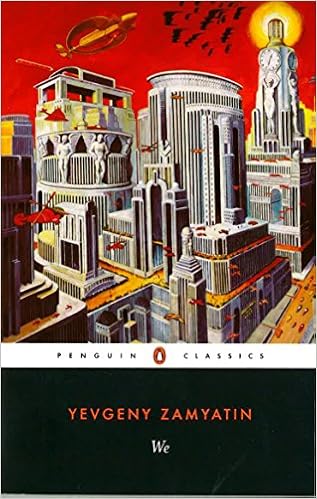
We

We: Yevgeny Zamyatin, Clarence Brown, Clarence Brown ...
We is a classic dystopian science fiction novel by Yevgeny Zamyatin, written in 1920-1921, published in 1924, via English translation in New York. Yevgeny was part of Russian proletariat writing groups and eventually requested to leave Russia as many writers were being persecuted, thus resulting in the death of their writing careers. In fact, when Zamyatin died, there was no mention of him in Russian papers. Most proletariat Russian writers made livings elsewhere like in Paris, England, and the United States. 

The novel depicts a world of harmony within a totalitarian system. There is freedom but only ruled by the Benefactor and activities are ordered along to the 'Table,' a system that controls every hour of everyone's day. In some respects, there wouldn't be a Brave New World by Huxley if it weren't for We. No 1984 by Orwell. No Handmaid's Tale. There wouldn't be all those tons of young adult dystopian novels either. We did it first. 

I will focus on the plot first because it's pertinent to the ideas therein. 

We is set in the future. Probably far future because they have space ships. It's said that there was a great war over something, which is only alluded to in the novel. A resource perhaps. It resulted in the use of weapons of mass destruction, leaving the world outside One State a post-apocalyptic landscape. 


The main character is D-503, a space engineer. People have no names, rather they are identified by number. It takes place in an urban society constructed of glass, which helps for mass surveillance. The people march in step with one another and wear uniforms.  Life is managed scientifically; everybody eats at the same time, works the same time, has recreation hours at the same time, and they even have scheduled times to have sex with partners they can sign up for, rather than of their own choosing. People think with science, logic, and reason above all. The formulas people use are ones devised by the One State, their form of government, lead by the Great Benefactor, their supreme leader.

One State has conquered the whole world. They're now building a spaceship in order to invade and conquer other planets, thus bringing One State across the universe, helping their cause, and increasing their numbers. The ship's project engineer D-503 writes a journal that is meant to be brought along the spaceship when they go to another planet.  

D-503 lives in a glass building like all the others. His partner, O-90 is deemed too short to bear children and is upset by this. His best friend is R-13, a guy who reads his poetry verses at public executions. On an assigned walk, D-503 meets I-330, who flirts with him without being properly assigned. I-330 is a careless free spirit; she drinks alcohol, smokes cigarettes, has casual [not assigned] sex. Every guy has met a girl like I-330, that footloose, and fancy-free girl. In short, she's doing everything that you're not supposed to do in One State. D-503 is appalled but intrigued at the same time. He continues to see her. 

D-503 starts to have a lot of freedom through I-330 and starts to have dreams, which the One State describes as mental illness. "What's wrong with me doc?" "You've found out that you have a soul, for which there is no cure." That's my favorite line in the book because it has that edge of snarky satire as well as philosophical ramifications that goes back to the Greeks. It works well. 

Slowly, I-330 reveals that she's part of an organization called Mephi, which plans to bring down One State. O-90 wants D-503 to illegally impregnate her but in order for her to stay with the baby, she has to leave One State and go beyond the wall, where primitive humans live, complete with coats of fur. 

The last journal entry details the 'Great Operation,' a brain surgery of sorts, that targets the brain with x-rays, so they can function as 'tractors in human form.' It basically makes you more of a vegetable. Removes imagination. Once D-503 gets the operation he runs to the Benefactor to tell him about the Mephi operation. I-330 and her associates are sentenced to death under the Benefactor's machine, which literally melts the human body. A  death ray.

But the novel ends on somewhat of a good note. The Mephi operation is doing well, birds are repopulating the city, and people start acting out against the regime. One State's survival is left in doubt. The book ends with a strong manifesto; just as there is no highest number, there can be no final revolution. 

 Now we get some ideas. 

First, the writing style can, at certain times, be quite a satire. There's one scene early in the book where a woman is playing the piano and people are watching and listening to her play. At one point during the impromptu performance, which is already rare in this society, D-503 starts laughing uncontrollably because music is such an unstructured improvised form that most of the citizens just aren't used to. 

The scene with the doctor is my favorite in the book. "You have a soul. There is no cure." That's a great satirical moment, a great laugh. Of course, it was true, D-503 had indeed, somehow developed a soul through his new girlfriend, I-330. 

The idea of having sex only with assigned partners and only at certain days and times is also a laugh. Did they also forbid masturbation?

There are philosophical ideas at work here too. In fact, the doctor scene isn't just a satire, there's a religious tone to it as well. The idea of the soul separate from the body and mind goes back to Plato and Aristotle. This is used in fiction to good effect. The fact that D-503 developed a soul rather than being born with one is another note on satire. 

The idea of a conformist culture where everybody is happy [for the most part One State is happy] should be considered utopian, right? Well, the thing that makes One State a dystopian novel rather than a utopian one is the fact that One State not only wants to take away freedoms [which is fine because most of the people are cool with that], but One State also wants to get rid of imagination. In We, imagination is the mind-killer rather. If the citizens of One State were allowed to imagine this would be an entirely different novel. 

Lastly, this is one of the important and critical works in science fiction, particularly in the dystopian canon. I initially read this on the recommendation of a Russian friend of mine. I'm glad I read it because it's truly a great story and it stays with you. This isn't something you read and forget about a few months later. It's that important of a book. Considering the way governments are run today you will find that Yevgeny Zamyatin's ideas still ring true to this day. For just as there is no highest number, there can be no final revolution.

Tuesday, April 14, 2020

On the Road


OnTheRoad.jpgOn the Road is a book by Jack Kerouac, published in 1957. About, well, being on the road. But really its much more than that. It's about the search for IT, whatever that may be; spiritual, musical, drugs, women, sex, drink, parties, friendship, solidarity, marriage, fame, fortune, success, traveling on the road looking for IT. Ultimately, they never find it, so it could be said that the story is about loss, not getting it, never finding it.

Kerouac was part of the beat generation of writers, or as he phrased it 'beatific', meaning blissful rather than the traditional beat, worn down and looking up the definition. The novel is a roman a clef, meaning real-life events with real people overlaid with a facade of fiction. It should be noted that the main characters in the novel are; Sal is Jack Kerouac himself, Old Bull Lee is William S. Burroughs, Carlo Marx is Allen Ginsberg, and Dean Moriarty is Neal Cassady, all-important, influential writers of the beat generation. What a cast. 

The writing of the book was taken from notes during a road trip in the 1940s. Later it was typed out in a continuous reel of paper for three weeks in April 1951. It was published by Viking Press in 1957. At the time of publication, the Nytimes hailed the book as a beautiful and most important utterance of the beats, with Kerouac being its chief avatar. But the reviews weren't all positive. One reviewer said the novel takes you on a long trip, ultimately leading to nowhere. The novel is generally regarded as one of those important English language novels. 

Kerouac was inspired to write the novel because of his friend and fellow beat writer Neal Cassady. Cassady wrote a 10,000-word letter, which prompted Kerouac to write "Essentials of Spontaneous Prose," a writing treatise on style that reflected a musical, jazz sensibility of improvisation with little rewriting and editing. 

The story is about a couple of carefree young friends who are somewhat literary that engage in road trips during a specific era of jazz history; the transition from Charlie Parker to Miles Davis, from early bop to straight-ahead jazz.

The influence of jazz music and blues is profound here. There are so many jazz musicians that are named here it's too many to recall in this short post. Being a jazz and blues musician myself, I see the utmost importance and care that Kerouac put into describing this specific era of time in America, and how important the music was to the people of his generation, to the beats. Some writers have said that On the Road contains some of the most important descriptions of jazz music ever. Interesting.

The jazz music also reflects the writing. The writing is done in a spontaneous prosaic. It's quite refreshing, considering that most of the novels I read are highly edited over and over again. Although the writing is sort of simple, because of the fact that it reads like a jazz song, it's very enjoyable to read as a musician. You can hear the swing beats in the writing, the sheets of sound if you will. But most importantly, it's fun. It isn't work to read this novel. It reads like a breeze, again, again, like sheets of sound of a tenor sax. Blowin', as they call it.

The characters of this story take pleasure in everything they do. Drinking, parties, women, sex, driving fast down the road, getting stranded with no money, doing stupid things. We aren't shocked by sex and drugs. They substitute family for male brotherhood and the ladder of success for freedom of the road, a new measure of male identity. It's about searching for something to hold on to; a larger truth which is never found. Some people may never find it. And our heroes in this book don't either. Broken dreams and failed plans. In retrospect, it could be seen as a gloomy, middle-aged disillusion. So in that regard, this book has completely lost the zeitgeist. The ethos of the book has been lost. Could it come back again?  Who knows.

Kerouac described his writing as Impressionist, art through observation. Not the traditional rewriting and editing process, rather, the emotional spontaneity of the writing itself. There's a personal nature of the text that makes it come alive, makes it more realistic, casual diction and relaxed syntax that depicts the energy and emotion of the experiences. 

All in all, I found this to be a good read. It's a good book for quarantine because you get a sense of fun and adventure even though we're all under lockdown because of COVID-19. I wouldn't want to have an adventure like the guys in this book for obvious reasons. Some of it is downright miserable, especially the parts being stranded in American cities with no cash and no car, hitchhiking. The zeitgeist for this kind of stuff is gone but it's still important for us to read and write about. The beats sure were some kind of generation. 

Sunday, March 15, 2020

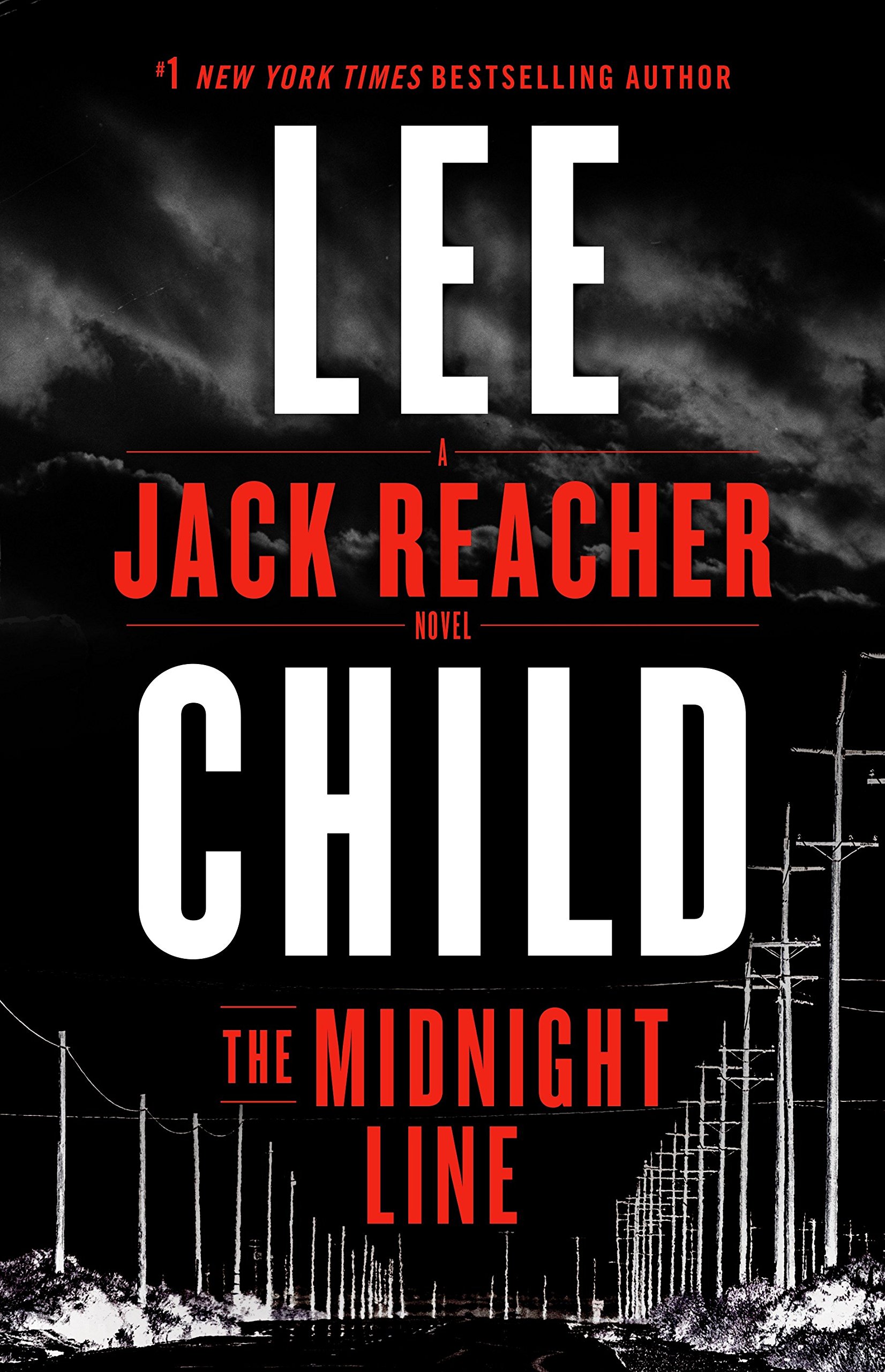
The Midnight Line [A Jack Reacher Novel]

Image result for the midnight line jack reacher book coverThe Midnight Line is a Jack Reacher novel written by Lee Child in 2017. Let me start out by saying this is my first Jack Reacher novel and it is a great one. I would even say superb. Before this, I was familiar with Jack Reacher only through No Middle Name, Child's short story collection about Jack Reacher. That was very good too. But not as good as this novel. 

Okay, so the novel takes place with Reacher somewhere in the midwest. He goes to a pawn shop and finds this ring, the catalyst for our entire story. The ring is engraved with the initials S.R.A and it's from West Point. The very same school Reacher graduated from back in the day. Reacher knows it's a woman's ring because it's tiny. He goes on a quest to find the woman, return the ring, and make sure that she's safe. Because the only reason a West Point student would sell her class ring is that they're in some sort of dire straights and/or trouble. Right? Right. 

As far as suspense thriller versus action this novel is more on the suspense thriller side of things. Which inevitably means its a more serious book. More serious than the next novel in the canon, Blue Moon. But there are still good fights and an incredible climatic takeover and/or heist moment in the end. Jack goes through all kinds of clues, traveling, following, and occasionally beating the crap outta anyone who gets in the way of his mission, to find the woman who owns the ring. One guy even gets his head blown off. Talk about over the top.

The action is simple and straight to the point. It actually reminds me of the action scenes I've read in Cecelia Holland's intense historical fiction novel fights. Except I believe Lee Child knows more about the actual machinations of guns and how and they work. Short, fast, climactic, and brutal in some cases. It's a good writing style. I've learned a lot from it. There's a lot going on stylistically in this novel that Child does.  Also, keep in mind that this novel doesn't feel like he's just making it up as he's going along. [Even if he actually did that.]

The prose is short, simple, and sweet. It's all simple-minded plotting and narration but there's a continuous momentum that keeps the book running from page 1 all the way to page 368. This is a longer novel than your typical suspense thriller. And despite that, it never loses momentum. You want to keep reading until you find out more. You keep reading, find out more, and that propels you into more reading. Well, you get the picture. I read almost half the novel in one day off work. It's that good. It's a great example of popular writing that keeps the readers wanting more. Hence the fact that Lee Child has written twenty-something of these Jack Reacher novels. Not all of them are as good as this one of course. 

So Reacher goes on to find a Private Investigator who is also looking for the woman. An Asian cop is trying to take down a low-level criminal involved in the case. The woman's twin sister gets involved. The Super Intendent from West Point looks back at the woman's records and finds information about her. She's ex-military, been to Iraq five times. Honorably discharged, Purple Heart, face wound. Her twin is so beautiful you don't want to look away. Serena Rose Anderson is the other one.  Hooked on drugs. Has three cowboys look after him in some cabin the woods. A former boyfriend who OD'd himself. No good news.

What we find out throughout the novel isn't quite as much of a big reveal as you'd expect. Nothing truly surprising happens. Rather, it's the way the story is told that is memorable and remarkable. There are touching scenes in this novel. Some that are even very sad. There's a lot of good one-liners from the characters, especially Reacher. 

"I need to pay Arthur Scorpio a visit. He lied to me about Porterfield, and he told two separate people to shoot me from behind a tree. He crossed the line. It's not going to end well for him. He's going in the tumble dryer." 

The actual story, narration, characters, plot, and actions are all very simple. But the delivery and result of all the work put into this are top-notch. Overall, I would say this is one of the better fiction novels I've read this year. Again, it's all simple-minded, and perhaps anyone with decent writing skills could write like this or at least something like this. But it takes Lee Child's drive and will to write an action-packed Jack Reacher story with emotional gravitas. Bravo.    

Much recommended. Better than Blue Moon, the most recent book by Lee Child.

Friday, January 17, 2020

2020 First Post

2020 is here finally. I took a long break away from writing or blogging and only just now decided to write with only a wee bit amount of time before work. 

The retail gig is going alright but somehow I'm finding myself more and more willing to quit and do something else. It's interesting because my friends in the office job world don't seem to be faring too well either. "You want a real career. You need to go back to college or trade school." This is the kind of advice I get from my superiors and peers. The thing is that most of them are in the same boat as I am...yadda yadda. 

I've been chilling with a lot of friends. The power of friendship as they say in the Yugioh! hit anime. I've also been reading a lot. I just finished reading Immanuel Kant's Critique of Pure Reason, where he goes into many different concepts, ideas, logic, including metaphysics and the existence and/or nonexistence of God. It took me about three weeks to read. Even longer to grasp the concepts, some of which I'm still digesting through lectures on YouTube and philosophy forums. 

The power of philosophy never ceases to amaze me. Kant's categorical imperative, something as the Catholic, do others as you would unto yourself, really puts intellectual curiosity in the best light. This is that no matter no smart we are, no matter how much we know, we are to use that knowledge to make ourselves and the world better. Make the world a better place, and be a better person. 

I've been getting interested in other countries' philosophers, like the French, but for the moment I've been focusing on German Idealism, which primarily concerns Kant, Schelling, Fichte, and Hegel. 

On another note, Christmas was good and my dad got me a really great science fiction novel called Engine Summer by British writer John Crowley. From 1979, the book isn't your typical science fiction fanfare, meaning its a much more serious, artful, delicate sort of reading. Some of it seems quite pretty and childlike but I have to finish it to find out more. Although the book is an average length I'm taking my time with it because it is something that you want to enjoy. The writing has more of a laid back yet still elliptical sort of style. Not elliptical like William Gibson but still elliptical. Some of the concepts remind me of American science fiction but yet this is fundamentally different. 

I have a lot of library books checked out at all times. I have a very strong focus on reading. I only read one book at a time and I usually finish them. After Engine Summer I'll probably get to Kant's Critique of Judgement, his philosophy on art and beauty. Which, ironically, I found that many philosophy YouTubers focused more on Kant's Critique of Pure Judgement than his Critique of Pure Reason, when talking about his general concepts a general introduction to him. I found that interesting, considering that I thought Critique of Pure Reason was the more serious discourse. As you can see I've become very interested in philosophy. In a way, I've gone from a more typical reading background based on science fiction to a more classical aesthetic. I'm very proud of that and hope to learn and understand more. 

The first post in 2020. Glad to have made it to 2020. There's still struggle and contradiction but at least there's great literature to keep me going. More posts incoming. My break on writing is over.

Sunday, December 15, 2019

It's the holiday season

Howdy, yall? Thought I'd write a short post late tonight. I haven't been writing much. Not because there's nothing to write about. I've been sick this whole week straight. I'm actually still sick but am in recovery mode from a serious cold. It started as faint flu-like symptoms earlier in the week and lasted the entire week until today...Sunday. 

Sunday Funday, as they say. I'm going in for a late 1am shift again. But this time I won't be sick. So I'll be more up to it. Have a better attitude and all that jazz. Although I haven't been writing as often I've been busier than ever. 

I've been playing a lot of guitar for one thing. Practicing Sequenza by Luciano Berio as well as my improvising skills. I took a break from the jazz duo jam session this week because I was sick but we will resume this upcoming week. 

For another thing, I finished a book in a single day today on my day off from work. I finished reading Ursula K. LeGuin's second novel, Planet in Exile, the second book in her Hainish trilogy cycle. Her first three novels. I'll probably write a post about all three books when I'm finished. Also, I recently finished reading Susan Sontag's second collection of essays entitled Styles of Radical Will. What a transformative informative read that was. 

I haven't even started on any holiday shopping but I'll get it done on my days off later this week. It's truly the holiday season. This time of year always reminds me of Paul McCartney doing that Christmas song, "Simply having, a wonderful Christmas time." Great tune, Paul. 

The job has been really tough this week with the flu/cold. I really wanted to call out four times in a row but sometimes you gotta tough it out and go with the flow. Especially when you need that holiday pay for Christmas gifts.  

I've been listening to a lot of straight-ahead jazz. That's been my spirit music for the longest now. I've given the 60s rock and roll a break. Too much Mothers of Invention and The Beatles. There's only so much Sgt. Pepper, Freak Out, Revolver, and We're Only In It For The Money I can take.

I've ordered a bunch of great books that I plan on reading soon. The list includes Sontag Under the Sign of Saturn, Dante Divine Comedy, Kant Critique of Pure Reason, Kushner Telex from Cuba, Goethe Faust, and more. I want to read more science fiction as well. Perhaps more LeGuin, say, The Dispossessed, or the Lathe of Heaven, heck, why not both? 

As a result of all this reading, my computer time has dwindled down to maybe an hour a day or just not at all. I don't even really play computer games anymore. There's just not enough time in the day if I want to read, play guitar, and go to work. 

That's the end of this one. Happy holidays!

Monday, August 5, 2019

The Silmarillon

The Silmarillion is JRR Tolkien's epic history of the elves of Middle Earth. It was published and edited posthumously by Christopher Tolkien [his son] and an editor in 1977. I somehow don't believe Tolkien would've published this book on his own accord. However, I'm grateful that his son published it because it is a fascinating work of fantasy fiction. 

Where do I start with this? In the beginning, the Illuvatar [the gods of Middle Earth] created the elves, men, and dwarves. The beginning of the story is what kept me reading all 365 pages. I started reading the book on Tuesday and I finished the book on Sunday.

The Ultimate Supreme Badass of Middle Earth is detailed in the first ten pages. His name is Melkor, later called Morgoth Bauglir, aka the Supreme Mother Fucker of Middle Earth. Why is he so angry? Why is he a monster? Well, you see it turns out that Morgoth was a musician, like all the other children of Illuvatar, he was apart of the Valar. Most of the children played the harmonious music of the Ainur, singing sweet songs. However, Morgoth played his own original music. Being a drama queen band leader, he created music of discord, aka death metal complete with blast beats and shrieking vocals. Basically, I see the arrogant evil side of Morgoth in musicians. Even myself but mostly in others. Musicians are real arrogant assholes sometimes. And I thought that was so interesting psychologically that I would say Morgoth is one of my favorite villains I've come across in fiction. He was a disturbance in the music before it is explained that he wised to be called Lord by others. Morgoth is really cool and the way that Tolkien starts his epic history of the elves is described thus: In the beginning there was music and eventually the music turned to discord, eventually leading to the battles that would go on for hundreds of years in Middle Earth. 

The truth about the Silmarillion is that its very thorny. I found it difficult to actually finish reading this book. In fact, I listened to all twelve hours of the audiobook version but it was so difficult to follow that I decided that I should go ahead and read the actual book if I wanted to truly understand the narrative, thus actually 'completing' the book. I had a biased attitude towards fantasy despite reading Harry Potter, The Hobbit, and the Lord of the Rings in middle school. In recent years I've been such a science fiction afionado that I sort of look down upon fantasy as a children's genre. Although this is a heavy book that you could knock someone out with it is still a children's novel after all. Young adult if you will.

The book reads like a manuscript history of everything that could, would, and ever happen in Middle Earth. But mostly the Silmarillion is about the Silmarils, these jewels that the elves created that had infinite power. They're very similar to the Rings of Power that Sauron creates later but more beautiful and the elves will die for them. They proceed to fight over them for hundreds of years. This happened here, this happened there, and these are the people who did it, up to the 39th line [Aragon, called Strider later, Lord of men] of this family name and that family name. There is so much going on and it's so hard to follow that most people who attempt to read this book either stop reading it at some point and give up or take a very long time to finish it. Luckily I finished the book in a few days through some very intense reading sessions. Dedication I guess.

There are certain aspects of fantasy writing that I learned are very important to the genre. Here are a few. First, you have to create your own language for your original fantasy universe. If you have interesting names of characters, places, things, and events that in itself will keep people reading. Tolkien was a master philologist, a master of language and it really shows. Even the most boring parts of the Silmarillion contain a mastery of language. Not only did I learn a lot of new words but I was able to pronounce his own made-up words in my own mind in my own accent but because I listened to the audiobook I already knew how the words were supposed to sound, at least according to the British voice actor. However, I found that my own phonetics in my mind were even better and easier to prounouce. Remember that this book starts with a clash of sound and music. Language is apart of that. In addition, I would say that in a great fantasy novel the dialogue between characters shouldn't be overbearing, but rather that they only say what they need to say, the meat and potatoes of dialogue if you will. That is on display here as well. 

Next, if you want to write fantasy you have to have things happening all the time. And you have to explain it. Sometimes it could be simple things like explaining family lines and other times it will be epic battles taking place between dark lords, elves, and men. The fact that something is happening all the time in the Silmarillion makes it more enjoyable. Although as I said the prose is very dry I can't deny that there is always something happening even if it is just the explanations of this, that, and the other. It can get tedious but the creative imagination is powerful at work here.

Lastly, you need epic battles of struggle, strife, and discord. This book is 365 pages and the climax hits at the 180-page mark. It is a one-on-one duel to the death between an Elvish Lord and Morgoth, a melee duel. Morgoth ends up killing the Elf Lord but not without getting his ass kicked. He gets slashed in the face with a sword seven times. During the entirety of the fight, I imagined epic heavy metal music in the background. Sometimes I didn't imagine it because there were times when I would read the book with music in the background. Most of the time it was heavy rock and roll bands like Black Sabbath and Deep Purple. Now you see why these battles were so much fun. Sometimes the background music was Richard Wagner. Again this is a book about language, music, and sound despite the fact that most of the time reading is a quiet experience except for the turning of pages fast or slow. 

There's a lot of fun facts about Middle Earth here. My favorite is that the orcs are actually bred from elves. There's a love story between two elves who later find out they are brother and sister. You can guess how that ends up. Men were created way after the elves and are called the Followers. Dwarves were created second. The Dwarves played a great role in the battle against Morgoth. Men lived short lives in comparison to the elves and in the end, it was men who helped build Sauron's power through their evil lust for power. Sauron was Morgoth's protege who went on to become the second great dark lord after Morgoth was trapped in the sky [or something] after hundreds of years battling elves, dwarves, and men. Sauron is the main villain in the Lord of the Rings. Learning about his rise to power was fun but he's no Morgoth. He didn't destroy the music of the Ainur. 

Some of the things Sauron is into is very dark. Maybe a little satanic? He builds this temple to serve the dark lord Morgoth and men bring him, people, to burn alive as a tribute. That was quite morbid. He has an epic one-on-one hand-to-hand combat duel but in the end, he loses and flees his body, leaving nothing but a spirit. He is able to take the form of many things. He is able to take the guise of a beautiful person, charming and deceiving his foes. The Eye of Sauron watches over all of Middle Earth, haunting all living things, the Dark Tower presiding over all. Men quake in terror.

In the end, we have a conclusion to the entirety of Middle Earth that is somewhat more satisfying that the end of the Lord of the Rings trilogy [at least from what I remember from middle school]. We find out how the three great wizards of men came to be and how they created the White Council [of elves and men] to counter and watch over all that Sauron does. We have Radagast who is pure of heart and loves animals, who controls and watches over nature. We have Gandalf who is a great leader and friend to men and the half-lings, aka the Hobbits. We have Sauraman who is evil but pretends to work with the good guys while he admires Sauron from afar, seeking all his power and destruction. Gandalf didn't trust Saruman for he already suspected that Sauraman sought the power of the One Ring. And silly Radagast was so sweet that he helped Sauraman find the One Ring by sending all the creatures of Middle Earth in search for it, thinking that it was just part of the plan to keep watch over Sauron. Lastly, we have the pen-ultimate conclusion that it wasn't actually the White Council, elves, men, nor dwarves that ended up saving Middle Earth from Sauron's evil. Rather it was a half-ling, a hobbit named Frodo who, with his friend ended up completing the task that no one else could achieve. Knowing that is very satisfying. But of course, it's written that way.

What a read. If you like fantasy you're going to love this book.

Monday, July 15, 2019

Pirate Utopia


Pirate Utopia is an alternate history satire written by Bruce Sterling. It was published in 2016 but somehow I completely missed it as I was sidetracked by that shit show of an Presidential election. As my readers would know, I've written quite a few reviews of books written by Bruce Sterling. I would go so far as to say that Sterling and William Gibson are my favorite science fiction writers. They created the cyberpunk genre, helped develop steampunk, and were the cream of the crop of science fiction writers during the entire 1980s. 

However, here Sterling chose not to write science fiction, but rather an alternate history satire, something he calls dieselpunk which turns out is a lot like steampunk and cyberpunk. Sterling considers this as a subgenre of science fiction. It's related to science fiction but its also rooted in history and makes use somewhat of real facts. He's using history, elements of science fiction and satire to create something that would appeal to more popular culture. In this case, catering to the European general public more so than the American science fiction crowd.

Sterling quotes this line from the manifesto of Despero and Giacomo in 1915:
We will find abstract equivalents for all the forms and elements of the universe, and then we will combine them with the caprice of our imagination. This just about sums up the motives of the characters in this novel.


The book is about a group of pirates around 1920, WWI era. They've taken control of this village called Fiume, now present-day Rijeka. They believe in the Futurist Manifesto. They steal everything they can including a communist controlled armored vechicle in the beginning of the novel. Their enemies are the communists, the rich, and the fascists, whom they are not entirely unsympathetic towards. They engage in Freemasonry, free love, equal pay and rights for women, they love jazz music, ceremonial rituals, etc. Kids today would say they are "extra". As you can see this gets pulpy very fast. 

Our main cast is comprised of the Ace of Hearts, a military leader of the secret police and the Pirate Engineer [lots of nicknames in this book] Secondari, a guy with a chip on his shoulder who lost an ear in the war but because he's an amazing weapons engineer he's given complete control to take over the means of production concerning weapons. There's even a Prophet, a warrior poet who runs a harem and the principle leader behind their ideology but deep down hates himself and his life. 

Secondari becomes "Minister of Vengeance Weapons" [what a great title!] He revitalizes a weapons factory and starts developing torpedoes and even a death ray [very cyberpunk and reminiscent of Nazi technology conspiracies]. Soon other governments become interested and Spymaster Colonel House from President Wilson's government sends Houdini and his assistant H.P. Lovecraft under the guise of a magic show to work out a secret deal. Along the way, Hitler gets killed by jumping into a bullet to save his friend and Mussolini gets shot to death in the dick by some girls that wandered into his office. That's where the book ends. 

This is all very fun and funny material but where's the meat and potatoes to it? The thing is that this book has a lot of exposition but everything else is mostly left up to the imagination of the reader. The characters themselves are only interesting to a point. Secondari is a mediocre villain. He lives only to serve his ideology, for the cause of the Pirate Futurist Utopia. But when Frau Pfeiffer [an industrial factory owner] throws herself at him he denies her. He only loves her daughter, because Frau Pfeiffer was the one woman that nursed him back him to health when he was at his worst. Even his own family didn't to do that for him. So he loved Frau Pfeiffer's daughter and made sure that she would never be harmed. However, this actually made him a worse person as a result. He vowed to kill anyone who ever harmed her. At all costs.

The Prophet seemed like a cool cat. I mean he runs a harem and he's a warrior poet. Sounds like a real hippie awesome free love guy. But when Secondari sees him for the first time he realizes that this man, the Prophet is broken, lifeless. Because Secondari doesn't hear very well [one of his ears was blown off in the war] he has this intimate ability to see into a person's soul. He looked at the Prophet and somehow knew right away that he was completely wasted, drained of life. So I guess having a ton of girls to fuck all the time can be a drag sometimes. It's an interesting observation.

On a side note, there's the Art Witch, one of the Prophet's women. I actually liked her a lot because she reminds me of the typical bohemian girl, of any race, although of course here she's Italian. She's into the occult, does spiritual seances, wears weird kinky outfits with probably no underwear, she's a fixture of the art scene, and of course she's rich because that way she has the time to do all this goofy stuff. She's one to remember. Actually, if you hang around the music and art scenes for a while you'll find girls like this. I've run into plenty in the music crowds I've chilled with at parties and such. It can get weird but its always fun.

The characters themselves are quite eloquent. But they aren't the focus of the story. A lot of it is actually exposition. The first thirty pages are exposition but the fact that the novel is so short [only 170 pages] it makes the beginning very slow. After a while, the writing seems to get into a flow that is very easy to continuously read and enjoy. That's the magic of this book. The writing style is very breezy, satirical, and entertaining. I wasn't reading so much as to find out the plot but more so out of the sheer fun and joy of just turning the pages and being amused by it all. 

There are some funny moments. Before the book officially starts there's a real H.P. Lovecraft quote that I love. "I fear my enthusiasm flags when real work is demanded of me." Well, that's just terrific. Not only is it true but the fact that Lovecraft said it makes it hilarious because he's known more for his horror than anything else. 

There's a lot of funny moments. Adolf Hitler dies by jumping into a bullet to save his friend. He's actually a great guy it turns out. Mussolini is in charge of a newspaper and gets killed by some girls who wandered into his office with a gun. How did they kill him? They shot him in the dick. The fact that our main villain here gets Hitler and Mussolini out of the way without realizing it makes it a true cosmic comedy. 

Then there's the Prophet who runs a harem but is completely devoid of life. It's sort of funny. Maybe too much sex could be bad for you? Houdini's magic trick at the end was definitely quite comical as well. For his last trick, he ends up sticking needles into his face and then eating them after he pulls them out. Sounds horrifying but at the same time realistically I'd probably be laughing my ass off if I saw someone do that. This is, after all, a satire not unlike something the gentlemen of the old days would write. Think Voltaire and Dante, but 80's cyberpunk version. 

At the back of the book, there's a great appendix and interview with Sterling. Why did he write this book? Because he felt that he had to tell the young people in Europe about what really happened back then because they don't know much about those times. In particular he wanted to remind people about how fascism got imported from Europe [Italy and Germany] to Britain and America where its still alive and well today. When he said that I thought to myself, "yeah, I get it." It's a joke, a complete joke but you have to understand history and its long-lasting impact on society to get it. It was a great Aha! moment. 

At the same time, I would also say that Sterling is at the end of his ropes regarding science fiction. He mentioned in the interview that he had a different writing persona, a European one, with a European name [Bruno of all names], even writing in a different voice. When I read that part I thought to myself, "oh god, don't do it." So yes that was very cringing for one of my favorite writers who helped duo-create the cyberpunk genre with William Gibson but hey what can you do? There was once a time where Gibson and Sterling were the best science fiction writers [the 80's] but now I see that the genre has moved away from them. They realized that and they have tried to become mainstream. Gibson has been writing graphic novels as of late [Arcangel] and now Sterling is writing stuff like Pirate Utopia. It's fun but it will never be the grand, serious, science fiction space operas that they wrote in the beginning of their careers. It's a shame because I believe if they went back to writing that sort of stuff the science fiction community would take notice. However, once you write something as great as The Difference Engine or Schismatrix Plus there's too much pressure on you keep putting out masterpieces for the rest of your life. I'll settle for Pirate Utopia because I'm a true fan and reader of Sterling but for other people, they might say,"this doesn't cut it."  For one thing, the plot isn't revaled until the very end and it ends on a cliffhanger. A lot of people would hate that. But I'm such a Sterling initiate I say let him get away with it. Not a super important novel but relevant in today's political and historical climate. The most fun I've had reading a book in a long time. Because it's short and easy reading I would recommend it. A taste of pop culture from the cyberpunk legend himself. 

On a side note, it should also be mentioned that there's terrific artwork in this book in between chapters. The cover was initially what spurred me on to pick it up and when I saw it was Sterling I checked it out from the library right then and there. The cover is great because it uses communist visual imagery to promote this Futurist ideology. The conceit is that they used communist propaganda visuals even though the characters in this book hate communists with a passion. It got me thinking more about futurist art and art movements in general like cubism. [I know nothing about art but I wish to learn more now]

Check out my other Bruce Sterling novel reviews
https://ofigueroamusic.blogspot.com/2018/12/holy-fire.html
https://ofigueroamusic.blogspot.com/2019/01/zeitgeist.html
https://ofigueroamusic.blogspot.com/2019/01/schismatrix-plus.

https://ofigueroamusic.blogspot.com/2018/11/the-difference-engine.html  

https://ofigueroamusic.blogspot.com/search?q=artificial+kid 

September Sweater Weather

Good evening ladies and gentlemen, hello world. How are you?  It's good to be writing on a good day off work today on a Saturday. Here, ...