Showing posts with label fantasy. Show all posts

Wednesday, July 1, 2020

Reading List & Thoughts

Hello, everybody! 


I took a couple days in between posts but now I'm back. Life is good despite the fact that what we're all going through regarding COVID-19 is undeniably terrible and bleak. I figured I'd take some time to write about some of the books I've been reading. 

I just finished Plutarch's Lives a few days ago. Undeniably, one of the greatest works of literature of the Western canon. One of the greatest literary works I've ever read, without a doubt. Most literary and scholarly types would know Plutarch's Lives, but for those that don't know, Plutarch was an ancient Greek that wrote biographies, histories, of famous Greeks, then compared them to famous Romans, then showed how they were similar and how they were different. It was so good that it eventually became a part of the Western canon.  For nearly 2,000 years the book was widely read. Still, to this day.

Plutarch starts the 1400 page mammoth of historical biographies with Pericles [Greek] and Romulus [Roman], thus by starting with the founders of each nation, giving them a grand introduction, as they appear rather as myths or folklore, or gods rather than men. Giving them a grand legendary story, maybe not sticking to the facts, he gives us a great introduction to the series.  This introduction is perfect as it sets a foundation myth story that is foundational to any culture.

Although a lot of the book is military conquest facts and historical details, events, and dates, what actually makes Plutarch's work more interesting than mere historical biography is the fact that he's interested more so in the personality and virtues of the characters as opposed to the other stuff. Meaning, that, however, some of his historical details, events, and dates are actually wrong, sometimes going on some random tangent, stories that might portray the character in a certain light or different angle. 

Here are some takeaways from completing the work:

1) Everybody should know at least a little bit about Greek and Roman history.
2) Military history is an important element and should be looked at closely.
3) The virtues of world leaders should be taken into consideration when they're elected into office.
4) In order to be an effective leader, one needs to have lots of free time; thus, when he spends his leisure time, he should spend the time reading works of the western canon, and studying philosophy, thus so when he interacts with people in society, he has a kind and gentle nature. 
5) If you read and finished this book, congrats, as its a heavy book, full of the dry, difficult, Victorian-era one-page sentences [by way of the Dryden translation, which has been revised by Arthur Hugh Clough in the 19th century]. Yeah, there are many one page sentences in the Dryden translation I read, and yes, it was all very hard to keep track of, and yes I did have to reread lines, and yes it was painstakingly time-consuming, but in the end, it was worth it, because I enjoyed what I was reading, what I was learning, and although the process was a chore, in the end, it was worth it because I was passionate about Greek and Roman history, history in general, and adding another great Western canon book to my list of reads. 
6) Read this book! Even if you only read Pericles and Romulus, it would give you such a great introduction to the history of the Western world. It appears to be the case, that at least in terms of written history we can recall from, the Western world starts with the Greeks and Romans. Very important. Foundational.

For a while, I was reading Don Quixote too. I love the idea of a satire about chivalry and knights-errant. What is also interesting is that although most of the stories seem to be jokes, some of them appear to be quite serious and realistic, almost as if they actually happened. Some of it is so realistic that it almost had to have happened to actual people. Some of the events might have been real, others satirized, and what have you. I've been reading a 2013 translation by Edith Grossman, the only woman to ever translate it, and she wrote it in a modern way, giving it more appeal than its usual 1800s translations, which have in my opinion, more of the language of their time. With the Grossman translation, it appears that Don Quixote has been modernized in the best way possible. I plan on eventually finishing it sometime in the near future. Another classic on my list. 

Lastly, I have a book I just started reading tonight, a fantasy novel. It's called The Last Ringbearer by a Russian writer named by Krill Yeskov. I heard about this book through friends on Facebook. They were talking about Tolkien and someone mentioned that someone wrote a book from where Tolkien left off and put things more in the orc's perspective. I asked them what the book was called. I started reading it. While the idea seems like a fanfiction sort of thing, Yeskov is a serious guy, a paleontologist of all things, and if you want a good reason for why he wrote a sequel to the Lord of the Rings, look no further than here, https://www.salon.com/test2/2011/02/23/last_ringbearer_explanation/and although I can't say the guy is a great writer or a literary writer, his style fits the bill decently, and it's a quite a fun read, especially considering that Tolkien never really cared much for his orcs, and here, Yeskov gives them a lot of depth and personality. I've been meaning to read more fantasy, this will work.

Reading has been my one solace during the pandemic. I hope all of you have been reading good books or at the very least recent news articles. It's hard to find time in the day to read but if you make time, the reading will be well worth your time and effort. 

Stay safe.

Tuesday, December 17, 2019

Hainish Cycle [Trilogy]

RocannonsWorld.jpg
PlanetofExile.jpg


CityofIllusions.JPG


Finally getting back to more book blogs. I just finished reading the third book in Ursula K LeGuin's Hainish Cycle, or trilogy in this case. Her other novels in the Hainish universe are much different from these, her first three novels. I'll describe each novel's plot and simply tell you my thoughts on the works in and of themselves, and then what I think of them as a whole. 

Rocannon's World

Rocannon's World is Ursula K LeGuin's literary debut. It's a science fiction space opera with heroic fantasy elements. Other alien races are similar to fairies and gnomes, who wield swords and axes. The word "ansible" for a faster-than-light communicator, was coined in the novel. The term has since been widely used in science fiction. 

The story begins with a prologue titled Semley's Necklace, which is about a woman who travels to a primitive planet to recover a family heirloom. However, her husband and daughter aged so much while she was on the trip, that when she got back they were dead. It combines Rip Van Winkle fairy tale [a person goes off with dwarves for a short bit, only to find that generations have gone by] with modern [the 1960s] science fiction elements.   

Rocannon is an ethnologist space operator turned warrior turned mystic god. The story has fantasy elements, especially the dialogue of the alien races being similar to the dialogues of fairies and elves in fantasy novels. Also, the idea of the impermasuit, a suit that makes the wearer invulnerable as long as he's wearing it. This seems like a now-classic fantasy trope. The characters ride on flying winged beasts. Rocannon learns how to Mindspeak [Le Guin's idea of telepathy in the Hainish universe], calls his human allies from the League of All Worlds to help him destroy the enemies' base, but because he's telepathic he feels the death of hundreds of his enemies, making him sorry and traumatized.

The first Le Guin novel is stunning. It's short, simple, straight to the point. The writing is simple but not too simple. It's still got the deep meaning behind the text. In this case, we're talking about Le Guin's primary ideas coming out for the first time in novel form. The idea of anthropology for one thing. One great civilization from outer space comes to some other faraway planet, only to find primitive aliens living in the Bronze Age. The idea of the cargo cult. Some evildoers are enemies of the League and then there are good guys like Rocannon, and then there are all the gray areas that would naturally appear. Considering this came out in 1966, I would say its an important book to read in the science fiction canon. Must read science fiction actually. 

Planet in Exile 

Planet in Exile also came out in 1966. The story is set one Werel, the third planet of the Gamma Draconis system. The planet is about to through its long winter. The planet has an orbital period of 60 Earth years. Wold, a chieftain and his daughter Rolery are humanlike aliens indigenous to the planet. Jakob Agat is a young man from a dwindling human colony. Although both races have human genes, the differences between them are enough to prevent interbreeding. The main point A to be B here is that the two races have to come together despite a dispute between Rolery getting involved with Agat, which is forbidden to Wold and his people in their culture. There are invading alien creatures, the Gaal, that aren't hilfs [LeGuin term meaning high intelligence life forms] that take them to war. 

Planet in exile plays back on the action that is at the forefront of Rocanon's world. In fact, the siege part where they're defending their city from the invaders doesn't focus entirely on the action and fighting. There are a few gory moments and descriptions but it's downplayed heavily considering they were at war. 

What Planet of Exile does bring more to the picture is the extension of the LeGuin aesthetic; anthropology, space opera, and believe it or not in 1966, feminist overtones. This novel focuses more on the ecology of the planet itself [something science fiction fans got for the first time from Frank Herbert in Dune]. There is a lot of exposition about the native animals, plants, and races here. 

Also, this is the first time that Le Guin writes a powerful sympathetic female character. Rolery isn't as powerful or as important as Agat, rather it's something of a Pocchahantas story. However, it was a push in the direction she would inevitably take. To write feminist science fiction space operas like The Left Hand of Darkness where she goes more into female identity, gender, sex, and equality. Sure, Planet of Exile is sort of conventional in terms of female characters, but it's also so early in the science fiction canon that it can't go unmentioned how important Le Guin's female characters were even as early as her second novel. 

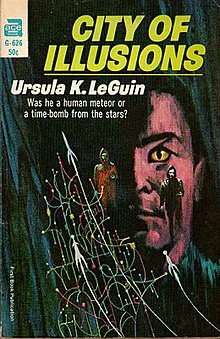
City of Illusions

City of Illusions came out in 1967 and lays the foundation for the Hainish universe, where most of Le Guin's novels take place. 

The story takes place 1200 years after the Shing has broken the power of the League of All Worlds and occupied Earth. Humans are alive, living as nomads and in small tribes. The Shing suppresses human civilization with Mindspeak, telepathy, and the ability to mind-lie. A descendant from the characters from Planet in Exile is involved in a spaceship crash. The Shing mindwipe him, leaving his mind a blank slate, tabula rasa. They throw him in the forest left to die as practically an infant. He develops a new identity and tries to find out who or what he is. 

I finished this novel today and find it to be the weakest of the three in terms of plot but the strongest in terms of character identity. Falk is a powerful sympathetic character. This novel is primarily about the inner psychology of the main character. Not unlike Frederic Pohl's masterpiece, Man Plus. It's not about action, it's about the soul. That's what matters here. 

The weakest part of this novel for me was the Shing themselves. They were supposed to be a race of Hitlers but they were portrayed as practically harmless. It was laughable in certain aspects considering that all the humans on Earth live in fear of them and animals have learned to talk because of them. The problem was that they were not convincingly evil. For one thing, they do not kill and have an oath about it. A group of 'bad guys' who don't come off as really all that bad is the death of a novel. Keep in mind that it's very hard to write a group of bad guys in novel form. Most of the time there are one or two bad guys in a novel, but a whole race? That's pushing it. This is why the idea of the literary Satan is usually left for poetry and drama.

LeGuin makes use of her own Tao Ching here. She creates a book for the humans that is basically their bible. It's important and was before and now a staple science fiction trope. I also liked how the humans on Earth 1200 years into the future were all nomads, barbarians, savages, yet there were still some peaceful ones living across the apocalyptic wasteland. It reminded me of Fallout 4. Of course, only in retrospect could someone [a video gamer] say that.  

In short, these three novels got me back into my science fiction readings. Le Guin strikes deep with her science fiction. As a whole, the work comes across as a vast cultural societal experience. Le Guin's work makes me think more about the bigger picture. Who really are the good guys in the world? Who are the bad guys? Who are we? What am I? I've already ordered Le Guin's The Lathe of Heaven and The Dispossessed [also in the Hainish cycle]. For now, I'm reading a modern 2013 new verse translation of Dante's Divine Comedy. Watch this space.

Monday, August 5, 2019

The Silmarillon

The Silmarillion is JRR Tolkien's epic history of the elves of Middle Earth. It was published and edited posthumously by Christopher Tolkien [his son] and an editor in 1977. I somehow don't believe Tolkien would've published this book on his own accord. However, I'm grateful that his son published it because it is a fascinating work of fantasy fiction. 

Where do I start with this? In the beginning, the Illuvatar [the gods of Middle Earth] created the elves, men, and dwarves. The beginning of the story is what kept me reading all 365 pages. I started reading the book on Tuesday and I finished the book on Sunday.

The Ultimate Supreme Badass of Middle Earth is detailed in the first ten pages. His name is Melkor, later called Morgoth Bauglir, aka the Supreme Mother Fucker of Middle Earth. Why is he so angry? Why is he a monster? Well, you see it turns out that Morgoth was a musician, like all the other children of Illuvatar, he was apart of the Valar. Most of the children played the harmonious music of the Ainur, singing sweet songs. However, Morgoth played his own original music. Being a drama queen band leader, he created music of discord, aka death metal complete with blast beats and shrieking vocals. Basically, I see the arrogant evil side of Morgoth in musicians. Even myself but mostly in others. Musicians are real arrogant assholes sometimes. And I thought that was so interesting psychologically that I would say Morgoth is one of my favorite villains I've come across in fiction. He was a disturbance in the music before it is explained that he wised to be called Lord by others. Morgoth is really cool and the way that Tolkien starts his epic history of the elves is described thus: In the beginning there was music and eventually the music turned to discord, eventually leading to the battles that would go on for hundreds of years in Middle Earth. 

The truth about the Silmarillion is that its very thorny. I found it difficult to actually finish reading this book. In fact, I listened to all twelve hours of the audiobook version but it was so difficult to follow that I decided that I should go ahead and read the actual book if I wanted to truly understand the narrative, thus actually 'completing' the book. I had a biased attitude towards fantasy despite reading Harry Potter, The Hobbit, and the Lord of the Rings in middle school. In recent years I've been such a science fiction afionado that I sort of look down upon fantasy as a children's genre. Although this is a heavy book that you could knock someone out with it is still a children's novel after all. Young adult if you will.

The book reads like a manuscript history of everything that could, would, and ever happen in Middle Earth. But mostly the Silmarillion is about the Silmarils, these jewels that the elves created that had infinite power. They're very similar to the Rings of Power that Sauron creates later but more beautiful and the elves will die for them. They proceed to fight over them for hundreds of years. This happened here, this happened there, and these are the people who did it, up to the 39th line [Aragon, called Strider later, Lord of men] of this family name and that family name. There is so much going on and it's so hard to follow that most people who attempt to read this book either stop reading it at some point and give up or take a very long time to finish it. Luckily I finished the book in a few days through some very intense reading sessions. Dedication I guess.

There are certain aspects of fantasy writing that I learned are very important to the genre. Here are a few. First, you have to create your own language for your original fantasy universe. If you have interesting names of characters, places, things, and events that in itself will keep people reading. Tolkien was a master philologist, a master of language and it really shows. Even the most boring parts of the Silmarillion contain a mastery of language. Not only did I learn a lot of new words but I was able to pronounce his own made-up words in my own mind in my own accent but because I listened to the audiobook I already knew how the words were supposed to sound, at least according to the British voice actor. However, I found that my own phonetics in my mind were even better and easier to prounouce. Remember that this book starts with a clash of sound and music. Language is apart of that. In addition, I would say that in a great fantasy novel the dialogue between characters shouldn't be overbearing, but rather that they only say what they need to say, the meat and potatoes of dialogue if you will. That is on display here as well. 

Next, if you want to write fantasy you have to have things happening all the time. And you have to explain it. Sometimes it could be simple things like explaining family lines and other times it will be epic battles taking place between dark lords, elves, and men. The fact that something is happening all the time in the Silmarillion makes it more enjoyable. Although as I said the prose is very dry I can't deny that there is always something happening even if it is just the explanations of this, that, and the other. It can get tedious but the creative imagination is powerful at work here.

Lastly, you need epic battles of struggle, strife, and discord. This book is 365 pages and the climax hits at the 180-page mark. It is a one-on-one duel to the death between an Elvish Lord and Morgoth, a melee duel. Morgoth ends up killing the Elf Lord but not without getting his ass kicked. He gets slashed in the face with a sword seven times. During the entirety of the fight, I imagined epic heavy metal music in the background. Sometimes I didn't imagine it because there were times when I would read the book with music in the background. Most of the time it was heavy rock and roll bands like Black Sabbath and Deep Purple. Now you see why these battles were so much fun. Sometimes the background music was Richard Wagner. Again this is a book about language, music, and sound despite the fact that most of the time reading is a quiet experience except for the turning of pages fast or slow. 

There's a lot of fun facts about Middle Earth here. My favorite is that the orcs are actually bred from elves. There's a love story between two elves who later find out they are brother and sister. You can guess how that ends up. Men were created way after the elves and are called the Followers. Dwarves were created second. The Dwarves played a great role in the battle against Morgoth. Men lived short lives in comparison to the elves and in the end, it was men who helped build Sauron's power through their evil lust for power. Sauron was Morgoth's protege who went on to become the second great dark lord after Morgoth was trapped in the sky [or something] after hundreds of years battling elves, dwarves, and men. Sauron is the main villain in the Lord of the Rings. Learning about his rise to power was fun but he's no Morgoth. He didn't destroy the music of the Ainur. 

Some of the things Sauron is into is very dark. Maybe a little satanic? He builds this temple to serve the dark lord Morgoth and men bring him, people, to burn alive as a tribute. That was quite morbid. He has an epic one-on-one hand-to-hand combat duel but in the end, he loses and flees his body, leaving nothing but a spirit. He is able to take the form of many things. He is able to take the guise of a beautiful person, charming and deceiving his foes. The Eye of Sauron watches over all of Middle Earth, haunting all living things, the Dark Tower presiding over all. Men quake in terror.

In the end, we have a conclusion to the entirety of Middle Earth that is somewhat more satisfying that the end of the Lord of the Rings trilogy [at least from what I remember from middle school]. We find out how the three great wizards of men came to be and how they created the White Council [of elves and men] to counter and watch over all that Sauron does. We have Radagast who is pure of heart and loves animals, who controls and watches over nature. We have Gandalf who is a great leader and friend to men and the half-lings, aka the Hobbits. We have Sauraman who is evil but pretends to work with the good guys while he admires Sauron from afar, seeking all his power and destruction. Gandalf didn't trust Saruman for he already suspected that Sauraman sought the power of the One Ring. And silly Radagast was so sweet that he helped Sauraman find the One Ring by sending all the creatures of Middle Earth in search for it, thinking that it was just part of the plan to keep watch over Sauron. Lastly, we have the pen-ultimate conclusion that it wasn't actually the White Council, elves, men, nor dwarves that ended up saving Middle Earth from Sauron's evil. Rather it was a half-ling, a hobbit named Frodo who, with his friend ended up completing the task that no one else could achieve. Knowing that is very satisfying. But of course, it's written that way.

What a read. If you like fantasy you're going to love this book.

Wednesday, March 6, 2019

E.T.A. Hoffmann Automata

Automata is an early proto-science fiction short story written by E.T.A. [Ernst Theodor Amadeus Hoffmann] Hoffmann in 1814. The story involves discussions and retellings of several distinct stories, during the evening amongst several men. The narrator walks into the gathering and notices all the guys are staring at this golden ring swinging in the ceiling. His friend says the ring moves according to the will of the men present. Then, another guy begins to tell his tale to prove the existence of the supernatural. 

Then, he tells a story about a young girl who every night at nine o'clock, sees this White Maiden. However, only she can see it. And her family soon believes that she's crazy. However, one night she sees the maiden and proves to her family that it is real. The girl throws a plate in the air to the White Lady [phantom] and the plate floats in the air, stunning everybody. Shocked, the mother dies, and the Colonel father dies in battle, leaving the girl a shell of her former self. 

Then, another guy recalls a story about a musician who was haunted by something playing on his piano at night, with virtuosic skill. Another guy is asked to speak so they can drop these occult stories but he brings up this manuscript titled Automata. Before starting he says something about how all of this is connected.

This story begins with an automaton called the Talking Turk [a reference to unbeatable chess playing Turk], which has such a lifelike human appearance, and people have a hard time figuring out its control mechanism, as well as how it answers questions accurately in many languages and attitudes. Its a bloody AI story, written in 1814. Or something like that. 

Lewis and Ferdinand end up visiting the Talking Turk and they see that the answers he's giving to the audience aren't to their satisfaction. Ferdinand goes to speak with the automaton and comes back to Lewis. He tells Lewis that there must be a spirit controlling the automaton because he asked him questions he had never told anybody else about. 

From here we learn that Ferdinand had a dream in an inn where a beautiful woman was singing to him, perhaps a childhood friend who he was destined to be with. Upon waking up, Ferdinand realized that the woman he saw from his window wasn't the woman from his dream. Although he locks eyes with the woman, she quickly takes off in a carriage. When he now asked the Turk if he would see the woman, the Turk says, "Next time you see her, she will be lost to you forever." 

Ferdinand is upset by his answer and won't give up. So Ferdinand and Lewis decide to learn more about the automaton and its maker, the old man Professor X. They meet the Professor and he puts on a musical performance for them, complete with performing automatons. Afterward, there is a discussion on the nature of music. On the sounds of nature and instruments.

Several months later Ferdinand leaves on business and sends a letter to Lewis, saying he's seen this long-sought-after singer. Upon recognizing Ferdinand she faints in the hands of Professor X. Ferdinand wonders if the Turk's prophecy has been fulfilled by psychic bonds making their way into everyday life. 

The story ends with Ferdinand being fine, they had even recently read one of his dialogues on opera. The group is tired of the automaton story, and ask to be done with it. It is said that the Talking Turk is merely a fragment, and the conversation moves away from the subject. 

This is a pretty great early sci-fi story from a German writer, artist, composer, jurist, and music critic. Hoffmann was an author of fantasy and Gothic horror, as this story seems to suggest. Hoffmann was also one of the major authors of the Romantic moment. One of the things that this short story does very well is involve music in the story. There are lots of musical terms, phrasing, sounds, as well the music performance of the automatons itself. I attempted to do something similar in my robot short story [which you can read here]. However, Hoffmann does it so much better. The way music is described by Lewis in the story is quite moving, he describes the way the sound of the stars might sound, and how he is appalled by the automatons performance. He believes that electronics and automatons cannot make moving music, because it is the human touch and emotion which moves us in music. It's quite a scarring rebuke in the postmodernist musical world, where EDM and house music can sound like a washing machine gyrating on and on. 

The literary style here is baroque. Hoffmann was a man of much learning. The way he writes isn't simple and some words I even had to look up online to understand the story. However, it isn't overly complex and his meanings do get across quite easily. The writing style isn't smooth, but it's not wooden either. It works. 

The musical aspects of this story moved me. The automatons themselves were interesting even though they weren't described too much or with much detail. Were they made of wood, plastic, or metal? How did they operate? Gears? Not sure but one thing for sure they could do many things. Another thing that this story makes me think about is the rise of AI, whether they are in the form of robots or just simply as everyday computers. This story definitely brings that all to mind. Although I can't say this is pure science fiction, there are definitely sci-fi elements here. This is a great read, recommended to anyone who likes literature of antiquity and proto-science fiction. 

I learned about this short story from Wikipedia's Timeline of science fiction. I found it under 1814, right before Mary Shelly's Frankenstein, a personal favorite. This story has aged gracefully and I believe it still has relevance in 2019, some 100 years later.

Read Automata here--http://users.clas.ufl.edu/burt/touchyfeelingsmaliciousobjects/Hoffmannautomata.pdf

Friday, October 26, 2018

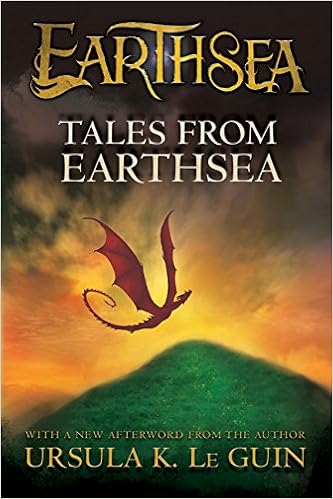
Tales From Earthsea

Image result for tales from earthsea coverTales From Earthsea by Ursula K Le Guin is one of those all-time great fantasy novels. Now I'm no expert on fantasy, but I know enough about the genre to say this is great fantasy, even if it might have been aimed at a younger audience. I've read some high fantasy in my youth; The Lord of The Rings series, The Hobbit, and some low-brow fantasy as well; every Harry Potter book. This is probably the extent of most general readers' knowledge of fantasy. Tolkien is a master of prose and high fantasy, and Le Guin just as well. 

The book is a series of novellas set in the world of Earthsea, all of them unique and different, offering us different glimpses of people and their ways in Earthsea. The first story, The Finder, details the wizard school on the island of Roke. Its said that J.K. Rowling's Harry Potter school is based on this. Important to note, the story focuses a lot on women and the role of women's magic within the school, which is integral to Le Guin's feminist tone. It sets the whole narrative up in an exciting way. Yes, there's sorcery, wizards, and wizards that turn into dragons but what makes Le Guin stand out from low-brow fantasy is that she makes a sociology out of it. 

The Bones of the Earth describes the relationship between Ogion, legendary wizard of Earthsea, and his first teacher, a very loving relationship. Darkrose and Diamond is also a sort of love story, about a guy who would rather be a musician than a mage, and the girl he loves. On the High Marsh is a tale of madness and redemption. 

The last novella is called Dragonfly, its about a girl that wants to enroll at the magic school at Roke island, at a time when women were banned. She ends up changing the world of Earthsea in the process. 

Le Guin is a gifted writer, and I've learned a lot about fantasy and writing from this book and one of her other novels, The Left Hand of Darkness, which is one of her best science fiction novels. I highly recommend The Left Hand of Darkness in addition to Tales From Earthsea. In the beginning I wasn't sure if I could get into fantasy, after all I haven't read fantasy since middle school. However, Le Guin makes it cool, smart, and literary. She's brought me back to the genre. 

Wednesday, September 12, 2018

Disenchantment, A Riff on Fantasy


Disenchantment is a new comedy animated show written by Matt Groening (Futurama, The Simpsons) and Josh Weinstein (The Simpsons). The show is about a princess who's friends with an elf who loves her and a demon who's possessed her for life. Its a fantasy inspired show with Futurama artwork. Not only do we get the characteristic Futurama style artwork, we also get the humor, albeit much dryer in the first couple episodes. 

Characters
Bean is an alcoholic bad girl princess to a terrible King who beheads and kills his subjects all the time. She's no saint herself, accidentally sending people to their deaths and such. She is a bad egg, a misfit, which might be because her mother was turned to stone when she was a kid and she's longed for her ever since. Likewise, her father is hell bent on getting the Elixir of Life, in order to restore his ex-wife, even though he remarried and even has a son with the new wife, an heir to the throne. 

Elfo is an elf who's completely ignorant of most things. He left his elf kingdom and almost died before he met Bean. Bean's father, King Krog keeps him alive because he believes he needs elf's blood in order make the Elixir of Life. 

Lucy
Lucy is a demon that possessed Bean when she opened up this bottle in the castle. He's the devil's advocate in every way, causing Bean to make horrible mistakes, ruining her relationships even more. Everyone thinks he's a talking cat. Despite being a terrible person, he's one of the more likable characters, joke-wise. 

The early episodes are slow and have almost rocky starts. This isn't a show that immediately envelops you in laughs. Rather, it makes you work for it, like a art-style science fiction novel, I'm thinking of Neal Stephenson, that kind of thing. Where you might enjoy the writing style, but its so dense that it takes you a long time before you get to the meat and potatoes of the story or what the writer intends to say. Same thing with Disenchantment. 

Slow early episodes
Things don't really start to become interesting until episode four, with each episode being 30 minutes that means you have to sit through almost two hours before things get rolling into a comfortable drama with jokes. In a way I've come to expect this, especially as a modern literary device, where writers can spend forever building up one idea, only for it to come to fruition and finish in two seconds. 

There are certain episodes where Bean does just this. She's put into a confrontational situation and she panics and we are wondering what she will do. Instead of something interesting or grandiose, she instead comes to a conclusion in two seconds, the plot is finished, episode done, fin. 

Now, I can certainly be critical here and say this is a result of lazy writing. It could be for all we know, we weren't there when they wrote it in their work room. However, it might not be lazy writing, perhaps they saw the easy way out and just went with the easiest solutions. Either way, I don't see it as entirely bad. Its just a cartoon after all. 

One of my favorite episodes was this one where Bean gets exorcised by a creepy guy who imprisons Lucy, and plans to throw him in a volcano at the top of a mountain, think Mordor. Turns out he had tons of Lucy's demon race people and he was throwing them all to their deaths! Bean almost falls into the volcano in order to save Lucy from death. Quite the surprise because we are given an understanding that none of these characters care about anything. When the old creepy priest is throwing demons to the fire, a female demon shouts out,"I possessed your aunt and she loved every second of it!"

End of season thoughts
The show takes a surprising twist near the end of the series when they get the actual Elixir of Life, and Bean uses it on her mother's stone corpse, which reanimates her to life. What will begin in season 2 will be a much different altogether piece of work, where Bean isn't at the beck and whim of her father, where she will be able to drink with her mother, and who knows, go on a quest and become a real warrior? They've been nudging Bean unto the warrior path a little bit. Which brings me to my next point. 

Is this real Fantasy? 
Have any of the writers of this show every read any real fantasy novels? Perhaps they have, and perhaps they haven't. I certainly haven't read any comedy fantasy novels, although I'm certain they exist. This isn't your high fantasy like Ursula K LeGuin or even low pop fantasy like Game of Thrones. In a way its just a fantasy skin, other than the fact that the time period is like the Middle Ages, albeit with swords and sorcery, this isn't like CS Lewis or Tolkien come to cartoon. Its video-gamish at times. There's a scene where the gang is flying atop a griffin, which is stereotypical of World of Warcraft fast traveling.

Critics of the show say it isn't fantasy enough, it doesn't satisfy fantasy fans. I say its okay, but that it needs to supercharge it fantasy credentials into high gear for season 2, otherwise I would say its pandering to the nerdy, intellectual, female, fantasy crowd. 

Female Lead
I've talked to friends about the show and some of them can't get into the female protagonist perspective. He said,"I don't find her funny." I think that's sexist, but perhaps this is a trend. By making progressive shows about female lead characters, TV shows are having an influence on gender politics and such. I think its great. In fact, I can relate to Bean in many ways, not because she's a girl but because of her alienation, which could be a symptom of being a woman in this universe. If the female protagonist is going to become a trend, I think its a good one because women aren't main characters much on TV (I mean this loosely, as the show is a Netflix exclusive). Its a nice touch. 

The verdict 
Although this show isn't as great as Futurama or The Simpsons I'm sold. I found it so good that I finished season 1 in three days, which is pretty fast for me because I don't watch TV shows too much. I see the entire first season as a slow buildup for more hip and happening fantasy-driven plot in season 2. I think that will be what brings in even more fans, and we'll see if the writers can 1) write better 2) write real fantasy 3) do more interesting things with the characters. I think if they do these things the show will not only become more popular, but develop into a cult classic, a new part of the geek culture, although in some ways it already is. Check out the show now, its on Netflix. 

Sunday, September 9, 2018

Science Fiction, An Important Genre


Science Fiction (and Fantasy) is a hellova genre. Its what got me into reading a lot, turning me into a hardcore book worm. I used to read a lot of the classics around 2011, back when I was a college student. I was into things like Shakespeare, Moby Dick, Walden, and The Sound and Fury. Once I dropped out of college I stopped reading altogether for a while. Then around 2013, I started reading again, mostly inspired by science fiction.

I've read a lot of science fiction novels and short stories since then. Phillip K. Dick, Ursula K. LeGuin, William Gibson, Issac Asimov, Robert Heinlein, Alfred Bester, Octavia Butler, Douglas Adams, Neal Stephenson, you name it. I began to build a love for ideas through these writers, at first enamored with the video game-ish ideas that can come from science fiction but eventually coming to an understanding that ideas from science fiction can help me to form ideas about real life. From Dune I learned about sociology and ecology. From Ursula K LeGuin I learned about anthropology. From Robert Heinlein I learned how conservative values can impact ones' writing. From Alfred Bester I learned that writing doesn't have to be fanciful to make an huge impact. These things are important.

Science Fiction is one of the most important genres today. Sci-Fi movies and novels help shape people's ideas and development of ideas when it comes to AI, automatons in the work place, consciousness, etc. This is an important ethical dilemma. Which is where science fiction has led me.

One day I was bored and typed in on google "oldest science fiction novels". It brought me to a Wikipedia page that listed Sir Tomas More's Utopia, Francis Bacon's New Atlantis, Margaret Cavendash's Blazing World, and Kepler's Somnium.

I read Utopia and New Atlantis and didn't look back (although I want to read both of them again). At first the archaic writing style of the 1500s was super difficult to understand. However, I kept reading and reading until it eventually made "more" sense, which took quite a while and a lot of google dictionary searching. The ideas of Utopia and New Atlantis were very utopian, socialistic, and communistic. From there I read The Communist Manifesto by Marx and Engels, which I found on a pdf through google.

That's not even the end of this quest (thumbs up fantasy nerds). After I read up on some socialist/communist ideas I went even farther back to Thomas Hobbes' political economy-Leviathan, which I'm almost done with. From there I read Descartes' Meditations on First Philosophy, a collection of essays in which he aims to prove the existence of God, quite an undertaking! For a while I became influenced by his writing, and even started to live a more holy life as a result. Holy as in being a nicer person, not fucking up at work, occasional prayer, diet and exercise. However, I am by no means religious. But the writers from the 1500s and 1600s who inspire me were mostly highly educated men from the Catholic schools.

Once my dad saw I was reading all of this without a context he recommended a great primer for me, which was Bertrand Russell's A History of Western Philosophy. This book has everything, as in every great idea of man and their originators from early man all the way to Marx and Engels. Russell is not only a philosopher who understands ideas but he's also an engaging writer that knows how to write in a highly educational way without being too technical, meaning anyone can understand if they put in the time and the effort. He's a mathematical person, this is very rare to find in people who are overly mathematical. The Russell book gave me a context for all the philosophy I was reading and will continue to read. If you read this book you will know more about ideas than most of the people you will run across in the general public. It was a great feeling once I finished it, its an 840 page book.

I also read classicist Madeline Miller's two novels Circe and The Song of Achilles, two books based on Greek mythology. From there I learned that I don't have to read fiction/nonfiction standard prose. I started reading the actual Iliad and from there started reading epic poetry of the Western canon. Now I'm reading Milton's Paradise Lost and Dante's Inferno. Although Miller's work isn't science fiction, not quite fantasy, it might as well be because its so highly unusual. Poetry is something I want to explore more of now.

Now we've completed the quest and earned some experience points. The point here is that science fiction has led me to the important things in Western literature. Its one of the most worthy genres out there despite what some people might say. A reader I was conversing with told me, "Science fiction gets a lot of shit but its done much for literature." I couldn't agree more.

Thursday, June 21, 2018

Summer Reading


I've been reading a lot lately. This entire month has been full of chapter and verse. Honestly I've just been trying to read as much as I can from a wide variety of subjects from science fiction, fantasy, the news, political science, philosophy, and classics. Here's some of the books I've been checking out. 

Thomas Hobbes Leviathan 
This book was recommended to me by Dad. It was written in the late 1600s so the prose is quite different from what I'm used to. Its political science philosophy sort of stuff. I've already finished the first book (its made of several books put together) and I have to say that Hobbes had some interesting ideas about well, everything. 

Marx and Engels the Communist Manifesto
This book opened my eyes to what the modern day Proletariat is all about. I have to go back and read certain sections, it was that good. 

Frank Herbert Dune
I saw the movie first before I finished the book (I'm almost done with it) but the book is quite a stunning science fiction epic. 

Ursuala K Leguin Tales from Earthsea
This was my first fantasy novel I've read since middle school with The Lord of the Rings and Harry Potter. This is way better than Harry Potter of course! 

William Gibson Burning Chrome
I'm almost done with Gibson's short story collection. I've learned a lot about science fiction short story writing from his great cyberpunk stories. 

Washingtonpost, NyTimes, The Guardian, BBC World News, Newyorker
Politics has become a big thing for me as of late. When I was ignorant I used to laugh at everything Trump did, and think that it didn't matter. When I realized I was wrong and stupid I changed my ways.  

Wired
I read a lot about Silicon Valley and the tech industry. Part of my interest for this came from pc gaming. From there I read Jaron Lanier's two books and didn't look back. 

W.E.B. Du Bois The Souls of Black Folk
I'm really into archaic prose and this is no exception. Not only is it exciting to read a black scholar's work from the late 1800's, I can relate to some of this stuff as a modern day black man. As my brother Robert said when I told him I bought the book for 50 cents,"I thought you weren't into that black stuff." 

I'm reading so much now that its hard to keep track of it all and I have to constantly manage my subscriptions from the library. I'm learning a lot and having fun doing it. 

"I find your lack of obsession with books disturbing."

Tuesday, June 5, 2018

An Android Story by Orlando Figueroa

Check out my first story written since 2013. Its called An Android Story by Orlando Figueroa. Its a science fiction story about an android that plays jazz saxophone. Enjoy!
Read it here.

Saturday, January 13, 2018

Kindred


Kindred is a time travel slave narrative written by Octavia Butler, an important black female science fiction writer from California. In Kindred a black woman (named Dana) in 1976 is transported to early 19th century Maryland (pre-Civil War), where she meets her ancestors, Rufus (white slave owner) and Alice (a black free woman forced back into slavery later in life).

The book is a first person account from Dana's point of view. She has a lot of trouble adjusting to becoming a slave, and the descriptions of events that happen to her and other slaves is horrifying. Butler has described the work as 'a grim kind of fantasy'. The novel takes into account power, gender, race issues, and speculates on future egalitarianism. Although this is science fiction because of its powerful portrayal of slave life this book is often a required reading for high school classes exploring African American literature.

Now I'd like to go into more detail about some of the topics that come to light from this book.

First, the story is from a woman's point a view, and a black woman at that. You could say its a sort of feminism but the idea of the strong black female protagonist isn't portrayed enough in science fiction novels, its a breath of fresh air. In the book Dana tries to change Rufus, her white slave owning relative by appealing to reason, and trying to allow him to see the evil in the ways of his time period. A man couldn't do that nearly as well or as clever as a woman.  

Race used as a social construckt. This book explores race thoroughly. The fact that she time travels back to the past shows a race paradigm that goes from the present (1970s) to the past (pre-Civil War) and goes into the present (today). 

"The lesson of Dana’s trips to the past, then, is that "we cannot escape or repress our racist history but instead must confront it and thereby reduce its power to pull us back, unthinkingly, to earlier modes of consciousness and interaction."  (wiki)    

Lastly, we have the meaning of the novel's title, Kindred. Kindred means a couple of things; it refers to the genealogical link between Dana and her ancestors but it also refers to the Universal link between all Americans regardless of ethnic background. Kinship of blacks and whites must be acknowledged if America is to become a better place for all.

Kindred is Butler's bestseller and its easy to see why. It oozes literary style (what a voice), emotional impact and drama, and keeps you on the edge of your seat for the two hundred and sixty page ride. As my first Octavia Butler book I was not disappointed, I look forward to reading more of her work soon. I'd also be interested in reading this again at a later date.

“‘Don’t argue with white folks,’ [Luke] had said. ‘Don’t tell them ‘no.’ Don’t let them see you mad. Just say ‘yes, sir.’ Then go ’head and do what you want to do. Might have to take a whippin’ for it later on, but if you want it bad enough, the whippin’ won’t matter much.”

Friday, January 5, 2018

Liliom


Liliom is an expressionist fantasy French film directed by Fritz Lang in 1934. Its based off a Hungarian play by Ferenc Molnár, which is where the movie's name comes from. The film stars Charles Boyer as Liliom, a carousal worker who gets fired from his job after defending a woman named Julie (Madeleine Ozeray), all because his boss was jealous of her and the attention he was giving her.

Julies becomes smitten with Liliom and they begin living together. The problem is that Julie works and takes care of Liliom but he doesn't work, he just takes and is a lazy bastard. Eventually Liliom learns he's about to become a father. So he takes part in a robbery, but it turns out the rich man they tried to rob had a gun! Rather than let himself be arrested he ends up stabbing himself, and his soul is transported to heaven. He sees all these babies with angel wings, and angels playing harps and stuff, space itself (fantasy elements). A heavenly commissioner tells him he's stuck in purgatory unless he goes back to Earth to do one good deed. That's the basic synopsis for the film.

"Liliom was one of the two first French productions by producer Erich Pommer for Fox-Europa and director Fritz Lang's only French film. On the film's release it was protested by the French Catholic clergy and was generally not well received by French film critics or playwright Ferenc Molnár. Despite the reception, the 1934 Liliom was one of Lang's favorites out of all his films." (wiki) 

I can see why the film was berated by French Catholic clergy for sure. The depiction of heaven is quite silly and laughable, however it is a product of its time and quite expressionistic, thus a bit unrealistic. More on the plot.

Once Liliom is in purgatory the commissioner asks him why he beat Julie (he was a woman beater folks), Liliom says he doesn't know. Then the commissioner plays a video of him talking to and then slapping Julie. Then he plays the same video, this time showcasing Liliom's thoughts out loud. He realizes he hit Julie a lot because he hated himself for his cruelty and selfishness (he finished the coffee in that video and didn't offer any to Julie until it was all gone, then proceeded to yell at her).

Sixteen years pass in purgatory and Liliom goes down to Earth to meet his daughter. He catches up with her and tells her that he knew her father, and that he was a violent brute. He had a gift for her too, a star that he stole on the way down to Earth from the heavens. His daughter Louise gets upset and throws the star in the gutter. The scale of good and evil gets tipped more towards the evil. This scale has the pyramid and all-seeing eye at the top of it, and the devil begins to inscribe Liliom's name on his tablet. Liliom slaps his daughter's hand out of frustration before he gets lifted back to the heavens.

Lousie goes to her mother and tells her Liliom's slap felt like a kiss. She then asks her if its possible to be beaten but for it not to hurt at all. Her mother says yes and and the two of them embrace with tears in their eyes. The scales of justice then tips towards the heavenly side and Liliom's name is slowly removed from the devil's tablet. Ending screen, FIN.

The film mostly got negative reception. But that didn't stop Fritz Lang from loving the movie. "Despite the film's reception, Liliom was one of Lang's favourite directorial efforts. In 1974, Lang stated that "Liliom, I always liked very much... Today, I almost like Liliom best of all". 

I actually liked the movie. It's the second Fritz Lang movie I've seen and I think he did a job directing it. I would say most of all I like the acting style in the movie the most. It had a sincere quality, the qualities of the characters seemed so believable and realistic, these characters could be people in real life with real life problems and lack of solutions.

The fantasy element of it was fun. In this film we find that for people who don't necessarily belong in heaven, there's justice waiting for them, and that's what we find in this film. I liked the special effect of the star that he tried to give to his daughter. And then there was the entire heavenly images and the scale with the devil, which was his friend that wanted to rob this rich man, except that he was in black face, or just covered in black paint wearing no shirt and shrubbery as his pantaloons. Kind of makes you wonder if they were trying to portray the evil side as African, which may or may not be the case.

All that being said, I don't think this is a necessary film to watch or know about, after all, its quite esoteric and expressionistic with its ideas. But I do think that its a good movie and quite an entertaining two hours of cinema. I would recommend this film to film students, directors, and film connoisseurs who haven't seen much of Fritz Lang's work. I highly recommend you see Metropolis from 1924 if you haven't seen it.

Liliom Zadowski: Even in Heaven, there's only justice - nothing but justice!

Friday, June 2, 2017

King Arthur Legend of the Sword


I figured I'd do a write up of this movie because it was so shockingly awful that it deserved to be written about in a negative way. The only thing worse than paying for this movie is getting in for free and finding that a whole two hours of your life was just wasted, vanished right before your very eyes. I'm gonna give you the good, the bad, and the mostly terrible.

First, what's good about this movie? Not much to be frank. However, if I could give this movie some compliments I would say that Mordred the evil wizard ends up turning into a cool demonic looking creature. He sacrifices the lives of his daughters and these snake women give him this incredible power. He becomes this giant monster with a scythe but that's not all. He can also shoot fireballs a la Skyrim mage. When Mordred and King Arthur were fighting at the end it was awesome seeing how powerful Mordred was physically as well as magically with his fireballs. Super cool villain.

The other cool thing about this movie is the actual sword that King Arthur pulls out of the stone. It turns out the sword is enchanted with magical powers but when Arthur uses it, it sort of just evaporates people into dust magically and can create tornadoes and stuff. It doesn't make any sense but its cool that they gave the sword some action packed fantasy elements rather than just "oh, here's a regular sword". The coolness of the movie ends with these two points.

The movie is mostly terrible. The plot-line goes nowhere and nothing makes sense. It seemed like the whole movie is just one scene to another scene with no thought put into what follows or what comes before. This is a 250 million dollar flop of a movie. If they can't even get the scenes to flow in good sequence what chance could they have for a great action flick? The other problem is that the movie is carried by action scenes. There's tons of destruction, action, fighting, kicking, arrows being shot, etc but its all wasted on a movie with a story line that ultimately doesn't matter because you stop caring about what's happening somewhere near the beginning of the film. The film ceases to be interesting after Arthur's grown up and we see him as a rugged man. Once he takes out the sword from the stone the movie just goes south.

I could see what they were trying to do here but they failed hardcore. They were trying to do a fantasy movie based on King Arthur and set it up for Game of Thrones and action flick crowd. Unfortunately you have to really know what you're doing to make that kind of movie and get people to actually like it. It seems like they just threw together this movie in a backhanded way. Also, the best actor in the movie was a guy who was actually from Game of Thrones. Props to that guy. I think his name is Little Finger.

The trailer for this movie was a little misleading. I thought it would be much better than that. I went in to the movie tired and by the end I was even more tired. I was mortified of the thought that I had just wasted two hours with my friends at the movies seeing a movie that was probably worse than watching a dog drop a turd on your front lawn. Do yourself a favor, don't go see King Arthur. Wait for it to come out on DVD, watch it, and then you'll see why this movie was so bad.

Look at the top, there's a cute Charmander mage!

On AI, Existential Threat, and the Collapse

Good evening ladies and gents. Hope you all had a good Sunday. I wanted to write here a bit more about AI, existential threat, and the Colla...