Showing posts with label novels. Show all posts

Sunday, August 3, 2025

Eliot's Renaissance Tempest: Romola's Moral Crucible


First, it may be surprising that, George Eliot, famous writer of 19th century English novels wrote one novel about the Renaissance period. Romola is George Eliot's fourth novel, a significant departure from all her other novels. Romola is set in Florence in the 15th century of Niccolo Machiavelli, [he's a minor character in the book], during Christian religious leader Savonarola's rise. 

George Eliot took meticulous notes on the Renaissance period for this novel and dives in deep to explore the themes of humanism and psychological human struggles. This is most likely Eliot's most intellectual novel, whereas her more popular books like Middlemarch and Mill On the Floss focus more on the intimate social realism of rural England in the 19th century, the core of all her writing and style. However, for the curious western canon reader, this book is not only important, but is a must read.

Second, Eliot uses the world of 15th century Renaissance Italy as more than a backdrop, it is a protagonist, the city itself comes alive almost like a character. This is one of Eliot's strongest stylistic writing skills. The political machinations of the city have it come alive like a person. The Medici's versus republicans, artististic ferment, impassioned religious leaders [Savonarola], and the passion of learning, ambition, and decline. The setting is important for the characters because it helps to explore the themes of humanism, faith, individualism, and communal duty. 

Third, Romola's journey from naive helper-scholar to her blind father to adept Holy Madonna is not only inspiring, it is downright transformative. Romola is one of Eliot's most well thought out characters, like Tito, her husband. Her duties were initially to help her blind-scholar father, her god-father, and her husband Tito, who she marries, but along the way she finds herself in struggle and contradiction. As every powerful character in Eliot's novels, she has to make tough decisions in order to find meaning in her life. She might be the most powerful and transformative character in Eliot's writings. 

Fourth, Tito Melema. Tito is a remarkable villain and, one of the best villains in Eliot's work. He's good looking, tall, dark, personable, intellectual, ambitious, but he's also backstabbing [marrying a peasant girl behind Romola's back and having two kids with her], he's so ambitious to the point of getting too involved in the internal politics of Italy [thus garnering him enemies], he backstabs his father who adopted him as a child, and because of that, his father ends up getting his revenge. Tito's Father's revenge is ultimately satisfying although not quite as action packed as one would think it would be. Most writers will never be able to write a better villain. If Romola represents Life and Holy Goodness, then Tito is Death and Intellect. 

Moving on, Savonarola plays a big role in the stage because of his strong religious fervor and influence. He's reacting against corruption of politics and the church, offering a powerful vision of moral renewal in Florence, Italy. You could say that because of Eliot's ideas on religion, she always has strong ideas of religious characters, ideas, and influence. You can say that she never has anything bad to say about religion. The role on religion on Romola is immense, to the point where in the end she finds a village suffering from the plague, and she ends up helping and saving a lot of them, thus becoming a Holy Madonna. 

Finally, putting it all together. Eliot's dense, allusive, descriptive, intellectual writing style in a psychologically penetrating prose style is what makes this book an amazing read. She's able to successfully and accurately use historical notes and detail without losing the narrative flow or psychological state of the characters. Her characteristic philosophical concerns are explored through this unique renaissance prism. The novel is considered Eliot's least popular novel and it was received with mixed reviews, but reading it in 2025 feels as fresh as a daisy, and I believe its a must read for the western canon list. 

In conclusion, like many historical novels of the western canon, this novel has epic scope. When the fires of belief and lightning of new ideas clash across Renaissance Florence, testing one woman's soul as kingdoms fall and fanatics rise, George Eliot's Romola forges a story so powerful it echoes through centuries, standing forever as a towering testament to how we hold onto what's true when the whole world shakes. The novel begs to ask the question, "How do we find meaning in our lives?" You could say that is what every George Eliot novel is really about.

Wednesday, February 17, 2021

This Immortal

This Immortal
, serialized as ...And Call me Conrad, is a novel by Roger Zelazny released in 1965. 

"It was abridged by the editor and published in two parts in The Magazine of Fantasy and Science Fiction in October and November 1965. It tied with Frank Herbert's Dune for the 1966 Hugo Award for Best Novel."

It's a short fantastic tale set in a post-apocalyptic world full of mutants and aliens.

In the beginning our protagonist Conrad, who either is or isn't Pan, [a Greek god], takes an alien visitor to a Haitian vodou ceremony. The idea of overmen, or gods, is very important here. The Haitians at the ceremony tell Conrad that his friend is possessed by a devil god named Angelsou. Well, to be fair he was a hired killer. The Haitian vodou section was a good experience reading in science fiction because Haiti isn't mentioned much in science fiction. As a Haitian-American, I find rather that most of the time Haiti is mentioned in popular works, it's always the negative zombies in the fields motif. Here, it was nice to see more of a cultural connection through religion. This shows Zelazny's interests in other cultures and makes his work more interesting other than big dumb objects in the sky of the science fiction pulp fanfare. The notion of tourism comes to mind especially while the characters are traveling in Greece, Rome, and Egypt. 

The story here is nothing special. Other people want our protagonist Conrad to kill someone going on his tour. Conrad doesn't want to do it unless they have a good reason for him to. They don't. So the whole point of the book is for Conrad to figure out why they want to kill him and how he's going to protect this guy from getting killed. It's very simple but the suspense is built up throughout the entire short novel. It's quite the usual linear novel that builds to a climax. 

Again, like in other Zelazny novels, it's not the story that is all that great or important, rather it is the writing style. Zelazny writes a fast, expressive exposition and dialogue that keeps you on the edge of your seat. There's a lot of fast action scenes in this novel. One of my favorite parts was when they attacked and captured by cannibals. And then some anthropologist who became leader of the cannibals pitted their vampire-god against Conrad, but it ends up being Husan, an Arab who ends up doing the fighting. 

Zelazny really got me when I found out they had to fight a vampire. But it turned out that the cannibals keep this guy locked up in a cage and only let him out to eat humans and drink their blood. So he's of course being taken advantage of even though his people see him as a god. Not only that but he's also a fat slab of 350 pounds that can barely move. However, what gives him his godlike physical abilities is not only his drinking of blood, which is the reason why he's called a vampire, because he drinks the blood, but also the cannibals give him drugs that numb any pain that may be inflicted upon him. He's basically a fat beefcake that feels no pain when fighting. But the fight was lackluster. It turned out that Husan had poison on his finger tips and although he got his ass kicked, the poison at some point finally kicked in and our vampire god dies in one instant. Anticlimactic to say the least but it does move the story along quickly. Simply put, it was written that way. 

At the end we still don't know what Conrad is. What we do know is that he is or isn't Pan. Also the novel begins and ends in the same way. Conrad and his girlfriend are just hanging out. Which is a good place to begin AND end a story. 

Saturday, February 13, 2021

Lord of Light

Lord of Light is a terrific science fiction novel written by Roger Zelazny. It was awarded the 1968 Hugo Award for Best Novel. It is was easy to see why this novel won the Nebula Award in 1968. Why? 

Because shock and awe. 

What can I say? This is one of the best science fiction novels I've read in a while [over 6 months], and if you take a look at my reading list [look here] you can tell that I've read a lot of really great science fiction. Although I've read a lot of the science fiction golden age canon, I must add that there's still a lot of great science fiction writers I haven't read. 

Moving on, the idea of gods, Buddhism, Hinduism, was known to me through hippy rock and roll and the flower power generation, even Frank Zappa says in a song, "a book of Indian lore." Keep in mind that I've also read the Bhagavad Gita and a primer on Buddhism entitled What the Buddha Taught, written by a Buddhist monk. But you don't have to know any of that to actually appreciate this book and that's the brilliance of it. However, I will say that known those two other books helps give me somewhat more of an understanding regarding these religious doctrines. Knowing about actual Buddhist parables gave me a much greater appreciation for this book. Having read the Bhagavad Gita, you can clearly see that the Hindu gods and their actions aren't entirely based on imagination. 

I fancy myself as some sort of zen master type. I tap into it quite often as a way to help me get through my day. Seeing our main character, Sam, as a Buddha but without having him actually proclaiming to be a Buddha, or even a god, or even a lesser god, although we still aren't sure what he is, that is something exactly like a real Buddha would do! It's brilliant. Why? Because its simple, it works, and it stays true to how we perceive gods and or prophet-god. The idea of Sam taking over all the godly order, there's a Luciferian catch to it, but the way the book is written, he's nothing like the Bible's Lucifer, nor even Milton's Lucifer, who is a lot more endearing in a sense than the Biblical version. Although the story is all over the place and the fight scenes are mostly just cinematic metaphors with thunder and lightning, the story makes sense until almost the complete end around the 230 page mark, where things go all over the place. But that's okay. I'll forgive Zelazny because it's fun. 

Zelazny is a stylist. Here the book turns out amazing not because the idea is great, unique, or original, rather it is because it is written in Zelazny's true voice, or original style as I will call it here, and because the writing is simply put, shock and awe. The idea of a science fiction novel in 1968 that's inspired by Hindu and Buddhist ideas from the East was probably a novel idea at the time, but it isn't so original these days. If this book was written in the modern era it would have a completely different effect on the audience, the reader. Because ideas were still new back then, and because it is precisely because its original that it doesn't matter if a lot of it doesn't make sense. Why? Because the way its written, the style, it just works.

A lot of the fight scenes between the gods make no sense. But it doesn't have to. Such is the nature of the gods. Long live the Lord of Light. 

Wednesday, August 19, 2020

August Update

Don Quixote eBook by Miguel de Cervantes - 1230000346474 | Rakuten ...Hello, everybody. I thought I'd write down a what's up post. I haven't been writing for some time now and perhaps just writing anything can get my back into the groove of things. So what's up?

I've been still doing my retail gig at the market. They took away our hazard pay after only 2 months but supposedly our union is trying to get it reinstated. I still can't believe that they took it away when COVID has only got worse. Keep in mind that the company is a million-dollar organization. How's that for a big fuck you to your employees? Jokes aside, I really do hope they reinstate the hazard pay. It's only an additional $2 an hour but every little bit helps. They also need to stop kicking their workers in the balls. 

Nevermind the fact that our chances of catching COVID are still super high there. Nobody cleans anything, not that I blame them. The customers are at a super high risk of catching COVID there too because nobody cleans anything. They could probably get it from touching the payment pinpad. The customers leave their masks and gloves in the carts for other customers to be surprised by when they grab the carts. Sometimes my community disgusts me. In a way, it's brought out the real me. You see, about 90% of the customers treat me like human garbage there, while maybe only about 10% treats me like a human being. I have to treat them accordingly if you get my drift.

For the last three months, I got switched to morning shifts. It was a big deal and I wasn't fond of it but I got used to it and enjoyed the free time at night to hang out with friends and family. Well, now I'm back to my usual night shift, which I've been doing for the last couple of years. It's not fun but I'm used to it. And after working mornings for the last couple of months, I actually miss the mornings, the morning coworkers, the better preparation, the extra help. Everything's easier during the morning and daytime when everybody is there. When you have a full staff to run things, you get a lot more done. At night our managers don't give us enough personnel to get everything done. So consequently, not much gets done. 

I've been using my nights to relax and smell the coffee. I'm trying to find a new way to live during COVID. It's very difficult and stressful at times. My job has become a lot more stressful and more of the customers are assholes all the time now. Them not being able to go out and party, on top of not having work, or having their kids at school, it's set them off. They're driving me and my coworkers crazy. This is not a good time for retail or any kind of store operation. If you have to go into a store, treat the workers really well. At the beginning of the pandemic, they were heroes, now the customers are treating them like shit. 

I spend most of my time reading books on my Kindle or on YouTube, where I can listen to my precious music, quite possibly the only thing keeping me going at the moment. My friends are there for me but they can't be there all the time. And I don't want to bother my family too much, I feel like I've been a burden to them. I realize I need to eventually spread my painted bird wings and fly out of the nest. Perhaps when this whole virus thing ends once and for all. 

I've been thinking about moving in somewhere with some roommates. Or with closer friends. Or perhaps joining a hippie commune somewhere? That would be like the ultimate hippie move and I would perhaps even be down to do it, provided my other plans in life don't work out the next few years or so. That would be so wild, born to be wild.

As you can tell, I've just been pretty stressed at the retail gig. But not only that. About a month or so ago, I sprained my right-hand pinkie, and playing the guitar isn't the same. It might be another month for it to completely heal IF it completely heals. If it doesn't heal, playing the guitar will never be the same. In a way, I've been super pissed ever since the day it happened, long story about that but I won't go into the excruciating details. But let's put it this way if you're a guitar player and you get a finger injury, the only thing you really have to say to everybody is, "go fuck yourself, fuck you." That sums it up perfectly.

But there's good news too. I've finished Livy's Early History of Rome and started reading Don Quixote again. Perhaps I'll finally get back to blogging about books again and albums. The whole lifestyle/rant blogging style has sort of run its course somewhat for the time being. Thanks for listening.

Enjoy your evening. 

Wednesday, July 1, 2020

Reading List & Thoughts

Hello, everybody! 


I took a couple days in between posts but now I'm back. Life is good despite the fact that what we're all going through regarding COVID-19 is undeniably terrible and bleak. I figured I'd take some time to write about some of the books I've been reading. 

I just finished Plutarch's Lives a few days ago. Undeniably, one of the greatest works of literature of the Western canon. One of the greatest literary works I've ever read, without a doubt. Most literary and scholarly types would know Plutarch's Lives, but for those that don't know, Plutarch was an ancient Greek that wrote biographies, histories, of famous Greeks, then compared them to famous Romans, then showed how they were similar and how they were different. It was so good that it eventually became a part of the Western canon.  For nearly 2,000 years the book was widely read. Still, to this day.

Plutarch starts the 1400 page mammoth of historical biographies with Pericles [Greek] and Romulus [Roman], thus by starting with the founders of each nation, giving them a grand introduction, as they appear rather as myths or folklore, or gods rather than men. Giving them a grand legendary story, maybe not sticking to the facts, he gives us a great introduction to the series.  This introduction is perfect as it sets a foundation myth story that is foundational to any culture.

Although a lot of the book is military conquest facts and historical details, events, and dates, what actually makes Plutarch's work more interesting than mere historical biography is the fact that he's interested more so in the personality and virtues of the characters as opposed to the other stuff. Meaning, that, however, some of his historical details, events, and dates are actually wrong, sometimes going on some random tangent, stories that might portray the character in a certain light or different angle. 

Here are some takeaways from completing the work:

1) Everybody should know at least a little bit about Greek and Roman history.
2) Military history is an important element and should be looked at closely.
3) The virtues of world leaders should be taken into consideration when they're elected into office.
4) In order to be an effective leader, one needs to have lots of free time; thus, when he spends his leisure time, he should spend the time reading works of the western canon, and studying philosophy, thus so when he interacts with people in society, he has a kind and gentle nature. 
5) If you read and finished this book, congrats, as its a heavy book, full of the dry, difficult, Victorian-era one-page sentences [by way of the Dryden translation, which has been revised by Arthur Hugh Clough in the 19th century]. Yeah, there are many one page sentences in the Dryden translation I read, and yes, it was all very hard to keep track of, and yes I did have to reread lines, and yes it was painstakingly time-consuming, but in the end, it was worth it, because I enjoyed what I was reading, what I was learning, and although the process was a chore, in the end, it was worth it because I was passionate about Greek and Roman history, history in general, and adding another great Western canon book to my list of reads. 
6) Read this book! Even if you only read Pericles and Romulus, it would give you such a great introduction to the history of the Western world. It appears to be the case, that at least in terms of written history we can recall from, the Western world starts with the Greeks and Romans. Very important. Foundational.

For a while, I was reading Don Quixote too. I love the idea of a satire about chivalry and knights-errant. What is also interesting is that although most of the stories seem to be jokes, some of them appear to be quite serious and realistic, almost as if they actually happened. Some of it is so realistic that it almost had to have happened to actual people. Some of the events might have been real, others satirized, and what have you. I've been reading a 2013 translation by Edith Grossman, the only woman to ever translate it, and she wrote it in a modern way, giving it more appeal than its usual 1800s translations, which have in my opinion, more of the language of their time. With the Grossman translation, it appears that Don Quixote has been modernized in the best way possible. I plan on eventually finishing it sometime in the near future. Another classic on my list. 

Lastly, I have a book I just started reading tonight, a fantasy novel. It's called The Last Ringbearer by a Russian writer named by Krill Yeskov. I heard about this book through friends on Facebook. They were talking about Tolkien and someone mentioned that someone wrote a book from where Tolkien left off and put things more in the orc's perspective. I asked them what the book was called. I started reading it. While the idea seems like a fanfiction sort of thing, Yeskov is a serious guy, a paleontologist of all things, and if you want a good reason for why he wrote a sequel to the Lord of the Rings, look no further than here, https://www.salon.com/test2/2011/02/23/last_ringbearer_explanation/and although I can't say the guy is a great writer or a literary writer, his style fits the bill decently, and it's a quite a fun read, especially considering that Tolkien never really cared much for his orcs, and here, Yeskov gives them a lot of depth and personality. I've been meaning to read more fantasy, this will work.

Reading has been my one solace during the pandemic. I hope all of you have been reading good books or at the very least recent news articles. It's hard to find time in the day to read but if you make time, the reading will be well worth your time and effort. 

Stay safe.

Monday, June 8, 2020

Back To Reality

Hello, world. I've been on a leave of absence from work since April. Tomorrow I get back to my retail gig at the market. I thought I'd jot down some thoughts on the time I spent away from work. 

I've been in my own quarantine without having caught the virus since April. I didn't see or talk to people in person other than people at the grocery store and my family. I really started to miss those everyday actions and interactions with people. I went out on a lot of long walks on most days. Even tonight I went for a long walk. 

The time I spent away for two months was great. Time spent enjoying an interior life. This pandemic calls for the individual to have an interior life. If you don't have an interior life this pandemic is going to be very rough for you.

I caught up on a lot of reading. I read The Plague by Albert Camus, We the Russian dystopian novel, Slan the first mutant novel sort of like X-Men, The Day They H Bombed Los Angeles the first zombie novel from the 1960s, an entire Science Fiction Hall of Fame collection of short stories from the 1930s-1960s, Love in the Time of Cholera by Gabriel Marquez, The Satyricon by Petronius Nero's style expert, The Art of War, the Tao Te Ching, parts of Don Quixote, 75% of Plutarch's Lives, and parts of Zhuangzi. All of these things have merit and were well spent reading time. I was particularly impressed by Love in the Time of Cholera. How it goes to such excruciating and yet humorous details about the tribulations of undying love. 

Reading was probably the one thing that I couldn't do without during this time. I learned a lot reading Plutarch's Lives about famous men of antiquity [my favorites are Pompey, Crassus, Ceasar, Pericles, Romulus, and Nero], their virtues or lack thereof, military conquest, and the culture, history, and philosophy of ancient Greece and Rome. I plan on finishing Plutarch's Lives within the next week or so. I got into reading Plutarch because my brother turned me onto a podcast about the History of Rome, Mike Duncan's History of Rome [downloaded over 100 million times] so I supplemented that with Plutarch. The book was given to me by a customer at my work. She thought I would like it because I've told her that I've read certain things in history and philosophy.

I also spent a lot of time gaming. I played a lot of Heroes of the Storm, Overwatch, and Team Fortress 2. My go-to games for the last six years. I started playing ranked Heroes of the Storm a lot more and that's been a good experience. I took a break from competitive Overwatch but still plan on playing it in the future. Likewise, I've been on a break from Team Fortress 2. So it's mostly been Heroes of the Storm ranked mode. Playing online games competitively teaches you how to be a team player and a leader. To improve and rank up in games takes determination, will, skill, and sheer luck. Although I probably played way too much I would say it was a good experience. Therapeutic even.

I also spent a lot of time reading the news, watching the news, and discussing politics with friends on social media. If you aren't following up on the news you should wise up and start paying attention. There's so much happening in a single 24-hour news cycle nowadays that not reading the news for one day will put you far behind on the issues. I read the news every night before bed and sometimes also in the morning when I wake up. It's a routine.

With the pandemic still ravaging the human population in America and the unending systemic oppression of black and brown people by police still haunting us every day, keeping up with the news will make you a smarter, more informed individual. You don't want to be an everyday low information person. Those people sound dumb when they speak before others and they speak the loudest as well. Do you want to be like them? If not, then keep up on the news. You don't have to be a news junkie but a few articles every day goes a long way.  I recommend Rachel Maddow [for a general but important view] on msnbc for TV and the Nytimes [for a national view] website for text-based news.

Lastly, I want to say that I did a lot of thinking and soul searching, without even going anywhere, doing anything in particular, or leaving my house. This is the time for us to do that; during a pandemic that's put millions of Americans out of work, during a period of civil unrest where police brutality and racism is running rampant. I thought a lot about what I want out of life. Goals, dreams, actions, near, far-term, the future, and all the metaphysical feelings associated with it. The time off really chilled me out. I see now more than ever that the world exists based on your reaction to it, as well as others'. You can only control yourself, your own actions, and your own thoughts. If you can bring people into your life and make them meaningful to it in some way then perhaps that's what we are all here for. "Love is life's sovereign goal." If more people saw life in that way, the world would be a much better place.

Tuesday, April 21, 2020

We

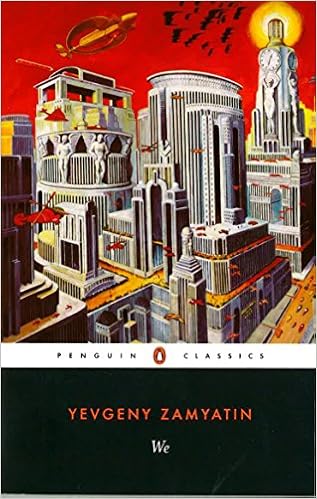
We: Yevgeny Zamyatin, Clarence Brown, Clarence Brown ...
We is a classic dystopian science fiction novel by Yevgeny Zamyatin, written in 1920-1921, published in 1924, via English translation in New York. Yevgeny was part of Russian proletariat writing groups and eventually requested to leave Russia as many writers were being persecuted, thus resulting in the death of their writing careers. In fact, when Zamyatin died, there was no mention of him in Russian papers. Most proletariat Russian writers made livings elsewhere like in Paris, England, and the United States. 

The novel depicts a world of harmony within a totalitarian system. There is freedom but only ruled by the Benefactor and activities are ordered along to the 'Table,' a system that controls every hour of everyone's day. In some respects, there wouldn't be a Brave New World by Huxley if it weren't for We. No 1984 by Orwell. No Handmaid's Tale. There wouldn't be all those tons of young adult dystopian novels either. We did it first. 

I will focus on the plot first because it's pertinent to the ideas therein. 

We is set in the future. Probably far future because they have space ships. It's said that there was a great war over something, which is only alluded to in the novel. A resource perhaps. It resulted in the use of weapons of mass destruction, leaving the world outside One State a post-apocalyptic landscape. 


The main character is D-503, a space engineer. People have no names, rather they are identified by number. It takes place in an urban society constructed of glass, which helps for mass surveillance. The people march in step with one another and wear uniforms.  Life is managed scientifically; everybody eats at the same time, works the same time, has recreation hours at the same time, and they even have scheduled times to have sex with partners they can sign up for, rather than of their own choosing. People think with science, logic, and reason above all. The formulas people use are ones devised by the One State, their form of government, lead by the Great Benefactor, their supreme leader.

One State has conquered the whole world. They're now building a spaceship in order to invade and conquer other planets, thus bringing One State across the universe, helping their cause, and increasing their numbers. The ship's project engineer D-503 writes a journal that is meant to be brought along the spaceship when they go to another planet.  

D-503 lives in a glass building like all the others. His partner, O-90 is deemed too short to bear children and is upset by this. His best friend is R-13, a guy who reads his poetry verses at public executions. On an assigned walk, D-503 meets I-330, who flirts with him without being properly assigned. I-330 is a careless free spirit; she drinks alcohol, smokes cigarettes, has casual [not assigned] sex. Every guy has met a girl like I-330, that footloose, and fancy-free girl. In short, she's doing everything that you're not supposed to do in One State. D-503 is appalled but intrigued at the same time. He continues to see her. 

D-503 starts to have a lot of freedom through I-330 and starts to have dreams, which the One State describes as mental illness. "What's wrong with me doc?" "You've found out that you have a soul, for which there is no cure." That's my favorite line in the book because it has that edge of snarky satire as well as philosophical ramifications that goes back to the Greeks. It works well. 

Slowly, I-330 reveals that she's part of an organization called Mephi, which plans to bring down One State. O-90 wants D-503 to illegally impregnate her but in order for her to stay with the baby, she has to leave One State and go beyond the wall, where primitive humans live, complete with coats of fur. 

The last journal entry details the 'Great Operation,' a brain surgery of sorts, that targets the brain with x-rays, so they can function as 'tractors in human form.' It basically makes you more of a vegetable. Removes imagination. Once D-503 gets the operation he runs to the Benefactor to tell him about the Mephi operation. I-330 and her associates are sentenced to death under the Benefactor's machine, which literally melts the human body. A  death ray.

But the novel ends on somewhat of a good note. The Mephi operation is doing well, birds are repopulating the city, and people start acting out against the regime. One State's survival is left in doubt. The book ends with a strong manifesto; just as there is no highest number, there can be no final revolution. 

 Now we get some ideas. 

First, the writing style can, at certain times, be quite a satire. There's one scene early in the book where a woman is playing the piano and people are watching and listening to her play. At one point during the impromptu performance, which is already rare in this society, D-503 starts laughing uncontrollably because music is such an unstructured improvised form that most of the citizens just aren't used to. 

The scene with the doctor is my favorite in the book. "You have a soul. There is no cure." That's a great satirical moment, a great laugh. Of course, it was true, D-503 had indeed, somehow developed a soul through his new girlfriend, I-330. 

The idea of having sex only with assigned partners and only at certain days and times is also a laugh. Did they also forbid masturbation?

There are philosophical ideas at work here too. In fact, the doctor scene isn't just a satire, there's a religious tone to it as well. The idea of the soul separate from the body and mind goes back to Plato and Aristotle. This is used in fiction to good effect. The fact that D-503 developed a soul rather than being born with one is another note on satire. 

The idea of a conformist culture where everybody is happy [for the most part One State is happy] should be considered utopian, right? Well, the thing that makes One State a dystopian novel rather than a utopian one is the fact that One State not only wants to take away freedoms [which is fine because most of the people are cool with that], but One State also wants to get rid of imagination. In We, imagination is the mind-killer rather. If the citizens of One State were allowed to imagine this would be an entirely different novel. 

Lastly, this is one of the important and critical works in science fiction, particularly in the dystopian canon. I initially read this on the recommendation of a Russian friend of mine. I'm glad I read it because it's truly a great story and it stays with you. This isn't something you read and forget about a few months later. It's that important of a book. Considering the way governments are run today you will find that Yevgeny Zamyatin's ideas still ring true to this day. For just as there is no highest number, there can be no final revolution.

Saturday, April 4, 2020

The Moon is a Harsh Mistress

The Moon Is a Harsh MistressThe Moon is a Harsh Mistress, the novel by the classic and famous Robert Heinlein is one of those classic science fiction novels, from the golden age of science fiction, the 50s-60s. TMIAHM was initially released through magazine installments, later as a full novel. The novel won the Hugo Award for best science fiction novel in 1967, during the height of the flower power hippie movement.

Which was great timing for Heinlein to write this book. For you see, this book is a good story, but it is also an exercise in literary politics and/or political economy, particularly libertarianism. So it makes sense that Heinlein would publish and write books with this flavor of politics during the 1960s when many young people would be exposed to these, then new ideas for them.

Let's start with the story. This is a story about revolution. A lunar colony on the moon is taking control over the colony, giving it to the people [in this case, our narrators/main characters], and saying, "screw you," to Earth, and all the Earth countries that won't recognize this new regime. 

The new regime comes to be through a particularly striking main character; a sentient supercomputer who befriends the narrator and his two friends. The supercomputer, named Mike, is so lifelike, but the fact that he wants to help humans stage a revolution and succeeds in helping them do so, makes him a lot like a computer Pinocchio. What does he get out of it? Friendship really is all. It's worth it.

The narrator, the main character as well, is a guy named Manuel, who's first language seems to be Russian, so he speaks in a sort of broken English not unlike what you would see in Slavic languages. Sort of like the slang in A Clockwork Orange. The first couple of pages reading it is sort of strange, but then you get a feel for it, and just go with it. After all, you can't expect everybody you talk to, to speak in perfect English, better get used to it. Mannie is Mike's technician, and he isn't a much of a political guy, but he gets roped into this. 

By a woman of course. Wyoming Knott-Davis. She's a beautiful blonde. For a while, she uses advanced technological makeup to make her look African while she's in hiding, complete with an afro. But she's blonde most of the time. She gets Mannie involved with politics, after Mannie saves her from a blood bath, as you see a political secret meeting against the Warden took place, and it was raided by Dragoon Troops, the Warden's hired goons. The action scene that took place in that instant was classic military science fiction, complete with laser guns, blood, and gore. I liked the scene a lot and expected more of this. Ironically, there isn't much actual fighting and action, at least not till the very end. But our three characters needed one more person to help them realize their mission. 

Enter Professor Bernado de la Paz. He's an old teacher who's taught nearly half of Luna. He describes himself as a Rationalist Anarchist, which basically means that the government has no existence but for the acts of responsible individuals, "tries to live perfectly in an imperfect world." He's the true radical of the group but realizes that the need for the government does indeed exist and achieves it.

Some info on the world-building here. Luna is seen as a sort of Old West, and the revolution is reminiscent of the Bolshevik October Revolution as opposed to the American Revolution. People are sent to Luna either to escape bad fate, live a new life, or they're prisoners. Luna is short on women so women are heads of families and families are composed of 'line marriages,' giant families that pool all their resources together. Once when Mannie is in North America he gets arrested for polygamy, as he has multiple wives. Women are so scarce on Luna that they never get hurt, or even raped. They're safer there than on Earth surprisingly, even among criminals.

So we have these characters achieve a revolution. Now what? They do their best to form a government, get the rest of the world to recognize their new independent status. Failing that, they 'throw rocks,' at the Earth, hitting most of the countries with heavy bombs, carefully shot from Luna with the help of Mike, a ballistics expert, who even gets his own human persona, which he creates using images on a screen. What a computer! Probably the best-written computer character I've seen in science fiction. 

After the Earthlings get mad at Loonies [yes that's what they're called] for bombing them, they retaliate by indoctrinating some prisoners and drugging them, telling them that unless they kill as many Loonies as possible, they won't get their freedom back. This results in an epic bloodbath on Luna. More Loonies die in the firefight that ensues, but they kill all the Earthling intruders and come together more than ever. In a blaze of glory!  

Realizing that they failed, the Earthlings concede Luna's independent status and the mission is complete. It's a great read in terms of story, plot, characters, politics, and philosophy, but the thing that can't be overlooked is that this is just a damn good story. Definitely read this is you're a science fiction avid reader. Don't get me wrong, this is not a masterpiece, but it's important enough that it's a must-read science fiction novel, in my humble opinion. 

On a side note, reading this during the pandemic has me thinking a lot about politics. Could it be that the politics that emerge out of this historic pandemic would shift to a more libertarian sort of state? Something to think about.

"There Ain't No Such Thing As A Free Lunch!", (a common expression on Luna that states one of the main ideas of the book's political system.)

Sunday, March 15, 2020

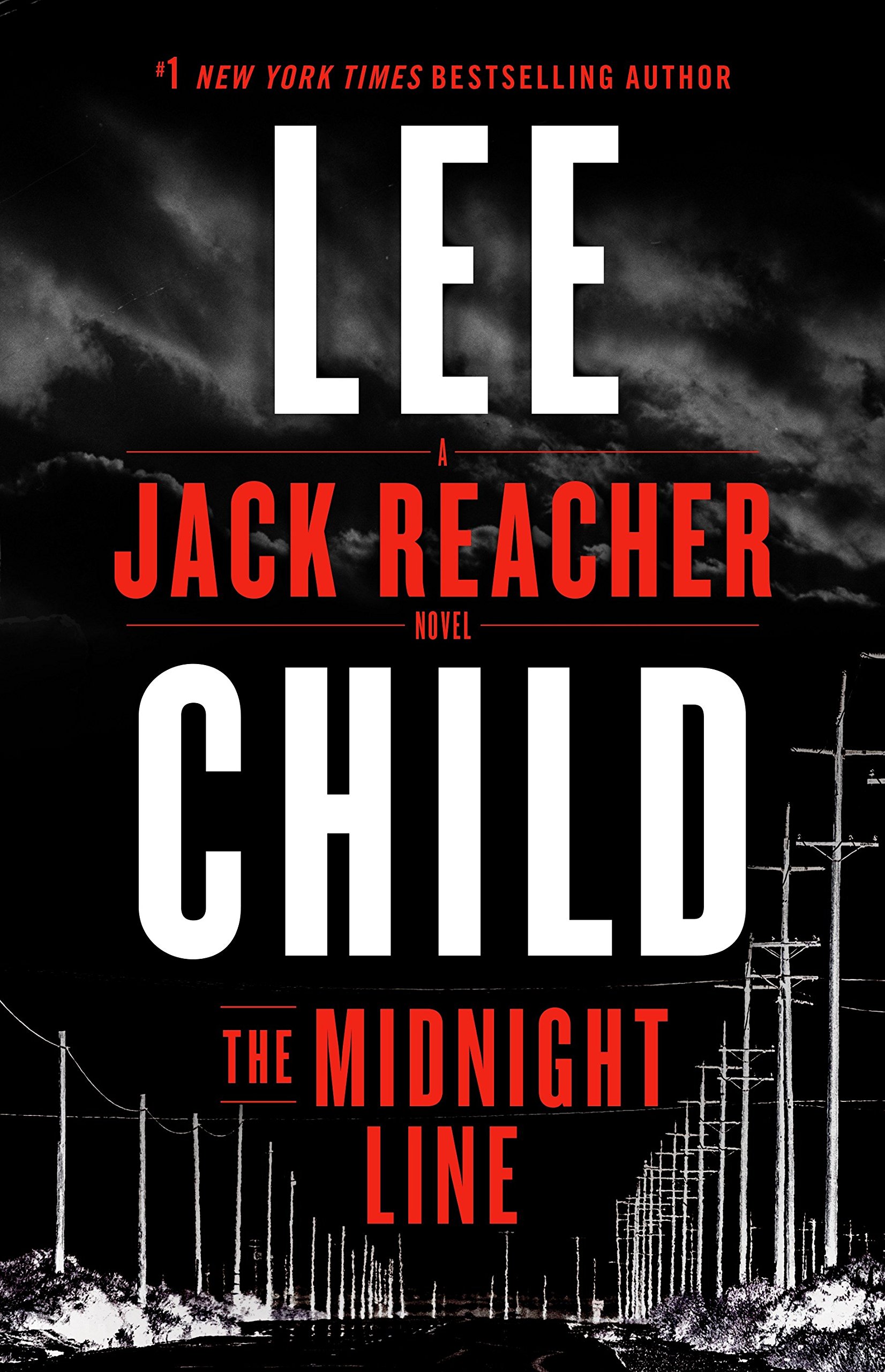
The Midnight Line [A Jack Reacher Novel]

Image result for the midnight line jack reacher book coverThe Midnight Line is a Jack Reacher novel written by Lee Child in 2017. Let me start out by saying this is my first Jack Reacher novel and it is a great one. I would even say superb. Before this, I was familiar with Jack Reacher only through No Middle Name, Child's short story collection about Jack Reacher. That was very good too. But not as good as this novel. 

Okay, so the novel takes place with Reacher somewhere in the midwest. He goes to a pawn shop and finds this ring, the catalyst for our entire story. The ring is engraved with the initials S.R.A and it's from West Point. The very same school Reacher graduated from back in the day. Reacher knows it's a woman's ring because it's tiny. He goes on a quest to find the woman, return the ring, and make sure that she's safe. Because the only reason a West Point student would sell her class ring is that they're in some sort of dire straights and/or trouble. Right? Right. 

As far as suspense thriller versus action this novel is more on the suspense thriller side of things. Which inevitably means its a more serious book. More serious than the next novel in the canon, Blue Moon. But there are still good fights and an incredible climatic takeover and/or heist moment in the end. Jack goes through all kinds of clues, traveling, following, and occasionally beating the crap outta anyone who gets in the way of his mission, to find the woman who owns the ring. One guy even gets his head blown off. Talk about over the top.

The action is simple and straight to the point. It actually reminds me of the action scenes I've read in Cecelia Holland's intense historical fiction novel fights. Except I believe Lee Child knows more about the actual machinations of guns and how and they work. Short, fast, climactic, and brutal in some cases. It's a good writing style. I've learned a lot from it. There's a lot going on stylistically in this novel that Child does.  Also, keep in mind that this novel doesn't feel like he's just making it up as he's going along. [Even if he actually did that.]

The prose is short, simple, and sweet. It's all simple-minded plotting and narration but there's a continuous momentum that keeps the book running from page 1 all the way to page 368. This is a longer novel than your typical suspense thriller. And despite that, it never loses momentum. You want to keep reading until you find out more. You keep reading, find out more, and that propels you into more reading. Well, you get the picture. I read almost half the novel in one day off work. It's that good. It's a great example of popular writing that keeps the readers wanting more. Hence the fact that Lee Child has written twenty-something of these Jack Reacher novels. Not all of them are as good as this one of course. 

So Reacher goes on to find a Private Investigator who is also looking for the woman. An Asian cop is trying to take down a low-level criminal involved in the case. The woman's twin sister gets involved. The Super Intendent from West Point looks back at the woman's records and finds information about her. She's ex-military, been to Iraq five times. Honorably discharged, Purple Heart, face wound. Her twin is so beautiful you don't want to look away. Serena Rose Anderson is the other one.  Hooked on drugs. Has three cowboys look after him in some cabin the woods. A former boyfriend who OD'd himself. No good news.

What we find out throughout the novel isn't quite as much of a big reveal as you'd expect. Nothing truly surprising happens. Rather, it's the way the story is told that is memorable and remarkable. There are touching scenes in this novel. Some that are even very sad. There's a lot of good one-liners from the characters, especially Reacher. 

"I need to pay Arthur Scorpio a visit. He lied to me about Porterfield, and he told two separate people to shoot me from behind a tree. He crossed the line. It's not going to end well for him. He's going in the tumble dryer." 

The actual story, narration, characters, plot, and actions are all very simple. But the delivery and result of all the work put into this are top-notch. Overall, I would say this is one of the better fiction novels I've read this year. Again, it's all simple-minded, and perhaps anyone with decent writing skills could write like this or at least something like this. But it takes Lee Child's drive and will to write an action-packed Jack Reacher story with emotional gravitas. Bravo.    

Much recommended. Better than Blue Moon, the most recent book by Lee Child.

Thursday, November 21, 2019

What's a brotha to do?

What's up ladies and gentlemen of the interwebz. It's been a minute since I last wrote a post. I've been on a blog/writing hiatus for a while now. The reason? A lot of work at the main retail gig mostly. Lately, I've been getting these long six-day work weeks. Eight hours, six days a week. They're exhausting but hey, I think they call that a job. 

I've been reading a lot. I recently finished The Brothers Karamazov by Fyodor Dostoevsky. Nearly 800 pages! At one point I was averaging about 100 pages a day. I'm currently reading the Canterbury Tales by Geoffrey Chaucer. Bring on more classics of the western canon! Brothers Karamazov is such a great work with so much gravitas that I think it deserves to be reread in a couple years if not sooner. 

The Canterbury Tales took me a long time to get into. For a while, I contemplated reading it but instead got hooked on video games for a few days. I've been playing a lot of Overwatch within my last two days off, leaving me in a kind of zoned-out, zombified, sort of state. The game is fun but it gets to be a little mind-numbing after a while. I've been in gaming limbo. Most of the time I don't play games at all but every now and then on days off, I play a lot. Missing out on precious reading time on days off.  

Actually, if I don't read pretty often [every day] my mind starts to wander and drift off into this kind of zoned-out mode. What can I say? I have to stay engaged in the literature to feel active in life. I've become such a reader that when I don't read for one-two days, I start to feel not quite like myself. Fiction especially. And philosophy. Literary essays. 

In terms of music, I've been playing weekly jazz duo jams with my friend Jason Thomas. I'll probably post some music from our sessions here at some point soon. The jam sessions have become more improvisational but I would say that we need to increase our repertoire. Especially Coltrane songs. Songs like Afro Blue, My Favorite Things, Naima, etc. 

I had a freaky moment at work during the past week where I met a music student who actually studied with my music mentor, the new music composer Frank Abbinanti. Apparently, Sid studied with Frank for five years [or more] in Chicago before he came out to California to study at Cal Art. This is pretty astounding. I was dumbstruck. This is where I get to say that I believe in God and metaphysics. What are the chances of meeting this guy? Considering that we are both from Chicago and both are mentored by Frank. Apparently, my step-father knows Sid and his father as well from when they used to run a new music orchestra. Wow! How about that? 

Having free time to write a rambling post like this has been great. In fact, I've been so tired from work lately that I haven't had the energy to turn on my laptop and write posts, let alone my usual book reviews. Instead, the last month or so I've been ranting a lot about retail, and my Marxist tendencies, as well as my arrival to class consciousness via retail work. It's a wonderful world. 

Plans for the future? Well, for one thing, I'm going to get back to my usual book review stuff. For another, I plan on going back and working on my first novel, which was written and finished a while ago, but definitely not perfect. I'm actually not satisfied with it and intend on going back to the original version, which didn't have much editing, without messing it up. My problem with my memoir initially was that I finished a rough draft and then wrote a longer, edited version. However, after going over the edited version I realized that it was edited in a wrongheaded way, forcing me to go back to the drawing board. 

Thankfully, I have the original version. Just to explain to you how different the original is from the edited version, the original version is only 50 pages, whereas the edited version is 100 pages. A lot of people have told me that I should submit it to publishers and try to get something done with it. We will see after I rework it again. 

Likewise, I want to write more short stories of a fictional nature. Science fiction and just plain, old, regular fiction. A reader must write if he or she is so inclined. I've been reading a lot of Jack Reacher [the short story collection]  so I'm inspired to write things in that vein. We will see. 

Lastly, it's not that I haven't quite had as much time to write that I haven't written anything. Rather, it's just that I've been damn tired. So tired that I haven't really been playing guitar much. I've stopped attending the bar open mics because I realized their limitations [two songs, ten minutes, buy drinks, too much $] and in fact, when I play and buy drinks there, I'm losing money and free time. In terms of music, I'm more motivated by Frank Abbinanti's musical advice and direction. In terms of writing, I'm very inspired. But sometimes you gotta force yourself to write. Even when you're dead tired. 

The holidays can be a real downer for people. This time of year is hard on workers because most people have to work during the holidays rather than spend time with their families. Sometimes you gotta do what you gotta do. The important thing is to keep doing the things that motivate you and push yourself to get the things you want to be done. If you don't push yourself, nobody else will. 

I've got to keep pushing myself. 

Tuesday, August 20, 2019

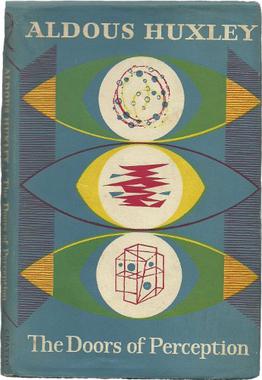
Aldous Huxley's Doors of Perception and Heaven and Hell


Image result for doors of perception heaven and hell book covers
“That humanity at large will ever be able to dispense with Artificial Paradises seems very unlikely. Most men and women lead lives at the worst so painful, at the best so monotonous, poor and limited that the urge to escape, the longing to transcend themselves if only for a few moments, is and has always been one of the principal appetites of the soul.” [The Doors of Perception]

I've picked up a lot of books over multiple library book sales. These are first-come, first-serve sales of mostly paperback but sometimes you can find handsome editions of hardcover novels. I picked up The Doors of Perception because I'm been inspired by the counterculture hippie movement since high school. The Doors was one of my favorite rock bands as a kid.

That's my paradigm. I'm mostly inspired through rock and roll rather than experimentation of drugs. But even as a youngster I was familiar with the Merry Pranksters, Timothy Leary, LSD, Sgt. Pepper, and "turn on, tune in, drop out." And of course, all my favorite American hippie rock bands supported all that stuff. The Doors named themselves after Huxley's Doors of Perception. This edition comes with a separate book entitled Heaven and Hell. Both of these short books explores the mind's remote frontiers and the unmapped areas of human consciousness. 

For starters, one of the main problems with these books is that its no longer apart of the zeitgeist or discourse. The idea of taking psychedelics in order to gain some insight into the spiritual self is no longer apart of the current paradigm. Native Americans were known to use peyote/mescaline for spiritual purposes. But do even they still do that today?  

The young people I know who have experimented with heavy drugs like LSD, mushrooms, cocaine, and heroine are using it in order to escape from their reality. Much like the quote above. They use drugs as a backlash against the real world because they feel they are suffering. Any release into paradise will suffice. Even if it only for but a moment. Drugs and alcohol relieve them from their suffering. Albeit only for a short while until they come down from the high. Knowing that, it's very difficult for millennials to truly understand anything that Huxley is talking about here. But I like a challenge. 

This isn't really a book. Rather its a dialogue of Huxley containing his trip on mescaline. Ironically the trip takes place in the world's largest pharmacy during the early stages of the trip. A bit of comedy for his mescaline trip.  What happens to someone under the influence of mescaline? 

a) Ability to think straight is little if at all reduced. You don't become stupid.
b) Visual impressions are greatly intensified and the eye recovers some of the perceptual innocence of childhood when the sensum was not immediately and automatically subordinated to the concept. Interest in space is diminished and interest in time falls almost to zero. 
c) Though the intellect remains unimpaired and though perception is enormously improved, the will suffers a profound change for the worse. The mescaline taker sees no reason for doing anything in particular and finds most of the causes for which, at ordinary times, he was prepared to act and suffer, profoundly uninteresting. He can't be bothered with them, for the good reason that he has better things to think about. 
d) These better things may be experienced (as I experienced them) "out there," or "in here," or in both worlds, the inner and the outer, simultaneously or successively. That they are better seems to be self-evident to all mescaline takers who come to the drug with a sound liver and an untroubled mind. [Doors of Perception]

Time meant nothing. Huxley mentions there was plenty of time. Not a concern. He also wasn't concerned by spatial forms. This could mean the distance between me to my computer screen as well as the matter of me writing this review and then finishing it. Neither mattered anymore. 

What really is important to him is experiencing and observing.  Looking around the room takes on a new perception and/or concepts of the things we see. Mescaline strips down concepts but allows you to see them for the first time, the beauty of it. 

Man-made art had little effect on him. He was humored by the fact that humans tried too hard to symbolize things. "How dare they?" "The audacity?" This goes alongside paintings as well as classical music composers. He was more mesmerized by nature than by human-made things. 

Heaven and Hell go into religious aspects. Huxley notes that in the middle ages Christians would beat themselves until wounds would fester [flagellants] and starve themselves until they literally saw visions. They would literally see the devil. The festering wounds would cause hallucinations. How about that? 

My favorite concept that Huxley mentions in heaven and hell is a simple one. If you are a mystic/artist, you must learn from the scholar. If you are a scholar you must learn from the mystic/artist. It makes perfect sense. Why isn't the world like that? Why aren't more people across different discipline working together and learning from each other? It makes me wonder what could have been.

The truth is that I would never do any hallucinatory drugs and this book doesn't make a convincing argument for me to find a dude off the street and buy some mescaline off him. Rather, I'm impressed with Huxley's experience. I'll take his word for it and agree that the experience changed him for the better. Even if it only changed him for that day I can see from his writing that it had a profound spiritual effect on him. None of these drugs should be used for recreational purposes. Hell, at this point I don't even believe marijuana should be used recreationally. Maybe I'm getting too old. Maybe I'm a square. Maybe drugs are good for people sometimes.

In the end, we are all riders on the storm.  

Tuesday, June 18, 2019

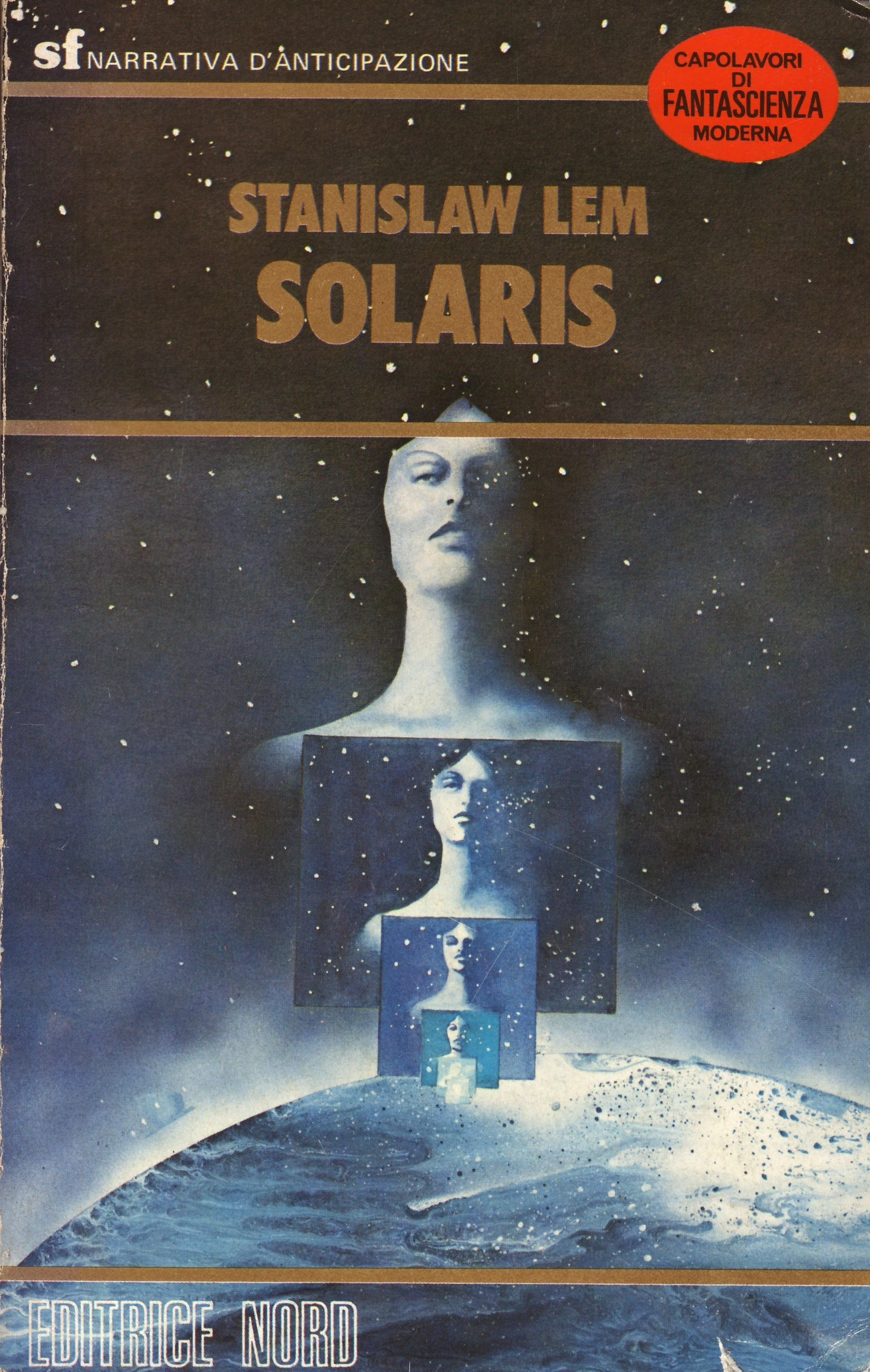
Solaris


Image result for solaris stanislaw lem book coversSolaris is a science fiction novel published in 1961 [later turned into movies in 1972 and 2002] by eastern [Polish] European science fiction writer Stanislaw Lem. It's a very thoughtful and philosophical novel in the SF genre. I would go so far as to say that this is one of the best science fiction novels I've read this year [so far]. 

The story starts with a psychologist named Kelvin. He goes up to the Solaris space station. Solaris is this planet with two suns, a red sun, and a blue sun. Scientists have been studying the place for years, coming up with all kinds of theories, that are all mostly speculation. 

It turns out that the entire planet's ocean is alive and may or may not be sentient. There's a sense of mysticism when Kelvin starts to see and experience strange phenomena on the space station. This possibly sentient ocean affects the human psyche to the extreme. For example, when he first gets there he meets his co-worker, Snow, and the guy looks like he's scared shitless most of the time, mad as a hatter. Kelvin goes into his room and becomes fearful when he sees a big black woman roaming around. Where did she come from? Who knows.

It turns out that although these scientists might be studying the sentient ocean, it is actually the sentient ocean that is studying them. The other character's experiences are mostly just alluded to. However, our main character Kelvin's experience is told first hand. 

Somehow the ocean creates a human simulacrum of Kelvin's long-dead wife, who committed suicide. He blames himself for the suicide and he can't handle the situation at all. He tries his best but by the end, the psychological trauma has changed him for the worst, forever. But perhaps it is only bad if seen in that one-dimensional view.  Racked by psychological trauma, Kelvin tries to do his job by observation and working with Snow. 

One of the main themes I picked up from Solaris is that no matter what you did in the past and what you're doing now, anything that happened in between can and may come back to haunt you in some form or another. It's basically a classic gothic horror theme in a science fiction skin. However, to just call it as such would be a disservice to Stanislaw Lem. After all, Lem amazes here. What amazes me is how he uses the idea of 'first contact', the alien being a benign ocean, and somehow turning into a thoughtful understanding of the human experience. It's very difficult to explain but Lem pulls that off in this novel.

There are other more philosophical themes as well. In the end, we have a dialogue about an imperfect god. Could this ocean be an imperfect God? After all, the God of the Old Testament was an imperfect God. He must've been because he got jealous of golden calves and demanded sacrifices when he wanted it. The dialogue mentions this. 

The great thing about this novel is that you're expecting some kind of resolution to all this madness and philosophical SF ideas. But in the end all we get is a guy who is sort of in shell shock, not unlike a soldier who experiences war for the first time. Yes, he could go back home and live a happy, normal life, but can he really? Perhaps he'll always be longing for his long-dead wife, even if his dead wife on Solaris was just an alien ghost. It will haunt him forever.  Maybe not.

My favorite thing about this novel is that it sort of reads like a madhouse. Not much really happens. Kelvin only leaves the space station to check out the ocean at the very end. It's a pure adrenaline rush in terms of the fear within the characters. I was sitting at the edge of my seat wondering what would happen next, only to find that not much happened throughout the entire thing. However, Lem makes it a rewarding experience because the way he explains everything is quite wonderful. He's a much more thoughtful science fiction writer, capable of interesting philosophical ideas. This is literary science fiction. Something like Ursula K LeGuin's The Left Hand of Darkness is literary science fiction as well. I could compare it to something like that. 

The English translation I read was a very smooth read. The book reads fast, moving along with action and dialogue. It isn't until perhaps the last 50 pages that the book is littered with tons of fancy science fiction exposition. The exposition is highly enjoyable but I found it to be my least favorite part of the book. However, I do think it was necessary to fully explain Solaris itself. Plus every great science fiction novel has to have some great exposition [imho]. The way Lem uses the end of the book for exposition is interesting. I would compare it to when a book is over but the author wants to add more information to help resolve things, an afterword if you will. This is commonplace in classic science fiction so I'm used to seeing it. 

This was the best Lem novel I've ever read and I plan on reading more of his work. Definitely read this book if you're a serious science fiction fan. Also make sure to check out the 1972 Tarkovsky movie Solaris, as its one of the best science fiction movies I've ever seen. 

Check out my review for Stanislaw Lem's novel Eden below:
https://ofigueroamusic.blogspot.com/2019/02/eden.html

Saturday, June 8, 2019

Islands in the Net


Islands in the Net is a science fiction novel from 1988 written by the cyberpunk master himself [second only to William Gibson imho] Bruce Sterling. I found this book on a whim. I randomly typed in best cyberpunk novels on google and it showed up on a couple of lists. So I figured I'd order the book from the library and give it a shot. Risky!

This book isn't what I was expecting. The introduction starts with a woman running on the beach and tripping onto the sand, bruising herself. A walking, talking robot comes to her aid. That first impression is important. I thought the talking robot was such a great first impression. I figured the rest of the book would have science fiction elements like that. I was dead wrong. 

Now, it's not that this isn't true science fiction. It's just downplayed super hard in favor of plot and dialogue. It is, in fact, true science fiction, maybe even cyberpunk if you want to call it that. However, the science fiction aspects of this book are very minimal. Although IITN was written in '88, Bruce Sterling was actually able to predict where the technology would go. Hence drones. This is where the plot lies. 

A civilian corporation called Rizome gets involved with data pirate terrorists. They're trying to get the data pirates to come together and stop bombing each others' countries, stop stealing each others' data and money, etc. They deploy drones a lot to kill people, even causing mini genocides and such. This is a prediction of the future because today we live in a world where drones kill people every day [in the middle east]. We have a female protagonist named Laura, who's married and has a baby daughter. Laura decides to be the lead negotiator between these data pirate groups. She wants to be the 'female man', the woman who does it all, risks it all, and comes back home safely, forever changed, but a glorious welcome home, a legend. 

The plot is actually very innovative and grandiose. The whole time I was reading it I kept thinking to myself, is Sterling going to pull this one off? After all, this is my sixth Sterling novel so I know when he writes a mediocre novel [Zeitgeist]. When great science fiction writers try to write what I think of as contemporary thrillers I am not into it. Think William Gibson's All Tomorrow's Parties. I couldn't even get through ten pages of that. Anyways, I actually really like the plot here. It's cutting edge. However, the way the plot and characters work is mediocre. 

The plotting is done mostly through dialogue. One of the best things I can say about this novel is that all the 'boring narration' is actually quite exciting. I liked to see what happened next in terms of pure action. There was a dog breathing fire, a president of Singapore calling Africans the n-word on national television [which reminds me so much of the Trump White House adminstration], two years of imprisonment, Laura's best friend from college marrying her husband while she was locked up, lotion that turns white people black [and they love it, prediction of tanning] and lots of explosions, which included nude women. Sounds pretty great right? Well, it is. 

But then you notice that Sterling is making you work for all that exciting stuff. In between all the action scenes, there's tons of wooden dialogue. It's not that it's terrible writing, on the contrary this is still decent writing. But there's a sense of just riding the breeze with the dialogue. There's little if any character development throughout the entire novel until the very last twenty pages. That's only because Sterling is obliged as a writer to resolve all tension throughout the narrative.

So yes we have a great ending but it takes you 350 pages to get there. Which I find super long given that it's not very much of a science fiction story, feels so contemporary that its modern, and has wooden dialogue. I didn't care for Laura until the very last twenty pages where she has an epiphany and resolves all her problems, comes to grip with reality through much hardship. She even meets her Optimal Persona while in prison. Don't ask. It's a California thing. 

In conclusion, this book had a very inspiring idea but is poorly executed. Sometimes even the great masters of science fiction miss the mark. In fact, I should've known this wasn't that great of a book because I'd never even heard of it. When I told my dad [an old school science fiction aficionado] that I was reading it he told me that it was almost contemporary. And that's my whole problem with it. 

Worth the read only if you're a hardcore Bruce Sterling fan. Not science fiction enough. The best thing I can say about this novel is that it is very ambitious. Sometimes Sterling hits the mark spot on with the way the world works [economies, organizations, countries, mercenaries, data, etc], even today, some 40 years later. That is remarkable but doesn't justify me thinking of this as a great science fiction novel. However, this cover with the woman on the cover in the 'matrix' is pretty damn cool. Unfortunately, that only tells a small fragment of the actual story. 

Check out my other Bruce Sterling novel reviews below:
https://ofigueroamusic.blogspot.com/2019/01/schismatrix-plus.html
https://ofigueroamusic.blogspot.com/2018/11/the-difference-engine.html
https://ofigueroamusic.blogspot.com/2018/12/holy-fire.html
https://ofigueroamusic.blogspot.com/2019/02/artificial-kid.html
https://ofigueroamusic.blogspot.com/2019/01/zeitgeist.html

Tuesday, April 16, 2019

The Sirens of Titan


sirens-of-titan
“I was a victim of a series of accidents, as are we all.”

The Sirens of Titan by Kurt Vonnegut is a satire science fiction novel from '59. The story is about a guy named Malachi Constant, who is told by a man-playing-God figure stuck in space via something called 'chrono-synclastic infundibulum', that he's going to marry his wife Beatrice, have a kid with her, and end up living [and dying] on Titan, one of Saturn's moons. Malachi, the richest man on Earth does everything in his power to make sure none of that happens. He responds by throwing the best damn party ever and loses all his money.

The first Vonnegut book I read was Slaughterhouse-Five, check out my review for that book here.  I liked The Sirens of Titan much more than Slaughterhouse-Five. And that's because Sirens is much more of a science fiction novel, with grandiose ideas about life, sprinkled with tons of satire, with what I call dark humor or black comedy. Siren's has a very breezy, easy reading style just like Slaughterhouse. The ideas are many but are rooted more in science fiction here than in Slaughter-house, which is why I liked it much better. After all, I'm a science fiction guy. 

There are two obvious themes of the novel. Free will is one of them. Vonnegut suggests that we are victims of a series of accidents, as its quoted from the story. Malachi Constant, Unk, Beatrice, Chrono, the Tralfamore robot [the reason why all this is happening is so the robot can get a part to go home], and Winston Niles Rumford don't have free will. Random events put them in the positions they were in and there's nothing they could say or do that could influence the unpredictable. 

The other theme is the philosophical one. The meaning of life. Vonnegut suggests that everyone knows how to find the meaning of life by themselves. Although there's no free will we can find meaning and purpose in life. And the purpose of life, no matter who's controlling it, is to love whoever is around to be loved. If I wasn't single this would be more meaningful. :D

Life is meaningless but we should be happy. No matter what happens we have the option to make life meaningful. That's what makes us different from the music organisms on Titan, what makes us human.  

Going forward, this isn't your typical 50's pulp science fiction novel, although technically it is a 'pulp 50's science fiction novel'. What I mean is that if you're into Heinlein, Asimov, and Alfred Bester, you'll notice that this is an entirely different animal. Although there are spaceships, a war between Martians and Earth, and Universal Will To Become [metaphysics perhaps] to power spaceships, Vonnegut is using science fiction to tell an allegorical story about life. With ideas and philosophy that is anti-war, anti-religion, and anti-Bio-Mass [anti-society]. 

The science fiction element stems from the character Winston Niles Rumfoord, who, with his dog Kazak, accidentally becomes “chrono-synclastic infundibulated” during a space voyage. They're spread through space and time, appearing on planets sometimes. Vonnegut explains the phenomenon in his own inimitable way. Being spread through space and time allows Rumfoord to know everything that is past, present, and future. This allows Rumfoord to play God with the human race, with emphasis on Malachi Constant, and Rumfoord's wife, Beatrice. Rumfoord stages a war between the Martians [there's Martians living on Mars in this story too] and Earth just to make a point, to teach mankind a lesson. 

There are enough great ideas in this novel to be two or three novels. The characters are unpredictable, the humor is dark at times, and satirical, and philosophical themes make this a terrific science fiction treatise. 

To conclude, you don't have to look into grandiose ideas for what this story is really about. As a matter of fact its very simple. Vonnegut's satire ends with this conceit: All of mankind's purpose, past, present, and future is for this alien robot [the Tralfmadorian] to find this one little metal part [the size of a can opening lid], that will take him home.

I'm already reading more Vonnegut. I'm currently reading his first published novel Player Piano, which is much different from this style and voice-wise. Stay tuned to the page, as I will write my Player Piano review sometime soon.   

[original book cover art by Richard Power pictured above] 

September Sweater Weather

Good evening ladies and gentlemen, hello world. How are you?  It's good to be writing on a good day off work today on a Saturday. Here, ...