Showing posts with label intellectual. Show all posts

Sunday, August 3, 2025

Eliot's Renaissance Tempest: Romola's Moral Crucible


First, it may be surprising that, George Eliot, famous writer of 19th century English novels wrote one novel about the Renaissance period. Romola is George Eliot's fourth novel, a significant departure from all her other novels. Romola is set in Florence in the 15th century of Niccolo Machiavelli, [he's a minor character in the book], during Christian religious leader Savonarola's rise. 

George Eliot took meticulous notes on the Renaissance period for this novel and dives in deep to explore the themes of humanism and psychological human struggles. This is most likely Eliot's most intellectual novel, whereas her more popular books like Middlemarch and Mill On the Floss focus more on the intimate social realism of rural England in the 19th century, the core of all her writing and style. However, for the curious western canon reader, this book is not only important, but is a must read.

Second, Eliot uses the world of 15th century Renaissance Italy as more than a backdrop, it is a protagonist, the city itself comes alive almost like a character. This is one of Eliot's strongest stylistic writing skills. The political machinations of the city have it come alive like a person. The Medici's versus republicans, artististic ferment, impassioned religious leaders [Savonarola], and the passion of learning, ambition, and decline. The setting is important for the characters because it helps to explore the themes of humanism, faith, individualism, and communal duty. 

Third, Romola's journey from naive helper-scholar to her blind father to adept Holy Madonna is not only inspiring, it is downright transformative. Romola is one of Eliot's most well thought out characters, like Tito, her husband. Her duties were initially to help her blind-scholar father, her god-father, and her husband Tito, who she marries, but along the way she finds herself in struggle and contradiction. As every powerful character in Eliot's novels, she has to make tough decisions in order to find meaning in her life. She might be the most powerful and transformative character in Eliot's writings. 

Fourth, Tito Melema. Tito is a remarkable villain and, one of the best villains in Eliot's work. He's good looking, tall, dark, personable, intellectual, ambitious, but he's also backstabbing [marrying a peasant girl behind Romola's back and having two kids with her], he's so ambitious to the point of getting too involved in the internal politics of Italy [thus garnering him enemies], he backstabs his father who adopted him as a child, and because of that, his father ends up getting his revenge. Tito's Father's revenge is ultimately satisfying although not quite as action packed as one would think it would be. Most writers will never be able to write a better villain. If Romola represents Life and Holy Goodness, then Tito is Death and Intellect. 

Moving on, Savonarola plays a big role in the stage because of his strong religious fervor and influence. He's reacting against corruption of politics and the church, offering a powerful vision of moral renewal in Florence, Italy. You could say that because of Eliot's ideas on religion, she always has strong ideas of religious characters, ideas, and influence. You can say that she never has anything bad to say about religion. The role on religion on Romola is immense, to the point where in the end she finds a village suffering from the plague, and she ends up helping and saving a lot of them, thus becoming a Holy Madonna. 

Finally, putting it all together. Eliot's dense, allusive, descriptive, intellectual writing style in a psychologically penetrating prose style is what makes this book an amazing read. She's able to successfully and accurately use historical notes and detail without losing the narrative flow or psychological state of the characters. Her characteristic philosophical concerns are explored through this unique renaissance prism. The novel is considered Eliot's least popular novel and it was received with mixed reviews, but reading it in 2025 feels as fresh as a daisy, and I believe its a must read for the western canon list. 

In conclusion, like many historical novels of the western canon, this novel has epic scope. When the fires of belief and lightning of new ideas clash across Renaissance Florence, testing one woman's soul as kingdoms fall and fanatics rise, George Eliot's Romola forges a story so powerful it echoes through centuries, standing forever as a towering testament to how we hold onto what's true when the whole world shakes. The novel begs to ask the question, "How do we find meaning in our lives?" You could say that is what every George Eliot novel is really about.

Monday, February 4, 2019

Candide

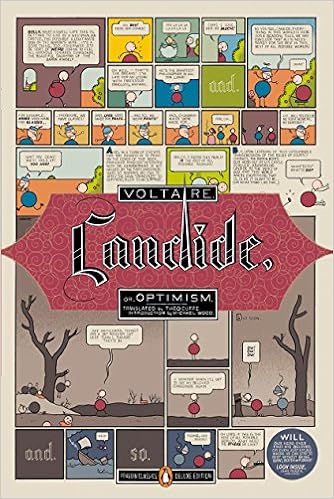
Image result for voltaire candide coverVoltaire's Candide [written in 1759 by French philosopher Voltaire, written during the Age of Enlightenment]  is a terrific work of satire that attacks Leibniz's philosophy of optimism. This is done through the constant refrains of the character Pangloss [Candide's philosophy teacher] saying, "This is the best outcome in the best of all possible worlds." This happens periodically throughout the story. In a way this is a perfect book for me because it reads like a philosophical cartoon strip. Ironically I think I've got a physical copy of Candide with a cartoon strip for a cover, pictured here.

Satire is used to full effect here. Everybody and anyone is fair game for ridicule. The religious establishment especially. Another important feature is that a lot of the events that occur were actually real events. For example, the Lisbon Earthquake was a real event that killed 30,000 people, an event that makes 9/11 look like nothing.

Voltaire ridicules Leibniz's philosophy through the character Pangloss, who's reasoning is silly. For example, the following is ridiculous:

"It is demonstrable that things cannot be otherwise than as they are; for as all things have been created for some end, they must necessarily be created for the best end. Observe, for instance, the nose is formed for spectacles, therefore we wear spectacles."   

Pangloss goes on to defend optimism and reiterate that "its for the best, in all the best of possible worlds." Consider this section where he explains why its good that syphilis exists:

"It was a thing unavoidable, a necessary ingredient in the best of worlds; for if Columbus had not caught in an island in America this disease, which contaminates the source of generation, and frequently impedes propagation itself, and is evidently opposed to the great end of nature, we should have had neither chocolate nor cochineal."

Candide, the main character, goes on to keep believing everything his philosophy teacher Pangloss says until everything goes wrong for him. Eventually he despairs and is ready to give up on everything in life. Thus Voltaire cures him of his optimism. Although its interesting to call out Leibniz I also think a large part of the idea for this work was to contrast irony with comedy, thus we have satire. And this it does very well. You could say that this kind of novel is created for men [and women] of wit to read for fun. And fun it is. 

Voltaire doesn't invent or exaggerate evils of the world. In fact he displays these things as regular real life events. A simple example of satire is when Candide watches as an admiral gets killed for failing to properly engage a French fleet. "The admiral is blindfolded and shot on the deck of his own ship, merely "to encourage the others" (French: pour encourager les autres, a popular quote from Candide). 

Almost of all Candide is a discussion of the various forms of evil. There is one notable exception; when Candide and Cacambo go to El Dorado. This is perhaps the only optimism in the book, where we find a place where everything is perfect. So perfect in fact, that satire doesn't exist here. But because we don't live in such a perfect world as that, satire must and will exist. 

The book is pretty simple plot-wise, a sort of adventure novel. In a way even its plot is a satire of European novels: Candide is of a lower caste than Cunegund, therefore he shan't dare marry her, romance, making fun of the high arts such as music and theater, the mishaps that happen around every corner, etc. These sorts of things are in a lot of archaic novels I've read. The one that comes to mind is The Blazing World by Margaret Cavandash. However, I think Candide is a lot better than that story. But they are very similar plot-wise and written and are archaic. 

All in all this is a fantastic read. I read it in one sitting last night. If you're a man [or woman] of wit, and enjoy philosophy as well as adventure novels this will definitely be on your reading list. Its a classic for a reason after all.

Monday, November 19, 2018

Divison of Labor


Image result for division of labor adam smithHey, more feel good psychological and vlog-esque writing for you all. Here I'd like to go into how I started living a more positive life, and positive outlook, specifically using a 'division of labor'. How I divide my time during the day has impacted me in more ways that I would've otherwise expected. I don't follow a schedule or anything but in a sense all of my time is spent on specific things. 

Typical day before work by myself
I would wake up late but early enough to have about 4 or 5 hours before my work shift. I usually start by playing a few rounds of Overwatch, but I've also been known to play Chess lately. 

Then after that I read the news typically. It could be a short reading session or it could last over an hour, it really depends on my mood. Then I like to walk to the library and read out of a physical book for a while, just right before my work shift. Being at the library is better than being at home because at home the computer is a distraction from reading a physical book. That would be a great typical day by myself. 

Typical day before work with friends 
With my friends we always like to get something to eat. It could be cheap junkfood like TacoBell, I'm partial to the Taco Supreme 3 taco meal lately. Then we play video games, mostly Marvel vs Capcom 2 right now, an old 2D fighting game from the 90s, Sega Dreamcast days. Then we jam on instruments. We have ukulele, bass, and acoustic guitar. The other guys aren't quite there musically but I still enjoy teaching them things, they can improve. 

Typical day off
This isn't too much different from anything else really. I usually start on the computer gaming until I get tired of it, then read the news, and perhaps I'll hang out with friends before they go to work, or after they finish a shift. Sometimes I go to the bar with friends. I try to go to the open mic music nights at the local bar.

Typical night hours after 1 am shifts 
My time after a 1 am retail shift is very valuable to me. This is where I get a lot of reading done, again news, and whatever I want to read on my Kindle, which right now has been Adam Smith's The Wealth of Nations, hence the 'Division of Labor' blog post title. In a sense doing all of these things every day is a job, although I'm having fun. 

Not only do I write blog posts (and should be writing more short stories soon) at night but its also my prime slot for guitar, only acoustic guitar this late. Right now I'm learning how to play Berio's Sequenza for guitar. Because I have limited time to practice its important for me to play everyday, even if its only 25-45 minutes a day. 

But why?    
A division of time into the things I do and a sort of outline of my plans is good for me. Its like an improvised schedule, it can change at any time but at the same time its sort of like my bread and butter. Doing this division of labor has given me a more positive outlook because I have broken down all my goals and have been actively going for it. The goals are very simple-relax, read, music, work, repeat.  Losing weight is also big on my list.

Imagine a guitar player who only practiced once a week. And then picture a guitarist who plays everyday 15 minutes. The once a week guy plays 4 hours once a week. The guy who plays everyday 15 minutes would still be the better guitar player overall even after six months of playing. I've put that kind of approach to my everyday life. Do the things you love and relax, everyday.

Sunday, August 12, 2018

Why there's no excuse for stupidy in 2018

I've gone through a vast reeducation, learning about everything from jazz music history, to philosophy, to ethics, politics, journalism, propaganda, and government. My friends aren't interested in any of that stuff and they don't want to hear about it. I have a friend who is even against reading in and of itself. The rise of anti-intellectualism has been timed perfectly with the rise of Trump. With anti-intellectualism comes racism, and prejudice, like the neo-Nazi rally last year in Charlottesville where one person died to to a neo-Nazi driving a car into the crowd. However, in today's modern technological golden age, there's no excuse to be stupid, uninformed, or uneducated. You don't have to go to college to be an intellectual. But it sure helps to go to school and come from a rich, educated family.

First of all, because the internet is pretty cheap (or free if you go to the library or a coffee shop), that means that everybody has constant access to free information. This free information is indispensable right now. I wouldn't be able to order the books I want to read without being able to look titles up through the library's servers. I wouldn't know whats going on in government if it weren't for the news websites. Its a given that you can learn a lot because of the free information on the net. Use it or lose it. Don't use it just for Instagram and Twitter. The modern thinker uses the internet to strengthen his wits and to engage discourse in ideas, art, and culture. Most of the music I listen to is on YouTube for free. That is how I know so much about music, by listening to it online for free.

Next, the archaic media known as books. Reading wasn't something I was attracted to for nearly twenty years. I did two years at the University of Wisconsin system and the entire time I was there I dreaded reading and preferred to play guitar in the guitar club and hang out with my buddies in the computer science club. It wasn't until the ripe age of twenty that I began my reading career. Technically I'm behind my peers, some of whom already have Bachelors, Masters, and even PhD's. When my dad was my age he had already read most of the best that science fiction had to offer whereas I'm still somewhere in the beginning of it.

Reading isn't something you can force yourself to do. You have to learn to enjoy it, to enjoy the process of prose, and gain intellectual understanding of the text, as well as empathy within the narrative. Its a powerful force. Literature may be more important to mankind than music, and I love music dearly! To finish on this subject there's no excuse to be stupid because books are free and you can learn about nearly anything and everything, provided you have a library card and dedicate the time to improving your mind. You might find that you have a greater appreciation from the world after you've read a lot. I've found that my thinking has become more linear, concise, and forward. It also helped me to become a better writer, something I strive for, especially because I have aspirations of becoming a writer.

Lastly, your peers, friends, co-workers, bosses, and even customers at your work affect you in some ways. Sometimes they can change you for the better, to become smarter by giving you advice, sometimes even when you didn't think you would need it. This guitar player customer taught me a lot about jazz guitar comping when he told me I should play the chords with the pick and fingers rather than just using the pick all the time. Such a simple thing but I never figured that out on my own in my ten years of playing the guitar. Its not rocket science but its helped me a lot.

The more people you know the more advice you'll get. Most of this you can take it or leave it. However, I find that when I look into things that people tell me to do or look up I find myself enriched by that said thing, even if its something small like,"you should write everyday", "look up this political writer", "listen to this classical composer", etc, etc. The list is endless. At the end of the day something your peers or customers tell you isn't going to change your world but it may help you somehow.

These are the reasons why there's no excuse to be stupid in 2018. Maybe instead of lurking on Facebook or Instagram or playing video games you should finally crack open that novel that you bought but haven't started yet. Your mind will thank you later.

Tuesday, January 16, 2018

Metropolis (novel)


Hey! What's up everybody? Its been quiet on this page the last couple days because I've been pretty tired and I took a night off from my work (reading) so I was behind with my readings. Now I'm all caught up, as I've already finished another novel, this time Metropolis written by German female intellectual Thea von Harbou. Metropolis is also the name for the movie that was made and inspired by this book. The book came first, and the movie thereafter.

The story of the book follows closely the movie so rather than rehash what I already wrote about you can get the gist of the plot from my movie synopsis, which can be read here. There's actually not much information on this book on the Wikipedia page for it but it should be known that the end of this book concludes with Freder's father realizing that his dead wife will be with him till the ends of the Earth (she died and left a letter for him). Lets focus on the literary style and high art that is this novel.

The novel is a short two hundred and fifteen pages but the writing style can be hard to wrap your head around. This is high German art language and Thea von Harbou was quite the intellectual, you can tell by the English translation of her writing. Don't get me wrong, its not dense by any means but there's a sense that you have to really understand everything you're reading because its so highly stylized. One sentence that describes a simple thing could turn into a whole page affair but she does it in a way that you want to read more about that one thing, without making it boring or trivial. Its quite something, I don't think I've ever read anything quite like this, its a powerful novel.

The film omits references that the book made to the occult. There's tons of references and images to the occult here but because I'm not familiar with that realm I didn't see it as particularly offensive or foul by any means. I learned about some evil things I suppose but its nothing that's going to make me wet the bed at night (lol). Besides, the pentagram beside the machine-woman is pretty evil enough for 1927.

In addition, the film omits moral motivation for certain actions by the main characters. Yes, the book differs quite a bit from the movie's characters, which are more black and white. In the book the characters are much more detailed, much like real people. We don't necessarily see things as good or evil, there's all these gray areas that are quite apparent.

This book is great! I would recommend the book to any science fiction readers, women that want to get into science fiction, and people who like really old books. I liked it so much I might read it again much sooner than expected, I could see myself reading it again in a few months or so, just to see if it still has that same poetic fire and intensity from the first read through. Definitely check this book out.

HEAD and HANDS need a mediator. THE MEDIATOR BETWEEN HEAD AND HANDS MUST BE THE HEART!

September Sweater Weather

Good evening ladies and gentlemen, hello world. How are you?  It's good to be writing on a good day off work today on a Saturday. Here, ...