Showing posts with label bruce sterling. Show all posts

Monday, July 15, 2019

Pirate Utopia


Pirate Utopia is an alternate history satire written by Bruce Sterling. It was published in 2016 but somehow I completely missed it as I was sidetracked by that shit show of an Presidential election. As my readers would know, I've written quite a few reviews of books written by Bruce Sterling. I would go so far as to say that Sterling and William Gibson are my favorite science fiction writers. They created the cyberpunk genre, helped develop steampunk, and were the cream of the crop of science fiction writers during the entire 1980s. 

However, here Sterling chose not to write science fiction, but rather an alternate history satire, something he calls dieselpunk which turns out is a lot like steampunk and cyberpunk. Sterling considers this as a subgenre of science fiction. It's related to science fiction but its also rooted in history and makes use somewhat of real facts. He's using history, elements of science fiction and satire to create something that would appeal to more popular culture. In this case, catering to the European general public more so than the American science fiction crowd.

Sterling quotes this line from the manifesto of Despero and Giacomo in 1915:
We will find abstract equivalents for all the forms and elements of the universe, and then we will combine them with the caprice of our imagination. This just about sums up the motives of the characters in this novel.


The book is about a group of pirates around 1920, WWI era. They've taken control of this village called Fiume, now present-day Rijeka. They believe in the Futurist Manifesto. They steal everything they can including a communist controlled armored vechicle in the beginning of the novel. Their enemies are the communists, the rich, and the fascists, whom they are not entirely unsympathetic towards. They engage in Freemasonry, free love, equal pay and rights for women, they love jazz music, ceremonial rituals, etc. Kids today would say they are "extra". As you can see this gets pulpy very fast. 

Our main cast is comprised of the Ace of Hearts, a military leader of the secret police and the Pirate Engineer [lots of nicknames in this book] Secondari, a guy with a chip on his shoulder who lost an ear in the war but because he's an amazing weapons engineer he's given complete control to take over the means of production concerning weapons. There's even a Prophet, a warrior poet who runs a harem and the principle leader behind their ideology but deep down hates himself and his life. 

Secondari becomes "Minister of Vengeance Weapons" [what a great title!] He revitalizes a weapons factory and starts developing torpedoes and even a death ray [very cyberpunk and reminiscent of Nazi technology conspiracies]. Soon other governments become interested and Spymaster Colonel House from President Wilson's government sends Houdini and his assistant H.P. Lovecraft under the guise of a magic show to work out a secret deal. Along the way, Hitler gets killed by jumping into a bullet to save his friend and Mussolini gets shot to death in the dick by some girls that wandered into his office. That's where the book ends. 

This is all very fun and funny material but where's the meat and potatoes to it? The thing is that this book has a lot of exposition but everything else is mostly left up to the imagination of the reader. The characters themselves are only interesting to a point. Secondari is a mediocre villain. He lives only to serve his ideology, for the cause of the Pirate Futurist Utopia. But when Frau Pfeiffer [an industrial factory owner] throws herself at him he denies her. He only loves her daughter, because Frau Pfeiffer was the one woman that nursed him back him to health when he was at his worst. Even his own family didn't to do that for him. So he loved Frau Pfeiffer's daughter and made sure that she would never be harmed. However, this actually made him a worse person as a result. He vowed to kill anyone who ever harmed her. At all costs.

The Prophet seemed like a cool cat. I mean he runs a harem and he's a warrior poet. Sounds like a real hippie awesome free love guy. But when Secondari sees him for the first time he realizes that this man, the Prophet is broken, lifeless. Because Secondari doesn't hear very well [one of his ears was blown off in the war] he has this intimate ability to see into a person's soul. He looked at the Prophet and somehow knew right away that he was completely wasted, drained of life. So I guess having a ton of girls to fuck all the time can be a drag sometimes. It's an interesting observation.

On a side note, there's the Art Witch, one of the Prophet's women. I actually liked her a lot because she reminds me of the typical bohemian girl, of any race, although of course here she's Italian. She's into the occult, does spiritual seances, wears weird kinky outfits with probably no underwear, she's a fixture of the art scene, and of course she's rich because that way she has the time to do all this goofy stuff. She's one to remember. Actually, if you hang around the music and art scenes for a while you'll find girls like this. I've run into plenty in the music crowds I've chilled with at parties and such. It can get weird but its always fun.

The characters themselves are quite eloquent. But they aren't the focus of the story. A lot of it is actually exposition. The first thirty pages are exposition but the fact that the novel is so short [only 170 pages] it makes the beginning very slow. After a while, the writing seems to get into a flow that is very easy to continuously read and enjoy. That's the magic of this book. The writing style is very breezy, satirical, and entertaining. I wasn't reading so much as to find out the plot but more so out of the sheer fun and joy of just turning the pages and being amused by it all. 

There are some funny moments. Before the book officially starts there's a real H.P. Lovecraft quote that I love. "I fear my enthusiasm flags when real work is demanded of me." Well, that's just terrific. Not only is it true but the fact that Lovecraft said it makes it hilarious because he's known more for his horror than anything else. 

There's a lot of funny moments. Adolf Hitler dies by jumping into a bullet to save his friend. He's actually a great guy it turns out. Mussolini is in charge of a newspaper and gets killed by some girls who wandered into his office with a gun. How did they kill him? They shot him in the dick. The fact that our main villain here gets Hitler and Mussolini out of the way without realizing it makes it a true cosmic comedy. 

Then there's the Prophet who runs a harem but is completely devoid of life. It's sort of funny. Maybe too much sex could be bad for you? Houdini's magic trick at the end was definitely quite comical as well. For his last trick, he ends up sticking needles into his face and then eating them after he pulls them out. Sounds horrifying but at the same time realistically I'd probably be laughing my ass off if I saw someone do that. This is, after all, a satire not unlike something the gentlemen of the old days would write. Think Voltaire and Dante, but 80's cyberpunk version. 

At the back of the book, there's a great appendix and interview with Sterling. Why did he write this book? Because he felt that he had to tell the young people in Europe about what really happened back then because they don't know much about those times. In particular he wanted to remind people about how fascism got imported from Europe [Italy and Germany] to Britain and America where its still alive and well today. When he said that I thought to myself, "yeah, I get it." It's a joke, a complete joke but you have to understand history and its long-lasting impact on society to get it. It was a great Aha! moment. 

At the same time, I would also say that Sterling is at the end of his ropes regarding science fiction. He mentioned in the interview that he had a different writing persona, a European one, with a European name [Bruno of all names], even writing in a different voice. When I read that part I thought to myself, "oh god, don't do it." So yes that was very cringing for one of my favorite writers who helped duo-create the cyberpunk genre with William Gibson but hey what can you do? There was once a time where Gibson and Sterling were the best science fiction writers [the 80's] but now I see that the genre has moved away from them. They realized that and they have tried to become mainstream. Gibson has been writing graphic novels as of late [Arcangel] and now Sterling is writing stuff like Pirate Utopia. It's fun but it will never be the grand, serious, science fiction space operas that they wrote in the beginning of their careers. It's a shame because I believe if they went back to writing that sort of stuff the science fiction community would take notice. However, once you write something as great as The Difference Engine or Schismatrix Plus there's too much pressure on you keep putting out masterpieces for the rest of your life. I'll settle for Pirate Utopia because I'm a true fan and reader of Sterling but for other people, they might say,"this doesn't cut it."  For one thing, the plot isn't revaled until the very end and it ends on a cliffhanger. A lot of people would hate that. But I'm such a Sterling initiate I say let him get away with it. Not a super important novel but relevant in today's political and historical climate. The most fun I've had reading a book in a long time. Because it's short and easy reading I would recommend it. A taste of pop culture from the cyberpunk legend himself. 

On a side note, it should also be mentioned that there's terrific artwork in this book in between chapters. The cover was initially what spurred me on to pick it up and when I saw it was Sterling I checked it out from the library right then and there. The cover is great because it uses communist visual imagery to promote this Futurist ideology. The conceit is that they used communist propaganda visuals even though the characters in this book hate communists with a passion. It got me thinking more about futurist art and art movements in general like cubism. [I know nothing about art but I wish to learn more now]

Check out my other Bruce Sterling novel reviews
https://ofigueroamusic.blogspot.com/2018/12/holy-fire.html
https://ofigueroamusic.blogspot.com/2019/01/zeitgeist.html
https://ofigueroamusic.blogspot.com/2019/01/schismatrix-plus.

https://ofigueroamusic.blogspot.com/2018/11/the-difference-engine.html  

https://ofigueroamusic.blogspot.com/search?q=artificial+kid 

Saturday, June 8, 2019

Islands in the Net


Islands in the Net is a science fiction novel from 1988 written by the cyberpunk master himself [second only to William Gibson imho] Bruce Sterling. I found this book on a whim. I randomly typed in best cyberpunk novels on google and it showed up on a couple of lists. So I figured I'd order the book from the library and give it a shot. Risky!

This book isn't what I was expecting. The introduction starts with a woman running on the beach and tripping onto the sand, bruising herself. A walking, talking robot comes to her aid. That first impression is important. I thought the talking robot was such a great first impression. I figured the rest of the book would have science fiction elements like that. I was dead wrong. 

Now, it's not that this isn't true science fiction. It's just downplayed super hard in favor of plot and dialogue. It is, in fact, true science fiction, maybe even cyberpunk if you want to call it that. However, the science fiction aspects of this book are very minimal. Although IITN was written in '88, Bruce Sterling was actually able to predict where the technology would go. Hence drones. This is where the plot lies. 

A civilian corporation called Rizome gets involved with data pirate terrorists. They're trying to get the data pirates to come together and stop bombing each others' countries, stop stealing each others' data and money, etc. They deploy drones a lot to kill people, even causing mini genocides and such. This is a prediction of the future because today we live in a world where drones kill people every day [in the middle east]. We have a female protagonist named Laura, who's married and has a baby daughter. Laura decides to be the lead negotiator between these data pirate groups. She wants to be the 'female man', the woman who does it all, risks it all, and comes back home safely, forever changed, but a glorious welcome home, a legend. 

The plot is actually very innovative and grandiose. The whole time I was reading it I kept thinking to myself, is Sterling going to pull this one off? After all, this is my sixth Sterling novel so I know when he writes a mediocre novel [Zeitgeist]. When great science fiction writers try to write what I think of as contemporary thrillers I am not into it. Think William Gibson's All Tomorrow's Parties. I couldn't even get through ten pages of that. Anyways, I actually really like the plot here. It's cutting edge. However, the way the plot and characters work is mediocre. 

The plotting is done mostly through dialogue. One of the best things I can say about this novel is that all the 'boring narration' is actually quite exciting. I liked to see what happened next in terms of pure action. There was a dog breathing fire, a president of Singapore calling Africans the n-word on national television [which reminds me so much of the Trump White House adminstration], two years of imprisonment, Laura's best friend from college marrying her husband while she was locked up, lotion that turns white people black [and they love it, prediction of tanning] and lots of explosions, which included nude women. Sounds pretty great right? Well, it is. 

But then you notice that Sterling is making you work for all that exciting stuff. In between all the action scenes, there's tons of wooden dialogue. It's not that it's terrible writing, on the contrary this is still decent writing. But there's a sense of just riding the breeze with the dialogue. There's little if any character development throughout the entire novel until the very last twenty pages. That's only because Sterling is obliged as a writer to resolve all tension throughout the narrative.

So yes we have a great ending but it takes you 350 pages to get there. Which I find super long given that it's not very much of a science fiction story, feels so contemporary that its modern, and has wooden dialogue. I didn't care for Laura until the very last twenty pages where she has an epiphany and resolves all her problems, comes to grip with reality through much hardship. She even meets her Optimal Persona while in prison. Don't ask. It's a California thing. 

In conclusion, this book had a very inspiring idea but is poorly executed. Sometimes even the great masters of science fiction miss the mark. In fact, I should've known this wasn't that great of a book because I'd never even heard of it. When I told my dad [an old school science fiction aficionado] that I was reading it he told me that it was almost contemporary. And that's my whole problem with it. 

Worth the read only if you're a hardcore Bruce Sterling fan. Not science fiction enough. The best thing I can say about this novel is that it is very ambitious. Sometimes Sterling hits the mark spot on with the way the world works [economies, organizations, countries, mercenaries, data, etc], even today, some 40 years later. That is remarkable but doesn't justify me thinking of this as a great science fiction novel. However, this cover with the woman on the cover in the 'matrix' is pretty damn cool. Unfortunately, that only tells a small fragment of the actual story. 

Check out my other Bruce Sterling novel reviews below:
https://ofigueroamusic.blogspot.com/2019/01/schismatrix-plus.html
https://ofigueroamusic.blogspot.com/2018/11/the-difference-engine.html
https://ofigueroamusic.blogspot.com/2018/12/holy-fire.html
https://ofigueroamusic.blogspot.com/2019/02/artificial-kid.html
https://ofigueroamusic.blogspot.com/2019/01/zeitgeist.html

Monday, March 25, 2019

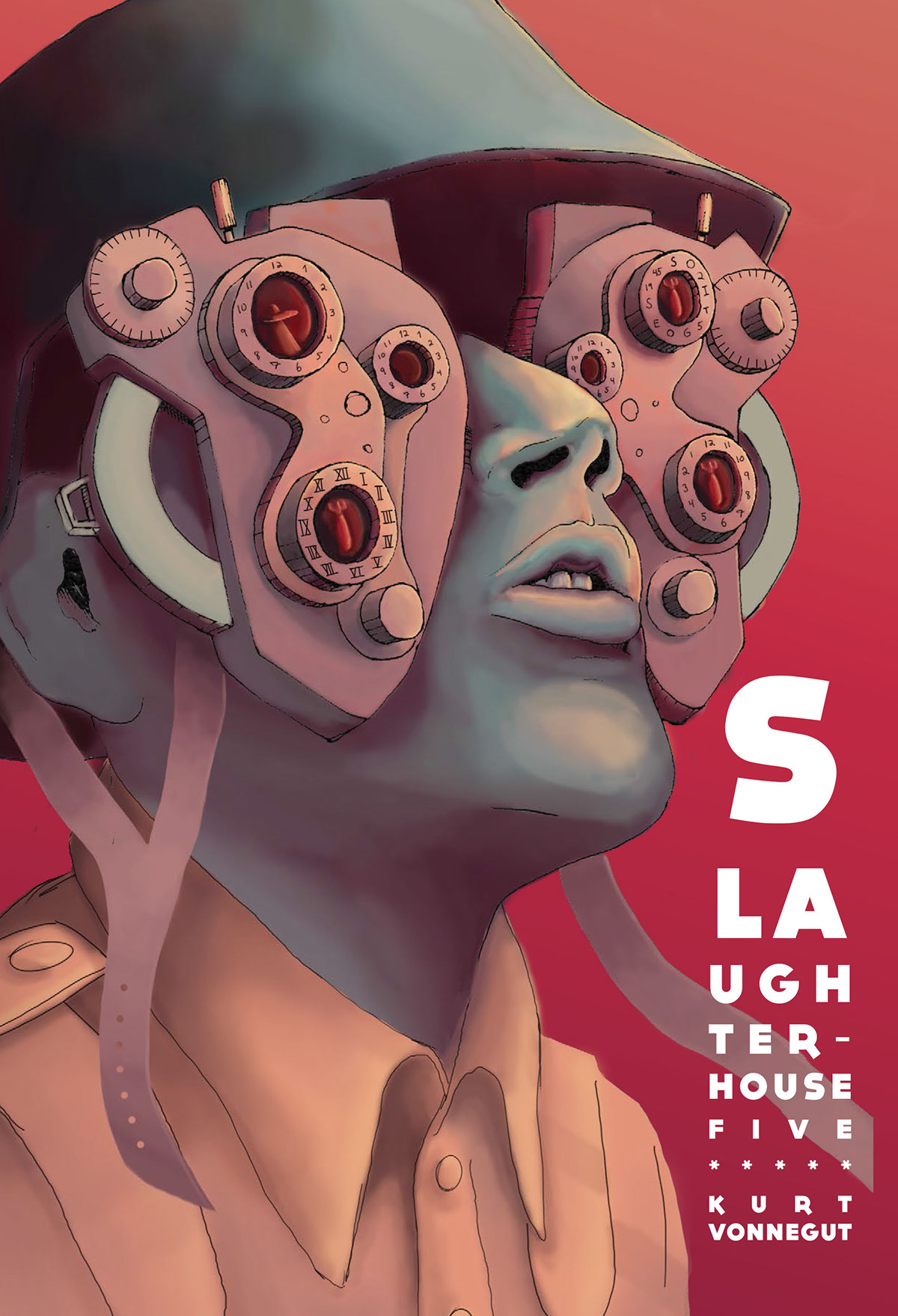
Slaughterhouse-Five


Image result for slaughterhouse-five book cover"All this happened, more or less." [opening line]


Slaughterhouse-Five, or The Children's Crusade: A Duty-Dance with Death (1969) is a science fiction anti-war book about World War 2, written by Kurt Vonnegut. The main character, Billy lives through the Allies' Firebombing of Dresden as a prisoner of war. Vonnegut was actually there in real life, and the book is semi-autobiographical. SH-V is Vonnegut's most influential and popular work, capturing the American zeitgeist in 1969, capturing the spirit of anti-war during Vietnam. Since then its become a classic statement of anti-war, dark humor, science fiction, and satire. 

The book is told in a non-linear way. Flashbacks going backward and forward in time. There's the science fiction element that Billy Dresden experiences. He has been abducted by aliens and now he sees everything in his life through time all at the same time, flashbacks and time travel experiences. On the alien planet, he's in a zoo and forced to mate with a movie star actress. He's 'unstuck in time'. 

Billy was a soldier who refused to fight. A real letdown of an American soldier. He gets captured and is forced to labor at a Dresden slaughterhouse, "Schlachthof-fünf," "slaughterhouse five". Hence the name of the title. The other part of the title's name [The Children's Crusade] comes from a section in the opening of the book about how children are always the ones to fight wars. 

Billy suffers from post-traumatic stress disorder, something not commonly known about back in 1969 but nowadays we are all familiar with because of Iraq and the war in Syria. Billy gets taken under the wing of these aliens, who see in four dimensions, observing all points in the space-time continuum [real science fiction elements, there's also a laser gun]. They adopt a fatalistic worldview. So it goes. That line so it goes is in the book some 106 times. You get used to seeing it. I saw it as dark humor. Your parents died? So it goes. You won a million dollars? So it goes. Nothing happened? So it goes...ad infinitum. 

The style is simplistic. This is probably the easiest book I've read in three months. Its a very enjoyable experience. I finished the book in two days because I couldn't put it down. It was thoroughly entertaining even though the plot isn't linear, its all over the place. 

Coincidentally I'm writing a memoir about myself, growing up in the midwest in the early 2000s with my single parent mother, and I'm writing in a style very similar to this. Although I'm nowhere near as good a writer as Vonnegut. I mean to say that my novella [so far] is kind of non-linear, and the writing style is purposely simplistic. 

It's a very attractive style, it makes you want to read more of the author's work. Another important detail is the fact that the novel reads as part fact [nonfiction] part fiction. Not to mention a lot of dark humor and satire. Initially, when I read the introduction I immediately thought of Voltaire's Candide and Micromegas. However, I find SH-V to be much more emotional than those mostly satirical works from the 1700s, France. Vonnegut manages to combine dark humor, satire, a spirit of the moment [flower power] anti-war message, science fiction, and his own life into a smorgasbord of a novel, and lo and behold, it works somehow.

No doubt there's a lot going on in this novel. In that way, it's not unlike Bruce Sterling's second novel, Artificial Kid, which tries to do everything, but in the end, fails to measure up to its ambition. However, with SH-V we have a work that is highly ambitious and is a winner, not just to me, but to the general reading public today, and from the readers of yesteryear [thank god for online newspaper archives]. This book is considered a classic, deservedly so. 

It's sad, funny, tough, delightful, and it all somehow fits into its own thing, a success. Even if you don't like science fiction I think you as a reader would get a lot out of this book. Its a classic for good reason. 

Recommended if you like classics, science fiction, and war novels.  

Check out my reviews for Voltaire's Candide and Sterling's Artificial Kid.
http://ofigueroamusic.blogspot.com/search?q=candide
http://ofigueroamusic.blogspot.com/search?q=artificial+kid

Tuesday, February 26, 2019

Artificial Kid

Image result for artificial kid bruce sterling original book cover


Artificial Kid is the second novel by Bruce Sterling. Written in 1980, the book is over the top and satirical, reminding me of the kung foo 80s films. The book's protagonist is a young clone, artificially born at an adult age. He's a big action star. He's a combat artist, where people fight on film, and people pay to watch. One of the Orwellian concepts Sterling uses is the idea of a constant surveillance state. In the world of Artificial Kid everyone films themselves doing everything: eating with friends at dinner, having sex, combat art, the works. All the plutocrats of this society used them constantly. The social structure of the society highly stratified. However, with Kid being a pop star combat artist, owning 4 shares of stock, he was super rich, and famous despite being young. This is something of a cyberpunk novel, as there are some pretty advanced technology.
But then bad things happen to Kid. This guy calls a blood feud on him, wipes Kids' maids mind [akin to murder], and has some goons beat him to a bloody pulp. Barely surviving, Kid and his entourage start living on the run. They find themselves getting blown up on a ship from another enemy sent by Angeluce, who's part of the Cabal, the society that controls the planet.

Moses Moses, Saint Anne-Twiceborn, and Kid end up swimming for hours and hours, only to somehow land upon a flying island. On the island kid miraculously finds his mentor, a scientist. They each take turns telling their personal story, as they might be about to die at any time. They were being hunted by Angeluce, because they knew about Moses Moses, who was out of cryosleep, and was apart of the original government some 300 years ago. Yes, none of this makes sense. 

Although none of the middle and ending sections have too much action, this section where the characters tell their own stories is where Sterling shines at creating a character, even if we have to use a bit of suspension of belief. Saint Anne really comes off as a true loving woman and Kid realizes this. Moses Moses' story about how the world and government of Reverid came to be is fascinating, as it works as exposition for the world. 

The story isn't executed nearly as well as the ideas themselves. Perhaps the outcome of a sophomore slump? I've read a lot of short reviews for Artificial Kid and reviews seem to be mixed. I think the novel is terrific. The plot is all over the place but I think the the characters were well written and the ending is quite nice.

Kid grows up as the story progresses. He starts off as an arrogant, drug addled, violent brute that smashes people with nunchucks, but in the end he turns into a loving guy and reciprocates the love of Saint Anne. Kid and Saint Anne raise Quade, the maid who got mind-wiped, up as a kid. But here we see that Kid gives up the combat artist lifestyle, and ends the novel living in peace with Saint Anne and Quade, on an island, his old mentor's house. Kid goes through an odyssey of his own to find out what the really important things are in life. There's even an alien eating a human head.

There are lots of novels with the theme used here. Candide comes to mind. The satirical aspects are strong here. The characters use 80s arcade slang and made-up slang jargon as well like, "Oh wau, holy death!" stuff like that. The gore described herein is pretty hardcore. At one point Kid kills a man for the first time and he ends up ripping up his skull, with grisly details. There is a science, technology, philosophy, and sociological intensity to the extensive dialogue of the characters and that's where the reader learns more and more, getting caught on turns of plot. I think that this is still a strong book from Sterling, and I've read a few of his books now so I can see where he's made his leaps and changes in writing.  

I do think that the plot could have been written in a more elegant or smooth style. But I think rather than rely on plot Sterling used a lot of dialogue for the reader to learn more about the history and lore of the utopia/dystopia planet, as well as the backgrounds of each of the main characters. It worked, for me. I would even be interested to read this again at some point.  As you can see from my list below of all the other Bruce Sterling books, I've read a lot of Sterling's work. I've even read his first novel Involution Ocean, a science fiction Moby Dick. I would say there's a good evolution from 1980 Artificial Kid Sterling to 1985 Schismatrix Plus Sterling. All great stuff relatively speaking, and definitely worth reading.

On a side note I couldn't find any good reviews for Artificial Kid on a google search. So that's why I decided to write my own. Sterling gets props for imagining a world everybody is constantly being watched by their own cameras. Its like he could see to the age of postmodernism where people enjoy watching Keeping up with the Kardashians and other reality TV popcorn bubblegum. Its an old trope for the state of a brutal regime, but its actually come to pass. Sometimes its good to turn off the cameras.

Check out my other Bruce Sterling novel reviews
https://ofigueroamusic.blogspot.com/2018/12/holy-fire.html
https://ofigueroamusic.blogspot.com/2019/01/zeitgeist.html
https://ofigueroamusic.blogspot.com/2019/01/schismatrix-plus.

https://ofigueroamusic.blogspot.com/2018/11/the-difference-engine.html 

Sunday, January 27, 2019

Zeitgeist


Image result for zeitgeist bruce sterling coverZeitgeist is a pop thriller by science fiction [cyberpunk especially] mastermind Bruce Sterling. It has no science fiction elements per se but there are some ideas that I've seen in Sterling's sci fi works here. The one that comes to mind is that nothing ever works out as planned. Don't even bother planning things because it will never turn out the way you want it. Shit happens.

The story is about a guy named "Leggy" Starlitz, who's running a Spicegirls-esque scam. He has seven girls from seven countries (the G-7, the American one, the French one, etc), and they go around touring, singing, and dancing, selling tons of merchandise but no records. The scam is going to the Middle East, where Leggy becomes a part of the criminal and political establishment, as an all girls pop group manager. Oh, and the girls can't sing, they're just lip syncing at shows. 

Leggy has just one rule for the group. The whole scam ends on Y2K. Written in 2000, this book fully captures what it was like at the beginning of the millennium. The novel takes a different course in the master narrative when Leggy's ex-lover [a lesbian with whom he had a threesome with, that spawned a child] leaves their kid with Leggy, in Istanbul. This is when Leggy realizes he has to change as a person, become a good father in his own way, while going through his own personal life. You could say Y2K is used as a midlife crisis here. 

Sterling makes good use of references here. Everything from Dragonball, Saliormoon, Celion Dion, heavy metal [which has the same meanings in every language, the language of distorted guitars and screaming vocals] Brian Eno, and tons of European philosophers that even I myself haven't heard of [I'm a big reader of philosophy but these seemed to be modern European philosophers], and Gabriel Marquez. You can see that Sterling knows a lot and that he can show off when he wants to. That's fine and dandy but some of the references can go over your head if you're not familiar with the terrain.

The master narrative, as Leggy tries to explain to his daughter is understood to be Leggy's own personal life story and everything contained within it. Leggy tells his daughter [who's 11 years old] that if you want to understand the world and people, you have to understand language. Never does this make any more sense than in a novel. However, this can also be applied to real life, where language is pretty much a science. The way you speak with your English in America can get you anywhere you want to go in life. 

The narrative takes a climatic turn when Leggy and Zeta, his daughter go off to Mexico to find Leggy's dad. They find him in some dump in the middle of nowhere, in an abandoned building. They had no ID, passports, money, or anything other than the clothes on their backs. "This is how most of the world lives. Most of their lives on the back page." Leggy says something to that effect and after seeing his dad his midlife crisis seems to be almost over. There's a lot of talk during this section about the atomic bomb testings and such. Apparently Leggy's father worked with the government as a code talker. But after this Leggy still has to deal with the G-7 girls, his pop group. 

Once he goes back to the Middle East he finds out the guy he made a deal with to manage the band while he was away didn't do a good job with the girls. Despite it all being a scam, one of Leggy's rules was "don't let any of the girls die". And two of them had died at this point in the novel. As you can imagine, they don't get along. Not to mention the fact that the business associate is also a heroin and arms deals trafficker with ties to government. 

The ending is very anticlimactic. In fact, Y2K passed very easily and painlessly for Leggy and he goes to a somewhat normal life after that. The novel is very funny, sometimes too funny. In fact the last couple sentences, there is a funny joke. Leggy's Russian buddy says they should do an all girls group from impoverished and war-beaten countries, and they wouldn't make any money from the group. And that in fact, they would pay people to lose money for them. That's pop for you. 

This is my third Bruce Sterling novel I've read and wrote about. Check out my other reviews below.

https://ofigueroamusic.blogspot.com/2018/12/holy-fire.html 
https://ofigueroamusic.blogspot.com/2019/01/schismatrix-plus.html 

Monday, January 21, 2019

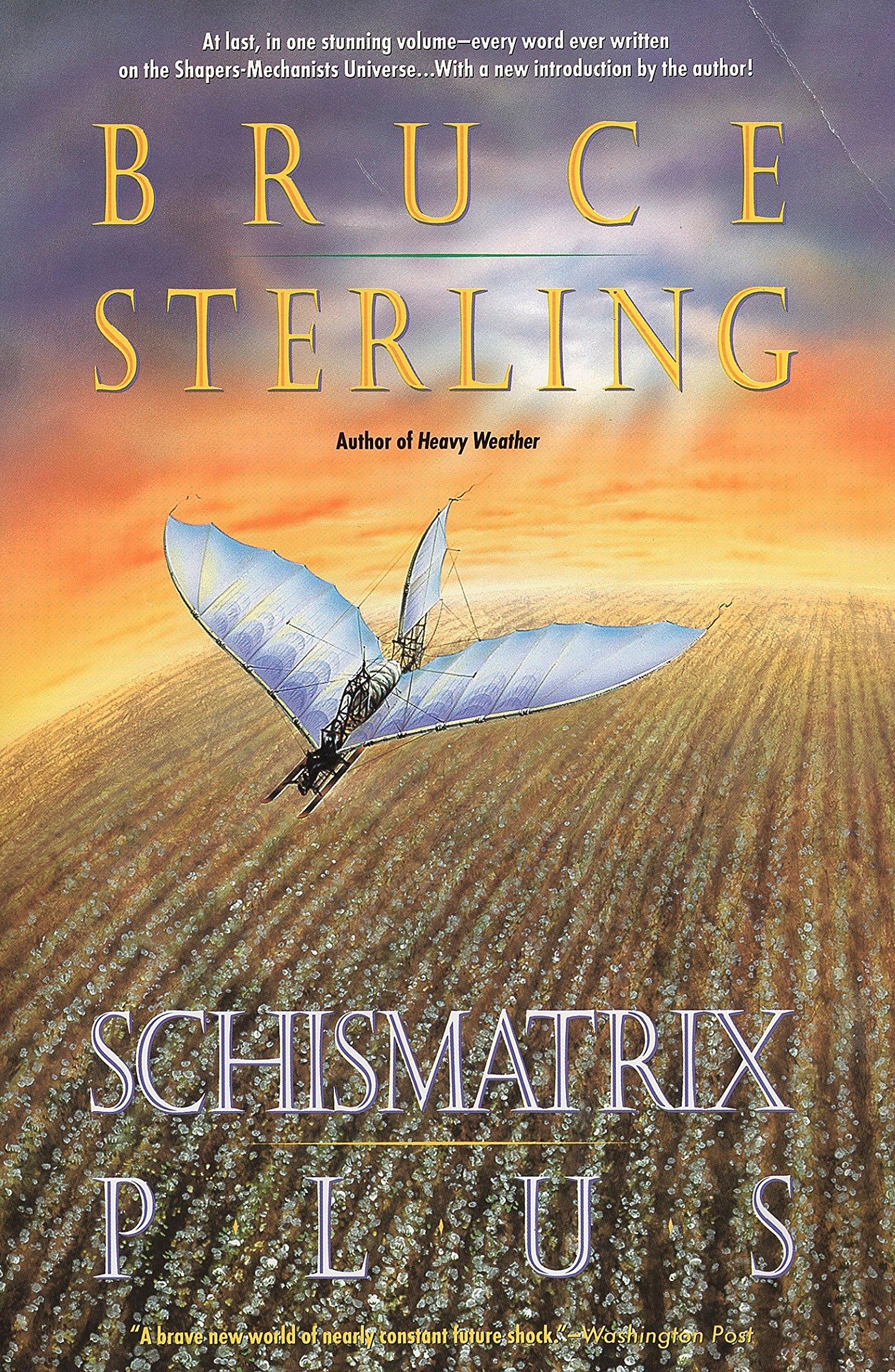
Schismatrix Plus

Image result for schismatrix book cover originalSchismatrix Plus is a science fiction novel by Bruce Sterling, written in 1985. Schismatrix was nominated for the Nebula Award for Best Novel in 1985, and the British Science Fiction Award in 1986. This story is set in Bruce Sterling's fictional Mechanist/Shaper universe. Five short stories that preceded the novel are apart of the Schismatrix Plus edition. The novel by itself without the short stories is simply titled Schismatrix. 

What can I say about this novel? It is simply fantastic and got me more interested in the cyberpunk genre. Sometimes you read a book and something hits you in the head. Bang! This is one of those books. This is an important book. Even a week after finishing the novel I still think about it, the themes and concepts, and especially the ending. 

There's a universe of potential, Lindsay, think of that. No rules, no limits.  

The world of Schismatrix is transhuman. There are Shapers, who use biotechnology and psychology to enhance human potential and then there are Mechanists, who apply AI, and mechanical parts to enhance themselves and become more than human. The Shapers/Mechanists are colonizing the solar system, divided in their two distinct philosophies. 

The book follows the life of a sundog [wanderer, ronin] named Ableard Lindsay, a Shaper with diplomatic training and a brilliant liar, which he uses to great effect. "Before the end of the novel his careers have included being a revolutionary, a theatre producer, a space pirate, a xenodiplomat, a scholar and a prophet." [https://www.aleph.se/Trans/Cultural/Art/schismatrix.html] 

"Politics pulls us together, technology pulls us apart".

Throughout the book changes in technology, habitat, economics, and politics change the dynamics of the entire narrative and discourse. There's a similarity here to the Cold War. This was written in 1985 after all, in a different era from mine [2019]. This similarity is shown when the Shapers/Mechanists have problems when they start colonizing neutral zones. 

The changes force people to adapt, their life styles as well as their philosophies. Some people turn to Zen Serotonin, something of a religion where people get high off neurochemical implants. Others are Cataclysts, who think radical change is a good way to open ones' eyes, whether you want it or not. 

The one theme that repeats throughout the novel is that nothing goes as planned. A plan might work out for a little while, but you have to always be prepared to move on, do something else, just in case. 

He mourned mankind, and the blindness of men, who thought that the Kosmos had rules and limits that would shelter them from their own freedom. There were no shelters. There were no final purposes. Futility, and freedom, were Absolute. [From the short story Ten Evocations]


Futility is freedom could be seen as the overarching mood of Schismatrix. Its impossible to plan for the future because the everything's always changing. But the chaos is also affected by our actions. 

In the short story Swarm, we find have a group of symbiotic non-sentient species living in a hive society. Through this story we find out that intelligence isn't needed for long-term survival, and sometimes it might not even be desirable.  

Sterling makes me think a lot about what transhumans would really be like. Transhumanism is one thing but when its mixed with politics, ideology, and power it becomes something else. Its not a cheerful thing. The flaws in ideology is the price paid for continued evolution. 

One thing I'd like to say that this book made me feel like a kid again. The Investors [tall, big, reptilian-like aliens, who are more interested in business than anything else] were really cool and I could see aliens really looking and acting like them. The ending where Lindsey becomes one with the Presence was pretty great too. Although the actual writing in the novel is a bit dense the mind-set of the novel is tough-minded, and never lets you down. 

The ideas here are thought provoking and would do well to be explored further by Sterling himself [not gonna happen] or others with similar ideas for the science fiction canon. Sterling seems to suggest that there wont be one posthumanity, but many and tremendously diverse posthumanities. Our greatest enemy might be our inability to handle infinite possibilities. [https://www.aleph.se/Trans/Cultural/Art/schismatrix.html]

Wednesday, December 5, 2018

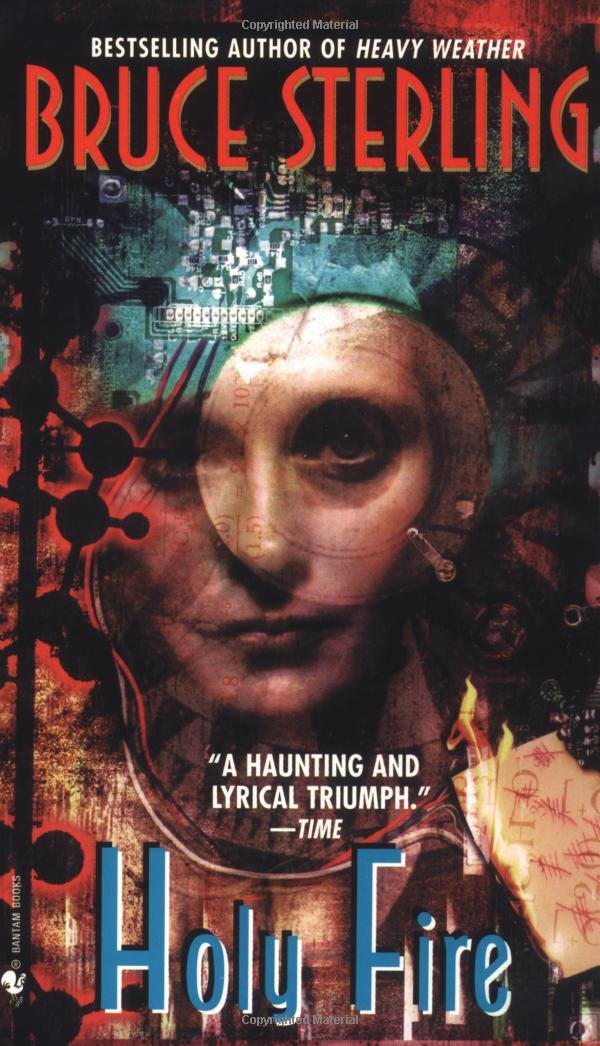
Holy Fire

Image result for bruce sterling holy fire book coverHoly Fire is a great science fiction novel written by Bruce Sterling. It came out in 1996. It was nominated for the British Science Fiction Award in 1996 and the Hugo and Locus awards in 1997. High praise for great art. 

The story follows a medical economist named Mia Ziemann, a ninety-year old woman who transforms into a twenty-year old girl through intrusive technological means. Now (post-op) and borderline psychotic she goes by the name Maya as a young lady, traveling across Europe with nothing but a bag and the clothes on her back. She makes friends with all kinds of artists, bohemians, hackers, and fashion gerontocrats. The story is about life, death, the human condition, art, fashion, a very poetic sort of philosophy and ontology. 

The world of Gilead is somewhere in the year 2100. Gerontocrats control mostly everything and young people are like the scraps on their shoes, living on the margins. However, most things are free, including free health care and food, provided you don't harm your body or anyone else. Its a near future but its not a totally implausible one.

Once transformed, Maya gets caught up with thieves and drifters, eventually making her way into the fashion/modeling industry because of her sexy look. From there she makes friends in high places, mostly programmer types that help her with her palace, a digital life-space given to her by her now dead husband, complete with ruins and stuff. This is a cyberpunk story and the technology here is out of this world. Even with Sterling's esoteric explanations, the tech can get lost in between the dialogue, which is what helps make the novel move along nicely. 

Sterling gets very in depth with the virtuality within the story. His scientific explanation for Ziemann's transformation was quite complex. It was like reading Greek for me. However, it was mostly just advanced biology terms. The tech stuff here reminded me of William Gibson. Although I think Gibson does it better because he's able to make more out of the tech with his literary technique. 

Anyways, Ziemann gets caught up with a bunch of rich, radical anarchists and they plan on 'living forever' and taking control of the system, and this and that...But it turns out in the end that Ziemann gets caught up with the police, who were tracking her down because she skipped out on paying back her medical bills for the youth procedure. And not only that, but her dead husbands' talking dog Plato was always in the virtual palace, he'd been looking for her too. 

Ziemann goes through an ontological transformation. She realizes that she doesn't want to go back to being a gerontocrat, and that she wants to be a young photographer, even if she's really bad at it. It takes becoming a full blown criminal, a celebrity (at the end), a widow, and a Frankenstein-esque monster to realize what she wanted in life. 

The novel contains many debates between these young bohemian types over the immorality of immortality as well as the aesthetics of fashion. The underclass here are also talked about frequently, the class of people who can't become 'post-human', those are the real disenfranchised of the story. 

The writing of this story is free flowing with great metaphysical ideas. This is mostly done through dialogue and small events that happen over many pages-fifty pages here, another fifty pages there, etc. Although there are heavy cyberpunk elements here the ideas presented command more authority than mere tech. This isn't an easy novel to understand but its easy to read because the dialogue is interesting and the characters have artistic and idealistic charm.

If you want a different sort of cyberpunk novel this is for you. If you want a different sort of science fiction novel, this is it. They don't make science fiction like this anymore these days. And this was only from 1996! 

I'm currently waiting for my order of Bruce Sterling's Schismatrix. I heard from my father that's his most important novel. After reading his amazing collaboration novel with William Gibson, The Difference Engine, this was a great follow-up. On his own Sterling has grandiose philosophical ideas to go along with his cyberpunk technology. It has legs. 

Sunday, November 25, 2018

The Difference Engine

Image result for the difference engine gibson sterling
The Difference Engine by William Gibson and Bruce Sterling is one of those all-time great 'hard' science fiction novels. Set in a steampunk alternative history where primitive computers were invented in the mid 1800s thanks to Charles Babbage's Analytical Engine, the story has the three things a good cyperpunk story has: steam airships, brass computers, and kinky feminine underwear (Gibson's words). 

The story follows Sybil Gerard, the daughter of a famous Luddite agitator Walter Gerard (Luddites being anti-technologists), Edward 'Leviathan' Mallory-paleontologist and explorer, and Laurence Oliphant, a historical figure, a travel writer who works under service of Her Majesty. What links all these characters together are these computer punch cards that are supposed to be powerful, important enough to die for. 

The characters believe the punch cards are part of a gambling 'modus', a device used in gambling where you can never lose, and have infinite money, a alchemist device.  "The last chapter reveals that the punched cards represent a program that proves two theorems which, in reality, would not be discovered until 1931 by Kurt Gödel. Ada Lovelace delivers a lecture on the subject in France." 

Mallory, his brothers, and Ebenezer Frazer (part of the Secret Police) defends the cards against Captain Swing, who leads a riot during the 'Stink', a major pollution event that happened in London, similar to the London Smog of December 1952. 

At the end Oliphant meets Sybil Gerard and tells her he knows who she is, the daughter of Walter Gerard, the famous Luddite agitator. He says he won't share her identity with anybody, but that he needs information to help take down Charles Egremont MP, her seducer, who poses as an obstacle in the way of Charles Babbage and Lord Brunnel's political careers. 

The end of the novel features all these different histories that occur in the world of Difference Engine. Lovelace delivers her lecture on Godel's Theorem, as its counterpart is known in our world. Fraser accompanies Sybil and meets Lovelace, with Sybil not ever able to forgive Lovelace's father Byron, for her role in her father's death.  

The end features a view of an alternate 1991 from the point of a computer, which turns out to be the narrator as it achieves self-awareness. 

Wow! What a novel. There's a lot to like about this novel. There's even realistic sex scenes, sort of like noir. The description of 'clackers', the book's version of hackers is pretty interesting, and similar to what hackers are like in real life, the 30-hour savants working around the clock with their calculations. 

But I think what was most exciting about this novel was the sheer brilliance of the writing-dialogue, plot, exposition, niche time period words of the 1850s, its got a lot going for it. The way that Gibson and Sterling made the narrator a computer, it gave them more options when it came to plot and exposition. I also believe that because this is the work of Gibson and Sterling, that it was destined to be great. This book was written at a high period of literary achievement for both writers. So its no surprise that the writing is very good. Both of them went on to become very different writers after the cyberpunk 90s. 

Although the novel was nearly 500 pages and took a long time to read (including a lot of 30 minute lunch breaks at work), I would say it was well worth it. This book compares to something like Dune, which I put at a really high literary and science fiction pinnacle. Its just that good.

The truth though is that the book took me a long time to get into. In fact, I had checked it out numerous times and barely ever got 50 pages in and at point I even listened to the audio book version on YouTube. Eventually I decided I was going to read the whole thing, turns out it was well worth the time and effort. But a book this great doesn't take too much effort, the words seemingly move across pages very easily. The time invested in reading this book is time well enjoyed. Such is the literary style of Gibson and Sterling. 

Well worth the read if you like alternative history, steampunk, or cyberpunk stories.  

On AI, Existential Threat, and the Collapse

Good evening ladies and gents. Hope you all had a good Sunday. I wanted to write here a bit more about AI, existential threat, and the Colla...