Showing posts with label 1980s. Show all posts

Saturday, January 4, 2025

Things I learned From Shows in Los Angeles

Letter from the composer: [sends me chords to play on piano]


Me: Thanks, I'll check them out. 


Happy New Year. Kind of bummed out with a work situation at the moment. But the music is keeping me going. The last couple nights I've been going to shows at the bar and figuring out how the sound technician gets all the sounds. I figured it out. 

There are monitors, subwoofers inside the bar on the top of corners on the ceiling. 

The owner only wants the sound tech to only use the brand new [digital equipment]. But he doesn't want to because he likes a more traditional system. 

The owners says the traditional system is too loud. So he can't use it every night. So he's been loading different equipment [a more fancier analog system] all by himself for different nights in a large SUV style van. Not good because the guy is 64 years old. 

The answer to this dilemma is that he must use a smaller sound system for each and every night. But he doesn't want to because he wants to do what he wants, and is reluctant to do anything the owner says because they've been working together for a long time and they have some sort of dispute about it. 

However, the sound technician showed me the older more basic [analog log system that's very small] and I saw that everything that it had was acceptable and could work within the small confines of a small local Encino bar. 

So, you find that the sound systems used to record music are not important at all to the sound of the recording. 

Rather, it is the direction of sound that is placed or pointed at the audience that determines the sound more than anything else. 

In conclusion, theoretically speaking, you could record a classical music album on an iphone 12. 

Keep in mind, this guy used to run sound for Black Flag.


Happy New Year! 

Monday, October 12, 2020

Eddie Van Halen

Eddie Van Halen died on October 6th, 2020. The music world has been deeply saddened by his death, as have I. 

Eddie was one of those quintessential guitar players. You might not like Van Halen or heavy metal but the fact remains that he was one of the pivotal guitar gods of the 1980's. He played on Michael Jackson's Thriller. Through his influence, there was a guitar boom during that time and everybody wanted to shred the guitar, leading to great players like Randy Rhoads. Eddie is the best guitar hero of the 80s, without a doubt. His influences, ironically, also my influences, the 1960s-1970s classic/blues rock, is evident in his playing, and helped develop his classic hard rock, "brown sound," if you will. 

What is the brown sound? Well, it's that most perfect hard rocking loud distorted guitar tone that every rock guitarist goes for without necessarily trying to because it's so good so why change things up? Eddie perfected it with his own hands, guitar modifications, and guitar effects like the phase 90 and tube screamer stomp boxes, guitar pedals, and electronics.

A guitarist named Ronn from a classic rock band from the 70s, called Lightning [find them on YouTube, he's a killer guitar player], also told me about Eddie, "He plays licks from outer space, from Mars." Well, that certainly makes sense considering how blazing fast, bluesy, and melodic Eddie was. There was something otherworldly there. His guitar playing had everything; heavy rocking riffs, decent vocals, blistering melodic solos, and a good band to keep everything going. Not to mention the intensity of a Van Halen stage show performance. Might as well jump! He had it all and did it all. 

His passing is especially sad during the middle of COVID, where some 200,000 Americans have died due to the novel virus. Although he died from cancer, we will never really know if perhaps his death was 'covid related,' as many deaths are these days. His death is personal for me because when I was a teenager I was obsessed with all things guitar. And when I discovered Van Halen, it changed my life for a while. 

I could see that although heavy metal wasn't the kind of music my kind of people listen to, the music resonated with me because of the power of Eddie's crushing guitar sound and melodic fast solos. It wasn't so much the anthems [Jump, Panama, Runnin' with the Devil, Jamie's Cryin', Hot for Teacher] rather it was just the fact of the matter; the heavy guitar riffing saved my teenage soul. After hearing Eruption I went on to learn parts of it. And even later I learned all the scales and modes so I could shred the fret-board like Eddie. It was a good time. It's good to be young. 

I also had a Van Halen disc golf that I cherished because I loved the band so much. I became a great Frisbee golfer back around 2011 and took great care to never lose my Van Halen disc golf, no matter how many trees were in the park, day or night.

Now that I'm older I see that people like Eddie Van Halen are rare. They won't come again. There will never be another Eddie Van Halen. There will be others similar to him but they will never be able to capture that intrinsic something, that epic guitar god status that is sorely lacking in today's musical environment because rap and pop have taken over and rock guitar has taken a back seat since then. 

But his legacy isn't over. Even someone like me, a guitarist in his 30s, has been influenced by Eddie, and his playing lives on through guitar players like me, who learned from him, honored, and respected him, loving the music and learning from it. 

Yeah, it's just heavy metal but it was MY heavy metal. 

"I know, it's only rock and roll but I like it."

*Rest In Peace*

Saturday, June 8, 2019

Islands in the Net


Islands in the Net is a science fiction novel from 1988 written by the cyberpunk master himself [second only to William Gibson imho] Bruce Sterling. I found this book on a whim. I randomly typed in best cyberpunk novels on google and it showed up on a couple of lists. So I figured I'd order the book from the library and give it a shot. Risky!

This book isn't what I was expecting. The introduction starts with a woman running on the beach and tripping onto the sand, bruising herself. A walking, talking robot comes to her aid. That first impression is important. I thought the talking robot was such a great first impression. I figured the rest of the book would have science fiction elements like that. I was dead wrong. 

Now, it's not that this isn't true science fiction. It's just downplayed super hard in favor of plot and dialogue. It is, in fact, true science fiction, maybe even cyberpunk if you want to call it that. However, the science fiction aspects of this book are very minimal. Although IITN was written in '88, Bruce Sterling was actually able to predict where the technology would go. Hence drones. This is where the plot lies. 

A civilian corporation called Rizome gets involved with data pirate terrorists. They're trying to get the data pirates to come together and stop bombing each others' countries, stop stealing each others' data and money, etc. They deploy drones a lot to kill people, even causing mini genocides and such. This is a prediction of the future because today we live in a world where drones kill people every day [in the middle east]. We have a female protagonist named Laura, who's married and has a baby daughter. Laura decides to be the lead negotiator between these data pirate groups. She wants to be the 'female man', the woman who does it all, risks it all, and comes back home safely, forever changed, but a glorious welcome home, a legend. 

The plot is actually very innovative and grandiose. The whole time I was reading it I kept thinking to myself, is Sterling going to pull this one off? After all, this is my sixth Sterling novel so I know when he writes a mediocre novel [Zeitgeist]. When great science fiction writers try to write what I think of as contemporary thrillers I am not into it. Think William Gibson's All Tomorrow's Parties. I couldn't even get through ten pages of that. Anyways, I actually really like the plot here. It's cutting edge. However, the way the plot and characters work is mediocre. 

The plotting is done mostly through dialogue. One of the best things I can say about this novel is that all the 'boring narration' is actually quite exciting. I liked to see what happened next in terms of pure action. There was a dog breathing fire, a president of Singapore calling Africans the n-word on national television [which reminds me so much of the Trump White House adminstration], two years of imprisonment, Laura's best friend from college marrying her husband while she was locked up, lotion that turns white people black [and they love it, prediction of tanning] and lots of explosions, which included nude women. Sounds pretty great right? Well, it is. 

But then you notice that Sterling is making you work for all that exciting stuff. In between all the action scenes, there's tons of wooden dialogue. It's not that it's terrible writing, on the contrary this is still decent writing. But there's a sense of just riding the breeze with the dialogue. There's little if any character development throughout the entire novel until the very last twenty pages. That's only because Sterling is obliged as a writer to resolve all tension throughout the narrative.

So yes we have a great ending but it takes you 350 pages to get there. Which I find super long given that it's not very much of a science fiction story, feels so contemporary that its modern, and has wooden dialogue. I didn't care for Laura until the very last twenty pages where she has an epiphany and resolves all her problems, comes to grip with reality through much hardship. She even meets her Optimal Persona while in prison. Don't ask. It's a California thing. 

In conclusion, this book had a very inspiring idea but is poorly executed. Sometimes even the great masters of science fiction miss the mark. In fact, I should've known this wasn't that great of a book because I'd never even heard of it. When I told my dad [an old school science fiction aficionado] that I was reading it he told me that it was almost contemporary. And that's my whole problem with it. 

Worth the read only if you're a hardcore Bruce Sterling fan. Not science fiction enough. The best thing I can say about this novel is that it is very ambitious. Sometimes Sterling hits the mark spot on with the way the world works [economies, organizations, countries, mercenaries, data, etc], even today, some 40 years later. That is remarkable but doesn't justify me thinking of this as a great science fiction novel. However, this cover with the woman on the cover in the 'matrix' is pretty damn cool. Unfortunately, that only tells a small fragment of the actual story. 

Check out my other Bruce Sterling novel reviews below:
https://ofigueroamusic.blogspot.com/2019/01/schismatrix-plus.html
https://ofigueroamusic.blogspot.com/2018/11/the-difference-engine.html
https://ofigueroamusic.blogspot.com/2018/12/holy-fire.html
https://ofigueroamusic.blogspot.com/2019/02/artificial-kid.html
https://ofigueroamusic.blogspot.com/2019/01/zeitgeist.html

Thursday, March 14, 2019

Dawn [from Octavia Butler's Xenogenesis trilogy]

Dawn is the first installment of science fiction writer Octavia Butler's Xenogenesis trilogy. Dawn was written in 1987. In 2000, a collection of the trilogy was released in an omnibus entitled Lilith's Brood, which thanks to my brother I have a copy of. I found out about this novel through Wikipedia's timeline of science fiction. I've read a lot of novels on the list, including some obscure archaic sci-fi like Sir Tomas More, Francis Bacon, and Margaret Cavendish, Kepler's Somnium, which goes back to the 1500s. However, I saw Dawn at the bottom of the list and thought it was worth reading because Octavia Butler is a great writer and I should read more of her work. 

Dawn is an incredibly raw and heavy book. Not for the weak minded. An African American woman wakes up in a room, locked inside these alien walls. She has these captors who turn out to be aliens. The aliens are planning on having our female protagonist Lilith, lead a group of humans onto the Earth, after it was destroyed by nuclear war. They're going to go back to the planet and repopulate and live on the Earth if they can learn how. In the meantime, they have to get along and hopefully not kill each other. The fact that the aliens make Lilith in charge of the human enterprise makes her into some kind of quasi-Messiah figure, meanwhile, the other humans hate her for being more than human, after she'd been tampered with genetically by the aliens.

That plot seems so simple. Hardly. There's not really any action at all in the entire novel. Most of its psychological, scary stuff regarding sexuality, reproduction, DNA, cloning, rape, colonialism, psychology, rights to your body and others' bodies, and freedom. These ideas are also prescient in modern society, for women, and women of color especially. Think about slave times when the white slavemasters used to rape the slave women and there would be mixed kids running around the plantations. There's a lot of serious themes going on here. Themes that are overtly female, that even science fiction gods like William Gibson and Bruce Sterling can't write about well. This is where Octavia Butler shines. Because although the themes are gut-wrenching and uncomfortable as all hell, the writing is so inspired and good, that I have to recommend this book to anyone interested in science fiction. It's such a good read that I couldn't put it down. I finished the book in only two days, two hundred and fifty pages read very easily. 

Butler's prose is quite unique. Although the writing isn't difficult, there's a sense of single-mindedness throughout the novel. Deliberate. It seems that she had a good editor, or edits well herself because no parts seemed to anything, nothing was too long, too short, everything seemed to have been given proper detail and time. Sometimes the sentences can get busy and colorful but again, nothing ever loses its place. Everything seems to fit. The beginning of this book reminded me of Margaret Atwood's Handmaid's Tale, but only in the sense that both novels start with a woman in a cage, in a sense. However, in reality, Octavia Butler is a much more powerful, visceral writer than Atwood. And in fact, Dawn is a much better book than Handmaid's Tale.

This is a great book. So great that it demands your attention to read the next books in the trilogy: Adulthood Rites [1988] and Imago [1989]. Thankfully, I already have a copy of the omnibus Lilith's Brood, so I already have my copy ready when I am ready to read. Definitely check out Octavia Butler's Xenogenesis trilogy. Every book in the trilogy was nominated for the Locust Award, but it was the short story "Bloodchild" that ended up winning the award.

Recommended to science fiction fans and feminists. It goes without saying that Octavia Butler should be read because she's a black female science fiction writer of the new wave of science fiction. As a black woman outside of the genre, she has important things to say about being black and female, that the other new wave science fiction writers can't get away with, no matter how hard they try. There's only one Octavia Butler. 

Check out my review for Octavia Butler's novel Kindred, where a black woman goes through a portal to the antebellum south, reliving the slavery era, https://ofigueroamusic.blogspot.com/2018/01/kindred.html

Next on my list is H.G. Wells' The War of the Worlds. It's a short read, also on the Wikipedia timeline of science fiction page. Looking forward to it. At some point soon I'll continue Butler's Xenogenesis trilogy. 

Tuesday, February 26, 2019

Artificial Kid

Image result for artificial kid bruce sterling original book cover


Artificial Kid is the second novel by Bruce Sterling. Written in 1980, the book is over the top and satirical, reminding me of the kung foo 80s films. The book's protagonist is a young clone, artificially born at an adult age. He's a big action star. He's a combat artist, where people fight on film, and people pay to watch. One of the Orwellian concepts Sterling uses is the idea of a constant surveillance state. In the world of Artificial Kid everyone films themselves doing everything: eating with friends at dinner, having sex, combat art, the works. All the plutocrats of this society used them constantly. The social structure of the society highly stratified. However, with Kid being a pop star combat artist, owning 4 shares of stock, he was super rich, and famous despite being young. This is something of a cyberpunk novel, as there are some pretty advanced technology.
But then bad things happen to Kid. This guy calls a blood feud on him, wipes Kids' maids mind [akin to murder], and has some goons beat him to a bloody pulp. Barely surviving, Kid and his entourage start living on the run. They find themselves getting blown up on a ship from another enemy sent by Angeluce, who's part of the Cabal, the society that controls the planet.

Moses Moses, Saint Anne-Twiceborn, and Kid end up swimming for hours and hours, only to somehow land upon a flying island. On the island kid miraculously finds his mentor, a scientist. They each take turns telling their personal story, as they might be about to die at any time. They were being hunted by Angeluce, because they knew about Moses Moses, who was out of cryosleep, and was apart of the original government some 300 years ago. Yes, none of this makes sense. 

Although none of the middle and ending sections have too much action, this section where the characters tell their own stories is where Sterling shines at creating a character, even if we have to use a bit of suspension of belief. Saint Anne really comes off as a true loving woman and Kid realizes this. Moses Moses' story about how the world and government of Reverid came to be is fascinating, as it works as exposition for the world. 

The story isn't executed nearly as well as the ideas themselves. Perhaps the outcome of a sophomore slump? I've read a lot of short reviews for Artificial Kid and reviews seem to be mixed. I think the novel is terrific. The plot is all over the place but I think the the characters were well written and the ending is quite nice.

Kid grows up as the story progresses. He starts off as an arrogant, drug addled, violent brute that smashes people with nunchucks, but in the end he turns into a loving guy and reciprocates the love of Saint Anne. Kid and Saint Anne raise Quade, the maid who got mind-wiped, up as a kid. But here we see that Kid gives up the combat artist lifestyle, and ends the novel living in peace with Saint Anne and Quade, on an island, his old mentor's house. Kid goes through an odyssey of his own to find out what the really important things are in life. There's even an alien eating a human head.

There are lots of novels with the theme used here. Candide comes to mind. The satirical aspects are strong here. The characters use 80s arcade slang and made-up slang jargon as well like, "Oh wau, holy death!" stuff like that. The gore described herein is pretty hardcore. At one point Kid kills a man for the first time and he ends up ripping up his skull, with grisly details. There is a science, technology, philosophy, and sociological intensity to the extensive dialogue of the characters and that's where the reader learns more and more, getting caught on turns of plot. I think that this is still a strong book from Sterling, and I've read a few of his books now so I can see where he's made his leaps and changes in writing.  

I do think that the plot could have been written in a more elegant or smooth style. But I think rather than rely on plot Sterling used a lot of dialogue for the reader to learn more about the history and lore of the utopia/dystopia planet, as well as the backgrounds of each of the main characters. It worked, for me. I would even be interested to read this again at some point.  As you can see from my list below of all the other Bruce Sterling books, I've read a lot of Sterling's work. I've even read his first novel Involution Ocean, a science fiction Moby Dick. I would say there's a good evolution from 1980 Artificial Kid Sterling to 1985 Schismatrix Plus Sterling. All great stuff relatively speaking, and definitely worth reading.

On a side note I couldn't find any good reviews for Artificial Kid on a google search. So that's why I decided to write my own. Sterling gets props for imagining a world everybody is constantly being watched by their own cameras. Its like he could see to the age of postmodernism where people enjoy watching Keeping up with the Kardashians and other reality TV popcorn bubblegum. Its an old trope for the state of a brutal regime, but its actually come to pass. Sometimes its good to turn off the cameras.

Check out my other Bruce Sterling novel reviews
https://ofigueroamusic.blogspot.com/2018/12/holy-fire.html
https://ofigueroamusic.blogspot.com/2019/01/zeitgeist.html
https://ofigueroamusic.blogspot.com/2019/01/schismatrix-plus.

https://ofigueroamusic.blogspot.com/2018/11/the-difference-engine.html 

Tuesday, February 19, 2019

Eden


EdenLem.jpgEden is an early science fiction novel written by Polish writer Stanislaw Lem, in 1959. However, it wasn't translated into English until 1989-way, way later.

The characters here don't have names, rather the crew are called the Doctor, the Chemist, the Captain, etc. The story starts with a crew landing on an alien planet called Eden. The ship gets damaged, but its repairable. So the crew works on fixing the ship as well as exploring the planet. 

What they see sort of reads like a horror story. They find spider-like plants, mass graves of dead aliens with amorphous shapes and faces all over the place, a bio-factory of aliens, flying, spinning discs, etc. All of which makes the whole experience look like an alien concentration camp. The crew keeps trying to make sense out of everything but at the end of all the debate they realize that nothing makes sense no matter how much they keep learning. 

Most of the book is the crew repairing the ship, exploring, and explanations of what they see, in their jeep with their giant robot. At one point they get attacked by aliens [whom they call doublers], and they retaliate using an atomic weapon! 

Nothing is really known the longer the novel goes on until the last chapters. In fact, there's no character development nor is there any clear plot or story line. At the end the crew finds an alien [a doubler] that's wearing clothes [a rag-like thing]. They find out through the doubler's star maps that he is a man of learning and science. They figure out a way to get the ship's computer to translate the doubler's gurgling cough language. 

From here we learn that the alien civilization here is highly stratified. There used to be a tyrannical government in place in the beginning. Then there were leaders who led anonymously. There's jails set in place where the aliens serve voluntarily, sent there for punishments from the higher ups of the planet, perhaps for doing wrong, perhaps not, we don't know as the computer is iffy with the doubler's translation. The higher ups also control who gets to distribute information, an Orwellian influence. Basically a concentration camp without any guards, designed so that prisoners stay inside on their own free will. I still don't quite get it, but I'm not sure if I'm suppose to nor do I think its that important. Its an interesting concept nonetheless. 

We also learn that although the doublers have no sense of nuclear power, they did once conduct a mass experiment to enhance the species. The experiment failed, which resulted in deformed doublers, who are ostracized from the main society. The doubler tells them that because information gets you killed here, that when he found out that a ship with aliens crash landed, he took this as the chance of a life time, which the humans empathized with.

The crew realizes that they've been exploring something of a prison planet, that sort of thing. The two doublers that the crew found during their stay decided to stay behind the ship's exhaust and die, rather than go back to their oppressive society.  

Before the crew leaves the planet the Captain and the Doctor have a debate. Should they intervene? This is the book's philosophical angle. In the end the Captain decides they shouldn't interfere with these aliens and their society, which makes sense especially because this book was written under Soviet-style regime. However, it also makes the case against having an influence upon another society, another civilization. Sometimes its best to leave things be, which they decide to do. 

Although the prose here isn't anything grand, this book kept my attention. I finished the novel in three days because I was so curious about what was happening on the planet. The book was sort of terrifying in a way, what with the whole prison concentration camp vibe. However, I think that horror element keeps the story exciting, as the prose is sort of dry. 

When the crew is flying off they look back at Eden and see that its a beautiful violet sphere. They realize that it was because of its beauty that they accidentally flew too close and entered its atmosphere. Because of this beauty, that's the reason its called Eden.

I would definitely read more Stanislaw Lem, he's one of the only modern European science fiction writers I've read. I've seen the movie version of his book Solaris, a terrific 1970s sci-fi flick. I would be interested in reading that. 

Monday, January 21, 2019

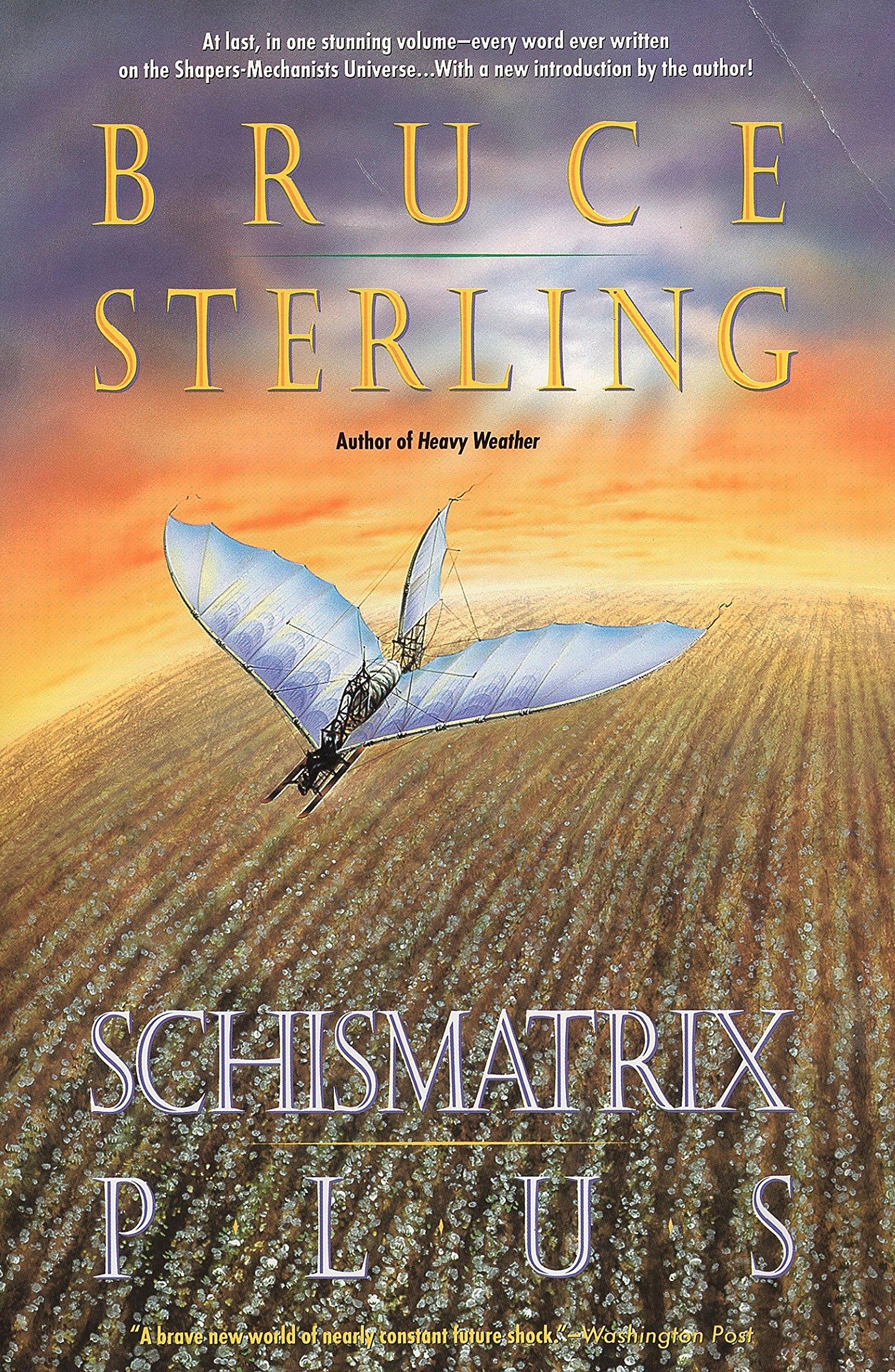
Schismatrix Plus

Image result for schismatrix book cover originalSchismatrix Plus is a science fiction novel by Bruce Sterling, written in 1985. Schismatrix was nominated for the Nebula Award for Best Novel in 1985, and the British Science Fiction Award in 1986. This story is set in Bruce Sterling's fictional Mechanist/Shaper universe. Five short stories that preceded the novel are apart of the Schismatrix Plus edition. The novel by itself without the short stories is simply titled Schismatrix. 

What can I say about this novel? It is simply fantastic and got me more interested in the cyberpunk genre. Sometimes you read a book and something hits you in the head. Bang! This is one of those books. This is an important book. Even a week after finishing the novel I still think about it, the themes and concepts, and especially the ending. 

There's a universe of potential, Lindsay, think of that. No rules, no limits.  

The world of Schismatrix is transhuman. There are Shapers, who use biotechnology and psychology to enhance human potential and then there are Mechanists, who apply AI, and mechanical parts to enhance themselves and become more than human. The Shapers/Mechanists are colonizing the solar system, divided in their two distinct philosophies. 

The book follows the life of a sundog [wanderer, ronin] named Ableard Lindsay, a Shaper with diplomatic training and a brilliant liar, which he uses to great effect. "Before the end of the novel his careers have included being a revolutionary, a theatre producer, a space pirate, a xenodiplomat, a scholar and a prophet." [https://www.aleph.se/Trans/Cultural/Art/schismatrix.html] 

"Politics pulls us together, technology pulls us apart".

Throughout the book changes in technology, habitat, economics, and politics change the dynamics of the entire narrative and discourse. There's a similarity here to the Cold War. This was written in 1985 after all, in a different era from mine [2019]. This similarity is shown when the Shapers/Mechanists have problems when they start colonizing neutral zones. 

The changes force people to adapt, their life styles as well as their philosophies. Some people turn to Zen Serotonin, something of a religion where people get high off neurochemical implants. Others are Cataclysts, who think radical change is a good way to open ones' eyes, whether you want it or not. 

The one theme that repeats throughout the novel is that nothing goes as planned. A plan might work out for a little while, but you have to always be prepared to move on, do something else, just in case. 

He mourned mankind, and the blindness of men, who thought that the Kosmos had rules and limits that would shelter them from their own freedom. There were no shelters. There were no final purposes. Futility, and freedom, were Absolute. [From the short story Ten Evocations]


Futility is freedom could be seen as the overarching mood of Schismatrix. Its impossible to plan for the future because the everything's always changing. But the chaos is also affected by our actions. 

In the short story Swarm, we find have a group of symbiotic non-sentient species living in a hive society. Through this story we find out that intelligence isn't needed for long-term survival, and sometimes it might not even be desirable.  

Sterling makes me think a lot about what transhumans would really be like. Transhumanism is one thing but when its mixed with politics, ideology, and power it becomes something else. Its not a cheerful thing. The flaws in ideology is the price paid for continued evolution. 

One thing I'd like to say that this book made me feel like a kid again. The Investors [tall, big, reptilian-like aliens, who are more interested in business than anything else] were really cool and I could see aliens really looking and acting like them. The ending where Lindsey becomes one with the Presence was pretty great too. Although the actual writing in the novel is a bit dense the mind-set of the novel is tough-minded, and never lets you down. 

The ideas here are thought provoking and would do well to be explored further by Sterling himself [not gonna happen] or others with similar ideas for the science fiction canon. Sterling seems to suggest that there wont be one posthumanity, but many and tremendously diverse posthumanities. Our greatest enemy might be our inability to handle infinite possibilities. [https://www.aleph.se/Trans/Cultural/Art/schismatrix.html]

Friday, January 12, 2018

The Hitchhiker's Guide to the Galaxy


The Hitchhiker's Guide to the Galaxy is a science fiction novel written by Douglas Adams in 1979. You can see the book influenced science fiction in a popular cultural aspect, just take a look at Dr. Who and this book is that. The idea of the actual book in the novel, entitled The Hitchhiker's Guide to the Galaxy, a book with so much information compiled into it that it could be city, this idea is in a book I'm currently reading, Neal Stephenson's The Diamond Age Or A Young Lady's Illustrated Primer. In this book an electronic book is given to a girl of a lower social class, a book compiled by men in government. That idea is much more serious than this book however. But Hitchhiker's is good fun. 

The plot follows a cast of characters (one human with a bunch of aliens) following the destruction of the planet Earth. This alien who was living on Earth for fifteen years and got stranded and this human are the only Earthlings that lived through it and now they've gone out into the Galaxy as sort of space dandy ronin, thus hilarity and shenanigans ensue.

It must be mentioned that Douglas Adams also wrote for Monty Python and it is evident here. There's lots of off the wall wacky descriptions of things (often with made up words), hilarious comedy dialogue, all the while being descriptive in a quasi literary way. 

I thought the ending was kind of funny. So basically because the Earth man had been on the Earth right before it was destroyed, somehow he knew the meaning to life (or something like that), and these mice (who were the secret overlords of the Earth, although they allowed themselves to be tested on by humans) needed his brain to access it and give this Universal Truth to the entire Universe, which needed to be said by this millions of years old Computer. They needed to remove his brain. Got that?

Its just funny that ultimately they found themselves in a sort of popular science fiction cyberpunk moment, which was a change of pace from the rest of the book, which is mostly descriptions of things and evolution of plot. There's a part where our gang of misfits meet two liberal cops who say they're just regular guys, liberals who embrace their girl friends in the fact that they feel bad when they shoot or kill people, and that they like to write poetry but haven't had anything published. It was an over the top moment like most of this book, but this part in particular had a Zen feeling, we can humanize our enemies, even within the contexts of this fun space adventure. That's probably the best thing I can say about it. Its not quite like the science fiction I mostly read, which is all serious works about class and society but it was a fun alternative for something to read in between my usual readings. Right now I'm reading through Octavia Butler's Kindred and I gotta say it is phenomenal, I'll be writing about that novel next. 

"In the beginning the Universe was created. This has made a lot of people very angry and been widely regarded as a bad move."

Tuesday, January 2, 2018

The Stars My Destination (Tiger! Tiger!)


The Stars My Destination (also known as Tiger! Tiger) is a science fiction novel written by Alfred Bester in 1957. Bester is known for science fiction stories as well as having written for Superman and Green Lantern (he created the Green Latern oath). Its a story that takes place in the 25th century and revolves around Gully Foyle, a teleporter driven mad by revenge.

"Originally serialized in Galaxy magazine in four parts beginning with the October 1956 issue, it first appeared in book form in the United Kingdom as Tiger! Tiger! – after William Blake's poem "The Tyger", the first verse of which is printed as the first page of the novel – and the book remains widely known under that title in markets where this edition was circulated. A working title for the novel was Hell's My Destination, and it was also associated with the name The Burning Spear." (wiki) 

Lets go over the plot. So the book starts off explaining this universe that Bester has created. Its the far future, people can teleport through their minds but not through space, and people have inhabited other planets and moons. Gully Foyle (an uneducated, unskilled, unambitious man), a monster (for many reasons, which will be explained) of a spaceman is trapped, stranded on a spaceship (the Nomad) for six months, subsisting on rations but pretty much starving and left to die.

All of a sudden he sees another spaceship (the Vorga). He sends out a distress signal and he knows the ship sees it. The ship passes him by and leaves him to die. His rage consumes him. He vows to kill whoever was on that ship, whoever gave the order to leave him there. This becomes his reason to live.

He eventually fixes the ship but gets captured by a cargo cult in the Asteroid belt. They tattoo an ugly mask of a tiger on his face, using needles etched into his face. Foyle eventually makes it back to Terra (Earth) where he makes an attempt to blow up Vorga using explosives. He fails and is captured by Presteign, a rich leader in government. Unknown to Foyle, the Nomad was carring PyrE, a substance that can make the difference between winning or losing in a war with the Outer Satellites.

Foyle goes to a juante proof (teleporting is called juanting) prison and here he meets Jisbella McQueen, and she teaches him to think clearly, and she also tells him that he needs to find out who gave the order to leave him to die, not just kill the people who were aboard the ship (Foyle's not too bright).

Together they escape the prison. Jisbella gets Foyle's tattoos removed but not completely. When Foyle gets emotional the tattoo appears. They return to the Nomad, where they take the PyrE (which is a weapon controlled by thought) and also a fortune in platinum.

Later Foyle returns as a man named "Geoffrey Fourmyle" (Foyle's alias was implanted in his subconscious mind during Dagenham's interrogation, Dagenham is a government worker), a rich dandy who is sort of silly to the other rich people. Through yoga he's learned to control his emotions and keep his tattoo from showing. He meets up with Robin Wednesbury, a one-way telepath, whom he raped earlier in the novel. He persuades her to help him charm his way through high society. The rape in the book brings to mind a problem that has existed for a long time. The rape isn't explicit but it is implied to the utmost degree. It was quite troubling and makes you sort of hate Foyle, but in the end you don't have to like Foyle or any of the characters to enjoy the story for what it is, a grand space opera, true cyberpunk. But I digress.

Foyle ends up tracking down the guys who were on the Vorga when it passed his ship but all of them were implanted with a death-reflex and die when questioned. Every time, Foyle is haunted by the image of "The Burning Man", an image of himself on fire but the fire turns out to be real and sometimes his clothes are actually burning.

At a high society party Foyle becomes smitten with Presteign's daughter Olivia. During a nuclear attack by the Outer Satellites Foyle goes to save Olivia and she says that if he is to have her he has to be as cruel and ruthless as she is. Robin is traumatized by the attack and wants out of this whole operation, so she gives Foyle information (on Vorga, on his whole mission) in exchange for her freedom and leaving this whole thing behind. Foyle takes the information then doesn't allow her to leave. Robin responds by going to Central Intelligence and betraying him.

Foyle learns that the captain of the Vorga joined a cult on Mars and had all her sensory nerves disabled, making her immune to traditional torture so Foyle kidnaps a telepath (a little kid) who interrogates the captain. From this he learns that Vorga didn't pick him up because instead it was picking up refugees, taking their belongings, and tossing them out into space. He also learns that this was all controlled by Olivia Presteign. Commandos come to arrest Foyle on Mars but Olivia ends up saving him, because she sees in him someone who can match her "hatred and need to destroy". 

Foyle becomes stricken with grief and wants to turn himself in for all the evil he's done in the universe. He gets captured by Presteign's lawyer Regis Sheffield, who turns out to be a spy for the Outer Satellites (Terra's enemy). 

"Sheffield tells Foyle that when the Nomad was attacked, Foyle was taken off the ship, transported 600,000 miles away, and set adrift in a spacesuit to be a decoy to attract ships to be ambushed. Instead, Foyle space-jaunted—a previously unknown possibility—back to the Nomad. Now, the Outer Satellites not only want PyrE, they want Foyle as well, to learn the secret of space-jaunting." (wiki)

Presteign reveals that PyrE is activated by telepaths and tells Robin to trigger it to bring out Foyle. Destruction is caused around the world but mainly at St. Patrick's Cathedral (where Sheffield brought Foyle) and it traps Foyle, leaving him unconscious.

"Suffering from synesthesia brought on by the explosion affecting his neurological implants, Foyle jauntes through space and time as The Burning Man. Finally he lands in the future, where Robin telepathically tells him how to escape from the collapsing cathedral." (wiki) 

Back in the present Foyle is pressured to hand over the PyrE and teach the world how to space-juante. He asks a robot what he should do and decides for himself. He juantes throughout Terra and throws a little bit of PyrE out to people, telling them if they want to learn how to space-jaunte they should follow him. "Either destroy yourselves or follow me into space".

Foyle realizes the key to space-jaunting is faith. He juantes from star-to-star finding places for colonization, but only reachable if he shares the secret of space-jaunting. The book ends with him back at the cargo cult, where the cultists await the holy man's revelation.

Wow, what a story! Now I'd like to go over the space opera & cyberpunk elements of this great piece of art and end with my thoughts on the work.

This book was very influential on the cyberpunk movement that would come later in the 1980's, particularly with William Gibson's Neuromancer. The ideas of the megacorporations, cybernetic enhancement (Foyle gets modded in the story, making him a killing machine), juanting (teleporting), telepathy (but limited), poetry (its partially inspired by a poem), and speculative science are all quite related to the space opera genre.

The literary style is quite stylized. In fact, once I started reading the book I couldn't put it down. The writing itself isn't complicated or highly detailed but it has a sort of "I must read more" prose. I read it at work on all my breaks. I wanted to find out more and more until I finished it, its that good. Here's a writer who is stylized, makes the reading exciting, and writes a great story in only two-hundred and thirty pages. This is quite a difference from what I usually read, third wave science fiction writers (I'm right now reading through Neal Stephenson's The Diamond Age, Or a Young Lady's Illustrated Primer). This book is more interesting than that, more exciting, not necessarily more detailed, but better in the long run because of that. I learned a lot about writing from this book. You don't have to write a thousand pages to get your point across, because instead you can do it in two-hundred.

All that being said, this would be a great novel to come back to in a couple months or years. Twenty or thirty years from now I could read it and either get something new out of its ideas or revel in its literary and cyberpunk style. Either way, its still a fascinating book. 

On AI, Existential Threat, and the Collapse

Good evening ladies and gents. Hope you all had a good Sunday. I wanted to write here a bit more about AI, existential threat, and the Colla...