Showing posts with label france. Show all posts

Friday, January 13, 2023

The Age of Voltaire by Will Durant


The Age of Voltaire is volume 9 of Will Durant's Story of Civilization series. So far I've read four of Will and Ariel Durant's Story of Civilization series of books: The Italian Renaissance, The Life of Greece, The Age of Reason Begins, and now finally I've read The Age of Voltaire. 

Closing this book, I felt that this was an extensive and comprehensive history of the age right up to and leading into the French Revolution, the Age of Enlightenment in France, roughly 1680s-1780. Voltaire was born in 1694, ensconced in education through the Jesuits. The Jesuits were the main educators in this period and had a lot of influence over schooling of children [boys and girls] and even sometimes in government and various occupations. They were known for being very educated and lenient towards their people, although they themselves were also quite dogmatic about Christianity and its spread throughout other parts of the world like in Latin America and even China. Despite this early great education from the Jesuits, Voltaire grew to increasing dislike the Church as he gained more fame and influence. He spent a lot of time running around to different homes and even the home of Frederick the Great because of his critiques of the church and nobility.  

However, there was a lot more going on in the Church other than Jesuits. There was the growing disputes between church, the peasantry, the aristocrats, the nobles, and the church's feuds with protestants [Jansenists], Catholics, and atheists from the philosophes, the intellectuals [writers, philosophers, scientists, artists, mathematicians, playwrights] like Voltaire, Diderot, Rosseau, Montesquieu, and d'Alembert. These named in particular would have the greatest influence on France and in the world. 

It should be named that being a philosopher in 18th century France isn't the same thing as being a philosopher in the 21st century. These intellectuals delved and wrote in a variety of fields and styles in order to reach their audience in the best ways they could. Voltaire didn't think much of giant books like the Encyclopédie [famous 18th century book from France by the philosophes], rather he thought that small books easily concealed would serve him better. So he ended up writing a lot of small works that contributed to his vast body of works. So Candide ended up becoming his most famous book.

But not every intellectual was an expert in a particular field. Rather a philosophe, was someone who was expected to know a little bit about every subject, even if they themselves weren't a master in each field. In order to write the Encyclopédie, the writers utilized and employed different philosophes for different phrases and words that they didn't feel adequate enough to cover themselves.

What caused the French Revolution? This book doesn't entirely aim to answer this question, rather it focuses more on historical detail. But after reading The Age of Voltaire, you can figure it out.

France was deep in debt from wars and the debt fell upon the peasants more and more, as the nobility became more and more corrupt. Tensions increased between the nobles and the church, and eventually even the Jesuits who had educated all the best minds of the time, were expelled from France. On top of that, the educated people were being more and more exposed to the works of the intellectuals of the time, the philosophes, and now, more than ever, people were more willing to become atheists, little by little, influenced by these great men with big ideas, ideas that changed the world, would eventually lead to the world we live in now. A world of more religious toleration, human rights, democracy, and equality.

Although the Age of Voltaire was published in 1965, it seems to somehow resonate in the scatter-brain afterimages of 21st century 2023. There's something there in this book that has an everlasting effect on the time it is describing, the time it was written in, and the time I live in now as I write this. It seems that now, more than ever, we're living in a world increasingly fraught with the same problems, plus a bunch of new additional ones, that weren't quite resolved from the French Revolution and perhaps never will be solved.

It has occurred to me after reading four volumes of Will Durant's Story of Civilization series, that the problems of any age seem to follow and recur in many others. There's always an endless cycle; renewal, back to the classic ages, onto a newer more advanced, more intellectual more philosophical more scientific less God, then an eventual regression back into a simpler mode of civilization, except we never really find out or perhaps we never can find out, that the civilization itself has already and always collapsed, only to be rebuilt by other people anew.

It is said that on his deathbed, Voltaire, when asked to return to the faith of his fathers and renounce the devil, responded with, “This is no time to be making new enemies.”

Wednesday, August 28, 2019

A Distant Mirror


Image result for a distant mirror book cover A Distant Mirror by historian Barbara W. Tuchman is one of the most captivating books I've ever read. The work encapsulates the history of the 14th century Europe in thrilling six-hundred pages. Have you ever wondered what life was like in the middle ages? This book is the perfect resource for that. This is the best nonfiction book I've ever read. It does have story elements within, however, they are rather limited. 

The book is loosely based around one man's life. Enguerrand De Coucy. He was a French noble that had a double allegiance, to England and his native France. He was the shining example of nobility, chivalry, and grace. He led war campaigns against England and led knights into battle in crusades as well. He helped unite England and France at key moments in the war. In the end, he got captured on a crusade and the Moslems imprisoned him. He died.

What was more fascinating than the life, goals, and happenings of Engerrand was the sheer alienness of this world, this so-called medieval Europe. What inspired me to read this book was the recommendation from my father. He said, "saying since you love science fiction so much, you should read this book. This world described therein is so foreign to you, that it will be like reading science fiction." He couldn't be any more correct. 

It's hard to believe that the middle ages even happened in some respects. Of course, it did, because we have literature, art, music [sheet music], and architecture to prove it. However, what I mean is that the world was so different back then, that it's hard to reconcile this universe in a modern perspective, which is what Tuchman does here. Spectacularly.  

The book covers the black plague [pestilence carried by rats, dung, and uncleanliness], the consanguinity of the papal order, the papal schism [which brought the Protestant Reformation some 100 years later-but it started here], knighthood, chivalry, philosophy of the time as well as art, literature, food, debauchery, flagellants, sexual deviancy, anti-semitism, as well as the gory bloody details that existed in the age; what life was like for the king, the noble, the knight, the squire, the peasant, the laborer, the noblewoman, the peasant woman, the priest, the pope, the aristocrat, the merchant, the sailor, the writer, the poet, the artiste, the architect. A Distant Mirror pretty much covers everything you would ever want to know about the middle ages. 

Some fun facts. The first sheet music was published in 1473. Contrary to popular belief the black plague did not only affect Europe, thus killing off 1/3 of the population. I learned from this book that the black plague affected India, Africa, and China. It was actually all over the world, not just in Europe. Chivalry was idealized in immortal knighthood but was hardly if ever utilized in practice. People lived long lives [living into their 70s sometimes], however, because of the brutal nature of the times [war, famine, pestilence], they often died at a younger age. People became senile faster too. Thus girls were married off at younger ages and bore children earlier, sometimes resulting in their deaths due to the nature of childbirth and the primitive methods of doing so. Kings and nobles were in a constant state of war, even with French on French assassinations, and likewise English on English murder. Kings and nobles kept power within families, making alliances with other countries by marrying off their daughters to royalty. 

The details of the war are remarkable. "To be a knight was to be a terrible worm in an iron cocoon." That's one of my favorite lines in the book. I had such a different view on knights in my mind. But the truth of the matter was that their iron armor was often so heavy that they could hardly move or attack very fast in it. They had to supported by archers wearing little armor for mobility and peasant foot soldier militia to win battles. They certainly couldn't swim in water if they had to. Terrible worm in an iron cocoon indeed. 

Overall, this is a remarkable work of history. In fact, I was so impressed with this book that I bought my own copy used from Amazon. Lucky for me, this book is very old so it was pretty cheap. In time I will look back to it. I read and finished the book in three weeks but during those three weeks, I didn't play any video games or waste my time in frivolous activity. Rather I went to the library and Starbucks and savored each and every word. This book is a masterpiece. You should definitely check it out. Reading the entire thing is a daunting task but once you finish you see the beauty in history. Bring on the Japanese feudal war era next.

Monday, February 4, 2019

Candide

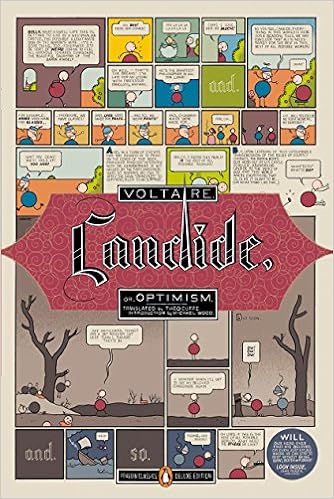
Image result for voltaire candide coverVoltaire's Candide [written in 1759 by French philosopher Voltaire, written during the Age of Enlightenment]  is a terrific work of satire that attacks Leibniz's philosophy of optimism. This is done through the constant refrains of the character Pangloss [Candide's philosophy teacher] saying, "This is the best outcome in the best of all possible worlds." This happens periodically throughout the story. In a way this is a perfect book for me because it reads like a philosophical cartoon strip. Ironically I think I've got a physical copy of Candide with a cartoon strip for a cover, pictured here.

Satire is used to full effect here. Everybody and anyone is fair game for ridicule. The religious establishment especially. Another important feature is that a lot of the events that occur were actually real events. For example, the Lisbon Earthquake was a real event that killed 30,000 people, an event that makes 9/11 look like nothing.

Voltaire ridicules Leibniz's philosophy through the character Pangloss, who's reasoning is silly. For example, the following is ridiculous:

"It is demonstrable that things cannot be otherwise than as they are; for as all things have been created for some end, they must necessarily be created for the best end. Observe, for instance, the nose is formed for spectacles, therefore we wear spectacles."   

Pangloss goes on to defend optimism and reiterate that "its for the best, in all the best of possible worlds." Consider this section where he explains why its good that syphilis exists:

"It was a thing unavoidable, a necessary ingredient in the best of worlds; for if Columbus had not caught in an island in America this disease, which contaminates the source of generation, and frequently impedes propagation itself, and is evidently opposed to the great end of nature, we should have had neither chocolate nor cochineal."

Candide, the main character, goes on to keep believing everything his philosophy teacher Pangloss says until everything goes wrong for him. Eventually he despairs and is ready to give up on everything in life. Thus Voltaire cures him of his optimism. Although its interesting to call out Leibniz I also think a large part of the idea for this work was to contrast irony with comedy, thus we have satire. And this it does very well. You could say that this kind of novel is created for men [and women] of wit to read for fun. And fun it is. 

Voltaire doesn't invent or exaggerate evils of the world. In fact he displays these things as regular real life events. A simple example of satire is when Candide watches as an admiral gets killed for failing to properly engage a French fleet. "The admiral is blindfolded and shot on the deck of his own ship, merely "to encourage the others" (French: pour encourager les autres, a popular quote from Candide). 

Almost of all Candide is a discussion of the various forms of evil. There is one notable exception; when Candide and Cacambo go to El Dorado. This is perhaps the only optimism in the book, where we find a place where everything is perfect. So perfect in fact, that satire doesn't exist here. But because we don't live in such a perfect world as that, satire must and will exist. 

The book is pretty simple plot-wise, a sort of adventure novel. In a way even its plot is a satire of European novels: Candide is of a lower caste than Cunegund, therefore he shan't dare marry her, romance, making fun of the high arts such as music and theater, the mishaps that happen around every corner, etc. These sorts of things are in a lot of archaic novels I've read. The one that comes to mind is The Blazing World by Margaret Cavandash. However, I think Candide is a lot better than that story. But they are very similar plot-wise and written and are archaic. 

All in all this is a fantastic read. I read it in one sitting last night. If you're a man [or woman] of wit, and enjoy philosophy as well as adventure novels this will definitely be on your reading list. Its a classic for a reason after all.

September Sweater Weather

Good evening ladies and gentlemen, hello world. How are you?  It's good to be writing on a good day off work today on a Saturday. Here, ...