Showing posts with label japan. Show all posts

Thursday, September 19, 2019

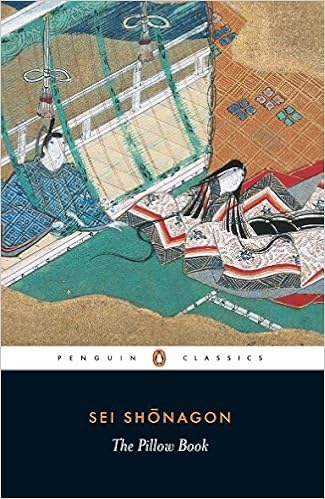
The Pillow Book

Image result for the pillow book mckinney In spring, the dawn — when the slowly paling mountain rim is tinged with red, and wisps of faintly crimson-purple cloud float in the sky.

The Pillow Book is a work of medieval Japanese literature from the Heian period, roughly 800-1200. Written by Sei Shonagon, a woman in the lower level court that served Empress Consort Teishi (定子). This isn't so much of a book per se, and definitely not a novel in the traditional sense, never mind the fact that the idea of a traditional novel didn't exist back then. However, her contemporary was Murasaki Shikibu, author of the famous Tale of Genji, a contemporary, woman serving in the court. Both of these works are studied in Japanese high school to this day. In fact, when Japanese study classical Japanese, it is the Heian period that they go to. 

The book is full of essays, lists, anecdotes, and personal thoughts. When I first started reading it I thought it was all over the place, and it really is. The Pillow Book reads like a conversation from Heian Japan. You get a sense of the character of Sei Shonagon, which is what Meredith McKinney focused on. She wanted to get the voice of the character done in a certain way, that is relatable some thousand years later. Did she get it right? I would say yes. Reading this book is somewhat of personal experience. I found myself smiling at things that were funny and likable, and likewise demurred when Sei said mean girl things. You feel like you are getting to know Sei and how she lives in Heian Japan, ultimately alien, foreign soil for me. Because of that, it is a true work of art, literature. 

In the McKinney translation, Sei comes across as personable but somewhat thorny. Basically, she isn't perfect. There's a mean girls vibe to some of the statements she makes but it doesn't dominate the text. But when you see it you do take notice. Were women really like that back then in Japan? Women are like that today! It's funny in a way how natural Sei comes across in the McKinney translation. Rather than translate the language in a dramatically different way, McKinney decided to change the voice of the character herself in her own inimitable way, that is personable, relatable. It's like listening to a Heian period woman, talks about her life, like a diary but better, much better because she comes across as likable and engaging rather than boring and nonstop. 

My favorite element of the Pillow Book is the anecdotes and stories. Stories of men who are clumsy with poetry, or retreat into hiding if they've walked in a woman's room. What festivals were like as the season changed. What it was like serving an Empress, whom you greatly loved and admired, despite you being of lesser rank, and never having the chance to be like her.  

If I were to compare the Tale of Genji [review here] to the Pillow Book, I would say the Pillow Book is breezy and personable, and that the Tale of Genji is more elusive and poetic. Both great works, vastly different. Sei has a way of explaining her world like a diary, that is in invaluable in respect to Japanese history. In short, its something of a masterpiece. 

"In autumn, the evening — the blazing sun has sunk very close to the mountain rim, and now even the crows, in threes and fours or twos and threes, hurrying to their roost, are a moving sight. Still more enchanting is the sight of a string of wild geese in the distant sky, very tiny. And oh how inexpressible, when the sun has sunk, to hear in the growing darkness the wind, and the song of autumn insects."

Tuesday, September 3, 2019

The Tale of Genji

The Tale of Genji (Penguin Classics) The Tale of Genji is a Japanese masterpiece of literature [considered the first novel] from the Heian period, roughly (794-1185). Written by a woman named Murasaki Shikibu. She was born into a minor branch of the Fujiwara clan. Her father was a governor. Men wrote in Chinese. Women wrote and read in Japanese, which led to female writers of Japanese, highborn women. She started writing this novel, which is over a thousand pages after her husband died. Scholars tend to disagree on the writer. Some say it was the work of many authors, as says Royall Tyler, who's translation [only 300 pages] I read. Others say its solely Muraski's work. The actual story itself has a continuity that suggests there is only one writer, her. 

The original manuscript is gone. This brings up the issue of translation. Heian Japanese is so different from modern Japanese. Translating Heian Japanese into English is a daunting task unto itself. However, a literal translation of Genji is impossible. Not only that but each English translation of Genji is so remarkably different. Consider these renderings of the same sentence by different English translators. 

In Chapter 4, titled “Yugao,” Genji comes across a run-down house, the abode of a young woman he is about to seduce. Waley describes the entrance like this: “There was a wattled fence over which some ivy-like creeper spread its cool green leaves, and among the leaves were white flowers with petals half-unfolded like the lips of people smiling at their own thoughts.” Seidensticker: “A pleasantly green vine was climbing a board wall. The white flowers, he thought, had a rather self-satisfied look about them.” Tyler: “A bright green vine, its white flowers smiling to themselves, was clambering merrily over what looked like a board fence.” Washburn: “A pleasant-looking green vine was creeping luxuriantly up a horizontal trellis, which resembled a board fence. White flowers were blooming on the vine, looking extremely self-satisfied and apparently without a care in the world.” [newyorker] 

Each version is so different, yet say the same thing in their own inimitable way. It's remarkable. The act of translating itself is a science. One could write an entire treatise on the art of translating. It would be worth the read. Genji made me realize how important a good translation of a book is. Before that, I was in the dark about it.

What is The Tale of Genji about? A noble and his concubines. It's about the art of seduction. But even simpler I would say it's about relationships. A man and his relationships with women. In this society, the way to a woman's heart was through poems, delivered by a go-between, who was elegantly dressed, and of appropriate social standing.

Courtly lovers didn't see each other face to face often, certainly not naked. Women of the upper class sat behind screens, and sliding doors. Women were protected by screens even when they spoke with males in their own family. A guy could be driven wild if he saw a woman's sleeve spill out or the sound of silk rustling behind the screen.

But people still got it on. Nobles and their ladies were promiscuous. Affairs with court ladies and ladies in waiting were perks of an aristocrat's life. So was adultery sometimes. Genji, when he's still young, has an affair with his father's [the Emperor] mistress. And both father and son lust after a young girl, that Genji adopted as his daughter. 

The requirement of a gentleman was style. You could be forgiven for seducing a man's wife. But you had to know how to write good poetry, have good handwriting, and wear the right perfume. Despite the influence of Buddhism, Heian society was governed by style rather than virtue. Good looks meant everything, virtue be damned. 

The ideal man wasn't too much different from the ideal woman in Heian society: highly perfumed, smooth-skinned, moon-faced, extravagantly dressed. The decadence of the times led to what Genji called a time “where everything seems to be in a state of decline." A state of decadence.

All of this had a strong sense of hierarchy of course. Also, Heian politics was marriage politics.  

Three important takeaways from reading Tyler's translation of Genji. 

First, this book gave me my first real look at Japanese culture that wasn't from anime or movies. I understand Japanese culture and society a lot better than I did in the past, and am grateful for the experience of reading world literature. It opened up my mind to the literature of other cultures [non-western canon], and that is an amazing gift to oneself, and for anyone who cares to discuss the book with me or listen to me explain it.

Second, the idea of translation. Lost in translation is a big possibility here. But the fact that the first novel can be somewhat preserved and rendered into modern readable English from Heian Japanese is fascinating to me. How do they do it? It's like nuclear physics. The translations in English are all vastly different. The book is 1300 pages, and the version I read and bought is only 300 pages. Obviously, Tyler's version is heavily edited, abridged, and he took out many passages, but I still found the book to be thrilling. 

Third, the sense of style. The elegance of this book is vast. You don't need action and fast-paced fiction writing to create a sense of depth. As a writer, this is very liberating to see, read, and experience. In fact, I had to read this book very slowly because each page is annotated, there's more than one poem on every page, and if you don't read the footnotes at the bottom of the page, you don't quite understand the poems. However, when you realize that the poems aren't literal translations, and don't quite mean much to you, the reader, you realize that you should focus on the story itself, rather than trying to find meanings in the poems. Going through that was a tedious yet rewarding experience. 

I plan on going back through Tyler's version again. Because I was so impressed with it, I bought my own used copy. Definitely worth it. Although the book took me almost a week to read, it was a very fruitful experience. At the very least, now I know where Overwatch's Genji got his inspiration. Of course, the real, yet fictional Genji is so much cooler. 

Friday, February 15, 2019

The Main in the High Castle


Image result for the man in the high castle original book coverThe Man in the High Castle, by Phillip K. Dick is a grand and magisterial science fiction novel. Written in 1962, the only thing 'science fiction' about it is the fact that its an alternate history novel. Set in 1962, fifteen years after an alternative ending to World War II. Here, Germany and Japan actually win the war. Now, both countries share control over the entire world, including the United States. The Man in the High Castle won the most prestigious science fiction award [the critically acclaimed Hugo Award] in 1963. In 2015, Amazon Prime adapted the novel into a series. However, you can't compare the show to the novel, its just not good enough to even compare notes on. 

Inspirations for the book include Ward Moore's alternate Civil War history, Bring the Jubilee [1952], various classic World War II histories, as well as the I, Ching [used by the characters in the novel], which creates a sense of a novel within a novel.   

More on the world within the novel. FDR was assassinated in 1934, leading the continuation of the Great Depression and isolation during the War. Hitler and Nazi Germany take over Europe and the Soviet Union, murdering anyone they don't like. Japan controls Eastern Asia and Oceania. The Nazis helped Italy conquer Africa. Japan invades the US West Coast while Germany invades US East Coast. By 1947, the US and Allies surrender to the Axis powers, ending the War. The US is still independent, but under Nazi rule. 

By 1960 Japan and Nazi Germany are the worlds' superpowers. Japan establishes the Pacific States of America [P.S.A] from the former Western United States, with the Rocky Mountains as a neutral zone between the PSA and the Nazi-occupied former Eastern United States. For reasons not explained the UK, Spain, Canada, and many other nations in the world remain independent. 

Hitler is still alive but he's going through an advanced stage of syphilis, not governing. Martin Bormann is Chancellor of Germany, with Goebbels, Heydrich, Göring, Seyss-Inquart (who oversees the extermination of the peoples of Africa), and other Nazi leaders soon trying to take his place.

The Nazis drained the Mediterranean to make room for farmland, developed the hydrogen bomb, designed rockets for fast travel across the world as well as space, having colonized the Moon, Mars, and Venus. The novel takes place in PSA, where Chinese are second class citizens, and blacks are slaves. The secondary setting for the novel is the Rocky Mountain states, Cañon City, Denver and Cheyenne.

Now for the plot. This is where things get interesting. In 1962, Robert Childan owns an antique shop frequented by bourgeois Japanese who like historical American artifacts. Childan is contacted by Tagomi, a high-ranking Japanese official, who is seeking a gift for Baynes, a Swedish industrialist. Childan's store is stocked with items from WM, a company that Frank Frink [formerly Fink, a Jewish name] works for. 

Frank Frink is secretly an American Jew who survived Nazi Germany. He's just been fired from WM, so him and Ed [also from WM, Ed quits WM] go into the jewelry making business on their own. 

Meanwhile, Frank's ex-wife Juliana, works as a judo instructor in Canon City, Colorado, where she begins a sexual relationship with an Italian truck driver and ex-soldier, Joe Cinadella. Throughout the book, most of the characters, resort to using the I, Ching, a cultural import from China used ask questions, "what should I do?". Ask the Oracle. Most of the characters are also reading the Grasshopper Lies Heavy, a popular work of fiction that depicts a world where the Allies won the War, similar to our real life world. 

Frink reveals that WM has been selling Childan counterfeit material, not stuff of actual historical value, which works to blackmail WM so he can fund his new jewelry venture. Tagomi and Baynes meet but Baynes keeps delaying until they get word from a third party from Japan. Suddenly, the Chancellor of Germany, Martin Bormann dies, making national and world-wide news. Childan takes Frink's work on consignment to some Japanese, who tell them that the artwork is junk, but contains spiritual value. That the items could be sold in Asia or Latin America as magic good luck charms, things of that nature. This upsets Childan, who thinks that original American artwork is too good to be junk magic charms. Juliana and Joe out of nowhere decide to visit Abendsen, the writer of the Grasshopper. Goebbels is announced as the next new Chancellor of Germany. 

Baynes and Tagomi meet their Japanese contact as the Nazi secret police close in to arrest Baynes [who is actually a high ranking Nazi official, although he is really a Jew, complete with body changes and enhancements to lose his Jewish 'look']. In fact, it turns out that Baynes is actually a Nazi defector named Rudolf Wegener. Wegener warns his contact, a famous, high-ranking Japanese General of Operation Dandelion, a Goebbels approved surprise attack on the Japanese Home Islands, in order to destroy them in one fell swoop! 

Frink is exposed as a Jew and arrested [but is later released with no explanation]. Meanwhile, Wegener and Tagomi take down two SD Agents, actually it is Tagomi who kills both of them with an antique Civil War revolver. Back in Colorado, Joe cuts his hair short, dyes it blonde, and starts acting differently, making Juliana believe that he's going to kill Abendsen. In fact, she's been had. He's actually a Nazi on assignment to kill the famous writer of Grasshopper. 

Wegener flies back to Germany and finds out that Goebbels has been ousted by Reinhard Heydrich, who is anti-Dandelion. Tagomi is extremely shaken by the blood on his hands. He goes back to sell the antique revolver to Childan, but Childan doesn't take it back. Instead, Tagomi buys one of Frink and Ed's 'silly' trinket items that Childan had on consignment for EdFrank Jewelry. Tagomi goes on an intense spiritual quest where he momentarily perceives an alternate history of San Francisco. He does 'see' into the metaphysical reality, a philosophical section of the book.

Elsewhere, Juliana puts a razor blade to Joe's neck, presumably killing him. Then she goes on to meet Abendsen, who it turns out, doesn't live in a High Castle surrounded by weapons, but in a normal house, with his family and friends. In fact, Abendsen doesn't even occupy his mind with thoughts that he's going to get assassinated. However, when Juliana tells him that she saved him from a potential killer [Joe], Abendsen is grateful. Juliana asks Abendsen tough questions about how he wrote the Grasshopper. At first he gives her half-assed answers and is arrogant. But eventually he admits that he used the I, Ching to write Grasshopper, which leads to Juliana, before leaving, to infer that "Truth" wrote the book in order to reveal the "Inner Truth" that Japan and Germany really lost the War. 

I don't usually go into this much detail about the plot of a book when I write a blog about it. However, this novel is so important and great that I felt obligated to, so that if you, the reader don't have the time to actually read the novel, you can read my synopsis and find the inspiration to make time to read this great book. 

Some novels just hit you on the head and a light bulb goes on, a little voice in your head says, "This is an important book."  This is so with The Man in the High Castle. The material here, so much about Nazi's and whatnot, is hard to bear, and I think snowflakes in the Twitter literary world would find lots to complain about. However, because it was written in 1962, it got the praise it deserved, for it shows a world that could have been, may have been, if only we had lost the war. 

Culturally, there is a lot going on here. For example, just like how the characters in the book used the I, Ching to make important decisions, so did Phillip K. Dick use it for decisions regarding plot and such. Not only that but in order for Dick to write the book he did a ton of Nazi history reading. Going down that road is difficult for anyone [excluding Nazis], for that history is hard to take in, absorb, and write about. In fact, Dick wanted to write a sequel but couldn't because he just didn't want to read and write more about Nazis, understandably so. 

The use of the I, Ching makes for a great novel-within-a-novel theme [so does the Grasshopper book]. The use of the I, Ching is downright fascinating. This book has everything: extrapolation, suspense, action, art, philosophy, plot, and character. Its no wonder that it won the Hugo Award in 1963, its a masterpiece. 

In addition, another thing that really 'spoke' to me as I read the book was the pure artistry of Dick's literary style, technique. He's a true master of fiction. I learned more about how to write a sympathetic character, from studying the way Dick describes the thoughts of the characters as they 'perform' in the world of this particular fiction. I haven't thought about doing this sort of thing in my own fiction. I'm striving to become a great fiction writer, and although I think it would be super difficult to imitate Dick's style, I also think I've learned from his style as well, how to use the voice of the writer as well as the voice of the characters. Very important stuff.

In terms of Phillip K. Dick, it might not get any better than this. I've read a lot of Dick's novels, and the one I can think of that I enjoyed as much as this one was Do Android Dream of Electric Sheep? However, I would say that this is arguably a more important novel in the genre, and for Dick as a writer.  

An aside, this is a very tough-minded book. Not for snowflakes.

Read the novel, skip the show, be amazed. 

Other blogs on Phillip K Dick
http://ofigueroamusic.blogspot.com/2017/05/phillip-k-dicks-cosmic-puppet.html 
http://ofigueroamusic.blogspot.com/2015/12/man-in-high-castle.html

Thursday, November 9, 2017

Your Name 君の名は


So I saw a fantastic anime film the other night called Your Name. The film is arguably science fiction, romance, and deals with the fact that nothing lasts forever, which is very Japanese. You could say the film is science fiction because its about a boy and a girl who swap bodies through the mystic mystery of a shrine and the impending doom of a large crash landing comet. And the film is obviously a romance because although they don't realize it at first our boy and girl are star-crossed, and this is made even more evident when they finally meet, where instead of the boy writing his name on the girls' hand he instead writes I love you. The film was a huge commercial success and aired at Anime Expo 2016 (which I attended, but didn't see the film at), but only recently came out on DVD, made available through Netflix shipping.

The film is very slow-paced and mysterious at first. But once the film gets going about thirty minutes in you start to understand where the film is going and the fact that they are living in different time periods, although its only a small difference of three years. But its still so much of a time difference for them to have a hard time finding each other. There's religious elements because the girl lives with her grandmother and they take care of a shrine. The shrine is said to be ruled by a guardian spirit who rules human experiences and connections.

There's a comet that the boy finds out is going to destroy the girl's town and he tells her to evacuate the town. Once back in his own body and time he finds out most of the people survived the comet miraculously and he spots the girl with her soon to be husband in his Tokyo hometown. They chase each other down and ask,"Your name?"

The artwork in the film was very good too. There was some 3D shading effects and details, like when the comet came crashing down. Apparently the art work was all mostly done by one guy. Pretty impressive stuff. The anime art style of the characters is drawn in a modern way and there are some funny Japanese sort of mannerisms, like how every time they swap bodies the girl always touches her breasts, and likewise the guy always grabs down there. Pretty funny but not something that would happen in an American animated film made for the box office.

This is a film I would recommend to all anime fans because although the film is slow it has a lot of meaning in it. The idea of love, trying to find love, always having it within your grasp but then only to have it slip away once again. This is an idea we think about our entire lives even if we think we've found our true love, weather it be a person or vocation. For that reason I'd even be down to watch the movie again with a girl or even my friends who like anime but not so much the thoughtful sorts of anime like this.

Highly recommended!

Monday, April 3, 2017

Ghost in The Shell


So my friend hit me up on my day off and we ended up going to see Ghost in the Shell at the Van Nuys plant. The ticket was only $7.50 and the movie was pretty good. Here, I'd like to give you a little rundown of the movie and my thoughts on it. If you haven't seen the film stop reading here as I don't want to spoil it for you.

This movie is pretty much a condensed version of some of the anime Ghost in the Shell movies. It stars Scarlett Johannson as the Major. She's the first successful human-ai hybrid and she works for this organization called Section 9 that fights terrorists. In the movie she's fighting a terrorist who turns out to be a failed human-ai hybrid. There were tons of experiments done on other people and they were junked, left to die.

Let's make one thing clear. Scarlett is a beautiful woman, pretty stunning sometimes in certain angles but when it comes to acting in this film her performances are very lukewarm. She shows little to no emotion, just like her acting in Avengers. She has the t and a but when it comes to the acting talent she's close but no cigar. With that being said the acting in this movie could've been way better. However, I still give Scarlett points for being hot. And trying. A lot of people online (reddit and elsewhere) were upset that the Major wasn't going to be played by an Asian actress. In the end they went with Scarlett and I think that hurt the film. But hey they wanted to get the sales and Scarlett brings in the sales.

There were tons of action shots and scenes all over the movie. The most memorable action scene was at the end when this evil corporate dude is using the spider tank (from the anime) to kill the Major and the Terrorist who had supposedly turned her. It was great to see the spider tank from the anime set to a live action film set. That might have been the most authentic Ghost in the Shell thing in the entire film. Everything else was close but no cigar. It was a massive firepower weapon and it looked damn cool. Most of the other action scenes were stereotypical shooting, punching, and kicking. Nothing out of the ordinary. In fact, I thought most of the action scenes in the movie were quite boring. I kind of tuned out during some of the fights because they started and ended so fast and I was just like "okay".

The story for the film was actually not bad. The anime movies have various plot lines but they all revolve around Section 9 fighting terrorists. In this movie it asks bigger questions. Questions like what is consciousness? What is the soul? What is ai? Things like that are questions that will continue to be important in the world in which we live. A world that has been overtaken by technology and perhaps in the future by robotics.

We live in a world controlled by technology. Technology has helped us but it has also hurt us. This movie brings to mind the fact that one day people could actually be enhanced by cybernetics. There's going to be a human head transplant done in a few months. And there are already people in the world who live on artificial hearts being kept alive by machinery. In a way ai has already been brought to the forefront in our world. The bigger question is how does technology affect consciousness? I think this movie asks those kinds of questions if we want to think about it in a more metaphysical and philosophical way.

Just because the movie brings up important questions about the world we live in I found it to be a thoughtful and engaging film. On the other hand I can also see where the movie threw out everything that makes sense and just turned it into an action flick. In the end it was just okay. Sometimes anime movies turn out like this because the important features from the anime (which is made by Japanese producers and artists) are lost in translation to the American audience. I think that happened with this movie but it was still a fun movie to watch.

7/10 by my book. Good to see Ghost in the Shell get some on screen love in a movie theater.

Friday, January 22, 2016

Gate and Gundam Iron Blooded Orphans


     I've been keeping up watching all the latest cool new anime. I've been trying to keep it down to anime with very few episodes so I don't have to put too much time into it. I am most certainly not down to watch something like One Piece or Naruto-way too many episodes.
     Gate is a really solid anime I've just started watching this week. Basically a gateway opens in modern day Japan and all these warriors, warlords, orcs, and dragons come out trying to pillage and kill everybody. Of course, modern day Japan reacts to this with advanced weaponry and easily takes out all these invaders. Then, Japan goes through the portal, creates a base of operations, and sends in this otaku main character to become a peace negotiator and stuff. He's really dumb but he's actually a really high up soldier with a code-name. He does everything in his power to help the citizens of this other world, even taking on a fire dragon to protect a town. There's a cute blonde elf girl, a gothic lolita, and young mage girl from this other world and they're pretty interesting characters. This anime started off being all about war and killing, but in the end it really turned out to be more about drama and suspense. I'm super hyped because tomorrow the last episode will be available to watch on Crunchyroll! Basically at the part I'm at the Emperor of this other world is letting the peace negotiations go on, but it seems to me like he really doesn't want to give in and let Japan have everything. So I'm thinking in the last episode there's going to be something sneaky happening. We'll see. I'll probably write a full review of the anime sometime after I've seen the last episode. Check this one out its called Gate, and don't be mistaken by Stein's Gate, which has a similar title.
     I started watching Gundam Iron Blooded Orphans today because the last episode of Gate isn't out yet. I gotta say that I don't like the art style at all. It seems to be too much of a modern anime art style. Well, I mean of course its going to be that way because it was made in 2015, but what I mean is that everything looks like it was drawn with computers. I mean, it isn't bad and it probably won't stop me from watching more of the series but it just looks like all these modern anime all have the same art style. Everything begins to look the same despite the fact that they are from different artists and maybe even different parts of Japan. Anyways, the first episode was actually pretty good. Very drama and dialogue focused but it ends with a great big battle scene against mobile suits. It was cool.
     That's all the anime I've been watching recently. Let me know of any you think are worth watching. In the past I was watching JoJo's Bizarre Adventures but I've kind of lost track of whats going on at the part I'm at. Sayonara! 

Saturday, August 8, 2015

Dragonball GT


     The other day I finished Dragonball GT. It is quite a feat because the whole series lasts about 64 episodes. Usually I avoid any anime longer than 24 episodes but sometimes I make exceptions. I've been kind of interested in watching One Piece, Naruto, and Bleach but because of how long those anime are I have avoided them. However, I might decide one day that I need to watch those because they are 'thee' modern anime of our time. GT is basically a bit after Dragonball Z, where Trunks and Goten are older, and Gohan and Videl have a daughter who's still a kid, her name is Pan. In GT, Goku gets transformed into a little kid because of Emperor Pilaf using the dragonballs. So basically the first 30 or 40 episodes of this anime are kid Goku, Trunks, and Pan searching the galaxy for the dragonballs.
     The entire beginning of this series is kind of lame. Goku fights some alien type dudes but most of them are extremely weak and he's able to defeat them as a Super Sayian while in kid form. However, once the series starts going, it gets really good! I would say GT is amazing just because of the enemies that Goku fights near the end of the series.
     The best part of GT, in my humble opinion, is the Baby saga. Baby is this robot mutant created by this evil doctor named Doctor Myuu. Baby kills Myuu and then proceeds to go after Goku. This is the hardest fight that Goku has ever faced at this point, even since Dragonball Z. Baby was way stronger then even Majinn Buu! Basically Baby's main power is that he can take over peoples' bodies and make them kind of do anything he wants. Eventually he takes over the entire Earth and turns them into his race, something called Truffles. He even takes over all the Sayians (Goten, Trunks, Gohan, and even Vegeta!). Once he takes over Vegeta he realizes he's at the peak of his powers and decides to use the dragonballs to re-create his Truffle planet that was killed years ago by King Vegeta and the Sayians of old. But eventually Goku comes to the rescue and has to take down this Baby. The Kai's decide that Goku isn't strong enough so they make him re-grow his tail the hard way; by using a giant pair of pliers and pulling his tail out of his rear end. It was pretty comical but effective. They did this because Goku's only chance of getting stronger was using his tail to become a Super Sayian four, the highest level of Super Sayian in any of the Dragonball series (but not in the Battle of the Gods or Resurrection of Freiza movies). Goku becomes a giant ape against Baby in the middle of their fight but goes on a rampage, almost destroying the entire Truffle planet (which had all the humans from Earth on it). Eventually Pan calms Goku down and he eventually transforms into a Super Sayian four, the peak of Super Sayian power! What's interesting is that he transforms as a kid but once he's Super Sayian four he's an adult again, with a fur coat, a tail, and long black hair; he looks super cool. In my opinion, this is the best looking Super Sayian form and the best. All is going well until Baby Vegeta (because he took over Vegeta's body) turns into a giant ape using something called bluntswaves from the moon, something that evil Bulma uses (he took over Bulma too) to help out Baby. This was the best fight in the series. It's hard to say exactly how Goku won because I've kind of forgotten a little bit. But from what I do remember it is a very close fight but in the end Goku annihilates him into the Sun using a Kamehameha wave.
     The second best part of GT was when Goku had to fight Super Android 17. I'm still a bit confused on how there were two Android 17's and how they fused together to become Super Android 17 but I don't mind being a little clueless; after all this is just a cartoon. This fight is very intense and basically Goku loses this fight just because he's simply not strong enough, even at a Super Sayian four. He ends up only winning this fight because Super Android 17 was fighting within himself, the good side trying to stop the bad side from killing everyone. It was interesting seeing Goku get utterly destroyed in this fight. It was also cool how Super Android 17 looked. He had his classic look but he was bulkier, his hair was longer, and his clothes had a different flair to them. Android 18 was the last one to stand up to him but eventually Goku punches through Super Android 17's chest using an attack called Dragon Fist. It was brutal and awesome!
     Finally, the last best part of GT was the last 20 episodes where Goku had to fight all of these dragons that were the evil contents from all of the dragonballs. At the end he fights this one super powerful dragon that uses all the dragonballs' power. His name was Omega Shenron and the fight against him was super fun, but trying at times because technically Goku could've killed him at some point and it would've been over with, but instead it just doesn't work like that. The horned guy in the picture is Omega Shenron, and that's Gogeta in the middle. In this fight Goku and Vegeta fuse as Super Sayian fours, becoming Gogeta! This fight could've been over when Gogeta used his fatal attack Big Bang Kamehameha but instead Gogeta is having fun at Omega's expense. But things turn bad when Gogeta's fusion time suddenly runs out, and Goku's left as a little kid again, and Vegeta's back to Super Sayian four. By the way, it was awesome seeing Vegeta turn into a Super Sayian four because for most of this series we don't get to see much fighting from him. Everything turns all bad and Omega's about to destroy the Earth, and pollute the entire galaxy with negative energy but then Goku tells Kai that he needs energy from all over the entire universe for his Spirit Bomb to be strong enough to destroy Omega. It was a great finishing move to end the series.
     Lastly, I loved GT and it has a place in my heart with the rest of all my favorite anime. Even though most DBZ fans call it crap I actually loved it. The last episode was amazing and almost brought me to tears, it was so beautiful. In the final episode we see Goku JR (Goku's great grandson) and Vegeta JR (Vegeta's great grandson) duke it out at the World Martial Arts Tournament. Vegeta JR says to Goku JR,"what are you wearing rags?" and then Goku JR (in the exact same cool manner as Goku),"they're not rags Vegeta, these happen to be the clothes of my great ancestor". It was awesome hearing him say that. Then they start fighting and they're amazing. Eventually Vegeta JR turns Super Sayian and Goku JR does the same. Vegeta JR makes a comment about how he didn't know they could both go blonde, and says,"This is gonna be a good fight". It was just awesome. If anyone is debating whether they should watch GT or not (basically because its not canon), I would say they definitely should. The good thing about it is that it is super old and I watched every single episode on YouTube. Its very easy to find and the series gets good right in the middle and stays super exciting until the very end. The cool thing about this was that I finished this series on the same day that I saw Resurrection of Freiza. I'm thinking about the next anime I'm going to watch next. I'm thinking I'll start watching Yu Yu Hakasho. My friends seem to like it so I'll probably give it a shot soon. What are some anime that you all watch? Let me know in the comments.

Friday, August 7, 2015

Dragonball Z: Resurrection of Freiza


     Yesterday was an awesome day. For one thing I've had a super busy and exciting week. On Sunday my friend had a party at his place. And then I had some important official business that I had to do for work on Wednesday. But also on that same day me and my friends went to go see Dragonball Z: Resurrection of Freiza. It was awesome! It was the first time I ever saw a Dragonball Z movie in the theaters. Usually I just watch them online. The last one, Dragonball Z: Battle of the Gods, I just saw online in Japanese before it came out in America. In comparison to BoG (Battle of the Gods), I would say that RoF (Resurrection of Freiza) is a lot more exciting and cooler. But for some reason I still prefer BoG because I think the language is better in Japanese, and I saw I saw in Japanese. The English voices in DBZ are what all the American fanboys are used to. However, I feel like sometimes the words and the sentences are better translated in English rather than being said in English. That's just how I prefer my anime. I am kind of elitist about this. I'm sure other people out there feel the same way about their anime. The one thing I hated was Freiza's voice in this movie. The Americans sometimes do very poor voices for anime characters. In this case I can't say that it's bad because its the classic American Freiza voice that we all know and love. But I just found it annoying. The voice for Freiza was at times high pitched and just hits my eardrums the wrong way. Everybody else sounded fine, especially Goku. However, Vegeta seemed to have a much deeper voice. I didn't mind it but I did notice it. Lets talk about the plot of this anime movie.
     Basically Freiza's in Hell being tormented in some childlike land with toys and fairies. He's been in Hell all this time after Goku's defeated Cell and Majinn Buu. Now, Freiza's henchmen suddenly decide that they should use the dragonballs on Earth to resurrect Freiza. When they make the wish Shenron (the dragon that grants wishes) tells them it is not wise because Freiza's body has been dismembered and cut up too much. They say to do it anyways and Freiza comes flying out of the sky in pieces. However, with the new technology that Freiza's henchmen have they are able to put together his dismembered body! Once Freiza's back to life he decides he's going to exact his revenge on Goku. He's comes up with a plan to train for four months. Why he thinks he can beat Goku after only training for four months is a major problem with the plot in this movie, because Goku has been training for years! Anyways, after Freiza trains he decides to attack Earth with a thousand of his men. Meanwhile, Goku and Vegeta are training with Whis on Lord Beerus's sleeping area. Whis is Lord Beerus's (God of Destruction, destroys planets for not having good food) caretaker. He was so fast that Goku and Vegeta together couldn't land a single blow on him. After their training was over Whis told Vegeta that he needs to relax more. And he told Goku that he relaxes too much. While that's happening there's a big battle on Earth. Piccolo, Gohan, Tien, Master Roshi, Krillin, and an Intergalactic Spacecop alien are fighting the thousand Freiza troops. They are all really weak so this is where the classic DBZ fighters shine. I really liked it when Master Roshi was all like,"All right. Let's do this!" and he powered up, getting extremely bulky and strong, reminding me of how Goku looked when he was first fighting Vegeta. My other favorite moment of the movie was when Master Roshi was using Kamehameha against Freiza's henchmen. That was pretty epic seeing as how we hardly got to see Master Roshi fight in classic DBZ. Finally, Goku and Vegeta get Bulma's distress call and Goku instant transmissions to Earth, ready to confront Freiza.
     Freiza is all cocky and challenges Goku to a straight-up fight. Freiza says that he's going to transform into his final form right from the start. He powers up and he's his classic white and purple skinny super fast form from classic DBZ. Goku punches him around like a rag-doll easily. After a while Freiza says that he's been holding back and transforms into a newer, kind of more lame (in my opinion) form. In this new form Freiza is golden, which looks hella lame. But he's like way more powerful in this form now. Him and Goku continue to fight but he's still not quite strong enough to damage Goku. So after a while he says he's done and that he quits. Goku, being who he is accepts this but a split second later Freiza's commander shoots his ray gun at Goku, and Goku's lying on the ground, his hair going from blonde to black. However, he isn't dead yet because Krillin gives him a Sensu bean and all of a sudden he's back up and walking. Freiza made a funny comment about how they had some kind of 'wonder drug'. Oh, and by the way Goku was fighting Freiza in Super Sayian God form, which he learned from the BoG movie. So now Vegeta is up to bat. He punishes Freiza easily. However, Freiza decides he's going to kill himself, as well as everyone on Earth, and the entire planet! Lord Beerus and Whis (who have been watching the fight w/ the Z fighters) put them all in a protective barrier and they watch as the planet explodes. Lord Beerus mentions that Freiza can survive in Space after being blown apart (somehow but I didn't get why, maybe its because of his race), so he calls what Freiza did a cheap blow but rather ingenious. Whis tells Goku that he can go back in time three minutes and Goku can just kill Freiza, thus preventing the Earth from being destroyed. So they go through with it and when they're back Goku just annihilates Freiza with a Kamehameha wave. Very nice!
     Lastly, I thought that ending was rather cheesy. They could've just had to re-fight Freiza on another planet and used the dragonballs on another planet to restore the Earth and all the people who died, but that would've made for a much longer movie. I believe this movie ran around one hour and forty-five minutes, something like that. So yeah, that's the gist of the movie. I really enjoyed the fight against Freiza's minions because they were weak and the other Z fighters looked extremely strong against them. I enjoyed seeing the other Z fighters getting in the fight. Also, it was cool seeing Vegeta go Super Sayian God against Freiza. Vegeta usually doesn't get as much airtime as Goku so it was cool seeing him absolutely destroy Freiza in some cool attacks. Also, it was cool seeing this movie in the theaters because I was sitting next to a young dad who was there with his kids and his wife. The kids were so excited about the movie and the characters, it was cool seeing kids excited about characters like Goku and Vegeta. DBZ was a big part of my childhood too so I could relate. The dad even talked to me a bit about DBZ and how he likes anime and stuff. At the end he even shook my hand and told me to have a good night. It was pretty cool. Later that night when I got home I watched the final episodes of Dragonball GT. If I had to say which is better: GT or this movie, I would have to say that I like GT more. I know most DBZ fans hate GT but I actually love it. Not more than classic DBZ but it does have a special place in my heart now (haha). Anyways, I would interested in seeing this movie again but in Japanese just to hear the difference in voices. This movie won't be in theaters very long so try to go see it soon. Otherwise you'll have to wait to see it online somewhere. It's probably out online in Japanese as I'm currently writing this, look for it if you want to see it. I highly recommend this one.

Tuesday, June 2, 2015

Steins Gate


     Steins Gate is an anime about dealing with death, friendship, love, and preventing World War III through the power of time travel. The anime is 24 episodes long and was released in the summer of 2011, so its a pretty recent anime. Also, its made by Funimation so you know its going to be a great anime. The story revolves around Rintarō Okabe, a self-proclaimed mad scientist and eccentric, who has these delusional ideas that the government is out to get him. He often refers to himself under an alias known as Kyōma Hōōin, which is basically his mad scientist name and name he uses to introduce himself to other people within the anime. Okabe is the founder of the 'Future Gadget Laboratory', where he spends all of his free time working with his other lab members, Itaru "Daru" Hashida and Mayuri Shiina. Other lab members are added later but at first it just starts off as just these three working together on inventions and just hanging out at the lab. Okabe always talks about the 'Organization' to his phone, and often bursts out with maniacal laughter. He always wore a lab coat except for one episode where he went out on a date. In addition, he always gave off the attitude of an arrogant personality. Once he begins time traveling, he realizes he's the only one who can remember the past time lines, which he calls 'Reading Steiner' ability. He's the most interesting character in the whole show, and is really a cool guy, despite being on the arrogant side. Deep down, everything about him is a lie, and near the end he realizes it but still decides to go through time traveling.
     First of all, the anime begins with Okabe and Mayuri going off to a scientific presentation on the theory of time machines. After Okabe causes an uproar and disrupts the guy giving the speech, calling all of his theories hogwash, he finds Kurisu Makise dead in a pool of blood upstairs in the building. He quickly runs out, not saying anything about what just happened. And then time starts to distort and he finds himself confused. Then, somehow he meets Kurisu, and she agrees to become a lab member and help him create gadgets and eventually a time machine. Well, they don't create a real time machine for a long time, but they do create a system where they can send emails through the microwave, and the emails are sent into the past, therefore changing things that happen in the future. So they send what they call 'D-mails' to the past and drastic things happen. Ruka Urushibara, a male that wants to turn male sends an email that somehow changes him to be a female in a different timeline. She even goes out on a date with Okabe because she realized she had feeling for him. This is kind of lgbt part of the anime because Rukkako could've been transgender in the first timeline but we don't know for sure. He looked like a girl, has a feminine personality, but is a guy. In another email sent by Faris Nyannyan, her dad who died comes back to life. Faris becomes another lab member and works at a maid cafe. So yeah all this stuff happens in the first part of the anime and it's really exciting seeing how them sending emails can change the future.
     But it really starts to get interesting where at the end of about three weeks and after Okabe has discovered SERN, the 'Organization' that in the future controls the world. Okabe, with the help from Daru and an IBN 5100 computer (super haxor!) hack into SERN and read their files to see that they've already created a time machine and attempts to leap through time have left people killed. Eventually, somehow, with Kurisu's help, they actually build a time machine. Once Okabe reveals that they will show their time machine to the press, somehow Moeka Kiryu raids the lab, and attempts to capture everyone there. But instead of of capturing Mayuri, Moeka kills her instead. Then Okabe uses the time machine to go back in time to try to prevent Mayuri's death, thus beginning dozens and dozens of time leaps, all of which all end with Mayuri's death. The first time he was shocked, but eventually he becomes numb to the pain. He realizes the only way to save Mayuri is to get back to the original beta lines, but in order to do that he has to undo each D-mail that was sent, no easy task saying since some of them he didn't know what the emails said. So there's that. Once that's taken care of Okabe has a love scene with Kurisu, where he tells her that he loves her. But she doesn't say he loves her back until just before he time leaps again, this time to prevent Kurisu from dying in the original beta line.
     Some time later, Suzuha appears before Rintarō, having arrived in a time machine from the future. She tells Okabe that the only way to prevent World War III in the future is to prevent Kurisu's death at the hands of her father, Dr. Nakabachi, who stole her time travel theory to present to SERN.  However, this operation ends in a disaster as Rintarō ends up killing Kurisu himself by mistake. After this failure, Rintarō receives a message from his future self, telling him that the way to save Kurisu without altering the events that led to him developing a time machine is to fool his past self into believing Kurisu had been killed and thus achieving the final divergence value of 1.048596%, which he dubs the 'Steins Gate'. Returning to the past again, Rintarō puts his own life in danger in order to save Kurisu's life, prevent Nakabachi from successfully escaping with the time travel theory, and fool his past self, setting him on his journey through time. Returning to the Steins Gate world line, safe from the threat of SERN, Rintarō and Kurisu manage to reunite by chance (or by fate) in the streets of Akihabara. (Wikipedia) 
     So in the very end of the show, Okabe gets to save the world from SERN and World War III, and also reunite by chance with his love from all those blurred world lines he traveled through. The ending is too good to be true because how would he suddenly meet Kurisu again when she was from America? Anyways, its great to see a refreshing anime that isn't focused on fighting and calling out the name of your attack as your doing it. The relationship Okabe had with Mayuri, a childhood friend of his, was just beautiful. At first, I thought he was in love with Mayuri because he kept time leaping to prevent her death, never accepting it. But in the end it was Kirisu who he truly loved. Maybe he loved both of these girls though. It wouldn't be implausible to say that. They all had a beautiful relationship with each other and their friendships crossed across world lines, as they all remembered their scattered memories across the different worlds. This anime was great, and I'd recommend it to any anime fans who want a break from the fighting and school stuff. Also, Okabe and Kirisu both like Dr.Pepper, just like me. 

Monday, May 18, 2015

Fate/Stay Night


     Fate/Stay Night was an enjoyable anime about magic users, Magi, using Epic Heroes called Servants to battle each other to the death in the hope of winning the Holy Grail to get any wishes they want granted. The anime focuses on a guy named Shirou Emiya and his Servant Saber. Emiya only wants to fight to end the fighting. He's interested in protecting people and even not making Saber fight unless he ultimately has to. He teams up with a master Magi girl named Tosahka to protect each other and fight against the other Servants and their Masters.
     First off, this anime is really slow and takes a while for it to really get going. I think it took a good four or five episodes before the anime really got beyond just telling the introductory story and into the main plots. One of the highlights of the show is that the female Servant Saber was actually King Arthur, or Arturia in her own time. She uses her blade, Excalibur against other Servants and she was actually one of the most powerful servants. Until they ran into this little girl with blonde hair, Illyavasiel Einzbern. She had an Epic Hero from Greece named Hercules and he could not be defeated unless he was killed twelve times. Pretty epic right? The way they defeat him is that Tossahka's Servant, Archer, goes one on one with the big brute Hercules and kills him several times before he actually gets mauled to death. By the way, this anime is mildly violent, there's blood and people die but its not graphic. Then, Tosahka uses her magic gems on Hercules, killing him yet again. But it was Saber's Noble Phantasm, or special move that kills Hercules seven times in one strike. Her Noble Phantasm is her swords scabbard.
     Next, other parts of this anime that was interesting was the ending. There was this Epic Hero from the last Holy Grail Wars that was still somehow in the world physical because he was "eating" human souls to keep his physical body in that current world. Usually after the Holy Grail Wars are over, Servants return back to their own time I guess until summoned for the next one. Anyways, there was this Epic Hero named Gilgamesh, the first true King of the world when the world was still one. Gilgamesh was very cool and stylish. When not fighting he wore a white coat with fur on it. When fighting he had this red armor on. His specialty was that he had hundreds of great epic weapons at his disposal. He was just super cool because he was using all these interesting weapons. Oh, and also he had a thing for Saber, saying that she was his. In the end Saber ends up winning the fight because of her scabbard. The thing that was powerful about Excalibur was the scabbard, not the actual sword itself. In the end Emiya has Saber destroy the Holy Grail. It was decided earlier the show that they would destroy the Holy Grail because they heard that if they actually ask for wishes, the world could be destroyed just like ten years ago when the last Holy Grail Wars occurred. Anyways, in the end Saber says that she loves Emiya and goes back to her own time. Once she's back she has a female knight of hers to return Excalibur to the Lady of the Lake.
     Lastly, this anime was pretty good. But it was just so slow, especially the beginning. There is a movie called Unlimited Bladeworks that I have to see that goes along with the anime. I would recommend this to any anime fan.  

Wednesday, May 6, 2015

Darker than Black Thoughts


     Darker than Black is a recent anime that came out in 2007. Let me break it down for you. A mysterious anomaly called Heaven's Gate appeared in South America, followed by Hell's Gate in Tokyo, changing the sky and destroying the landscape. The real sky and stars disappeared and were replaced by a different sky. During this time, people with special powers called Contractors appeared. Contractors are named by their Messier catalog number. Contractors are called contractors because for their powers they all have to pay a price each time their power is used. One woman had to kiss someone. Another had to drink alcohol. Another had to eat cigarettes. The main character is a Chinese guy that goes under the name BK201 but other-times just as Hei. Also, when Hei is doing contractor work he wears a black jacket, a white mask, and goes under the name by the police as the Black Reaper. He's pretty much the epitome of a cool character in an anime. These contractors are known to be cold blooded killers, using their powers to overcome their enemies.
     First, the anime is divided in two sections; the first season involving Hei trying to find his sister and his general work as a contractor, and the second season involving Hei rescuing and training a young Russian girl named Suo that just became a contractor. Although Hei is the main character of the anime, a lot of attention and focus is given to a young police woman who is trying to expose the syndicate, an underground organization that uses contractors for assassinations. Hei works for the syndicate and performs many jobs, killing high ranking officials and anyone who the syndicate wants dead. Hei's special power is that he can send electricity through his hands. He also uses a kind of weapon that is like a dagger but also has a rope to it, giving him a long range attack. The first season is twenty-four episodes and so much happens. The main storyline is that a girl from Hei's past has the power to go back in time, but each time she does she grows older. She's trying to prevent the government from using a weapon that will kill every contractor in the world. In the end Hei ends up helping her. Although at first, he was against her because she wouldn't tell Hei the whereabouts of his younger sister. In the end, Hei ends up saving the world, by saving the world I mean saving the contractors, and life in a world where contractors exist goes on.
     Second, the other part of this anime is the second season. This involves a Russian girl named Suo, and her brother Shion. Shion was born a contractor and has the ability to make copies of stuff, but his price is that he can't use his legs. Also, their father named Palichenkov was a scientist that worked on research involving the Gate. One day, while Paslichenkov is working at University, his children are there with him and there's an explosion, killing Suo. But Professor Palichenkov uses Shion's ability to make a copy of Suo and give her implanted memories, so its as if she never died. They played God in that case and it all works out fine until Suo finds out she's a copy. But everything really goes crazy when a government agency that the police woman from the first season works for raids her house looking for Shion. Suo is left on the run but Hei finds her and captures her. He ends up in a fight with an interesting contractors. She's a woman with a kind of lightsaber type sword with blue energy. Her price is that she has to kiss someone every-time she uses her power. She's one of the coolest characters in the whole anime, also her hair is really cool. Anyway, Hei kidnaps Suo but Suo ends up loving him, in a caretaker kind of way. Somehow Suo also becomes a contractor. Her power is that a long gun with a super long scope comes out of her body and she fires it at people. But the main focus is that Yin, a doll that Hei worked with in the syndicate now has a power that is killing contractors. A doll is someone who isn't truly human, but has cognitive speech and gives out valuable information. In this world though, dolls are more or not used as playthings. But the girl from the first season that could go back in time predicted that if Yin and some other character meet, then the world would end. So the whole point is to stop Yin from meeting that other character. But in the end it was kind of confusing because when Hei finally meets with Yin nothing is explained or happens. Instead we realize that everything we learned about Suo is erased, and she's back to being a schoolgirl in class with her friends, her parents are alive, but she says its as if she's forgotten something. And the police woman ends up being an even higher ranking job, and the people in the future even call her and her organization the syndicate. Oh yeah, and they also show hover cars. Interesting stuff but they don't really explain what happens. Obviously the world didn't end but we don't find out what happened to Hei. Maybe that's what Gemini of the Meteor is for. Its the sequel. It premiered in Japan in 2008. I'll have to check that out for more information.
     Lastly, it was a great anime and the fights were interesting because each contractor had their own set of special powers. There were some brutal bloody moments but it wasn't really about the fights or the violence, it was always about where the storyline was going to take you rather than lets have a big rival fight. Also, the artwork is great in this. Also, there's a talking cat that turns into a talking flying squirrel. Check this one out, you won't regret it! 

Tuesday, May 5, 2015

Parasyte the Maxim


Parasyte the Maxim was one of the great new anime that came out in America recently. I saw it on the website crunchyroll, which has tons of Japanese anime with subtitles. This anime is about a teenage boy named Shinichi Izumi, who lives in a quiet neighborhood in Tokyo. One night a worm-like parasite tries to burrow through Shinichi's ears to get to his brain, but because he was wearing headphones, makes an attempt to go his arm instead. So Migi, the parasyte takes over Shinichi's right hand and they attempt to coexist and talk, and help each other out to survive in this world where parasites have become commonplace in Tokyo. Not only have they become commonplace, but they are man-eating killers who can disguise themselves as humans. A lot of stuff happens in this anime, I'll try to break it down.
     First, the main thing that happens in the beginning is that a parasite attacks Shinichi at school, killing tons of his classmates, in an attempt to kill Shinichi. Shinichi and Migi have to work together to kill their foe, and they end up killing him. This anime is not for the light-hearted, its very gory and bloody.
      Next, another main part of the storyline was when Shinichi learns that his mother was killed by a parasite while she was out on vacation with Shinichi's father. What happens is the parasite actually figures out where Shinichi lives and stabs Shinichi right through the heart, killing Shinichi instantly. But he doesn't die there. Migi does something to grow a part of him where Shinichi's heart used to be. It was quite something. If Migi didn't do it, he would've died. The parasite Migi plays an important role in this anime, and he's just as important as Shinichi.
    Then, Shinichi finds out that one of his teachers at his school Ryoko Tamiya is a parasite but she says she doesn't want to fight, that she wants to join forces with him and be friends. Little does Shinichi know, that she is part of an elite parasite group where they make decisions about human feeding grounds, and other nefarious parasite stuff. Eventually their club gets wiped out and Shinichi has to fight for his life against their leader, Gotou.
     In addition, there's more to this anime than just fighting parasites and bloody bodies. There are other important characters like Shinichi's girl friend Satomi Murano. The more Shinichi gets caught in the world of parasites, the more he becomes cold, less human, and out of touch with Samtomi. Also, there is another girl who gets infatuated with Shinichi. However, she ends up getting killed by a parasite and Shinichi ends up killing the parasite in a fit of rage. Then, there is the loss of his mother. And Ryoko ends up getting killed protecting her baby in her arms. She gets shot by the cops despite holding a human baby in her hands. Despite her being a parasite, her baby ended up somehow human, which I never quite understood. Also, the relationship between Shinichi and Migi was like brothers. Despite Migi being a burden on him, Shinichi ended up loving Migi.
     Lastly, the fights in this anime are intense. They keep the anime interesting and on your toes while watching. The last fight at the end versus Gotou is an incredible anime fight, where Shinichi barely wins because he doesn't have Migi to help him. Instead he ends up stabbing Gotou with a stick, a stick that has poison in it, thus weakening his state. He didn't know that the stick would poison Gotou, so he thought he was going to die, but fought him anyway, pretty cool right? He did it because he wanted to weaken Gotou before he got to kill any more people. The police end up raiding Tokyo and killing most of the parasites but the main question that doesn't get answered in the end of the show is where do the parasites come from? And what is their purpose of existence? This is kind of only answered through the dialogue of Ryoko. But we never truly learn if the parasites are aliens or what. All in all it was a great anime and I'd highly recommend it to any anime man. The latest anime that I've been watching is Darker than Black, I'm on the second season and it is fantastic.

September Sweater Weather

Good evening ladies and gentlemen, hello world. How are you?  It's good to be writing on a good day off work today on a Saturday. Here, ...