Showing posts with label review. Show all posts

Sunday, August 3, 2025

Eliot's Renaissance Tempest: Romola's Moral Crucible


First, it may be surprising that, George Eliot, famous writer of 19th century English novels wrote one novel about the Renaissance period. Romola is George Eliot's fourth novel, a significant departure from all her other novels. Romola is set in Florence in the 15th century of Niccolo Machiavelli, [he's a minor character in the book], during Christian religious leader Savonarola's rise. 

George Eliot took meticulous notes on the Renaissance period for this novel and dives in deep to explore the themes of humanism and psychological human struggles. This is most likely Eliot's most intellectual novel, whereas her more popular books like Middlemarch and Mill On the Floss focus more on the intimate social realism of rural England in the 19th century, the core of all her writing and style. However, for the curious western canon reader, this book is not only important, but is a must read.

Second, Eliot uses the world of 15th century Renaissance Italy as more than a backdrop, it is a protagonist, the city itself comes alive almost like a character. This is one of Eliot's strongest stylistic writing skills. The political machinations of the city have it come alive like a person. The Medici's versus republicans, artististic ferment, impassioned religious leaders [Savonarola], and the passion of learning, ambition, and decline. The setting is important for the characters because it helps to explore the themes of humanism, faith, individualism, and communal duty. 

Third, Romola's journey from naive helper-scholar to her blind father to adept Holy Madonna is not only inspiring, it is downright transformative. Romola is one of Eliot's most well thought out characters, like Tito, her husband. Her duties were initially to help her blind-scholar father, her god-father, and her husband Tito, who she marries, but along the way she finds herself in struggle and contradiction. As every powerful character in Eliot's novels, she has to make tough decisions in order to find meaning in her life. She might be the most powerful and transformative character in Eliot's writings. 

Fourth, Tito Melema. Tito is a remarkable villain and, one of the best villains in Eliot's work. He's good looking, tall, dark, personable, intellectual, ambitious, but he's also backstabbing [marrying a peasant girl behind Romola's back and having two kids with her], he's so ambitious to the point of getting too involved in the internal politics of Italy [thus garnering him enemies], he backstabs his father who adopted him as a child, and because of that, his father ends up getting his revenge. Tito's Father's revenge is ultimately satisfying although not quite as action packed as one would think it would be. Most writers will never be able to write a better villain. If Romola represents Life and Holy Goodness, then Tito is Death and Intellect

Moving on, Savonarola plays a big role in the stage because of his strong religious fervor and influence. He's reacting against corruption of politics and the church, offering a powerful vision of moral renewal in Florence, Italy. You could say that because of Eliot's ideas on religion, she always has strong ideas of religious characters, ideas, and influence. You can say that she never has anything bad to say about religion. The role on religion on Romola is immense, to the point where in the end she finds a village suffering from the plague, and she ends up helping and saving a lot of them, thus becoming a Holy Madonna

Finally, putting it all together. Eliot's dense, allusive, descriptive, intellectual writing style in a psychologically penetrating prose style is what makes this book an amazing read. She's able to successfully and accurately use historical notes and detail without losing the narrative flow or psychological state of the characters. Her characteristic philosophical concerns are explored through this unique renaissance prism. The novel is considered Eliot's least popular novel and it was received with mixed reviews, but reading it in 2025 feels as fresh as a daisy, and I believe its a must read for the western canon list

In conclusion, like many historical novels of the western canon, this novel has epic scope. When the fires of belief and lightning of new ideas clash across Renaissance Florence, testing one woman's soul as kingdoms fall and fanatics rise, George Eliot's Romola forges a story so powerful it echoes through centuries, standing forever as a towering testament to how we hold onto what's true when the whole world shakes. The novel begs to ask the question, "How do we find meaning in our lives?" You could say that is what every George Eliot novel is really about.

Sunday, April 4, 2021

The Decameron

What can I say about Boccaccio's Decameron? Well, for starters, its the best dirtiest book in the western canon. A group of noble young women and three men decide to travel and tell tales for ten nights, amongst the ten of them, telling ten tales, thus equaling 100 tales. There's some significance to the number ten as relating to the Greeks, which is where the Decameron name comes from.  It provides a document of life at the time. Written in the vernacular of the Florentine language, it is considered a masterpiece of classical early Italian prose.


Not every story here is a ten out of ten. In fact, every night perhaps three out of the ten tales that they tell aren't that great. But those other seven in fact have everything you would want in a story, book, or novel; adventure, picaresque, nobles, kings, queens, lords, peasants, farmers, thieves, murderers, a threesome even.

There's sex, lots and lots of sex. But the sex isn't described in a saucy or offensive way, rather it's more interesting albeit still provocative such as "the resurrection of the flesh," "they made the nightingale sing many times," phrases such as that. 

One of my favorite stories was the one where a young girl goes through a series of unfortunate events and finds herself getting fucked by nine different men over a short period of time. At the end of her misery she marries a King, who believes she is a virgin, and she fakes how good the sex is making it seem as if she really is a virgin. It was comical yet still realistic, showcasing something within the human condition. 

What is so fascinating about this book is that the stories are mostly about everyday people; nobles, lords, and peasants, there are lots of common ordinary peasants in the Decameron, and it seems that Bocaccio has a lot to say about them, the way the live, their wants and desires, which always somehow come back to lots and lots of sex. 

Most of the stories have an ABCD format. Something begins, then three things happen, and then the story is over. Some of the stories are only a page or two long, others are more complex. Although the stories are pretty simple, there's always something unexpected here and there to bring the stories to a climax. Usually in the form of actions and/or dialogue. 

Women take on a very important role here although they end up being the butt of a lot of the jokes. However, there are many stories where the wife commits adultery, right under the husband's nose and gets away with it, the wife being the better for it in the end even in terms of the morality of some of these stories. Consequently, you could see why in terms of morality, this book was condemned by the church and religious peoples. 

Boccaccio uses actions and dialogue to move the stories along. One of the finer details to note is that the language the people use is the common tongue and language of the people of the times, making the Decameron something noteworthy as a historical literary work in addition to being the best dirtiest book in the western canon. 

Again, some of the stories don't really go anywhere or are just for giggles, and that's okay. This book is a must read for readers of the western canon, medieval literature, and Italian literature. I was so inspired by Italy with Boccaccio that I've started reading Purgatorio of Dante's Divine Comedy. Before now, I've only read the Inferno. 

A must read for the western canon crowd or those interested in historical literature from the 13th century. 

Wednesday, February 17, 2021

This Immortal

This Immortal
, serialized as ...And Call me Conrad, is a novel by Roger Zelazny released in 1965. 

"It was abridged by the editor and published in two parts in The Magazine of Fantasy and Science Fiction in October and November 1965. It tied with Frank Herbert's Dune for the 1966 Hugo Award for Best Novel."

It's a short fantastic tale set in a post-apocalyptic world full of mutants and aliens.

In the beginning our protagonist Conrad, who either is or isn't Pan, [a Greek god], takes an alien visitor to a Haitian vodou ceremony. The idea of overmen, or gods, is very important here. The Haitians at the ceremony tell Conrad that his friend is possessed by a devil god named Angelsou. Well, to be fair he was a hired killer. The Haitian vodou section was a good experience reading in science fiction because Haiti isn't mentioned much in science fiction. As a Haitian-American, I find rather that most of the time Haiti is mentioned in popular works, it's always the negative zombies in the fields motif. Here, it was nice to see more of a cultural connection through religion. This shows Zelazny's interests in other cultures and makes his work more interesting other than big dumb objects in the sky of the science fiction pulp fanfare. The notion of tourism comes to mind especially while the characters are traveling in Greece, Rome, and Egypt. 

The story here is nothing special. Other people want our protagonist Conrad to kill someone going on his tour. Conrad doesn't want to do it unless they have a good reason for him to. They don't. So the whole point of the book is for Conrad to figure out why they want to kill him and how he's going to protect this guy from getting killed. It's very simple but the suspense is built up throughout the entire short novel. It's quite the usual linear novel that builds to a climax. 

Again, like in other Zelazny novels, it's not the story that is all that great or important, rather it is the writing style. Zelazny writes a fast, expressive exposition and dialogue that keeps you on the edge of your seat. There's a lot of fast action scenes in this novel. One of my favorite parts was when they attacked and captured by cannibals. And then some anthropologist who became leader of the cannibals pitted their vampire-god against Conrad, but it ends up being Husan, an Arab who ends up doing the fighting. 

Zelazny really got me when I found out they had to fight a vampire. But it turned out that the cannibals keep this guy locked up in a cage and only let him out to eat humans and drink their blood. So he's of course being taken advantage of even though his people see him as a god. Not only that but he's also a fat slab of 350 pounds that can barely move. However, what gives him his godlike physical abilities is not only his drinking of blood, which is the reason why he's called a vampire, because he drinks the blood, but also the cannibals give him drugs that numb any pain that may be inflicted upon him. He's basically a fat beefcake that feels no pain when fighting. But the fight was lackluster. It turned out that Husan had poison on his finger tips and although he got his ass kicked, the poison at some point finally kicked in and our vampire god dies in one instant. Anticlimactic to say the least but it does move the story along quickly. Simply put, it was written that way. 

At the end we still don't know what Conrad is. What we do know is that he is or isn't Pan. Also the novel begins and ends in the same way. Conrad and his girlfriend are just hanging out. Which is a good place to begin AND end a story. 

Saturday, February 13, 2021

Lord of Light

Lord of Light is a terrific science fiction novel written by Roger Zelazny. It was awarded the 1968 Hugo Award for Best Novel. It is was easy to see why this novel won the Nebula Award in 1968. Why? 

Because shock and awe. 

What can I say? This is one of the best science fiction novels I've read in a while [over 6 months], and if you take a look at my reading list [look here] you can tell that I've read a lot of really great science fiction. Although I've read a lot of the science fiction golden age canon, I must add that there's still a lot of great science fiction writers I haven't read. 

Moving on, the idea of gods, Buddhism, Hinduism, was known to me through hippy rock and roll and the flower power generation, even Frank Zappa says in a song, "a book of Indian lore." Keep in mind that I've also read the Bhagavad Gita and a primer on Buddhism entitled What the Buddha Taught, written by a Buddhist monk. But you don't have to know any of that to actually appreciate this book and that's the brilliance of it. However, I will say that known those two other books helps give me somewhat more of an understanding regarding these religious doctrines. Knowing about actual Buddhist parables gave me a much greater appreciation for this book. Having read the Bhagavad Gita, you can clearly see that the Hindu gods and their actions aren't entirely based on imagination. 

I fancy myself as some sort of zen master type. I tap into it quite often as a way to help me get through my day. Seeing our main character, Sam, as a Buddha but without having him actually proclaiming to be a Buddha, or even a god, or even a lesser god, although we still aren't sure what he is, that is something exactly like a real Buddha would do! It's brilliant. Why? Because its simple, it works, and it stays true to how we perceive gods and or prophet-god. The idea of Sam taking over all the godly order, there's a Luciferian catch to it, but the way the book is written, he's nothing like the Bible's Lucifer, nor even Milton's Lucifer, who is a lot more endearing in a sense than the Biblical version. Although the story is all over the place and the fight scenes are mostly just cinematic metaphors with thunder and lightning, the story makes sense until almost the complete end around the 230 page mark, where things go all over the place. But that's okay. I'll forgive Zelazny because it's fun. 

Zelazny is a stylist. Here the book turns out amazing not because the idea is great, unique, or original, rather it is because it is written in Zelazny's true voice, or original style as I will call it here, and because the writing is simply put, shock and awe. The idea of a science fiction novel in 1968 that's inspired by Hindu and Buddhist ideas from the East was probably a novel idea at the time, but it isn't so original these days. If this book was written in the modern era it would have a completely different effect on the audience, the reader. Because ideas were still new back then, and because it is precisely because its original that it doesn't matter if a lot of it doesn't make sense. Why? Because the way its written, the style, it just works.

A lot of the fight scenes between the gods make no sense. But it doesn't have to. Such is the nature of the gods. Long live the Lord of Light. 

Saturday, October 3, 2020

Thoughts on Tolstoy's War and Peace, Parts X-XV

So I finally got around to finishing the 1200 pages that is War and Peace by Leo Tolstoy. If you haven't kept up to date with my writings on the novel check these posts out here, and here.

Those posts cover the first quarter and half of the book. Now I will write about parts X-XV, the ending, and epilogue. 

The entire second half of War and Peace turns into a lot of war and philosophical exposition. The war scenes in this book are probably the best war scenes I've ever seen described in a book, aside from Homer and Plutarch's Romans. Nothing else really comes close. You get such a nihilistic sense [this goes back to the philosophy] of what war really is, how it is perpetrated, and the end result in terms of history of mankind. 

A bit of history. The novel spans the years 1805 to 1820. Catherine the Great was still in the minds of older Russians. She made French the language of the Royal Court and made the nobility to learn about French culture. Louis Antoine, Duke of Enghien is executed in 1805 and Alexander I rules Russia in the Napoleonic Wars. 

"Key historical events woven into the novel include the Ulm Campaign, the Battle of Austerlitz, the Treaties of Tilsit, and the Congress of Erfurt. Tolstoy also references the Great Comet of 1811 just before the French invasion of Russia. Tolstoy then uses the Battle of Ostrovno and the Battle of Shevardino Redoubt in his novel, before the occupation of Moscow and the subsequent fire. The novel continues with the Battle of Tarutino, the Battle of Maloyaroslavets, the Battle of Vyazma, and the Battle of Krasnoi. The final battle cited is the Battle of Berezina, after which the characters move on with rebuilding Moscow and their lives." [wiki]

If you know history, you know how the French lost this war. Napoleon killed thousands of Russians and eventually sacked the capital, Moscow. However, the French needed supplies to keep up their troops. The problem was that the French were very far from home, low on supplies, and the Russian winter is a deadly cold winter. This was what saved Russia. 

The French had to keep retreating while the Russians attacked their supplies and counter-attacked them. Although more Russians died and their army was smaller, therefore weaker, their will, their spirit was stronger, and the fact that they attacked the supplies of the French forced the French army to fight without supplies, namely food, resulting in a devastating, humiliating, defeat. But it is the way that Tolstoy describes all of this that is downright remarkable and ultimately creating an unforgettable war story. 

Pierre, the principal character gets captured by French soldiers in Moscow and becomes a prisoner of war. This part of the book is so lifelike, so visceral, you know that being a pow is exactly like what is described here. It's like a historical document. Prince Andrey, an important secondary character dies after eating a grenade. The result is that her betrothed, Natasha, ends up marrying Pierre, who was Andrey's friend. Very awkward and bad timing, but the way Tolstoy writes it is that Pierre and Natasha had actually always loved each other, and were happy to finally consecrate their love. What is revealing is that Pierre never loved his first wife and he's even happy when she dies. However, it's not the storytelling of the book that highlights parts X-XV, it is the ideas. 

The very last part of the epilogue is intriguing. Tolstoy writes of a historical philosophy that disclaims the fact that heroes or great men are the leaders of destiny, the creators of history, like Plutarch's Romans [the idea of the ancients]. Rather, it is the collective will of the multitude of men that makes or breaks history. Basically, great historical events are the result of many smaller events driven by the thousands of individuals involved. 

The other two parts that I've written [listed above in the second line] go into more of the philosophical details of War and Peace. Namely, the fact that Tolstoy wrote this not as a novel, not as a history, not as a chronicle, but as something philosophical. Tolstoy himself said the novel was his response to Schopenhauer's  The World as Will and Representation. 

Moving on, the critics didn't take the book well when it first appeared in Russia in 1865 [it was serialized and took till 1889 for book form]. "However, the most prominent Russian writers of the time supported the novel wholeheartedly. Goncharov, Turgenev, Leskov, Dostoyevsky and Fet have all gone on record as declaring War and Peace the masterpiece of the Russian literature.  Fyodor Dostoyevsky (in a May 30, 1871 letter to Strakhov) described War and Peace as "the last word of the landlord's literature and the brilliant one at that"." [wiki]

Lastly, my closing thoughts. This is without a doubt, one of the best works of Russian literature. Going beyond that, it's one of the best books I'll read or will ever read. The book challenged me in a way that no other work of fiction ever has. Each line is potentially thought provoking, forcing you to commit to all of it without hesitation. This book will make you smarter because it will make you think a lot about people, emotions, history, and ideas. The more you read it, the more you keep thinking, and the more you can understand. Even understanding just a slight bit more and more, every time you read it, is ultimately satisfying. 

I talked to a lot of everyday people about War and Peace and most of them said, "its too long," and, "I'm not ready," and some even, "I'm not worthy," well the truth of the matter is that most people talk about Tolstoy but haven't actually read him. My advice to these people and others is that Tolstoy is for everyone and you should read War and Peace in particular. Yes, its long, and sometimes even grueling, but in the end the reward is a lifetime achievement of ideas. 

No matter who you are out there, read this book.

Tuesday, September 22, 2020

Thoughts on Tolstoy's War and Peace, Parts V-X

Tolstoy - War and Peace - first edition, 1869.jpg
 

Okay, so if you have made it this far on my series on War and Peace, thanks for reading. Make sure you check out the last post here. So if you saw that post you noticed that although the book has many characters in it, I focused mostly on Pierre and Prince Andrey. 

Pierre goes on a hunt for spiritual enlightenment by joining the Freemasons. Andrey recovers from a near fatal wound from an army battle, only to come home and have his wife die from childbirth, the child Nikolai survives but Andrey feels bad that he didn't treat his wife better. 

Pierre's wife, who Pierre had a falling out with because he believed she was cheating on him, begs Pierre to take her back, and Pierre, urged by the Freemasons' laws of forgiveness, decides to take her back. 

Natasha, the Countess of the Rostov family, is engaged with Prince Andrey. However, she meets a new man, named Anatole who seamlessly gets her to fall in love with him, and him with her. Faced with new feelings of loving a different man other than Prince Andrey, she inevitably breaks off the marriage with Andrey, which was scheduled to go on. This entire section devoted to Natasha, her falling in, and consequently out of love is such a heartbreaking part of this book. Because when you see that she could have been happy if not for wanting more, wanting what she couldn't have, you see how capricious love really can be sometimes. What is also interesting is that Pierre realizes he's in love with Natasha. And Prince Andrey coldly accepts Natasha's break off of the engagement, but he doesn't wish to ever see her again. 

Meanwhile, the whole of Russia is fighting Napoleon's army. Napoleon is characterized by Tolstoy as a charismatic man, even a good man, although he has his moments of arrogance. At times he sounds like a guy who loves the sound of his own voice. But at other times, he's sympathetic, caring, charismatic, powerful, well spoken, the very best of the best qualities that leaders and generals all share. Napoleon is a man who has many virtues according to this description in the book. 

Alright, so all these things are happening right after the next. But it is also at the end of this section [or near it at least], where the rest of War and Peace becomes a reading difficulty, the strain on you from reading the book becomes much more intensified, there's a degree of heaviness that bears upon the soul. Because of that this is probably one of the most difficult, most intense books I have ever read, maybe will ever read, who knows. 

Because you see that Tolstoy puts every emotion: joy, surprise, fear, disgust, anger, contempt, and sadness, and all the variations on and between them. This is what is meant by the fact that the second part of War and Peace [this part and onward to the end] becomes less a literary novel and more a grand philosophical design. "Tolstoy wrote in a letter to Afanasy Fet that what he has written in War and Peace is also said by Schopenhauer in The World as Will and Representation. However, Tolstoy approaches it from the other side." [wiki]

"Tolstoy said War and Peace is "not a novel, even less is it a poem, and still less a historical chronicle." Large sections, especially the later chapters, are philosophical discussions rather than narrative. Tolstoy also said that the best Russian literature does not conform to standards and hence hesitated to call War and Peace a novel. Instead, he regarded Anna Karenina as his first true novel." [wiki]

So when Tolstoy puts these aristocrat characters in these very personal, intense situations, and then he goes into every detail of their lives in a grand philosophical way, you get to experience philosophy in a much more literal literary form. It's been simplified of course so that we can experience it more from our hearts rather than just from our heads. This is important to note because I think this is what is meant by the fact that Tolstoy says the same thing as Schopenhauer in his The World as Will and Representation, but "from the other side," the other side could perhaps be the heart rather than the head [or brain]. I've also seen this particular comparison in Fritz Lang's Metropolis [the mediator between, the heart and the brain]. 

The book has become immensely more difficult but I plan to be done with the novel perhaps by early next week, perhaps earlier. At this point its not about how long it takes to read 1200 pages, rather it is about all the thinking that takes place when one reads something like this. You'll be thinking a lot. Nonstop, in fact, it seems. 

Tuesday, April 14, 2020

On the Road


OnTheRoad.jpgOn the Road is a book by Jack Kerouac, published in 1957. About, well, being on the road. But really its much more than that. It's about the search for IT, whatever that may be; spiritual, musical, drugs, women, sex, drink, parties, friendship, solidarity, marriage, fame, fortune, success, traveling on the road looking for IT. Ultimately, they never find it, so it could be said that the story is about loss, not getting it, never finding it.

Kerouac was part of the beat generation of writers, or as he phrased it 'beatific', meaning blissful rather than the traditional beat, worn down and looking up the definition. The novel is a roman a clef, meaning real-life events with real people overlaid with a facade of fiction. It should be noted that the main characters in the novel are; Sal is Jack Kerouac himself, Old Bull Lee is William S. Burroughs, Carlo Marx is Allen Ginsberg, and Dean Moriarty is Neal Cassady, all-important, influential writers of the beat generation. What a cast. 

The writing of the book was taken from notes during a road trip in the 1940s. Later it was typed out in a continuous reel of paper for three weeks in April 1951. It was published by Viking Press in 1957. At the time of publication, the Nytimes hailed the book as a beautiful and most important utterance of the beats, with Kerouac being its chief avatar. But the reviews weren't all positive. One reviewer said the novel takes you on a long trip, ultimately leading to nowhere. The novel is generally regarded as one of those important English language novels. 

Kerouac was inspired to write the novel because of his friend and fellow beat writer Neal Cassady. Cassady wrote a 10,000-word letter, which prompted Kerouac to write "Essentials of Spontaneous Prose," a writing treatise on style that reflected a musical, jazz sensibility of improvisation with little rewriting and editing. 

The story is about a couple of carefree young friends who are somewhat literary that engage in road trips during a specific era of jazz history; the transition from Charlie Parker to Miles Davis, from early bop to straight-ahead jazz.

The influence of jazz music and blues is profound here. There are so many jazz musicians that are named here it's too many to recall in this short post. Being a jazz and blues musician myself, I see the utmost importance and care that Kerouac put into describing this specific era of time in America, and how important the music was to the people of his generation, to the beats. Some writers have said that On the Road contains some of the most important descriptions of jazz music ever. Interesting.

The jazz music also reflects the writing. The writing is done in a spontaneous prosaic. It's quite refreshing, considering that most of the novels I read are highly edited over and over again. Although the writing is sort of simple, because of the fact that it reads like a jazz song, it's very enjoyable to read as a musician. You can hear the swing beats in the writing, the sheets of sound if you will. But most importantly, it's fun. It isn't work to read this novel. It reads like a breeze, again, again, like sheets of sound of a tenor sax. Blowin', as they call it.

The characters of this story take pleasure in everything they do. Drinking, parties, women, sex, driving fast down the road, getting stranded with no money, doing stupid things. We aren't shocked by sex and drugs. They substitute family for male brotherhood and the ladder of success for freedom of the road, a new measure of male identity. It's about searching for something to hold on to; a larger truth which is never found. Some people may never find it. And our heroes in this book don't either. Broken dreams and failed plans. In retrospect, it could be seen as a gloomy, middle-aged disillusion. So in that regard, this book has completely lost the zeitgeist. The ethos of the book has been lost. Could it come back again?  Who knows.

Kerouac described his writing as Impressionist, art through observation. Not the traditional rewriting and editing process, rather, the emotional spontaneity of the writing itself. There's a personal nature of the text that makes it come alive, makes it more realistic, casual diction and relaxed syntax that depicts the energy and emotion of the experiences. 

All in all, I found this to be a good read. It's a good book for quarantine because you get a sense of fun and adventure even though we're all under lockdown because of COVID-19. I wouldn't want to have an adventure like the guys in this book for obvious reasons. Some of it is downright miserable, especially the parts being stranded in American cities with no cash and no car, hitchhiking. The zeitgeist for this kind of stuff is gone but it's still important for us to read and write about. The beats sure were some kind of generation. 

Sunday, March 1, 2020

It is Being

Greetings everyone! Thought I'd do a short post saying since I haven't written much for about a month. Things are alright but could be better. Work has been a little rough around the edges but I'm doing the best that I can [it's getting better all the time]. Sometimes you just have to relax and not take work seriously. It's not like it's as serious as your life [a great title of a great free jazz book by a British woman]. Honestly, these days, I'm just glad to still have a job, lol. 

I've been reading a lot. I'm nearly finished reading The Republic by Plato. Wow! What a terrific read. 2,000 years of philosophical thought, transcended down to today. The funny thing is that after reading so much philosophy, there isn't really anything new or truly great, or exciting from reading The Republic. Rather, it's the way it's written that is quite unique and interesting to the budding philosopher. 

The Republic is written as one long 400-page conversation between philosopher friends. There's the guy who questions Plato on everything, and he answers everything back, in great detail. The great thing is that although the dialogue itself is quite simple, it forces you to really think about questions and answers, going towards any plausible or implausible questions and answers. The Republic forces you to think. In addition, the way it's written ensures that there's no way you can speed through this. Because it's written as people talking together and asking questions, then answering, akin to the way people talk. This is a very engaging way to learn philosophy. I'm more used to the more dry prose of say Hobbs or Kant.

But yeah, so I've finally read Plato. Bring on Aristotle next. I'll write a proper report on The Republic in the next couple of days. I haven't written much within the last month because my laptop broke and I usually write all my blog posts on a laptop. Just because I find the desktop computer to be too distracting. It takes away from my writing so instead, I just stopped writing for a month. In a way, I suffered a lot because writing on here has been therapeutic for me, and helps me to sustain all my thoughts and emotions in written form. Without it was a bit like going back to the dark ages. 

It's good to be back in it. I got a new laptop and its quite nice. In other news, I've been performing solo acoustic guitar at open mics at the Sugar Mill Saloon. I do a lot of improvisation and jazz there. And I also plan on going back to rock and roll open mic jams at Petie's Place. I have plans on writing more fiction, working more on my somewhat finished but unfinished memoir, and more blogs on books, music, and such. 

Lay down all thoughts, surrender to the void, it is shining. -Tomorrow Never Knows-

Tuesday, December 17, 2019

Hainish Cycle [Trilogy]

RocannonsWorld.jpg
PlanetofExile.jpg


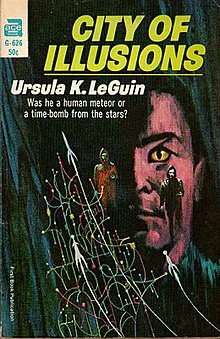
CityofIllusions.JPG


Finally getting back to more book blogs. I just finished reading the third book in Ursula K LeGuin's Hainish Cycle, or trilogy in this case. Her other novels in the Hainish universe are much different from these, her first three novels. I'll describe each novel's plot and simply tell you my thoughts on the works in and of themselves, and then what I think of them as a whole. 

Rocannon's World

Rocannon's World is Ursula K LeGuin's literary debut. It's a science fiction space opera with heroic fantasy elements. Other alien races are similar to fairies and gnomes, who wield swords and axes. The word "ansible" for a faster-than-light communicator, was coined in the novel. The term has since been widely used in science fiction. 

The story begins with a prologue titled Semley's Necklace, which is about a woman who travels to a primitive planet to recover a family heirloom. However, her husband and daughter aged so much while she was on the trip, that when she got back they were dead. It combines Rip Van Winkle fairy tale [a person goes off with dwarves for a short bit, only to find that generations have gone by] with modern [the 1960s] science fiction elements.   

Rocannon is an ethnologist space operator turned warrior turned mystic god. The story has fantasy elements, especially the dialogue of the alien races being similar to the dialogues of fairies and elves in fantasy novels. Also, the idea of the impermasuit, a suit that makes the wearer invulnerable as long as he's wearing it. This seems like a now-classic fantasy trope. The characters ride on flying winged beasts. Rocannon learns how to Mindspeak [Le Guin's idea of telepathy in the Hainish universe], calls his human allies from the League of All Worlds to help him destroy the enemies' base, but because he's telepathic he feels the death of hundreds of his enemies, making him sorry and traumatized.

The first Le Guin novel is stunning. It's short, simple, straight to the point. The writing is simple but not too simple. It's still got the deep meaning behind the text. In this case, we're talking about Le Guin's primary ideas coming out for the first time in novel form. The idea of anthropology for one thing. One great civilization from outer space comes to some other faraway planet, only to find primitive aliens living in the Bronze Age. The idea of the cargo cult. Some evildoers are enemies of the League and then there are good guys like Rocannon, and then there are all the gray areas that would naturally appear. Considering this came out in 1966, I would say its an important book to read in the science fiction canon. Must read science fiction actually. 

Planet in Exile 

Planet in Exile also came out in 1966. The story is set one Werel, the third planet of the Gamma Draconis system. The planet is about to through its long winter. The planet has an orbital period of 60 Earth years. Wold, a chieftain and his daughter Rolery are humanlike aliens indigenous to the planet. Jakob Agat is a young man from a dwindling human colony. Although both races have human genes, the differences between them are enough to prevent interbreeding. The main point A to be B here is that the two races have to come together despite a dispute between Rolery getting involved with Agat, which is forbidden to Wold and his people in their culture. There are invading alien creatures, the Gaal, that aren't hilfs [LeGuin term meaning high intelligence life forms] that take them to war. 

Planet in exile plays back on the action that is at the forefront of Rocanon's world. In fact, the siege part where they're defending their city from the invaders doesn't focus entirely on the action and fighting. There are a few gory moments and descriptions but it's downplayed heavily considering they were at war. 

What Planet of Exile does bring more to the picture is the extension of the LeGuin aesthetic; anthropology, space opera, and believe it or not in 1966, feminist overtones. This novel focuses more on the ecology of the planet itself [something science fiction fans got for the first time from Frank Herbert in Dune]. There is a lot of exposition about the native animals, plants, and races here. 

Also, this is the first time that Le Guin writes a powerful sympathetic female character. Rolery isn't as powerful or as important as Agat, rather it's something of a Pocchahantas story. However, it was a push in the direction she would inevitably take. To write feminist science fiction space operas like The Left Hand of Darkness where she goes more into female identity, gender, sex, and equality. Sure, Planet of Exile is sort of conventional in terms of female characters, but it's also so early in the science fiction canon that it can't go unmentioned how important Le Guin's female characters were even as early as her second novel. 

City of Illusions

City of Illusions came out in 1967 and lays the foundation for the Hainish universe, where most of Le Guin's novels take place. 

The story takes place 1200 years after the Shing has broken the power of the League of All Worlds and occupied Earth. Humans are alive, living as nomads and in small tribes. The Shing suppresses human civilization with Mindspeak, telepathy, and the ability to mind-lie. A descendant from the characters from Planet in Exile is involved in a spaceship crash. The Shing mindwipe him, leaving his mind a blank slate, tabula rasa. They throw him in the forest left to die as practically an infant. He develops a new identity and tries to find out who or what he is. 

I finished this novel today and find it to be the weakest of the three in terms of plot but the strongest in terms of character identity. Falk is a powerful sympathetic character. This novel is primarily about the inner psychology of the main character. Not unlike Frederic Pohl's masterpiece, Man Plus. It's not about action, it's about the soul. That's what matters here. 

The weakest part of this novel for me was the Shing themselves. They were supposed to be a race of Hitlers but they were portrayed as practically harmless. It was laughable in certain aspects considering that all the humans on Earth live in fear of them and animals have learned to talk because of them. The problem was that they were not convincingly evil. For one thing, they do not kill and have an oath about it. A group of 'bad guys' who don't come off as really all that bad is the death of a novel. Keep in mind that it's very hard to write a group of bad guys in novel form. Most of the time there are one or two bad guys in a novel, but a whole race? That's pushing it. This is why the idea of the literary Satan is usually left for poetry and drama.

LeGuin makes use of her own Tao Ching here. She creates a book for the humans that is basically their bible. It's important and was before and now a staple science fiction trope. I also liked how the humans on Earth 1200 years into the future were all nomads, barbarians, savages, yet there were still some peaceful ones living across the apocalyptic wasteland. It reminded me of Fallout 4. Of course, only in retrospect could someone [a video gamer] say that.  

In short, these three novels got me back into my science fiction readings. Le Guin strikes deep with her science fiction. As a whole, the work comes across as a vast cultural societal experience. Le Guin's work makes me think more about the bigger picture. Who really are the good guys in the world? Who are the bad guys? Who are we? What am I? I've already ordered Le Guin's The Lathe of Heaven and The Dispossessed [also in the Hainish cycle]. For now, I'm reading a modern 2013 new verse translation of Dante's Divine Comedy. Watch this space.

Tuesday, December 3, 2019

The Canterbury Tales


2696The Canterbury Tales is a collection of 24 stories running over 17,000 lines written in Middle English by Geoffrey Chaucer between 1387 and 1400. Chaucer was appointed Controller of Customs and Justice of Peace, and in 1389, Clerk of the King's work. It was during this time that Chaucer wrote the Canterbury Tales. He was a court poet that wrote for nobility.

Although Chaucer wrote other works it is Canterbury Tales that is considered his magnum opus. He uses the stories within stories to satirize, and paint a critical and ironical picture of English society of the times. The fact that all the characters in the story are all from a cornucopia of social classes was something fairly new to English literature. Even poorer, more lowly classes could still call out a more noble, character, like a knight, and stop them mid-story, to criticize and tell their own story instead. Because of all the characters here are on a pilgrimage, they are all concerned with everything spiritual. The work itself is considered incomplete especially considering that all the characters didn't get to tell their stories. The work is generally opened to a lot of different interpretations. 

Canterbury Tales is a sort of stories within stories. We have some 30 pilgrims at a tavern. They are all on pilgrimage to St. Thomas Beckett's Shrine. We have our host proclaiming, "Tell your best stories. The one who tells the best story shall have a feast here when we get back and I shall pay for it." Needless to say, everybody from the knight to the parson tells a story. Some are short, some long, some serious, some jokey, some holy, some about love, some about chivalry, some epic like the knight's tale. What's interesting is that other characters interrupt and/or stop some stories by calling them out and criticizing them [regardless of social class or wealth], sometimes thereby starting their own tale.   

I enjoyed the knight's tale the most. It opens the book and gets the reader acquainted with the style of the book. Two cousins, Palamon and Arcite, both knights are in prison and they chance upon a beautiful woman, Emily from their cell windows. They both claim her but they both can't have her. They end up having this epic duel with 100 warriors on both sides. Palamon is wounded by a chance sword thrust from one of Arcite's men, leaving Arcite the victor, but then Arcite is mortally wounded by his horse throwing him off and falling on him, leaving Palamon to marry Emily. The story is epic and intended to be. The next story is an antithesis to this knight's tale of courtly love and chivalry. In the next story, the miller's story, it is about regular people in love and is more lowbrow.

As stories go, none of them are especially terrific or satisfying in my opinion. In fact, I didn't start to thoroughly enjoy the book until at least 150/484 pages. Why? Because I was expecting the stories to be more thrilling. What I found out was that as I read farther on, the stories didn't become particularly more interesting, rather, my thoughts on them changed. I began to find seemingly unimportant yet realistic stories for the medieval time, to be fun. How, why? I'm not even quite sure. Like I said I didn't get into the book until nearly 150 pages in. In fact, I found the constant rhyming going on nonstop to be quite jarring to get used to, especially considering the format is poetic but of an especially non-epic quality. Homer is forgiven for constant rhyme but I wasn't so sure about Chaucer. Consider the fact that most of these archaic works of literature that I've read have been epic, think Aeneid, Odysee, Iliad, Beowulf, Gilgamesh, Divine Comedy, so when you come to Canterbury Tales from all that you just say to yourself, "where's the action?" That was what made Canterbury Tales so hard to get into for me. Eventually, the text speaks for itself and you see how great and important it really is. For me, it took a while to sink in.

It is believed Chaucer got a good deal of his ideas from other literary works. But no other works of literature featured pilgrims telling tales together. In that sense, he's a true visionary. Harold Bloom says the text is mostly original but the idea of the host, a "master of ceremonies" was derived from Dante and Virgil in the Divine Comedy. The Decameron by Giovanni Boccaccio is most similar to the Canterbury Tales than any other work. It features a cast of characters telling stories as they flee from the Black Death. It is believed that Chaucer might have known him.

The tales themselves usually center around a single theme, mostly religious. However, the themes here aren't necessarily all religious or set. They're dependent upon the characters themselves and they don't speak in any sort of hierarchy. The passage of the time, or any traveling what so ever, or even locations along the way, is never mentioned. Rather the stories themselves are all that is spoken of. 

The version I read was a modern English translation, translated by Nevill Coghill. His translation is very smooth, breezy even in the most difficult of circumstances. Considering this is almost a 500-page book, the modern translation reads almost like modern-day. Of course, it really doesn't. What I mean is that it's very smooth as opposed to old medieval English. The words used sometimes can still be complicated and I did still have to look words up online at times. Another thing that must be said about Canterbury Tales is that a lot of the lines rhyme and they are definitely in poetic verse. Sometimes the rhyming gets overwhelming. That's typical for a lot of the 14th-century prose. But overall, for my first Canterbury Tales experience, the Penguin Classics modern translation was very good. I'll try reading it again in the future, but a different translation. I would recommend this book to anyone: students, writers, readers who like the western canon especially. A "do not miss" book.

Thursday, November 21, 2019

What's a brotha to do?

What's up ladies and gentlemen of the interwebz. It's been a minute since I last wrote a post. I've been on a blog/writing hiatus for a while now. The reason? A lot of work at the main retail gig mostly. Lately, I've been getting these long six-day work weeks. Eight hours, six days a week. They're exhausting but hey, I think they call that a job. 

I've been reading a lot. I recently finished The Brothers Karamazov by Fyodor Dostoevsky. Nearly 800 pages! At one point I was averaging about 100 pages a day. I'm currently reading the Canterbury Tales by Geoffrey Chaucer. Bring on more classics of the western canon! Brothers Karamazov is such a great work with so much gravitas that I think it deserves to be reread in a couple years if not sooner. 

The Canterbury Tales took me a long time to get into. For a while, I contemplated reading it but instead got hooked on video games for a few days. I've been playing a lot of Overwatch within my last two days off, leaving me in a kind of zoned-out, zombified, sort of state. The game is fun but it gets to be a little mind-numbing after a while. I've been in gaming limbo. Most of the time I don't play games at all but every now and then on days off, I play a lot. Missing out on precious reading time on days off.  

Actually, if I don't read pretty often [every day] my mind starts to wander and drift off into this kind of zoned-out mode. What can I say? I have to stay engaged in the literature to feel active in life. I've become such a reader that when I don't read for one-two days, I start to feel not quite like myself. Fiction especially. And philosophy. Literary essays. 

In terms of music, I've been playing weekly jazz duo jams with my friend Jason Thomas. I'll probably post some music from our sessions here at some point soon. The jam sessions have become more improvisational but I would say that we need to increase our repertoire. Especially Coltrane songs. Songs like Afro Blue, My Favorite Things, Naima, etc. 

I had a freaky moment at work during the past week where I met a music student who actually studied with my music mentor, the new music composer Frank Abbinanti. Apparently, Sid studied with Frank for five years [or more] in Chicago before he came out to California to study at Cal Art. This is pretty astounding. I was dumbstruck. This is where I get to say that I believe in God and metaphysics. What are the chances of meeting this guy? Considering that we are both from Chicago and both are mentored by Frank. Apparently, my step-father knows Sid and his father as well from when they used to run a new music orchestra. Wow! How about that? 

Having free time to write a rambling post like this has been great. In fact, I've been so tired from work lately that I haven't had the energy to turn on my laptop and write posts, let alone my usual book reviews. Instead, the last month or so I've been ranting a lot about retail, and my Marxist tendencies, as well as my arrival to class consciousness via retail work. It's a wonderful world. 

Plans for the future? Well, for one thing, I'm going to get back to my usual book review stuff. For another, I plan on going back and working on my first novel, which was written and finished a while ago, but definitely not perfect. I'm actually not satisfied with it and intend on going back to the original version, which didn't have much editing, without messing it up. My problem with my memoir initially was that I finished a rough draft and then wrote a longer, edited version. However, after going over the edited version I realized that it was edited in a wrongheaded way, forcing me to go back to the drawing board. 

Thankfully, I have the original version. Just to explain to you how different the original is from the edited version, the original version is only 50 pages, whereas the edited version is 100 pages. A lot of people have told me that I should submit it to publishers and try to get something done with it. We will see after I rework it again. 

Likewise, I want to write more short stories of a fictional nature. Science fiction and just plain, old, regular fiction. A reader must write if he or she is so inclined. I've been reading a lot of Jack Reacher [the short story collection]  so I'm inspired to write things in that vein. We will see. 

Lastly, it's not that I haven't quite had as much time to write that I haven't written anything. Rather, it's just that I've been damn tired. So tired that I haven't really been playing guitar much. I've stopped attending the bar open mics because I realized their limitations [two songs, ten minutes, buy drinks, too much $] and in fact, when I play and buy drinks there, I'm losing money and free time. In terms of music, I'm more motivated by Frank Abbinanti's musical advice and direction. In terms of writing, I'm very inspired. But sometimes you gotta force yourself to write. Even when you're dead tired. 

The holidays can be a real downer for people. This time of year is hard on workers because most people have to work during the holidays rather than spend time with their families. Sometimes you gotta do what you gotta do. The important thing is to keep doing the things that motivate you and push yourself to get the things you want to be done. If you don't push yourself, nobody else will. 

I've got to keep pushing myself. 

Saturday, October 26, 2019

Weekend Update

Greetings everyone! Thought I'd do a weekend update, unfortunately not SNL style, but rather a vlog style summary of what's been going on in my life. Alright, alright. 

I've been working a lot at the retail gig. Forty hours or more every week. This upcoming Halloween week I only have one day off. That's kind of a bummer. But if I learned anything from the first episode of Futurama, "you gotta do what you gotta do." I've found that at a job such as mine you really have to stay positive and keep a good attitude. This is where all my improvements in thinking [from literature] come to the rescue. 

I've stopped drinking soda and energy drinks at work. Now I'm not nearly as tired when I get off work at one am, nor am I as tired during the beginning or middle of my shifts. Overall, I feel a lot healthier and better. I've lost a few pounds already only after a couple days. My body feels like it's going through some sort of detox from all the sugar I've been ingesting all these years. I have withdrawals and crave the sugary rush but when I actually have a little bit of soda I find that I'm not satisfied by it anymore. Ain't that a bitch? That sudden realization that I was drinking too many calories and in fact not overeating all the time that contributed to my weight. That hit me like a lightning bolt.  

I'll probably have to cancel my weekly jazz jam session, unfortunately. I haven't had as much time for music as a result. I haven't even been listening to as much music either. Oh well, things happen. I haven't done the open mic sessions for two months now. Sometimes I think about giving it up for good. I've done it for about two years straight and I would say that it's run its course. Thankfully, I got a lot of great recordings out of it that you can hear on my Soundcloud

In terms of reading and improving the mind, that's been my number one goal. Today, I'm going to go through some Jack Reacher short stories before work. Within the last couple weeks, I've read Against Interpretation by Susan Sontag, Tractatus Logico Philosophicus by Wittgenstein, Zen and the Art of Motorcycle Maintenance by Robert Pirsig, and now I'm halfway through The Outsider by Colin Wilson. I've been reading a lot in my living room on the couch, but I also read a lot at Starbucks, where although it's noisy [damn indie rock music], it gives me an opportunity to get out of the house. I really love the coffee there as well. 

I've been thinking a lot about writing [thinking about writing a second novel, I finished my first one a while ago] but haven't had the time to really do much writing on my usual subjects: literary criticism/synopsis, my main and favorite subject the last couple of years. I'm sure I'll get back to it, in due time. I really want to write a review for Colin Greenland's space opera from 1990, Take Back Plenty. Now that is a true science fiction gem. However, as you can see from the recent posts I've been writing, just not about books. Not a lot but I'm keeping a flow, a gestalt if you will. Lately, I've been writing posts like these, going into my thoughts, my meager life [lol]. This goes with all the books I've been reading, as they've influenced me in my life heavily, more so than my friends and colleagues. So when you see me writing about the dialectics of the modern proletariat [a recent post] that is definitely an influence from philosophy and extended readings. 

Lastly, I want to say that reading doesn't just help with my writing but also with my social interactions. I always experience status inconsistency wherever I go but I've also learned that when you get to the heart of the matter and really use all your social skills to max capacity, you will end up having more friends than enemies. 

Have an excellent end of October weekend. Happy Halloween! Free candy for everyone! 

Thursday, September 19, 2019

The Pillow Book

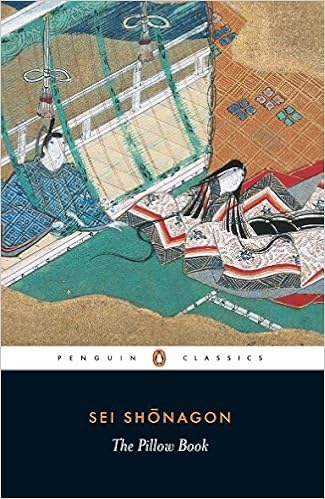
Image result for the pillow book mckinney In spring, the dawn — when the slowly paling mountain rim is tinged with red, and wisps of faintly crimson-purple cloud float in the sky.

The Pillow Book is a work of medieval Japanese literature from the Heian period, roughly 800-1200. Written by Sei Shonagon, a woman in the lower level court that served Empress Consort Teishi (定子). This isn't so much of a book per se, and definitely not a novel in the traditional sense, never mind the fact that the idea of a traditional novel didn't exist back then. However, her contemporary was Murasaki Shikibu, author of the famous Tale of Genji, a contemporary, woman serving in the court. Both of these works are studied in Japanese high school to this day. In fact, when Japanese study classical Japanese, it is the Heian period that they go to. 

The book is full of essays, lists, anecdotes, and personal thoughts. When I first started reading it I thought it was all over the place, and it really is. The Pillow Book reads like a conversation from Heian Japan. You get a sense of the character of Sei Shonagon, which is what Meredith McKinney focused on. She wanted to get the voice of the character done in a certain way, that is relatable some thousand years later. Did she get it right? I would say yes. Reading this book is somewhat of personal experience. I found myself smiling at things that were funny and likable, and likewise demurred when Sei said mean girl things. You feel like you are getting to know Sei and how she lives in Heian Japan, ultimately alien, foreign soil for me. Because of that, it is a true work of art, literature. 

In the McKinney translation, Sei comes across as personable but somewhat thorny. Basically, she isn't perfect. There's a mean girls vibe to some of the statements she makes but it doesn't dominate the text. But when you see it you do take notice. Were women really like that back then in Japan? Women are like that today! It's funny in a way how natural Sei comes across in the McKinney translation. Rather than translate the language in a dramatically different way, McKinney decided to change the voice of the character herself in her own inimitable way, that is personable, relatable. It's like listening to a Heian period woman, talks about her life, like a diary but better, much better because she comes across as likable and engaging rather than boring and nonstop. 

My favorite element of the Pillow Book is the anecdotes and stories. Stories of men who are clumsy with poetry, or retreat into hiding if they've walked in a woman's room. What festivals were like as the season changed. What it was like serving an Empress, whom you greatly loved and admired, despite you being of lesser rank, and never having the chance to be like her.  

If I were to compare the Tale of Genji [review here] to the Pillow Book, I would say the Pillow Book is breezy and personable, and that the Tale of Genji is more elusive and poetic. Both great works, vastly different. Sei has a way of explaining her world like a diary, that is in invaluable in respect to Japanese history. In short, its something of a masterpiece. 

"In autumn, the evening — the blazing sun has sunk very close to the mountain rim, and now even the crows, in threes and fours or twos and threes, hurrying to their roost, are a moving sight. Still more enchanting is the sight of a string of wild geese in the distant sky, very tiny. And oh how inexpressible, when the sun has sunk, to hear in the growing darkness the wind, and the song of autumn insects."

Tuesday, September 3, 2019

The Tale of Genji

The Tale of Genji (Penguin Classics) The Tale of Genji is a Japanese masterpiece of literature [considered the first novel] from the Heian period, roughly (794-1185). Written by a woman named Murasaki Shikibu. She was born into a minor branch of the Fujiwara clan. Her father was a governor. Men wrote in Chinese. Women wrote and read in Japanese, which led to female writers of Japanese, highborn women. She started writing this novel, which is over a thousand pages after her husband died. Scholars tend to disagree on the writer. Some say it was the work of many authors, as says Royall Tyler, who's translation [only 300 pages] I read. Others say its solely Muraski's work. The actual story itself has a continuity that suggests there is only one writer, her. 

The original manuscript is gone. This brings up the issue of translation. Heian Japanese is so different from modern Japanese. Translating Heian Japanese into English is a daunting task unto itself. However, a literal translation of Genji is impossible. Not only that but each English translation of Genji is so remarkably different. Consider these renderings of the same sentence by different English translators. 

In Chapter 4, titled “Yugao,” Genji comes across a run-down house, the abode of a young woman he is about to seduce. Waley describes the entrance like this: “There was a wattled fence over which some ivy-like creeper spread its cool green leaves, and among the leaves were white flowers with petals half-unfolded like the lips of people smiling at their own thoughts.” Seidensticker: “A pleasantly green vine was climbing a board wall. The white flowers, he thought, had a rather self-satisfied look about them.” Tyler: “A bright green vine, its white flowers smiling to themselves, was clambering merrily over what looked like a board fence.” Washburn: “A pleasant-looking green vine was creeping luxuriantly up a horizontal trellis, which resembled a board fence. White flowers were blooming on the vine, looking extremely self-satisfied and apparently without a care in the world.” [newyorker] 

Each version is so different, yet say the same thing in their own inimitable way. It's remarkable. The act of translating itself is a science. One could write an entire treatise on the art of translating. It would be worth the read. Genji made me realize how important a good translation of a book is. Before that, I was in the dark about it.

What is The Tale of Genji about? A noble and his concubines. It's about the art of seduction. But even simpler I would say it's about relationships. A man and his relationships with women. In this society, the way to a woman's heart was through poems, delivered by a go-between, who was elegantly dressed, and of appropriate social standing.

Courtly lovers didn't see each other face to face often, certainly not naked. Women of the upper class sat behind screens, and sliding doors. Women were protected by screens even when they spoke with males in their own family. A guy could be driven wild if he saw a woman's sleeve spill out or the sound of silk rustling behind the screen.

But people still got it on. Nobles and their ladies were promiscuous. Affairs with court ladies and ladies in waiting were perks of an aristocrat's life. So was adultery sometimes. Genji, when he's still young, has an affair with his father's [the Emperor] mistress. And both father and son lust after a young girl, that Genji adopted as his daughter. 

The requirement of a gentleman was style. You could be forgiven for seducing a man's wife. But you had to know how to write good poetry, have good handwriting, and wear the right perfume. Despite the influence of Buddhism, Heian society was governed by style rather than virtue. Good looks meant everything, virtue be damned. 

The ideal man wasn't too much different from the ideal woman in Heian society: highly perfumed, smooth-skinned, moon-faced, extravagantly dressed. The decadence of the times led to what Genji called a time “where everything seems to be in a state of decline." A state of decadence.

All of this had a strong sense of hierarchy of course. Also, Heian politics was marriage politics.  

Three important takeaways from reading Tyler's translation of Genji. 

First, this book gave me my first real look at Japanese culture that wasn't from anime or movies. I understand Japanese culture and society a lot better than I did in the past, and am grateful for the experience of reading world literature. It opened up my mind to the literature of other cultures [non-western canon], and that is an amazing gift to oneself, and for anyone who cares to discuss the book with me or listen to me explain it.

Second, the idea of translation. Lost in translation is a big possibility here. But the fact that the first novel can be somewhat preserved and rendered into modern readable English from Heian Japanese is fascinating to me. How do they do it? It's like nuclear physics. The translations in English are all vastly different. The book is 1300 pages, and the version I read and bought is only 300 pages. Obviously, Tyler's version is heavily edited, abridged, and he took out many passages, but I still found the book to be thrilling. 

Third, the sense of style. The elegance of this book is vast. You don't need action and fast-paced fiction writing to create a sense of depth. As a writer, this is very liberating to see, read, and experience. In fact, I had to read this book very slowly because each page is annotated, there's more than one poem on every page, and if you don't read the footnotes at the bottom of the page, you don't quite understand the poems. However, when you realize that the poems aren't literal translations, and don't quite mean much to you, the reader, you realize that you should focus on the story itself, rather than trying to find meanings in the poems. Going through that was a tedious yet rewarding experience. 

I plan on going back through Tyler's version again. Because I was so impressed with it, I bought my own used copy. Definitely worth it. Although the book took me almost a week to read, it was a very fruitful experience. At the very least, now I know where Overwatch's Genji got his inspiration. Of course, the real, yet fictional Genji is so much cooler. 

Wednesday, August 28, 2019

A Distant Mirror


Image result for a distant mirror book cover A Distant Mirror by historian Barbara W. Tuchman is one of the most captivating books I've ever read. The work encapsulates the history of the 14th century Europe in thrilling six-hundred pages. Have you ever wondered what life was like in the middle ages? This book is the perfect resource for that. This is the best nonfiction book I've ever read. It does have story elements within, however, they are rather limited. 

The book is loosely based around one man's life. Enguerrand De Coucy. He was a French noble that had a double allegiance, to England and his native France. He was the shining example of nobility, chivalry, and grace. He led war campaigns against England and led knights into battle in crusades as well. He helped unite England and France at key moments in the war. In the end, he got captured on a crusade and the Moslems imprisoned him. He died.

What was more fascinating than the life, goals, and happenings of Engerrand was the sheer alienness of this world, this so-called medieval Europe. What inspired me to read this book was the recommendation from my father. He said, "saying since you love science fiction so much, you should read this book. This world described therein is so foreign to you, that it will be like reading science fiction." He couldn't be any more correct. 

It's hard to believe that the middle ages even happened in some respects. Of course, it did, because we have literature, art, music [sheet music], and architecture to prove it. However, what I mean is that the world was so different back then, that it's hard to reconcile this universe in a modern perspective, which is what Tuchman does here. Spectacularly.  

The book covers the black plague [pestilence carried by rats, dung, and uncleanliness], the consanguinity of the papal order, the papal schism [which brought the Protestant Reformation some 100 years later-but it started here], knighthood, chivalry, philosophy of the time as well as art, literature, food, debauchery, flagellants, sexual deviancy, anti-semitism, as well as the gory bloody details that existed in the age; what life was like for the king, the noble, the knight, the squire, the peasant, the laborer, the noblewoman, the peasant woman, the priest, the pope, the aristocrat, the merchant, the sailor, the writer, the poet, the artiste, the architect. A Distant Mirror pretty much covers everything you would ever want to know about the middle ages. 

Some fun facts. The first sheet music was published in 1473. Contrary to popular belief the black plague did not only affect Europe, thus killing off 1/3 of the population. I learned from this book that the black plague affected India, Africa, and China. It was actually all over the world, not just in Europe. Chivalry was idealized in immortal knighthood but was hardly if ever utilized in practice. People lived long lives [living into their 70s sometimes], however, because of the brutal nature of the times [war, famine, pestilence], they often died at a younger age. People became senile faster too. Thus girls were married off at younger ages and bore children earlier, sometimes resulting in their deaths due to the nature of childbirth and the primitive methods of doing so. Kings and nobles were in a constant state of war, even with French on French assassinations, and likewise English on English murder. Kings and nobles kept power within families, making alliances with other countries by marrying off their daughters to royalty. 

The details of the war are remarkable. "To be a knight was to be a terrible worm in an iron cocoon." That's one of my favorite lines in the book. I had such a different view on knights in my mind. But the truth of the matter was that their iron armor was often so heavy that they could hardly move or attack very fast in it. They had to supported by archers wearing little armor for mobility and peasant foot soldier militia to win battles. They certainly couldn't swim in water if they had to. Terrible worm in an iron cocoon indeed. 

Overall, this is a remarkable work of history. In fact, I was so impressed with this book that I bought my own copy used from Amazon. Lucky for me, this book is very old so it was pretty cheap. In time I will look back to it. I read and finished the book in three weeks but during those three weeks, I didn't play any video games or waste my time in frivolous activity. Rather I went to the library and Starbucks and savored each and every word. This book is a masterpiece. You should definitely check it out. Reading the entire thing is a daunting task but once you finish you see the beauty in history. Bring on the Japanese feudal war era next.

On AI, Existential Threat, and the Collapse

Good evening ladies and gents. Hope you all had a good Sunday. I wanted to write here a bit more about AI, existential threat, and the Colla...