Showing posts with label reviews. Show all posts

Friday, January 13, 2023

The Age of Voltaire by Will Durant


The Age of Voltaire is volume 9 of Will Durant's Story of Civilization series. So far I've read four of Will and Ariel Durant's Story of Civilization series of books: The Italian Renaissance, The Life of Greece, The Age of Reason Begins, and now finally I've read The Age of Voltaire. 

Closing this book, I felt that this was an extensive and comprehensive history of the age right up to and leading into the French Revolution, the Age of Enlightenment in France, roughly 1680s-1780. Voltaire was born in 1694, ensconced in education through the Jesuits. The Jesuits were the main educators in this period and had a lot of influence over schooling of children [boys and girls] and even sometimes in government and various occupations. They were known for being very educated and lenient towards their people, although they themselves were also quite dogmatic about Christianity and its spread throughout other parts of the world like in Latin America and even China. Despite this early great education from the Jesuits, Voltaire grew to increasing dislike the Church as he gained more fame and influence. He spent a lot of time running around to different homes and even the home of Frederick the Great because of his critiques of the church and nobility.  

However, there was a lot more going on in the Church other than Jesuits. There was the growing disputes between church, the peasantry, the aristocrats, the nobles, and the church's feuds with protestants [Jansenists], Catholics, and atheists from the philosophes, the intellectuals [writers, philosophers, scientists, artists, mathematicians, playwrights] like Voltaire, Diderot, Rosseau, Montesquieu, and d'Alembert. These named in particular would have the greatest influence on France and in the world. 

It should be named that being a philosopher in 18th century France isn't the same thing as being a philosopher in the 21st century. These intellectuals delved and wrote in a variety of fields and styles in order to reach their audience in the best ways they could. Voltaire didn't think much of giant books like the Encyclopédie [famous 18th century book from France by the philosophes], rather he thought that small books easily concealed would serve him better. So he ended up writing a lot of small works that contributed to his vast body of works. So Candide ended up becoming his most famous book.

But not every intellectual was an expert in a particular field. Rather a philosophe, was someone who was expected to know a little bit about every subject, even if they themselves weren't a master in each field. In order to write the Encyclopédie, the writers utilized and employed different philosophes for different phrases and words that they didn't feel adequate enough to cover themselves.

What caused the French Revolution? This book doesn't entirely aim to answer this question, rather it focuses more on historical detail. But after reading The Age of Voltaire, you can figure it out.

France was deep in debt from wars and the debt fell upon the peasants more and more, as the nobility became more and more corrupt. Tensions increased between the nobles and the church, and eventually even the Jesuits who had educated all the best minds of the time, were expelled from France. On top of that, the educated people were being more and more exposed to the works of the intellectuals of the time, the philosophes, and now, more than ever, people were more willing to become atheists, little by little, influenced by these great men with big ideas, ideas that changed the world, would eventually lead to the world we live in now. A world of more religious toleration, human rights, democracy, and equality.

Although the Age of Voltaire was published in 1965, it seems to somehow resonate in the scatter-brain afterimages of 21st century 2023. There's something there in this book that has an everlasting effect on the time it is describing, the time it was written in, and the time I live in now as I write this. It seems that now, more than ever, we're living in a world increasingly fraught with the same problems, plus a bunch of new additional ones, that weren't quite resolved from the French Revolution and perhaps never will be solved.

It has occurred to me after reading four volumes of Will Durant's Story of Civilization series, that the problems of any age seem to follow and recur in many others. There's always an endless cycle; renewal, back to the classic ages, onto a newer more advanced, more intellectual more philosophical more scientific less God, then an eventual regression back into a simpler mode of civilization, except we never really find out or perhaps we never can find out, that the civilization itself has already and always collapsed, only to be rebuilt by other people anew.

It is said that on his deathbed, Voltaire, when asked to return to the faith of his fathers and renounce the devil, responded with, “This is no time to be making new enemies.”

Friday, January 7, 2022

Aristoi

Wow, what a terrific space opera god adventure story!

The way I described this book to people was this: this is a space opera about gods that become humanized. I mentioned Homer and his humanizing of his Olympians. So there's a long cherished tradition here going back throughout time, the western canon, of pathos, from Plato. What does it mean to be human? A god? What is good and evil? Who gets to justify right and wrong? These are some of the existential philosophical questions this book brings to mind in a general sense, disguised in the form of a 90s space opera. 

In addition to that, the momentum of the book never really stops, not even at the very bitter end. The story itself isn't remarkable, its rather predictable, and we've seen this same science fiction space opera tropes used time and time again within the golden age of science fiction and even the cyberpunk and new wave, it's rather space opera cliché. 

However, it is the way he tells the story that is truly a thrill. The style is simple but downright effective. It was never dull and every moment is a good one. I'm somewhat of a science fiction connoisseur but I missed this one all these years and I know I've missed much more. I would even say it's a required science fiction reading in the genre of space opera. It would be extremely difficult for a new science fiction writer in 2021 to write a space opera this good. It might even be downright impossible unless it was coming from overseas [not the US], maybe China.

Saturday, May 1, 2021

A Farewell to Arms

A Farewell to Arms is a terrific and thought provoking novel written by Ernest Hemingway. It tells the somewhat story of love, death, and war that is based on Hemingway's actual war experience in the first world war. The book was published in 1929 but not in published in Italy until 1948 because the way Hemingway depicted the Italian battles were seen as anti-militaristic by the Italian government and could have been detrimental to the war effort. Hemingway wrote no less than some thirty nine different endings to the novel until he picked the one he ended up with. What makes this book great, terrific, and probably his best novel, and best known work?

Well, the book describes three different things superbly. Love, war, and death. These themes permeate the literature of the western canon and Hemingway's depiction of the first world war is probably one of the best descriptions of war in the western canon. Especially modern warfare. Remember, when this came out in 1929 there was no realistic depiction of modern warfare in fiction. You end up really living the life of this soldier, how he gets wounded, how he falls in love, how he talks to and works with his officers. You get the feeling that this was really how it was on the battlefield. A lot of the off duty time of the officers was spent on drinking, drinking, and drinking. Alcohol appears in endless scene after scene and it permeates throughout Hemingway's life, continuously leading to his suffering. 

Another important theme was love. We get the feeling at first that our young Frederic Henry is wounded and just wants a girl to pass the time until his recovery. What instead happens is that he falls in love with her, but is it really love? The circumstances of war were excruciatingly difficult especially with his war wound [a shell hit him in the leg], not to mention his surgery to his knee. So what we have is a wounded soldier and a lonely nurse. It's a match made in heaven. 

Lastly, it must be mentioned the theme of death. Death appears many times. A fellow friend and officer gets shot down out of nowhere for no reason, but when Frederic and another officer go out into the open, nobody shoots them, and they walk past both German and Italian soldiers unmolested. 

Now, the most striking part of this book for me was the ending. The nurse is pregnant and gives birth but nearly dies. Frederic hates the baby and states within himself, "I care nothing of fatherhood of it, it nearly killed its mother," which goes back to the Greeks, the idea of the father hating the son because he could take his place in the patriarch of the family. However, in this case I prefer to see it as Hemingway's allegory for war, meaning that war is a ghastly nihilism, no good will ever come of it, it brings only evil and destruction and misery. To add insult to injury, the baby ends up dying and our young father is relieved. 

That ending knocked my socks off because although it seems simple I found it to be philosophical, a display of existentialism in fiction format. It's an ending I will never forget. Something sort of like what Tolstoy did with War and Peace, it was a fictional novel but parts of it translated into philosophy, at least in my viewing. Obviously you can make the case that Hemingway's take on war is that it is terrible and must be eradicated at all costs. Although the first 140 pages focus on the romance, the rest of the novel is thrilling, moving, and mindful. A must read for the western canon, a must read Hemingway, a must read war novel, and a must read novel for all. 

Want more Hemingway? Check out my blog post about Hemingway's Spanish American war novel For Whom The Bell Tolls https://ofigueroamusic.blogspot.com/2019/03/for-whom-bell-tolls.html.

Tuesday, March 16, 2021

Bertrand Russell The Problems of Philosophy


Great introduction to philosophy. It's not really the problems of philosophy that are important, rather the ideas where they come from, the terms, the definitions, the meanings, the different ways to explain, refute, and rationalization, in short, how to think about well, anything, and everything. 

If you've read a lot of philosophy, chances are you will know everything in this book, or at least be familiar with the ideas and concepts presented, but it's a good fresh reminder and Bertrand's final chapters here are especially refreshing for a retail philosopher in aisle 9 like myself. 

One of my favorite parts of the book was the chapter where Russell explains Hegelian dialectic in 15 pages. It's poignant, and the fact that I'm familiar with Hegel firsthand, I found Russell's interpretation quite appreciated and inciteful. 

Remember that his friend, Ludwig Wittgenstein said there are no problems with philosophy, only a problem with language. One is standing with the pillars of western philosophy and the other is smashing it to pieces in a way.

Tuesday, February 2, 2021

Hegel: Outlines of the Philosophy of Right


I read this book directly after reading The Phenomenology of Spirit. It was a great, smooth transition. Also keep in my mind that because I've read Kant, Wittgenstein, and Heidegger, and a little Fichte, this makes a lot more sense that if I had gone in not knowing much about German philosophy, particularly the style known as German Idealism. Hegel is dense reading but his ideas are truly thought provoking and exciting for those who are curious. This is truly fascinating reading during the coronavirus pandemic of January 2021. What a great way to spend quarantine. 


Anyways, Hegel would say I have a good life because I have a job under a corporation, that is under a government, that is under a nation, we as a people all are one people together, and as individuals we mere atoms, nothing. However, there is a clear and important discussion about we the people, and how important the universal will is, how important it is to see the good, and make the world a better place. But remember that is only the universal will, and that the state must act in whatever ways it may, such as by fighting wars or making peace in the world, increased taxes, and such.

Wednesday, January 27, 2021

Tower of Glass


Tower of Glass, a terrific Robert Silverberg 1970 novel that includes android sex, their relationships with humans, equality for all androids, interstellar space travel, and more.

Terrific early new wave science fiction writing. Watchman and Lilith are androids written to be, and are, real human beings. A lot happens and there's a grand crescendo, ironically, the Godhead that screws everything gets what he wants, a true Voltaire, a true cosmic joke in the universe.

Saturday, January 2, 2021

Pavane


One of my favorite last moments with this book was the warm hearted story at the end where the young man seeks refuge in a old world town. Him, being a new worlder, has no one to help him, but a girl sees him and decides to show favor upon him. That's heart warming. 


You only get to see a few glimpses into the world Roberts has created here. The Church runs everything, they're using technology that is pretty much steampunk aesthetic but won't share it with the rest of the world. 


A heretical Priest forms his own faction and becomes a leader. A Queen forbids technology from entering her country in order for her people to have more time to believe in Truth and Reason, a Renaissance of sorts, that could have actually happened in an alternate history timeline simulacra. 


There's train haulers that know every nook and cranny of their machines. There's a lot of mini stories in Pavene, but in addition to interesting story lines and narrative development, there's also a lot of very well written sentences, sentences written in an elegant, stylistic way. Roberts is a stylist after all. And he never failed to deliver. In some ways I could compare this with some of William Gibson's stories from Burning Chrome or Neuromancer, but that wouldn't do it justice, it's simply a thing  entirely on its own, it's Pavane: 


a stately dance in slow duple time, popular in the 16th and 17th centuries and performed in elaborate clothing.

a piece of music for a pavane.

"the repertory consists mainly of pavanes and galliards"

Tuesday, September 15, 2020

Thoughts on Tolstoy's War and Peace, Parts I-V

 
Tolstoy - War and Peace - first edition, 1869.jpgSo I'm reading War and Peace by Tolstoy for the first time. I figured I would do a writing exercise where I lay out my thoughts on what I've read so far and use it as further analysis for when I finish the book and inevitably write more about it. Because the book is some 1200 pages, I thought breaking it down into parts might be easier to read and understand, mostly for myself, but also for the readers. So without further adieu, here are my thoughts on War Peace Parts I-V, approximately from page 1 to 400, about 1/3 of the book. This will read like a reaction review.

For starters, this book is amazing. The beginning is quite complicated because Tolstoy introduces many characters at once, everybody is chatty, and many characters are introduced right after the other. What you get is that there are about 3 or 4 major characters, and everyone else are minor characters that might get more screen time later on, presumably. 

Pierre appears to be the "main", main character, a bastard son who's committed some crimes in the past, like the hilarious crime where he tied a police officer to a bear. He inherits a large some of money from the Count, his father, and is troubled by what he must do with it, as well as what he should do with his life in general. He thinks his wife is having an affair with a family friend, a gentlemen he's helped greatly in life. Pierre challenges him to a duel, and the poor man doesn't even fire at Pierre because of everything Pierre's done for him, but Pierre shoots him, satisfying his ego but destroying his soul in the process. Later, Pierre tries to pick the pieces and come to grace, by becoming a Freemason and changing his life forever, trying to become a better man; a better man to his peasants, his family, and his friends. Tolstoy goes into great detail, displaying Pierre's initiation into Freemasonry, and its quite what you would expect.

Prince Andrey seems to be another important, "main", character. He joins the army and fights against the French, fighting against Napoleon. He goes to war to prove himself and become a hero, he wants to be loved by men who will never know his name, but instead all he finds is death and suffering. He wants Pierre to apologize to his wife about the duel and the affair, for which Pierre had no evidence, but Pierre wants nothing to do with his wife and says he's done with it forever. 

Pierre and Andrey seem to me to be the two most important characters in the novel thus far. There are many other characters; children of the aristocrats [they're all rich people here except for the maids and peasants, who sometimes take on important roles], princesses, counts, generals, soldiers, the list goes on and on, but for me, I tend to focus on Pierre and Andrey because Tolstoy writes them [as well as the minor characters, fantastically] with such detailed precision, its like an x-ray onto the character. Tolstoy goes into the general character, their thoughts, their moods, their language and dialogue, but he also goes into the soul of the character; mind, body, and spirit, which brings me to my next point. 

At this point in the book one begins to realize that this is not just a book, not just a story. Sure, there are innovative plot points and the narrative flows better than most fiction today [the development of good story and narration is something I learned a lot about from Don Quixote, but Tolstoy is such a master of this art, that it leaves one awestruck], but what I'm getting at is that this book isn't just a story, or about characters, or about war and peace, rather it could perhaps be a grand philosophical opus. Tolstoy himself said that War and Peace was his take on German philosopher Arthur Schopenhauer's ideas, particularly his masterpiece, The World as Will and Representation. 

Here is where the reader must know Kant, and must know that Schopenhauer's ideas take off from Kant's metaphysical system of transcendental idealism. 

Schopenhauer saw the human will as our one window to the reality behind the world as representation, i.e. the external world as we experience it through our mental faculties. According to Schopenhauer, the will is the 'inner essence' of the entire world, i.e. the Kantian thing-in-itself (Ding an sich), and exists independently of the forms of the principle of sufficient reason that govern the world as representation. Schopenhauer believed that while we may be precluded from direct knowledge of the Kantian noumenon, we may gain knowledge about it to a certain extent (unlike Kant, for whom the noumenon was completely unknowable). This is because, according to Schopenhauer, the relationship between the world as representation and the world as it is 'in itself' can be understood by investigating the relationship between our bodies (material objects, i.e. representations, existing in space and time) and our will. [wiki] 

That's very intense German metaphysics for the laymen, but the ideas represented do fit like a missing puzzle piece to this great novel. Why do you think this novel is so great? Of course Tolstoy read Schopenhauer and took some ideas of it for War and Peace.

More on this subject when I reach the halfway point. Watch this space.   

Wednesday, August 26, 2020

An Odyssey: A Father, a Son, and an Epic


The Patience of Penelope, Pre-Raphaelite Muse | 19th Century ...An Odyssey: A Father, a Son, and an Epic is a terrific book written by classics scholar, philologist, and professor David Mendelsohn. Written in 2017, the novel is part memoir, part scholarly insight into the Odyssey, and has its share of philosophy as well. I would compare this sort of writing to Zen and the Art of Motorcycle Maintenance, except this is much more scholarly and that is much more hippie. However, the classic idea of a novel being a memoir, the idea of how you can travel without really going anywhere by going in circles, and the bonds made in the process is what makes them similar. As the Dead would sing, "What a long strange trip it's been."

Mendelsohn compares the Odyssey to his relationship with his father. And it works. His father is a mathematician who regrets that he never got his Ph.D. or ever read Ovid in Latin like he wanted to. David, the son, and writer is a gay man who always wanted to be close to his father but his father is the typical grumpy dad type that doesn't like to be touched even by the wife sometimes. He's the conventional stiff math guy. Mendelsohn goes into great detail what type of man his father was but its a sore oversight that he doesn't say much about any of his mentors in life or his relationship to a female partner whom he has kids with. Yes, you heard that right, a gay man who has a female partner so he can have kids. Until I read this book I didn't even know that was a thing that gay people did, but apparently, it's not out of the ordinary. So yes, although it is great that Mendelsohn can describe his father, mother, and uncle with great detail and we get a sense of who they were, he doesn't really describe himself or any of his mentors much. Which makes the book lesser.

However, despite that, what makes this book truly remarkable is the scholarly aspects and the form, the way it is written; before, after, and future can happen all at once like in the Odyssey. It goes without saying that if you read this book you will know more about the Odyssey, the Iliad, and the Aeneid than everyone you come across. Heck, Mendelsohn even goes into the elements of the Greek language, which is downright informative and good to know even if I could never use or apply it.

Mendelsohn teaches a university course to freshman about the Odyssey, and his father ends up taking the course. Using the class, his father, and his students as a way to explain the many ways you can, should, and should not interpret the Odyssey, Mendelsohn does a fantastic job not only of describing the experience in his book but making it fun, digestible, and easy to understand. The scholarly elements of this book are like gold, the insight I got from Mendelsohn's explanations on every part of the Odyssey not only strengthens my love for classics and the Western Canon, but also makes me smarter, so that when I reread the Iliad, Odyssey, and Aeneid, I will read them with a much more sophisticated outlook, one that takes into account how to interpret its many lines, chapters, and books. One of the things Mendelsohn stresses to his students is that you can't just make up interpretations, rather, he has been taught how to look at the Greek classics in a specific way, the way his teachers taught him. In a way, this is limiting to the students, meaning they have to listen and accept everything he says, but on the other hand, I can see things through the more traditional route as well. His father is always there in class to stand up to him and disagree at times.

For an example of some scholarly things I learned, one of them is the idea of the proem, or the beginning of the epic poem. This establishes the entire epic poem in the first couple lines and is so important to the interpretation that you can't understand it without understanding and analyzing the proem first. The last lines are equally important to the interpretation as well. Then there's the famous Homeric Question: Was he a real person? Most scholars believe that there might have been a real Homer but that if he did exist, he did not know how to read or write, thus the idea of traveling poets and bards comes up. Poets and bards who memorize some 15k lines of epic poetry and know it so well that they can improvise new lines and variations upon it while telling the same story. It's history.

Lastly, one of the best elements of the book is that it's an odyssey itself. By talking about and interpreting the odyssey, Mendelsohn takes us on one. And like the Odyssey, the end has to do with a strong bond between father and son. Mendelsohn relates how at the end of the Odyssey, it is the reveal from Odysseus to his father that he's still alive and well, that is truly heartwarming and brings about the final end, the slaughter of Penelope's suitors, who have tried to force Penelope to marry them, taken over the palace, seduced the maids, and eaten all the food.

This is one hellova book. I recommend it to anyone who's read the Iliad, the Odyssey, and the Aeneid. It will give you more than enough new information to last a lifetime. Not only is it valuable for its scholarly and philosophical insight, but its also a decent memoir, and shows that you can write a book that has many styles in one; memoir, scholarly insight, and philosophy, using time in any which way you choose. Recommended to anyone who likes memoirs, the classics, or wants to learn more about the classics. 

The painting above is called The Patience of Penelope, who waited 20 years for Odysseus to come home.

Tuesday, April 21, 2020

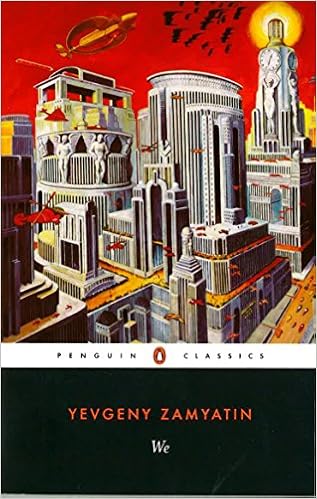
We

We: Yevgeny Zamyatin, Clarence Brown, Clarence Brown ...
We is a classic dystopian science fiction novel by Yevgeny Zamyatin, written in 1920-1921, published in 1924, via English translation in New York. Yevgeny was part of Russian proletariat writing groups and eventually requested to leave Russia as many writers were being persecuted, thus resulting in the death of their writing careers. In fact, when Zamyatin died, there was no mention of him in Russian papers. Most proletariat Russian writers made livings elsewhere like in Paris, England, and the United States. 

The novel depicts a world of harmony within a totalitarian system. There is freedom but only ruled by the Benefactor and activities are ordered along to the 'Table,' a system that controls every hour of everyone's day. In some respects, there wouldn't be a Brave New World by Huxley if it weren't for We. No 1984 by Orwell. No Handmaid's Tale. There wouldn't be all those tons of young adult dystopian novels either. We did it first. 

I will focus on the plot first because it's pertinent to the ideas therein. 

We is set in the future. Probably far future because they have space ships. It's said that there was a great war over something, which is only alluded to in the novel. A resource perhaps. It resulted in the use of weapons of mass destruction, leaving the world outside One State a post-apocalyptic landscape. 


The main character is D-503, a space engineer. People have no names, rather they are identified by number. It takes place in an urban society constructed of glass, which helps for mass surveillance. The people march in step with one another and wear uniforms.  Life is managed scientifically; everybody eats at the same time, works the same time, has recreation hours at the same time, and they even have scheduled times to have sex with partners they can sign up for, rather than of their own choosing. People think with science, logic, and reason above all. The formulas people use are ones devised by the One State, their form of government, lead by the Great Benefactor, their supreme leader.

One State has conquered the whole world. They're now building a spaceship in order to invade and conquer other planets, thus bringing One State across the universe, helping their cause, and increasing their numbers. The ship's project engineer D-503 writes a journal that is meant to be brought along the spaceship when they go to another planet.  

D-503 lives in a glass building like all the others. His partner, O-90 is deemed too short to bear children and is upset by this. His best friend is R-13, a guy who reads his poetry verses at public executions. On an assigned walk, D-503 meets I-330, who flirts with him without being properly assigned. I-330 is a careless free spirit; she drinks alcohol, smokes cigarettes, has casual [not assigned] sex. Every guy has met a girl like I-330, that footloose, and fancy-free girl. In short, she's doing everything that you're not supposed to do in One State. D-503 is appalled but intrigued at the same time. He continues to see her. 

D-503 starts to have a lot of freedom through I-330 and starts to have dreams, which the One State describes as mental illness. "What's wrong with me doc?" "You've found out that you have a soul, for which there is no cure." That's my favorite line in the book because it has that edge of snarky satire as well as philosophical ramifications that goes back to the Greeks. It works well. 

Slowly, I-330 reveals that she's part of an organization called Mephi, which plans to bring down One State. O-90 wants D-503 to illegally impregnate her but in order for her to stay with the baby, she has to leave One State and go beyond the wall, where primitive humans live, complete with coats of fur. 

The last journal entry details the 'Great Operation,' a brain surgery of sorts, that targets the brain with x-rays, so they can function as 'tractors in human form.' It basically makes you more of a vegetable. Removes imagination. Once D-503 gets the operation he runs to the Benefactor to tell him about the Mephi operation. I-330 and her associates are sentenced to death under the Benefactor's machine, which literally melts the human body. A  death ray.

But the novel ends on somewhat of a good note. The Mephi operation is doing well, birds are repopulating the city, and people start acting out against the regime. One State's survival is left in doubt. The book ends with a strong manifesto; just as there is no highest number, there can be no final revolution. 

 Now we get some ideas. 

First, the writing style can, at certain times, be quite a satire. There's one scene early in the book where a woman is playing the piano and people are watching and listening to her play. At one point during the impromptu performance, which is already rare in this society, D-503 starts laughing uncontrollably because music is such an unstructured improvised form that most of the citizens just aren't used to. 

The scene with the doctor is my favorite in the book. "You have a soul. There is no cure." That's a great satirical moment, a great laugh. Of course, it was true, D-503 had indeed, somehow developed a soul through his new girlfriend, I-330. 

The idea of having sex only with assigned partners and only at certain days and times is also a laugh. Did they also forbid masturbation?

There are philosophical ideas at work here too. In fact, the doctor scene isn't just a satire, there's a religious tone to it as well. The idea of the soul separate from the body and mind goes back to Plato and Aristotle. This is used in fiction to good effect. The fact that D-503 developed a soul rather than being born with one is another note on satire. 

The idea of a conformist culture where everybody is happy [for the most part One State is happy] should be considered utopian, right? Well, the thing that makes One State a dystopian novel rather than a utopian one is the fact that One State not only wants to take away freedoms [which is fine because most of the people are cool with that], but One State also wants to get rid of imagination. In We, imagination is the mind-killer rather. If the citizens of One State were allowed to imagine this would be an entirely different novel. 

Lastly, this is one of the important and critical works in science fiction, particularly in the dystopian canon. I initially read this on the recommendation of a Russian friend of mine. I'm glad I read it because it's truly a great story and it stays with you. This isn't something you read and forget about a few months later. It's that important of a book. Considering the way governments are run today you will find that Yevgeny Zamyatin's ideas still ring true to this day. For just as there is no highest number, there can be no final revolution.

Monday, January 21, 2019

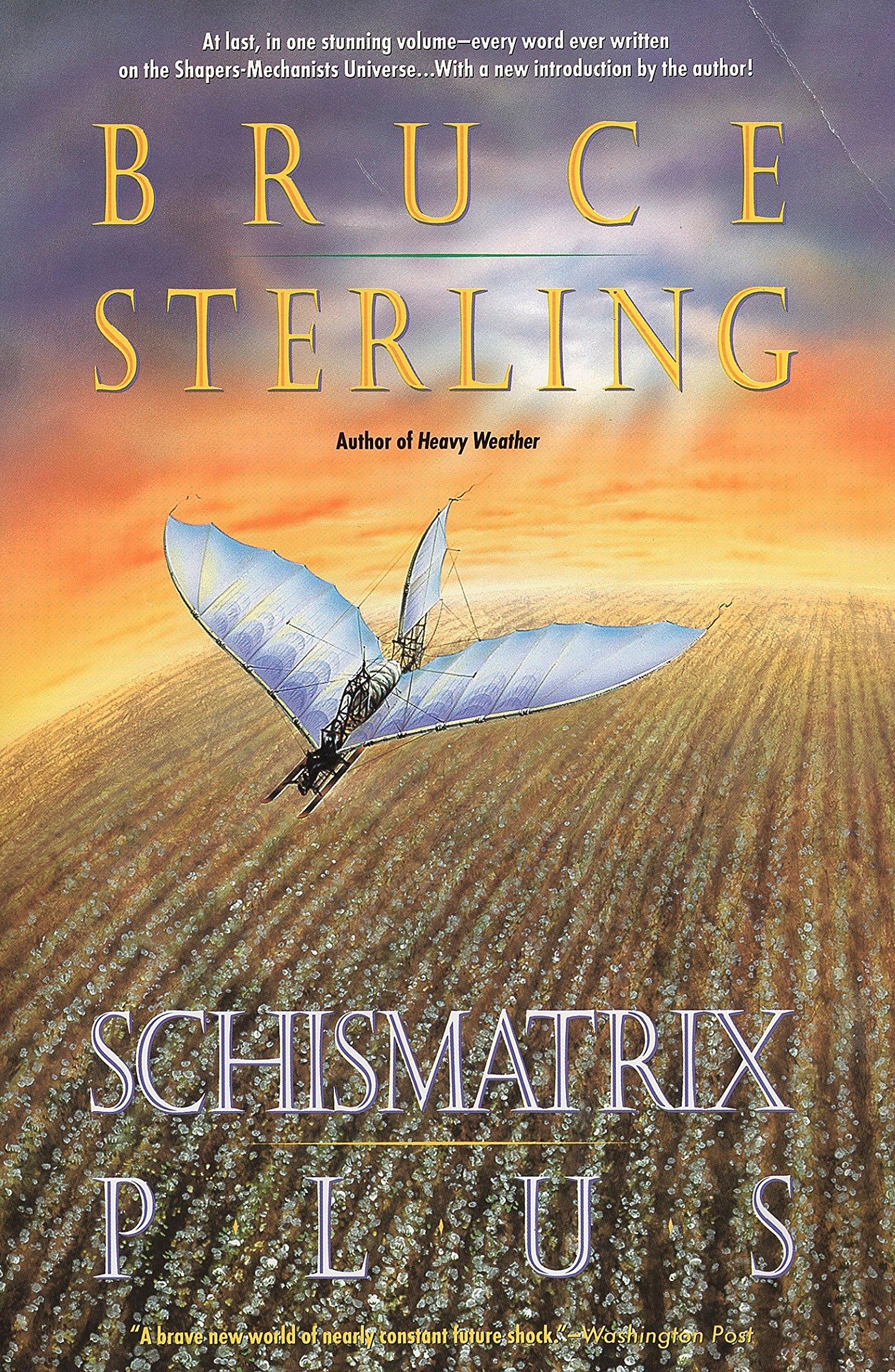
Schismatrix Plus

Image result for schismatrix book cover originalSchismatrix Plus is a science fiction novel by Bruce Sterling, written in 1985. Schismatrix was nominated for the Nebula Award for Best Novel in 1985, and the British Science Fiction Award in 1986. This story is set in Bruce Sterling's fictional Mechanist/Shaper universe. Five short stories that preceded the novel are apart of the Schismatrix Plus edition. The novel by itself without the short stories is simply titled Schismatrix. 

What can I say about this novel? It is simply fantastic and got me more interested in the cyberpunk genre. Sometimes you read a book and something hits you in the head. Bang! This is one of those books. This is an important book. Even a week after finishing the novel I still think about it, the themes and concepts, and especially the ending. 

There's a universe of potential, Lindsay, think of that. No rules, no limits.  

The world of Schismatrix is transhuman. There are Shapers, who use biotechnology and psychology to enhance human potential and then there are Mechanists, who apply AI, and mechanical parts to enhance themselves and become more than human. The Shapers/Mechanists are colonizing the solar system, divided in their two distinct philosophies. 

The book follows the life of a sundog [wanderer, ronin] named Ableard Lindsay, a Shaper with diplomatic training and a brilliant liar, which he uses to great effect. "Before the end of the novel his careers have included being a revolutionary, a theatre producer, a space pirate, a xenodiplomat, a scholar and a prophet." [https://www.aleph.se/Trans/Cultural/Art/schismatrix.html] 

"Politics pulls us together, technology pulls us apart".

Throughout the book changes in technology, habitat, economics, and politics change the dynamics of the entire narrative and discourse. There's a similarity here to the Cold War. This was written in 1985 after all, in a different era from mine [2019]. This similarity is shown when the Shapers/Mechanists have problems when they start colonizing neutral zones. 

The changes force people to adapt, their life styles as well as their philosophies. Some people turn to Zen Serotonin, something of a religion where people get high off neurochemical implants. Others are Cataclysts, who think radical change is a good way to open ones' eyes, whether you want it or not. 

The one theme that repeats throughout the novel is that nothing goes as planned. A plan might work out for a little while, but you have to always be prepared to move on, do something else, just in case. 

He mourned mankind, and the blindness of men, who thought that the Kosmos had rules and limits that would shelter them from their own freedom. There were no shelters. There were no final purposes. Futility, and freedom, were Absolute. [From the short story Ten Evocations]


Futility is freedom could be seen as the overarching mood of Schismatrix. Its impossible to plan for the future because the everything's always changing. But the chaos is also affected by our actions. 

In the short story Swarm, we find have a group of symbiotic non-sentient species living in a hive society. Through this story we find out that intelligence isn't needed for long-term survival, and sometimes it might not even be desirable.  

Sterling makes me think a lot about what transhumans would really be like. Transhumanism is one thing but when its mixed with politics, ideology, and power it becomes something else. Its not a cheerful thing. The flaws in ideology is the price paid for continued evolution. 

One thing I'd like to say that this book made me feel like a kid again. The Investors [tall, big, reptilian-like aliens, who are more interested in business than anything else] were really cool and I could see aliens really looking and acting like them. The ending where Lindsey becomes one with the Presence was pretty great too. Although the actual writing in the novel is a bit dense the mind-set of the novel is tough-minded, and never lets you down. 

The ideas here are thought provoking and would do well to be explored further by Sterling himself [not gonna happen] or others with similar ideas for the science fiction canon. Sterling seems to suggest that there wont be one posthumanity, but many and tremendously diverse posthumanities. Our greatest enemy might be our inability to handle infinite possibilities. [https://www.aleph.se/Trans/Cultural/Art/schismatrix.html]

September Sweater Weather

Good evening ladies and gentlemen, hello world. How are you?  It's good to be writing on a good day off work today on a Saturday. Here, ...