Showing posts with label dystopian. Show all posts

Tuesday, April 21, 2020

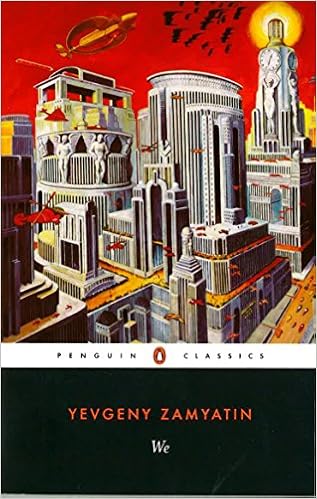
We

We: Yevgeny Zamyatin, Clarence Brown, Clarence Brown ...
We is a classic dystopian science fiction novel by Yevgeny Zamyatin, written in 1920-1921, published in 1924, via English translation in New York. Yevgeny was part of Russian proletariat writing groups and eventually requested to leave Russia as many writers were being persecuted, thus resulting in the death of their writing careers. In fact, when Zamyatin died, there was no mention of him in Russian papers. Most proletariat Russian writers made livings elsewhere like in Paris, England, and the United States. 

The novel depicts a world of harmony within a totalitarian system. There is freedom but only ruled by the Benefactor and activities are ordered along to the 'Table,' a system that controls every hour of everyone's day. In some respects, there wouldn't be a Brave New World by Huxley if it weren't for We. No 1984 by Orwell. No Handmaid's Tale. There wouldn't be all those tons of young adult dystopian novels either. We did it first. 

I will focus on the plot first because it's pertinent to the ideas therein. 

We is set in the future. Probably far future because they have space ships. It's said that there was a great war over something, which is only alluded to in the novel. A resource perhaps. It resulted in the use of weapons of mass destruction, leaving the world outside One State a post-apocalyptic landscape. 


The main character is D-503, a space engineer. People have no names, rather they are identified by number. It takes place in an urban society constructed of glass, which helps for mass surveillance. The people march in step with one another and wear uniforms.  Life is managed scientifically; everybody eats at the same time, works the same time, has recreation hours at the same time, and they even have scheduled times to have sex with partners they can sign up for, rather than of their own choosing. People think with science, logic, and reason above all. The formulas people use are ones devised by the One State, their form of government, lead by the Great Benefactor, their supreme leader.

One State has conquered the whole world. They're now building a spaceship in order to invade and conquer other planets, thus bringing One State across the universe, helping their cause, and increasing their numbers. The ship's project engineer D-503 writes a journal that is meant to be brought along the spaceship when they go to another planet.  

D-503 lives in a glass building like all the others. His partner, O-90 is deemed too short to bear children and is upset by this. His best friend is R-13, a guy who reads his poetry verses at public executions. On an assigned walk, D-503 meets I-330, who flirts with him without being properly assigned. I-330 is a careless free spirit; she drinks alcohol, smokes cigarettes, has casual [not assigned] sex. Every guy has met a girl like I-330, that footloose, and fancy-free girl. In short, she's doing everything that you're not supposed to do in One State. D-503 is appalled but intrigued at the same time. He continues to see her. 

D-503 starts to have a lot of freedom through I-330 and starts to have dreams, which the One State describes as mental illness. "What's wrong with me doc?" "You've found out that you have a soul, for which there is no cure." That's my favorite line in the book because it has that edge of snarky satire as well as philosophical ramifications that goes back to the Greeks. It works well. 

Slowly, I-330 reveals that she's part of an organization called Mephi, which plans to bring down One State. O-90 wants D-503 to illegally impregnate her but in order for her to stay with the baby, she has to leave One State and go beyond the wall, where primitive humans live, complete with coats of fur. 

The last journal entry details the 'Great Operation,' a brain surgery of sorts, that targets the brain with x-rays, so they can function as 'tractors in human form.' It basically makes you more of a vegetable. Removes imagination. Once D-503 gets the operation he runs to the Benefactor to tell him about the Mephi operation. I-330 and her associates are sentenced to death under the Benefactor's machine, which literally melts the human body. A  death ray.

But the novel ends on somewhat of a good note. The Mephi operation is doing well, birds are repopulating the city, and people start acting out against the regime. One State's survival is left in doubt. The book ends with a strong manifesto; just as there is no highest number, there can be no final revolution. 

 Now we get some ideas. 

First, the writing style can, at certain times, be quite a satire. There's one scene early in the book where a woman is playing the piano and people are watching and listening to her play. At one point during the impromptu performance, which is already rare in this society, D-503 starts laughing uncontrollably because music is such an unstructured improvised form that most of the citizens just aren't used to. 

The scene with the doctor is my favorite in the book. "You have a soul. There is no cure." That's a great satirical moment, a great laugh. Of course, it was true, D-503 had indeed, somehow developed a soul through his new girlfriend, I-330. 

The idea of having sex only with assigned partners and only at certain days and times is also a laugh. Did they also forbid masturbation?

There are philosophical ideas at work here too. In fact, the doctor scene isn't just a satire, there's a religious tone to it as well. The idea of the soul separate from the body and mind goes back to Plato and Aristotle. This is used in fiction to good effect. The fact that D-503 developed a soul rather than being born with one is another note on satire. 

The idea of a conformist culture where everybody is happy [for the most part One State is happy] should be considered utopian, right? Well, the thing that makes One State a dystopian novel rather than a utopian one is the fact that One State not only wants to take away freedoms [which is fine because most of the people are cool with that], but One State also wants to get rid of imagination. In We, imagination is the mind-killer rather. If the citizens of One State were allowed to imagine this would be an entirely different novel. 

Lastly, this is one of the important and critical works in science fiction, particularly in the dystopian canon. I initially read this on the recommendation of a Russian friend of mine. I'm glad I read it because it's truly a great story and it stays with you. This isn't something you read and forget about a few months later. It's that important of a book. Considering the way governments are run today you will find that Yevgeny Zamyatin's ideas still ring true to this day. For just as there is no highest number, there can be no final revolution.

Thursday, April 9, 2020

Human, Ghoul, Zombie

Hey everybody, how's the quarantine life going? Here, I'd like to share with you a fictional short story I wrote that was inspired by the virus. It's called Human, Ghoul, Zombie. It's going to be a series, maybe eventually the theme would be written into a novel. You can read it here; Human, Ghoul, Zombie

Thanks for reading. Keep social distancing and stay healthy! We will get through this together.  

Saturday, March 2, 2019

Battle Angel Alita [anime movie]


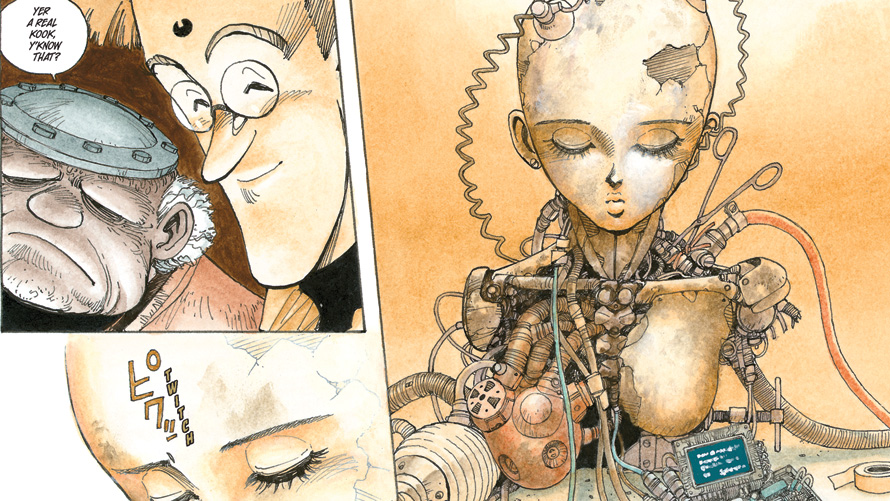
Image result for alita battle angel anime scenesBattle Angel Alita [Gunnm, literally translated "gun dream"] is a Japanese cyberpunk manga series by Yukito Kishiro. To be clear, this is the OVA [anime movie] I'm reviewing. It consists of two parts-Rusty Angel and Tears Sign. Kishiro has no plans to revisit the anime. The film was adapted to a live action movie with motion capture in 2019. Check out my Alita Battle Angel live action movie review here. I wanted to do a separate post about the anime movie, titled Battle Angel Alita because I thought the anime movie was better than the movie in some ways, but not others. Lets discuss the differences. 

The story is fundamentally the same and the film follows almost the same course of events almost to a tee. However, the anime movie looks much better than the film adaptation. The artwork here is quite stunning. The characters all have that late 80s [this was created in 1993] anime look: tall, short, wide eyed, glasses on some characters [super circular oval glasses and googles]. That was the style back then. The backgrounds in every scene are highly stylized and textured but the characters themselves are simple. This was the state of anime back in the late 80s, as this movie was created in 1993, just a few years after I was born. The biggest and best reason for the anime being better than the live action film is simply the cinematography. The hand-made drawings can't be beat, even with a motion capture suit [which is still pretty cool]. 

Next, the anime does everything the movie does plot-wise, but faster and with more skill. The anime movie is only an hour long. The live action film is over two hours. Quite a difference. Although the anime film crams everything together super fast, I actually think it does a better and more concise job. When you watch the anime you realize you don't need to have all that extra clutter of plot.

In addition, another thing the anime does better than the live action film is action. The amount of gore in the anime is at an all time much higher level than the live action movie. In fact, there wasn't even red blood in the live action film. There was this weird blue blood when the cyborgs got killed in violent ways. However, the anime takes that to a whole new level. Some of the killing scenes in the anime will stick with me for a while. They were just that gruesome. When the dog gets killed in the anime it is a grotesque death. Likewise, when cyborgs get their skulls bashed in, there is a freaking pool of blood smeared across the walls, floors, and characters. Its a blood bath. Much different from the live action film, which of course couldn't be that violent, otherwise it would be rated R, which means no kiddies get to experience Alita fanfare. Also, in the anime Alita seems to have some extra powers that weren't shown in the live action film. She has these power-up moves that are quite cool. Instead of having these power-ups in the live action film, they simply gave her a 300 year-old sword [her age].  

Another thing that stood out is the fact that Alita doesn't seem to be objectified or sexualized in the anime. In the live action film they give both of her suits breasts and stuff, which doesn't really make sense, but whatever. In the anime they downplay the feminine aspect of her cybernetic body. Just something I noticed. Its a good thing.

What the live action movie does better that the anime movie doesn't do quite as well is create a likable sympathetic character. In the live action film Alita's actress does a fantastic job portraying herself as a young, naive, empathetic cyborg girl [with those big anime eyes you can see into her soul]. We feel for her. I know that sounds cheesy but when I saw Alita Battle Angel [live action film] I really felt for Alita: for all her problems, not knowing who she was, how she couldn't get her boyfriend to Zolumn, and if she was capable of being loved by a human boy. These are realistic things that people can feel and understand. Again, I know these seems cheesy but I thought it was a very important aspect to the film, maybe the most important one. Blue-blood-oozing-sickle-wielding cyborgs aside. 

All in all the anime is pretty damn good. Its only an hour long. You really can't go wrong. If you watch the live action film I think you can benefit from watching the anime as well, provided that you like anime and you would like to see a different interpretation. Sure, the live action film is a $300 million dollar movie and the anime was probably nowhere near that budget but they got some things right. They don't make anime like that anymore. In a sense, because of that, it is priceless, a relic of the 90s. Something that can easily be forgotten and lost forever.

Check it out, you can watch it on YouTube. 
Part 1 Rusty Angel https://www.youtube.com/watch?v=mKTxbZPqzFM 
Part 2 Tears Sign https://www.youtube.com/watch?v=VaidL6_fE_c 
Make sure to add the English subtitles on the YouTube options. Enjoy!

Check out my Alita Battle Angel live action review http://ofigueroamusic.blogspot.com/2019/02/alita-battle-angel.html

Saturday, December 30, 2017

Metropolis


Metropolis is a science fiction film from 1928 that's inspired by the book of the same name written by Thea von Harbou, an actress (who plays Maria, a working class prophet) in the film and also Fritz Lang's wife. Where do I start with this film? There's so much going on, much of it is open to interpretation from the viewers. Here's a basic synopsis.

The story follows Freder, the son of the city's (Metropolis) ruler and Maria, a poor worker. They try to overcome the societal differences between the poor that live beneath the city and the rich who (live above ground) wear white shirts and shorts and play tennis. The movie is said to have Communist ideas, I can see that but to me its not overtly pronounced. I see the film more for its beauty, to find that common ground between the rich and poor.

So Freder is hanging out in some sort of garden relaxing and Maria comes in with a bunch of poor kids to show them how the rich live. "Look at them. These are your brothers," Maria says. Maria and the kids get sent away but Freder follows her to a machine room. He sees an explosion that kills some workers and experiences a hallucination. In the hallucination he sees workers being fed to the Machine, a sort of Aztec sacrificial ceremony, at least that's what I thought when I saw it.

Freder tells Fredersen, his dad (and ruler of the city) but his indifference towards the treatment of the workers leaves him cold, so Freder decides to help the workers in any way he can, in an attempt to help the poor and disenfranchised. There's a lot of stuff that happens in between this as the movie is about two hours and twenty-eight minutes long but for the sake of a shorter blog post I'll summarize things more briefly.

Later, we see Maria is prophesying the arrival of a mediator who can unite the working and ruling classes together. There's a mad occult scientist who uses this machine-woman (robot) to create another version of Maria, who goes on to sow discord within the working class, creating many problems and dissent.

The workers end up destroying the Heart Machine, which the false Maria told them to do. This causes the city to flood, and all their children are left to drown unless somebody saves them. The real Maria and Freder end up saving them. The working class burn the false Maria at the stake as a witch and find out that it was just a robot, as the fire burns through to the metal. There's a fight between Freder and the mad scientist Rotwang but Rotwang ends up falling to his death. In the end Freder fulfills his role as mediator between the working class and ruling class by uniting hands with the foreman (in charge of the working class), his father, and himself, a sort of male triangular unity, perhaps even referencing the Holy Trinity, the father, son, and holy spirit.

So that's it. If you think about it and see the movie, the plot is quite simplistic. Its the ideas that go within them that's open to interpretation, which is where a lot can be said of the movie. First, I would like to point out the fact that there's a lot of science fiction based on this: the idea of a political break between the rich and poor. The poor trying to 'get whats theirs', a sort of futurist communism, although in this movie the Marxism is probably very high by today's science fiction standards, but at that time I would say its not quite as pronounced. I might be wrong on that though. So yes, the idea of social construckts, government, poor living underground, and the rich living above ground is something seen in tons of science fiction. Its quite a common trope.

Then there's the idea of love between Freder and Maria. They obviously love each other and find romance in each other. They ended up saving all the children of the underclass together, becoming surrogate parents to an entire generation. That's love for sure. One could say that Freder might have even become interested in following Maria to the Machine Room because he was interested in her, interested in a woman who wasn't from his social class. In doing this he opened up to the world around him, and found love in the process, a sense of discovery.

Then there's the ideas of science and the occult, another common idea in sci-fi. Rotwang, the mad scientist is a true screwball who planned on using the Machine-woman (named Hel) to take over Metropolis. In the scene where we first see the Machine-woman we see a giant pentagram symbol at the foot of her body. This signified a sort of luciferian procreation. Metropolis the book has more occult associations than this movie, which makes sense because its easier to do that in a book than in a movie that will be showed to thousands of people.

The science part was pretty cool. In Rotwang's lab we see all sorts of potions, tubes, lights, bells, and whistles. It was a cross between a 15th century laboratory and a science physics lab from the year 2000. Something like that. It was quite something. That was a cool scene indeed.

In the end we find that Freder has fulfilled his destiny as a mediator between the rich and poor. One could say he was swayed and perhaps even chosen by Maria to be the guy to do this. This shows us that perhaps leaders in government have to be certain kinds of people, come from certain places, have a lot of money, and perhaps be chosen for and by the people, much like the systems we have in place today for our political elections and office.

For example, if Freder wasn't the son of the guy ruling the city he wouldn't have as much power or sway over government. If he wasn't the son of the ruler Maria might not have come to him with the children. This ending gives me a lot of ideas about government and power. Can politicians come from anywhere, be anyone, and still be elected into high positions of power? I'm not so sure. I think it works in some cases and other cases it doesn't. There's a gray area for sure.

Take for example Donald Trump. He's been a media highlight for a long time and he didn't come out of nowhere. He was the son of a rich guy, thus making him rich. He started talking about government and the poor white working class of America voted him into the Presidency. It could not have happened if he didn't have those other traits: being born rich, using that money to political advantage, and using his political platform to speak to the poor white working class.

This movie makes me think about things like that, why certain politicians get elected into power. However, its probably more important to think of this movie as a great example of German expressionist art, of which it is a wonderful example.

You can watch the film here.

HEAD and HANDS need a mediator. THE MEDIATOR BETWEEN HEAD AND HANDS MUST BE THE HEART!

On AI, Existential Threat, and the Collapse

Good evening ladies and gents. Hope you all had a good Sunday. I wanted to write here a bit more about AI, existential threat, and the Colla...