Hey everybody, how's the quarantine life going? Here, I'd like to share with you a fictional short story I wrote that was inspired by the virus. It's called Human, Ghoul, Zombie. It's going to be a series, maybe eventually the theme would be written into a novel. You can read it here; Human, Ghoul, Zombie
Thanks for reading. Keep social distancing and stay healthy! We will get through this together.
Showing posts with label author. Show all posts
Showing posts with label author. Show all posts
Thursday, April 9, 2020

Tuesday, August 20, 2019
Aldous Huxley's Doors of Perception and Heaven and Hell

I've picked up a lot of books over multiple library book sales. These are first-come, first-serve sales of mostly paperback but sometimes you can find handsome editions of hardcover novels. I picked up The Doors of Perception because I'm been inspired by the counterculture hippie movement since high school. The Doors was one of my favorite rock bands as a kid.
That's my paradigm. I'm mostly inspired through rock and roll rather than experimentation of drugs. But even as a youngster I was familiar with the Merry Pranksters, Timothy Leary, LSD, Sgt. Pepper, and "turn on, tune in, drop out." And of course, all my favorite American hippie rock bands supported all that stuff. The Doors named themselves after Huxley's Doors of Perception. This edition comes with a separate book entitled Heaven and Hell. Both of these short books explores the mind's remote frontiers and the unmapped areas of human consciousness.
For starters, one of the main problems with these books is that its no longer apart of the zeitgeist or discourse. The idea of taking psychedelics in order to gain some insight into the spiritual self is no longer apart of the current paradigm. Native Americans were known to use peyote/mescaline for spiritual purposes. But do even they still do that today?
The young people I know who have experimented with heavy drugs like LSD, mushrooms, cocaine, and heroine are using it in order to escape from their reality. Much like the quote above. They use drugs as a backlash against the real world because they feel they are suffering. Any release into paradise will suffice. Even if it only for but a moment. Drugs and alcohol relieve them from their suffering. Albeit only for a short while until they come down from the high. Knowing that, it's very difficult for millennials to truly understand anything that Huxley is talking about here. But I like a challenge.
This isn't really a book. Rather its a dialogue of Huxley containing his trip on mescaline. Ironically the trip takes place in the world's largest pharmacy during the early stages of the trip. A bit of comedy for his mescaline trip. What happens to someone under the influence of mescaline?
a) Ability to think straight is little if at all reduced. You don't become stupid.
b) Visual impressions are greatly intensified and the eye recovers some of the perceptual innocence of childhood when the sensum was not immediately and automatically subordinated to the concept. Interest in space is diminished and interest in time falls almost to zero.
c) Though the intellect remains unimpaired and though perception is enormously improved, the will suffers a profound change for the worse. The mescaline taker sees no reason for doing anything in particular and finds most of the causes for which, at ordinary times, he was prepared to act and suffer, profoundly uninteresting. He can't be bothered with them, for the good reason that he has better things to think about.
d) These better things may be experienced (as I experienced them) "out there," or "in here," or in both worlds, the inner and the outer, simultaneously or successively. That they are better seems to be self-evident to all mescaline takers who come to the drug with a sound liver and an untroubled mind. [Doors of Perception]
Time meant nothing. Huxley mentions there was plenty of time. Not a concern. He also wasn't concerned by spatial forms. This could mean the distance between me to my computer screen as well as the matter of me writing this review and then finishing it. Neither mattered anymore.
What really is important to him is experiencing and observing. Looking around the room takes on a new perception and/or concepts of the things we see. Mescaline strips down concepts but allows you to see them for the first time, the beauty of it.
Man-made art had little effect on him. He was humored by the fact that humans tried too hard to symbolize things. "How dare they?" "The audacity?" This goes alongside paintings as well as classical music composers. He was more mesmerized by nature than by human-made things.
Heaven and Hell go into religious aspects. Huxley notes that in the middle ages Christians would beat themselves until wounds would fester [flagellants] and starve themselves until they literally saw visions. They would literally see the devil. The festering wounds would cause hallucinations. How about that?
My favorite concept that Huxley mentions in heaven and hell is a simple one. If you are a mystic/artist, you must learn from the scholar. If you are a scholar you must learn from the mystic/artist. It makes perfect sense. Why isn't the world like that? Why aren't more people across different discipline working together and learning from each other? It makes me wonder what could have been.
The truth is that I would never do any hallucinatory drugs and this book doesn't make a convincing argument for me to find a dude off the street and buy some mescaline off him. Rather, I'm impressed with Huxley's experience. I'll take his word for it and agree that the experience changed him for the better. Even if it only changed him for that day I can see from his writing that it had a profound spiritual effect on him. None of these drugs should be used for recreational purposes. Hell, at this point I don't even believe marijuana should be used recreationally. Maybe I'm getting too old. Maybe I'm a square. Maybe drugs are good for people sometimes.
In the end, we are all riders on the storm.
Monday, March 25, 2019
Slaughterhouse-Five
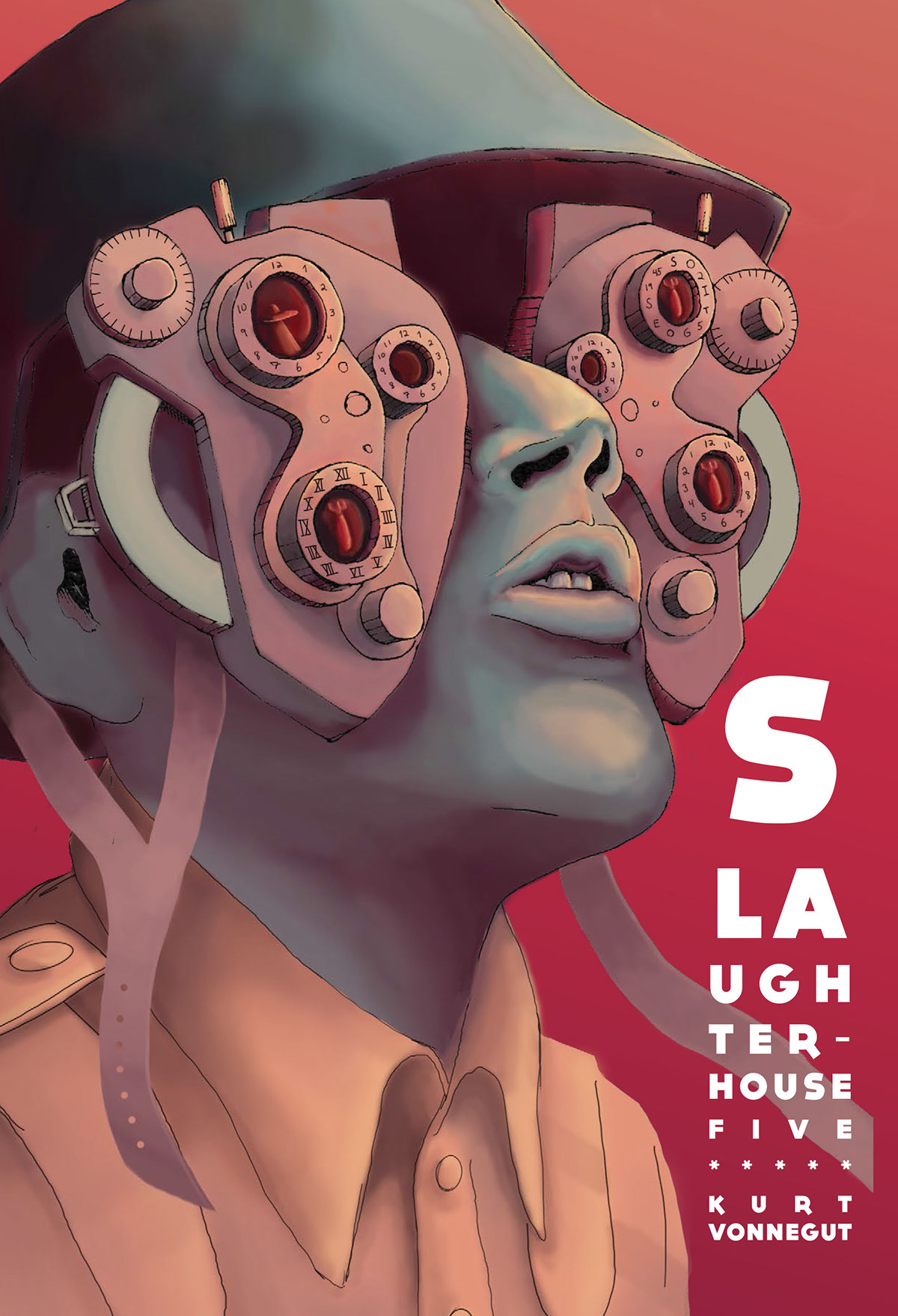 "All this happened, more or less." [opening line]
Slaughterhouse-Five, or The Children's Crusade: A Duty-Dance with Death (1969) is a science fiction anti-war book about World War 2, written by Kurt Vonnegut. The main character, Billy lives through the Allies' Firebombing of Dresden as a prisoner of war. Vonnegut was actually there in real life, and the book is semi-autobiographical. SH-V is Vonnegut's most influential and popular work, capturing the American zeitgeist in 1969, capturing the spirit of anti-war during Vietnam. Since then its become a classic statement of anti-war, dark humor, science fiction, and satire.
The book is told in a non-linear way. Flashbacks going backward and forward in time. There's the science fiction element that Billy Dresden experiences. He has been abducted by aliens and now he sees everything in his life through time all at the same time, flashbacks and time travel experiences. On the alien planet, he's in a zoo and forced to mate with a movie star actress. He's 'unstuck in time'.
Billy was a soldier who refused to fight. A real letdown of an American soldier. He gets captured and is forced to labor at a Dresden slaughterhouse, "Schlachthof-fünf," "slaughterhouse five". Hence the name of the title. The other part of the title's name [The Children's Crusade] comes from a section in the opening of the book about how children are always the ones to fight wars.
Billy suffers from post-traumatic stress disorder, something not commonly known about back in 1969 but nowadays we are all familiar with because of Iraq and the war in Syria. Billy gets taken under the wing of these aliens, who see in four dimensions, observing all points in the space-time continuum [real science fiction elements, there's also a laser gun]. They adopt a fatalistic worldview. So it goes. That line so it goes is in the book some 106 times. You get used to seeing it. I saw it as dark humor. Your parents died? So it goes. You won a million dollars? So it goes. Nothing happened? So it goes...ad infinitum.
The style is simplistic. This is probably the easiest book I've read in three months. Its a very enjoyable experience. I finished the book in two days because I couldn't put it down. It was thoroughly entertaining even though the plot isn't linear, its all over the place.
Coincidentally I'm writing a memoir about myself, growing up in the midwest in the early 2000s with my single parent mother, and I'm writing in a style very similar to this. Although I'm nowhere near as good a writer as Vonnegut. I mean to say that my novella [so far] is kind of non-linear, and the writing style is purposely simplistic.
It's a very attractive style, it makes you want to read more of the author's work. Another important detail is the fact that the novel reads as part fact [nonfiction] part fiction. Not to mention a lot of dark humor and satire. Initially, when I read the introduction I immediately thought of Voltaire's Candide and Micromegas. However, I find SH-V to be much more emotional than those mostly satirical works from the 1700s, France. Vonnegut manages to combine dark humor, satire, a spirit of the moment [flower power] anti-war message, science fiction, and his own life into a smorgasbord of a novel, and lo and behold, it works somehow.
No doubt there's a lot going on in this novel. In that way, it's not unlike Bruce Sterling's second novel, Artificial Kid, which tries to do everything, but in the end, fails to measure up to its ambition. However, with SH-V we have a work that is highly ambitious and is a winner, not just to me, but to the general reading public today, and from the readers of yesteryear [thank god for online newspaper archives]. This book is considered a classic, deservedly so.
It's sad, funny, tough, delightful, and it all somehow fits into its own thing, a success. Even if you don't like science fiction I think you as a reader would get a lot out of this book. Its a classic for good reason.
Recommended if you like classics, science fiction, and war novels.
Check out my reviews for Voltaire's Candide and Sterling's Artificial Kid.
http://ofigueroamusic.blogspot.com/search?q=candide
http://ofigueroamusic.blogspot.com/search?q=artificial+kid
Wednesday, March 6, 2019
E.T.A. Hoffmann Automata

Then, he tells a story about a young girl who every night at nine o'clock, sees this White Maiden. However, only she can see it. And her family soon believes that she's crazy. However, one night she sees the maiden and proves to her family that it is real. The girl throws a plate in the air to the White Lady [phantom] and the plate floats in the air, stunning everybody. Shocked, the mother dies, and the Colonel father dies in battle, leaving the girl a shell of her former self.
Then, another guy recalls a story about a musician who was haunted by something playing on his piano at night, with virtuosic skill. Another guy is asked to speak so they can drop these occult stories but he brings up this manuscript titled Automata. Before starting he says something about how all of this is connected.
This story begins with an automaton called the Talking Turk [a reference to unbeatable chess playing Turk], which has such a lifelike human appearance, and people have a hard time figuring out its control mechanism, as well as how it answers questions accurately in many languages and attitudes. Its a bloody AI story, written in 1814. Or something like that.
Lewis and Ferdinand end up visiting the Talking Turk and they see that the answers he's giving to the audience aren't to their satisfaction. Ferdinand goes to speak with the automaton and comes back to Lewis. He tells Lewis that there must be a spirit controlling the automaton because he asked him questions he had never told anybody else about.
From here we learn that Ferdinand had a dream in an inn where a beautiful woman was singing to him, perhaps a childhood friend who he was destined to be with. Upon waking up, Ferdinand realized that the woman he saw from his window wasn't the woman from his dream. Although he locks eyes with the woman, she quickly takes off in a carriage. When he now asked the Turk if he would see the woman, the Turk says, "Next time you see her, she will be lost to you forever."
Ferdinand is upset by his answer and won't give up. So Ferdinand and Lewis decide to learn more about the automaton and its maker, the old man Professor X. They meet the Professor and he puts on a musical performance for them, complete with performing automatons. Afterward, there is a discussion on the nature of music. On the sounds of nature and instruments.
Several months later Ferdinand leaves on business and sends a letter to Lewis, saying he's seen this long-sought-after singer. Upon recognizing Ferdinand she faints in the hands of Professor X. Ferdinand wonders if the Turk's prophecy has been fulfilled by psychic bonds making their way into everyday life.
The story ends with Ferdinand being fine, they had even recently read one of his dialogues on opera. The group is tired of the automaton story, and ask to be done with it. It is said that the Talking Turk is merely a fragment, and the conversation moves away from the subject.
This is a pretty great early sci-fi story from a German writer, artist, composer, jurist, and music critic. Hoffmann was an author of fantasy and Gothic horror, as this story seems to suggest. Hoffmann was also one of the major authors of the Romantic moment. One of the things that this short story does very well is involve music in the story. There are lots of musical terms, phrasing, sounds, as well the music performance of the automatons itself. I attempted to do something similar in my robot short story [which you can read here]. However, Hoffmann does it so much better. The way music is described by Lewis in the story is quite moving, he describes the way the sound of the stars might sound, and how he is appalled by the automatons performance. He believes that electronics and automatons cannot make moving music, because it is the human touch and emotion which moves us in music. It's quite a scarring rebuke in the postmodernist musical world, where EDM and house music can sound like a washing machine gyrating on and on.
The literary style here is baroque. Hoffmann was a man of much learning. The way he writes isn't simple and some words I even had to look up online to understand the story. However, it isn't overly complex and his meanings do get across quite easily. The writing style isn't smooth, but it's not wooden either. It works.
The musical aspects of this story moved me. The automatons themselves were interesting even though they weren't described too much or with much detail. Were they made of wood, plastic, or metal? How did they operate? Gears? Not sure but one thing for sure they could do many things. Another thing that this story makes me think about is the rise of AI, whether they are in the form of robots or just simply as everyday computers. This story definitely brings that all to mind. Although I can't say this is pure science fiction, there are definitely sci-fi elements here. This is a great read, recommended to anyone who likes literature of antiquity and proto-science fiction.
I learned about this short story from Wikipedia's Timeline of science fiction. I found it under 1814, right before Mary Shelly's Frankenstein, a personal favorite. This story has aged gracefully and I believe it still has relevance in 2019, some 100 years later.
Read Automata here--http://users.clas.ufl.edu/burt/touchyfeelingsmaliciousobjects/Hoffmannautomata.pdf
Subscribe to:
Posts (Atom)
September Sweater Weather
Good evening ladies and gentlemen, hello world. How are you? It's good to be writing on a good day off work today on a Saturday. Here, ...

-
The Difference Engine by William Gibson and Bruce Sterling is one of those all-time great 'hard' science fiction novels. Set in a ...
-
Man Plus is a science fiction novel written by Frederik Pohl in 1976. Pohl is one of those rare great writers who was not only a great wr...
-
Holy Fire is a great science fiction novel written by Bruce Sterling . It came out in 1996. It was nominated for the British Science Fi...

