Showing posts with label dystopia. Show all posts

Monday, September 21, 2020

Surviving the Zombie Apocalypse Virus pt. 9: It can't get much worse

Sgt. Pepper's Lonely Hearts Club Band | The Beatles 

Lennon's return phrase to McCartney's "It's Getting Better All the Time," comes to mind right about now, "It Can't Get Much Worse". As of today there are currently over 200,000 Americans who have died due to corona virus, the novel virus. Just try to take that in. That's an immensely large number, but more importantly, we can't look at them as just numbers; rather those are men, women, and children who have died and will never come back. Seeing things from that angle, it really can't get much worse, but of course, it will. Brace yourselves. Winter is coming.

As far as work goes there's a lot to say. We aren't limiting the numbers of customers that come into the store so sometimes it gets super packed and we're stuck working on top of each other like sardines. The company took away our $2 emergency bonus pay and never reinstated it, BUT decided all they had to do to remedy this was by giving us $100 on our employee discount cards. The $100 was a nice touch but in actuality the $2 bonus pay was much more important, it held symbolic power, and the fact that the union could not and did not get it back is a harsh blow to retail workers, the so-called front line workers. 

The store is filthy. Nothing is clean. In the beginning of the pandemic management was going crazy having everything cleaned all the time. Now, some six months later, it's like they don't even care anymore. Why bother? The punch-in clock is never cleaned, door handles are never cleaned, the break room is a dirty mess, and on top of that most of the registers, and definitely the payment pads aren't wiped down at all, or at least not often, I've never seen it being done. It's just something I've come to expect over there. Unless I clean something myself, almost nobody else there will really be cleaning surfaces or any areas that are touched by multiple people. It's troublesome because I think customers would be very squeamish to the idea that the payment pads are never properly wiped, possibly spreading more and more germs between customers, a higher risk of COVID, at least theoretically.  

Surprisingly though, our store has only had about 3 or 4 cases confirmed. I believe there was a couple unconfirmed cases of employees/management who were exposed and might have been infected, and these individuals went into quarantine for two weeks and then promptly returned thereafter. So as dark as it seems, surprisingly not very many people have caught it at our store, and if they did catch it, it is believed they caught it out elsewhere, not while working at the store. So in that sense, although the fear and danger is hanging over my head like the Sword of Damocles, in actuality, my chances of actually getting COVID from the store and dying from it is probably relatively small.

However, you're never truly safe while working retail. Some of my friends have caught COVID and they had strong reactions to it. One of them was bedridden for a week straight, forcing his friend to take care of him, and he caught the virus while helping him, although it was a more mild case. And another friend had a mild case of it, but said that his breathing was so heavily impacted, that sometimes when he was trying to sleep his breathing would almost stop. They believe they have anti-bodies now, and that perhaps they are immune, but now I'm wondering what are the true long term effects of the corona virus, for I see that in some of these people that they aren't quite the same after they've caught the virus. Perhaps it also does some long term neurological damage, because I see strong changes in personality and a stronger sense of irritability in them, as if they've lost a piece of themselves and will never get it back. I think that if you think you're going to die from this virus, and it impacts you much harder than just a mild case, it changes you for life.  

In terms of what the future brings, who knows for sure really. And anyone who says they know is lying to you or taking you for a fool's errand. Honestly, it's pure dystopia out here. Who needs to watch Handmaid's Tale TV show when we're actually living right through it with ICE abusing women in detention facilities, and the Trump administration fundamentally dismantling American democracy like the death-cult that they are. I guess right now in this particular blog I'm not too optimistic about the future. I think a vaccine is far down the line. Many, many, many more Americans will die from COVID during this time until there is a vaccine, and by the time the vaccine is available it will already have been too late because our numbers will probably already have reached near 400,000 by then, my rough estimate. 

If there is a silver lining it is the fact that things are so bad and so many bad things have happened under Trump's watch, that it is nearly impossible for him to recover from this: he botched corona virus and didn't respond to it in a way that could've saved more Americans [he downplayed it, resulting in much higher numbers of American deaths], George Floyd's murder brought the whole country together in a way that hasn't been seen since the 1960s Civil Rights Movement, he was impeached [at least on paper], he's torn asunder the Republican party and turned it into a laughing stock of cowardice, spineless idiocy, and Americans are just fed up of him with his lies and hate.  

So in fact even if it can't much worse, there's a hope that it will get better, and that hope is what keeps me going everyday. There's a lot to think about. At this moment the best thing we can do is be there for ourselves, our loved ones, and try to find a way to live, a new way to live, that isn't tied down by the constraints of dream jobs, lots of money, and other such desires. Staring at the face of death, into the abyss, it only appears to be staring back at us.

Thursday, June 25, 2020

Surviving the Zombie Apocalypse Virus pt. 8

It's dystopia! 

The world has been dealt a grievous blow from the virus and it appears now, more than ever, that nothing will ever be the same. If you are an educated person like myself, someone who reads regularly, reads the news regularly, and perhaps even watches the news regularly, you should be very alarmed. This is not normal, of course, nor is it a drill, nor is this where we could and should be at this stage in the pandemic. 

We're in a bad place right now. We're seeing the highest numbers of new case increases in a single day. It's very high, something like 4,000-5,000 new cases in a single day, in places like California and Texas. We've already reopened states but the reality of the situation is that if we don't close down all nonessential businesses in say, 4-5 weeks, there will be so many dead people in America, that there will no choice but to close down everything again. Here's the reality; nothing will be done until the shit hits the fan, however, it might be so bad at this current juncture that it's already too late. Sleep on that. 

I work at a grocery store. Today, I received a text from a union representative leader, stating that someone who works at my store was tested positive for the virus. This is the second person who's tested positive at my store, the first one being a worker that has already quarantined, become clean, and is back at work.

The fear of catching the virus is high. If I catch the virus and possibly die, will there be anything left to remember me by? This sort of darknesse is reality. It turns out, in a way, that the company cutting down hours on all employees is actually a good thing. Although we get less money, we're around mass crowded people in the market less [where they're not limiting the numbers of customers allowed in], saving us in the long run from being exposed to the virus more often. But some people need to work a lot of hours and make a lot of money, what about them? They're going to have to deal with having less money and fewer hours, unfortunately.

I'm sort of actually coming to the gravity of the situation recently. I was previously on a two-month leave of absence from work and it was good. I was safe from the virus and did a lot of reading and writing. But now I'm back working with the public, often in crowded aisles and a crowded front end workplace. The situation is dire.

It's only just now hit me today that most things don't matter much anymore. The most important thing right now is your health and finding a way to live.

What I mean to say is that it's finally dawned on me that mine as well as all of us, our collective goals, dreams, desires, and fortunes don't even matter anymore. In a post-COVID-19 world, your goals, dreams, and fortune don't matter one bit, because, in that world, the individual person doesn't matter much because we're all one and the same when it comes to the virus. Rather, I believe, in a post-virus world, the collective unity, the group, the whole human tribe as a whole, matters much more so than any other time in human history. If this thing doesn't bring us together soon, nothing else will.

So as I sit here writing this I think about my future. It doesn't matter if I never become a rock star, or the best selling author, or a computer coder, or any of that crap. Rather, what is more important than any of that is finding a way to live that is meaningful to you. Once this thing continues, it will take more lives, more lives than you can possibly imagine, and in that paradigm, things like money and jobs will decrease in value, because people will spend most of their time in quarantine and isolation so that they, and their loved ones don't die.

The lack of leadership shown in this current administration is shocking and appalling. However, even if Biden takes control in November, there's still a lot of shit that needs to be cleaned up in terms of government, and it could take years to fix that up. Not to mention that there probably won't be a coronavirus vaccine by that time, and Biden will have to form his own strategy against the virus because it will still be ravaging by that time, most likely.

There's a lot to think about. At this moment the best thing we can do is be there for ourselves, our loved ones, and try to find a way to live, a new way to live, that isn't tied down by the constraints of dream jobs, lots of money, and other such desires. Staring at the face of death, into the abyss, it only appears to be staring back at us.   

Tuesday, April 21, 2020

We

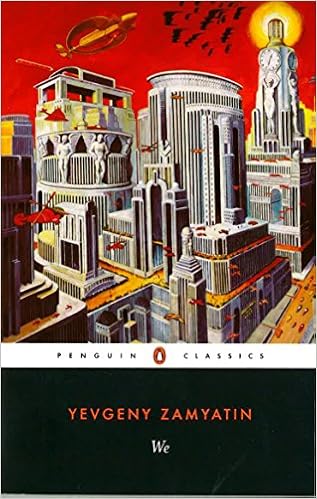
We: Yevgeny Zamyatin, Clarence Brown, Clarence Brown ...
We is a classic dystopian science fiction novel by Yevgeny Zamyatin, written in 1920-1921, published in 1924, via English translation in New York. Yevgeny was part of Russian proletariat writing groups and eventually requested to leave Russia as many writers were being persecuted, thus resulting in the death of their writing careers. In fact, when Zamyatin died, there was no mention of him in Russian papers. Most proletariat Russian writers made livings elsewhere like in Paris, England, and the United States. 

The novel depicts a world of harmony within a totalitarian system. There is freedom but only ruled by the Benefactor and activities are ordered along to the 'Table,' a system that controls every hour of everyone's day. In some respects, there wouldn't be a Brave New World by Huxley if it weren't for We. No 1984 by Orwell. No Handmaid's Tale. There wouldn't be all those tons of young adult dystopian novels either. We did it first. 

I will focus on the plot first because it's pertinent to the ideas therein. 

We is set in the future. Probably far future because they have space ships. It's said that there was a great war over something, which is only alluded to in the novel. A resource perhaps. It resulted in the use of weapons of mass destruction, leaving the world outside One State a post-apocalyptic landscape. 


The main character is D-503, a space engineer. People have no names, rather they are identified by number. It takes place in an urban society constructed of glass, which helps for mass surveillance. The people march in step with one another and wear uniforms.  Life is managed scientifically; everybody eats at the same time, works the same time, has recreation hours at the same time, and they even have scheduled times to have sex with partners they can sign up for, rather than of their own choosing. People think with science, logic, and reason above all. The formulas people use are ones devised by the One State, their form of government, lead by the Great Benefactor, their supreme leader.

One State has conquered the whole world. They're now building a spaceship in order to invade and conquer other planets, thus bringing One State across the universe, helping their cause, and increasing their numbers. The ship's project engineer D-503 writes a journal that is meant to be brought along the spaceship when they go to another planet.  

D-503 lives in a glass building like all the others. His partner, O-90 is deemed too short to bear children and is upset by this. His best friend is R-13, a guy who reads his poetry verses at public executions. On an assigned walk, D-503 meets I-330, who flirts with him without being properly assigned. I-330 is a careless free spirit; she drinks alcohol, smokes cigarettes, has casual [not assigned] sex. Every guy has met a girl like I-330, that footloose, and fancy-free girl. In short, she's doing everything that you're not supposed to do in One State. D-503 is appalled but intrigued at the same time. He continues to see her. 

D-503 starts to have a lot of freedom through I-330 and starts to have dreams, which the One State describes as mental illness. "What's wrong with me doc?" "You've found out that you have a soul, for which there is no cure." That's my favorite line in the book because it has that edge of snarky satire as well as philosophical ramifications that goes back to the Greeks. It works well. 

Slowly, I-330 reveals that she's part of an organization called Mephi, which plans to bring down One State. O-90 wants D-503 to illegally impregnate her but in order for her to stay with the baby, she has to leave One State and go beyond the wall, where primitive humans live, complete with coats of fur. 

The last journal entry details the 'Great Operation,' a brain surgery of sorts, that targets the brain with x-rays, so they can function as 'tractors in human form.' It basically makes you more of a vegetable. Removes imagination. Once D-503 gets the operation he runs to the Benefactor to tell him about the Mephi operation. I-330 and her associates are sentenced to death under the Benefactor's machine, which literally melts the human body. A  death ray.

But the novel ends on somewhat of a good note. The Mephi operation is doing well, birds are repopulating the city, and people start acting out against the regime. One State's survival is left in doubt. The book ends with a strong manifesto; just as there is no highest number, there can be no final revolution. 

 Now we get some ideas. 

First, the writing style can, at certain times, be quite a satire. There's one scene early in the book where a woman is playing the piano and people are watching and listening to her play. At one point during the impromptu performance, which is already rare in this society, D-503 starts laughing uncontrollably because music is such an unstructured improvised form that most of the citizens just aren't used to. 

The scene with the doctor is my favorite in the book. "You have a soul. There is no cure." That's a great satirical moment, a great laugh. Of course, it was true, D-503 had indeed, somehow developed a soul through his new girlfriend, I-330. 

The idea of having sex only with assigned partners and only at certain days and times is also a laugh. Did they also forbid masturbation?

There are philosophical ideas at work here too. In fact, the doctor scene isn't just a satire, there's a religious tone to it as well. The idea of the soul separate from the body and mind goes back to Plato and Aristotle. This is used in fiction to good effect. The fact that D-503 developed a soul rather than being born with one is another note on satire. 

The idea of a conformist culture where everybody is happy [for the most part One State is happy] should be considered utopian, right? Well, the thing that makes One State a dystopian novel rather than a utopian one is the fact that One State not only wants to take away freedoms [which is fine because most of the people are cool with that], but One State also wants to get rid of imagination. In We, imagination is the mind-killer rather. If the citizens of One State were allowed to imagine this would be an entirely different novel. 

Lastly, this is one of the important and critical works in science fiction, particularly in the dystopian canon. I initially read this on the recommendation of a Russian friend of mine. I'm glad I read it because it's truly a great story and it stays with you. This isn't something you read and forget about a few months later. It's that important of a book. Considering the way governments are run today you will find that Yevgeny Zamyatin's ideas still ring true to this day. For just as there is no highest number, there can be no final revolution.

Thursday, April 9, 2020

Human, Ghoul, Zombie

Hey everybody, how's the quarantine life going? Here, I'd like to share with you a fictional short story I wrote that was inspired by the virus. It's called Human, Ghoul, Zombie. It's going to be a series, maybe eventually the theme would be written into a novel. You can read it here; Human, Ghoul, Zombie

Thanks for reading. Keep social distancing and stay healthy! We will get through this together.  

Tuesday, April 23, 2019

Player Piano


PlayerPianoFirstEd.jpgPlayer Piano is Kurt Vonnegut's first novel. Released in 1952, the book tells a story of a brave new world [Nytimes back in the 50s, book reviewer compared it to Huxley's Brave New World], where machines have taken over society, a dystopia. This is a book about automation and humans, how they co-exist in a dystopian society ruled by an oligarchy but the interesting thing is that the oligarchs are engineers rather than kings or presidents.

Player Piano's universe is ruled by engineers who build, fix, and keep the machines running. Everyone else with low IQ's [IQ's are known in the public sphere, thru testings] are either in the Army or the Reeks and Wrecks, which is the low-level grunt work of the society. Paul's father helped build the machines that helped win the war, and that currently helps society. He made the engineers the most important class and his son is high up in the company. Paul's father is now deceased and Paul is struggling to find himself, that is, he has an existential crisis. 

Paul thinks that there's more to life than fixing machines and being an engineer, even if he's rich, has a beautiful wife, and a nice house and car. Paul tries to find a way out. He starts reading novels about burly men that do extravagant things in life. He wants to become like Thoreau. He plans on quitting his Engineering managerial position at the factory, one of the most important jobs in the world. He even goes so far as to buy a farm, thinking he's going to get his wife to quit living the high life and work as a farmer with him. She doesn't like his surprise when she sees the farm.

The book hits a high note once Paul goes on an Engineer's retreat, in the woods with all the managers and young engineers from factories all over the country. You get a sense that these engineers are being brainwashed into thinking their job is the most important and everyone else is below them. It's at the retreat that Paul is asked by factory management to infiltrate this organization called the Ghost Shirts. The Ghost Shirts are disgruntled engineers and low-level workers that have had enough of machines taking all the jobs. They want life to go back to the good 'old days when people washed laundry with their hands and jobs were done by people rather than machines. If Paul does this he gets a higher level job at another factory. Big whoop.

Paul plays along quite nicely, and says, "I quit! I quit! I quit!", with so much enthusiasm that his managers think he's playing along too well. The fact of the matter is that his managers had to fire him so he could infiltrate the Ghost Shirts. But Paul really meant that he was really quitting for real, which they interpreted as him playing along. It's very funny. 

Paul goes back home from the retreat and is treated like a second-class citizen by the police, who is notified that he's lost his job, status, and position in society as one of the Engineering Class, the highest social class. 

Once Paul's in the Ghost Shirt Society they make him their leader, almost a Messianic figure because he's the son of the "Father of all Machines, the Father of Engineers", oh how he's fallen from grace. A revolution takes place, and people go ballistic, destroying machines and burning buildings. But when the destruction is over, Paul and the Ghost Shirt Leaders find out that people are finding all the scraps of machines they can find only to rebuild machines! It's very ironic, satire. It turned out that people actually wanted the machines to work for them, and that all this time Paul might have been wrong about society, machines, everything. Or maybe not.
 
Player Piano isn't such much a tirade against technology, machines, or automation so much as it is a critique of progress, within society and politics. Vonnegut may be a Luddite in the sense that he rejects society's unhealthy relationship to technology. But today that could be most people as most people think the young folk shouldn't be so consumed with the tech of the day-social media, online gaming, spending all their time in front of a screen, be it a smartphone, tablet, TV, laptop, or computer. Most adults in the room would say our young people need to stop being consumed by these things, go back to a simpler time-spend more time outdoors with nature or reading books at libraries. Vonnegut perhaps might be saying that a nation that innovates technologically but not socially is not truly progressing. 

These are ideas Vonnegut used for his first novel because they were real and close to him. He had been a prisoner of war after being captured by the Germans during the Battle of the Bulge. You can sort of see how he got some of his ideas. Germany thought that all their problems would go away once factories were built but it turned out that Germany was actually on the wrong side of history socially and politically. Factories and jobs didn't end up helping them. Likewise, Facebook, Twitter, Amazon, SnapChat, Discord, Instagram, and YouTube haven't helped us to progress socially or politically either. 

At the end of the novel when the people are grabbing scraps of machines to rebuild their beloved machines, one of the Ghost Shirt leaders says to Paul, “This isn’t the end, you know… Nothing ever is, nothing ever will be – not even Judgment Day.”

"After all, there’s always a step backward, and a step backward, after making a wrong turn, is a step in the right direction." [vonnegutreview.com] 

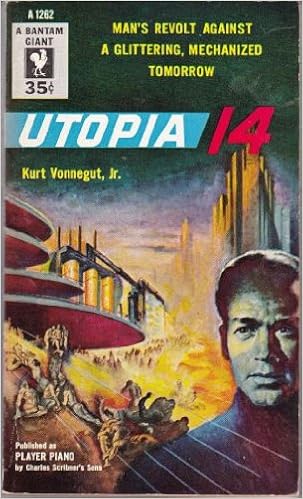
Interesting tidbit-one edition for Player Piano was titled Utopia 14, just to give it a more science fiction name, "whereby Vonnegut gained the repute of a science fiction writer, a genre held in disdain by writers at that time. He defended the genre and deplored a perceived sentiment that "no one can simultaneously be a respectable writer and understand how a refrigerator works" [wiki] Also, it should be noted that Player Piano is more conventional storytelling, especially with the slow narrative. His other novels would go on to more grandiose ideas, more science fiction, and much more satire. If he kept writing in this plain style that is Player Piano he wouldn't have become such a famous name.
 
The original cover pictured above, Utopia 14 cover pictured below
Image result for utopia 14 vonnegut


Friday, December 29, 2017

La Jetee


La Jetee is a French short science fiction film made in 1962. It runs at about twenty-eight minutes. The movie was a big influence on William Gibson, one of my favorite science fiction writers. The story focuses on a man as a child and adult who is watching planes take off at an airport. He sees a woman there. The last thing he remembers is seeing the woman and in that moment he knew that he saw a man die, but this is all he can discover from this. Eventually the world becomes engulfed in darkness, a sort of nuclear apocalypse perhaps? In the end we learn that what he saw was actually his own death.

Later he wakes up as an adult in this underground city, called galleries in the film. There's these scientists that are doing experiments on people so that they can go to the future to find a technology that can restore the world of the past. They decide to use this man because the strain of going to the future is hard on the mind. They think that because this guy is so attached to this idea of his youth, that moment described above, that his chances for doing it will be greater. So they put some stuff over his eyes and conduct experiments on him. In these experiments he meets (in a sort of other world) the woman he saw at the airport as a child and he comes to have a romantic relationship with her complete with jokes, conversations, and numerous hangouts every time he goes through the experiments.

Eventually during one of these experiments our protagonist finds himself in the world of the future, where the people have this black dot stuff (not all of them were dots, some were other shapes) on their foreheads. The future civilization people give him a technology that can restore the past and prevent impending doom. So he goes back to the dystopian present where his mission is completed, thus saving humanity.

Upon his arrival our main character figures out that these scientists are going to kill him. The aliens of the future ask him if he wants to leave that time permanently and go with them but the man instead asks to go back to the past so he can meet the woman. They agree to do this.

So he goes back to the past at the airport. He knows he is there as a kid. He sees the woman and just before he gets to her he dies, killed by a government agent that works for the scientists. What a movie!

The movie brings to mind a bunch ideas. Time is inescapable. Try as we might we are all subservient to time, we bend to its will in a way. We think we understand the past but we don't totally get it. Instead, we find ourselves in the hear and now, an important concept in Zen Buddhism, which I've read a little about. 

It also brings to mind the idea of dystopian modernism. If the Earth got flattened by nuclear war we would probably build cities underground, a popular idea in many science fiction movies. The surface would be contaminated by nuclear waste and we wouldn't be able to live in such nice places anymore. As the movie said we would become lords of rats.

There's ideas of utopia thrown in there as well, The scientists in the present think that the world in which they live is so horrible that they have to keep conducting experiments that probably harm peoples' minds because they want to regain what they had lost, their precious happy-go-lucky past where parents take their children to see airplanes take off at the airport. What a precious and happy thought.

Lastly, the film brings up romance. Ultimately our main character becomes attracted to the woman and keeps wanting to see her. When he finds out he's going to be killed, instead of going with the future citizens he asks them to send him back to the past so he can find the woman. When he does this it shows that he loves the woman, perhaps may want to spend the rest of his life with her. He could have gone to the future and lived the life of a revolutionary but instead he chooses love.

There you have it. A short science fiction film that displays tons of great ideas and all with still photos! I can see how and why something like this would influence William Gibson. These ideas are still portrayed in movies and talked about to this very day. You could even say that some of the virtual reality things I've been blogging about and reading are sort of related to this-science, dystopia, utopia, love, futurism, and the modern dark ages.

You can watch the film here.

Nothing distinguishes memories from ordinary moments. Only later do they become memorable by the scars they leave.

Tuesday, December 26, 2017

The Machine Stops


The Machine Stops is a science fiction short story written by E.M. Forster in 1909 for the Oxford and Cambridge Review. At 12,000 words its pretty detailed. This isn't your third wave science fiction folks, which is what I'm more used to.

Here we have a civilization that lives in honeycomb-like underground cities. People don't touch each other, not even for handshakes or hugs. People have become anxious when it comes to non-virtual meetings. Each pod that people live in comes with one book, The Book of the Machine. All other books and information are electronic. "All other info is electronic, and the forests, Forster explains, "had been destroyed during the literature epoch for the purpose of making newspaper pulp." The Book not only instructs which button to push when, but alleviates the trepidations of life in the Machine." (Wired) 

The story focuses on a mother and her son. The mother is a lecturer (I think she teaches music of certain civilizations) that gives these lectures from inside a room that is controlled by machines, much like how today we can do tons of things in the comfort of our homes, behind our computer screens, Iphones, and television screens. Her son is against the Machine, the electronics that give the people everything they need, from beds, email, to video (a prehistoric FaceMeet, where you can video call people). The people live underground with no sunlight of course but they can go to the surface, if they wear the proper attire (facemasks, the air can kill them) and if they have permission from the Government. We learn that this guy makes illegal trips to the surface often. He's quite the resistance type. 

Even scholarly trips to the surface are not allowed. Experts get their information about the surface from the Machine, a sort of proto-google. The Machine doesn't sustain itself forever. Life is not getting better. The music starts to get blurbs and bad quality sounds. The water has a smell. The Government says they're fixing the problems with the Machine but the repairs needed exceed the damage that keeps accumulating.

On the final day Vashti (our mother character) isn't doing so well. She's horrified to see whats outside her cubicle.

She whirled around, praying to be saved from this, at any rate, kissing the Book, pressing button after button....
An airship ... crashed downwards, exploding as it went, rending gallery after gallery with its wings of steel. For a moment they saw the nations of the dead, and, before they joined them, scraps of the untainted sky.

And I thought working a nine to five everyday for the rest of my life was scary. 

Here we have a science fiction dystopian sort of story that looks similar to the world we live in today. If all the computers in the world crashed right now the entire world would go into chaos. We're reliant upon these machines for everyday life. Could you live without a smartphone? I don't even own one and never have. We think we can do without it (modern technology) but most Americans would never put themselves through that. For them it would be torture, even for myself. Have we really empowered the machines to the degree that we've become weaker as humans? Perhaps that was what Forster was going for. Nevertheless it certainly makes for interesting science fiction writing. Everyone that likes science fiction and uses computers should read this short story, there's a lot to be gained from its dark brooding mentality about technology.

Read the full story here.

September Sweater Weather

Good evening ladies and gentlemen, hello world. How are you?  It's good to be writing on a good day off work today on a Saturday. Here, ...