Showing posts with label war. Show all posts

Wednesday, March 4, 2026

March Madness

Good evening ladies and gentlemen. How's it been? I've been silent on the writing since the new year. I feel the need to write as an outlet because I believe reading and writing is the greatest tool for communication as a medium. Sure, I talk to friends and family, but you just don't get to really say everything you want to say with friends and family. That's why I've had this blog for so many years. The blog is a good outlet not only for creativity but also to say everything I want to say. I haven't really been too busy or anything, but I do think I had some slight writer's block that lasted all of February. But I've been good. I've been reading, working, and tonight I was playing guitar and electronic keyboard, just practicing, and improvising. 

I've been on a roll since the new year 2026 reading a lot of books. So far already since January I've read 10 books: The Mammoth Hunters [by Jean M. Auel], Van Gogh The Passionate Eye [Pascal Bonafoux], Plato's Symposium, Caesar's War on Gaul, Lolita by Nabokov, Words of Wisdom, The Nibelungenlied,  Cousin Bette by Balzac, The New Grove Mozart, and Heart of Darkness by Joseph Conrad. I'm also currently reading The Portable Medieval Reader and A History of China. My reading has stayed mostly in the realms of fiction, non-fiction, western canon but I will sometimes still read science fiction, more modern day science fiction as well as the golden age sci fi stuff. 

All the reading has been keeping me sharp and keeping me going. The state of our country isn't good and now all of a sudden we're on day 5 in a war against Iran with our partner Israel. What does reading all these great books of the western canon tell you about the political nature of the times we're currently living in? As Hegel would put it, "We learn from history that we don't learn from history." As bad as Trump and the MAGA Republican tinfoil hat crowd are, we have seen this before and we have been here before. 

Even this war against Iran. We're shooting at them with all these airstrikes and we're hoping for a regime change with no boots on the ground as of yet, which is unheard of and has never happened before. Well, this scene looks a lot like Bush's declaration of war in Afghanistan, but at least Bush got approval from Congress to go to war. With Trump, he declared it and we were instantly in war. It's an interesting time to be alive in the United States, being someone of my age, of my education, of my economic and social class. 

You see, you could argue that Americans like me, American citizens with good education, good family structure, they're doing okay economically, they're eating well, they're exercising, they're getting entertained, they have friends and family, they read books, etc, well you might say that Trump, what Trump does, and the new war against Iran, maybe it might not affect them as much as you think. 

The reality is that the Trump regime has had a profound influence on practically every facet of American culture, politics, entertainment, and governance. I believe, personally, that ever since President Trump was elected, since even the first time, American culture has largely degenerated and gotten worse and worse. I could even see it among the largely minority employees and management at the retail grocery job I worked at for years. You could see that because they loved Trump and praised him, they wanted to become like Trump, which included becoming more hateful and full of cruelty towards others around them. For them Trump wasn't just a symbol of American conservatism, he was the example to show them that it was okay to be a racist, to be hateful, to be cruel, and show it anywhere and anytime they wanted. Yeah, it was that bad there folks. That was just a market. Imagine how people who love Trump would act in a mob [January 6], or in Congress as leaders in the White House. Houston, we have a problem.

Which brings us to the end of February 2026, a new war with Iran. This war is like the perfect foil for Trump because he was already in trouble for the killings of two US Citizens with his gestapo-esque police force ICE [Rene Good, and Alex Pretti who were called terrorists by Kristi Nome leader of Homeland Security] and in addition Trump was in trouble for his too close ties to child trafficker Jeffrey Epstein. Also, there's the fact that the economy under Trump has slowed down a lot, there's a lot less jobs, food and gas prices are very high, and companies are putting more and more money and effort into AI [stupid idea] when in reality, Americans are struggling to pay rent, eat well, and find a job that gives them enough cash to live in a house or apartment. Trump's problem as President as always, has been affordability, as Democrats would say. Trump inherited a robust economy from Biden, and now when you go to Fatburger you're paying $24 for a burger, fries, and a soda. 

It almost seems at times like what Trump does is seemingly random. Which makes you wonder what is really going on in this world, what systems are controlling what's going on behind the scenes. For example, you notice how not once has Trump pushed back against Putin despite Putin's war crimes against Ukraine. So it makes you wonder, what does Putin have on Trump? Is Trump really a pedophile rapist like the newly reported story said? If its true, then we have to seriously discuss and decide what kind of a country we are and what kind of a country we should be. Because if we allow a guy who's done that to be our President and get us into a war then we have fundamentally failed as a democratic experiment. 

It helps to be somewhat of a cynic right now. In a way, to stay informed, you pretty much have to read the news every 24-48 hours or watch the news on TV daily, just to stay up to date on basic information, but in reality, you still have to question everything, not only Trump and his administration and their actions, but also the news and media itself, as well as yourself. Henry David Thoreau has this great quote where he says all the news stories are all things that have happened in other super old news stories from other times and years. That was a stunning revelation because in some sense, yes, it's very true. 

But why is this, why is that quote true? I think a small part of being a cynic is the feeling and knowing that something is amiss, something is not right, even though you don't know what it is, something like a conspiracy, who's to say that there isn't something like that going on right now and/or has been going on since the foundation of this state. Like I said, you have to question everything, even yourself and your own beliefs, even if you have a low education level, play videogames, and are more concerned about being 'turnt at da club.' There's something undeniable about the current times we're living in that has an eerie similarity to the past, something we don't understand, or perhaps will never be granted the right to understand. Who knows what evil lurks in the hearts of men? The Shadow knows!

Wednesday, August 28, 2019

A Distant Mirror


Image result for a distant mirror book cover A Distant Mirror by historian Barbara W. Tuchman is one of the most captivating books I've ever read. The work encapsulates the history of the 14th century Europe in thrilling six-hundred pages. Have you ever wondered what life was like in the middle ages? This book is the perfect resource for that. This is the best nonfiction book I've ever read. It does have story elements within, however, they are rather limited. 

The book is loosely based around one man's life. Enguerrand De Coucy. He was a French noble that had a double allegiance, to England and his native France. He was the shining example of nobility, chivalry, and grace. He led war campaigns against England and led knights into battle in crusades as well. He helped unite England and France at key moments in the war. In the end, he got captured on a crusade and the Moslems imprisoned him. He died.

What was more fascinating than the life, goals, and happenings of Engerrand was the sheer alienness of this world, this so-called medieval Europe. What inspired me to read this book was the recommendation from my father. He said, "saying since you love science fiction so much, you should read this book. This world described therein is so foreign to you, that it will be like reading science fiction." He couldn't be any more correct. 

It's hard to believe that the middle ages even happened in some respects. Of course, it did, because we have literature, art, music [sheet music], and architecture to prove it. However, what I mean is that the world was so different back then, that it's hard to reconcile this universe in a modern perspective, which is what Tuchman does here. Spectacularly.  

The book covers the black plague [pestilence carried by rats, dung, and uncleanliness], the consanguinity of the papal order, the papal schism [which brought the Protestant Reformation some 100 years later-but it started here], knighthood, chivalry, philosophy of the time as well as art, literature, food, debauchery, flagellants, sexual deviancy, anti-semitism, as well as the gory bloody details that existed in the age; what life was like for the king, the noble, the knight, the squire, the peasant, the laborer, the noblewoman, the peasant woman, the priest, the pope, the aristocrat, the merchant, the sailor, the writer, the poet, the artiste, the architect. A Distant Mirror pretty much covers everything you would ever want to know about the middle ages. 

Some fun facts. The first sheet music was published in 1473. Contrary to popular belief the black plague did not only affect Europe, thus killing off 1/3 of the population. I learned from this book that the black plague affected India, Africa, and China. It was actually all over the world, not just in Europe. Chivalry was idealized in immortal knighthood but was hardly if ever utilized in practice. People lived long lives [living into their 70s sometimes], however, because of the brutal nature of the times [war, famine, pestilence], they often died at a younger age. People became senile faster too. Thus girls were married off at younger ages and bore children earlier, sometimes resulting in their deaths due to the nature of childbirth and the primitive methods of doing so. Kings and nobles were in a constant state of war, even with French on French assassinations, and likewise English on English murder. Kings and nobles kept power within families, making alliances with other countries by marrying off their daughters to royalty. 

The details of the war are remarkable. "To be a knight was to be a terrible worm in an iron cocoon." That's one of my favorite lines in the book. I had such a different view on knights in my mind. But the truth of the matter was that their iron armor was often so heavy that they could hardly move or attack very fast in it. They had to supported by archers wearing little armor for mobility and peasant foot soldier militia to win battles. They certainly couldn't swim in water if they had to. Terrible worm in an iron cocoon indeed. 

Overall, this is a remarkable work of history. In fact, I was so impressed with this book that I bought my own copy used from Amazon. Lucky for me, this book is very old so it was pretty cheap. In time I will look back to it. I read and finished the book in three weeks but during those three weeks, I didn't play any video games or waste my time in frivolous activity. Rather I went to the library and Starbucks and savored each and every word. This book is a masterpiece. You should definitely check it out. Reading the entire thing is a daunting task but once you finish you see the beauty in history. Bring on the Japanese feudal war era next.

Sunday, May 5, 2019

The Iliad


Image result for the iliad book coverThe Iliad is one of those majesterial works. It's an all-time classic Western masterpiece, maybe THE classic Western work of fiction. I read Robert Fagles' translation, released in 1996. It's one of the best books of 1996. Fagles brings the archaic ancient fiction story into the modern age with his translation. Sure, it isn't 100% what it is in Greek BUT it stays faithful to it AND reads like beautiful epic poetry. Rather than write my typical book review blog post, I'm going to explain the story itself just a bit and then point out things about it.

I'm familiar with epic poetry. I've read John Milton's Paradise Lost, Dante's Inferno, and the King James Bible. However, Homer's meter and verse are much different, of an older time period, a dramatic, emotive, precursor to all that Renaissance stuff in Europe after the Dark Ages. Homer portrays the Trojan War in a brutalist manner, complete with brains and entrails flying over the battlefield. One thing that Homer makes clear is that once a man is dead, he is dead. Nothing becomes of him. Later in the European Rennaissance, orators, writers, and poets would use Christianity as justification for salvation or damnation after death. Interesting little tidbit.

There's this big Homer debate. Was he blind? Could he write? Was he illiterate? The Iliad is some 2,700 years old and there's evidence that supports that the story was altered, changed over hundreds of years. Homer was the Shakespeare of his time. It doesn't really matter if he was a blind oral poet or one of the very early Europeans who could write on stones or papyrus. In his day you didn't write unless you were of the upper class. Most people were illiterate. So it goes. 

The story itself is about Helen of Troy. The Trojans are safeguarding her in Troy. Meanwhile, the Acheans are coming to kill them, take back Helen, and the city. The fighting description and imagery are so raw, visceral that I joked with my friends that the violence in the Iliad makes me want to throw up. Some of it is pretty gut-wrenching. At times it can be a bit much. But fictional death can't be all that bad, right? Well...

At some point, Patroclus, Achilles' friend [and people have also said that Patroclus was Achilles' lover] gets killed by Hector, son of Priam, king of Troy. Achilles responds by going to war. Thus the Iliad is about the Rage of Achilles. Rage is definitely what it was. He goes on a massive murder spree, even chasing Trojans into the river and killing them there. The gods get involved in all the fighting. This war takes place over multiple years by the way, so this really is epic in proportion, even more, epic than Avengers End Game [review here].  

This is a battlefield where men give speeches, telling their life story and taunting to their enemies before they duke it out in a blaze of glory and honor. A lot of times both sides are fighting harder and harder every time an enemy gets a leader or champion's corpse and tries to defile it, stabbing at it, mashing it up, etc. This leads to both armies gaining fighting strength in order to preserve said dead allies' body so that it can be brought to their family for a proper burial. Not to mention Poseidon's war cry, making troops gain sudden strength and will. 

The gods intervene a lot. They seem to have a big stake in this. Achilles is destined to die if he fights in the Trojan War-a prophecy from his goddess mother Thetis. Hera and Artemis work to undermine the Trojans. Poseidon fights on the actual battlefield for a large portion of the story. Gods shield certain champions from certain death. Zeus makes sure Hector's body gets back to Priam, back to Troy, because Hector was a much-loved champion who always praised Zeus and sacrificed the right amount of goats and pigs in Zeus' honor. This shows that the gods will always be involved in mortal human life. They all have their reasons. But maybe they just don't have anything better to do? 

Achilles kills Hector and defiles his corpse by dragging it around the battlefield, three times around Patroclus' grave. Now satisfied, Achilles holds the greatest games, the last chapter entitled Funeral Games For Patroclus [perhaps a precursor to the Olympic Games]. There are all kinds of contests in honor of Patroclus, fighting to the death even. And there's a huge bbq party, and Priam, Hector's father comes. 

When Priam comes to get Hector's body for Achilles, Achilles goes from rampaging god-like creature to a mere mortal when he realizes that Priam's love for Hector reminds him of his father. You could say that at that moment he is humanized, no longer the raging invincible monster, angry because Agamemnon, lord of men stole his girl. His rage is hard to justify.  Because he didn't fight until the end of the war he caused a lot of death amongst his comrades. 

So what is the Iliad about? Generally speaking its about a city about to get sacked. But in between, we have the making of the origin story of tragedy. The Iliad is usually described as the Rage of Achilles but it can also be thought of as the Tragedy of Hector. Although Achilles was a master warrior and a much better fighter than Hector, Hector, in fact, was much more loved, more loving, and a better man to his family and comrades. No wonder Zeus brought his body back to his family. The caveat is that Priam [Hector's father] had to get the body personally from Achilles, who might have killed him if not for the threat of Zeus looming overhead. Very dangerous move for the King to go out and meet with the enemies, especially right before your city is about to get sacked. 

This story has everything: love, war, death, honor, love, sex, gods, mortals. Robert Fagles' translation is easy to understand. The lines all flow in a cohesive way. You have to read a good translation for the Iliad or any work of ancient fiction. A crappy translation will completely ruin the experience. I enjoyed the Iliad so much that now I'm reading the Odyssey, also the Robert Fagles translation. I've caught the ancient fiction bug all of a sudden. I have plans to read the Aeneid and Beowulf after.

You pick up this book and you realize its a 617-page behemoth. I was deep into it, reading it on and off for a while. I started on page 240 on Monday and by Wednesday I had finished the book on page 617. I managed to read 400 pages in three days in a wild burst of long and super enjoyable reading sessions. The language is simply beautiful. I can't explain the mechanics of the poetry at work here, the line, meter, verse and all that but there's overarching linearity to the prose here. It's like the entire work itself connected in such a way that it was all one long sentence. Like it was an oratory experience. This is one of those books I will definitely come back to. I would love to read other translations. 

How could you rate this book? It's a masterpiece, a complete 5 out of 5 stars. Anyone who disagrees either doesn't like epic poetry or just doesn't get it. That's fair too, to not get it. After all Greek mythology isn't for everybody. But I sincerely believe that this ancient fiction is so magnificent that most people would enjoy it. Especially Robert Fagles' version. Do check out this book, it's one of the best books ever.

Monday, March 25, 2019

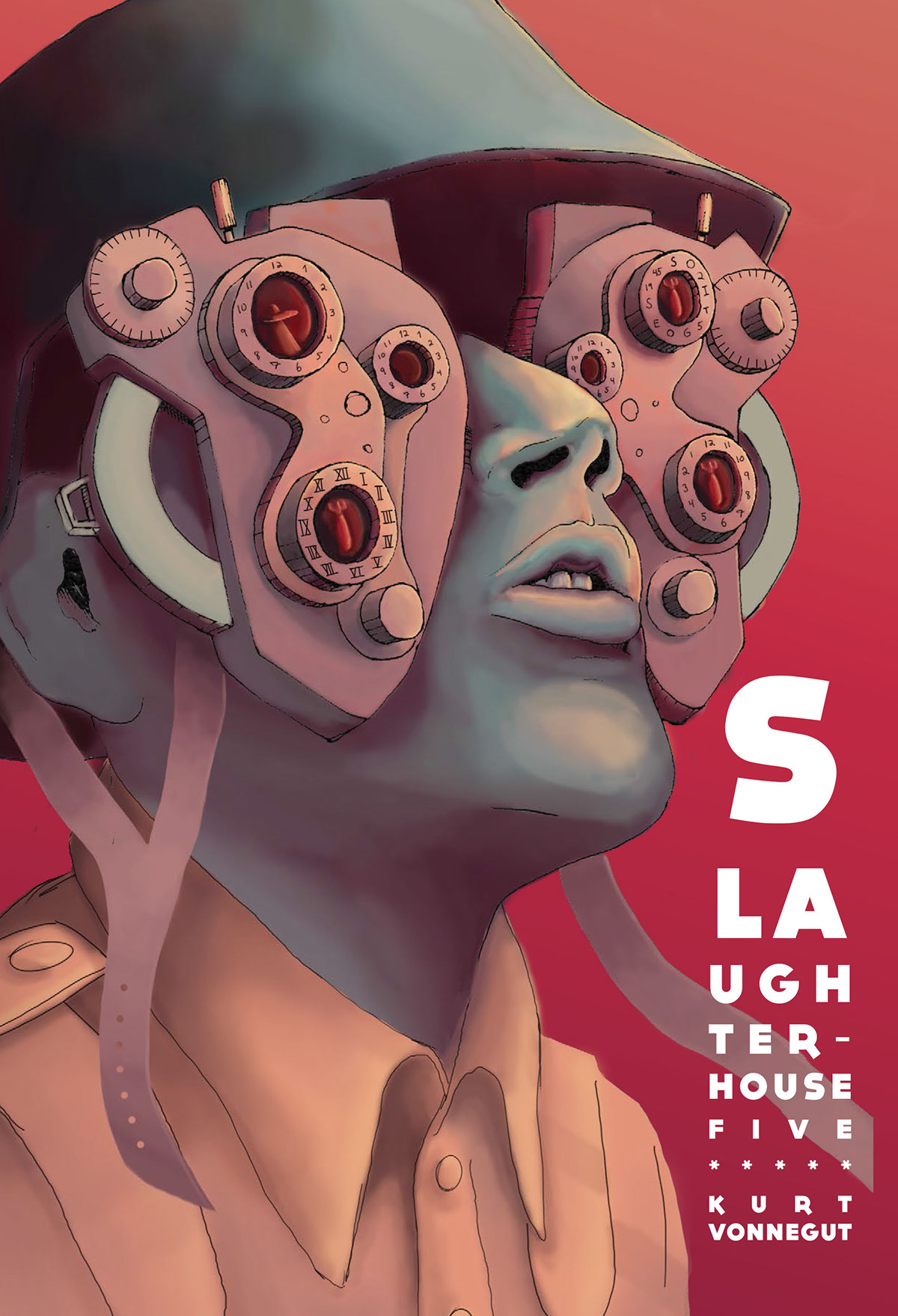
Slaughterhouse-Five


Image result for slaughterhouse-five book cover"All this happened, more or less." [opening line]


Slaughterhouse-Five, or The Children's Crusade: A Duty-Dance with Death (1969) is a science fiction anti-war book about World War 2, written by Kurt Vonnegut. The main character, Billy lives through the Allies' Firebombing of Dresden as a prisoner of war. Vonnegut was actually there in real life, and the book is semi-autobiographical. SH-V is Vonnegut's most influential and popular work, capturing the American zeitgeist in 1969, capturing the spirit of anti-war during Vietnam. Since then its become a classic statement of anti-war, dark humor, science fiction, and satire. 

The book is told in a non-linear way. Flashbacks going backward and forward in time. There's the science fiction element that Billy Dresden experiences. He has been abducted by aliens and now he sees everything in his life through time all at the same time, flashbacks and time travel experiences. On the alien planet, he's in a zoo and forced to mate with a movie star actress. He's 'unstuck in time'. 

Billy was a soldier who refused to fight. A real letdown of an American soldier. He gets captured and is forced to labor at a Dresden slaughterhouse, "Schlachthof-fünf," "slaughterhouse five". Hence the name of the title. The other part of the title's name [The Children's Crusade] comes from a section in the opening of the book about how children are always the ones to fight wars. 

Billy suffers from post-traumatic stress disorder, something not commonly known about back in 1969 but nowadays we are all familiar with because of Iraq and the war in Syria. Billy gets taken under the wing of these aliens, who see in four dimensions, observing all points in the space-time continuum [real science fiction elements, there's also a laser gun]. They adopt a fatalistic worldview. So it goes. That line so it goes is in the book some 106 times. You get used to seeing it. I saw it as dark humor. Your parents died? So it goes. You won a million dollars? So it goes. Nothing happened? So it goes...ad infinitum. 

The style is simplistic. This is probably the easiest book I've read in three months. Its a very enjoyable experience. I finished the book in two days because I couldn't put it down. It was thoroughly entertaining even though the plot isn't linear, its all over the place. 

Coincidentally I'm writing a memoir about myself, growing up in the midwest in the early 2000s with my single parent mother, and I'm writing in a style very similar to this. Although I'm nowhere near as good a writer as Vonnegut. I mean to say that my novella [so far] is kind of non-linear, and the writing style is purposely simplistic. 

It's a very attractive style, it makes you want to read more of the author's work. Another important detail is the fact that the novel reads as part fact [nonfiction] part fiction. Not to mention a lot of dark humor and satire. Initially, when I read the introduction I immediately thought of Voltaire's Candide and Micromegas. However, I find SH-V to be much more emotional than those mostly satirical works from the 1700s, France. Vonnegut manages to combine dark humor, satire, a spirit of the moment [flower power] anti-war message, science fiction, and his own life into a smorgasbord of a novel, and lo and behold, it works somehow.

No doubt there's a lot going on in this novel. In that way, it's not unlike Bruce Sterling's second novel, Artificial Kid, which tries to do everything, but in the end, fails to measure up to its ambition. However, with SH-V we have a work that is highly ambitious and is a winner, not just to me, but to the general reading public today, and from the readers of yesteryear [thank god for online newspaper archives]. This book is considered a classic, deservedly so. 

It's sad, funny, tough, delightful, and it all somehow fits into its own thing, a success. Even if you don't like science fiction I think you as a reader would get a lot out of this book. Its a classic for good reason. 

Recommended if you like classics, science fiction, and war novels.  

Check out my reviews for Voltaire's Candide and Sterling's Artificial Kid.
http://ofigueroamusic.blogspot.com/search?q=candide
http://ofigueroamusic.blogspot.com/search?q=artificial+kid

September Sweater Weather

Good evening ladies and gentlemen, hello world. How are you?  It's good to be writing on a good day off work today on a Saturday. Here, ...