Showing posts with label 1990s. Show all posts

Friday, January 7, 2022

Aristoi

Wow, what a terrific space opera god adventure story!

The way I described this book to people was this: this is a space opera about gods that become humanized. I mentioned Homer and his humanizing of his Olympians. So there's a long cherished tradition here going back throughout time, the western canon, of pathos, from Plato. What does it mean to be human? A god? What is good and evil? Who gets to justify right and wrong? These are some of the existential philosophical questions this book brings to mind in a general sense, disguised in the form of a 90s space opera. 

In addition to that, the momentum of the book never really stops, not even at the very bitter end. The story itself isn't remarkable, its rather predictable, and we've seen this same science fiction space opera tropes used time and time again within the golden age of science fiction and even the cyberpunk and new wave, it's rather space opera cliché. 

However, it is the way he tells the story that is truly a thrill. The style is simple but downright effective. It was never dull and every moment is a good one. I'm somewhat of a science fiction connoisseur but I missed this one all these years and I know I've missed much more. I would even say it's a required science fiction reading in the genre of space opera. It would be extremely difficult for a new science fiction writer in 2021 to write a space opera this good. It might even be downright impossible unless it was coming from overseas [not the US], maybe China.

Sunday, May 5, 2019

The Iliad


Image result for the iliad book coverThe Iliad is one of those majesterial works. It's an all-time classic Western masterpiece, maybe THE classic Western work of fiction. I read Robert Fagles' translation, released in 1996. It's one of the best books of 1996. Fagles brings the archaic ancient fiction story into the modern age with his translation. Sure, it isn't 100% what it is in Greek BUT it stays faithful to it AND reads like beautiful epic poetry. Rather than write my typical book review blog post, I'm going to explain the story itself just a bit and then point out things about it.

I'm familiar with epic poetry. I've read John Milton's Paradise Lost, Dante's Inferno, and the King James Bible. However, Homer's meter and verse are much different, of an older time period, a dramatic, emotive, precursor to all that Renaissance stuff in Europe after the Dark Ages. Homer portrays the Trojan War in a brutalist manner, complete with brains and entrails flying over the battlefield. One thing that Homer makes clear is that once a man is dead, he is dead. Nothing becomes of him. Later in the European Rennaissance, orators, writers, and poets would use Christianity as justification for salvation or damnation after death. Interesting little tidbit.

There's this big Homer debate. Was he blind? Could he write? Was he illiterate? The Iliad is some 2,700 years old and there's evidence that supports that the story was altered, changed over hundreds of years. Homer was the Shakespeare of his time. It doesn't really matter if he was a blind oral poet or one of the very early Europeans who could write on stones or papyrus. In his day you didn't write unless you were of the upper class. Most people were illiterate. So it goes. 

The story itself is about Helen of Troy. The Trojans are safeguarding her in Troy. Meanwhile, the Acheans are coming to kill them, take back Helen, and the city. The fighting description and imagery are so raw, visceral that I joked with my friends that the violence in the Iliad makes me want to throw up. Some of it is pretty gut-wrenching. At times it can be a bit much. But fictional death can't be all that bad, right? Well...

At some point, Patroclus, Achilles' friend [and people have also said that Patroclus was Achilles' lover] gets killed by Hector, son of Priam, king of Troy. Achilles responds by going to war. Thus the Iliad is about the Rage of Achilles. Rage is definitely what it was. He goes on a massive murder spree, even chasing Trojans into the river and killing them there. The gods get involved in all the fighting. This war takes place over multiple years by the way, so this really is epic in proportion, even more, epic than Avengers End Game [review here].  

This is a battlefield where men give speeches, telling their life story and taunting to their enemies before they duke it out in a blaze of glory and honor. A lot of times both sides are fighting harder and harder every time an enemy gets a leader or champion's corpse and tries to defile it, stabbing at it, mashing it up, etc. This leads to both armies gaining fighting strength in order to preserve said dead allies' body so that it can be brought to their family for a proper burial. Not to mention Poseidon's war cry, making troops gain sudden strength and will. 

The gods intervene a lot. They seem to have a big stake in this. Achilles is destined to die if he fights in the Trojan War-a prophecy from his goddess mother Thetis. Hera and Artemis work to undermine the Trojans. Poseidon fights on the actual battlefield for a large portion of the story. Gods shield certain champions from certain death. Zeus makes sure Hector's body gets back to Priam, back to Troy, because Hector was a much-loved champion who always praised Zeus and sacrificed the right amount of goats and pigs in Zeus' honor. This shows that the gods will always be involved in mortal human life. They all have their reasons. But maybe they just don't have anything better to do? 

Achilles kills Hector and defiles his corpse by dragging it around the battlefield, three times around Patroclus' grave. Now satisfied, Achilles holds the greatest games, the last chapter entitled Funeral Games For Patroclus [perhaps a precursor to the Olympic Games]. There are all kinds of contests in honor of Patroclus, fighting to the death even. And there's a huge bbq party, and Priam, Hector's father comes. 

When Priam comes to get Hector's body for Achilles, Achilles goes from rampaging god-like creature to a mere mortal when he realizes that Priam's love for Hector reminds him of his father. You could say that at that moment he is humanized, no longer the raging invincible monster, angry because Agamemnon, lord of men stole his girl. His rage is hard to justify.  Because he didn't fight until the end of the war he caused a lot of death amongst his comrades. 

So what is the Iliad about? Generally speaking its about a city about to get sacked. But in between, we have the making of the origin story of tragedy. The Iliad is usually described as the Rage of Achilles but it can also be thought of as the Tragedy of Hector. Although Achilles was a master warrior and a much better fighter than Hector, Hector, in fact, was much more loved, more loving, and a better man to his family and comrades. No wonder Zeus brought his body back to his family. The caveat is that Priam [Hector's father] had to get the body personally from Achilles, who might have killed him if not for the threat of Zeus looming overhead. Very dangerous move for the King to go out and meet with the enemies, especially right before your city is about to get sacked. 

This story has everything: love, war, death, honor, love, sex, gods, mortals. Robert Fagles' translation is easy to understand. The lines all flow in a cohesive way. You have to read a good translation for the Iliad or any work of ancient fiction. A crappy translation will completely ruin the experience. I enjoyed the Iliad so much that now I'm reading the Odyssey, also the Robert Fagles translation. I've caught the ancient fiction bug all of a sudden. I have plans to read the Aeneid and Beowulf after.

You pick up this book and you realize its a 617-page behemoth. I was deep into it, reading it on and off for a while. I started on page 240 on Monday and by Wednesday I had finished the book on page 617. I managed to read 400 pages in three days in a wild burst of long and super enjoyable reading sessions. The language is simply beautiful. I can't explain the mechanics of the poetry at work here, the line, meter, verse and all that but there's overarching linearity to the prose here. It's like the entire work itself connected in such a way that it was all one long sentence. Like it was an oratory experience. This is one of those books I will definitely come back to. I would love to read other translations. 

How could you rate this book? It's a masterpiece, a complete 5 out of 5 stars. Anyone who disagrees either doesn't like epic poetry or just doesn't get it. That's fair too, to not get it. After all Greek mythology isn't for everybody. But I sincerely believe that this ancient fiction is so magnificent that most people would enjoy it. Especially Robert Fagles' version. Do check out this book, it's one of the best books ever.

Wednesday, December 5, 2018

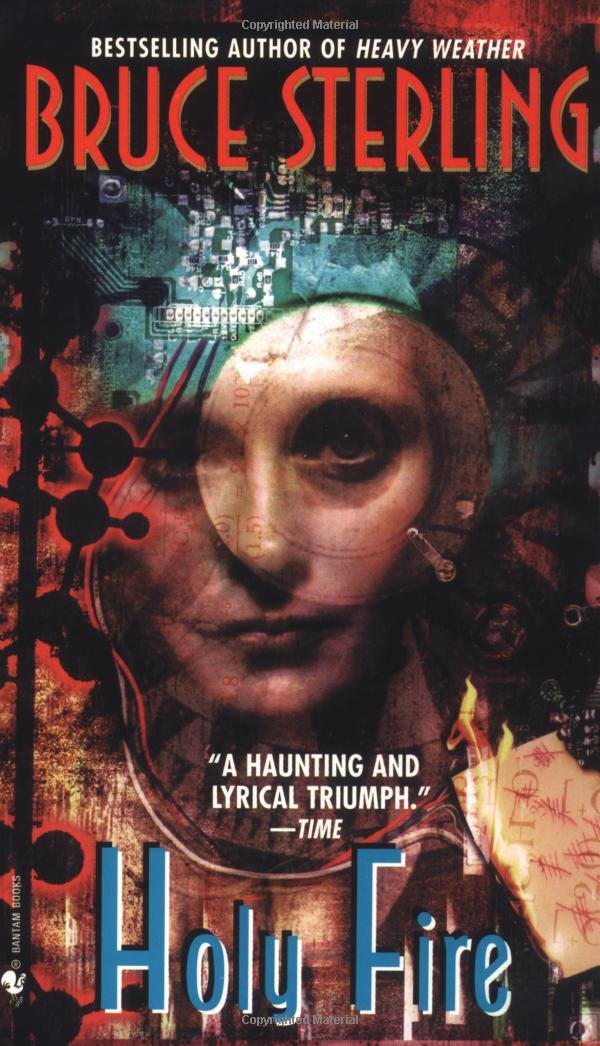
Holy Fire

Image result for bruce sterling holy fire book coverHoly Fire is a great science fiction novel written by Bruce Sterling. It came out in 1996. It was nominated for the British Science Fiction Award in 1996 and the Hugo and Locus awards in 1997. High praise for great art. 

The story follows a medical economist named Mia Ziemann, a ninety-year old woman who transforms into a twenty-year old girl through intrusive technological means. Now (post-op) and borderline psychotic she goes by the name Maya as a young lady, traveling across Europe with nothing but a bag and the clothes on her back. She makes friends with all kinds of artists, bohemians, hackers, and fashion gerontocrats. The story is about life, death, the human condition, art, fashion, a very poetic sort of philosophy and ontology. 

The world of Gilead is somewhere in the year 2100. Gerontocrats control mostly everything and young people are like the scraps on their shoes, living on the margins. However, most things are free, including free health care and food, provided you don't harm your body or anyone else. Its a near future but its not a totally implausible one.

Once transformed, Maya gets caught up with thieves and drifters, eventually making her way into the fashion/modeling industry because of her sexy look. From there she makes friends in high places, mostly programmer types that help her with her palace, a digital life-space given to her by her now dead husband, complete with ruins and stuff. This is a cyberpunk story and the technology here is out of this world. Even with Sterling's esoteric explanations, the tech can get lost in between the dialogue, which is what helps make the novel move along nicely. 

Sterling gets very in depth with the virtuality within the story. His scientific explanation for Ziemann's transformation was quite complex. It was like reading Greek for me. However, it was mostly just advanced biology terms. The tech stuff here reminded me of William Gibson. Although I think Gibson does it better because he's able to make more out of the tech with his literary technique. 

Anyways, Ziemann gets caught up with a bunch of rich, radical anarchists and they plan on 'living forever' and taking control of the system, and this and that...But it turns out in the end that Ziemann gets caught up with the police, who were tracking her down because she skipped out on paying back her medical bills for the youth procedure. And not only that, but her dead husbands' talking dog Plato was always in the virtual palace, he'd been looking for her too. 

Ziemann goes through an ontological transformation. She realizes that she doesn't want to go back to being a gerontocrat, and that she wants to be a young photographer, even if she's really bad at it. It takes becoming a full blown criminal, a celebrity (at the end), a widow, and a Frankenstein-esque monster to realize what she wanted in life. 

The novel contains many debates between these young bohemian types over the immorality of immortality as well as the aesthetics of fashion. The underclass here are also talked about frequently, the class of people who can't become 'post-human', those are the real disenfranchised of the story. 

The writing of this story is free flowing with great metaphysical ideas. This is mostly done through dialogue and small events that happen over many pages-fifty pages here, another fifty pages there, etc. Although there are heavy cyberpunk elements here the ideas presented command more authority than mere tech. This isn't an easy novel to understand but its easy to read because the dialogue is interesting and the characters have artistic and idealistic charm.

If you want a different sort of cyberpunk novel this is for you. If you want a different sort of science fiction novel, this is it. They don't make science fiction like this anymore these days. And this was only from 1996! 

I'm currently waiting for my order of Bruce Sterling's Schismatrix. I heard from my father that's his most important novel. After reading his amazing collaboration novel with William Gibson, The Difference Engine, this was a great follow-up. On his own Sterling has grandiose philosophical ideas to go along with his cyberpunk technology. It has legs. 

Sunday, November 25, 2018

The Difference Engine

Image result for the difference engine gibson sterling
The Difference Engine by William Gibson and Bruce Sterling is one of those all-time great 'hard' science fiction novels. Set in a steampunk alternative history where primitive computers were invented in the mid 1800s thanks to Charles Babbage's Analytical Engine, the story has the three things a good cyperpunk story has: steam airships, brass computers, and kinky feminine underwear (Gibson's words). 

The story follows Sybil Gerard, the daughter of a famous Luddite agitator Walter Gerard (Luddites being anti-technologists), Edward 'Leviathan' Mallory-paleontologist and explorer, and Laurence Oliphant, a historical figure, a travel writer who works under service of Her Majesty. What links all these characters together are these computer punch cards that are supposed to be powerful, important enough to die for. 

The characters believe the punch cards are part of a gambling 'modus', a device used in gambling where you can never lose, and have infinite money, a alchemist device.  "The last chapter reveals that the punched cards represent a program that proves two theorems which, in reality, would not be discovered until 1931 by Kurt Gödel. Ada Lovelace delivers a lecture on the subject in France." 

Mallory, his brothers, and Ebenezer Frazer (part of the Secret Police) defends the cards against Captain Swing, who leads a riot during the 'Stink', a major pollution event that happened in London, similar to the London Smog of December 1952. 

At the end Oliphant meets Sybil Gerard and tells her he knows who she is, the daughter of Walter Gerard, the famous Luddite agitator. He says he won't share her identity with anybody, but that he needs information to help take down Charles Egremont MP, her seducer, who poses as an obstacle in the way of Charles Babbage and Lord Brunnel's political careers. 

The end of the novel features all these different histories that occur in the world of Difference Engine. Lovelace delivers her lecture on Godel's Theorem, as its counterpart is known in our world. Fraser accompanies Sybil and meets Lovelace, with Sybil not ever able to forgive Lovelace's father Byron, for her role in her father's death.  

The end features a view of an alternate 1991 from the point of a computer, which turns out to be the narrator as it achieves self-awareness. 

Wow! What a novel. There's a lot to like about this novel. There's even realistic sex scenes, sort of like noir. The description of 'clackers', the book's version of hackers is pretty interesting, and similar to what hackers are like in real life, the 30-hour savants working around the clock with their calculations. 

But I think what was most exciting about this novel was the sheer brilliance of the writing-dialogue, plot, exposition, niche time period words of the 1850s, its got a lot going for it. The way that Gibson and Sterling made the narrator a computer, it gave them more options when it came to plot and exposition. I also believe that because this is the work of Gibson and Sterling, that it was destined to be great. This book was written at a high period of literary achievement for both writers. So its no surprise that the writing is very good. Both of them went on to become very different writers after the cyberpunk 90s. 

Although the novel was nearly 500 pages and took a long time to read (including a lot of 30 minute lunch breaks at work), I would say it was well worth it. This book compares to something like Dune, which I put at a really high literary and science fiction pinnacle. Its just that good.

The truth though is that the book took me a long time to get into. In fact, I had checked it out numerous times and barely ever got 50 pages in and at point I even listened to the audio book version on YouTube. Eventually I decided I was going to read the whole thing, turns out it was well worth the time and effort. But a book this great doesn't take too much effort, the words seemingly move across pages very easily. The time invested in reading this book is time well enjoyed. Such is the literary style of Gibson and Sterling. 

Well worth the read if you like alternative history, steampunk, or cyberpunk stories.  

September Sweater Weather

Good evening ladies and gentlemen, hello world. How are you?  It's good to be writing on a good day off work today on a Saturday. Here, ...