Showing posts with label cyberpunk. Show all posts

Thursday, December 3, 2020

Luditas y Tecnócratas

The world today is a machine of chaos. The virus is running rampant, killing 2700 in one day. Social media sows discord and division in our populace and politics. Things aren't the way they were before, you'd hardly even recognize it anymore. We, as an organism are so attached to our technology that most of us couldn't live without it, or even imagine a world without it. Would it be like the Utopia or New Atlantis or Sir Tomas More and Francis Bacon? Maybe. Maybe not. Would I even be writing this if I knew that nobody would read it? Without the support of the internet to share my ideas, would they still be worth writing about only for myself, or just family and friends?  

Everyday is a new construct in which technology is used to maximum effect. We leave our smartphones in our pocket all day long at work and even go on them when at home at night. Our computers, televisions, and video game consoles are bastions of the shiftless biomass, the state of nature in America right now, especially under quarantine. Social media is used to no end and will probably continue to be ad infinitum. 

But not all of it is bad. Tech can be used for the good of society but more often than not, when tech is left unregulated, it becomes a tool of the super rich, powerful, technocrats. They use their mathematical scientific abilities to create apps, or websites, or algorithms that potentially can last forever until eventually replaced by another one. 

You are not a gadget. It isn't normal for a human being or animal [for man is but an animal with sense of virtue of what is good] to walk around with a computer in their pocket, forever connected to a fantasy mini universe [the internet] at all times of morning, day, or night. But we let these things happen because we're moving with the spirit of the times. If everyone has the new iPhone, then it means it's time to upgrade my old iPhone and get the newer one. Is that what you should do?

The luddites that exist in society today are borderline living on the fringe types. They might live in the woods, on a farm, or Wisconsin, or Alaska, or a wood elf type of forest area with big houses enshrouded in darkness. Isolation and loneliness isn't as much of a problem for the luddites, for they always have the natural world, the natural order of things that makes them happy. On the other side of the equation, in comparison, the technocrats have their money, power, and grand influence over the emerging world to make them happy. Who am I to deny any of them happiness? 

The way of the old world is dying and/or already dead. Language learning isn't a focus in America. Music learning isn't a focus. We no longer read books or get our kids to be interested in them. Math test scores are very low. Science scores are very low. Kids from other countries come here to learn and learn more than our kids do, taking their knowledge back to their own countries and doing good things in their worlds. We focus on getting our kids through college and getting them to work, a very fine venture but if they don't actually learn anything, are we really doing a good job?

The old world is nature, animals, music, books, art. The new world is television, video games, movies, social media, and constant overuse of technology. There are good and bad variables regarding the characteristics of the old world versus the new world, but it can't be denied that the way of the world is shifting into a deified technological statehood, being and time of the digital age. 

The cyberpunk aesthetic of William Gibson and Bruce Sterling is already here. Fundamentally, most Americans [most humans with smartphones and computers] are cyborgs. We're attached to our phones, computers, and tv's like they're an extension of our body, an extension of ourselves. Who needs to play Cyberpunk 2077 when we're living through it everyday of our lives. This is why it is important to always take time to reject technology, set it down for a set period, and come back to it at a later period. If you're interested in what a true gritty cyberpunk world looks like, read William Gibson's Neuromancer. In the Trump era, it goes without saying that we are living in the realm of science fiction and far right political ideology that is so fringe that it reminds us of Nazi Germany. The past is reminiscent of the future. When we stare into the abyss, it looks back at us. 

Will the future remember things like Plutarch, Homer, Mozart, and Charlie Bird Parker? Or will they focus more on what happened during the 2016 to 2020 elections? The world lives another day but tomorrow never knows.    

Friday, June 19, 2020

2100

ArtStation - Freelance Work V2, Josan Gonzalez (con imágenes ... Hello, how's it going? I was thinking about the current state of affairs in the world and started thinking about what planet Earth would look and be like in say, 2050, 2100. I'd like to jot down some ideas on that subject. 

1) Will we take to the Stars?

Well, technically speaking, we have already gone far in space via machinery. But to see the human race fly to the stars and live there, that would be a true scientific revolution, the likes of which haven't been seen for a long time.

2) What would a banana republic like the United States look like in say, 2100, over the current debacle going on since 2016?

Government has shown to be effective and useful when used by the right hands, working with the heads and hearts of the people. But there are always going to be bad actors in any sort of governing, thus, as bad as Trump is, is there any more worse it can get?

3) How would we react to an overheated Earth, with lots of pollution? Natural disasters that get worse and worse every year. It's already happened in the California and Australian fires recently, but the key to effective climate control is your government officials, signing laws that lessen the impact of pollution, using clean, renewable energy and resources and cracking down on companies that violate those protocols. 

4) What if there's life out there?

The potentiality of others, alien life, is always there. Perhaps not in our solar system but in another one like it, or different to it. Possibly travel there via wormholes. Wormhole technology. I surely jest with science fiction but if there's water on other planets perhaps there's a slight chance that sentient life lived there at some point in the billions of millennia.  

5) Will education fail our young?

Education is a powerful thing, especially when imposed upon the young. What we teach our youth, or even younger friends even, is what we know based on education and experience. Learning through various methods will help you get through in life, bearing a modest sentimental education. You don't have to go to college, you don't even have to have finished high school, the more you educate yourself through various activity like reading, writing, and public speaking, the better your chances. Sounding less street can get you places. 

6) Will there be hover cars? 

Of course! But probably meant for the pure novelty at first until they figure out how all the techno-gadgetry works.  

7) What will people eat?

Obviously, the world's supply of chicken, beef, and pork will run out. With a growing population, planet Earth is eventually going to run out of food. Will this inevitably bring about an apocalyptic vision that was early COVID where all retailers rationed chicken, beef, and pork to only two packages? Perhaps we will need a lot more farmers in the world and America can become like the Old West. Oh, where the buffalos roam. 

8) Will we run out of air? 

What if the oxygen on Earth runs out and we all have to fly to colonies on Mars? Or perhaps to some neighboring star?

9) Will there be laser-guns or portal-guns? 

There are some great laser-gun fights in Heinlein's The Moon is a Harsh Mistress. It gave the novel a lot of pure action. Would laser-gun tech come about easily? Likewise, it would be cool to have a real, live, portal-gun, and be able to go places through your portals. Much like the critically acclaimed Steam game, Portal.  

10) Where does humanity go from here?

Well, you ask that question to everyone and they'd all tell you something different. Some would say we need to take to the stars and colonize them. Others would say stay home and read your Bible. Yet more would say we need to improve science and technology, because, as they say, things like artificial intelligence, machine learning, and cognitive learning are where it's at. We live in a postmodern philosophical world if one could even call it that. There's no telling where we as a people, as a tribe, as dna, will go. 

Excelsior! 

Saturday, June 8, 2019

Islands in the Net


Islands in the Net is a science fiction novel from 1988 written by the cyberpunk master himself [second only to William Gibson imho] Bruce Sterling. I found this book on a whim. I randomly typed in best cyberpunk novels on google and it showed up on a couple of lists. So I figured I'd order the book from the library and give it a shot. Risky!

This book isn't what I was expecting. The introduction starts with a woman running on the beach and tripping onto the sand, bruising herself. A walking, talking robot comes to her aid. That first impression is important. I thought the talking robot was such a great first impression. I figured the rest of the book would have science fiction elements like that. I was dead wrong. 

Now, it's not that this isn't true science fiction. It's just downplayed super hard in favor of plot and dialogue. It is, in fact, true science fiction, maybe even cyberpunk if you want to call it that. However, the science fiction aspects of this book are very minimal. Although IITN was written in '88, Bruce Sterling was actually able to predict where the technology would go. Hence drones. This is where the plot lies. 

A civilian corporation called Rizome gets involved with data pirate terrorists. They're trying to get the data pirates to come together and stop bombing each others' countries, stop stealing each others' data and money, etc. They deploy drones a lot to kill people, even causing mini genocides and such. This is a prediction of the future because today we live in a world where drones kill people every day [in the middle east]. We have a female protagonist named Laura, who's married and has a baby daughter. Laura decides to be the lead negotiator between these data pirate groups. She wants to be the 'female man', the woman who does it all, risks it all, and comes back home safely, forever changed, but a glorious welcome home, a legend. 

The plot is actually very innovative and grandiose. The whole time I was reading it I kept thinking to myself, is Sterling going to pull this one off? After all, this is my sixth Sterling novel so I know when he writes a mediocre novel [Zeitgeist]. When great science fiction writers try to write what I think of as contemporary thrillers I am not into it. Think William Gibson's All Tomorrow's Parties. I couldn't even get through ten pages of that. Anyways, I actually really like the plot here. It's cutting edge. However, the way the plot and characters work is mediocre. 

The plotting is done mostly through dialogue. One of the best things I can say about this novel is that all the 'boring narration' is actually quite exciting. I liked to see what happened next in terms of pure action. There was a dog breathing fire, a president of Singapore calling Africans the n-word on national television [which reminds me so much of the Trump White House adminstration], two years of imprisonment, Laura's best friend from college marrying her husband while she was locked up, lotion that turns white people black [and they love it, prediction of tanning] and lots of explosions, which included nude women. Sounds pretty great right? Well, it is. 

But then you notice that Sterling is making you work for all that exciting stuff. In between all the action scenes, there's tons of wooden dialogue. It's not that it's terrible writing, on the contrary this is still decent writing. But there's a sense of just riding the breeze with the dialogue. There's little if any character development throughout the entire novel until the very last twenty pages. That's only because Sterling is obliged as a writer to resolve all tension throughout the narrative.

So yes we have a great ending but it takes you 350 pages to get there. Which I find super long given that it's not very much of a science fiction story, feels so contemporary that its modern, and has wooden dialogue. I didn't care for Laura until the very last twenty pages where she has an epiphany and resolves all her problems, comes to grip with reality through much hardship. She even meets her Optimal Persona while in prison. Don't ask. It's a California thing. 

In conclusion, this book had a very inspiring idea but is poorly executed. Sometimes even the great masters of science fiction miss the mark. In fact, I should've known this wasn't that great of a book because I'd never even heard of it. When I told my dad [an old school science fiction aficionado] that I was reading it he told me that it was almost contemporary. And that's my whole problem with it. 

Worth the read only if you're a hardcore Bruce Sterling fan. Not science fiction enough. The best thing I can say about this novel is that it is very ambitious. Sometimes Sterling hits the mark spot on with the way the world works [economies, organizations, countries, mercenaries, data, etc], even today, some 40 years later. That is remarkable but doesn't justify me thinking of this as a great science fiction novel. However, this cover with the woman on the cover in the 'matrix' is pretty damn cool. Unfortunately, that only tells a small fragment of the actual story. 

Check out my other Bruce Sterling novel reviews below:
https://ofigueroamusic.blogspot.com/2019/01/schismatrix-plus.html
https://ofigueroamusic.blogspot.com/2018/11/the-difference-engine.html
https://ofigueroamusic.blogspot.com/2018/12/holy-fire.html
https://ofigueroamusic.blogspot.com/2019/02/artificial-kid.html
https://ofigueroamusic.blogspot.com/2019/01/zeitgeist.html

Saturday, March 2, 2019

Battle Angel Alita [anime movie]


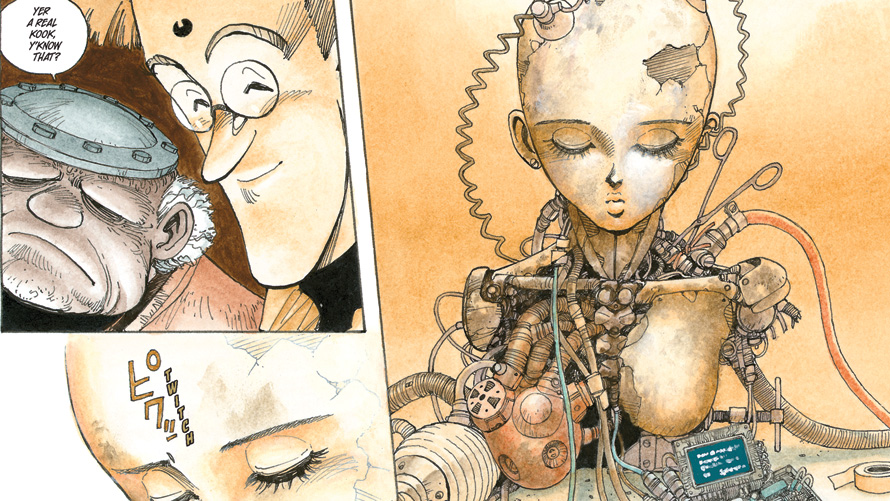
Image result for alita battle angel anime scenesBattle Angel Alita [Gunnm, literally translated "gun dream"] is a Japanese cyberpunk manga series by Yukito Kishiro. To be clear, this is the OVA [anime movie] I'm reviewing. It consists of two parts-Rusty Angel and Tears Sign. Kishiro has no plans to revisit the anime. The film was adapted to a live action movie with motion capture in 2019. Check out my Alita Battle Angel live action movie review here. I wanted to do a separate post about the anime movie, titled Battle Angel Alita because I thought the anime movie was better than the movie in some ways, but not others. Lets discuss the differences. 

The story is fundamentally the same and the film follows almost the same course of events almost to a tee. However, the anime movie looks much better than the film adaptation. The artwork here is quite stunning. The characters all have that late 80s [this was created in 1993] anime look: tall, short, wide eyed, glasses on some characters [super circular oval glasses and googles]. That was the style back then. The backgrounds in every scene are highly stylized and textured but the characters themselves are simple. This was the state of anime back in the late 80s, as this movie was created in 1993, just a few years after I was born. The biggest and best reason for the anime being better than the live action film is simply the cinematography. The hand-made drawings can't be beat, even with a motion capture suit [which is still pretty cool]. 

Next, the anime does everything the movie does plot-wise, but faster and with more skill. The anime movie is only an hour long. The live action film is over two hours. Quite a difference. Although the anime film crams everything together super fast, I actually think it does a better and more concise job. When you watch the anime you realize you don't need to have all that extra clutter of plot.

In addition, another thing the anime does better than the live action film is action. The amount of gore in the anime is at an all time much higher level than the live action movie. In fact, there wasn't even red blood in the live action film. There was this weird blue blood when the cyborgs got killed in violent ways. However, the anime takes that to a whole new level. Some of the killing scenes in the anime will stick with me for a while. They were just that gruesome. When the dog gets killed in the anime it is a grotesque death. Likewise, when cyborgs get their skulls bashed in, there is a freaking pool of blood smeared across the walls, floors, and characters. Its a blood bath. Much different from the live action film, which of course couldn't be that violent, otherwise it would be rated R, which means no kiddies get to experience Alita fanfare. Also, in the anime Alita seems to have some extra powers that weren't shown in the live action film. She has these power-up moves that are quite cool. Instead of having these power-ups in the live action film, they simply gave her a 300 year-old sword [her age].  

Another thing that stood out is the fact that Alita doesn't seem to be objectified or sexualized in the anime. In the live action film they give both of her suits breasts and stuff, which doesn't really make sense, but whatever. In the anime they downplay the feminine aspect of her cybernetic body. Just something I noticed. Its a good thing.

What the live action movie does better that the anime movie doesn't do quite as well is create a likable sympathetic character. In the live action film Alita's actress does a fantastic job portraying herself as a young, naive, empathetic cyborg girl [with those big anime eyes you can see into her soul]. We feel for her. I know that sounds cheesy but when I saw Alita Battle Angel [live action film] I really felt for Alita: for all her problems, not knowing who she was, how she couldn't get her boyfriend to Zolumn, and if she was capable of being loved by a human boy. These are realistic things that people can feel and understand. Again, I know these seems cheesy but I thought it was a very important aspect to the film, maybe the most important one. Blue-blood-oozing-sickle-wielding cyborgs aside. 

All in all the anime is pretty damn good. Its only an hour long. You really can't go wrong. If you watch the live action film I think you can benefit from watching the anime as well, provided that you like anime and you would like to see a different interpretation. Sure, the live action film is a $300 million dollar movie and the anime was probably nowhere near that budget but they got some things right. They don't make anime like that anymore. In a sense, because of that, it is priceless, a relic of the 90s. Something that can easily be forgotten and lost forever.

Check it out, you can watch it on YouTube. 
Part 1 Rusty Angel https://www.youtube.com/watch?v=mKTxbZPqzFM 
Part 2 Tears Sign https://www.youtube.com/watch?v=VaidL6_fE_c 
Make sure to add the English subtitles on the YouTube options. Enjoy!

Check out my Alita Battle Angel live action review http://ofigueroamusic.blogspot.com/2019/02/alita-battle-angel.html

Tuesday, February 26, 2019

Artificial Kid

Image result for artificial kid bruce sterling original book cover


Artificial Kid is the second novel by Bruce Sterling. Written in 1980, the book is over the top and satirical, reminding me of the kung foo 80s films. The book's protagonist is a young clone, artificially born at an adult age. He's a big action star. He's a combat artist, where people fight on film, and people pay to watch. One of the Orwellian concepts Sterling uses is the idea of a constant surveillance state. In the world of Artificial Kid everyone films themselves doing everything: eating with friends at dinner, having sex, combat art, the works. All the plutocrats of this society used them constantly. The social structure of the society highly stratified. However, with Kid being a pop star combat artist, owning 4 shares of stock, he was super rich, and famous despite being young. This is something of a cyberpunk novel, as there are some pretty advanced technology.
But then bad things happen to Kid. This guy calls a blood feud on him, wipes Kids' maids mind [akin to murder], and has some goons beat him to a bloody pulp. Barely surviving, Kid and his entourage start living on the run. They find themselves getting blown up on a ship from another enemy sent by Angeluce, who's part of the Cabal, the society that controls the planet.

Moses Moses, Saint Anne-Twiceborn, and Kid end up swimming for hours and hours, only to somehow land upon a flying island. On the island kid miraculously finds his mentor, a scientist. They each take turns telling their personal story, as they might be about to die at any time. They were being hunted by Angeluce, because they knew about Moses Moses, who was out of cryosleep, and was apart of the original government some 300 years ago. Yes, none of this makes sense. 

Although none of the middle and ending sections have too much action, this section where the characters tell their own stories is where Sterling shines at creating a character, even if we have to use a bit of suspension of belief. Saint Anne really comes off as a true loving woman and Kid realizes this. Moses Moses' story about how the world and government of Reverid came to be is fascinating, as it works as exposition for the world. 

The story isn't executed nearly as well as the ideas themselves. Perhaps the outcome of a sophomore slump? I've read a lot of short reviews for Artificial Kid and reviews seem to be mixed. I think the novel is terrific. The plot is all over the place but I think the the characters were well written and the ending is quite nice.

Kid grows up as the story progresses. He starts off as an arrogant, drug addled, violent brute that smashes people with nunchucks, but in the end he turns into a loving guy and reciprocates the love of Saint Anne. Kid and Saint Anne raise Quade, the maid who got mind-wiped, up as a kid. But here we see that Kid gives up the combat artist lifestyle, and ends the novel living in peace with Saint Anne and Quade, on an island, his old mentor's house. Kid goes through an odyssey of his own to find out what the really important things are in life. There's even an alien eating a human head.

There are lots of novels with the theme used here. Candide comes to mind. The satirical aspects are strong here. The characters use 80s arcade slang and made-up slang jargon as well like, "Oh wau, holy death!" stuff like that. The gore described herein is pretty hardcore. At one point Kid kills a man for the first time and he ends up ripping up his skull, with grisly details. There is a science, technology, philosophy, and sociological intensity to the extensive dialogue of the characters and that's where the reader learns more and more, getting caught on turns of plot. I think that this is still a strong book from Sterling, and I've read a few of his books now so I can see where he's made his leaps and changes in writing.  

I do think that the plot could have been written in a more elegant or smooth style. But I think rather than rely on plot Sterling used a lot of dialogue for the reader to learn more about the history and lore of the utopia/dystopia planet, as well as the backgrounds of each of the main characters. It worked, for me. I would even be interested to read this again at some point.  As you can see from my list below of all the other Bruce Sterling books, I've read a lot of Sterling's work. I've even read his first novel Involution Ocean, a science fiction Moby Dick. I would say there's a good evolution from 1980 Artificial Kid Sterling to 1985 Schismatrix Plus Sterling. All great stuff relatively speaking, and definitely worth reading.

On a side note I couldn't find any good reviews for Artificial Kid on a google search. So that's why I decided to write my own. Sterling gets props for imagining a world everybody is constantly being watched by their own cameras. Its like he could see to the age of postmodernism where people enjoy watching Keeping up with the Kardashians and other reality TV popcorn bubblegum. Its an old trope for the state of a brutal regime, but its actually come to pass. Sometimes its good to turn off the cameras.

Check out my other Bruce Sterling novel reviews
https://ofigueroamusic.blogspot.com/2018/12/holy-fire.html
https://ofigueroamusic.blogspot.com/2019/01/zeitgeist.html
https://ofigueroamusic.blogspot.com/2019/01/schismatrix-plus.

https://ofigueroamusic.blogspot.com/2018/11/the-difference-engine.html 

Sunday, January 27, 2019

Man Plus


Image result for man plus frederik pohl cover
Man Plus is a science fiction novel written by Frederik Pohl in 1976. Pohl is one of those rare great writers who was not only a great writer but also a great editor. I heard from my dad that he didn't start out as a great writer either. In fact, it took him a while and eventually he just got good.  [much like how gamers get good after playing for years and years, practicing rigorously]

Man Plus is a the modern world at that time, in the 70s. Communism has taken hold in every part of the world except North America. They mention the evil Chinese and this and that but no word on Africa at all. Anyways, the world is in a Cold War state and the only thing that will save humanity from Armageddon is colonizing Mars and eventually settling a colony. The Americans come up with the Man Plus program to achieve this.

Interestingly enough, when I compare the politics and President here to the current Trump administration and the rise of Communism across the globe, I see an eerie similarity. Basically President Deshantine in Man Plus is very much like Trump. Full of shit with bad politics. 

Roger Torraway was third in line to be the Man Plus. However, the first guy has a complication and dies. The second guy has a broken leg. Roger is up. The thing is that the scientists needed to create a being who can stand on the surface of Mars without a space suit, something totally implausible in any scenario. But Pohl makes it almost make sense. And he plays it off very well. In order to get this to work the scientists rip apart Roger's body and rebuild him with mechanical parts and a computer, saving only what makes him human, his brain. He becomes a human-machine hybrid, a cyborg. 

The cyborg seems like one of those old pulp science fiction tropes. Or Doctor Who if you're familiar with that show. Its a popular idea for a good reason. Because its interesting. Its captivating and all that jazz. We as the audience want to see into the inner soul of the cyborg, can they have that?

While Roger's failing to control his new mechanical body he's also failing to deal with his own personal relationship; mainly the fact that his wife has been cheating on him with his best friend! [which reminds me of The Room, a parody movie

Roger doesn't fully come into his own until he actually walks the surface of Mars. Once there he realizes he can't control the machine within him, and at the end we learn that the machines built within him as well as the machines of the Earth might've influenced him and humanity in order to get to Mars and establish a colony, a sort of AI-human hybrid influenced fate. Perhaps Pohl is saying that the machine will become sentient and we'll be the machines? Role-reversals? I think of things like this when I see how smartphones have taken over the consumer to the point where consumers are using their phones for everything instead of just to make calls. [E.M Forster's The Machine Stops comes to mind]

The ending is very interesting and I'm still not sure what to make of it. Satire maybe? You could say the whole novel is satire. I only know that I think its fantastic. It left me in a state where after I read it at a lunch break at work, finished it, clocked back into work, and thought "I just finished reading a masterpiece". Realistically and thinking back on it a day later, its just a great work of style. 

Pohl is a stylist here. This is New Wave science fiction with a high literary style and voice. This is beyond the 50s and 60s pulp science fiction. More technical, more scientific but in the end its all great made up fiction, which is really the only thing that matters in the end. Never mind all the biological and technological jargon regarding the machinery and the climate/habitat of Mars. Forget how the frog's eyes work. All that is just extra for great writing and great ideas. 

Another important factor is the psychology of the characters involved. This novel is intellectual in a psychological way. None of them are say villains but they ain't saints, especially Roger's best friend, who ends up going to space with him. [you can guess what happens on Mars when that happens

This book was so captivating that I could hardly put it down. I finished all 180 pages in two days and was thoroughly satisfied upon completion. Great classic science fiction read, recommended to anyone who loves space, adventure, as well as an intellectually stimulating narrative.

Monday, January 21, 2019

Schismatrix Plus

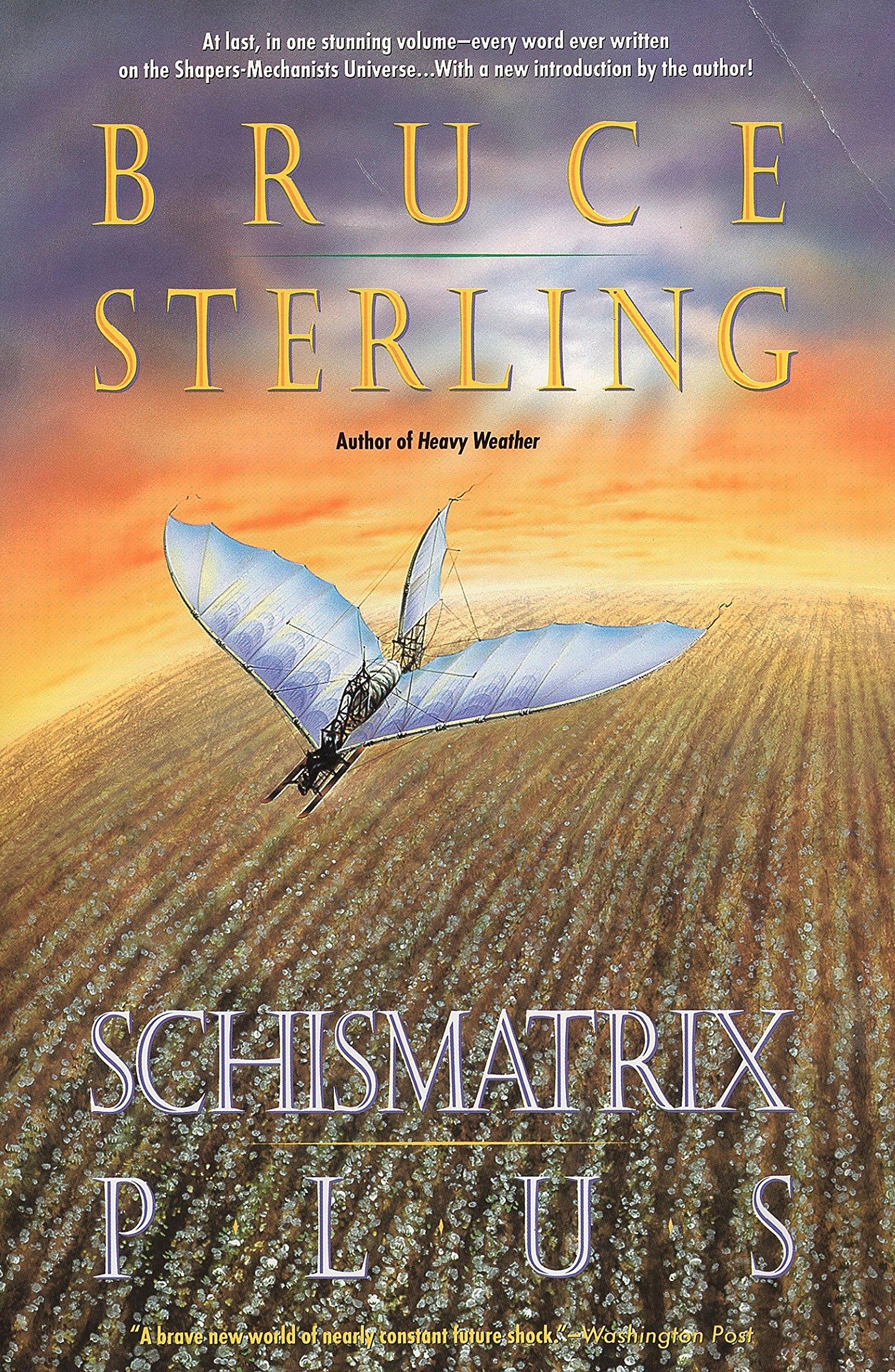
Image result for schismatrix book cover originalSchismatrix Plus is a science fiction novel by Bruce Sterling, written in 1985. Schismatrix was nominated for the Nebula Award for Best Novel in 1985, and the British Science Fiction Award in 1986. This story is set in Bruce Sterling's fictional Mechanist/Shaper universe. Five short stories that preceded the novel are apart of the Schismatrix Plus edition. The novel by itself without the short stories is simply titled Schismatrix. 

What can I say about this novel? It is simply fantastic and got me more interested in the cyberpunk genre. Sometimes you read a book and something hits you in the head. Bang! This is one of those books. This is an important book. Even a week after finishing the novel I still think about it, the themes and concepts, and especially the ending. 

There's a universe of potential, Lindsay, think of that. No rules, no limits.  

The world of Schismatrix is transhuman. There are Shapers, who use biotechnology and psychology to enhance human potential and then there are Mechanists, who apply AI, and mechanical parts to enhance themselves and become more than human. The Shapers/Mechanists are colonizing the solar system, divided in their two distinct philosophies. 

The book follows the life of a sundog [wanderer, ronin] named Ableard Lindsay, a Shaper with diplomatic training and a brilliant liar, which he uses to great effect. "Before the end of the novel his careers have included being a revolutionary, a theatre producer, a space pirate, a xenodiplomat, a scholar and a prophet." [https://www.aleph.se/Trans/Cultural/Art/schismatrix.html] 

"Politics pulls us together, technology pulls us apart".

Throughout the book changes in technology, habitat, economics, and politics change the dynamics of the entire narrative and discourse. There's a similarity here to the Cold War. This was written in 1985 after all, in a different era from mine [2019]. This similarity is shown when the Shapers/Mechanists have problems when they start colonizing neutral zones. 

The changes force people to adapt, their life styles as well as their philosophies. Some people turn to Zen Serotonin, something of a religion where people get high off neurochemical implants. Others are Cataclysts, who think radical change is a good way to open ones' eyes, whether you want it or not. 

The one theme that repeats throughout the novel is that nothing goes as planned. A plan might work out for a little while, but you have to always be prepared to move on, do something else, just in case. 

He mourned mankind, and the blindness of men, who thought that the Kosmos had rules and limits that would shelter them from their own freedom. There were no shelters. There were no final purposes. Futility, and freedom, were Absolute. [From the short story Ten Evocations]


Futility is freedom could be seen as the overarching mood of Schismatrix. Its impossible to plan for the future because the everything's always changing. But the chaos is also affected by our actions. 

In the short story Swarm, we find have a group of symbiotic non-sentient species living in a hive society. Through this story we find out that intelligence isn't needed for long-term survival, and sometimes it might not even be desirable.  

Sterling makes me think a lot about what transhumans would really be like. Transhumanism is one thing but when its mixed with politics, ideology, and power it becomes something else. Its not a cheerful thing. The flaws in ideology is the price paid for continued evolution. 

One thing I'd like to say that this book made me feel like a kid again. The Investors [tall, big, reptilian-like aliens, who are more interested in business than anything else] were really cool and I could see aliens really looking and acting like them. The ending where Lindsey becomes one with the Presence was pretty great too. Although the actual writing in the novel is a bit dense the mind-set of the novel is tough-minded, and never lets you down. 

The ideas here are thought provoking and would do well to be explored further by Sterling himself [not gonna happen] or others with similar ideas for the science fiction canon. Sterling seems to suggest that there wont be one posthumanity, but many and tremendously diverse posthumanities. Our greatest enemy might be our inability to handle infinite possibilities. [https://www.aleph.se/Trans/Cultural/Art/schismatrix.html]

Wednesday, December 5, 2018

Holy Fire

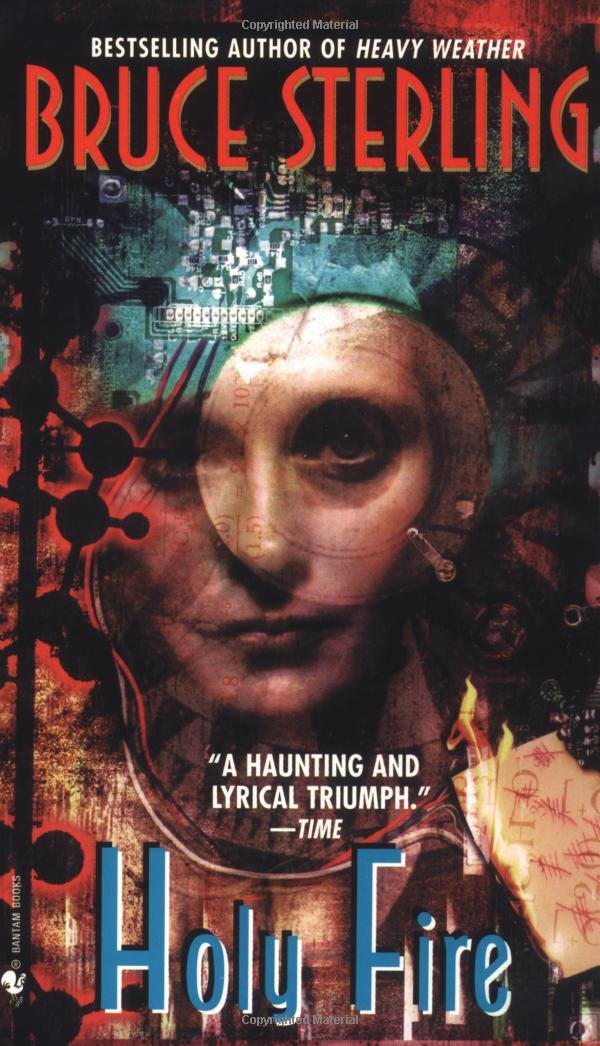
Image result for bruce sterling holy fire book coverHoly Fire is a great science fiction novel written by Bruce Sterling. It came out in 1996. It was nominated for the British Science Fiction Award in 1996 and the Hugo and Locus awards in 1997. High praise for great art. 

The story follows a medical economist named Mia Ziemann, a ninety-year old woman who transforms into a twenty-year old girl through intrusive technological means. Now (post-op) and borderline psychotic she goes by the name Maya as a young lady, traveling across Europe with nothing but a bag and the clothes on her back. She makes friends with all kinds of artists, bohemians, hackers, and fashion gerontocrats. The story is about life, death, the human condition, art, fashion, a very poetic sort of philosophy and ontology. 

The world of Gilead is somewhere in the year 2100. Gerontocrats control mostly everything and young people are like the scraps on their shoes, living on the margins. However, most things are free, including free health care and food, provided you don't harm your body or anyone else. Its a near future but its not a totally implausible one.

Once transformed, Maya gets caught up with thieves and drifters, eventually making her way into the fashion/modeling industry because of her sexy look. From there she makes friends in high places, mostly programmer types that help her with her palace, a digital life-space given to her by her now dead husband, complete with ruins and stuff. This is a cyberpunk story and the technology here is out of this world. Even with Sterling's esoteric explanations, the tech can get lost in between the dialogue, which is what helps make the novel move along nicely. 

Sterling gets very in depth with the virtuality within the story. His scientific explanation for Ziemann's transformation was quite complex. It was like reading Greek for me. However, it was mostly just advanced biology terms. The tech stuff here reminded me of William Gibson. Although I think Gibson does it better because he's able to make more out of the tech with his literary technique. 

Anyways, Ziemann gets caught up with a bunch of rich, radical anarchists and they plan on 'living forever' and taking control of the system, and this and that...But it turns out in the end that Ziemann gets caught up with the police, who were tracking her down because she skipped out on paying back her medical bills for the youth procedure. And not only that, but her dead husbands' talking dog Plato was always in the virtual palace, he'd been looking for her too. 

Ziemann goes through an ontological transformation. She realizes that she doesn't want to go back to being a gerontocrat, and that she wants to be a young photographer, even if she's really bad at it. It takes becoming a full blown criminal, a celebrity (at the end), a widow, and a Frankenstein-esque monster to realize what she wanted in life. 

The novel contains many debates between these young bohemian types over the immorality of immortality as well as the aesthetics of fashion. The underclass here are also talked about frequently, the class of people who can't become 'post-human', those are the real disenfranchised of the story. 

The writing of this story is free flowing with great metaphysical ideas. This is mostly done through dialogue and small events that happen over many pages-fifty pages here, another fifty pages there, etc. Although there are heavy cyberpunk elements here the ideas presented command more authority than mere tech. This isn't an easy novel to understand but its easy to read because the dialogue is interesting and the characters have artistic and idealistic charm.

If you want a different sort of cyberpunk novel this is for you. If you want a different sort of science fiction novel, this is it. They don't make science fiction like this anymore these days. And this was only from 1996! 

I'm currently waiting for my order of Bruce Sterling's Schismatrix. I heard from my father that's his most important novel. After reading his amazing collaboration novel with William Gibson, The Difference Engine, this was a great follow-up. On his own Sterling has grandiose philosophical ideas to go along with his cyberpunk technology. It has legs. 

Sunday, November 25, 2018

The Difference Engine

Image result for the difference engine gibson sterling
The Difference Engine by William Gibson and Bruce Sterling is one of those all-time great 'hard' science fiction novels. Set in a steampunk alternative history where primitive computers were invented in the mid 1800s thanks to Charles Babbage's Analytical Engine, the story has the three things a good cyperpunk story has: steam airships, brass computers, and kinky feminine underwear (Gibson's words). 

The story follows Sybil Gerard, the daughter of a famous Luddite agitator Walter Gerard (Luddites being anti-technologists), Edward 'Leviathan' Mallory-paleontologist and explorer, and Laurence Oliphant, a historical figure, a travel writer who works under service of Her Majesty. What links all these characters together are these computer punch cards that are supposed to be powerful, important enough to die for. 

The characters believe the punch cards are part of a gambling 'modus', a device used in gambling where you can never lose, and have infinite money, a alchemist device.  "The last chapter reveals that the punched cards represent a program that proves two theorems which, in reality, would not be discovered until 1931 by Kurt Gödel. Ada Lovelace delivers a lecture on the subject in France." 

Mallory, his brothers, and Ebenezer Frazer (part of the Secret Police) defends the cards against Captain Swing, who leads a riot during the 'Stink', a major pollution event that happened in London, similar to the London Smog of December 1952. 

At the end Oliphant meets Sybil Gerard and tells her he knows who she is, the daughter of Walter Gerard, the famous Luddite agitator. He says he won't share her identity with anybody, but that he needs information to help take down Charles Egremont MP, her seducer, who poses as an obstacle in the way of Charles Babbage and Lord Brunnel's political careers. 

The end of the novel features all these different histories that occur in the world of Difference Engine. Lovelace delivers her lecture on Godel's Theorem, as its counterpart is known in our world. Fraser accompanies Sybil and meets Lovelace, with Sybil not ever able to forgive Lovelace's father Byron, for her role in her father's death.  

The end features a view of an alternate 1991 from the point of a computer, which turns out to be the narrator as it achieves self-awareness. 

Wow! What a novel. There's a lot to like about this novel. There's even realistic sex scenes, sort of like noir. The description of 'clackers', the book's version of hackers is pretty interesting, and similar to what hackers are like in real life, the 30-hour savants working around the clock with their calculations. 

But I think what was most exciting about this novel was the sheer brilliance of the writing-dialogue, plot, exposition, niche time period words of the 1850s, its got a lot going for it. The way that Gibson and Sterling made the narrator a computer, it gave them more options when it came to plot and exposition. I also believe that because this is the work of Gibson and Sterling, that it was destined to be great. This book was written at a high period of literary achievement for both writers. So its no surprise that the writing is very good. Both of them went on to become very different writers after the cyberpunk 90s. 

Although the novel was nearly 500 pages and took a long time to read (including a lot of 30 minute lunch breaks at work), I would say it was well worth it. This book compares to something like Dune, which I put at a really high literary and science fiction pinnacle. Its just that good.

The truth though is that the book took me a long time to get into. In fact, I had checked it out numerous times and barely ever got 50 pages in and at point I even listened to the audio book version on YouTube. Eventually I decided I was going to read the whole thing, turns out it was well worth the time and effort. But a book this great doesn't take too much effort, the words seemingly move across pages very easily. The time invested in reading this book is time well enjoyed. Such is the literary style of Gibson and Sterling. 

Well worth the read if you like alternative history, steampunk, or cyberpunk stories.  

Tuesday, June 5, 2018

An Android Story by Orlando Figueroa

Check out my first story written since 2013. Its called An Android Story by Orlando Figueroa. Its a science fiction story about an android that plays jazz saxophone. Enjoy!
Read it here.

Tuesday, January 16, 2018

Metropolis (novel)


Hey! What's up everybody? Its been quiet on this page the last couple days because I've been pretty tired and I took a night off from my work (reading) so I was behind with my readings. Now I'm all caught up, as I've already finished another novel, this time Metropolis written by German female intellectual Thea von Harbou. Metropolis is also the name for the movie that was made and inspired by this book. The book came first, and the movie thereafter.

The story of the book follows closely the movie so rather than rehash what I already wrote about you can get the gist of the plot from my movie synopsis, which can be read here. There's actually not much information on this book on the Wikipedia page for it but it should be known that the end of this book concludes with Freder's father realizing that his dead wife will be with him till the ends of the Earth (she died and left a letter for him). Lets focus on the literary style and high art that is this novel.

The novel is a short two hundred and fifteen pages but the writing style can be hard to wrap your head around. This is high German art language and Thea von Harbou was quite the intellectual, you can tell by the English translation of her writing. Don't get me wrong, its not dense by any means but there's a sense that you have to really understand everything you're reading because its so highly stylized. One sentence that describes a simple thing could turn into a whole page affair but she does it in a way that you want to read more about that one thing, without making it boring or trivial. Its quite something, I don't think I've ever read anything quite like this, its a powerful novel.

The film omits references that the book made to the occult. There's tons of references and images to the occult here but because I'm not familiar with that realm I didn't see it as particularly offensive or foul by any means. I learned about some evil things I suppose but its nothing that's going to make me wet the bed at night (lol). Besides, the pentagram beside the machine-woman is pretty evil enough for 1927.

In addition, the film omits moral motivation for certain actions by the main characters. Yes, the book differs quite a bit from the movie's characters, which are more black and white. In the book the characters are much more detailed, much like real people. We don't necessarily see things as good or evil, there's all these gray areas that are quite apparent.

This book is great! I would recommend the book to any science fiction readers, women that want to get into science fiction, and people who like really old books. I liked it so much I might read it again much sooner than expected, I could see myself reading it again in a few months or so, just to see if it still has that same poetic fire and intensity from the first read through. Definitely check this book out.

HEAD and HANDS need a mediator. THE MEDIATOR BETWEEN HEAD AND HANDS MUST BE THE HEART!

Friday, January 12, 2018

The Hitchhiker's Guide to the Galaxy


The Hitchhiker's Guide to the Galaxy is a science fiction novel written by Douglas Adams in 1979. You can see the book influenced science fiction in a popular cultural aspect, just take a look at Dr. Who and this book is that. The idea of the actual book in the novel, entitled The Hitchhiker's Guide to the Galaxy, a book with so much information compiled into it that it could be city, this idea is in a book I'm currently reading, Neal Stephenson's The Diamond Age Or A Young Lady's Illustrated Primer. In this book an electronic book is given to a girl of a lower social class, a book compiled by men in government. That idea is much more serious than this book however. But Hitchhiker's is good fun. 

The plot follows a cast of characters (one human with a bunch of aliens) following the destruction of the planet Earth. This alien who was living on Earth for fifteen years and got stranded and this human are the only Earthlings that lived through it and now they've gone out into the Galaxy as sort of space dandy ronin, thus hilarity and shenanigans ensue.

It must be mentioned that Douglas Adams also wrote for Monty Python and it is evident here. There's lots of off the wall wacky descriptions of things (often with made up words), hilarious comedy dialogue, all the while being descriptive in a quasi literary way. 

I thought the ending was kind of funny. So basically because the Earth man had been on the Earth right before it was destroyed, somehow he knew the meaning to life (or something like that), and these mice (who were the secret overlords of the Earth, although they allowed themselves to be tested on by humans) needed his brain to access it and give this Universal Truth to the entire Universe, which needed to be said by this millions of years old Computer. They needed to remove his brain. Got that?

Its just funny that ultimately they found themselves in a sort of popular science fiction cyberpunk moment, which was a change of pace from the rest of the book, which is mostly descriptions of things and evolution of plot. There's a part where our gang of misfits meet two liberal cops who say they're just regular guys, liberals who embrace their girl friends in the fact that they feel bad when they shoot or kill people, and that they like to write poetry but haven't had anything published. It was an over the top moment like most of this book, but this part in particular had a Zen feeling, we can humanize our enemies, even within the contexts of this fun space adventure. That's probably the best thing I can say about it. Its not quite like the science fiction I mostly read, which is all serious works about class and society but it was a fun alternative for something to read in between my usual readings. Right now I'm reading through Octavia Butler's Kindred and I gotta say it is phenomenal, I'll be writing about that novel next. 

"In the beginning the Universe was created. This has made a lot of people very angry and been widely regarded as a bad move."

Saturday, January 6, 2018

The Demolished Man


The Demolished Man is a science fiction novel written by Alfred Bester in 1953. The book was the first winner of the prestigious science fiction honor, the Hugo Award. This book is cyberpunk's version of Crime and Punishment.

The story is set in the 24th century in a universe of telepaths (Espers, called peepers in the book), although telepathic effectiveness depends on how great of a telepathic the person is. For example there are level 1 telepaths (the best), level 2 (pretty good), and level 3 (not of much use but still employed).

Here's a basic synopsis of the book.

A man named Ben Reich (owner of Monarch Utilities and Resources) is a rich megacorporation owner and he finds that his megacorporation is in jeopardy (danger of bankruptcy) because of his rival the D'Courtney Cartel, headed by the older Craye D'Courtney. He has nightmares about a "Man With No Face", which always leaves him scared for his life, and throughout the book even screaming and running.

Reich contacts D'Courtney about a merger between the companies and Reich misreads D'Courney's response as a refusal. So Reich creates a plan to murder him so his company will be alright, and so he will be able to take over the D'Courtney Cartel. Because of the peepers its hard to commit murder and murder hasn't been committed for seventy-nine years. If caught Reich will have to serve "Demolition" for his crime, which is later described as a sort of violent mental and neurological re-education. 

In order to carry out the murder Reich builds a mental block using a song he hears.

Eight, sir; seven, sir;
Six, sir; five, sir;
Four, sir; three, sir;
Two, sir; one!
Tenser, said the Tensor.
Tension, apprehension,
And dissension have begun. 

Believe it or not this jingle actually prevents most of the Espers from hearing and seeing his murderous intent. I could get more detailed with the plot but I think I will go with my edited short-hand version for the sake of being easier on the eyes (lol).

So basically Reich ends up killing D'Courtney, and he hires two strong Espers to work for him while he is being investigated by the police and their own league of peepers. D'Courtney's daughter catches Reich at the scene of the crime (where he shot D'Courtney through the mouth, blowing through his skull) and she runs away. She gets found later by the police who have her undergo some sort of mental rebirth, not Demolition but still mentally jarring. 

At the same time Powell, the main cop doing the murder investigation is finding out tons of information but he needs everything to be right if he's to prosecute, as this could make or break his career. Not only that, but the murder could be a break in the universe, for he couldn't take information from peepers about the crime because that would be against the Esper Guild Oath, which he had to respeckt at all costs. Even though he had or could get information about the murder from peepers it was against Esper regulations to use it in court. So there's that. Ethics in the future just like today.

So we have Reich and Powell fighting and going through the ropes, the criminal and the cop after him. Eventually Reich comes face to face with the Man With No Face, which turns out to be part himself and part D'Courtney, who is revealed to be his father. Surprise! The bad guy is your father! Star Wars anyone?

Anyways, Powell "asks the help of every Esper in attempting to arrest Reich, channeling their collective mental energy through Powell in the dangerous telepathic procedure called the "Mass Cathexis Measure". He justifies this by claiming that Reich is an embryonic megalomaniac who will remake society in his own twisted image if not stopped." (wiki)

Reich is revealed to be the son of D'Courtney, the result of an affair between his mother and D'Courtney, making Barbara (D'Courtney's daughter) his half-sister. Barabara is revealed to be a peeper so its possible that Reich's hatred for D'Courtney was inspired by a telepathic connection, which is also a sort of Freudian complex.

"Once arrested and convicted, Reich is sentenced to the dreaded Demolition— the stripping away of his memories and the upper layers of his personality, emptying his mind for re-education. This 24th-century society uses psychological demolition because it recognizes the social value of strong personalities able to successfully defy the law, seeking the salvaging of positive traits while ridding the person of the evil consciousness of the criminal." (wiki) 

The idea of re-education for criminals is a good one. I like that idea very much, in fact if America re-educated all the criminals we would live in a better society. It doesn't have to be as drastic as this book, it could simply be re-education through labor like how the Chinese do it.

The book shows us that although the world may change in the future with its technological advances, human nature will always remain the same. People will still be evil, murder will still take place in the future. Here we have a story that isn't utopia, nor is it post-apocalyptic, its almost like how real life actually was in Alfred Bester's time-the 50's.

The idea of the peepers is totally science fiction. In addition the idea that the bad guy is your father is also a popular trope in science fiction (Star Wars). The idea of Demolition (re-education of criminal minds) is also another popular idea from many contexts. I remember when I played the video game Star Wars Knights of the Old Republic I, in the end you find out that you were an evil murderer ruler of the Galaxies, and that the Jedi re-programmed your mind and swayed you to do right to all the wrongs you had committed. The book reminded me of that game.

This is a pretty important book in science fiction I would say. I was inspired by Bester's other novel, The Stars My Destination (which you can read about here), and I have to say I was not disappointed by this book either. The literary style has finesse and gravitas. In fact, the prose has such momentum that once I started reading it I could hardly put it down until I finished it. I felt exactly the same way as when I was reading Tiger! Tiger! (The Stars My Destination). Here is great writing and he finished the book in less than three-hundred pages. It's terrific. I've learned a lot about the old school style science fiction of the 1950's and I'm ready to read more.

Definitely check out this novel if you like science fiction.

“If a man's got talent and guts to buck society, he's obviously above average. You want to hold on to him. You straighten him out and turn him into a plus value. Why throw him away? Do that enough and all you've got left are the sheep.”

Tuesday, January 2, 2018

The Stars My Destination (Tiger! Tiger!)


The Stars My Destination (also known as Tiger! Tiger) is a science fiction novel written by Alfred Bester in 1957. Bester is known for science fiction stories as well as having written for Superman and Green Lantern (he created the Green Latern oath). Its a story that takes place in the 25th century and revolves around Gully Foyle, a teleporter driven mad by revenge.

"Originally serialized in Galaxy magazine in four parts beginning with the October 1956 issue, it first appeared in book form in the United Kingdom as Tiger! Tiger! – after William Blake's poem "The Tyger", the first verse of which is printed as the first page of the novel – and the book remains widely known under that title in markets where this edition was circulated. A working title for the novel was Hell's My Destination, and it was also associated with the name The Burning Spear." (wiki) 

Lets go over the plot. So the book starts off explaining this universe that Bester has created. Its the far future, people can teleport through their minds but not through space, and people have inhabited other planets and moons. Gully Foyle (an uneducated, unskilled, unambitious man), a monster (for many reasons, which will be explained) of a spaceman is trapped, stranded on a spaceship (the Nomad) for six months, subsisting on rations but pretty much starving and left to die.

All of a sudden he sees another spaceship (the Vorga). He sends out a distress signal and he knows the ship sees it. The ship passes him by and leaves him to die. His rage consumes him. He vows to kill whoever was on that ship, whoever gave the order to leave him there. This becomes his reason to live.

He eventually fixes the ship but gets captured by a cargo cult in the Asteroid belt. They tattoo an ugly mask of a tiger on his face, using needles etched into his face. Foyle eventually makes it back to Terra (Earth) where he makes an attempt to blow up Vorga using explosives. He fails and is captured by Presteign, a rich leader in government. Unknown to Foyle, the Nomad was carring PyrE, a substance that can make the difference between winning or losing in a war with the Outer Satellites.

Foyle goes to a juante proof (teleporting is called juanting) prison and here he meets Jisbella McQueen, and she teaches him to think clearly, and she also tells him that he needs to find out who gave the order to leave him to die, not just kill the people who were aboard the ship (Foyle's not too bright).

Together they escape the prison. Jisbella gets Foyle's tattoos removed but not completely. When Foyle gets emotional the tattoo appears. They return to the Nomad, where they take the PyrE (which is a weapon controlled by thought) and also a fortune in platinum.

Later Foyle returns as a man named "Geoffrey Fourmyle" (Foyle's alias was implanted in his subconscious mind during Dagenham's interrogation, Dagenham is a government worker), a rich dandy who is sort of silly to the other rich people. Through yoga he's learned to control his emotions and keep his tattoo from showing. He meets up with Robin Wednesbury, a one-way telepath, whom he raped earlier in the novel. He persuades her to help him charm his way through high society. The rape in the book brings to mind a problem that has existed for a long time. The rape isn't explicit but it is implied to the utmost degree. It was quite troubling and makes you sort of hate Foyle, but in the end you don't have to like Foyle or any of the characters to enjoy the story for what it is, a grand space opera, true cyberpunk. But I digress.

Foyle ends up tracking down the guys who were on the Vorga when it passed his ship but all of them were implanted with a death-reflex and die when questioned. Every time, Foyle is haunted by the image of "The Burning Man", an image of himself on fire but the fire turns out to be real and sometimes his clothes are actually burning.

At a high society party Foyle becomes smitten with Presteign's daughter Olivia. During a nuclear attack by the Outer Satellites Foyle goes to save Olivia and she says that if he is to have her he has to be as cruel and ruthless as she is. Robin is traumatized by the attack and wants out of this whole operation, so she gives Foyle information (on Vorga, on his whole mission) in exchange for her freedom and leaving this whole thing behind. Foyle takes the information then doesn't allow her to leave. Robin responds by going to Central Intelligence and betraying him.

Foyle learns that the captain of the Vorga joined a cult on Mars and had all her sensory nerves disabled, making her immune to traditional torture so Foyle kidnaps a telepath (a little kid) who interrogates the captain. From this he learns that Vorga didn't pick him up because instead it was picking up refugees, taking their belongings, and tossing them out into space. He also learns that this was all controlled by Olivia Presteign. Commandos come to arrest Foyle on Mars but Olivia ends up saving him, because she sees in him someone who can match her "hatred and need to destroy". 

Foyle becomes stricken with grief and wants to turn himself in for all the evil he's done in the universe. He gets captured by Presteign's lawyer Regis Sheffield, who turns out to be a spy for the Outer Satellites (Terra's enemy). 

"Sheffield tells Foyle that when the Nomad was attacked, Foyle was taken off the ship, transported 600,000 miles away, and set adrift in a spacesuit to be a decoy to attract ships to be ambushed. Instead, Foyle space-jaunted—a previously unknown possibility—back to the Nomad. Now, the Outer Satellites not only want PyrE, they want Foyle as well, to learn the secret of space-jaunting." (wiki)

Presteign reveals that PyrE is activated by telepaths and tells Robin to trigger it to bring out Foyle. Destruction is caused around the world but mainly at St. Patrick's Cathedral (where Sheffield brought Foyle) and it traps Foyle, leaving him unconscious.

"Suffering from synesthesia brought on by the explosion affecting his neurological implants, Foyle jauntes through space and time as The Burning Man. Finally he lands in the future, where Robin telepathically tells him how to escape from the collapsing cathedral." (wiki) 

Back in the present Foyle is pressured to hand over the PyrE and teach the world how to space-juante. He asks a robot what he should do and decides for himself. He juantes throughout Terra and throws a little bit of PyrE out to people, telling them if they want to learn how to space-jaunte they should follow him. "Either destroy yourselves or follow me into space".

Foyle realizes the key to space-jaunting is faith. He juantes from star-to-star finding places for colonization, but only reachable if he shares the secret of space-jaunting. The book ends with him back at the cargo cult, where the cultists await the holy man's revelation.

Wow, what a story! Now I'd like to go over the space opera & cyberpunk elements of this great piece of art and end with my thoughts on the work.

This book was very influential on the cyberpunk movement that would come later in the 1980's, particularly with William Gibson's Neuromancer. The ideas of the megacorporations, cybernetic enhancement (Foyle gets modded in the story, making him a killing machine), juanting (teleporting), telepathy (but limited), poetry (its partially inspired by a poem), and speculative science are all quite related to the space opera genre.

The literary style is quite stylized. In fact, once I started reading the book I couldn't put it down. The writing itself isn't complicated or highly detailed but it has a sort of "I must read more" prose. I read it at work on all my breaks. I wanted to find out more and more until I finished it, its that good. Here's a writer who is stylized, makes the reading exciting, and writes a great story in only two-hundred and thirty pages. This is quite a difference from what I usually read, third wave science fiction writers (I'm right now reading through Neal Stephenson's The Diamond Age, Or a Young Lady's Illustrated Primer). This book is more interesting than that, more exciting, not necessarily more detailed, but better in the long run because of that. I learned a lot about writing from this book. You don't have to write a thousand pages to get your point across, because instead you can do it in two-hundred.

All that being said, this would be a great novel to come back to in a couple months or years. Twenty or thirty years from now I could read it and either get something new out of its ideas or revel in its literary and cyberpunk style. Either way, its still a fascinating book. 

On AI, Existential Threat, and the Collapse

Good evening ladies and gents. Hope you all had a good Sunday. I wanted to write here a bit more about AI, existential threat, and the Colla...