Showing posts with label machines. Show all posts

Wednesday, March 19, 2025

Beware the Ides of March

Well, here we are. 2 13 AM on a Wednesday morning. It's March 19, 2025. Something like day 60 of the Trump recaptured White House. Here, I'll go into some details about life, music, AI, and politics. the usual subjects as of late. 

First, life is what you make it. Regardless of the fact that the United States has entered unchartered territory, life is still somehow amazing. Why? Because I have the capacity for happiness. That's not to say that bad things won't happen, I mean, that's Murphy's Law. But, what I mean to say is that regardless of all the bad things that are happening in the world, or possibly even in our lives and in our loved ones' lives, we should all learn to have the capacity for happiness, and realize, and see/acknowledge, that regardless of how much or how little we have, we all have a lot to be grateful for, in one way or another. Even if you don't believe in God.

Case in point, I'm not necessarily in the best position right now. I'm currently unemployed, after working as a retail grocery cashier for the last ten years straight. This is a mega-change for me, as I'm used to working nonstop 5-6 days per week. And now? Nothing. No weekly paycheck, no cute girl coworkers to talk to or hangout with, no affirmation from customers [mostly beautiful women] telling me I'm doing a good job, no steady schedule of any kind. The biggest problem is that I lost a good form of structure in my life. I miss it and am trying to get back into the job market as soon as I can. 

So, the response to this has been to create a new sort of order to my life. In whatever way I can. For me, this has meant turning more inwards towards books, music, AI, exercise, and cultivating a good clean headspace for me to be in as much as I can. I've found that a lot of my friends/associates from the retail grocery world are much more miserable than I am. Not only that, but they have a lot of health problems like drugs/alcohol, behavioral issues, they don't have money, and the ones that do, they tend to not enjoy their lives because of various reasons like: relationship troubles and lack of purpose working within retail grocery. On top of that, most of them whine and complain like there's no tomorrow. So what's the issue, doc? They simply lack the capacity for happiness. That's right! 

Second, music. I'm finding that music has more often than not, has become more of a background experience for most listeners. Like how all these years I've been going to the bar for music, almost all of the music never mattered, because the audience just uses it as background to drink beer to. This has been true for a long time now, but I think it will become even more so in the coming months and years. 

Why? Because of the advent and widespread usage and acceptance of AI by intellectuals, techies, nerds, artists, musicians, writers, and even the GOP itself, we're finding that AI content is not only accepted, but people are more and more willing to use it for, well, pretty much anything and everything. This includes using AI content for music generation and video generation. And once that content becomes more commonplace and accepted, I think real, live, musicians will be in trouble because people will say, "If I can get an AI orchestra to play Mozart, why would I need to pay a real orchestra?" It sounds a little off but I think it's already happening. Case in point, music production software that increasingly replaces live musicians, although that's been happening for a long time now.  

Third, going back to AI. Right now we live in a world where the Tech Bros are winning at everything and anything. Contrary to popular opinion, while I think AI is a gamechanger and a must use tool for creatives of any kind, I also acknowledge that AI is another weapon in the tech oligarch toolbelt, that can be potentially used to intentionally AND unintentionally harm people who don't use it and understand it. So yes, all this AI stuff is mind-blowing and amazing and it will make you more creative and techy and more computer savvy, but what about all the people who are opposed to it, either they don't like it or they just don't want to use it or acknowledge it? 

Well, unfortunate to say, those people will simply get left behind. People that don't acknowledge, use, or stay informed on AI will find that other people around them will eventually start using it more and more, adding it to their daily routines, and they will catch up to where the Culture is on AI. Right now I think most people are still asleep at the wheel when it comes to AI, as I also believe most people are asleep at the wheel in terms of politics. It's especially important to keep in mind that right now, in some aspects, AI and politics are interlinked, as some liberal thinkers believe that it's because of AI's algorithms that Trump was able to recapture the White House. That's right folks. Beware the Ides of March. 

Lastly, politics. So you see all these things are interlinked [Bladerunner 2049, Ryan Gosling: Interlinked]. The Tech Bros were at the White House inauguration. That's because technology has always been a tool in electing public officials, probably starting with the printing press back in Europe over hundreds of years ago. But now, with the power of AI algorithms, we're finding that controlling the flow and access of various forms of media, in fact, controlling ALL of the flow and access of media, has been very easy for the Republican and Democrats to do, utilizing the new emerging technologies like AI algorithms created by these Tech Bros like Open AI's Sam Altman, who was at the inauguration at the White House when Trump was re-elected. 

It would be nice if people who were using AI were all nice well-to-do dandy intellectual techie guys who want to make the world a better place. But increasingly, more and more, I'm finding that its usually always the opposite, especially when you tune into the media and the news daily and are really reading and paying attention to what's going on. In a truly fucked up way, I think, increasingly, people who use AI look down upon people who are unfamiliar with it and/or don't know about it or don't use it, they're being looked down upon, as like cavemen, as country hicks, or lesser than, simply because they aren't in tune with what's going on with the emerging tech and how it's being utilized to help destroy our late period capitalistic society. 

But for the most part people are asleep at the wheel. We still believe in the Rule of Law. We believe that as long as we go to work, listen to our bosses, do a good job, come home to our families and take care of our wives and kids, that everything's going to be alright, as long we got cash, a car, a home, a wife, and our 2.5 kids and a dog. Well, what if we're asleep at the wheel and we're Caesar and we're about to get stabbed? "And you too, Brutus?" 

Good news for people who love bad news. Watch this space.


[image AI generated] 

Tuesday, April 23, 2019

Player Piano


PlayerPianoFirstEd.jpgPlayer Piano is Kurt Vonnegut's first novel. Released in 1952, the book tells a story of a brave new world [Nytimes back in the 50s, book reviewer compared it to Huxley's Brave New World], where machines have taken over society, a dystopia. This is a book about automation and humans, how they co-exist in a dystopian society ruled by an oligarchy but the interesting thing is that the oligarchs are engineers rather than kings or presidents.

Player Piano's universe is ruled by engineers who build, fix, and keep the machines running. Everyone else with low IQ's [IQ's are known in the public sphere, thru testings] are either in the Army or the Reeks and Wrecks, which is the low-level grunt work of the society. Paul's father helped build the machines that helped win the war, and that currently helps society. He made the engineers the most important class and his son is high up in the company. Paul's father is now deceased and Paul is struggling to find himself, that is, he has an existential crisis. 

Paul thinks that there's more to life than fixing machines and being an engineer, even if he's rich, has a beautiful wife, and a nice house and car. Paul tries to find a way out. He starts reading novels about burly men that do extravagant things in life. He wants to become like Thoreau. He plans on quitting his Engineering managerial position at the factory, one of the most important jobs in the world. He even goes so far as to buy a farm, thinking he's going to get his wife to quit living the high life and work as a farmer with him. She doesn't like his surprise when she sees the farm.

The book hits a high note once Paul goes on an Engineer's retreat, in the woods with all the managers and young engineers from factories all over the country. You get a sense that these engineers are being brainwashed into thinking their job is the most important and everyone else is below them. It's at the retreat that Paul is asked by factory management to infiltrate this organization called the Ghost Shirts. The Ghost Shirts are disgruntled engineers and low-level workers that have had enough of machines taking all the jobs. They want life to go back to the good 'old days when people washed laundry with their hands and jobs were done by people rather than machines. If Paul does this he gets a higher level job at another factory. Big whoop.

Paul plays along quite nicely, and says, "I quit! I quit! I quit!", with so much enthusiasm that his managers think he's playing along too well. The fact of the matter is that his managers had to fire him so he could infiltrate the Ghost Shirts. But Paul really meant that he was really quitting for real, which they interpreted as him playing along. It's very funny. 

Paul goes back home from the retreat and is treated like a second-class citizen by the police, who is notified that he's lost his job, status, and position in society as one of the Engineering Class, the highest social class. 

Once Paul's in the Ghost Shirt Society they make him their leader, almost a Messianic figure because he's the son of the "Father of all Machines, the Father of Engineers", oh how he's fallen from grace. A revolution takes place, and people go ballistic, destroying machines and burning buildings. But when the destruction is over, Paul and the Ghost Shirt Leaders find out that people are finding all the scraps of machines they can find only to rebuild machines! It's very ironic, satire. It turned out that people actually wanted the machines to work for them, and that all this time Paul might have been wrong about society, machines, everything. Or maybe not.
 
Player Piano isn't such much a tirade against technology, machines, or automation so much as it is a critique of progress, within society and politics. Vonnegut may be a Luddite in the sense that he rejects society's unhealthy relationship to technology. But today that could be most people as most people think the young folk shouldn't be so consumed with the tech of the day-social media, online gaming, spending all their time in front of a screen, be it a smartphone, tablet, TV, laptop, or computer. Most adults in the room would say our young people need to stop being consumed by these things, go back to a simpler time-spend more time outdoors with nature or reading books at libraries. Vonnegut perhaps might be saying that a nation that innovates technologically but not socially is not truly progressing. 

These are ideas Vonnegut used for his first novel because they were real and close to him. He had been a prisoner of war after being captured by the Germans during the Battle of the Bulge. You can sort of see how he got some of his ideas. Germany thought that all their problems would go away once factories were built but it turned out that Germany was actually on the wrong side of history socially and politically. Factories and jobs didn't end up helping them. Likewise, Facebook, Twitter, Amazon, SnapChat, Discord, Instagram, and YouTube haven't helped us to progress socially or politically either. 

At the end of the novel when the people are grabbing scraps of machines to rebuild their beloved machines, one of the Ghost Shirt leaders says to Paul, “This isn’t the end, you know… Nothing ever is, nothing ever will be – not even Judgment Day.”

"After all, there’s always a step backward, and a step backward, after making a wrong turn, is a step in the right direction." [vonnegutreview.com] 

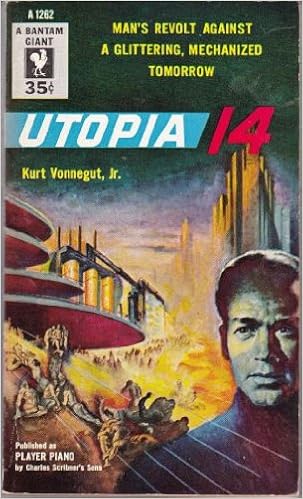
Interesting tidbit-one edition for Player Piano was titled Utopia 14, just to give it a more science fiction name, "whereby Vonnegut gained the repute of a science fiction writer, a genre held in disdain by writers at that time. He defended the genre and deplored a perceived sentiment that "no one can simultaneously be a respectable writer and understand how a refrigerator works" [wiki] Also, it should be noted that Player Piano is more conventional storytelling, especially with the slow narrative. His other novels would go on to more grandiose ideas, more science fiction, and much more satire. If he kept writing in this plain style that is Player Piano he wouldn't have become such a famous name.
 
The original cover pictured above, Utopia 14 cover pictured below
Image result for utopia 14 vonnegut


Tuesday, December 26, 2017

The Machine Stops


The Machine Stops is a science fiction short story written by E.M. Forster in 1909 for the Oxford and Cambridge Review. At 12,000 words its pretty detailed. This isn't your third wave science fiction folks, which is what I'm more used to.

Here we have a civilization that lives in honeycomb-like underground cities. People don't touch each other, not even for handshakes or hugs. People have become anxious when it comes to non-virtual meetings. Each pod that people live in comes with one book, The Book of the Machine. All other books and information are electronic. "All other info is electronic, and the forests, Forster explains, "had been destroyed during the literature epoch for the purpose of making newspaper pulp." The Book not only instructs which button to push when, but alleviates the trepidations of life in the Machine." (Wired) 

The story focuses on a mother and her son. The mother is a lecturer (I think she teaches music of certain civilizations) that gives these lectures from inside a room that is controlled by machines, much like how today we can do tons of things in the comfort of our homes, behind our computer screens, Iphones, and television screens. Her son is against the Machine, the electronics that give the people everything they need, from beds, email, to video (a prehistoric FaceMeet, where you can video call people). The people live underground with no sunlight of course but they can go to the surface, if they wear the proper attire (facemasks, the air can kill them) and if they have permission from the Government. We learn that this guy makes illegal trips to the surface often. He's quite the resistance type. 

Even scholarly trips to the surface are not allowed. Experts get their information about the surface from the Machine, a sort of proto-google. The Machine doesn't sustain itself forever. Life is not getting better. The music starts to get blurbs and bad quality sounds. The water has a smell. The Government says they're fixing the problems with the Machine but the repairs needed exceed the damage that keeps accumulating.

On the final day Vashti (our mother character) isn't doing so well. She's horrified to see whats outside her cubicle.

She whirled around, praying to be saved from this, at any rate, kissing the Book, pressing button after button....
An airship ... crashed downwards, exploding as it went, rending gallery after gallery with its wings of steel. For a moment they saw the nations of the dead, and, before they joined them, scraps of the untainted sky.

And I thought working a nine to five everyday for the rest of my life was scary. 

Here we have a science fiction dystopian sort of story that looks similar to the world we live in today. If all the computers in the world crashed right now the entire world would go into chaos. We're reliant upon these machines for everyday life. Could you live without a smartphone? I don't even own one and never have. We think we can do without it (modern technology) but most Americans would never put themselves through that. For them it would be torture, even for myself. Have we really empowered the machines to the degree that we've become weaker as humans? Perhaps that was what Forster was going for. Nevertheless it certainly makes for interesting science fiction writing. Everyone that likes science fiction and uses computers should read this short story, there's a lot to be gained from its dark brooding mentality about technology.

Read the full story here.

On AI, Existential Threat, and the Collapse

Good evening ladies and gents. Hope you all had a good Sunday. I wanted to write here a bit more about AI, existential threat, and the Colla...