Showing posts with label book. Show all posts

Sunday, June 30, 2019

Coders

Image result for coders the making of a new tribe book coverCoders, The Making of a New Tribe and the Remaking of the World

Coders is the latest book I read. Its about computer programmers. What it takes to be a programmer, what programmers actually do, which could be blue-collar work, hackers, etc. The book takes a much darker tone at the ending chapters about the rise of AI in modern society. 

Coders is written by Clive Thompson, a longtime contributing writer for The New York Times Magazine and a monthly columnist for Wired. A tech writer. 

The book starts out with a chapter titled The Software Update That Changed Reality. This, of course, is Facebook. Clive goes on to talk about how the Like button feature came to be. Its interesting but the Like feature itself is kind of a dumb feature. Then there are The Four Waves of Coders which basically tells the history of coders starting from the female lead 1960s to the rise of the nerdy male dominated field programmer in the 1980s, to today, where the field is being filled with just slightly more women and minorities. 

Myspace is mentioned as an important happening in the early 2000s but isn't given nearly enough attention. Likewise, gaming is only mentioned in the Neopets context until the very end of the book. Not saying much about gaming makes this book a little lacking, because for the most part gaming has become the most popular entertainment system in the world, surpassing movies even in revenue and sales. That makes it worthy of a entire chapter in this book.

There's a great chapter called 10x, Rock Stars, and the Myth of Meritocracy which basically states that there's a myth of the rock star programmer, who by himself, is better than 10 or 20 coders. Surprising some of the best programs and software have been written by only a one or two person team. This rock star myth can be true but Thompson goes to lengths to state that this "better than thou" attitude 'great programmers' are hard to deal with, and besides, most companies need a team of programmers to do their work. Sometimes its difficult to get these rock stars to work well with the less sophisticated co-worker.

The last couple of chapters gets more philosophical. The Rise of AI, Scale, Trolls, and Big Tech. These are the more dystopian aspects of the book. How Facebook got used by Russian bots to swing American perceptions during the 2016 election, possibly swaying favor to Trump. How Twitter is used by white nationalists to spread hate. Machine learning algorithms have taken a big role in modern society but there are inherent biases in therein. When Google tried to create a face recognition software it scanned a picture of a black person and labeled it as 'gorilla', which is, of course, laughable because you realize how incredibly machines and people are but its also horribly racist. There are some leaders in tech who think if the real world is racist then shouldn't these things reflect that? Of course, this brings a lot of ethics into the equation. Which is the reason why we need more women and minorities in tech. The general consensus is that having white programmer dudes create everything we use is a bad idea because they've made mistakes like not thinking of the rise of hate on their platforms, like how Twitter ended up being used by white nationalists and such. Programmers tend to be pretty mixed with their political beliefs. Some are libertarian but for the most part, accept the democratic policy. There aren't many conservative programmers. A lot of them think government should get out of the way but still apply social policies. They see through their work that a person shouldn't be shunned because of their race, gender, sexuality, rather by the strength of their code. This is a good thing. 

The book ends with Blue-collar Coding. At the very end, he mentions how the creators of the videogame Minecraft wanted to create a game that was fun. But kids were doing more interesting things with Minecraft than what the creators expected. Kids were learning how to build all kinds of grand buildings and displays using the game's lego block-style engine. At the end of the day the coders of the future might not all come from 4-year college institutions, but rather milennials/middle age folks looking to change their careers, young gamer nerds that want to code their own games, and people who do it a lot in their spare time for fun. In some ways, the programmer of the past resembles that of the programmer today because in both contexts the programmer's credentials don't matter, only great coding skills. It's one of the only jobs where you can find an employee with a college degree working with another employee who has no degree. Of course, if a programmer was trying to get a job at Google that college degree wouldn't hurt. 

No doubt this is a pretty boring nonfiction book not nearly as exciting as my science fiction novels I go through. However, this book got me more interested in programming, learning some programming languages, maybe trying to create my own games and apps, or find a job where I can tinker around writing code in whatever context. There's a future in programming and I'm in front of the computer a lot anyways so I might as well look into it. I also find it fun and exciting. Another book that is similar to this one is Steven Levy's Hackers, a very good book about the early computer revolution going back to the 1950s and into the 1980's Apple II computer and it even has extensive chapters on videogames like the first MMO [massively multiplayer online game], Richard Garriott's Ultima Online. That book was very engaging and exciting whereas this one was more informational. Now I have a very good idea of what it takes to be a programmer: good knowledge and experience of the languages and error messages, logical thinking skills, patience, ability to deal with frustration, and the ability to find and fix bugs, an act known as debugging. 

This is a new book from 2019 May. Definitely worth the read if you're into tech and interested in programming.

Saturday, April 27, 2019

Gateway


GatewayNovel.JPGGateway is a science fiction novel by Frederik Pohl, written in 1977. This is part of a five book series, called the Heechee Saga, comprised of five books altogether. However, I think I'm going to just settle for just this first one.

"Gateway won the 1978 Hugo Award for Best Novel, the 1978 Locus Award for Best Novel, the 1977 Nebula Award for Best Novel, and the 1978 John W. Campbell Memorial Award for Best Science Fiction Novel. The novel was adapted into a computer game in 1992." [wiki] As you can see this was a very important, very good book when it was released back in the '70s.

The book follows a young man with the unusually feminine name of Robinette Broadhead. He's a filthy rich bastard but he's a crybaby. He's sad and depressed even though he has sex all the time, he's filthy rich, and he has new body parts that will give him an extended human life, wow! 

Why is Robinette sad? Why's he an asshole? How did he get rich? Where's the science fiction in this? Why read it? The book unravels like a good mystery. One. Clue. At. A. Time. Just like that, the book keeps you reading by giving you little snippets of information that reveals the why of the story.

The MC [main character] is sad because he had a terrible childhood working in food mines back on Earth. His mother never told him he loved him, and he felt close to her when he was a kid when she would stick a thermometer up his ass to check his temperature when he was sick. [this is why Robinette's homophobic] His father died and he was a nobody until he won a lottery. Enter Gateway. 

Robinette won a lottery ticket that got him to Gateway. Gateway is this space station of an alien race. They left behind all these ships but humans have no idea how to control them, or where they will go, meaning that many people die just to experiment with the aliens' ships. Sometimes they go to other universes, other galaxies. The purpose of Gateway is to learn all the rules, get a crew, and take Heechee spaceships [aliens here are called Heechee, great name, sounds cute] to wherever it will take them, to somewhere where they will hopefully find Heechee artifacts. Hopefully you don't die along the way. The organization running Gateway pays top dollar for artifacts once crews come back from their trips. The thing is that most crews don't come back. Or they come back splattered all over the ship.

So we have an unsympathetic character and a myriad of other characters, most of which don't have nearly as much personality [or lack thereof] in contrast to Robinette. His girlfriend that he meets on Gateway becomes very important to the story. But eventually, Robinette finds out that she's been sleeping with a bisexual guy, which gets Robinette upset. There's a confrontation about it. Robinette responds by beating the shit out of her, knocking out some of her teeth. It's a super brutal confrontation. Domestic abuse, in a science fiction novel, blasphemy, right? Well, I've actually seen worse in other novels, it's just that this type of thing doesn't happen often in science fiction. In Floating Worlds by Cecelia Holland, the main character gets raped. And in The Stars My Destination by Alfred Bester the main character rapes a woman who eventually becomes his wife. So science fiction has tackled these sorts of difficult issues before. I think we have to look back at the time period that it was written to understand why it would be put into the book. Also, we should look at the age of the writer when they wrote it. What were they trying to say? Of course, Robinette apologizes and things are okay, but its that's just because it's written that way. In real life, the woman would've put a restraining order against him.

There's a side story within the main plot that features Robinette having therapy sessions with a robot called Sigfrid Freud. It's all mostly psychobabble but I can understand a lot of what went into those sessions because I've read a little bit of Freud. There's all the typical stuff. It isn't that interesting but it gives you the bird's eye view of Robinette's mind. Why is he so ungrateful even though he has everything? This gives us some reasons why. 

The science fiction elements here aren't super strong but it's good enough for me. There aren't any spaceship battles, or firefights, or any space action until the very end. In fact, Robinette spends most of the book cowering in fear, deciding when and if he should go out on an expedition. After all, a lot of people don't make it back alive, as humans don't even know how any of the Heechee ships work! However, it is that penultimate ending of the book that finally gave me my science fiction fix-at least until I finish reading the Iliad. At the end of the story, we find out that our main character has survived his space expedition only by killing off nine other people, coming back alive as the sole survivor with tons of artifacts, making him one rich, lucky, son of a bitch. Technically he didn't kill them. They're stuck in a blackhole out in the middle of space. But, he's madly depressed now because, in order to be the last one to survive, he had to 'kill' off his girlfriend. Gateway is one hell of a drug. 

The great thing about this book is that you look at the cover and expect some grand space opera adventure. Or a pulp science fiction novel. What you actually get is a psychoanalytical story that involves alien technology. The writing isn't amazing but writing a science fiction story about psychology and alien tech can take you places if you're Frederik Pohl. It's not as good as Man Plus but its worth the read. I haven't completely given up the idea of reading the series, you never know what the future has in store. The novel was short enough for me to read in a few days, definitely worth the read if you're on a science fiction book hunt. I don't think it's necessary to read the full series, as I think this first book works well as a standalone novel.

Sunday, March 10, 2019

Berio's Sequenzas

Image result for berios sequenzas book janet halfyardBerio's Sequenzas is a music book edited by Janet Halfyard but written by many different musicians. Luciano Berio was an Italian composer from of the modernist school [Cage, Boulez, Stockhausen] and he wrote these pieces titled Sequenza for different instruments. These are a series of works for different instruments that are written for the virtouoso in mind. The book has three parts: 1) Performance Issues, 2) The Compositional Process, and 3) Analytical Approaches. All the parts correspond with each other if you read it that way. 

This sort of book is very important because modernism has in a sense, died and left the building. Replaced by postmodernism, which is nothing in comparison. Now its not unheard of jazz musicians to play rap music for a living. Or for classical musicians' serious 'gigs' to be nothing but pop music gigs. However, back in the 1950s modernism was king. Once you take a look back at the past you realize how important all of this music really was: historically, culturally, musically, and emotionally. 

The section that had the most profound effect on me was the sections regarding Berio's compositional process. "For Berio and the compositional process there was always a question of what does time do?, What is duration and sound? When we experience it, what is the "now" for music." [Amazon review by composer Frank Abbinanti]

There's charts on pitch structure, dynamics, and timbral analysis, as well as performative insights. Written by the musicians who performed the pieces. There's also a lot of information regarding Berio's compositional process as well as his ideas regarding performance aesthetic. All of this had a profound effect on me while reading and upon completion. 

In a way me being a rock and roll jazz guitar player makes me a stranger in a strange land when it comes to this sort of hardcore classical [avant garde, modern] musical analysis. I've been working on Sequenza for Guitar since October but I still have a lot of work before I can actually play the piece in front of anybody. Although I don't think I completely understood everything in the book, I do think I gained a lot of insight regarding music, mainly regarding performance aesthetic, composition, and how to analyze compositions. For that, its a very valuable tool. I think I'll go back to it in due time, and try to see if I can understand parts that I didn't get or misunderstood. 

Listening to all the Sequenzas by themselves is refreshing. Music really was quite something back then. This book is set for retail price of 50 dollars on Amazon. Luckily, my music mentor, and composer Frank Abbinanti gave me a copy back in October. I didn't read it until now. I'm late to the party but I'm glad I finally read it. In some aspects, I can't look at music the same, something has changed. 

And what's changed? Perhaps everything. 

Sunday, February 24, 2019

Floating Worlds

Image result for floating worlds cecelia hollandFloating Worlds is a terrific science fiction novel from 1975. Written by historical fiction writer Cecilia Holland, this is her first and only science fiction novel. The book is about a biracial woman named Paula Mendoza, who at the beginning of the book gets tired of her lame boyfriend, dumps him, and gets a job working for The Committee, a group of Anarchists who help manage Earth's government. This all happens thousands of years into the future by the way, where pollution has decimated the Earth, resulting in humans living protected in domes. 

Enter Styths. Paula's job is to get the Styths to agree to a treaty, which lasts ten years. The Styths are descendants of the first humans on Uranus, except they've changed, they're mutated. They're eight feet tall mutated humans [aliens], that speak a different language, live in a patriarchal society, are disgustingly racist [use the n-word all the time], and are complete savages who raid Mars and enslave thousands of people. They are described as black skinned mutants with long mustaches. Paula's means of getting the Styths to sign the treaty is a bit scandalous. She seduces their leader, Saba, and has a Styth baby by him, goes to live with him on his home planet, and engages in the politics from there.

Saba is a brutal alien. He beats Paula and at one point even rapes her. However, Paula comes back to him in order to do what she wants, which is whatever she wants, whenever she wants it. She's the idea of the female man, she's the perfect anarchist because although she's working for the Committee, she's also working for herself, and for the Styths, all at the same and sometimes different points in the novel. In a sense, we never get to know whats going on in Paula's head, but we can infer from the prose.

Floating worlds has two very important quirks. First, the prose is very short and simple sentences. Second, Holland never explains anything. There's no legendary or epic grand science fiction exposition here. This isn't Man Plus, with its eloquent and long exposition, a book I read recently. She doesn't explain how any of the technology works, the world of the space opera itself, the psychological state and/or feelings of the characters. Instead, we get a point of view of the character told from these short simple sentences that explain whats going on, and the dialogue between the different characters. It's a unique way to write, a very inspiring one as well when you realize that sometimes all you need is to be simple and straight to the point. In a way, this book taught me a new way to approach writing. I realized that technically, I don't have know the scientific facts that exist in the world of science fiction. You could just have incredible technology and just have it work, that's what Holland does here. None of the tech is explained, the characters just use these advanced computers and they work fine without any fine details.

There's space combat, tribal duels to claim the Styth throne, romance, lesbian sex, lots of sex in general, seduction, betrayal, politics regarding gender, race, and class, war, a fallout Earth that feels like the 1970s, contemporary. The ending itself is almost the same as the ending for Schismatrix, which came out ten years later, which is the main character walking away from the entire space opera in a state of experienced zen-bliss? Perhaps something like describes it.

There are many reasons why this novel is important. The biggest reason is that this is a science fiction novel with a powerful female protagonist. Another important female protagonist I can think of is Lady Jessica, of the Bene Gesserit Order, from Dune. Also, this is a space opera on a grand scale that takes place over twenty years. You're going to be going through long reading sessions to finish this novel [465 pages]. However, you get in a rhythm, pacing if you will, when you learn to enjoy the simpleness of the sentences, and the uniqueness of the prose. I can see how the 80's of writers like Bruce Sterling may have been influenced by this. If not influenced then at least definitely aware. Schismatrix Plus comes to mind especially. Lastly, because of the writing style and lack of psychological detail and exposition, this is a very unique science fiction novel, which makes it worth reading, dusting off the 1970's dust and brought into the light of 2019.

I liked this book so much that I ended up buying a used copy from a third party on Amazon for eight bucks. This is going to be one of my prized SF novels on my book shelf. It's so good that I'm planning on reading Holland's historical fiction at some point in the future too. This is a work of great lost art from the '70s, it deserves to be on anyone's book shelf. 

[my copy has this book cover, the original book cover, pictured top]

Tuesday, February 19, 2019

Eden


EdenLem.jpgEden is an early science fiction novel written by Polish writer Stanislaw Lem, in 1959. However, it wasn't translated into English until 1989-way, way later.

The characters here don't have names, rather the crew are called the Doctor, the Chemist, the Captain, etc. The story starts with a crew landing on an alien planet called Eden. The ship gets damaged, but its repairable. So the crew works on fixing the ship as well as exploring the planet. 

What they see sort of reads like a horror story. They find spider-like plants, mass graves of dead aliens with amorphous shapes and faces all over the place, a bio-factory of aliens, flying, spinning discs, etc. All of which makes the whole experience look like an alien concentration camp. The crew keeps trying to make sense out of everything but at the end of all the debate they realize that nothing makes sense no matter how much they keep learning. 

Most of the book is the crew repairing the ship, exploring, and explanations of what they see, in their jeep with their giant robot. At one point they get attacked by aliens [whom they call doublers], and they retaliate using an atomic weapon! 

Nothing is really known the longer the novel goes on until the last chapters. In fact, there's no character development nor is there any clear plot or story line. At the end the crew finds an alien [a doubler] that's wearing clothes [a rag-like thing]. They find out through the doubler's star maps that he is a man of learning and science. They figure out a way to get the ship's computer to translate the doubler's gurgling cough language. 

From here we learn that the alien civilization here is highly stratified. There used to be a tyrannical government in place in the beginning. Then there were leaders who led anonymously. There's jails set in place where the aliens serve voluntarily, sent there for punishments from the higher ups of the planet, perhaps for doing wrong, perhaps not, we don't know as the computer is iffy with the doubler's translation. The higher ups also control who gets to distribute information, an Orwellian influence. Basically a concentration camp without any guards, designed so that prisoners stay inside on their own free will. I still don't quite get it, but I'm not sure if I'm suppose to nor do I think its that important. Its an interesting concept nonetheless. 

We also learn that although the doublers have no sense of nuclear power, they did once conduct a mass experiment to enhance the species. The experiment failed, which resulted in deformed doublers, who are ostracized from the main society. The doubler tells them that because information gets you killed here, that when he found out that a ship with aliens crash landed, he took this as the chance of a life time, which the humans empathized with.

The crew realizes that they've been exploring something of a prison planet, that sort of thing. The two doublers that the crew found during their stay decided to stay behind the ship's exhaust and die, rather than go back to their oppressive society.  

Before the crew leaves the planet the Captain and the Doctor have a debate. Should they intervene? This is the book's philosophical angle. In the end the Captain decides they shouldn't interfere with these aliens and their society, which makes sense especially because this book was written under Soviet-style regime. However, it also makes the case against having an influence upon another society, another civilization. Sometimes its best to leave things be, which they decide to do. 

Although the prose here isn't anything grand, this book kept my attention. I finished the novel in three days because I was so curious about what was happening on the planet. The book was sort of terrifying in a way, what with the whole prison concentration camp vibe. However, I think that horror element keeps the story exciting, as the prose is sort of dry. 

When the crew is flying off they look back at Eden and see that its a beautiful violet sphere. They realize that it was because of its beauty that they accidentally flew too close and entered its atmosphere. Because of this beauty, that's the reason its called Eden.

I would definitely read more Stanislaw Lem, he's one of the only modern European science fiction writers I've read. I've seen the movie version of his book Solaris, a terrific 1970s sci-fi flick. I would be interested in reading that. 

Thursday, December 13, 2018

The Handmaid's Tale

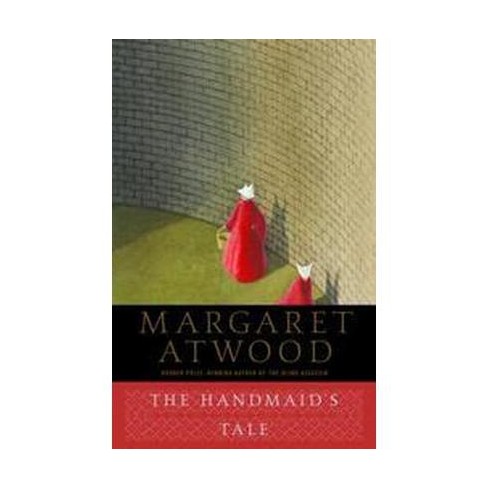
Handmaid's Tale (Paperback) (Margaret Eleanor Atwood) - image 1 of 1The Handmaid's Tale is a feminist dystopian fiction novel written in the 1980's by Canadian writer Margaret Atwood. Thirty years after publication, the novel has captured the zeitgeist and inspired many female writers to take up dystopian feminist fiction, inspiring a new breed of science fiction writers. There's tons of nytimes articles about this sort of stuff. I can see how influential Atwood has been on the genre.

The Handmaid's Tale is told from the first person, from a woman called Offred. It takes place in a near future New England (2005), where women's rights have been taken away, and government has been replaced by a totalitarian state called The Republic of Gilead, resembling a theonomy (theo-god, nomos-law), basically a Divine Christian law. Most of the novel takes place at night and during the day when Offred is out with other handmaids running errands around town as well as the descriptions of other handmaids from Offred's point of view.

These Handmaids bear children for women called Wives, who take care of the kids. There are male Commanders that rape these so-called Handmaids in an attempt to impregnate them. In this world women are commonly infertile so a woman with healthy reproductive organs are usually the Handmaids. Although initially the Commander's relationship with Offred was supposed to be strictly limited to an initiation ceremony, a ritual of rape with the Wife in attendance, she ends up hanging out with the Commander and seeing him regularly, enjoying sex with him despite the rape ritual.

The Commander plays Scrabble with her in his study, something scandalous because women aren't allowed to read and write. In addition, the Commander takes Offred to a brothel, where she meets her college best friend Moira, and is told that these women are yes, prostitutes, but that they get drugs and alcohol as well, and that this is better than being a government rebel, ending up cleaning radioactive waste in the colonies. However, Moira says that its frowned upon to reject any man. So there's a strong sense of control over prostitutes as well.

Through another handmaid Offred learns about the Mayday Resistance, people who are working against the government. Eventually the Commander's Wife finds out about the fling with Offred and Offred contemplates suicide. However, she doesn't kill herself. Instead, Offred tells Nick that she thinks she's pregnant. Some time after that she is taken away by men in uniform (The Eyes, or the Eyes of God), basically the secret police. As she's waiting to go inside a van, Nick tells her not to worry. Offred goes but she isn't sure if these men in uniform are the Mayday Resistance or the Eyes, and if Nick is apart of the Resistance or part of the Eyes.

Lastly, I would have to say that this is a fine work of speculative fiction. Its very difficult to say this is science fiction, although its been up for the critically acclaimed Hugo award, an achievement in and of itself. Atwood has created a world not very different from our own, but goes to the dystopian extremes-of totalitarian religious government, male dominated hierarchy, and class, caste, and status symbols. Although not much happens plot-wise throughout the novel, you get a sense that this is realistic, that this has happened in other countries, and that yes, it could even happen here if powers go unchecked, unbalanced, and out of control. In fact, when Trump got elected this book became more popular, unsurprisingly. Although its a dark and at times deeply disturbing book, it really gives you a sense of ourselves, our country, a mirror not quite reflected yet, but could if we went out of bounds.

Wednesday, December 5, 2018

Holy Fire

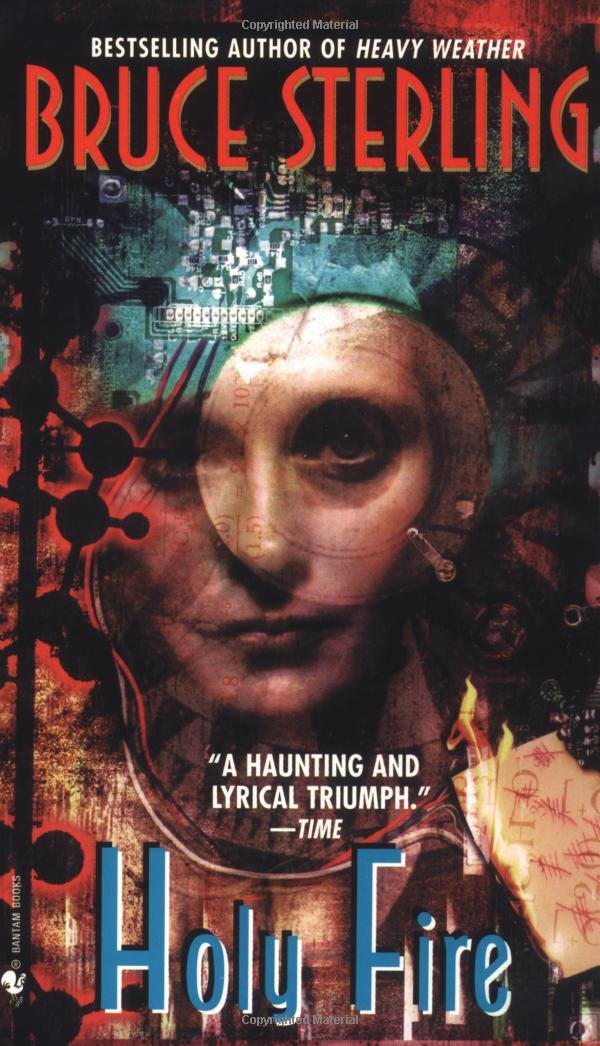
Image result for bruce sterling holy fire book coverHoly Fire is a great science fiction novel written by Bruce Sterling. It came out in 1996. It was nominated for the British Science Fiction Award in 1996 and the Hugo and Locus awards in 1997. High praise for great art. 

The story follows a medical economist named Mia Ziemann, a ninety-year old woman who transforms into a twenty-year old girl through intrusive technological means. Now (post-op) and borderline psychotic she goes by the name Maya as a young lady, traveling across Europe with nothing but a bag and the clothes on her back. She makes friends with all kinds of artists, bohemians, hackers, and fashion gerontocrats. The story is about life, death, the human condition, art, fashion, a very poetic sort of philosophy and ontology. 

The world of Gilead is somewhere in the year 2100. Gerontocrats control mostly everything and young people are like the scraps on their shoes, living on the margins. However, most things are free, including free health care and food, provided you don't harm your body or anyone else. Its a near future but its not a totally implausible one.

Once transformed, Maya gets caught up with thieves and drifters, eventually making her way into the fashion/modeling industry because of her sexy look. From there she makes friends in high places, mostly programmer types that help her with her palace, a digital life-space given to her by her now dead husband, complete with ruins and stuff. This is a cyberpunk story and the technology here is out of this world. Even with Sterling's esoteric explanations, the tech can get lost in between the dialogue, which is what helps make the novel move along nicely. 

Sterling gets very in depth with the virtuality within the story. His scientific explanation for Ziemann's transformation was quite complex. It was like reading Greek for me. However, it was mostly just advanced biology terms. The tech stuff here reminded me of William Gibson. Although I think Gibson does it better because he's able to make more out of the tech with his literary technique. 

Anyways, Ziemann gets caught up with a bunch of rich, radical anarchists and they plan on 'living forever' and taking control of the system, and this and that...But it turns out in the end that Ziemann gets caught up with the police, who were tracking her down because she skipped out on paying back her medical bills for the youth procedure. And not only that, but her dead husbands' talking dog Plato was always in the virtual palace, he'd been looking for her too. 

Ziemann goes through an ontological transformation. She realizes that she doesn't want to go back to being a gerontocrat, and that she wants to be a young photographer, even if she's really bad at it. It takes becoming a full blown criminal, a celebrity (at the end), a widow, and a Frankenstein-esque monster to realize what she wanted in life. 

The novel contains many debates between these young bohemian types over the immorality of immortality as well as the aesthetics of fashion. The underclass here are also talked about frequently, the class of people who can't become 'post-human', those are the real disenfranchised of the story. 

The writing of this story is free flowing with great metaphysical ideas. This is mostly done through dialogue and small events that happen over many pages-fifty pages here, another fifty pages there, etc. Although there are heavy cyberpunk elements here the ideas presented command more authority than mere tech. This isn't an easy novel to understand but its easy to read because the dialogue is interesting and the characters have artistic and idealistic charm.

If you want a different sort of cyberpunk novel this is for you. If you want a different sort of science fiction novel, this is it. They don't make science fiction like this anymore these days. And this was only from 1996! 

I'm currently waiting for my order of Bruce Sterling's Schismatrix. I heard from my father that's his most important novel. After reading his amazing collaboration novel with William Gibson, The Difference Engine, this was a great follow-up. On his own Sterling has grandiose philosophical ideas to go along with his cyberpunk technology. It has legs. 

Tuesday, October 9, 2018

Dune


Dune by Frank Herbert is one of those all time great novels that you read, and in many ways the book is more relevant (it was published in the 60s) now more than ever. Dune encapsulates many things; ecology, politics, religion, ideas of the messiah, science, government, space travel, intergalactic planetary systems, its got a lot going on. At over 500 pages (including an appendix, which is a must read to learn more about the world of Dune), this is a very thick novel that can take a long time. However, its such a great novel that reading the 500 pages was an enjoyable experience. 

I saw the theatrical released David Lynch movie before I read the book so I had a basic idea of the plot. Its complicated but I will attempt to explain it with as little words possible. 

House Atreides has governing power over a desert planet called Arrakis, home of a spice called melange, used to prolong life, and for the workings of intergalactic space travel; think petroleum and cocaine mixed in one. 

Shaddam IV, the Emperor of this galactic space opera organization,  secretly has a setup with the Baron Harkonnen, of House Harkonnen, and they setup a sting operation to attack House Atreides after they move to Arrakis. 

Duke Leto of House Atriedes realizes this is a trap but the offer is to good to refuse, after all Arrakis is home to spice. The Duke's concubine, Lady Jessica is a Bene Gesserit (witchy, part of a breeding program to create the 'chosen one', Kwisatz Haderach, a male Bene Gesserit). Paul Atreides becomes this messianic figure, who goes on to have powers to see through space and time, and act accordingly in the present. 

Lady Jessica and her son Paul end up going into hiding in the desert after the Duke gets betrayed, and murdered. The rest of the book is Paul and his mother planning in the desert, where they are presumed to be dead. 

However, they end up in the hands of the natives, called Fremen. There, they teach the Fremen the "weirding way" fighting technique. Paul proves himself in a duel to the Fremen, choosing his Fremen name of Muad'Dib. He becomes a messianic figure, and stops spice production via Fremen raids. Paul drinks the Water of Life and becomes the Kwisatz Haderach, a kind of messianic god-like being that can see through space and time. He senses that the Emperor is in space and about to come down to the planet. 

Paul leads a Fremen raid to attack the Emperor's troops and there's a big battle, the Fremen against the Harkonnens. Paul's only son Leo II dies. Paul threatens the Emperor, and says he will stop spice production forever unless he abdicates the throne. Baron Harkonnen's nephew Feyd-Rautha attempts to duel Paul in a knife battle but loses, thus the Emperor gives in, and even has to give his daughter to Paul's hand for a royal marriage! Paul realizes he's achieved his goal, but its too late to stop the Fremen jihad, because they have a powerful belief in him. 

What can be said about this book? Its a terrific novel, one of the best and longest science fiction novels I've ever read. Dune introduced a sense of ecology for me, something I was aware of but didn't think much about. The lack of technology in the story gives you a sense of primitiveness, something most science fiction lacks. You find this lack of technology in old historical fiction and in fantasy. 

The ideas of politics and religion are huge here. Here Herbert creates his own political philosophy and religious context. The appendix talks more about this, its a must read once you finish the story. 

In addition, there's tons of Middle Eastern references, mostly words. The native language of the Fremen is supposed to be mixed from Arabic and Persian. "Paul's messianic name (Muad'Dib) means in Arabic "the teacher or maker of politeness or literature", and the prophesied appearance of one known as the "Kwisatz Haderach", meaning "one who shortens the way" borrows the Hebrew term Kefitzat Haderech (×§ְפִיצַת ×”ַדֶּרֶךְ), a Kabbalistic Jewish term meaning one who can "clench the way", i.e. the distance between two places - and teleport. The Fremen language is also embedded with Islamic terms such as, jihad, Mahdi, Shaitan, and the personal bodyguard of Paul Muad'Dib Fedaykin is a transliteration of the Arabic Feda'yin." (https://en.wikipedia.org/wiki/Dune_(novel))

Lastly, I must mention that the women in Dune are powerful and have their feminist tendencies. This isn't your 50s science fiction where women are plain and simple. Here, the female characters are just as important as the main character. They are powerful and impact the story in their own way, especially Lady Jessica. She is just as important as Paul. Paul's Fremen wife also has a big role too. 

Dune is an important book in the science fiction genre. It took me a long time to read, but I'm really glad I did. Its an unforgettable book and I can see much to be gained in reading it again. The movie doesn't do the book justice, it lacks the eloquence and beauty of Herbert's literary sensibility. I won't be reading the sequels, that's too much man.

Fear is the mind killer.

Wednesday, September 26, 2018

The Blazing World

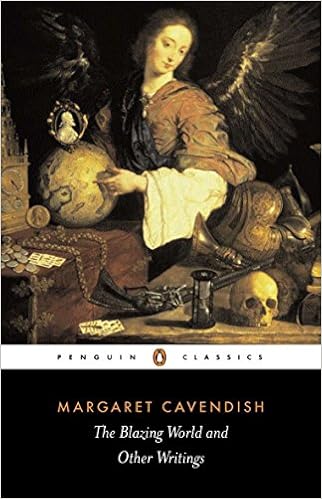
The Description of a New World, Called the Blazing-World, otherwise known as The Blazing World is a 1666 work of prose fiction written by Margaret Cavendash, Duchess of Newcastle. Its considered a proto-science fiction novel, with utopian themes and political ideas that resonant with Thomas Hobbes, whom Cavendash would have read, and for the most part agrees with. This is the only utopian fiction novel written by a woman from the 17th century, making it a rare event and a feminist work, she's one of the first feminist writers in a sense. The book was published as a companion piece to her scientific work, Observations Upon Experimental Philosophy, which I ordered a while back from the library.
 

The Blazing World is a fanciful, romantical, satirical, utopian vision where a young woman enters another world via the North Pole, where she becomes an Empress of a world with talking creatures, complete with fish-men, bear-men, mer-men, and the like. She even converses with spirits, and the real life Duchess herself, that is, the author becomes a character in the story itself.

What really got me into this novel, reading it for hours every day other than the fact that its considered ancient science fiction, was the fact that the writing is different, it has a voice. Cavendash creates a poetic space with her imaginative creative style. Its one of the first ever feminist takes on utopian fiction. Its feminist in the sense that its about a woman who takes over control of a whole world in a utopian society, a kind of feminist ideological. But it doesn't end there. This is a work of many genres, be them poetry, utopia, proto-science fiction, romance, epic, morality, kabbala, philosophy, its a hybridization, which makes it even more highly unusual.
 

In the book, the Empress creates a monarchy government. Cavendash argues that monarchy is the best form of government because it eliminates separations of powers. She writes, "it was natural for one body to have one head, so it was also natural for a politic body to have but one governor … besides, said they, a monarchy is a divine form of government, and agrees most with our religion.
 

Cavendash gets her philosophy from Thomas Hobbes, who says in his work Leviathan (which I'm almost done reading) that monarchy is the best form of rule, and without it men would be at each others throats by the sword, and lastly, that life is nasty, brutish, and short. We see Hobbes echoed through The Blazing World, and its not surprisingly to me given that they're both from civil war era England and Cavendash was even familiar with the smartest men of the day. She even dined with Descartes.

But how does the book read, and is it good? The book reads kind of slow. It was some three-hundred pages but sometimes a whole day of reading (which is only like three hours for me) felt like it didn't get me very far. Its so overly detailed and all over the place that sometimes its hard to keep track of whats going on. Arguably you could say that Cavendash's refusal to write in a simplistic 'feminine' way is her being a rebel, a true feminist doing whatever she wants, saying whatever she wants, and writing whatever she wants in her own self-published books, just because she can.
 

I also think the writing is very good. The book lives up or down depending on your outlook, although it doesn't exactly keep you on the edge of your seat. I have the advantage of reading this book four-hundred years later and not only enjoying it, but interpreting it in my own way. The book gets tedious, it meanders through many, many pages, and it seemingly becomes more and more fantastical and philosophical, its exciting through and through and I would probably read it again given some time. The story is a little bonkers but if you keep going with it you can find its riches.
 

Read this if you're into creative writing, feminist writing, or archaic science fiction of the utopian variety. Also recommended: Sir Tomas More Utopia and Francis Bacon New Atlantis.

Tuesday, January 16, 2018

Metropolis (novel)


Hey! What's up everybody? Its been quiet on this page the last couple days because I've been pretty tired and I took a night off from my work (reading) so I was behind with my readings. Now I'm all caught up, as I've already finished another novel, this time Metropolis written by German female intellectual Thea von Harbou. Metropolis is also the name for the movie that was made and inspired by this book. The book came first, and the movie thereafter.

The story of the book follows closely the movie so rather than rehash what I already wrote about you can get the gist of the plot from my movie synopsis, which can be read here. There's actually not much information on this book on the Wikipedia page for it but it should be known that the end of this book concludes with Freder's father realizing that his dead wife will be with him till the ends of the Earth (she died and left a letter for him). Lets focus on the literary style and high art that is this novel.

The novel is a short two hundred and fifteen pages but the writing style can be hard to wrap your head around. This is high German art language and Thea von Harbou was quite the intellectual, you can tell by the English translation of her writing. Don't get me wrong, its not dense by any means but there's a sense that you have to really understand everything you're reading because its so highly stylized. One sentence that describes a simple thing could turn into a whole page affair but she does it in a way that you want to read more about that one thing, without making it boring or trivial. Its quite something, I don't think I've ever read anything quite like this, its a powerful novel.

The film omits references that the book made to the occult. There's tons of references and images to the occult here but because I'm not familiar with that realm I didn't see it as particularly offensive or foul by any means. I learned about some evil things I suppose but its nothing that's going to make me wet the bed at night (lol). Besides, the pentagram beside the machine-woman is pretty evil enough for 1927.

In addition, the film omits moral motivation for certain actions by the main characters. Yes, the book differs quite a bit from the movie's characters, which are more black and white. In the book the characters are much more detailed, much like real people. We don't necessarily see things as good or evil, there's all these gray areas that are quite apparent.

This book is great! I would recommend the book to any science fiction readers, women that want to get into science fiction, and people who like really old books. I liked it so much I might read it again much sooner than expected, I could see myself reading it again in a few months or so, just to see if it still has that same poetic fire and intensity from the first read through. Definitely check this book out.

HEAD and HANDS need a mediator. THE MEDIATOR BETWEEN HEAD AND HANDS MUST BE THE HEART!

On AI, Existential Threat, and the Collapse

Good evening ladies and gents. Hope you all had a good Sunday. I wanted to write here a bit more about AI, existential threat, and the Colla...