Showing posts with label 1600s. Show all posts

Wednesday, September 9, 2020

The Ingenious Gentleman Don Quixote of La Mancha


"The Ingenious Gentleman Don Quixote of La Mancha (Modern Spanish: El ingenioso hidalgo (in Part 2, caballero) Don Quijote de la Mancha, is a Spanish novel by Miguel de Cervantes. It was published in two parts, in 1605 and 1615. A founding work of Western literature, it is often labeled "the first modern novel" and many authors consider it to be the best literary work ever written." [wiki]

 The book is about an old noble named Alonso Quixano, who reads so many books of knighthood and chivalry that he goes mad out of his mind, decides he's a knight, and goes out on adventures; helping fair maidens, righting wrongs, dreaming the impossible dream. Once he reinvents himself as Don Quixote de la Mancha, he recruits a simple farmer named Sancho Panza as his squire. Although Sancho is a simple farmer, he speaks eloquently at times throughout the novel, and he's a master of endless proverbs, much to Quixote's chagrin. 

To put it simply, Don Quixote doesn't want to or simply doesn't understand or take the world for what it is [1600s Spain] and instead decides to live in a fantasy where he's a knight. The book takes place in the 1600s, in Spain, so at that point the people of his world think he's a lunatic, for knighthood and chivalry were seen as things of the past, medieval. People had already moved past that at this point, in the novel, and in the real time period in which Cervantes wrote the book. 

"The book was a bestseller and had a strong impact on the literary community, influencing works like Alexandre Dumas' The Three Musketeers (1844) and Mark Twain's Adventures of Huckleberry Finn (1884). The 19th-century German philosopher Arthur Schopenhauer cited Don Quixote as one of the four greatest novels ever written." [wiki]

I consider Don Quixote as the all time best example of the first modern novel. It bridges the gap between medieval classical literature and modern literature. Why is this the case? Well, for starters, the old medieval literature that comes before this period puts God above all else. As above, so below. The ancient literature might not be about the Christian God, rather it revolves around other deities, like the Greek or Roman gods, or others. Literature back then was meant solely for the glorification of God or gods, sometimes employing heroes to carry out their bidding.

Here comes Don Quixote in 1605. Although it isn't the "first" example of what I would consider modern literature, it's surely the best and does it the best. This differs from ancient and medieval literature because its one of the first and best examples of the transition from ancient/medieval literature to modern literature. Why? Because you can clearly see that the transition from glorification to God goes to being about the individual, becoming less religious, but still examining central themes that every novel has; looking at virtue, the mind, the body, and the soul. Just as important is the fact that this is the first example in literature where we have a linear story-line, stellar story telling, narrative development, and a beginning, middle, and end. Mostly all other works of fiction prior wasn't like this although you can find little snippets and elements throughout various time periods and other countries' works of fiction. For these reasons, Don Quixote is in my opinion, one of the best books of all time, maybe the best novel ever written. 

Don Quixote is considered both a comedy and a tragedy. For its time it was considered comic. You can say its central idea is that individual can be right while society is wrong. It was considered social commentary, satire, if you will. 

What does it mean? This is a hard question to tackle, because the work is open to many different interpretations. For myself, I saw the work like a comedy or satire movie. I watched a man bewitched with his silly knight-errantry. I laughed throughout most of his silly adventures but there was always certain moments when I would stop laughing and think this is quite sad, this gentlemen being so far out of wack that he doesn't even know when he's being taken advantage of. The beauty of the work is that even if you find it tragic, or even if you find it too funny, you're never laughing or crying too long, because Cervantes throws so much at you; more plot development, more characters, more actions, more dialogue, more of everything, more is more. Because of this you don't [or at least I didn't] get bogged down by my emotions. 

The one truly emotional part, for me at least, was at the halfway mark through the book, where Don Quixote gets into too much trouble, gets really hurt, almost dies, and goes back to his house to get rest and heal from his wounds. This is where he might denounce knighthood and end it all forever, and just relax at home. When he gets home, his niece and his maid are worried sick for him, and are so afraid he might die from his wounds, that they are tearing their hair out and cursing knighthood and chivalry. That was when I realized how powerful this book truly is and was.

What the book means to me is quite simple. Even if you are mad, your reality is only substantiated by society so much. In a way, you are your reality. I think, therefore I am. Don Quixote thinks he's a knight-errant, so he is a knight-errant. It's very simple but very deep in a philosophical way and individualistic way. 

Lastly, it must be mentioned that this novel made me see the development and history of the novel in good form. The progression of beginning, middle, and end, development of story, narration, dialogue, action, plot, climax, are all great elements within the novel. Although I was aware of all of these important literary devices, it was only while reading Don Quixote that I came to understand, see, and analyze these devices in other works of literature, news articles, and even in spoken dialogue between friends and family. There's a form and there's substance, you can see it when it's there, and you can see it when it's missing. This was such a big revelation to me as a reader and a people's person, who gets so much out of spoken dialogue with friends, family, acquaintances, and customers. 

There's a way to tell a story and Cervantes was a master of doing so. I'll definitely check it out again at some point and take a look at some other translations. I switched between reading the late 1800s Ormsby translation and the modern Edith Grossman translation. I like the older translation better for a more literal older style and I liked Edith Grossman's translation for its simplicity. This is one of the best novels, you must read this if you like books, especially classics of the western canon. Even if you can't read all 800 pages, just being familiar with the work will make an impression upon you.  

"Bewitched with his silly knight-errantry."

Sunday, March 31, 2019

How are you doing?

Time for a vlog style blog post, spring 2019 style. I like to write these every now and then, talk about real life, as opposed to sharing memes, tweets, and Facebook posts via social media. That stuff is so blah.

First off, I quit soda and energy drinks cold turkey. I've noticed a big difference in my stamina and stress levels. In addition, I'm starting to lose weight again, albeit very slowly, about a pound or two a day. At this rate, I'll lose twenty pounds in twenty days. This might be the way I lose weight and keep it off forever, in shallah. [as the Muslims say] 

I really needed to do something drastic because I don't want to get diabetes. I was drinking soda and energy drinks every day at work. I'm glad I'm not buying and drinking that crap anymore. 

My body is detoxing. My stress levels are down and my stamina is up. I still get tired after one am shifts at the job, however, without the sugar chemicals messing with my system, I don't get as tired as I used to. It's quite a change. 

Speaking of changes, I've been taking things slower with my reading. I'm spending more time reading the news during the day before work and reading physical books at night before bed. I'm letting all the readings ruminate more. Rather than say, reading a book in three days and then starting another one on the same day. I'm guilty of that. 

I'm also guilty of being completely obsessed with classical music. I've always liked it but now its pretty much my favorite thing to listen to. Saying since most modern straight-ahead jazz is pretty clean cut, not many interesting things going on, I mostly listen to classical music, usually while reading. 

My favorites lately have been baroque composers within the last couple months-Bach in particular right now. Coincidentally it was his birthday the other day. I'm getting into piano prodigy Glen Gould's Bach interpretations. I've also been listening to Handel, Telemann, Vivaldi, Mozart, Chopin, Corelli, Marcello, there are tons of composers from 1600-1700s that display beautiful music, composed of functional harmony. I've become a huge fan of harpsichord and clavichord. So much to the point that I'm planning on playing keyboard more seriously and possibly having my dad put together our harpsichord one day [yes I have a harpsichord]. I have the time, I just need to put in the effort. "Or so it goes."

Work is work and I'm glad to get the hours. My jazz trio is coming along nicely, although I need a bass player asap to complete the sound I want, a chamber jazz sort of sound, with bass playing the role of percussion. The plan is still to record at a studio [and release an album on bandcamp], and apparently, the saxophonist can get us free recording time at the studio because he's done session work for the studio, ie they owe him. I'm still working on my memoir, and I've got thirty-four pages to work with so far. I'm at a crossroads with the text at this point, but I'm getting ideas on how to make it flow more thematically now that I've covered all the facts, exposition and lots of dialogue between characters. Lastly, I've been doing well making new friends, of the female variety. As that Ramones song goes, "I don't wanna be a pinhead no more, I just met a nurse that I can go for." 

April will bring hot temperatures and soon summer will be among us Californians. Bring on the one-hundred-degree heat. I love it when its over one-hundred degrees in the Valley.

Not! 

April Fools     :D 

Tuesday, October 23, 2018

John Milton's Paradise Lost


Image result for paradise lost john milton book coverParadise Lost is a biblical epic poem by John Milton, written in 1668, the most well known epic poem in English. It has about 10,000 lines of verse. Milton was a highly religious man, a Protestant until late in life, who became apart of the new government in England, after they chopped off King Henry's head. He worked in government in between writing; poems and discourses on things like divorce and monarchy, he argued that the Divine Right of Kings was wrong, even idolatrous. Paradise Lost tells the story of the fall of man, when Satan tempts Eve to eat from the Tree of Knowledge, and ultimately lose Eternity with God in the Garden in Eden.

The story has everything; love, war, peace, evil, politics, science fiction style peaks into the future, marriage talk, sex talk, metaphysics, and philosophy. There are a lot of themes that this book touches on. I'd like to go over a few that I found interesting.

Milton shows us that his God in Paradise Lost is an artistic god, omnific, knowing all, creating all, everything. God is professorial here, the ultimate Monarch. In the passages where we see how God created the Earth, we see the true artist in his godly abilities. Milton's God is also shown as the ultimate sovereign, who sends his Warrior Son Chieftain to single-handedly destroy Satan and his evil angel allies, sending them to Hell. This is unusual because Milton doesn't believe in the Divine Right of Kings, but despite this he chooses to write a biblical epic about the most divine right of thee King. Milton strives to show us "the ways of God to men". Here we must take note and separate Milton's work in Parliament from his work as a poet. The artist's pen differs greatly from the political essays. 

Another theme is the justification of Satan being a sympathetic character. Here, Satan is portrayed as a bad guy, yes, but there's strong argumentation for Satan being a more understandable character than Milton's God, empathy. Sure, Satan is evil, and wants to overthrow God with a third of the angels, but in seeing this we see that, yes he is proud, but we can also see his "radicalism and fraudulence, freedom and its counterfeit fused in a single personality not easily pigeonholed." (hudsonreview) Milton doesn't see Satan as a hero, because Milton understands whats its like to go against an absolute soverign and lose. We can sympathize with Satan's determination, never to yield, perhaps because its inherently human, which we see when Eve eats from the Forbidden fruit. 

Another strong theme is the relationship between Adam and Eve. There's a hierarchical aspect to their relationship because when Raphael comes to warn them of an approaching enemy in the future, Raphael mostly talks with Adam. They talk about marriage, the enemy, even sex. When Satan enters their lives, things change forever. It seems to me that the way Raphael warns Adam and speaks mostly to him, it was like an early temptation for Eve to rebel. 

Once we see Satan travel through the Earth's globe, and take the form of the serpent, we know its all over for the human race. However, what comes off as a surprise is the psychological justification for Eve choosing to rebel from God, and eat from the Tree of Knowledge, and that justification creates greater empathy for Eve than it did for Satan. Its interesting, what a way to write. Of course, Adam choose to Fall with Eve because he "loves his wife too much." He can't stand the thought of being away from her, and the thought of losing another rib doesn't sound too good.

The book is quite astonishing. There's a great scene where after the Fall, Adam talks with the archangel Michael and is shown the future of the human race. This part had a strong emotional effect on me, in some aspects I could see how that future represents the world of today in a way, I almost can't explain it in words, the sheer emotional intelligence brings to mind Wagner's music (my signature daily favorite is Tannhauser), or the sounds of the archaic delta bluesmen, with their yells, shouts, blue notes expressing emotion and pain. This section had a science fiction vibe to it, because they were looking at the heavens at this portal, and seeing everything that would happen on Earth. It was beautiful. 

Another highlight was the description of the civil war between God's angels, Satan, and his army of evil angels. Again, I really like the archangel Michael's stature, because he's the ultimate angel-warrior, with a flaming sword, second only to the Son of God Himself. We get this description of the most epic civil war in the universe. Ultimately though it is Christ Himself, The Son of God, who comes out and single-handedly defeats Satan and his army, sending them to Hell. 

Yet another interesting section was a talk between Satan and his evil angels in Hell. Here we get a real glimpse of the ultimate evil-doers in their lair. This section gave me a strong Dante's Inferno vibe, reminiscent because I just finished reading that a few weeks back. 

Paradise Lost is one of the all time great writings. Its something I plan on going back to and rereading, and I think the poetic beauty in every line will be just as exciting the next time I read it. In today's world, Milton is still relevant. These ideas haven't died as technology has taken over, rather these ideas are forever, and shouldn't be overlooked in the modern age of literature. This isn't just for Lit grad students, its for everyone. 

Wednesday, September 26, 2018

The Blazing World

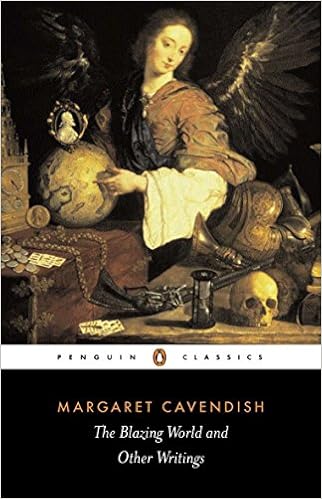
The Description of a New World, Called the Blazing-World, otherwise known as The Blazing World is a 1666 work of prose fiction written by Margaret Cavendash, Duchess of Newcastle. Its considered a proto-science fiction novel, with utopian themes and political ideas that resonant with Thomas Hobbes, whom Cavendash would have read, and for the most part agrees with. This is the only utopian fiction novel written by a woman from the 17th century, making it a rare event and a feminist work, she's one of the first feminist writers in a sense. The book was published as a companion piece to her scientific work, Observations Upon Experimental Philosophy, which I ordered a while back from the library.
 

The Blazing World is a fanciful, romantical, satirical, utopian vision where a young woman enters another world via the North Pole, where she becomes an Empress of a world with talking creatures, complete with fish-men, bear-men, mer-men, and the like. She even converses with spirits, and the real life Duchess herself, that is, the author becomes a character in the story itself.

What really got me into this novel, reading it for hours every day other than the fact that its considered ancient science fiction, was the fact that the writing is different, it has a voice. Cavendash creates a poetic space with her imaginative creative style. Its one of the first ever feminist takes on utopian fiction. Its feminist in the sense that its about a woman who takes over control of a whole world in a utopian society, a kind of feminist ideological. But it doesn't end there. This is a work of many genres, be them poetry, utopia, proto-science fiction, romance, epic, morality, kabbala, philosophy, its a hybridization, which makes it even more highly unusual.
 

In the book, the Empress creates a monarchy government. Cavendash argues that monarchy is the best form of government because it eliminates separations of powers. She writes, "it was natural for one body to have one head, so it was also natural for a politic body to have but one governor … besides, said they, a monarchy is a divine form of government, and agrees most with our religion.
 

Cavendash gets her philosophy from Thomas Hobbes, who says in his work Leviathan (which I'm almost done reading) that monarchy is the best form of rule, and without it men would be at each others throats by the sword, and lastly, that life is nasty, brutish, and short. We see Hobbes echoed through The Blazing World, and its not surprisingly to me given that they're both from civil war era England and Cavendash was even familiar with the smartest men of the day. She even dined with Descartes.

But how does the book read, and is it good? The book reads kind of slow. It was some three-hundred pages but sometimes a whole day of reading (which is only like three hours for me) felt like it didn't get me very far. Its so overly detailed and all over the place that sometimes its hard to keep track of whats going on. Arguably you could say that Cavendash's refusal to write in a simplistic 'feminine' way is her being a rebel, a true feminist doing whatever she wants, saying whatever she wants, and writing whatever she wants in her own self-published books, just because she can.
 

I also think the writing is very good. The book lives up or down depending on your outlook, although it doesn't exactly keep you on the edge of your seat. I have the advantage of reading this book four-hundred years later and not only enjoying it, but interpreting it in my own way. The book gets tedious, it meanders through many, many pages, and it seemingly becomes more and more fantastical and philosophical, its exciting through and through and I would probably read it again given some time. The story is a little bonkers but if you keep going with it you can find its riches.
 

Read this if you're into creative writing, feminist writing, or archaic science fiction of the utopian variety. Also recommended: Sir Tomas More Utopia and Francis Bacon New Atlantis.

September Sweater Weather

Good evening ladies and gentlemen, hello world. How are you?  It's good to be writing on a good day off work today on a Saturday. Here, ...