Showing posts with label 1950s. Show all posts

Wednesday, December 2, 2020

Live Performance 12/2/2020

This is a live performance from today, 12/2/2020, that took place from 430pm-530pm. Featuring myself, Orlando Miguel Figueroa on guitar and Jason Tomas on alto saxophone. We perform [in order], an untitled composition, Footprints, Freddie Freeloader, Blue Monk, a jam based on a diminished chord, and ending the set with Body and Soul. 

Watch the performance here, https://www.facebook.com/orlando.figueroa.3150/videos/1730748607096466

Thanks for listening and supporting our music. 

The modern improviser refuses to die! 

Tuesday, April 14, 2020

On the Road


OnTheRoad.jpgOn the Road is a book by Jack Kerouac, published in 1957. About, well, being on the road. But really its much more than that. It's about the search for IT, whatever that may be; spiritual, musical, drugs, women, sex, drink, parties, friendship, solidarity, marriage, fame, fortune, success, traveling on the road looking for IT. Ultimately, they never find it, so it could be said that the story is about loss, not getting it, never finding it.

Kerouac was part of the beat generation of writers, or as he phrased it 'beatific', meaning blissful rather than the traditional beat, worn down and looking up the definition. The novel is a roman a clef, meaning real-life events with real people overlaid with a facade of fiction. It should be noted that the main characters in the novel are; Sal is Jack Kerouac himself, Old Bull Lee is William S. Burroughs, Carlo Marx is Allen Ginsberg, and Dean Moriarty is Neal Cassady, all-important, influential writers of the beat generation. What a cast. 

The writing of the book was taken from notes during a road trip in the 1940s. Later it was typed out in a continuous reel of paper for three weeks in April 1951. It was published by Viking Press in 1957. At the time of publication, the Nytimes hailed the book as a beautiful and most important utterance of the beats, with Kerouac being its chief avatar. But the reviews weren't all positive. One reviewer said the novel takes you on a long trip, ultimately leading to nowhere. The novel is generally regarded as one of those important English language novels. 

Kerouac was inspired to write the novel because of his friend and fellow beat writer Neal Cassady. Cassady wrote a 10,000-word letter, which prompted Kerouac to write "Essentials of Spontaneous Prose," a writing treatise on style that reflected a musical, jazz sensibility of improvisation with little rewriting and editing. 

The story is about a couple of carefree young friends who are somewhat literary that engage in road trips during a specific era of jazz history; the transition from Charlie Parker to Miles Davis, from early bop to straight-ahead jazz.

The influence of jazz music and blues is profound here. There are so many jazz musicians that are named here it's too many to recall in this short post. Being a jazz and blues musician myself, I see the utmost importance and care that Kerouac put into describing this specific era of time in America, and how important the music was to the people of his generation, to the beats. Some writers have said that On the Road contains some of the most important descriptions of jazz music ever. Interesting.

The jazz music also reflects the writing. The writing is done in a spontaneous prosaic. It's quite refreshing, considering that most of the novels I read are highly edited over and over again. Although the writing is sort of simple, because of the fact that it reads like a jazz song, it's very enjoyable to read as a musician. You can hear the swing beats in the writing, the sheets of sound if you will. But most importantly, it's fun. It isn't work to read this novel. It reads like a breeze, again, again, like sheets of sound of a tenor sax. Blowin', as they call it.

The characters of this story take pleasure in everything they do. Drinking, parties, women, sex, driving fast down the road, getting stranded with no money, doing stupid things. We aren't shocked by sex and drugs. They substitute family for male brotherhood and the ladder of success for freedom of the road, a new measure of male identity. It's about searching for something to hold on to; a larger truth which is never found. Some people may never find it. And our heroes in this book don't either. Broken dreams and failed plans. In retrospect, it could be seen as a gloomy, middle-aged disillusion. So in that regard, this book has completely lost the zeitgeist. The ethos of the book has been lost. Could it come back again?  Who knows.

Kerouac described his writing as Impressionist, art through observation. Not the traditional rewriting and editing process, rather, the emotional spontaneity of the writing itself. There's a personal nature of the text that makes it come alive, makes it more realistic, casual diction and relaxed syntax that depicts the energy and emotion of the experiences. 

All in all, I found this to be a good read. It's a good book for quarantine because you get a sense of fun and adventure even though we're all under lockdown because of COVID-19. I wouldn't want to have an adventure like the guys in this book for obvious reasons. Some of it is downright miserable, especially the parts being stranded in American cities with no cash and no car, hitchhiking. The zeitgeist for this kind of stuff is gone but it's still important for us to read and write about. The beats sure were some kind of generation. 

Tuesday, April 23, 2019

Player Piano


PlayerPianoFirstEd.jpgPlayer Piano is Kurt Vonnegut's first novel. Released in 1952, the book tells a story of a brave new world [Nytimes back in the 50s, book reviewer compared it to Huxley's Brave New World], where machines have taken over society, a dystopia. This is a book about automation and humans, how they co-exist in a dystopian society ruled by an oligarchy but the interesting thing is that the oligarchs are engineers rather than kings or presidents.

Player Piano's universe is ruled by engineers who build, fix, and keep the machines running. Everyone else with low IQ's [IQ's are known in the public sphere, thru testings] are either in the Army or the Reeks and Wrecks, which is the low-level grunt work of the society. Paul's father helped build the machines that helped win the war, and that currently helps society. He made the engineers the most important class and his son is high up in the company. Paul's father is now deceased and Paul is struggling to find himself, that is, he has an existential crisis. 

Paul thinks that there's more to life than fixing machines and being an engineer, even if he's rich, has a beautiful wife, and a nice house and car. Paul tries to find a way out. He starts reading novels about burly men that do extravagant things in life. He wants to become like Thoreau. He plans on quitting his Engineering managerial position at the factory, one of the most important jobs in the world. He even goes so far as to buy a farm, thinking he's going to get his wife to quit living the high life and work as a farmer with him. She doesn't like his surprise when she sees the farm.

The book hits a high note once Paul goes on an Engineer's retreat, in the woods with all the managers and young engineers from factories all over the country. You get a sense that these engineers are being brainwashed into thinking their job is the most important and everyone else is below them. It's at the retreat that Paul is asked by factory management to infiltrate this organization called the Ghost Shirts. The Ghost Shirts are disgruntled engineers and low-level workers that have had enough of machines taking all the jobs. They want life to go back to the good 'old days when people washed laundry with their hands and jobs were done by people rather than machines. If Paul does this he gets a higher level job at another factory. Big whoop.

Paul plays along quite nicely, and says, "I quit! I quit! I quit!", with so much enthusiasm that his managers think he's playing along too well. The fact of the matter is that his managers had to fire him so he could infiltrate the Ghost Shirts. But Paul really meant that he was really quitting for real, which they interpreted as him playing along. It's very funny. 

Paul goes back home from the retreat and is treated like a second-class citizen by the police, who is notified that he's lost his job, status, and position in society as one of the Engineering Class, the highest social class. 

Once Paul's in the Ghost Shirt Society they make him their leader, almost a Messianic figure because he's the son of the "Father of all Machines, the Father of Engineers", oh how he's fallen from grace. A revolution takes place, and people go ballistic, destroying machines and burning buildings. But when the destruction is over, Paul and the Ghost Shirt Leaders find out that people are finding all the scraps of machines they can find only to rebuild machines! It's very ironic, satire. It turned out that people actually wanted the machines to work for them, and that all this time Paul might have been wrong about society, machines, everything. Or maybe not.
 
Player Piano isn't such much a tirade against technology, machines, or automation so much as it is a critique of progress, within society and politics. Vonnegut may be a Luddite in the sense that he rejects society's unhealthy relationship to technology. But today that could be most people as most people think the young folk shouldn't be so consumed with the tech of the day-social media, online gaming, spending all their time in front of a screen, be it a smartphone, tablet, TV, laptop, or computer. Most adults in the room would say our young people need to stop being consumed by these things, go back to a simpler time-spend more time outdoors with nature or reading books at libraries. Vonnegut perhaps might be saying that a nation that innovates technologically but not socially is not truly progressing. 

These are ideas Vonnegut used for his first novel because they were real and close to him. He had been a prisoner of war after being captured by the Germans during the Battle of the Bulge. You can sort of see how he got some of his ideas. Germany thought that all their problems would go away once factories were built but it turned out that Germany was actually on the wrong side of history socially and politically. Factories and jobs didn't end up helping them. Likewise, Facebook, Twitter, Amazon, SnapChat, Discord, Instagram, and YouTube haven't helped us to progress socially or politically either. 

At the end of the novel when the people are grabbing scraps of machines to rebuild their beloved machines, one of the Ghost Shirt leaders says to Paul, “This isn’t the end, you know… Nothing ever is, nothing ever will be – not even Judgment Day.”

"After all, there’s always a step backward, and a step backward, after making a wrong turn, is a step in the right direction." [vonnegutreview.com] 

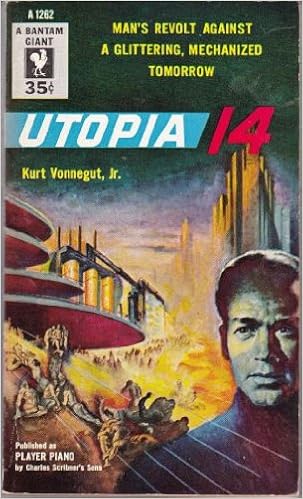
Interesting tidbit-one edition for Player Piano was titled Utopia 14, just to give it a more science fiction name, "whereby Vonnegut gained the repute of a science fiction writer, a genre held in disdain by writers at that time. He defended the genre and deplored a perceived sentiment that "no one can simultaneously be a respectable writer and understand how a refrigerator works" [wiki] Also, it should be noted that Player Piano is more conventional storytelling, especially with the slow narrative. His other novels would go on to more grandiose ideas, more science fiction, and much more satire. If he kept writing in this plain style that is Player Piano he wouldn't have become such a famous name.
 
The original cover pictured above, Utopia 14 cover pictured below
Image result for utopia 14 vonnegut


Tuesday, April 16, 2019

The Sirens of Titan


sirens-of-titan
“I was a victim of a series of accidents, as are we all.”

The Sirens of Titan by Kurt Vonnegut is a satire science fiction novel from '59. The story is about a guy named Malachi Constant, who is told by a man-playing-God figure stuck in space via something called 'chrono-synclastic infundibulum', that he's going to marry his wife Beatrice, have a kid with her, and end up living [and dying] on Titan, one of Saturn's moons. Malachi, the richest man on Earth does everything in his power to make sure none of that happens. He responds by throwing the best damn party ever and loses all his money.

The first Vonnegut book I read was Slaughterhouse-Five, check out my review for that book here.  I liked The Sirens of Titan much more than Slaughterhouse-Five. And that's because Sirens is much more of a science fiction novel, with grandiose ideas about life, sprinkled with tons of satire, with what I call dark humor or black comedy. Siren's has a very breezy, easy reading style just like Slaughterhouse. The ideas are many but are rooted more in science fiction here than in Slaughter-house, which is why I liked it much better. After all, I'm a science fiction guy. 

There are two obvious themes of the novel. Free will is one of them. Vonnegut suggests that we are victims of a series of accidents, as its quoted from the story. Malachi Constant, Unk, Beatrice, Chrono, the Tralfamore robot [the reason why all this is happening is so the robot can get a part to go home], and Winston Niles Rumford don't have free will. Random events put them in the positions they were in and there's nothing they could say or do that could influence the unpredictable. 

The other theme is the philosophical one. The meaning of life. Vonnegut suggests that everyone knows how to find the meaning of life by themselves. Although there's no free will we can find meaning and purpose in life. And the purpose of life, no matter who's controlling it, is to love whoever is around to be loved. If I wasn't single this would be more meaningful. :D

Life is meaningless but we should be happy. No matter what happens we have the option to make life meaningful. That's what makes us different from the music organisms on Titan, what makes us human.  

Going forward, this isn't your typical 50's pulp science fiction novel, although technically it is a 'pulp 50's science fiction novel'. What I mean is that if you're into Heinlein, Asimov, and Alfred Bester, you'll notice that this is an entirely different animal. Although there are spaceships, a war between Martians and Earth, and Universal Will To Become [metaphysics perhaps] to power spaceships, Vonnegut is using science fiction to tell an allegorical story about life. With ideas and philosophy that is anti-war, anti-religion, and anti-Bio-Mass [anti-society]. 

The science fiction element stems from the character Winston Niles Rumfoord, who, with his dog Kazak, accidentally becomes “chrono-synclastic infundibulated” during a space voyage. They're spread through space and time, appearing on planets sometimes. Vonnegut explains the phenomenon in his own inimitable way. Being spread through space and time allows Rumfoord to know everything that is past, present, and future. This allows Rumfoord to play God with the human race, with emphasis on Malachi Constant, and Rumfoord's wife, Beatrice. Rumfoord stages a war between the Martians [there's Martians living on Mars in this story too] and Earth just to make a point, to teach mankind a lesson. 

There are enough great ideas in this novel to be two or three novels. The characters are unpredictable, the humor is dark at times, and satirical, and philosophical themes make this a terrific science fiction treatise. 

To conclude, you don't have to look into grandiose ideas for what this story is really about. As a matter of fact its very simple. Vonnegut's satire ends with this conceit: All of mankind's purpose, past, present, and future is for this alien robot [the Tralfmadorian] to find this one little metal part [the size of a can opening lid], that will take him home.

I'm already reading more Vonnegut. I'm currently reading his first published novel Player Piano, which is much different from this style and voice-wise. Stay tuned to the page, as I will write my Player Piano review sometime soon.   

[original book cover art by Richard Power pictured above] 

Tuesday, February 19, 2019

Eden


EdenLem.jpgEden is an early science fiction novel written by Polish writer Stanislaw Lem, in 1959. However, it wasn't translated into English until 1989-way, way later.

The characters here don't have names, rather the crew are called the Doctor, the Chemist, the Captain, etc. The story starts with a crew landing on an alien planet called Eden. The ship gets damaged, but its repairable. So the crew works on fixing the ship as well as exploring the planet. 

What they see sort of reads like a horror story. They find spider-like plants, mass graves of dead aliens with amorphous shapes and faces all over the place, a bio-factory of aliens, flying, spinning discs, etc. All of which makes the whole experience look like an alien concentration camp. The crew keeps trying to make sense out of everything but at the end of all the debate they realize that nothing makes sense no matter how much they keep learning. 

Most of the book is the crew repairing the ship, exploring, and explanations of what they see, in their jeep with their giant robot. At one point they get attacked by aliens [whom they call doublers], and they retaliate using an atomic weapon! 

Nothing is really known the longer the novel goes on until the last chapters. In fact, there's no character development nor is there any clear plot or story line. At the end the crew finds an alien [a doubler] that's wearing clothes [a rag-like thing]. They find out through the doubler's star maps that he is a man of learning and science. They figure out a way to get the ship's computer to translate the doubler's gurgling cough language. 

From here we learn that the alien civilization here is highly stratified. There used to be a tyrannical government in place in the beginning. Then there were leaders who led anonymously. There's jails set in place where the aliens serve voluntarily, sent there for punishments from the higher ups of the planet, perhaps for doing wrong, perhaps not, we don't know as the computer is iffy with the doubler's translation. The higher ups also control who gets to distribute information, an Orwellian influence. Basically a concentration camp without any guards, designed so that prisoners stay inside on their own free will. I still don't quite get it, but I'm not sure if I'm suppose to nor do I think its that important. Its an interesting concept nonetheless. 

We also learn that although the doublers have no sense of nuclear power, they did once conduct a mass experiment to enhance the species. The experiment failed, which resulted in deformed doublers, who are ostracized from the main society. The doubler tells them that because information gets you killed here, that when he found out that a ship with aliens crash landed, he took this as the chance of a life time, which the humans empathized with.

The crew realizes that they've been exploring something of a prison planet, that sort of thing. The two doublers that the crew found during their stay decided to stay behind the ship's exhaust and die, rather than go back to their oppressive society.  

Before the crew leaves the planet the Captain and the Doctor have a debate. Should they intervene? This is the book's philosophical angle. In the end the Captain decides they shouldn't interfere with these aliens and their society, which makes sense especially because this book was written under Soviet-style regime. However, it also makes the case against having an influence upon another society, another civilization. Sometimes its best to leave things be, which they decide to do. 

Although the prose here isn't anything grand, this book kept my attention. I finished the novel in three days because I was so curious about what was happening on the planet. The book was sort of terrifying in a way, what with the whole prison concentration camp vibe. However, I think that horror element keeps the story exciting, as the prose is sort of dry. 

When the crew is flying off they look back at Eden and see that its a beautiful violet sphere. They realize that it was because of its beauty that they accidentally flew too close and entered its atmosphere. Because of this beauty, that's the reason its called Eden.

I would definitely read more Stanislaw Lem, he's one of the only modern European science fiction writers I've read. I've seen the movie version of his book Solaris, a terrific 1970s sci-fi flick. I would be interested in reading that. 

Tuesday, January 9, 2018

The Beats


The Beats: A Very Short Introduction by David Sterritt is a cute one hundred and twenty six page book about the Beatnik writers and poets from the 1950s. The lives and works of Jack Kerouac, Allen Ginsberg, and William S.Burroughs are covered with great detail in addition to Neal Cassady, Gregory Corso, Lawrence Ferlinghetti, John Clellon Holmes, Gary Snyder, and Kenneth Rexroth. I must also mention LeRoi Jones, Anne Waldeman, and DiPrima too, as they are mentioned near the end.

My dad found the short book at the library and thought it would give me a better perspective on the true Hipsters (not the Arcade Fire fans), the Beatniks, as I formed an interest and I've been reading Kerouac's On the Road, which I found out is one of the most important works to come out of this movement.

I learned that the Beats mostly came from middle class and sometimes even bourgeois background, which gave them the comfortable life, which enabled them to becomes Beats in the first place. You can't become an artist and dissident of society if you are struggling to survive or pay rent. They were mostly white males who explored with sexuality, drugs, and religion. Ginsberg and Burroughs were gay in a time where being gay could get you beaten up or possibly killed. The Beats were avid readers of Oriental religious text, and were heavily inspired by Buddhism. Interestingly enough I had a book on Zen Buddhism that I read everyday for a while until I could understand the hermeneutics  of it. I can leave the gay sex and drugs (especially hard drugs) behind though (lol).

Another important influence on the Beats was jazz music, particularly bebop. Ginsberg had a name for Kerouac's improvisational writing style where he would write and write without stopping, creating the sensation of a saxophone player blowing on the bandstand. I like that very much. I'm beginning to see jazz's influence on literature a lot more now after reading this book whereas before when I was just reading about the AACM (Association for the Advancement of Creative Musicians, a book by George Lewis) and biographies (Kansas City Lightning by Stanley Crouch), I couldn't see that correlation. But now I see that jazz has an even longer extended reach than I previously thought, interesting indeed.

I especially liked the ending of the book where Sterritt makes a bold universal claim; nearly all the movements that sprang up in recent times owe something in part to the Beats. He makes references to the Tea Party Movement, Occupy Movement, Cyberpunk (of which I am definitely apart of) Movement, and more. In a lot of ways I can see that he's right. In order for various movements to be started people have to reject society in a certain way, to create their own form of society through art, in this case through artistic literary works. It's quite wonderful.

All these writers will be legends in the future. The world won't forget them. It seems as society has become more conservative (the Reagan years and now in the Trump years) the ideas of the Beats have never sounded so universal. Sterritt says that there are Beats (in a different sense) in other countries but especially China, where there are people who are different kinds of Beats that might come to important and historical light in the upcoming years. All interesting things to think about.

Its quite a good book and if you want to learn about these great writers, their works, and the Beatniks in general this would be a great place to start. Very informative, engaging, and most importantly fun to read.

Lastly, learning all this stuff about the Beats makes me realize that most of the young people today who believe that are true outsiders are actually quite conservative conformists. The idea of young people today believing that they are 'different', 'cool', outside of the norms of society is quite wrong. Most of them will never truly be outsiders because they will never have to deal with status inconsistency. These writers did. That's the difference.

Great things are not accomplished by those who yield to trends and fads and popular opinion.
Read more at: https://www.brainyquote.com/quotes/jack_kerouac_119789
Great things are not accomplished by those who yield to trends and fads and popular opinion. -Kerouac 
Great things are not accomplished by those who yield to trends and fads and popular opinion.
Read more at: https://www.brainyquote.com/quotes/jack_kerouac_119789

Saturday, January 6, 2018

The Demolished Man


The Demolished Man is a science fiction novel written by Alfred Bester in 1953. The book was the first winner of the prestigious science fiction honor, the Hugo Award. This book is cyberpunk's version of Crime and Punishment.

The story is set in the 24th century in a universe of telepaths (Espers, called peepers in the book), although telepathic effectiveness depends on how great of a telepathic the person is. For example there are level 1 telepaths (the best), level 2 (pretty good), and level 3 (not of much use but still employed).

Here's a basic synopsis of the book.

A man named Ben Reich (owner of Monarch Utilities and Resources) is a rich megacorporation owner and he finds that his megacorporation is in jeopardy (danger of bankruptcy) because of his rival the D'Courtney Cartel, headed by the older Craye D'Courtney. He has nightmares about a "Man With No Face", which always leaves him scared for his life, and throughout the book even screaming and running.

Reich contacts D'Courtney about a merger between the companies and Reich misreads D'Courney's response as a refusal. So Reich creates a plan to murder him so his company will be alright, and so he will be able to take over the D'Courtney Cartel. Because of the peepers its hard to commit murder and murder hasn't been committed for seventy-nine years. If caught Reich will have to serve "Demolition" for his crime, which is later described as a sort of violent mental and neurological re-education. 

In order to carry out the murder Reich builds a mental block using a song he hears.

Eight, sir; seven, sir;
Six, sir; five, sir;
Four, sir; three, sir;
Two, sir; one!
Tenser, said the Tensor.
Tension, apprehension,
And dissension have begun. 

Believe it or not this jingle actually prevents most of the Espers from hearing and seeing his murderous intent. I could get more detailed with the plot but I think I will go with my edited short-hand version for the sake of being easier on the eyes (lol).

So basically Reich ends up killing D'Courtney, and he hires two strong Espers to work for him while he is being investigated by the police and their own league of peepers. D'Courtney's daughter catches Reich at the scene of the crime (where he shot D'Courtney through the mouth, blowing through his skull) and she runs away. She gets found later by the police who have her undergo some sort of mental rebirth, not Demolition but still mentally jarring. 

At the same time Powell, the main cop doing the murder investigation is finding out tons of information but he needs everything to be right if he's to prosecute, as this could make or break his career. Not only that, but the murder could be a break in the universe, for he couldn't take information from peepers about the crime because that would be against the Esper Guild Oath, which he had to respeckt at all costs. Even though he had or could get information about the murder from peepers it was against Esper regulations to use it in court. So there's that. Ethics in the future just like today.

So we have Reich and Powell fighting and going through the ropes, the criminal and the cop after him. Eventually Reich comes face to face with the Man With No Face, which turns out to be part himself and part D'Courtney, who is revealed to be his father. Surprise! The bad guy is your father! Star Wars anyone?

Anyways, Powell "asks the help of every Esper in attempting to arrest Reich, channeling their collective mental energy through Powell in the dangerous telepathic procedure called the "Mass Cathexis Measure". He justifies this by claiming that Reich is an embryonic megalomaniac who will remake society in his own twisted image if not stopped." (wiki)

Reich is revealed to be the son of D'Courtney, the result of an affair between his mother and D'Courtney, making Barbara (D'Courtney's daughter) his half-sister. Barabara is revealed to be a peeper so its possible that Reich's hatred for D'Courtney was inspired by a telepathic connection, which is also a sort of Freudian complex.

"Once arrested and convicted, Reich is sentenced to the dreaded Demolition— the stripping away of his memories and the upper layers of his personality, emptying his mind for re-education. This 24th-century society uses psychological demolition because it recognizes the social value of strong personalities able to successfully defy the law, seeking the salvaging of positive traits while ridding the person of the evil consciousness of the criminal." (wiki) 

The idea of re-education for criminals is a good one. I like that idea very much, in fact if America re-educated all the criminals we would live in a better society. It doesn't have to be as drastic as this book, it could simply be re-education through labor like how the Chinese do it.

The book shows us that although the world may change in the future with its technological advances, human nature will always remain the same. People will still be evil, murder will still take place in the future. Here we have a story that isn't utopia, nor is it post-apocalyptic, its almost like how real life actually was in Alfred Bester's time-the 50's.

The idea of the peepers is totally science fiction. In addition the idea that the bad guy is your father is also a popular trope in science fiction (Star Wars). The idea of Demolition (re-education of criminal minds) is also another popular idea from many contexts. I remember when I played the video game Star Wars Knights of the Old Republic I, in the end you find out that you were an evil murderer ruler of the Galaxies, and that the Jedi re-programmed your mind and swayed you to do right to all the wrongs you had committed. The book reminded me of that game.

This is a pretty important book in science fiction I would say. I was inspired by Bester's other novel, The Stars My Destination (which you can read about here), and I have to say I was not disappointed by this book either. The literary style has finesse and gravitas. In fact, the prose has such momentum that once I started reading it I could hardly put it down until I finished it. I felt exactly the same way as when I was reading Tiger! Tiger! (The Stars My Destination). Here is great writing and he finished the book in less than three-hundred pages. It's terrific. I've learned a lot about the old school style science fiction of the 1950's and I'm ready to read more.

Definitely check out this novel if you like science fiction.

“If a man's got talent and guts to buck society, he's obviously above average. You want to hold on to him. You straighten him out and turn him into a plus value. Why throw him away? Do that enough and all you've got left are the sheep.”

Tuesday, January 2, 2018

The Stars My Destination (Tiger! Tiger!)


The Stars My Destination (also known as Tiger! Tiger) is a science fiction novel written by Alfred Bester in 1957. Bester is known for science fiction stories as well as having written for Superman and Green Lantern (he created the Green Latern oath). Its a story that takes place in the 25th century and revolves around Gully Foyle, a teleporter driven mad by revenge.

"Originally serialized in Galaxy magazine in four parts beginning with the October 1956 issue, it first appeared in book form in the United Kingdom as Tiger! Tiger! – after William Blake's poem "The Tyger", the first verse of which is printed as the first page of the novel – and the book remains widely known under that title in markets where this edition was circulated. A working title for the novel was Hell's My Destination, and it was also associated with the name The Burning Spear." (wiki) 

Lets go over the plot. So the book starts off explaining this universe that Bester has created. Its the far future, people can teleport through their minds but not through space, and people have inhabited other planets and moons. Gully Foyle (an uneducated, unskilled, unambitious man), a monster (for many reasons, which will be explained) of a spaceman is trapped, stranded on a spaceship (the Nomad) for six months, subsisting on rations but pretty much starving and left to die.

All of a sudden he sees another spaceship (the Vorga). He sends out a distress signal and he knows the ship sees it. The ship passes him by and leaves him to die. His rage consumes him. He vows to kill whoever was on that ship, whoever gave the order to leave him there. This becomes his reason to live.

He eventually fixes the ship but gets captured by a cargo cult in the Asteroid belt. They tattoo an ugly mask of a tiger on his face, using needles etched into his face. Foyle eventually makes it back to Terra (Earth) where he makes an attempt to blow up Vorga using explosives. He fails and is captured by Presteign, a rich leader in government. Unknown to Foyle, the Nomad was carring PyrE, a substance that can make the difference between winning or losing in a war with the Outer Satellites.

Foyle goes to a juante proof (teleporting is called juanting) prison and here he meets Jisbella McQueen, and she teaches him to think clearly, and she also tells him that he needs to find out who gave the order to leave him to die, not just kill the people who were aboard the ship (Foyle's not too bright).

Together they escape the prison. Jisbella gets Foyle's tattoos removed but not completely. When Foyle gets emotional the tattoo appears. They return to the Nomad, where they take the PyrE (which is a weapon controlled by thought) and also a fortune in platinum.

Later Foyle returns as a man named "Geoffrey Fourmyle" (Foyle's alias was implanted in his subconscious mind during Dagenham's interrogation, Dagenham is a government worker), a rich dandy who is sort of silly to the other rich people. Through yoga he's learned to control his emotions and keep his tattoo from showing. He meets up with Robin Wednesbury, a one-way telepath, whom he raped earlier in the novel. He persuades her to help him charm his way through high society. The rape in the book brings to mind a problem that has existed for a long time. The rape isn't explicit but it is implied to the utmost degree. It was quite troubling and makes you sort of hate Foyle, but in the end you don't have to like Foyle or any of the characters to enjoy the story for what it is, a grand space opera, true cyberpunk. But I digress.

Foyle ends up tracking down the guys who were on the Vorga when it passed his ship but all of them were implanted with a death-reflex and die when questioned. Every time, Foyle is haunted by the image of "The Burning Man", an image of himself on fire but the fire turns out to be real and sometimes his clothes are actually burning.

At a high society party Foyle becomes smitten with Presteign's daughter Olivia. During a nuclear attack by the Outer Satellites Foyle goes to save Olivia and she says that if he is to have her he has to be as cruel and ruthless as she is. Robin is traumatized by the attack and wants out of this whole operation, so she gives Foyle information (on Vorga, on his whole mission) in exchange for her freedom and leaving this whole thing behind. Foyle takes the information then doesn't allow her to leave. Robin responds by going to Central Intelligence and betraying him.

Foyle learns that the captain of the Vorga joined a cult on Mars and had all her sensory nerves disabled, making her immune to traditional torture so Foyle kidnaps a telepath (a little kid) who interrogates the captain. From this he learns that Vorga didn't pick him up because instead it was picking up refugees, taking their belongings, and tossing them out into space. He also learns that this was all controlled by Olivia Presteign. Commandos come to arrest Foyle on Mars but Olivia ends up saving him, because she sees in him someone who can match her "hatred and need to destroy". 

Foyle becomes stricken with grief and wants to turn himself in for all the evil he's done in the universe. He gets captured by Presteign's lawyer Regis Sheffield, who turns out to be a spy for the Outer Satellites (Terra's enemy). 

"Sheffield tells Foyle that when the Nomad was attacked, Foyle was taken off the ship, transported 600,000 miles away, and set adrift in a spacesuit to be a decoy to attract ships to be ambushed. Instead, Foyle space-jaunted—a previously unknown possibility—back to the Nomad. Now, the Outer Satellites not only want PyrE, they want Foyle as well, to learn the secret of space-jaunting." (wiki)

Presteign reveals that PyrE is activated by telepaths and tells Robin to trigger it to bring out Foyle. Destruction is caused around the world but mainly at St. Patrick's Cathedral (where Sheffield brought Foyle) and it traps Foyle, leaving him unconscious.

"Suffering from synesthesia brought on by the explosion affecting his neurological implants, Foyle jauntes through space and time as The Burning Man. Finally he lands in the future, where Robin telepathically tells him how to escape from the collapsing cathedral." (wiki) 

Back in the present Foyle is pressured to hand over the PyrE and teach the world how to space-juante. He asks a robot what he should do and decides for himself. He juantes throughout Terra and throws a little bit of PyrE out to people, telling them if they want to learn how to space-jaunte they should follow him. "Either destroy yourselves or follow me into space".

Foyle realizes the key to space-jaunting is faith. He juantes from star-to-star finding places for colonization, but only reachable if he shares the secret of space-jaunting. The book ends with him back at the cargo cult, where the cultists await the holy man's revelation.

Wow, what a story! Now I'd like to go over the space opera & cyberpunk elements of this great piece of art and end with my thoughts on the work.

This book was very influential on the cyberpunk movement that would come later in the 1980's, particularly with William Gibson's Neuromancer. The ideas of the megacorporations, cybernetic enhancement (Foyle gets modded in the story, making him a killing machine), juanting (teleporting), telepathy (but limited), poetry (its partially inspired by a poem), and speculative science are all quite related to the space opera genre.

The literary style is quite stylized. In fact, once I started reading the book I couldn't put it down. The writing itself isn't complicated or highly detailed but it has a sort of "I must read more" prose. I read it at work on all my breaks. I wanted to find out more and more until I finished it, its that good. Here's a writer who is stylized, makes the reading exciting, and writes a great story in only two-hundred and thirty pages. This is quite a difference from what I usually read, third wave science fiction writers (I'm right now reading through Neal Stephenson's The Diamond Age, Or a Young Lady's Illustrated Primer). This book is more interesting than that, more exciting, not necessarily more detailed, but better in the long run because of that. I learned a lot about writing from this book. You don't have to write a thousand pages to get your point across, because instead you can do it in two-hundred.

All that being said, this would be a great novel to come back to in a couple months or years. Twenty or thirty years from now I could read it and either get something new out of its ideas or revel in its literary and cyberpunk style. Either way, its still a fascinating book. 

Wednesday, December 27, 2017

The Day the Earth Stood Still

Day the Earth Stood Still 1951.jpg

The Day the Earth Stood Still is a science fiction film from 1951 (in black and white), 20th Century Fox, produced by Julian Blaustein, and directed by Robert Wise. The movie stars Michael Rennie, Patricia Neal, Billy Gray, Hugh Marlowe, and Sam Jaffe. The film was inspired by a short story called Farewell to the Master by Harry Bates. The score was composed by Bernard Herrmann. 

The film is about this humanoid alien named Klaatu. He comes to earth in a spaceship accompanied by an eight-foot robot named Gort. He has an important message for the entire human race. Klaatu only gets to speak through a few sentences before some lunatic shoots him down, blood oozing out of his shoulder. 


Klaatu goes to a hospital where he's treated by doctors ("He makes me look like a third world witch doctor!") but the doctors eventually learn that Klaatu has healed himself with some sort of futuristic healing salve. He gets himself out of there, mysteriously. The government was not going to let Klaatu go off and do his own thing. Their primary directive was to keep him imprisoned for a while, maybe even do some experiments on him (the dark side of political and scientific research). They don't show on-screen how he leaves the hospital, as it was surrounded by army personnel. In the next scene we find him on the streets, at a dry cleaners. He takes a suit with the name Mr. Carpenter on it, his new human identity. 


He finds lodging in a sort of boarding house, using the name Mr. Carpenter. There's a boy and her mother there that Klaatu becomes involved in. He babysits the son while the mother is off with a guy (boyfriend, businessman) who wants to marry her. While exploring the city Klaatu asks the kid who the most important person in the world is. He says some scientist. So off they go the scientists's house. 


Klaatu tells the scientist that he needs to bring together all the greatest minds of Earth to the spaceship and there he will give a speech outlining a message for the future of human civilization. There's some political and relationship stuff that happens in between that happening. For example the mother's boyfriend suspects Klaatu is the alien (who everybody is looking for) and he informs the authorities. Consequently the mother dumps her boyfriend and goes off with our alien main character. 


In the end Klaatu ends up getting shot (again!). But this time Gort (the eight-foot tall robot) comes to his rescue, doing a lot of damage in the meantime. Klaatu had told the mother some alien language words that she needed to say to Gort if anything was to happen to him. So she ends up saying the magick alien words and the robot calms down and stops destroying everything. 


Gort picks up the mother and they go in the spaceship. Gort places Klaatu is some sort of plasma beam generator healing tank and it makes a bunch of melodious beeping and tea-pot kettle-esque sounds. My friends really liked that sound effect and scene in particular, although I found it to be quite jarring. Klaatu starts breathing again and the gun wound is but a blood spot on his suit.


He puts on his alien clothes, this sort of chrome sports suit and goes to address the greatest minds of Earth. He warns them about their tendency to war and violence. And that if they keep it up Earth will be blown asunder. He doesn't really explain much beyond this, its almost as if his entire being for going to Earth was more of a warning, which the Earthlings could construe as a sort of threat. 


After that he goes back into the ship, which causes the smartest Earthlings to run in fear, ironic. Klaatu and the mother fly off into space. The End in cool science fiction letters. Cool movie. 


A movie like this is quite stylized for its time period, the 50's. Its a sort of old school science fiction when science fiction was still in the ghetto. The characters are sympathetic, understanding, and realistic. The idea of an alien coming to warn Earthlings about their nature and future is a popular idea. The movie does a great job of developing Klaatu and the ways in which he learns to work with humans from a different civilization from his own. I think I got a lot out of that idea from the movie. 


The film can be found on Netflix. 

Klaatu: I must admit I'm a little confused. 

Wednesday, May 10, 2017

Phillip K Dick's The Cosmic Puppets


The Cosmic Puppets was the perfect book to get me back into reading science fiction novels. The story itself is very short (130 pages), the writing is simple, and the theme and plot is also quite simplistic. Let's get into it.

The book starts off with a man going on vacation with his wife to his childhood hometown. Once he gets there he realizes that everything is wrong-all wrong. The streets are all named different names, the people are all different, and nobody can remember anything that Ted Barton (the man) remembers about the whole town. He ends up finding out that he actually died in the record books as a kid. So, he ends up going on a mystery tour (magical, in a way) to figure out everything.

He ends up learning all kinds of stuff. There's a kid who can build golems that can get in and out of the barrier between towns. There's these spirits called Wanderers that can float through objects and they're actually people from the old real town. The book has a strong thematic ending that basically resolves with two gods fighting among themselves and the town is just a small picture in a giant universe. Its kind of a metaphysical kind of horror but the beings themselves gives it a science fiction element because they live as part of the Earth as well as space nebula too. 

It's short, simplistic, and straight to the point. Its not the best thing I've read from Dick but it was cool to read one of his short early works. To think this book had horror, fantasy, and science fiction elements and it was written in 1957! That's like way cool man. Although I'm not the biggest fan of horror in science fiction I do think the science fiction element overpowers the horror and it comes out pretty good.

Check this out if you want something short and fun

Sunday, March 19, 2017

Rock and Roll Legend Chuck Berry Dies at 90


So today when I went to work an old timer that I know told me that Chuck Berry died. The importance didn't really hit me until I got to relax and think about it. I actually just got into old school 50s rock and roll and found its importance in terms of guitar playing and its place in the history of music. It's important stuff and Chuck Berry was one of the most important musicians to come out of that era. Heck, he might as well have invented rock and roll.

His songs had that snare back-beat, that rock guitar rhythm, and country/blues twanging guitar licks that makes rock and roll rock and roll. One thing to take note of is the fact that there are certain guitar licks on the guitar that people still do to this day that are pretty much stock Chuck Berryisms-things he did back in the 50s that guitar players still do to this day. Mostly the double stops (which is popular in blues) and the bluesy power chord rhythms played with 8th notes in 4/4 time.

More important than his guitar playing (as great as it was) was his songwriting craft. He brought the rock and roll narrative to the forefront where previously blues and country dominated and had a different story to tell. Fast cars, girls, wild parties, etc. This is what rock and roll was originally about. Later the Beatles and The Stones expanded on this and added their own stories to fit the lyrics of the music.

Personally, he's a pretty big inspiration. He's a black guy that can really play the guitar, he's a great songwriter, and he sings pretty well too. He's a great musician. Probably the perfect rock musician. Not every rock musician is good at songwriting, playing their instrument, and singing. He was one of the best.

He lived a long life and probably had a lot of fun. He was about to release an album of all new material but he didn't finish it in time. Oh, well as one of his songs go c'est la vie. 

Play the guitar just like a-ringin' a bell!

September Sweater Weather

Good evening ladies and gentlemen, hello world. How are you?  It's good to be writing on a good day off work today on a Saturday. Here, ...