Showing posts with label writer. Show all posts

Wednesday, February 24, 2021

Dubliners

Dubliners by James Joyce is one of the best collections of short stories. Maybe the best ever of all time. Yes, it's that good. 

This is a collection of short stories based on people, their lives, relationships, and the history of their times in which they're living in, Victorian era. It's based in Dublin, Ireland, which is full of alcoholics, Catholics, Protestants, Priests, school children, working people, and rich people of the Victorian style era in which this is written. 

What makes James Joyce's stories here so great and so effective is that he writes a simple style that is easy to read and understand. Not only that, but his stories go somewhere emotionally, something that is very much lacking in modern entertainment like video games, television, and movies where things simply just happen in a linear escapade. 

One of the stories that hit me hard was the one where two friends are talking. One is a bigshot that made it in Europe, traveled everywhere, has a great career, wife, and kid. The other didn't make anything of himself and never left their hometown. We get the idea that the other didn't appreciate his friend because he declined his friends' offer to see his wife and kid, thinking that his friend thinks he's better than him because he's so successful in life. But at the end of the story we find that the successful one with the wife and kid is actually miserable and doesn't like his life. Things like that are impressive in writing, that sort of contrast.  

There's a meta magical realism in James Joyce's writing that is unmatched even by other writers of the same period like say for example, Jane Austen. It's realism but there's always a little something extra, a twist here and there that makes the short stories pop and shine with luster unmatched by other writers of his time period, of even the entire western canon. I haven't completely tapped into and understood this writing style completely, but I will understand more when I read more of his works, the next one being Portrait of an Artist as a Young Man. 

Lastly, a review can't be written without mentioning The Dead, the story at the end. Here we have a party where a wife and husband attend. The husband is ready to have sex with the wife in their hotel room, but he sees she's crying about something so it doesn't happen. It turned out that she was thinking about a boy she loved when she was younger, who was a great singer. Music is very important in Joyce's world. In Ireland. In Europe in general during this period. The husband realizes that his relationship with his wife is actually nothing in comparison with the boy who died loving her. The snow falls outside the window. It doesn't really get more meta than that. 

James Joyce is one of the greatest writers of the western canon. I plan on reading much more of his works: Portrait of an Artist as a Young Man, Ulysses, and Finnegan's Wake. 

Thursday, April 9, 2020

Human, Ghoul, Zombie

Hey everybody, how's the quarantine life going? Here, I'd like to share with you a fictional short story I wrote that was inspired by the virus. It's called Human, Ghoul, Zombie. It's going to be a series, maybe eventually the theme would be written into a novel. You can read it here; Human, Ghoul, Zombie

Thanks for reading. Keep social distancing and stay healthy! We will get through this together.  

Saturday, February 15, 2020

What's up!

What's up, everybody? I thought I'd take a little time out to write a post.

Things have been pretty good. Except for the fact that I have a sore throat cold. I still have high energy most of the time but damn the sore throat makes talking a real chore. I've been working consistently 40 hours every week, which is good. Especially considering the fact that a lot of peoples' hours got cut recently. You know how it goes in retail. Blah, blah, blah...

I'm still doing a lot of morning shifts but now they're at least giving me some night shifts so potentially I can be at the store at any time. I actually think that if you're one of the special chosen ones to work early mornings or even like 9,10, 11, 1130am, that they want you there early because you're one of the better workers. Everyone fights for those early hours because they all want to get done with work and go hang out with their girlfriends, wives, families, whatever. The morning shifts at work are a much more adulting shift than the late shift.  

In other news, I've been doing the open mics at the Sugar Mill Saloon on Ventura Boulevard. That happens every week on Tuesday nights. Sometimes I sing solo with just acoustic guitar. Simple songs like Hendrix. I've been doing Purple Haze and Hey Joe. Other times I do instrumental jams with another guitarist named Dave. He's a great player, a true acoustic player.

I've also been reading a lot. Since finishing Kant's Critique of Judgement and the Critique of Pure Reason, I've also finished John Crowley's Engine Summer, and just last night on Valentine's day I finished Cecelia Holland's The Angel and the Sword.

Holland is a historical fiction novelist with some twenty novels written. I learned about her through my dad, who vouched for her one and only science fiction novel, a feminist [joanna ross' the female man] space opera called Floating Worlds. It spans twenty years and five hundred pages. It's a true epic, one of the best science fiction novels in the canon. Check out my review for Floating Worlds here.

Anyways, The Angel and the Sword is a great novel about Roderick the Beardless, a 9th-century European story about a Princess named Ragny, of the blood of the last rightful ruler of Spain. She runs away from her father who tries to force her to marry him. She disguises herself as a man, becomes a knight, and saves Paris from being overrun by Vikings. She even falls in love. This story has everything folks. 

The remarkable thing about the Angel and the Sword isn't even the great, realistic historical aspects and the non-psychological character stylings of the characters [the Hemingway model, the action is plot]. Rather it is the main character herself. Ragny/Roderick is simply a captivating woman. She struggles hard in a fierce world dominated by men [and Vikings], and she faces down every obstacle in her way. Strong female lead! 

Next, I plan on reading The Republic by Plato. Finally, after reading so much philosophy, I'm reading the original texts of Plato. I'm a modernist but in a way, I think Plato was a modernist too, of his time. Everybody knows about the allegory of the cave. That is such a modern concept, especially in a postmodern world.

Just finding the time to write more has been a struggle. I'm usually really tired after work and now that I'm working mornings too, half the time I have to go to sleep somewhat early. Oh, the agony! How I wish I had more time to read books, write, and play guitar. However, it's good to just sit down and write, whatever. Writing anything seems to suffice, I get a real thrill out of just writing down on a blank canvas and seeing what turns out. Sometimes the writing is meh, but oftentimes there's a little something, a little flair, that I see, and I say, "Hey, that's pretty cool." To more flair!

Sunday, December 29, 2019

Children of the grave

Where has all the militancy gone? The youth of today are docile and weak-spirited. Lured by the forbidden fruit of pop music, clubbing, alcohol, marijuana, video games, Netflix, and pornography. That's where they've gone. Instead of being out there on the front lines being [fighting] as people of means, respectability, and importance. 

You know what I think of most young people my age? As Susan Sontag said of her day in the 1960s, they're a bunch of barbarous yahoos. They don't read, they go out in packs, they buy alcohol at the check out line every day, they drive mommy and daddy's nice expensive cars, depending on them even in their late 20's.  

What we really need is a return to militancy. We need to set some guidelines. There are requirements. People need to do real things in the real world and not be so obsessed with the internet. We need more people to spend less time on the internet. They need to be more productive in the real world instead.  Productive in hobbies, work, and relationships.

The internet has become a master tool of the elite [the tech industry] to make the young docile, weak, creatures of a low nature. All the things that are addicting about the internet are not good for people, yet everybody still thinks its the greatest thing ever made. News flash, it's making you, your family, and all your friends stupid. 

There's a caveat of course. We still need online news for example. That 24/7 news cycle would be ruthless without it. But don't use the internet for everything. Millennials have become so stupid because of their reliance upon this newfound, so-called, great tech. Have you ever heard of something called books? 

You've got to read actual books of substance. Classics of the western canon, philosophy, history, fiction, nonfiction, technical manuals, maps, those sorts of things. Just random articles about things you're interested in are cool but you'll never be satisfied with one article about one particular subject, so what you're going to start reading tons of articles all the time in your free time? Leaders read books. Keep that in mind. 

People might think this is tough and I'm cruel for saying most of the entire youth to thirty age gap in this country are all mindless babies but it's damn true. Without militancy, their minds are easy prey by their parents, their bosses, and their sick, twisted Republican-controlled government. 

The youth of today, if you don't change, you're completely fucked. For some of you its already too late. 

All you children of today are children of the grave.

Tuesday, December 3, 2019

The Canterbury Tales


2696The Canterbury Tales is a collection of 24 stories running over 17,000 lines written in Middle English by Geoffrey Chaucer between 1387 and 1400. Chaucer was appointed Controller of Customs and Justice of Peace, and in 1389, Clerk of the King's work. It was during this time that Chaucer wrote the Canterbury Tales. He was a court poet that wrote for nobility.

Although Chaucer wrote other works it is Canterbury Tales that is considered his magnum opus. He uses the stories within stories to satirize, and paint a critical and ironical picture of English society of the times. The fact that all the characters in the story are all from a cornucopia of social classes was something fairly new to English literature. Even poorer, more lowly classes could still call out a more noble, character, like a knight, and stop them mid-story, to criticize and tell their own story instead. Because of all the characters here are on a pilgrimage, they are all concerned with everything spiritual. The work itself is considered incomplete especially considering that all the characters didn't get to tell their stories. The work is generally opened to a lot of different interpretations. 

Canterbury Tales is a sort of stories within stories. We have some 30 pilgrims at a tavern. They are all on pilgrimage to St. Thomas Beckett's Shrine. We have our host proclaiming, "Tell your best stories. The one who tells the best story shall have a feast here when we get back and I shall pay for it." Needless to say, everybody from the knight to the parson tells a story. Some are short, some long, some serious, some jokey, some holy, some about love, some about chivalry, some epic like the knight's tale. What's interesting is that other characters interrupt and/or stop some stories by calling them out and criticizing them [regardless of social class or wealth], sometimes thereby starting their own tale.   

I enjoyed the knight's tale the most. It opens the book and gets the reader acquainted with the style of the book. Two cousins, Palamon and Arcite, both knights are in prison and they chance upon a beautiful woman, Emily from their cell windows. They both claim her but they both can't have her. They end up having this epic duel with 100 warriors on both sides. Palamon is wounded by a chance sword thrust from one of Arcite's men, leaving Arcite the victor, but then Arcite is mortally wounded by his horse throwing him off and falling on him, leaving Palamon to marry Emily. The story is epic and intended to be. The next story is an antithesis to this knight's tale of courtly love and chivalry. In the next story, the miller's story, it is about regular people in love and is more lowbrow.

As stories go, none of them are especially terrific or satisfying in my opinion. In fact, I didn't start to thoroughly enjoy the book until at least 150/484 pages. Why? Because I was expecting the stories to be more thrilling. What I found out was that as I read farther on, the stories didn't become particularly more interesting, rather, my thoughts on them changed. I began to find seemingly unimportant yet realistic stories for the medieval time, to be fun. How, why? I'm not even quite sure. Like I said I didn't get into the book until nearly 150 pages in. In fact, I found the constant rhyming going on nonstop to be quite jarring to get used to, especially considering the format is poetic but of an especially non-epic quality. Homer is forgiven for constant rhyme but I wasn't so sure about Chaucer. Consider the fact that most of these archaic works of literature that I've read have been epic, think Aeneid, Odysee, Iliad, Beowulf, Gilgamesh, Divine Comedy, so when you come to Canterbury Tales from all that you just say to yourself, "where's the action?" That was what made Canterbury Tales so hard to get into for me. Eventually, the text speaks for itself and you see how great and important it really is. For me, it took a while to sink in.

It is believed Chaucer got a good deal of his ideas from other literary works. But no other works of literature featured pilgrims telling tales together. In that sense, he's a true visionary. Harold Bloom says the text is mostly original but the idea of the host, a "master of ceremonies" was derived from Dante and Virgil in the Divine Comedy. The Decameron by Giovanni Boccaccio is most similar to the Canterbury Tales than any other work. It features a cast of characters telling stories as they flee from the Black Death. It is believed that Chaucer might have known him.

The tales themselves usually center around a single theme, mostly religious. However, the themes here aren't necessarily all religious or set. They're dependent upon the characters themselves and they don't speak in any sort of hierarchy. The passage of the time, or any traveling what so ever, or even locations along the way, is never mentioned. Rather the stories themselves are all that is spoken of. 

The version I read was a modern English translation, translated by Nevill Coghill. His translation is very smooth, breezy even in the most difficult of circumstances. Considering this is almost a 500-page book, the modern translation reads almost like modern-day. Of course, it really doesn't. What I mean is that it's very smooth as opposed to old medieval English. The words used sometimes can still be complicated and I did still have to look words up online at times. Another thing that must be said about Canterbury Tales is that a lot of the lines rhyme and they are definitely in poetic verse. Sometimes the rhyming gets overwhelming. That's typical for a lot of the 14th-century prose. But overall, for my first Canterbury Tales experience, the Penguin Classics modern translation was very good. I'll try reading it again in the future, but a different translation. I would recommend this book to anyone: students, writers, readers who like the western canon especially. A "do not miss" book.

Tuesday, August 20, 2019

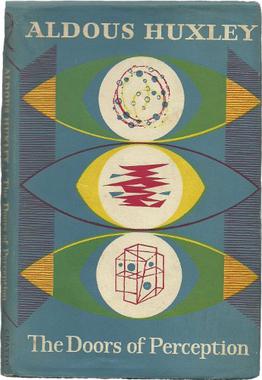
Aldous Huxley's Doors of Perception and Heaven and Hell


Image result for doors of perception heaven and hell book covers
“That humanity at large will ever be able to dispense with Artificial Paradises seems very unlikely. Most men and women lead lives at the worst so painful, at the best so monotonous, poor and limited that the urge to escape, the longing to transcend themselves if only for a few moments, is and has always been one of the principal appetites of the soul.” [The Doors of Perception]

I've picked up a lot of books over multiple library book sales. These are first-come, first-serve sales of mostly paperback but sometimes you can find handsome editions of hardcover novels. I picked up The Doors of Perception because I'm been inspired by the counterculture hippie movement since high school. The Doors was one of my favorite rock bands as a kid.

That's my paradigm. I'm mostly inspired through rock and roll rather than experimentation of drugs. But even as a youngster I was familiar with the Merry Pranksters, Timothy Leary, LSD, Sgt. Pepper, and "turn on, tune in, drop out." And of course, all my favorite American hippie rock bands supported all that stuff. The Doors named themselves after Huxley's Doors of Perception. This edition comes with a separate book entitled Heaven and Hell. Both of these short books explores the mind's remote frontiers and the unmapped areas of human consciousness. 

For starters, one of the main problems with these books is that its no longer apart of the zeitgeist or discourse. The idea of taking psychedelics in order to gain some insight into the spiritual self is no longer apart of the current paradigm. Native Americans were known to use peyote/mescaline for spiritual purposes. But do even they still do that today?  

The young people I know who have experimented with heavy drugs like LSD, mushrooms, cocaine, and heroine are using it in order to escape from their reality. Much like the quote above. They use drugs as a backlash against the real world because they feel they are suffering. Any release into paradise will suffice. Even if it only for but a moment. Drugs and alcohol relieve them from their suffering. Albeit only for a short while until they come down from the high. Knowing that, it's very difficult for millennials to truly understand anything that Huxley is talking about here. But I like a challenge. 

This isn't really a book. Rather its a dialogue of Huxley containing his trip on mescaline. Ironically the trip takes place in the world's largest pharmacy during the early stages of the trip. A bit of comedy for his mescaline trip.  What happens to someone under the influence of mescaline? 

a) Ability to think straight is little if at all reduced. You don't become stupid.
b) Visual impressions are greatly intensified and the eye recovers some of the perceptual innocence of childhood when the sensum was not immediately and automatically subordinated to the concept. Interest in space is diminished and interest in time falls almost to zero. 
c) Though the intellect remains unimpaired and though perception is enormously improved, the will suffers a profound change for the worse. The mescaline taker sees no reason for doing anything in particular and finds most of the causes for which, at ordinary times, he was prepared to act and suffer, profoundly uninteresting. He can't be bothered with them, for the good reason that he has better things to think about. 
d) These better things may be experienced (as I experienced them) "out there," or "in here," or in both worlds, the inner and the outer, simultaneously or successively. That they are better seems to be self-evident to all mescaline takers who come to the drug with a sound liver and an untroubled mind. [Doors of Perception]

Time meant nothing. Huxley mentions there was plenty of time. Not a concern. He also wasn't concerned by spatial forms. This could mean the distance between me to my computer screen as well as the matter of me writing this review and then finishing it. Neither mattered anymore. 

What really is important to him is experiencing and observing.  Looking around the room takes on a new perception and/or concepts of the things we see. Mescaline strips down concepts but allows you to see them for the first time, the beauty of it. 

Man-made art had little effect on him. He was humored by the fact that humans tried too hard to symbolize things. "How dare they?" "The audacity?" This goes alongside paintings as well as classical music composers. He was more mesmerized by nature than by human-made things. 

Heaven and Hell go into religious aspects. Huxley notes that in the middle ages Christians would beat themselves until wounds would fester [flagellants] and starve themselves until they literally saw visions. They would literally see the devil. The festering wounds would cause hallucinations. How about that? 

My favorite concept that Huxley mentions in heaven and hell is a simple one. If you are a mystic/artist, you must learn from the scholar. If you are a scholar you must learn from the mystic/artist. It makes perfect sense. Why isn't the world like that? Why aren't more people across different discipline working together and learning from each other? It makes me wonder what could have been.

The truth is that I would never do any hallucinatory drugs and this book doesn't make a convincing argument for me to find a dude off the street and buy some mescaline off him. Rather, I'm impressed with Huxley's experience. I'll take his word for it and agree that the experience changed him for the better. Even if it only changed him for that day I can see from his writing that it had a profound spiritual effect on him. None of these drugs should be used for recreational purposes. Hell, at this point I don't even believe marijuana should be used recreationally. Maybe I'm getting too old. Maybe I'm a square. Maybe drugs are good for people sometimes.

In the end, we are all riders on the storm.  

Sunday, June 30, 2019

Coders

Image result for coders the making of a new tribe book coverCoders, The Making of a New Tribe and the Remaking of the World

Coders is the latest book I read. Its about computer programmers. What it takes to be a programmer, what programmers actually do, which could be blue-collar work, hackers, etc. The book takes a much darker tone at the ending chapters about the rise of AI in modern society. 

Coders is written by Clive Thompson, a longtime contributing writer for The New York Times Magazine and a monthly columnist for Wired. A tech writer. 

The book starts out with a chapter titled The Software Update That Changed Reality. This, of course, is Facebook. Clive goes on to talk about how the Like button feature came to be. Its interesting but the Like feature itself is kind of a dumb feature. Then there are The Four Waves of Coders which basically tells the history of coders starting from the female lead 1960s to the rise of the nerdy male dominated field programmer in the 1980s, to today, where the field is being filled with just slightly more women and minorities. 

Myspace is mentioned as an important happening in the early 2000s but isn't given nearly enough attention. Likewise, gaming is only mentioned in the Neopets context until the very end of the book. Not saying much about gaming makes this book a little lacking, because for the most part gaming has become the most popular entertainment system in the world, surpassing movies even in revenue and sales. That makes it worthy of a entire chapter in this book.

There's a great chapter called 10x, Rock Stars, and the Myth of Meritocracy which basically states that there's a myth of the rock star programmer, who by himself, is better than 10 or 20 coders. Surprising some of the best programs and software have been written by only a one or two person team. This rock star myth can be true but Thompson goes to lengths to state that this "better than thou" attitude 'great programmers' are hard to deal with, and besides, most companies need a team of programmers to do their work. Sometimes its difficult to get these rock stars to work well with the less sophisticated co-worker.

The last couple of chapters gets more philosophical. The Rise of AI, Scale, Trolls, and Big Tech. These are the more dystopian aspects of the book. How Facebook got used by Russian bots to swing American perceptions during the 2016 election, possibly swaying favor to Trump. How Twitter is used by white nationalists to spread hate. Machine learning algorithms have taken a big role in modern society but there are inherent biases in therein. When Google tried to create a face recognition software it scanned a picture of a black person and labeled it as 'gorilla', which is, of course, laughable because you realize how incredibly machines and people are but its also horribly racist. There are some leaders in tech who think if the real world is racist then shouldn't these things reflect that? Of course, this brings a lot of ethics into the equation. Which is the reason why we need more women and minorities in tech. The general consensus is that having white programmer dudes create everything we use is a bad idea because they've made mistakes like not thinking of the rise of hate on their platforms, like how Twitter ended up being used by white nationalists and such. Programmers tend to be pretty mixed with their political beliefs. Some are libertarian but for the most part, accept the democratic policy. There aren't many conservative programmers. A lot of them think government should get out of the way but still apply social policies. They see through their work that a person shouldn't be shunned because of their race, gender, sexuality, rather by the strength of their code. This is a good thing. 

The book ends with Blue-collar Coding. At the very end, he mentions how the creators of the videogame Minecraft wanted to create a game that was fun. But kids were doing more interesting things with Minecraft than what the creators expected. Kids were learning how to build all kinds of grand buildings and displays using the game's lego block-style engine. At the end of the day the coders of the future might not all come from 4-year college institutions, but rather milennials/middle age folks looking to change their careers, young gamer nerds that want to code their own games, and people who do it a lot in their spare time for fun. In some ways, the programmer of the past resembles that of the programmer today because in both contexts the programmer's credentials don't matter, only great coding skills. It's one of the only jobs where you can find an employee with a college degree working with another employee who has no degree. Of course, if a programmer was trying to get a job at Google that college degree wouldn't hurt. 

No doubt this is a pretty boring nonfiction book not nearly as exciting as my science fiction novels I go through. However, this book got me more interested in programming, learning some programming languages, maybe trying to create my own games and apps, or find a job where I can tinker around writing code in whatever context. There's a future in programming and I'm in front of the computer a lot anyways so I might as well look into it. I also find it fun and exciting. Another book that is similar to this one is Steven Levy's Hackers, a very good book about the early computer revolution going back to the 1950s and into the 1980's Apple II computer and it even has extensive chapters on videogames like the first MMO [massively multiplayer online game], Richard Garriott's Ultima Online. That book was very engaging and exciting whereas this one was more informational. Now I have a very good idea of what it takes to be a programmer: good knowledge and experience of the languages and error messages, logical thinking skills, patience, ability to deal with frustration, and the ability to find and fix bugs, an act known as debugging. 

This is a new book from 2019 May. Definitely worth the read if you're into tech and interested in programming.

Tuesday, June 18, 2019

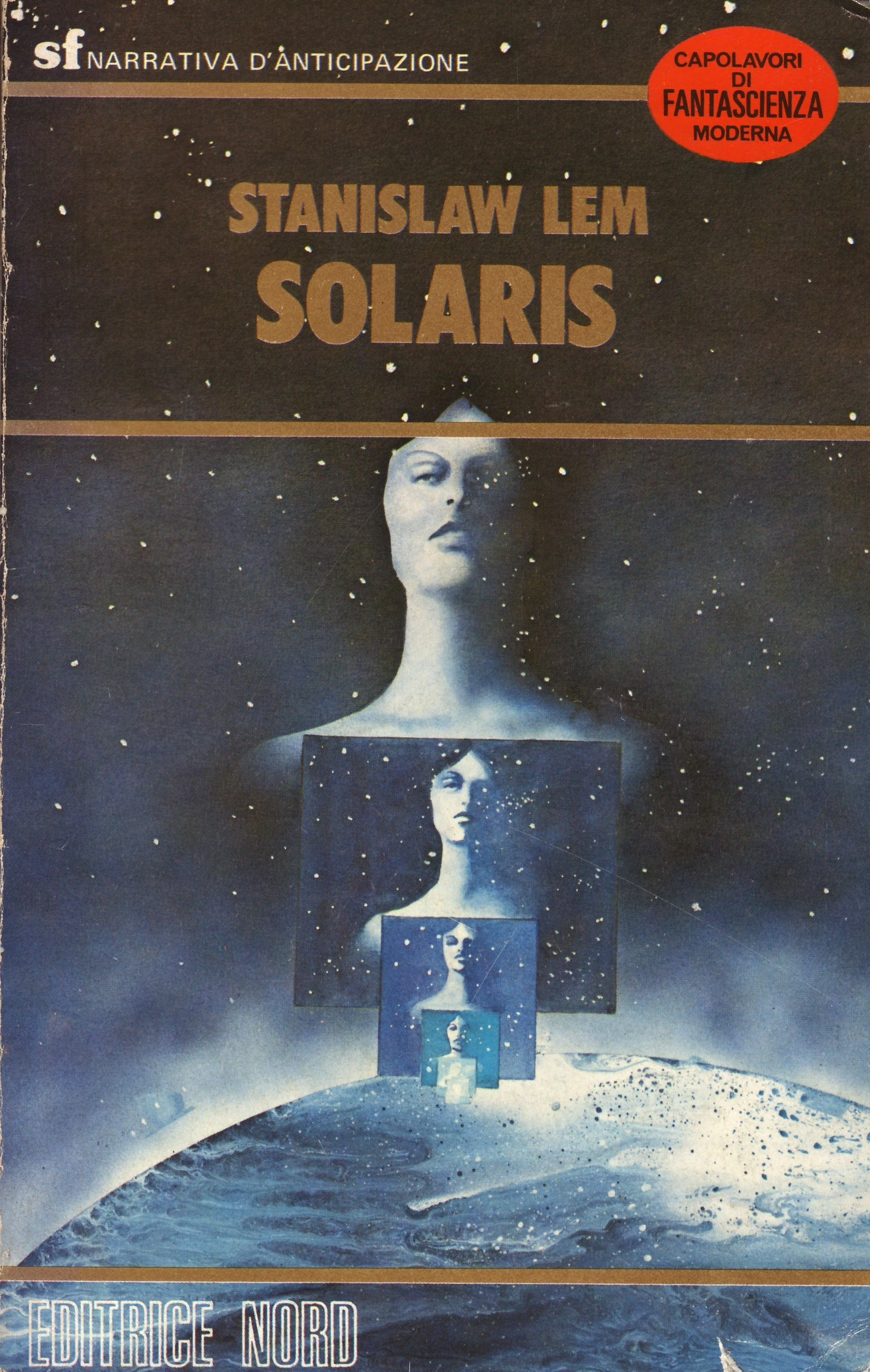
Solaris


Image result for solaris stanislaw lem book coversSolaris is a science fiction novel published in 1961 [later turned into movies in 1972 and 2002] by eastern [Polish] European science fiction writer Stanislaw Lem. It's a very thoughtful and philosophical novel in the SF genre. I would go so far as to say that this is one of the best science fiction novels I've read this year [so far]. 

The story starts with a psychologist named Kelvin. He goes up to the Solaris space station. Solaris is this planet with two suns, a red sun, and a blue sun. Scientists have been studying the place for years, coming up with all kinds of theories, that are all mostly speculation. 

It turns out that the entire planet's ocean is alive and may or may not be sentient. There's a sense of mysticism when Kelvin starts to see and experience strange phenomena on the space station. This possibly sentient ocean affects the human psyche to the extreme. For example, when he first gets there he meets his co-worker, Snow, and the guy looks like he's scared shitless most of the time, mad as a hatter. Kelvin goes into his room and becomes fearful when he sees a big black woman roaming around. Where did she come from? Who knows.

It turns out that although these scientists might be studying the sentient ocean, it is actually the sentient ocean that is studying them. The other character's experiences are mostly just alluded to. However, our main character Kelvin's experience is told first hand. 

Somehow the ocean creates a human simulacrum of Kelvin's long-dead wife, who committed suicide. He blames himself for the suicide and he can't handle the situation at all. He tries his best but by the end, the psychological trauma has changed him for the worst, forever. But perhaps it is only bad if seen in that one-dimensional view.  Racked by psychological trauma, Kelvin tries to do his job by observation and working with Snow. 

One of the main themes I picked up from Solaris is that no matter what you did in the past and what you're doing now, anything that happened in between can and may come back to haunt you in some form or another. It's basically a classic gothic horror theme in a science fiction skin. However, to just call it as such would be a disservice to Stanislaw Lem. After all, Lem amazes here. What amazes me is how he uses the idea of 'first contact', the alien being a benign ocean, and somehow turning into a thoughtful understanding of the human experience. It's very difficult to explain but Lem pulls that off in this novel.

There are other more philosophical themes as well. In the end, we have a dialogue about an imperfect god. Could this ocean be an imperfect God? After all, the God of the Old Testament was an imperfect God. He must've been because he got jealous of golden calves and demanded sacrifices when he wanted it. The dialogue mentions this. 

The great thing about this novel is that you're expecting some kind of resolution to all this madness and philosophical SF ideas. But in the end all we get is a guy who is sort of in shell shock, not unlike a soldier who experiences war for the first time. Yes, he could go back home and live a happy, normal life, but can he really? Perhaps he'll always be longing for his long-dead wife, even if his dead wife on Solaris was just an alien ghost. It will haunt him forever.  Maybe not.

My favorite thing about this novel is that it sort of reads like a madhouse. Not much really happens. Kelvin only leaves the space station to check out the ocean at the very end. It's a pure adrenaline rush in terms of the fear within the characters. I was sitting at the edge of my seat wondering what would happen next, only to find that not much happened throughout the entire thing. However, Lem makes it a rewarding experience because the way he explains everything is quite wonderful. He's a much more thoughtful science fiction writer, capable of interesting philosophical ideas. This is literary science fiction. Something like Ursula K LeGuin's The Left Hand of Darkness is literary science fiction as well. I could compare it to something like that. 

The English translation I read was a very smooth read. The book reads fast, moving along with action and dialogue. It isn't until perhaps the last 50 pages that the book is littered with tons of fancy science fiction exposition. The exposition is highly enjoyable but I found it to be my least favorite part of the book. However, I do think it was necessary to fully explain Solaris itself. Plus every great science fiction novel has to have some great exposition [imho]. The way Lem uses the end of the book for exposition is interesting. I would compare it to when a book is over but the author wants to add more information to help resolve things, an afterword if you will. This is commonplace in classic science fiction so I'm used to seeing it. 

This was the best Lem novel I've ever read and I plan on reading more of his work. Definitely read this book if you're a serious science fiction fan. Also make sure to check out the 1972 Tarkovsky movie Solaris, as its one of the best science fiction movies I've ever seen. 

Check out my review for Stanislaw Lem's novel Eden below:
https://ofigueroamusic.blogspot.com/2019/02/eden.html

Thursday, May 23, 2019

The Aeneid


The Aeneid is a Latin epic poem written by the Roman poet Virgil between 29 and 19 BC. It tells the story of Aeneas, a Trojan who traveled to Italy and became the ancestor of the Romans. It comprises nearly 10,000 lines dactylic hexameter. The first half of the book tells of the travels he and his fellow Trojans go through. The other half deals with battling the Latins and defeating them.

Aeneas was already known in Greco-Roman legend as he was a character in the Iliad. Virgil took the character and created a compelling national epic that tied Rome to the legends of Troy, explained the Punic Wars, glorified Roman values, and legitimized the Julio-Claudian dynasty as descendants of the founders, heroes, and gods of Rome and Troy.

Virgil begins his poem with a statement of his theme (Arma virumque cano ..., "Of arms and the man I sing ...") and an invocation to the Muse, falling some seven lines after the poem's inception (Musa, mihi causas memora ..., "O Muse, recount to me the causes ..."). He then explains the reason for the principal conflict in the story: the resentment held by the goddess Juno against the Trojan people. This is consistent with her role throughout the Homeric epics. [wiki]

Now onto my actual ideas on this great work of Western literature. For starters, Virgil grew up in a small town and was taken in by the wealthy to study in the great cities of his day. He's regarded as one of Rome's greatest poets, even being popular in the middle ages, where Dante Alighieri uses Virgil the poet/writer as one of the main characters for his Divine Comedy, another great classic of Western literature. He is described as a tall man, very learned but he spoke like a commoner of his day.

I read the Robert Fagles translation from 2006. It's got a strong modernist sensibility without being too easy to read or understand. I also read Fagles' modern translation of the Iliad and the Odyssey and it should be noted that there is a continuity of style and particular words in usage throughout all three works. I recommend this version for a first read. I'm also interested in reading a more literal and/or different translations, as well as these are the kind of books that I'd like to reread in order to understand more about it and enjoy again.

The beginning of the Aeneid is very slow. In that sense its a lot different from the Odyssey, which is fast-paced. There's the sacking of Troy, the Trojan horse, lots of wandering and sailing, Queen Dido, Sicily, Underworld, and lastly, war. However, the events that happen in the Aeneid are so similar to the Odyssey and the Iliad that you could say that the Aeneid is Virgil's take, putting both the Iliad and the Odyssey together in his own story. After all, he used Homer's works as the template for his creativity here.

One of the most compelling moments is when Aeneas falls in love with Queen Dido but ends up leaving her in order to fulfill his destiny, as prophesized by the gods. It's presumed after they get lost together during a hunting expedition that they have sex, which Dido takes as an indication of marriage between them. However, Jupiter sends Mercury [these gods have different names but are roughly equivalent to the Greek gods] to send Aeneas out to sail, to focus on his task. Her heart crushed and thrown in the garbage, Dido commits suicide, stabbing herself upon a pyre with Aeneas' sword. How tragic.

The fighting in this book is intense, full of heroes fighting valiantly. It's not quite as powerful psychologically as the Iliad but that's my take. The speeches taunting the other champions are aplenty but I found it a little flat compared to the epic chest-beating in the Iliad. The actual fighting was more interesting to me especially the female warrior Camilla, a warrior virgin. It's interesting because I've been reading these epics like Beowulf and Homer and none of them have any female warriors in particular. That really stood out to me. Early feminist overtones? It was sad to see her die to treachery.

Also, it should be noted that during the time of this writing Rome was going through a lot of changes with the Fall of the Republic and the Final War of the Roman Republic having torn through society and many people began to think twice about the "Greatness of Rome". But then the new Emperor Augustus Ceaser brought on an era of prosperity and peace through the reintroduction of traditional Roman values, which Virgil highlights with the utmost detail in the Aeneid. The abrupt ending suggests that Virgil died without finishing the work.

This is one of those all time great books that should be a must-read for anyone interested in great literature. The story itself is grand, eloquent, and contains very expressive and beautiful lines and themes. Although the original text was written in Latin, it comes across very well in English to my young modern mind. Sometimes these epics from the early ages come across sort of flat. Not so here in Fagles' translation, where although it isn't a literal translation, he has taken care to update the writing without losing its edge, its expressive quality. This is why I enjoyed reading it [and Fagle's other translations] so much. Yes, its a very long work and lots of lines and words with little spacing, but it's just so good that reading it is a breeze, a pleasure, stimulating intellectually and aesthetically. Take as long as you need because although its a slow-burn, its fantastic.

Check out my Fagle's translation reviews for the Iliad and the Odyssey below
http://ofigueroamusic.blogspot.com/2019/05/the-iliad.html
https://ofigueroamusic.blogspot.com/2019/05/the-odysee.html

Thursday, May 16, 2019

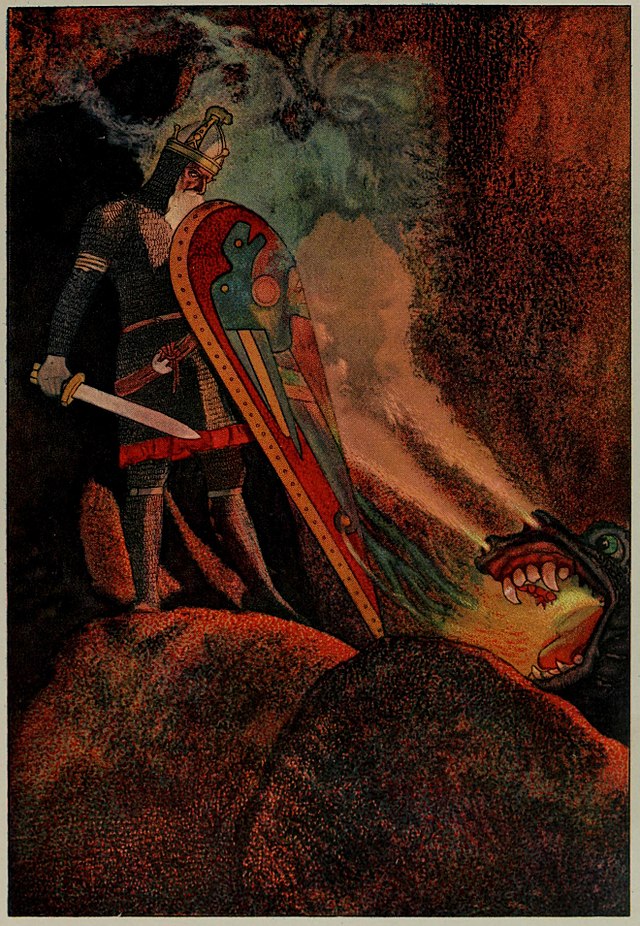
Beowulf


Image result for beowulf classical artBeowulf is a classic of western literature. Dating back to 975-1000 AD, it was written by an anonymous writer. The translation I read had the Old English on the left pages and a modern English translation on the right side of the pages. The work is some 3,000 lines of verse. 

Beowulf is also a Scandinavian epic about a great warrior, who stands up to save people from this monster, Grendel. Grendel rips apart humans and eats them raw and bloody. Beowulf, the brave hero, takes him down, then kills his mother, Grendel's mother seeking revenge. In old age, Beowulf is a King. But a dragon has attacked, so he goes to arms. He kills the dragon with his most trusted soldier but likewise the dragon lands a killing blow on him. The tale ends with Beowulf's grand funeral, cremated with hero's rites. 

The action flows along with the poetic style. When Grendel attacks it's menacing. When Grendel's mother vows revenge, things get psychological. When Beowulf fights the dragon it's the first time he's ever scared. 

The narrative tropes appear in other literature throughout time. The translation is a little bare at times, but there are also lots of archaic sayings at work. Meaning you might have to look up certain words or just read slowly for better comprehension. You have to read this one slow in order to fully understand. Thankfully Beowulf is pretty short. I was able to finish reading it in two sessions. 

I was holding off on reading Beowulf for a long time because I wasn't sure if I would truly be into epics, poetry, mythology. But it turns out that I'm really into it. So far I've read Paradise Lost, Dante's Inferno, the Odyssey, the Iliad, Beowulf, and now I'm currently reading Virgil's Aeneid. This is a big departure from my usual science fiction reading sprees. At first, it took a while to get into all these epics. You get a taste then you're hooked. 

Skyrim anyone? 

Saturday, April 27, 2019

Gateway


GatewayNovel.JPGGateway is a science fiction novel by Frederik Pohl, written in 1977. This is part of a five book series, called the Heechee Saga, comprised of five books altogether. However, I think I'm going to just settle for just this first one.

"Gateway won the 1978 Hugo Award for Best Novel, the 1978 Locus Award for Best Novel, the 1977 Nebula Award for Best Novel, and the 1978 John W. Campbell Memorial Award for Best Science Fiction Novel. The novel was adapted into a computer game in 1992." [wiki] As you can see this was a very important, very good book when it was released back in the '70s.

The book follows a young man with the unusually feminine name of Robinette Broadhead. He's a filthy rich bastard but he's a crybaby. He's sad and depressed even though he has sex all the time, he's filthy rich, and he has new body parts that will give him an extended human life, wow! 

Why is Robinette sad? Why's he an asshole? How did he get rich? Where's the science fiction in this? Why read it? The book unravels like a good mystery. One. Clue. At. A. Time. Just like that, the book keeps you reading by giving you little snippets of information that reveals the why of the story.

The MC [main character] is sad because he had a terrible childhood working in food mines back on Earth. His mother never told him he loved him, and he felt close to her when he was a kid when she would stick a thermometer up his ass to check his temperature when he was sick. [this is why Robinette's homophobic] His father died and he was a nobody until he won a lottery. Enter Gateway. 

Robinette won a lottery ticket that got him to Gateway. Gateway is this space station of an alien race. They left behind all these ships but humans have no idea how to control them, or where they will go, meaning that many people die just to experiment with the aliens' ships. Sometimes they go to other universes, other galaxies. The purpose of Gateway is to learn all the rules, get a crew, and take Heechee spaceships [aliens here are called Heechee, great name, sounds cute] to wherever it will take them, to somewhere where they will hopefully find Heechee artifacts. Hopefully you don't die along the way. The organization running Gateway pays top dollar for artifacts once crews come back from their trips. The thing is that most crews don't come back. Or they come back splattered all over the ship.

So we have an unsympathetic character and a myriad of other characters, most of which don't have nearly as much personality [or lack thereof] in contrast to Robinette. His girlfriend that he meets on Gateway becomes very important to the story. But eventually, Robinette finds out that she's been sleeping with a bisexual guy, which gets Robinette upset. There's a confrontation about it. Robinette responds by beating the shit out of her, knocking out some of her teeth. It's a super brutal confrontation. Domestic abuse, in a science fiction novel, blasphemy, right? Well, I've actually seen worse in other novels, it's just that this type of thing doesn't happen often in science fiction. In Floating Worlds by Cecelia Holland, the main character gets raped. And in The Stars My Destination by Alfred Bester the main character rapes a woman who eventually becomes his wife. So science fiction has tackled these sorts of difficult issues before. I think we have to look back at the time period that it was written to understand why it would be put into the book. Also, we should look at the age of the writer when they wrote it. What were they trying to say? Of course, Robinette apologizes and things are okay, but its that's just because it's written that way. In real life, the woman would've put a restraining order against him.

There's a side story within the main plot that features Robinette having therapy sessions with a robot called Sigfrid Freud. It's all mostly psychobabble but I can understand a lot of what went into those sessions because I've read a little bit of Freud. There's all the typical stuff. It isn't that interesting but it gives you the bird's eye view of Robinette's mind. Why is he so ungrateful even though he has everything? This gives us some reasons why. 

The science fiction elements here aren't super strong but it's good enough for me. There aren't any spaceship battles, or firefights, or any space action until the very end. In fact, Robinette spends most of the book cowering in fear, deciding when and if he should go out on an expedition. After all, a lot of people don't make it back alive, as humans don't even know how any of the Heechee ships work! However, it is that penultimate ending of the book that finally gave me my science fiction fix-at least until I finish reading the Iliad. At the end of the story, we find out that our main character has survived his space expedition only by killing off nine other people, coming back alive as the sole survivor with tons of artifacts, making him one rich, lucky, son of a bitch. Technically he didn't kill them. They're stuck in a blackhole out in the middle of space. But, he's madly depressed now because, in order to be the last one to survive, he had to 'kill' off his girlfriend. Gateway is one hell of a drug. 

The great thing about this book is that you look at the cover and expect some grand space opera adventure. Or a pulp science fiction novel. What you actually get is a psychoanalytical story that involves alien technology. The writing isn't amazing but writing a science fiction story about psychology and alien tech can take you places if you're Frederik Pohl. It's not as good as Man Plus but its worth the read. I haven't completely given up the idea of reading the series, you never know what the future has in store. The novel was short enough for me to read in a few days, definitely worth the read if you're on a science fiction book hunt. I don't think it's necessary to read the full series, as I think this first book works well as a standalone novel.

Tuesday, April 23, 2019

Player Piano


PlayerPianoFirstEd.jpgPlayer Piano is Kurt Vonnegut's first novel. Released in 1952, the book tells a story of a brave new world [Nytimes back in the 50s, book reviewer compared it to Huxley's Brave New World], where machines have taken over society, a dystopia. This is a book about automation and humans, how they co-exist in a dystopian society ruled by an oligarchy but the interesting thing is that the oligarchs are engineers rather than kings or presidents.

Player Piano's universe is ruled by engineers who build, fix, and keep the machines running. Everyone else with low IQ's [IQ's are known in the public sphere, thru testings] are either in the Army or the Reeks and Wrecks, which is the low-level grunt work of the society. Paul's father helped build the machines that helped win the war, and that currently helps society. He made the engineers the most important class and his son is high up in the company. Paul's father is now deceased and Paul is struggling to find himself, that is, he has an existential crisis. 

Paul thinks that there's more to life than fixing machines and being an engineer, even if he's rich, has a beautiful wife, and a nice house and car. Paul tries to find a way out. He starts reading novels about burly men that do extravagant things in life. He wants to become like Thoreau. He plans on quitting his Engineering managerial position at the factory, one of the most important jobs in the world. He even goes so far as to buy a farm, thinking he's going to get his wife to quit living the high life and work as a farmer with him. She doesn't like his surprise when she sees the farm.

The book hits a high note once Paul goes on an Engineer's retreat, in the woods with all the managers and young engineers from factories all over the country. You get a sense that these engineers are being brainwashed into thinking their job is the most important and everyone else is below them. It's at the retreat that Paul is asked by factory management to infiltrate this organization called the Ghost Shirts. The Ghost Shirts are disgruntled engineers and low-level workers that have had enough of machines taking all the jobs. They want life to go back to the good 'old days when people washed laundry with their hands and jobs were done by people rather than machines. If Paul does this he gets a higher level job at another factory. Big whoop.

Paul plays along quite nicely, and says, "I quit! I quit! I quit!", with so much enthusiasm that his managers think he's playing along too well. The fact of the matter is that his managers had to fire him so he could infiltrate the Ghost Shirts. But Paul really meant that he was really quitting for real, which they interpreted as him playing along. It's very funny. 

Paul goes back home from the retreat and is treated like a second-class citizen by the police, who is notified that he's lost his job, status, and position in society as one of the Engineering Class, the highest social class. 

Once Paul's in the Ghost Shirt Society they make him their leader, almost a Messianic figure because he's the son of the "Father of all Machines, the Father of Engineers", oh how he's fallen from grace. A revolution takes place, and people go ballistic, destroying machines and burning buildings. But when the destruction is over, Paul and the Ghost Shirt Leaders find out that people are finding all the scraps of machines they can find only to rebuild machines! It's very ironic, satire. It turned out that people actually wanted the machines to work for them, and that all this time Paul might have been wrong about society, machines, everything. Or maybe not.
 
Player Piano isn't such much a tirade against technology, machines, or automation so much as it is a critique of progress, within society and politics. Vonnegut may be a Luddite in the sense that he rejects society's unhealthy relationship to technology. But today that could be most people as most people think the young folk shouldn't be so consumed with the tech of the day-social media, online gaming, spending all their time in front of a screen, be it a smartphone, tablet, TV, laptop, or computer. Most adults in the room would say our young people need to stop being consumed by these things, go back to a simpler time-spend more time outdoors with nature or reading books at libraries. Vonnegut perhaps might be saying that a nation that innovates technologically but not socially is not truly progressing. 

These are ideas Vonnegut used for his first novel because they were real and close to him. He had been a prisoner of war after being captured by the Germans during the Battle of the Bulge. You can sort of see how he got some of his ideas. Germany thought that all their problems would go away once factories were built but it turned out that Germany was actually on the wrong side of history socially and politically. Factories and jobs didn't end up helping them. Likewise, Facebook, Twitter, Amazon, SnapChat, Discord, Instagram, and YouTube haven't helped us to progress socially or politically either. 

At the end of the novel when the people are grabbing scraps of machines to rebuild their beloved machines, one of the Ghost Shirt leaders says to Paul, “This isn’t the end, you know… Nothing ever is, nothing ever will be – not even Judgment Day.”

"After all, there’s always a step backward, and a step backward, after making a wrong turn, is a step in the right direction." [vonnegutreview.com] 

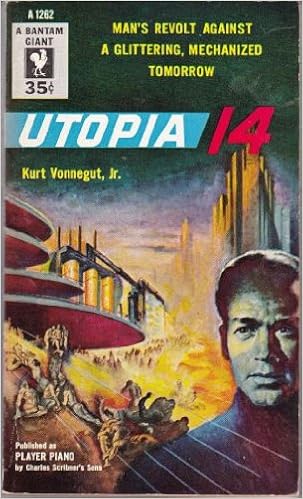
Interesting tidbit-one edition for Player Piano was titled Utopia 14, just to give it a more science fiction name, "whereby Vonnegut gained the repute of a science fiction writer, a genre held in disdain by writers at that time. He defended the genre and deplored a perceived sentiment that "no one can simultaneously be a respectable writer and understand how a refrigerator works" [wiki] Also, it should be noted that Player Piano is more conventional storytelling, especially with the slow narrative. His other novels would go on to more grandiose ideas, more science fiction, and much more satire. If he kept writing in this plain style that is Player Piano he wouldn't have become such a famous name.
 
The original cover pictured above, Utopia 14 cover pictured below
Image result for utopia 14 vonnegut


Monday, March 25, 2019

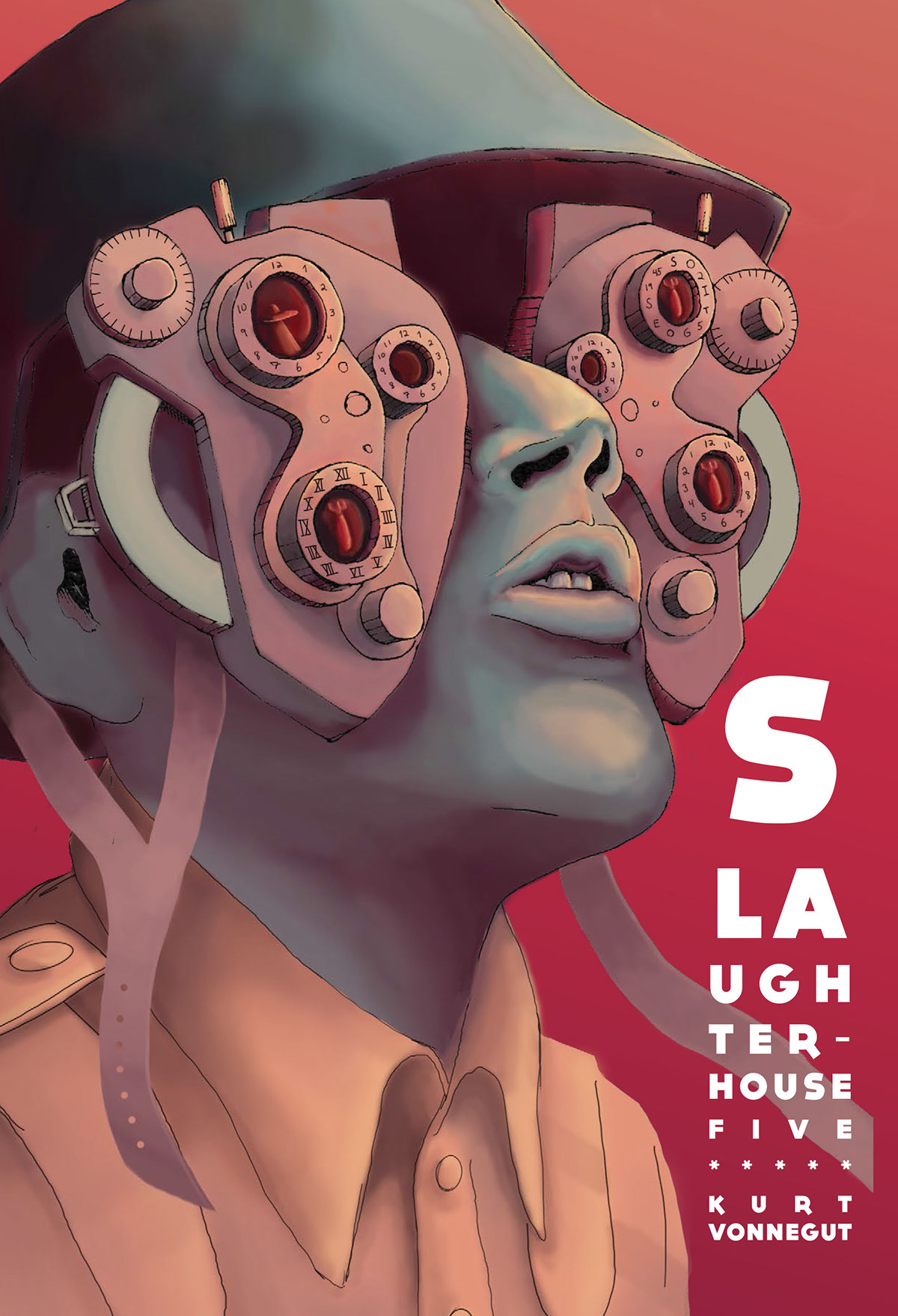
Slaughterhouse-Five


Image result for slaughterhouse-five book cover"All this happened, more or less." [opening line]


Slaughterhouse-Five, or The Children's Crusade: A Duty-Dance with Death (1969) is a science fiction anti-war book about World War 2, written by Kurt Vonnegut. The main character, Billy lives through the Allies' Firebombing of Dresden as a prisoner of war. Vonnegut was actually there in real life, and the book is semi-autobiographical. SH-V is Vonnegut's most influential and popular work, capturing the American zeitgeist in 1969, capturing the spirit of anti-war during Vietnam. Since then its become a classic statement of anti-war, dark humor, science fiction, and satire. 

The book is told in a non-linear way. Flashbacks going backward and forward in time. There's the science fiction element that Billy Dresden experiences. He has been abducted by aliens and now he sees everything in his life through time all at the same time, flashbacks and time travel experiences. On the alien planet, he's in a zoo and forced to mate with a movie star actress. He's 'unstuck in time'. 

Billy was a soldier who refused to fight. A real letdown of an American soldier. He gets captured and is forced to labor at a Dresden slaughterhouse, "Schlachthof-fünf," "slaughterhouse five". Hence the name of the title. The other part of the title's name [The Children's Crusade] comes from a section in the opening of the book about how children are always the ones to fight wars. 

Billy suffers from post-traumatic stress disorder, something not commonly known about back in 1969 but nowadays we are all familiar with because of Iraq and the war in Syria. Billy gets taken under the wing of these aliens, who see in four dimensions, observing all points in the space-time continuum [real science fiction elements, there's also a laser gun]. They adopt a fatalistic worldview. So it goes. That line so it goes is in the book some 106 times. You get used to seeing it. I saw it as dark humor. Your parents died? So it goes. You won a million dollars? So it goes. Nothing happened? So it goes...ad infinitum. 

The style is simplistic. This is probably the easiest book I've read in three months. Its a very enjoyable experience. I finished the book in two days because I couldn't put it down. It was thoroughly entertaining even though the plot isn't linear, its all over the place. 

Coincidentally I'm writing a memoir about myself, growing up in the midwest in the early 2000s with my single parent mother, and I'm writing in a style very similar to this. Although I'm nowhere near as good a writer as Vonnegut. I mean to say that my novella [so far] is kind of non-linear, and the writing style is purposely simplistic. 

It's a very attractive style, it makes you want to read more of the author's work. Another important detail is the fact that the novel reads as part fact [nonfiction] part fiction. Not to mention a lot of dark humor and satire. Initially, when I read the introduction I immediately thought of Voltaire's Candide and Micromegas. However, I find SH-V to be much more emotional than those mostly satirical works from the 1700s, France. Vonnegut manages to combine dark humor, satire, a spirit of the moment [flower power] anti-war message, science fiction, and his own life into a smorgasbord of a novel, and lo and behold, it works somehow.

No doubt there's a lot going on in this novel. In that way, it's not unlike Bruce Sterling's second novel, Artificial Kid, which tries to do everything, but in the end, fails to measure up to its ambition. However, with SH-V we have a work that is highly ambitious and is a winner, not just to me, but to the general reading public today, and from the readers of yesteryear [thank god for online newspaper archives]. This book is considered a classic, deservedly so. 

It's sad, funny, tough, delightful, and it all somehow fits into its own thing, a success. Even if you don't like science fiction I think you as a reader would get a lot out of this book. Its a classic for good reason. 

Recommended if you like classics, science fiction, and war novels.  

Check out my reviews for Voltaire's Candide and Sterling's Artificial Kid.
http://ofigueroamusic.blogspot.com/search?q=candide
http://ofigueroamusic.blogspot.com/search?q=artificial+kid

September Sweater Weather

Good evening ladies and gentlemen, hello world. How are you?  It's good to be writing on a good day off work today on a Saturday. Here, ...