Showing posts with label floating worlds. Show all posts

Wednesday, March 13, 2019

The Firedrake


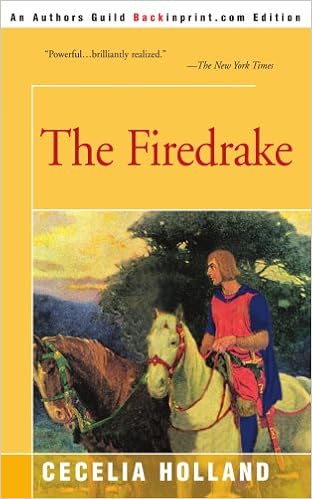
Image result for the firedrake cecelia hollandThe Firedrake is the debut novel written by historical fiction writer Cecelia Holland, published in 1966, during the height of the flower power movement. I found out about Holland through my stepfather, who recommended that I read her feminist space opera Floating Worlds, which was such an amazing novel that I had to have a copy, nevermind the library's copy. Now its one of my favorite books on my shelf. I plan on going back and rereading it sometime soon. Firedrake is such a rare book because its a debut novel and its from the 60s. There are physical copies going for as much as fifty dollars on Amazon. Talk about expensive. 

Anyways, what made Floating Worlds so great was Holland's style, her voice as a writer. I was extremely happy to see that her writing style was very similar. Short, choppy sentences. You never see the inner mind or psychology of the characters. The story moves by plot and action. Things are always happeneing, even when nothing is happening. The time you spend away from the book leaves you in suspense. This is what makes Holland a great writer. 

Firedrake follows an Irish knight in the year 1006. Named Laeghair, Laeghair from Traelee, Laeghair of the Long Road, he makes his way as a ronin [wanderer] into a commander of William the Conquerer's Army. The novel ends at the Battle of Hastings, where William takes England. Laeghair is very sour, a real asshole. He's a beserker knight that fights like a devil. He kills a guy just because he insulted him in front of the other knights. He's a leader of an army. He buys a woman he sees getting beat up. Hilde bears him a son and two still born children but at the end of the novel he leaves her when she's pregnant yet again, saying, "Leave me alone." He never married her nor did he love her. Yet there were times when he was happy with her. Having that as the ending had me thinking of Laeghaire as a real piece of work. After pillaging a town, he has his way with a woman. She doesn't cry out but its still considered a rape. This guy is bad news. 

What's interesting is William the Conquerer's personality. Is it based on real historical fact? The man seems to be an enigma in the novel. Laeghair pleases William very much, and in fact Laeghair saves William's life at the Battle of Hastings. Not only that, but William finds delight in Laeghair's snotty attitude towards everyone. They would make great friends if one were not subordinate to the other. The historical aspects of this novel were so foreign to me that it was almost like reading a science fiction novel. I couldn't relate to anything here, instead I had to use my imagination and try to imagine a world where people fight with swords, axes, ride horses, drink beer and wine everyday, and women aren't healthy enough to give birth to healthy children, resulting in a lot of still born deaths. 

The physical combat here is brutal. But not gruesome. It reminded me of the Illiad in the way the combat is described. Sort of. But Holland has her own unique way of action as well. Because of her short and choppy style, the action moves along very fast. Like a real fight. It leaves you wanting more and more combat but then the battle is over and something new occurs. 

Lastly, this is a remarkable debut novel. Holland got me into historical fiction from Floating Worlds and now Firedrake. I have in my possession two of her other historical fiction novels, Jerusalem and The Angel and the Sword. I never thought I would be into historical fiction but here I am. I'm reading new genres other than science fiction, classics, and philosophy. Always good to explore new territory. Especially if the writing is so damn good.

Holland wrote this when she was only 22, still studying at college, probably to get her Masters. I don't think she had any grand goals or ideas when she wrote this novel. I don't think the story needed anything grand or idealistic, it works as historical fiction work on its own without any gimmicks. This is a simple, plain novel. No fancy bells or whistles. Just plain old good writing. Highly recommended if you like history, fiction, medevial history in particular.

Check out my review for Ceceila Holland's science fiction epic, Floating Worlds- http://ofigueroamusic.blogspot.com/2019/02/floating-worlds.htm

Sunday, February 24, 2019

Floating Worlds

Image result for floating worlds cecelia hollandFloating Worlds is a terrific science fiction novel from 1975. Written by historical fiction writer Cecilia Holland, this is her first and only science fiction novel. The book is about a biracial woman named Paula Mendoza, who at the beginning of the book gets tired of her lame boyfriend, dumps him, and gets a job working for The Committee, a group of Anarchists who help manage Earth's government. This all happens thousands of years into the future by the way, where pollution has decimated the Earth, resulting in humans living protected in domes. 

Enter Styths. Paula's job is to get the Styths to agree to a treaty, which lasts ten years. The Styths are descendants of the first humans on Uranus, except they've changed, they're mutated. They're eight feet tall mutated humans [aliens], that speak a different language, live in a patriarchal society, are disgustingly racist [use the n-word all the time], and are complete savages who raid Mars and enslave thousands of people. They are described as black skinned mutants with long mustaches. Paula's means of getting the Styths to sign the treaty is a bit scandalous. She seduces their leader, Saba, and has a Styth baby by him, goes to live with him on his home planet, and engages in the politics from there.

Saba is a brutal alien. He beats Paula and at one point even rapes her. However, Paula comes back to him in order to do what she wants, which is whatever she wants, whenever she wants it. She's the idea of the female man, she's the perfect anarchist because although she's working for the Committee, she's also working for herself, and for the Styths, all at the same and sometimes different points in the novel. In a sense, we never get to know whats going on in Paula's head, but we can infer from the prose.

Floating worlds has two very important quirks. First, the prose is very short and simple sentences. Second, Holland never explains anything. There's no legendary or epic grand science fiction exposition here. This isn't Man Plus, with its eloquent and long exposition, a book I read recently. She doesn't explain how any of the technology works, the world of the space opera itself, the psychological state and/or feelings of the characters. Instead, we get a point of view of the character told from these short simple sentences that explain whats going on, and the dialogue between the different characters. It's a unique way to write, a very inspiring one as well when you realize that sometimes all you need is to be simple and straight to the point. In a way, this book taught me a new way to approach writing. I realized that technically, I don't have know the scientific facts that exist in the world of science fiction. You could just have incredible technology and just have it work, that's what Holland does here. None of the tech is explained, the characters just use these advanced computers and they work fine without any fine details.

There's space combat, tribal duels to claim the Styth throne, romance, lesbian sex, lots of sex in general, seduction, betrayal, politics regarding gender, race, and class, war, a fallout Earth that feels like the 1970s, contemporary. The ending itself is almost the same as the ending for Schismatrix, which came out ten years later, which is the main character walking away from the entire space opera in a state of experienced zen-bliss? Perhaps something like describes it.

There are many reasons why this novel is important. The biggest reason is that this is a science fiction novel with a powerful female protagonist. Another important female protagonist I can think of is Lady Jessica, of the Bene Gesserit Order, from Dune. Also, this is a space opera on a grand scale that takes place over twenty years. You're going to be going through long reading sessions to finish this novel [465 pages]. However, you get in a rhythm, pacing if you will, when you learn to enjoy the simpleness of the sentences, and the uniqueness of the prose. I can see how the 80's of writers like Bruce Sterling may have been influenced by this. If not influenced then at least definitely aware. Schismatrix Plus comes to mind especially. Lastly, because of the writing style and lack of psychological detail and exposition, this is a very unique science fiction novel, which makes it worth reading, dusting off the 1970's dust and brought into the light of 2019.

I liked this book so much that I ended up buying a used copy from a third party on Amazon for eight bucks. This is going to be one of my prized SF novels on my book shelf. It's so good that I'm planning on reading Holland's historical fiction at some point in the future too. This is a work of great lost art from the '70s, it deserves to be on anyone's book shelf. 

[my copy has this book cover, the original book cover, pictured top]

Wednesday, February 13, 2019

February Update

Image result for floating worlds cecelia holland book coverHowdy partner! I've had a lot of free time lately, but haven't been writing as much. However, I've been extremely busy living an interior life, which of course involves a lot of reading and guitar playing. 

Usually I keep the blog updated very frequently but I haven't finished any novels, albums, or seen any interesting movies. However, I'm in the middle of a couple of great books and I'm even writing a rough draft for a novella, which I will try to get published, eventually, maybe in 2020 when I'm done with it. My goal is for it to be around 100 pages. Its about growing up in the Midwest in the early 2000's, very autobiographical. 

For starters, I've been reading this epic [457 page] science fiction novel by Cecelia Holland, a female historical fiction writer, called Floating Worlds. Floating Worlds is her first and only science fiction novel and it is quite grand. In a way, this book heavily reminds me of Schismatrix Plus by Bruce Sterling, however, this book was written in 1976, some ten years before Schismatrix Plus. 

Basically, the Earth has been run down by pollution. Anarchists control the Earth's government. There are people on other planets and even aliens [Martians and others], called Styths. Our female protagonist gets a government job [ironic b/c they're anarchists], and is in charge of writing a treaty between the anarchists of Earth and Styths, these 'black' aliens with mustaches, claws, and very tall bodies. The female lead ends up getting the treaty by sleeping with the Styth leader, and she even has a baby by him! I'm about half-way through the novel. Interesting to note that the Styths say the word 'nigger' a lot, usually in reference to humans. In addition, Martians and other alien races refer to the Styths as niggers. I imagine that this would upset a lot of the social media crowd these days.

The idea is a very popular science fiction trope: a grand space opera spanning many pages. However, the writing is unlike most science fiction space operas I've read. The writing is simplistic, sometimes even bare bones. Sentences read easily, in fact, you could say the book reads itself, although it is quite long. Its quite something to see that you don't have to be as technical as say William Gibson or even Bruce Sterling to write great science fiction. This is a great example of that. 

In addition, I've been reading Being and Time [1927, 500 pages] by Martin Heidegger, the modern German philosopher.  In Being and Time, Heidegger attempts to explain "what is being". He says that since the time of the Greeks, philosophers have avoided the question, instead referring to the analysis of particular beings. He goes on to explain and define the meaning of being. I can't say that I truly understand everything in Being and Time. However, everything written in it is so captivating that sometimes I can't put it down. It keeps my attention, and makes me think very hard about what he's trying to say, which is to definite being. 

One thing that makes it very difficult to understand is the fact that its translated from German, meaning that a lot of the words and phrases get lost in translation. If you truly want to study Being and Time, you would have to read it in German. The other aspect of understanding here is the fact that the ideas presented are so abstract, so abstract that you can get lost in thoughts, your own thoughts about the ideas presented, as well as the sentences themselves. This is the most difficult philosophy I've read, [and I've read bits of Plato, Aristotle, Sir Tomas More, Francis Bacon, Margaret Cavendash, Hobbes, Descartes, Adam Smith, Voltaire, and Bertrand Russell]. Nonetheless, its a terrific work that keeps me thinking and striving to understand 'being'.  Very motivating!

Moving on, and speaking of Germans, I just today started reading Man in the High Castle [1962, 240 pages] by Phillip K. Dick. I read half the book at the library and plan on finishing it soon. Its a terrific novel with a great pace. There is a show based on the novel on Amazon Prime but it doesn't hold a candle to the majesty of the novel itself. This novel won the prestigious science fiction award, the Hugo Award in 1963-well deserved! 

The Man in the High Castle is an alternate history novel where Germany and Japan won World War II. Now, the Nazi's and Japan share control over the world, including the United States. The book makes use of the I, Ching, an ancient Chinese text used for religion, psychoanalysis, literature, and art. The way its used in the novel is fascinating, a sort of book within a book, with extra variations and themes. Man in the High Castle has everything: art, philosophy, plot, character, suspense, action, and character. I'll probably write about it in my next post. 

Life is moving fast. I'm trying to keep up day-to-day with what is really important. Inevitably, this means that I haven't been playing video games, instead preferring to read, write, and nap [sleep is the best 'drug' you can ever use]. I'm finding that my time is becoming more precious so playing Overwatch just doesn't do it for me anymore. I still play Smash Ultimate with my buddies when I hang out with them. But when I'm by myself I'm going to stick with the more important stuff, reading, writing, napping, and playing guitar. 

Thanks for reading, I look forward to the next post about Man in the High Castle. 

On AI, Existential Threat, and the Collapse

Good evening ladies and gents. Hope you all had a good Sunday. I wanted to write here a bit more about AI, existential threat, and the Colla...